Category Archives: Italy

Italy Declares Lampedusa Unsafe; Rescued or Intercepted Migrants Will Be Taken to Sicily; 700 Migrants Detained On Board Ships for Past 3 Days

As a result of the violent disturbances on Lampedusa over the past week and a fire that damaged buildings at the island’s migrant reception centre, Italian officials have responded with drastic measures.  Lampedusa has been declared an unsafe port and newly intercepted or rescued migrants will not be brought to Lampedusa, but will instead be taken to Sicily.

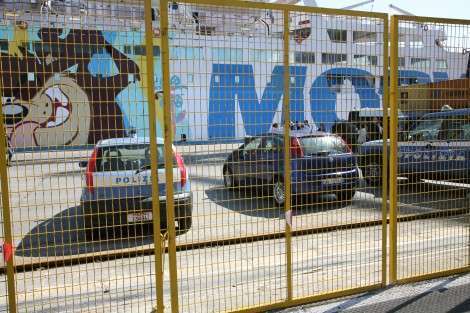
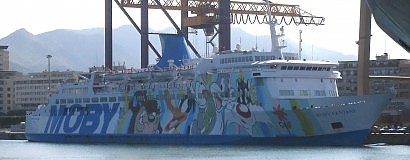
Hundreds of Tunisians have continued to arrive on Lampedusa in recent weeks and severe overcrowding has again resulted.  The overcrowding culminated in the past week’s protests by the Tunisians.  Most of the 1200+ Tunisian migrants who were on Lampedusa have been moved from the island by ship or military planes.  Approximately 700 Tunisian migrants have been held for the past three days on board passenger ships in the Palermo harbour.   News reports say that three ships being used to detain the migrants are the Moby Vincent, Moby Fantasy, and Audacia.  AIS ship tracking information shows that as of early Sunday morning, 25 September, the Moby Vincent and Audacia are still in the harbour and that the Moby Fantasy left Palermo during the night of the 24th and is sailing towards Sardinia.  It is unclear whether the Moby Fantasy is carrying migrants or not.

Interior Minister Roberto Maroni was quoted on Saturday as saying that the migrants now in Palermo will all be repatriated within a few days.  (“Roberto Maroni ha assicurato che gli immigrati che sono stati prelevati da Lampedusa e che si trovano attualmente a Palermo ‘saranno tutti rimpatriati nel giro di pochi giorni’”.)  Maroni said that 600 Tunisians were repatriated last week and that ten repatriation flights were scheduled for the coming week.

Click here (IT), here (IT), here (FR), and here (EN) for articles.

Click here for the Euro-Police blog post on the situation.

Click here, here, here, here, here, and here for additional articles (All IT)

Leave a comment

Filed under Italy, Mediterranean, News, Tunisia

IOM and Italy Sign Agreement to Facilitate Voluntary Returns for Migrants Recently Arrived from North Africa

Italy and IOM signed an agreement last week pursuant to which IOM will facilitate the voluntary returns of up to 600 migrants from Italy.  The agreement will be in place until the end of 2011.  The agreement is focused on assisting with the returns of migrants who have recently arrived in Italy from North Africa to their various countries of origin.

Click here for IOM statement on the programme.  (IT).

Click here for statement from the Dipartimento della Protezione Civile.  (IT).

Click here for article. (IT).

Leave a comment

Filed under Italy, Libya, Mediterranean, News, Tunisia

CoE Human Rights Commissioner Releases Report on Italy’s Treatment of Roma and Migrants

Council of Europe Commissioner for Human Rights, Thomas Hammarberg, just released a report on Italy based upon his visit to Italy on 26-27 May 2011.  The report addresses concerns relating to the treatment of the Roma and Sinti and relating to the treatment of migrants, including migrants arriving from North Africa.

Excerpts:

“Strasbourg, 7 September 2011 – CommDH(2011)26 – English only

Report by Thomas Hammarberg, Commissioner for Human Rights of the Council of Europe, following his visit to Italy from 26 to 27 May 2011

[***]

II. Protection of the human rights of migrants, including asylum seekers

Rescue operations and interceptions at sea

The Commissioner welcomes the invaluable efforts of the Italian authorities aimed at rescuing migrants on boats crossing the Mediterranean. He strongly encourages the Italian authorities to maintain their long-standing tradition of rescue, which is all the more indispensable in the current context of forced migration from Libya. He calls on the Italian authorities to ensure that in all cases where migrants are in distress at sea their rescue and safety enjoy absolute priority over all other considerations, including any lack of clarity and agreement, notably between Italy and Malta, about responsibilities for rescue. With reference to the operations carried out jointly with Libya in the central Mediterranean aimed at intercepting migrants fleeing Libya on boats and returning them there (so-called push-backs), the Commissioner urges the Italian authorities to discontinue and refrain from becoming involved in any practices in the field of interceptions at sea that may result in migrants being sent to places where they are at risk of ill treatment or onward refoulement.

[***]

II. Protection of the human rights of migrants, including asylum seekers

44. Following the political unrest in Tunisia and the armed conflict in Libya, the number of migrants, including asylum seekers, arriving on boats to Italy, and in particular Lampedusa, has increased sharply. Since mid-January, approximately 24 000 people have arrived from Tunisia. At the end of March 2011, migrants also started to arrive on boats from Libya (the biggest groups being nationals of Nigeria, Ghana, Mali, Ivory Coast, Bangladesh, Eritrea and Somalia) and by 23 June their number had almost reached 20 000. In addition to arrivals from Tunisia and Libya, some 2 000 migrants landed in southern Italy on boats coming from Egypt, Greece and Turkey. On 23 June, the total figure of arrivals by sea to Italy since January 2011 therefore stood at around 46 000.

45. It is clear that these events pose a number of challenges relating to a wide range of human rights, including the right to seek asylum and the right to life, notably in connection with rescue operations at sea. With most of the migrants from Northern Africa seeking refuge and a new life in “Europe” generally, and not specifically in the countries that they reach first, the European dimension of these challenges is equally clear. Certainly, the ongoing military operations in Libya and their impact on migratory movements bound to Europe has lent further visibility to this European and international dimension. Accordingly, the Commissioner has on many occasions called for a greater European role, in the form of solidarity and co-operation in meeting the human rights challenges relating to arrivals of migrants, including asylum seekers, from Northern Africa, but unfortunately the response has been limited. The Commissioner reiterates this call in respect of the situation with which Italy is confronted at the moment.

46. At the same time, the Commissioner wishes to stress that Italy must abide by its human rights obligations vis-à-vis all migrants, including asylum seekers, who find themselves within Italy’s jurisdiction – a responsibility which in the Commissioner’s view has not been met fully. While the Italian authorities have taken a number of steps to protect the human rights of these persons, from rescue at sea through to reception and access to asylum, concerns remain in different subject areas, some of which are highlighted below.

47. More generally, the Commissioner wishes to stress that a more objective and balanced representation of the migration movements prompted by the events in Northern Africa, and notably the conflict in Libya, would assist in ensuring a human rights compliant response to these phenomena in both Italy and Europe as a whole. In this respect, the Commissioner notes that the 20 000 arrivals from Libya to Italy mentioned above stand, at least for the moment, in stark contrast with the many times greater forecasts concerning the potential number of arrivals from Libya which had been made publicly in Italy at the beginning of the conflict. It is also sobering to note that these arrivals account for around 2% of the persons having left Libya as a result of the conflict. Indeed, 98% of the approximately 1 100 000 people who have left Libya so far have done so by crossing land borders into Tunisia, Egypt, Niger, Chad and Algeria.

a. Rescue operations and interceptions at sea

48. The Italian authorities, and particularly the coast guard and customs police, have been instrumental in saving the lives of many migrants who have attempted to reach European shores from Northern Africa on unseaworthy boats. Rescue operations have obviously intensified in recent months, reflecting the increase in departures of migrant boats from Tunisia and Libya since January 2011.

49. Over the same time period, however, at least as many as 1 500 persons have lost their lives while trying to cross the Mediterranean to seek a safe haven. The Commissioner notes that responsibilities remain to be ascertained in certain cases. For instance, in an episode which is currently being investigated by the Parliamentary Assembly of the Council of Europe, and which resulted in the death at sea of 61 persons, including over 20 women and children, a boat carrying 72 migrants was left adrift for two weeks in spite of its presence having reportedly been signalled to the authorities of Italy, Malta and NATO, and the boat itself having been spotted by a helicopter and a passing vessel of unidentified nationalities. The Commissioner notes that in some cases, lack of clarity and agreement, notably between Italy and Malta, about responsibilities for rescue may delay operations or otherwise put the lives of migrants in distress at risk. More generally, the Commissioner finds it difficult to accept that people in distress at sea can face death in one of the busiest areas of the Mediterranean, especially now with the large numbers of military and other vessels in the area.

50. The Commissioner also notes that since May 2009, and up to the beginning of the armed conflict in Libya in February 2011, the Italian authorities have carried out operations jointly with Libya in the central Mediterranean, aimed at intercepting migrants fleeing Libya on boats and returning them there (so-called respingimenti, or push-backs). The practice has been repeatedly criticised for violating international human rights law, as migrants, including asylum seekers, are returned to Libya where they risk being ill-treated or in turn deported to other countries where they are exposed to such a risk, without being given an opportunity to seek and enjoy international protection through an individual assessment of their case. Indeed, in a case that is currently pending before the Grand Chamber of the European Court of Human Rights, a group of Somali and Eritrean migrants who were travelling by boat from Libya have argued that the decision of the Italian authorities to intercept their vessels on the high seas and send them straight back to Libya exposed them to a risk of ill-treatment there, as well as to a serious threat of being sent back to their countries of origin, where they might also face ill-treatment.24

51. The Commissioner notes that the beginning of these operations started shortly after the conclusion of agreements between Italy and Libya in 2008 and 2009.25 In his 2009 report on Italy, the Commissioner expressed “his disapproval of bilateral or multilateral agreements for the forced return of irregular migrants to countries with long-standing, proven records of torture”,26 a concern which was shared by the Parliamentary Assembly in June 2010.27 In February 2011, following the beginning of the armed conflict in Libya, Italy announced that it had suspended the implementation of its agreements with Libya. However, the Commissioner also notes that on 17 June 2011, Italy signed with the Libyan National Transitional Council a Memorandum of Understanding, which refers to the commitments contained in the agreements previously signed with Libya and provides for mutual assistance and co-operation in combating irregular immigration, “including the repatriation of immigrants in an irregular situation.”28

Conclusions and recommendations

52. The Commissioner welcomes the invaluable efforts of the Italian authorities aimed at rescuing migrants on boats in the Mediterranean, which have saved thousands of lives over the past months and years. He strongly encourages the Italian authorities to maintain their long-standing tradition of rescue, a task which is all the more indispensable in the current context of forced migration from Libya.

53. At the same time, the Commissioner calls on the Italian authorities to ensure that in all cases where migrants are in distress at sea their rescue and safety enjoy absolute priority over all other considerations. The attention of the Italian authorities is drawn to the PACE resolution 1821 (2011)29 adopted in June 2011, which calls on member states to “fulfil without exception and without delay their obligation to save people in distress at sea.”30 In this connection, the Commissioner recalls that on 8 April, just two days after a boat from Libya carrying more than 220 migrants capsized near the Italian island of Lampedusa causing the death by drowning of more than 200 persons, UNHCR recommended that “[a]ny overcrowded boat leaving Libya these days should be considered to be in distress.” On the same occasion UNHCR also underlined that “[a] long-standing tradition of saving lives at sea may be at risk if it becomes an issue of contention between States as to who rescues whom.”

54. The Commissioner urges the Italian authorities to discontinue and refrain from becoming involved in any practices in the field of interceptions at sea that may result in migrants being sent to places where they are at risk of ill treatment or onward refoulement. The Commissioner wishes to highlight that when a state exercises effective control, authority or power over third-country nationals rescued or intercepted at sea (including the state’s own territorial waters, those of another state and international waters) its obligations include ensuring effective access to adequate asylum determination procedures and not returning individuals to countries where they would face a real risk of persecution or treatment contrary notably to Articles 2 (right to life) and 3 (prohibition of torture) of the ECHR.

55. In this connection, the Commissioner draws once more the attention of the Italian authorities to the PACE resolution 1821 (2011) which calls on member states to: “refrain from any practices that might be tantamount to direct or indirect refoulement, including on the high seas, in keeping with the UNHCR’s interpretation of the extraterritorial application of that principle and with the relevant judgements of the European Court of Human Rights”; and to “suspend any bilateral agreements they may have concluded with third states if the human rights of those intercepted are not appropriately guaranteed therein, particularly the right of access to an asylum procedure, and wherever these might be tantamount to a violation of the principle of non-refoulement […].”31

56. In accordance with UNHCR’s recommendations on protection with regard to people fleeing from Libya, the Commissioner strongly encourages the Italian authorities to continue to keep the country’s borders open for people who are forced to flee from Libya and are in need of international protection.32

[***]”

Click here for Report.

Click here for CoE Press Statement.

Click here for CoE Human Rights website regarding human rights of immigrants, refugees, and asylum seekers.
Leave a comment

Filed under Commissioner for Human Rights, Council of Europe, Italy, Libya, Malta, Mediterranean, News, Reports, Tunisia

PACE Rapporteur Conducts Interviews in Italy Regarding Mediterranean Migrant Deaths

Tineke Strik (Netherlands, SOC) concluded a two day fact-finding trip to Italy on 7 September as Rapporteur for the PACE Migration Committee.  She is investigating the deaths of boat people who have died in the Mediterranean since January 2011.  Strik interviewed Father Moses Zerai, an Eritrean priest, who was in satellite phone contact with several migrant boats during their voyages from Libya, including the disabled migrant boat that drifted for days in March-April this year and on which 61 persons are believed to have died.  In addition to Zerai, Strik interviewed three of the nine survivors from the boat, Italian Coastguard officials, and NGO and UNHCR staff.  Strik “is planning interviews with officials from Nato and the Maltese government, which the Italian coastguard says was alerted to the boat’s plight.”

From the PACE press statement: “‘There is an obligation to help all people in distress.  If anyone did not live up to this responsibility and deliberately did not assist them, they must not be allowed to get away with it. … The testimonies of witnesses directly involved in this incident are coherent, but we have to continue to collect more data and information on who was when and where in the area,’ Mrs Strik reported.  ‘My mission is to try to find out what went wrong, and if there was perhaps a gap in responsibility-sharing. The recommendation which will be contained in my report is aimed at establishing responsibilities and trying to determine how to deal with such incidents in the future. We have to draw the right lessons to prevent similar situations from occurring again.  … At the end of my inquiry, I expect national jurisdictions, governments and parliaments to carry on the investigations and I very much hope that the dynamic of truth … will pave the way,’ she concluded.”

Click here (EN), here (FR), and here (ES) for articles.

Click here for PACE press statement.

Click here for previous post.

2 Comments

Filed under Council of Europe, European Union, Frontex, Italy, Libya, Malta, Mediterranean, News, Tunisia, UNHCR

More Evidence that Gaddafi Government Facilitated Migrant Boat Departures from Libya

There has been evidence for many months that the Gaddafi regime was facilitating migrant boat departures from Libya towards Italy and Malta; here are two recent articles on the topic from the Los Angeles Times and the Telegraph.

LA Times: “… During its life as a military base, the impromptu camp [at Janzour / Zanzour] was heavily guarded, but in recent in months, several people from the area said, Kadafi’s government facilitated the entry of Africans hoping to migrate by boat to Europe. … The military base was run by a Kadafi operative named Zuhair, according to several people familiar with its operation. As rebels approached Tripoli, they said, Zuhair was seen taking off in a speedboat, accompanied by his top aide and two bodyguards. … [The base] is also the scene of one of Muammar Gaddafi’s most bizarre and cynical plans; an operation to flood Europe with black African illegal immigrants in revenge for Nato’s bombing campaign. For months until the uprising in Tripoli two weeks ago, men in uniform were seen around the port directing the loading of immigrants onto leaky boats bound for Italy. Africans who landed this summer on the tiny island of Lampedusa – a speck of rock south of Sicily – said they had paid nothing for their passage, in contrast to the $1,000 fee usually demanded by people smugglers. No boats have left since the rebels drove Gaddafi’s men out, but the human cargo is still stranded there; a thousand desperate black African men, women and children, clustered in the dirt under beached boats in utter squalor, hungry, scared, penniless, and desperate to escape….”

The Telegraph: “…[a] man, who would not give his name, claimed that the port [of Zanzour] had been controlled by a shadowy official called Zuhair, who had vanished when the rebels arrived. ‘He is a Palestinian originally, with several passports,’ the man said. ‘He had people under him and they sent the boats to Lampedusa.’ There seems little likelihood that the operation was being conducted without official sanction; Zanzour is located not on some remote, unpoliced stretch of coast but within an old military base, only about ten miles west of Tripoli, an area which was firmly under Gaddafi’s control until recently. … Laura Boldrini, of UNHCR, warned that illegal immigration could get much worse in the months ahead, adding that nobody knew how the new government would deal with the problem. ‘What happens depends on security,’ she said. ‘If violence explodes in Libya, there is a danger of a massive new influx of people trying to escape.’”

Click here and here for articles.

Click on these links for some previous posts on the subject:

Is Libyan Government Facilitating Migrant Boat Departures from Libya? (31/03/11)

IOM Reports Migrants Were Forced by Libyan Soldiers to Board Boats (10/05/11)

Libya: Because of NATO Aggression, We Cannot Be Guards of Europe (11/05/11)

Guardian: Libya Official Admits Migrant Ships Being Allowed to Sail as Protest Against Nato (11/05/11)

Maltese JHA Minister Doubts Migrants Are Being Pushed to Flee Libya (13/05/11)

1 Comment

Filed under European Union, Italy, Libya, Malta, Mediterranean, News, UNHCR

PACE Rapporteur to Begin Fact-Finding Mission to Italy to Investigate Mediterranean Migrant Deaths

Tineke Strik (Netherlands, SOC) will begin a two day fact-finding trip to Italy on 6 September as Rapporteur for the PACE Migration Committee (Parliamentary Assembly of the Council of Europe).  She is investigating the deaths of boat people who have died in the Mediterranean since January 2011.

From the PACE press statement of 2 September:  “Meetings are scheduled with survivors of a shipwreck, officers of Italian coastguard units, representatives of NGOs active in the field and representatives of the Office of the United Nations High Commissioner for Refugees.  During her visit the rapporteur will in particular look into the way boats are intercepted – or not intercepted – by national coastguard forces, or by military vessels under either NATO or national command.  Further to reports that migrants and refugees have perished after their distress calls were ignored, the PACE Committee on Migration, Refugees and Population appointed Ms Strik in June to conduct an inquiry into these matters.”

From the PACE press statement issued in June 2011: “‘There have been allegations that migrants and refugees are dying after their appeals for rescue have been ignored,’ said Mrs Strik. ‘Such a grave allegation must be urgently investigated.  I intend to look into the manner in which these boats are intercepted – or not – by the different national coastguards, the EU’s border agency FRONTEX, or even military vessels. I also intend to speak to witnesses directly involved in reported incidents, and put questions to national authorities, the UNHCR, FRONTEX and NATO, among others.’  On 8 May, the Guardian newspaper reported that 61 boat people escaping from Libya had died after their appeals for rescue had been ignored by armed forces operating in the Mediterranean. The following day PACE President Mevlüt Çavusoglu called for ‘an immediate and comprehensive enquiry’ into the incident.”

Presumably Ms. Strik’s investigation will also seek information from Maltese authorities.  The Maltese Rescue Coordination Centre run by the Armed Forces of Malta is in possession of relevant information pertaining to incidents within the Maltese Search and Rescue Area where many (perhaps most?) of the migrant deaths have occurred.

Click here and here for COE press statements.

Click here for link to COE’s web page regarding “PACE’s Response to Migrants and refugees arriving from North Africa.”

Click here and here for my previous posts on the topic.

1 Comment

Filed under Council of Europe, European Union, Frontex, Italy, Libya, Malta, Mediterranean, News, Reports, Tunisia

3rd Anniversary of Italy-Libya Treaty on Friendship, Partnership and Co-operation

This past Tuesday, 30 August, marked the third anniversary of the signing of the Treaty on Friendship, Partnership and Co-operation by Italy and Libya.  The Agreement was signed in Benghazi in 2008 by Prime Minister Silvio Berlusconi and then Libyan leader Gaddafi.  The Agreement included a provision calling for the “intensification of the ongoing cooperation in the context of the fight against terrorism, organized crime, drug trafficking and clandestine migration.” (See p. 2 of UNHCR’s Third Party submission to the European Court of Human Rights in the case of Hirsi and Others v. Italy (Application no. 27765/09) for more information regarding the history of the Agreement.)  The Agreement, which included a provision for the payment by Italy to Libya of $5 billion in compensation for colonial occupation, paved the way for Libya’s implementation of the  provisions of an earlier agreement signed in December 2007 which provided the basis for joint Italy-Libya maritime patrols and Italy’s so-called “push-back” practice.  The first push-back operations began in May 2009.  As I’ve noted in previous posts, the Libyan NTC has given Italy assurances that a new Libyan government will honour the terms of the Friendship Agreement.

Click here (IT), here (EN), and here (EN) for articles from 2008.

Click here for UNHCR’s Third Party Submission to the ECtHR in the Hirsi case.

Leave a comment

Filed under Italy, Libya, Mediterranean, News

Italy Fears New Surge in People Fleeing Post-Qadhafi Libya

As I noted earlier this week, Italy hopes to re-implement the migration control provisions of the Italy-Libya Friendship Agreement with a new Libyan government as soon as possible.  This desire is motivated by fears of a new surge in refugees fleeing Libya.  In one of the articles to which I previously linked, Italian Undersecretary for Foreign Affairs Alfredo Mantica also said Italy fears that instability in a post-Qadhafi Libya will lead to increased numbers of Libyans and sub-Saharan Africans seeking to escape to Europe.  Father Moses Zerai, an Eritrean priest who heads the Agenzia Habeshia per la Cooperazione allo Sviluppo, also said in the article that he believes over the short to medium term many sub-Saharan Africans in Libya will likely try to flee to Italy and Europe.  Moses Zerai said that he is in contact with migrants in Tripoli who are fearful of treatment at the hands of the rebels.

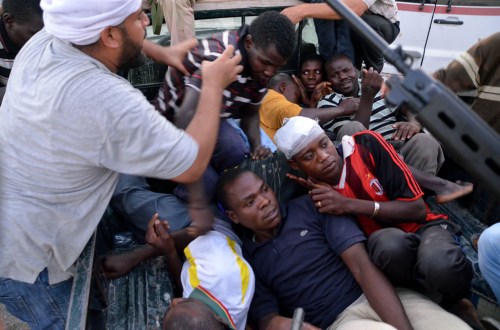
Images such as the one below demonstrate vividly why many sub-Saharan Africans in Libya may be fearful of reprisal or harm if they are suspected by rebel forces of being a Qadhafi mercenary.  This picture (Florent Marcie/AFP/Getty Images) was taken on 19 August in Zawiya and reportedly shows “suspected members of the Libyan regime forces [being] rounded up in a pick-up truck by Libyan rebel fighters in Zawiya.”

Click here for article.  (IT)

Click here for my previous post on re-implementing the migration control agreement.

Leave a comment

Filed under Italy, Libya, Mediterranean, News

Italy Hopes to Revive Libyan Friendship Treaty, Including Migration Control Provisions

Italian officials, including Defence Minister Ignazio La Russa, said yesterday that the Italian-Libyan friendship treaty signed in 2008 by Prime Minister Berlusconi and Gaddafi should be revived once a new government takes power in Libya.  The head of the Libyan National Transitional Council, Mustafa Abdel Jalil, has previously said that the provisions of the treaty, including the migration control provisions, would be respected by the new Libyan government.  Italian Under Secretary for Foreign Affairs, Alfredo Mantica, is quoted by ANSA as saying that “the first duty of Italy will be to update the part [of the treaty] relating to migration” as soon as the situation in Libya has stabilized. [“Mantica ha spiegato che ‘il primo dovere dell’Italia sarà quello di aggiornare la parte che riguarda i flussi migratori’ del Trattato di amicizia italo-libico, non appena la situazione in Libia si sarà stabilizzata.”]

Click here and here for articles. (IT)

Click here and here for previous posts about Libyan NTC’s statements regarding the treaty.

2 Comments

Filed under European Union, Italy, Libya, Mediterranean, News

Malta Blocks Italian Navy Ship From Disembarking 334 Rescued Migrants

Malta yesterday refused permission to the Italian Navy ship Borsini to land in Malta for the purpose of disembarking 334 rescued migrants.  The migrants were rescued in the Maltese Search and Rescue Area south of Lampedusa on Saturday by several Italian coastguard patrol boats and transferred at sea to the Borsini.  The Borsini then sailed to Malta.  Malta refused permission because it said that Lampedusa or Tunisia were the closest safe locations.  The Italians sought to disembark the rescued migrants at Malta because Lampedusa was overwhelmed with the arrivals of approximately 2000 migrants over the past 36 hours.  The Borsini left Malta and is sailing to Taranto on the Italian mainland to disembark the migrants.

Click here and here for articles.

3 Comments

Filed under Italy, Libya, Malta, Mediterranean, News, Tunisia

2000 Migrants Land on Lampedusa

Approximately 2000 migrants in 11 boats reached Lampedusa and Pantelleria over the past 36 hours or so.  Most of the migrant boats were rescued by Italian authorities and most are believed to have travelled from Libya, though one small boat is believed to have left from Tunisia.  Good weather is again the likely reason for the latest surge in numbers.

Click here (IT) and here (EN) for articles.

Leave a comment

Filed under Italy, Libya, Mediterranean, News, Tunisia

Fortress Europe Calculates 1,931 Deaths in the Mediterranean During First 7 Months of 2011

According to calculations made by Fortress Europe, 2011 is the deadliest year in the Mediterranean since at least 1994.  1,931 people have died during the first seven months of 2011.  This number is higher than the total number of deaths in all of 2008, the year with the previous highest death toll of 1,274.  Fortress Europe estimates that 1,674 (87%) of the 1,931 deaths have occurred in the Sicilian Channel and that most of the deaths in the Sicilian Channel have involved migrants travelling from Libya towards Europe.

Click here for Fortress Europe post.  (IT)

Click here for Clandestina blog post.  (EN)

From Fortress Europe:

Vittime del Canale di Sicilia dal 2002 ai primi 7 mesi del 2011
Anno 2002 2003 2004 2005 2006 2007 2008 2009 2010 2011
Morti 236 413 206 437 302 556 1274 425 20 1674

Leave a comment

Filed under Data / Stats, European Union, Italy, Libya, Malta, Mediterranean, News, Tunisia

NATO Denies It Failed to Respond to Migrant Boat in Distress

NATO said yesterday that Italian authorities never directly requested assistance from NATO in regard to the disabled migrant boat discovered earlier in the week by a Cypriot tug boat.  NATO spokespersons said while NATO was informed that the migrant boat was in distress, Italian authorities also informed NATO that Italian patrol boats and a rescue helicopter were responding to the situation.  NATO spokesperson Carmen Romero said NATO had a history of responding to emergency situations and pointed by way of example to NATO’s response on 26 March to two migrant boats in distress.   A Canadian naval ship under NATO command in March rendered assistance to two migrant boats but, unlike the incident last month when a Spanish ship under NATO command rescued 100 migrants and was unable to offload the migrants for five days, the Canadian ship did not take the migrants on board.

Click here (EN), here (IT) and here (IT) for articles.

Click here and here for previous posts on topic.

Click here for previous post about 11 July incident.

Click here and here for previous posts about the 26 March incident.

Leave a comment

Filed under Italy, Libya, Mediterranean, News

Italy Calls for Formal Inquest Into “Presumed Failure” of NATO to Render Assistance to Disabled Migrant Boat and for Expansion of NATO Mandate to Include Rescue at Sea

Here is today’s full statement from the Italian Foreign Ministry:

Minister for Foreign Affairs Franco Frattini instructed the Italian Permanent Representative to NATO to call for a formal inquest into the dynamic regarding the presumed failure to come to the aid of boats carrying civilians fleeing Libya. Minister Frattini also asked Ambassador Sessa to urge discussion within the Atlantic Alliance of the possibility of adapting the mandate of the mission sanctioned by UN resolutions 1970 and 1973 to safeguard Libyan civilians, to the effect that the defence and aid of those fleeing the conflict by sea, and thereby risking their lives, be adequately taken into consideration.

In relazione alle polemiche circa il presunto mancato soccorso a battelli con clandestini a bordo in fuga dalla Libia, il Ministro degli Esteri Frattini ha dato istruzioni al Rappresentante Permanente italiano presso la NATO di chiedere un’inchiesta formale per l’accertamento della dinamica di quanto accaduto. Il Ministro Frattini ha anche chiesto all’Ambasciatore Sessa di sollecitare una discussione all’interno dell’Alleanza Atlantica per il possibile adeguamento del mandato della missione di salvaguardia delle popolazioni civili in Libia, sulla base delle risoluzioni delle Nazioni Unite 1970 e 1973, affinchè vengano opportunamente considerate la tutela e soccorso anche di coloro che per cause belliche sono costretti a fuggire su barconi mettendo a rischio la propria incolumità.

Click here (EN) and here (IT) for links.

Click here (EN), here (EN) and here (IT) for articles.

Click here for previous post.

2 Comments

Filed under Italy, Libya, Mediterranean, News

Italy Rescues 300 Migrants from Disabled Boat; Multiple Deaths May Have Occurred Before Rescue; Italy Seeks Clarification Regarding Possible Failure of NATO Ship to Render Assistance

Italian patrol boats yesterday rescued approximately 300 migrants from a disabled boat 90 miles south of Lampedusa.  There are unconfirmed reports from survivors that before the rescue many people died and bodies were put in the sea.  The boat may have been drifting for one and a half days before the rescue.

The disabled migrant boat was reportedly first discovered by a Cyprus tug boat which was forced to move away from the disabled boat when some migrants jumped overboard and tried to swim to the tug.  An Italian helicopter which attempted to lower emergency supplies was forced to abandon its efforts when persons attempted to climb into the basket being used to drop supplies.

According to news reports, a NATO ship was located about 27 miles from the disabled migrant boat, but NATO reportedly failed to respond to a request by Italian authorities to render assistance.  Italian patrol boats were then forced to travel 90 miles from Lampedusa in order to reach the migrant boat.

The Italian government is seeking clarification from NATO regarding the possible failure to respond to the request to render assistance to the migrant boat.  A Spanish frigate under NATO command on 11 July rescued 100 migrants.  During the five day period that the migrants were on board the Spanish frigate, before the migrants were eventually transferred to Tunisian authorities, the Spanish frigate was removed from its NATO Operation Unified Protector embargo patrols due to the civilian passengers.

Click here, here, here, here, and here for articles. (IT)

Click here and here for articles.  (EN)

Click here for short AFP TV video from rescue helicopter.

Click here and here for previous posts on migrant rescue by Spanish frigate.

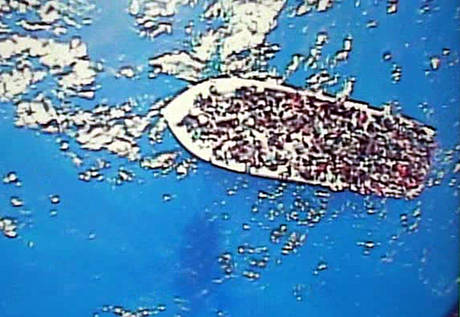
Image of migrant boat from monitor inside Italian rescue helicopter


3 Comments

Filed under Italy, Libya, Mediterranean, News