Category Archives: Libya

Updated CARIM Overview of Migration Developments in Libya

CARIM just issued a short paper, Libya: The Migration Scene – Which implications for migrants and refugees?: “In the light of UNHCR’s announcement of the 8th of June 2010 that it was requested to close its offices in Libya, CARIM provides an overview of migration developments in Libya from sociopolitical, legal and demographic-economic perspectives.”

Click here for the document.

Leave a comment

Filed under Analysis, European Union, Libya, Mediterranean, UNHCR

Amnesty Int’l Report on Libya Criticises Libya and EU on Refugee Treatment

Amnesty International has released a comprehensive report on Libya entitled “Libya of Tomorrow – What Hope for Human Rights?”  The report covers a range of matters including the criminal justice system and the use of the death penalty.   Section 5 of the report (beginning at p 91) addresses the rights of refugees, asylum-seekers and migrants.  The report was finalised before the recent decision of the Libyan government to close the UNHCR office in Tripoli.

In regard to refugee issues, Amnesty is very critical of both Libya and the EU and calls upon EU member states to “ensure that any bilateral agreements with Libya in the area of migration and asylum, including the EU-Libya Framework Agreement currently being negotiated, are based on full respect for the rights of asylum-seekers, refugees and migrants.”

Excerpts from Section 5, “Rights of refugees, asylum-seekers and migrants”:

Members of the EU have been actively seeking the collaboration of Libya in controlling the flow of migrants to European shores – turning a blind eye to Libya’s dire human rights record, the absence of a functioning asylum system in Libya, and persistent reports of the abuse and ill-treatment of refugees, asylum-seekers and migrants.  The Treaty of Friendship, Partnership and Co-operation signed in August 2008 between Italy and Libya includes provisions for bilateral efforts to combat “illegal migration”, facilitated by the joint patrolling of the sea agreed upon in December 2007 in the “Protocol” and the “Additional Technical-Operational” Protocol”.

As part of the agreements, Italy promised to compensate Libya for its occupation of the country between 1911 and 1943. The Treaty of Friendship, Partnership and Co-operation involves a US$5bn package for construction projects, [and other items].  In return, Libya agreed, among other things, to tighten control of its territorial waters and accept disembarkation on its soil of individuals intercepted at sea by Italian vessels. Italy was also reported to have undertaken to provide resources, including technology, to control migrant flows through the southern borders of Libya. In fact, Italy has provided Libya with six motor patrol boats since the Treaty entered into force.

In the framework of these agreements, from May 2009 onwards Italy started returning refugees, asylum-seekers and migrants intercepted in international waters to Libya. On 6 May 2009, distress calls were sent from three vessels with an estimated 230 third-country nationals on board. Italian coastguard vessels intervened but transported the individuals to Tripoli, without stopping in an Italian port and without checking whether any individuals on board were in need of international protection or basic humanitarian assistance. Further interceptions and returns occurred in the subsequent months: according to official information from the Italian Ambassador to Libya, between 6 May and 3 September 2009, over 1,000 individuals were returned to Libya. They included nationals from Eritrea, Somalia and other sub-Saharan African countries. The Italian Minister of the Interior Roberto Maroni was reported to have called this action “an historic achievement after one year of bilateral negotiations with Libya”….

Despite these pleas by UNHCR and consistent reports of abuses suffered by refugees, asylum-seekers and migrants in Libya, the Italian authorities continue to intercept vessels at sea and send them back to other countries most notably Libya.  In January 2010, Italian Minister of the Interior Roberto Maroni stated that the number of migrants arriving to Italian shores was reduced by 74 per cent in 2009 compared to 2008, attributing the reduction to Italy’s bilateral agreements with Libya.

Italy is not alone in seeking Libya’s cooperation to control the flow of migrants to European shores. Negotiations between Libya and the EU over a Framework Agreement started in November 2008 covering the control of migration, among other issues, including potential readmission agreements for third-country nationals who have transited through Libya on their way to Europe….

UNHCR [prior to its recent expulsion from Libya] and its partners have also been involved in screening individuals pushed back to Libya from Italy. UNHCR declared that by October 2009, it had been able to screen 890 people and had registered 206 of them as refugees and secured their release from detention.  UNCHR also registered 80 individuals pushed back from Italy in November 2009, granting 40 of them refugee status. The remainder were awaiting their interviews for refugee status determination at the time of writing. UNHCR confirmed that a total of 685 individuals determined to be refugees or asylum-seekers were released from detention from 2008 to February 2010, including 450 Eritreans and 150 Somalis…..

Click here for the Report.

Click here for AI Press Release regarding the Report.

Leave a comment

Filed under European Union, Italy, Libya, Mediterranean, Reports, UNHCR

La Tribune (Algérie): La Libye met l’Union européenne au pied du mur

“L’Europe, l’obsession sécuritaire et l’immigration utilitaire – … Les négociations entre l’UE et la Libye semblent suggérer que les Européens sont prêts à aller très loin dans la volonté de faire des Etats du Sud les gendarmes luttant contre l’immigration clandestine. En effet, pour signer un accord d’association comprenant le volet immigration, la Libye exige la fermeture pure et simple du bureau du Haut-Commissariat aux réfugiés (HCR), en plus de moyens financiers supplémentaires et du matériel de surveillance des frontières terrestres et maritimes qui viendront s’ajouter aux nombreux dispositifs de contrôle déjà financés par l’UE dans ce pays depuis le début des années 2000. La politique européenne sur l’immigration inclut également l’ouverture sur le sol libyen de «points d’accueil», qui permettraient aux réfugiés de déposer leur demande d’asile sans prendre le risque d’une traversée de la Méditerranée. Le commissaire en charge des questions d’asile et d’immigration, Jacques Barrot, s’était rendu sur place pour étudier la possibilité d’un tel dispositif…..”

Cliquez ici pour télécharger l’article.

Leave a comment

Filed under Algeria, European Union, Libya, Mediterranean, News

Frontex: Collaboration With African Countries Contributed to Reduction in Irregular Migrants in 2009

Speaking at a press conference in Athens earlier this week, Gil Arias Fernandez, Frontex’s deputy executive director, credited the global recession as the key factor in 2009 for the reduced numbers of migrants seeking to enter the EU.  He also credited “good collaboration from the African countries where immigrants usually depart[,]” referring to measures taken by Libya, Mauritania and Senegal to prevent migrants from leaving the countries.

Click here and here for articles.

Click here and here for earlier posts on Frontex’s 2009 General Report.

Leave a comment

Filed under Data / Stats, European Union, Frontex, Libya, Mauritania, News, Senegal, Statements

ECRE: Can EU Trust Libya With Refugee Protection?

ECRE issued a press release last week regarding Libya’s decision to expel the UNHCR:

“Bjarte Vandvik, Secretary General of the European Council on Refugees and Exiles (ECRE) said: ‘UNHCR’s expulsion from Libya will hopefully be temporary but it does reveal the unreliability of this regime, as well as its understanding of refugee protection. How will the EU ensure that Libya keeps its word regarding commitments towards human rights? How can the EU trust such a partner?’”

“ECRE calls on the EU to seriously reconsider its cooperation on asylum and refugee issues with Libya, a country that is not a party to the 1951 Geneva Refugee Convention. In particular, negotiations on an EU – Libya framework agreement must now be reviewed, as should any EU funding that supports Libyan authorities in intercepting refugees along their Southern border…. While UNHCR”s presence does not make Libya a safe place for refugees, the decision to prevent UNHCR from operating in the country once again illustrates the real intentions of the Libyan authorities when it comes to refugee protection. The EU cannot simply continue to ignore this reality but should make clear that the protection of refugees is still a fundamental value of the EU.”

(HT to Ana Lopez, ECRE’s Media and Information Officer).

Click here for full ECRE statement.

1 Comment

Filed under European Union, Libya, Mediterranean, Statements, UNHCR

Migreurop: What Price Will Europe Pay if Gaddafi Authorises UNHCR’s Return to Libya?

Migreurop takes the position that Libya’s recent decision to expel the UNHCR is a negotiating tactic that will be used to leverage more money and concessions from the European Union in the context of the ongoing EU-Libya partnership negotiations and poses the important question:  What Price Will Europe Pay if Gaddafi Again Authorises UNHCR’s Return to Libya?  The UNHCR’s presence in Libya has played an essential role in Europe’s immigration policy, specifically Europe’s migration management and border outsourcing:

“Thanks to UNHCR’s presence in Tripoli, Europe and Italy, which concluded its agreement with Libya in August 2008, were able to claim that the boat people who were forcibly returned to Libya could find a minimal level of security and protection. Everyone knows full well that this was a smokescreen: the conditions under which migrants are treated in Libya are well documented and well known to European authorities and institutions.”

“The presence of the UNHCR in Libya justified the policy of externalisation and deportation carried out by the EU. … Libya has now raised the stakes and the UNHCR is an accomplice in the sordid negotiations:  UNHCR’s return is already planned.…”

Click here or here for Migreurop’s full statement / analysis (FR).

Click here for previous post.

Leave a comment

Filed under Analysis, European Union, Italy, Libya, Mediterranean, UNHCR

More on Libya’s Decision to Expel UNHCR

Libya’s decision to expel the UNHCR from Libya was made public during the seventh round of Framework Agreement talks between the EU and Libya.  The talks concluded yesterday in Tripoli.  “[Libya’s Deputy Foreign Minister Mohammed Tahar] Sayala said the main stumbling blocks to progress were illegal immigration and the International Criminal Court (ICC), which Libya does not recognise.  [Sayala] said Libya wanted financing and equipment [from the EU] for the surveillance of its borders, both on land and sea.”

Amnesty International criticized the decision to expel the UNHCR and called on Libya to reverse the decision:

“[***] The move to expel the UNHCR came against the backdrop of the 7th round of negotiations, which started on 6 June in Tripoli, between Libya and the EU over a Framework Agreement, which addresses bilateral cooperation in the control of irregular migration, among other issues, including potential readmission agreements for third-country nationals, who have transited through Libya on their way to Europe. EU member states, most notably Italy, have been seeking Libya’s assistance in decreasing the flow of arrivals of asylum-seekers and migrants to European shores. The expulsion of the UNHCR further casts doubt on Libya’s commitment to respect its obligations under the Organization of African Unity Convention Governing the Specific Aspects of Refugee Problems in Africa. It also shows how essential it is to include effective human rights safeguards and adequate standards of protection in any bilateral agreements with Libya in the field of the control of migration. [***]”

The European Commission also expressed “concern” with Libya’s decision “but sees it as one more reason to engage in ‘dialogue’ with General Gaddafi’s country on immigration and asylum.”

And as noted by Michèle Morel on International Law Observer, even though Libya is not a signatory to the UN Refugee Convention, Libya is bound by customary international law which prohibits refoulement to countries where there is a risk of torture, “[t]herefore, while Libya itself has no asylum system for the examination of asylum seekers’ situations, refusing to allow UNHCR to carry out its activities in Libya would amount to a violation of international human rights law.”

Click here, here, here (EN), and here (AR) for articles.

Click here for Amnesty International’s statement.

Click here for link to ILO post.

3 Comments

Filed under European Union, Libya, Mediterranean, News, UNHCR

EU-Libya Resume Partnership Talks

The seventh round of negotiations on the EU-Libya partnership accord began on 8 June in Tripoli.  According to the AFP, EU negotiators hope to have a final agreement with Libya signed by the end of 2010.  The current EU delegation is led by Hugo Mingarelli, deputy head of the European Commission for foreign affairs.  The negotiations have been slow for a variety of reasons, one of them being disagreement over immigration topics and the reported pressure on Libya by the EU to sign the UN Refugee Convention.  (See my previous post on Libya’s sudden decision to close the UNHCR office in Tripoli.)

Click here and here (AR) for articles.

Click here for EC External Relations web page on Libya.

Leave a comment

Filed under European Union, Libya, Mediterranean, News

Libya Orders UNHCR Office Closed – Possible Link to EU-Libya Talks on Partnership Accord

The Libyan government has ordered the UNHCR office in Libya to halt all activities and to close it office.  UNHCR has been working in Libya since 1991 even though Libya is not a signatory to the UN Refugee Convention.

The UNHCR said it was not given a reason for the Libyan decision.  Reuters reported that Libya’s Foreign Ministry considers the UNHCR presence within Libya to be illegal since Libya is not a signatory to the Refugee Convention.  Reuters also says that JANA, the Libyan news agency, accused a UNHCR official of carrying out an unspecified illegal activity.

The Libyan newspaper Oya and other reports say that the EU is pressuring Libya in the ongoing EU-Libya Partnership Talks to sign the Refugee Convention and that illegal immigration is one of the main areas of disagreement in the current negotiations.

The UNHCR said in a press release “[i]n the absence of a national asylum system, UNHCR has carried out registration and refugee status determination, visiting detention facilities and providing medical and humanitarian assistance to detainees.”  Among the asylum seekers detained in Libya over the past year are persons who were forcibly returned to Libya by Italian authorities pursuant to the Italy-Libya migration agreement.

Click here for UNHCR press release.

Click here for Oya article (AR).

Click here, here, and here for articles (EN).

2 Comments

Filed under European Union, Libya, Mediterranean, News, UNHCR

UNHCR Criticises Delay by Italy and Malta in Launching Search and Rescue of Migrant Boat

“UNHCR is concerned about delays in a search-and-rescue operation on Sunday and Monday [6-7 June]  involving a boat carrying more than 20 people, mostly Eritreans, near Malta. Distress calls were received on Sunday evening, including by UNHCR, and passed to Maltese and Italian maritime authorities. It is unclear which country had search-and-rescue responsibility when the distress calls were first sent. According to information made available to UNHCR, the boat was only rescued late on Monday, and by Libyan vessels.”

The persons on board the boat have reportedly been taken to Libya.

Click here for UNHCR statement.

Click here and here for articles.

Leave a comment

Filed under Italy, Libya, Malta, Mediterranean, News, UNHCR

Malta: Italian Sea Patrols are Secretive But Effective

A Malta Today article quotes an unidentified source within the Armed Forces of Malta as saying that Italy’s anti-migrant operations are effective but are veiled in a suspicious secrecy:

“‘Nothing is happening [in regard to migrants], because the Italians are effective with joint patrolling, donations of sea vessels, and hands-on training,’ an informed officer said.  Developments on the Libyan sea-front, where the Italian army is engaged in joint repatriations of migrant traffic, seem to be veiled in a suspicious secrecy. The same officer said ‘we don’t know what the Italians are doing’, and as the first months of 2010 saw no significant migrant arrivals, observers feel the situation may not alter radically.  There seems to be consensus that the deal forged between the Italian and Libyan leaders has stemmed the migrant tide in the Mediterranean.”

Click here for article.

Leave a comment

Filed under Italy, Libya, Malta, Mediterranean, News

Mass Human Trafficking Trials Continue in Libya

The criminal trials involving almost 500 defendants charged with human trafficking are still ongoing in Tripoli.  Some new defence attorneys are reportedly involved in the case and have complained that the prosecutor’s office is relying on reports provided by Italian authorities and on reports on the topic of illegal immigration which were prepared for distribution to the media.  Some defence lawyers have said that the criminal charges are motivated by media and political pressure brought against the Libyan government.  Defence lawyers have also reportedly asserted that the special State Security Court trying the cases does not have jurisdiction over charges relating to illegal immigration.

Click here for earlier post.

Click here and here for articles. (in Arabic)

1 Comment

Filed under Italy, Libya, Mediterranean, News

Details from Frontex General Report 2009 (Post 2 of 2)

Last week I posted a summary of the first part of Frontex’s 2009 General Report.  This second post summarizes the portion of the Report pertaining to Frontex’s sea operations.

The General Report 2009 provides selective information regarding the six major Joint Operations conducted at the sea borders.  With only one exception, no information or data is provided regarding the specific numbers of intercepted migrants or vessels.

Instead of numbers, the Report provides various descriptive terms which could mean almost anything.  For example, Operation Hera led to a “drastic decrease of migrants,” during Operation Nautilus there was a “remarkable decrease” in migrants, and during Operation Hermes, the numbers of migrants arriving and dying at sea “decreased dramatically.” The one exception is for Operation Indalo where the Report states that 750 irregular migrants and 10 facilitators were detected.

When desired, the Report provides details and numbers.  For example, Operation Poseidon utilized 4 open sea vessels, 6 coastal patrol vessels, 13 coastal patrol boats, six airplanes, 4 helicopters, and 152 experts who delivered 2680 man days of operational activities, but no data regarding the total number of irregular migrants intercepted at sea is provided.

Here is a summary of the information provided in the Report for each of the six major Joint Operations:

Poseidon 2009, Eastern Mediterranean (365 Days)

Poseidon was conducted along land borders as well as at sea.  Interpreters were deployed on board ships to facilitate the identification process of intercepted migrants.  Less than 10% of the interviewed migrants claimed their original nationality.  There was an overall reduction in migrant flow of 16% (land and sea) compared to 2008.  “The main operational objectives of the joint operation were achieved but there is a clear need for closer cooperation between local authorities.”

Hera 2009, Atlantic Ocean waters between North Western African countries and Canary Islands (365 Days)

Due to the permanent implementation of Joint Operation Hera and better cooperation from “involved African countries”, there was a notable reduction in migrants reaching the Canary Islands, 2280 in 2009 compared with 9200 in 2008.  Aerial and maritime surveillance conducted close to the territory of Senegal and Mauritania and local cooperation from police led to the decrease in migrants.  “Despite these clear successes, participation of more member States would greatly increase effectiveness and outcomes.”  [NF- While the Report does provide migrant arrival data for the Canary Islands, it is silent on the number of migrants intercepted at sea or within Senegal or Mauritania.]

Nautilus 2009, Central Mediterranean (172 Days)

There was a remarkable decrease in migrant arrivals in Malta.  A “significant obstacle to the effectiveness of the Joint Operation lay in the contrasting interpretations of the International Law of the Sea by Member States….”  The effectiveness of the operation compared with 2008 was not improved.

Hermes 2009, Central Mediterranean (184 Days)

“Due to the bilateral agreement between Italy and Libya, the number of people arriving from Libya, as well as the number of migrants died at sea, decreased dramatically….”  “In addition, the first examples of co-operation with Algeria should also be considered as promising.”  As with Nautilus, “differing interpretations of the International Law of the Sea led to a limited contribution by the Member States to the joint operation by maritime surface means.”  The effectiveness of the operation compared with 2008 can be considered as increased.

Minerva 2009, Western Mediterranean (39 Days)

The launch of the operation was delayed in 2009.  Its effectiveness compared with 2008 has remained the same.

Indalo 2009, Western Mediterranean (50 Days)

The lack of cooperation from Algeria is an obstacle for operational activities.  10 Facilitators and 750 irregular migrants were identified.

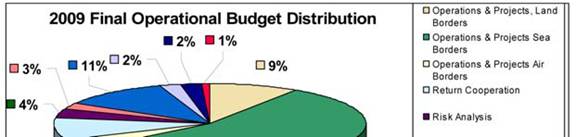
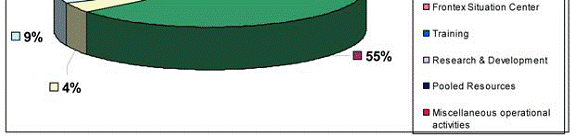
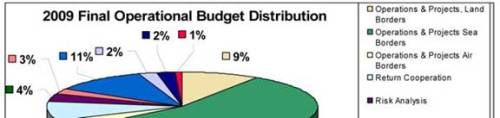
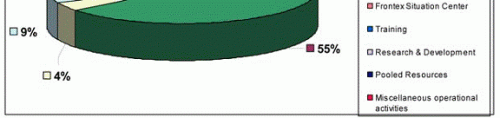
And as I noted in my earlier post, Frontex continued to devote the biggest single portion of its expenditures to maritime enforcement.  Almost 40% of Frontex’s total budget, over € 34 million, was spent on sea operations in 2009, constituting 55% of the operational budget.

This chart from the Report (p 23) shows the breakdown of expenditures within the 2009 Operational Budget (which was 71% of the total 2009 Frontex budget).
Click here for previous post.

Click here for the Frontex General Report 2009.

2 Comments

Filed under Aegean Sea, Algeria, Data / Stats, Eastern Atlantic, Frontex, Greece, Italy, Libya, Malta, Mauritania, Mediterranean, Reports, Senegal, Spain

1 Year Anniversary of Italy’s Push-Back Practice

This month marks the first anniversary of the implementation of Italy’s push-back practice with Libya.  The practice is based primarily on the Italy-Libya Treaty of Friendship, August 2008, and the Supplementary Protocol of 4 February 2009.

The first push-back operation occurred on 6 May.  As a reminder, here is the European Committee for the Prevention of Torture’s (CPT) description of the first operation:

Operation of 6 May 2009

According to data provided by the Italian authorities, 231 migrants (191 men and 40 women) were aboard three vessels in distress. The information collected from other sources indicates that among the migrants there were unaccompanied minors and four pregnant women. Following the interception of the boats by two Coast Guard vessels and one vessel of the Guardia di Finanza, the migrants were transferred onto the three Italian vessels and returned to Libya. The CISOM [Order of Malta Italian Relief Corps] personnel and a journalist, who was aboard the vessel of the Guardia di Finanza, indicated that they were not aware that the migrants would be pushed back to Libya, and that the captains of the Italian vessels only received an order to do so in the course of the operation.

The delegation was unable to interview the migrants pushed back to Libya or, given the authorities’ refusal to provide their names, the captains of the Italian vessels involved in the operation. However, reliable information collected by the delegation would indicate that, during the operation, which lasted around 12 hours, the 74 persons on the Guardia di Finanza vessel were provided insufficient water and no food or blankets; further, physical violence, in particular with kicks, punches and blows with an oar, was allegedly used against a number of migrants by Libyan police at the harbour in Tripoli, to force them to disembark from the two Coast Guard vessels.

Click here (IT) for article and podcast from AMISnet: “Un anno di respingimenti.”

Click here for earlier post.

Click here for the full CPT Report.

Click here for the Response of the Italian Government.

1 Comment

Filed under European Committee for the Prevention of Torture and Inhuman or Degrading Treatment or Punishment, Italy, Libya, Mediterranean, News

EU-Libya Association Agreement Negotiations

A Reuters article from 11 May reports that the EU and Libya may sign a cooperation pact known as an Association Agreement before the end of the year and that the pact would address matters such as trade and the control illegal immigration.   An EU mission will likely be opened in Libya before the end of the year according to Reuters.

Commissioner Cecilia Malmström during an interview with the Times of Malta several weeks ago referred to her efforts to begin immigration discussions with Libya:

“Libya is not exactly the easiest government to cooperate with and you know that much better being neighbours. It’s a complicated but important country and we will try to move forward. I’ve already written a letter to the Libyan Foreign Minister suggesting that we should sit together and identify areas where we can cooperate more in the field of migration.”

And Frontex’s 2009 General Report states that one of Frontex’s “overriding priorit[ies]” for 2010 is the development of “structured operational co-operation with neighbouring Mediterranean countries.”  Presumably Frontex desires such an agreement with Libya.

Click here and here for articles.

2 Comments

Filed under European Union, Frontex, Libya, Mediterranean, News