Category Archives: Malta

Malta Says Frontex Chronos Mission Not Needed Due to Success of Italy-Libya Push-Back Agreement

Malta previously said that it would not host Operation Chronos, Frontex’s annual central Mediterranean enforcement operation, formerly known as Nautilus, due to the recently approved guidelines governing Frontex enforcement operations at sea which require that intercepted migrants be taken to the country hosting the mission under certain circumstances.

But the Times of Malta is reporting that a Maltese government spokesperson said that the decision not to host Frontex is not because of the new guidelines, but is due to Malta’s view that there is no longer a need for Operation Chronos because of the success of the Italy-Libya migration agreement. “The reason why we decided not to take part in this year’s mission is that we feel there is no need for this year’s EU patrol.  We have noticed that, following the introduction of joint patrols by Libya and Italy last year, the number of illegal immigrants reaching Malta has dropped significantly. We feel that, as long as this operation remains in place, there is no real need for another anti-migration mission on behalf of the EU.”

The Times article reports that 84 boats carrying 2,775 migrants arrived in 2008 and that this number was reduced in 2009 to 17 boats carrying 1,475, with the majority of arrivals occurring in the first half of 2009 before the Italian push-back policy was implemented.

Commissioner Cecilia Malmström travels to Rome and Malta this week for meetings with officials on asylum and migration issues.

Click here for article.

Click here, here, and here for earlier related posts.

4 Comments

Filed under Data / Stats, European Union, Frontex, Italy, Libya, Malta, Mediterranean, News

Thomas More Institute: Towards a Sustainable Security in the Maghreb – An Opportunity for the Region

The Thomas More Institute has released a report, “Towards a Sustainable Security in the Maghreb –  An Opportunity for the Region, a Commitment for the European Union.”  The report was released on 7 April at the “Maghreb and the European Union: Enhancing the partnership for a sustainable security” conference in Brussels.

From the Executive Summary:  “The relationship between Europe and the Maghreb is a complex, multidimensional and somewhat passionate one. The two areas share a common history and are bound by common interests. United against a number of joint challenges (economic development, regional stability, fight against terrorism, migration, sustainable development), it is time for the two shores of the Mediterranean to reconsider the basis for their cooperation. [***] The EU is well aware of what is at stake and must now look for ways of making a more active commitment in the region, particularly on sensitive issues such as human rights and migration. [***] The question of migration, which extends as far as the Sahelian area, is another area of cooperation which needs to be looked into in more depth, since the EU’s policy of limiting migratory flows can no longer be restricted to the northern border of the Maghreb. Reinforcing the role of the European agency FRONTEX throughout the area, for example by opening regional offices and assigning resources, is one possible solution. Intensifying efforts to coordinate development assistance policies between the EU and Maghreb countries to help Sub-Saharan African countries that represent sources of immigration is another solution that should not be ignored.”

A further excerpt: “A need for increased cooperation between the European Union and the Maghreb – Europe’s policy on migration is based on the principle that the great era of mass migrations is over, replaced by a new international division of labour, whereby a foreign workforce is substituted for the national workforce, and by policies that involve returning and rehabilitating non-Europeans in their countries of origin and internal mobility for Europeans within an area with no interior borders. European countries – and the Community, followed by the EU – concentrated their efforts on border control, in a securitarian view dictated by the migratory risk and concerns about the challenges of integration. Schengen relegated the countries of the Maghreb, and others, to the status of “outsider countries”, with which human circulation is restricted. This logic was maintained by the militarisation of borders which started in 1988 when barriers were built around the Spanish enclaves of Ceuta and Melilla, then as of 2002 by the installation of the Integrated System of External Vigilance (SIVE) around Gibraltar and later along the Spanish coasts – including the Canary isles – comprising twenty-five detection points, a dozen mobile radar and ten or so patrol units. The attacks perpetrated on September 11th reinforced the security component and, following the creation of FRONTEX (European Agency for the Management of Operational Cooperation at the External Borders) in 2005, other areas were militarised, with preventive sea and air patrols in the Mediterranean and even in the Atlantic, near the Canary isles. The EU also provides its members with technical assistance. [***] The Maghreb has made a real effort to contribute and cooperate with the EU in the fight against immigration.  In February 2004, Morocco and Spain started joint patrols and in 2008, cooperation was reinforced by improving controls in the ports of Tangier and Algeciras.  According to the Spanish authorities, the result was an overall drop of 60% in illegal immigration originating in Morocco between 2007 and 2008.  The decrease in illegal Moroccans was reportedly around 38%. However, reinforced controls caused a shift in migratory routes. According to the Italian Ministry of the Interior, the number of illegal immigrants arriving in Italy by sea rose by 75% between 2007 and 2008. 14 000 people arrived in Italy illegally in 2007, whereas the figure was in excess of 40 000 in 2008. Following the signature of the Benghazi treaty between Italy and Libya on 30th August 2008, Italy obtained greater assistance from Tripoli in the form of bilateral cooperation on illegal immigration and the application of the December 2007 agreement on joint patrols off the Libyan coasts, plus the installation of radars by Finmeccanica at Libya’s southern borders.”

Click here for full Report.

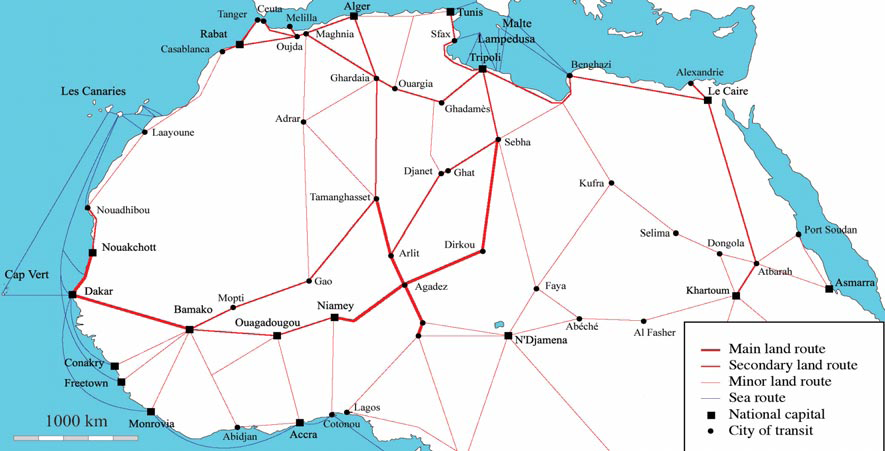
Main routes of present-day Trans-Saharan migrations

1 Comment

Filed under Algeria, Analysis, Data / Stats, Eastern Atlantic, European Union, Frontex, Italy, Libya, Malta, Mauritania, Mediterranean, Morocco, Spain

Spain Adds New SIVE Radar Stations

The Spanish Ministry of Interior is investing €3.8 million to expand the SIVE network in Valencia.  The two new SIVE radar stations are in addition to the four SIVE radar stations that operate on the Alicante coast in Cabo Roig, Santa Pola, Sierra Frost, and Denia.  According to ABC, the Ministry of Interior acknowledges that SIVE has numerous problems and that since its entry into operation last September in Alicante, SIVE has detected only four of the fifteen illegal boats discovered on the coast.

ABC also reports that despite the problems with SIVE on the Alicante coast, Frontex’s coming summer enforcement operation, Operation Indalo, will not extend to Alicante.  Operation Indalo, using patrol boats and helicopters from Spain, Portugal, France, Italy, Malta and Luxembourg, will be deployed along the Spanish coast from Granada to Murcia.

Click here (ES) for article.

1 Comment

Filed under France, Frontex, Libya, Luxembourg, Malta, Mediterranean, News, Portugal, Spain

France Agrees to Accept 92 Refugees from Malta for Resettlement

French Ambassador Daniel Rondeau announced that France will shortly accept 92 additional refugees from Malta as part of the EU voluntary resettlement programme.  The Times of Malta reports that the Ambassador said “These people are prepared to die to live anywhere except their country; so many die in the Mediterranean Sea. It is really a tragedy and Malta was affected by it… we have to share this tragedy with the Maltese and with the immigrants. It’s our sea and it’s at our door, we cannot look the other way.”  France resettled 95 refugees from Malta last year.  Several other countries, including Germany and the UK have voluntarily accepted refugees from Malta.

Click here for article.

1 Comment

Filed under European Union, France, General, Malta, Mediterranean, News

8th Conference of the Foreign Ministers of the Western Mediterranean (“5+5”)

Foreign Ministers from the so-called “5+5” countries, France, Spain, Italy, Malta, Portugal, Morocco, Algeria, Libya, Mauritania, and Tunisia, are meeting this week in Tunis to discuss a variety of issues including migration, which will be discussed at the plenary session on 16 April.

Click here (FR) and here (FR) for articles.

Leave a comment

Filed under Algeria, France, Italy, Libya, Malta, Mauritania, Mediterranean, Morocco, News, Portugal, Spain, Tunisia

Frontex Operation Chronos Delayed Pending Talks With Malta

Times of Malta reports that Frontex will delay the start of its central Mediterranean enforcement mission, Operation Chronos (known in previous years as Operation Nautilus), pending talks between the European Commission and the Maltese Government regarding the new Frontex guidelines governing enforcement operations at sea.   EU Home Affairs Commissioner Cecilia Malmström is scheduled to go to Malta for meetings with the Maltese Government on 30 April.  The Times of Malta article states that “Ms Malmström had already announced she would continue speaking to Malta over the Frontex guidelines because she considered the island an important player in the fight against illegal immigration, a Commission official in Brussels said. ‘Ms Malmström has decided to personally visit Malta later this month to engage the government in more talks to try to find a solution acceptable to both parties,’ the official said.”

Click here for article.

Click here, here, and here for related posts.

1 Comment

Filed under Frontex, Malta, Mediterranean, News

Analysis of the Real Instituto Elcano- Frontex: Successful Blame Shifting of the Member States?

Analysis of the Real Instituto Elcano: “Frontex: Successful Blame Shifting of the Member States?” by Jorrit J. Rijpma, PhD European University Institute, Florence, and Lecturer in EU law, Europa Instituut, Leiden University.

Excerpts:

“Frontex in Short – Frontex can be seen as the outcome of a ‘re-balancing’ of powers between the Member States, the Council and the Commission following the communitarisation of the policy on external borders after the Treaty of Amsterdam, constituting an important shift from the intergovernmental coordination of operational activity under the Council to a more Community-based approach. [***]

Joint Operations at Sea – [***] Currently, the most controversial practice is that of the diversion by national border guards of ships back to their point of departure. This practice entails not only a real risk to the life and safety of the passengers on board these often unseaworthy ships, but as regards possible asylum seekers on board, it also risks violating the right to claim asylum and the prohibition of refoulement. The Greek coast guard has the questionable reputation of regularly diverting boats back to the Turkish shores. Italy has openly admitted to the interception and return of irregular migrants and asylum seekers from Libya under its 2008 Treaty on Friendship, Partnership and Cooperation with the latter country. Both within and outside the Hera operations, Spain has been returning people to Senegal and Mauritania, but here at least the interceptions are formally cast in terms of rescue operations and transfer to the nearest place of safety.

Frontex: the Lesser Evil?- There are many reasons why Frontex can be subject to criticism. It could be argued that it is an instrument of an essentially flawed EU migration and asylum policy. [***] Finally, it could be said that the Agency reinforces a securitised perception of what is essentially a humanitarian problem through its one-sided mandate, the background of most of its staff in national law-enforcement agencies and its military-style operations. [***] However, it is important to realise that for the moment the Agency’s scope for independent action remains very limited, both in practical and in legal terms. Serious human-rights violations are more likely to occur in operations from national border guards removed from the public eye, than in relatively well-scrutinised joint operations. Frontex, being a Community body, is subject to numerous reporting and evaluation duties, as well rules on transparency. [***]

Conclusion: Efforts should focus on ensuring full respect of international rules regarding international protection and search and rescue and an authoritative interpretation of these rules in a broad sense. These are essentially political decisions. It is the Member States and the Community institutions, not Frontex, that are to be reproached for the failure to do so. [***]”

Click here for full Analysis.

Leave a comment

Filed under Aegean Sea, Analysis, Eastern Atlantic, European Union, Frontex, Greece, Italy, Libya, Malta, Mauritania, Mediterranean, Senegal, Spain, Turkey

New Book: Migrant Smuggling by Sea

“Migrant Smuggling by Sea-Combating a Current Threat to Maritime Security through the Creation of a Cooperative Framework” by Patricia Mallia, lecturer and Head of the Department of International Law at the University of Malta.

Publisher’s summary of the book:  “A number of rules of the international law governing the oceans were created at a time far removed from the challenges of the present day. The principle of the freedom of the high seas and its corollary of flag State exclusivity are archetypical examples of this. Today these rules may appear to be obstacles in the effort to combat a number of contemporary maritime threats such as migrant smuggling by sea. This study examines this multi-faceted threat to maritime security against the backdrop of the current international legal framework and State practice in order to establish whether this threat can be effectively addressed within the existing framework of the law of the sea.”

In an interview with the Malta Independent the author suggests that the new Frontex guidelines governing operations at sea are inconsistent with international law:  “On the recently approved Frontex guidelines, apart from the fact that the wrong legal basis was used to get them through, the position taken in the guidelines goes beyond what is stipulated in international conventions, namely the International Maritime Organisation’s Safety of Life at Sea Convention (SOLAS) and Search and Rescue (SAR) Convention.”

Click here for link to publisher.

Click here for article.

Leave a comment

Filed under Books, Frontex, Malta, Mediterranean

UNHCR Comments on Malta’s Decision Not to Host Frontex Missions

Times of Malta reports on comments made by the head of UNHCR’s Malta Office, Jon Hoisaeter, who said that “international law was not clearly defined when it came to the disembarkation of migrants after rescue operations.”

“There are situations when urgent health and safety considerations would require that those rescued are brought to the nearest safe port of call. In fact, even the new Frontex guidelines acknowledge this… Asylum seekers should be brought to a territory where their situation and claims can be individually assessed in a fair manner.  Of course, close cooperation among relevant states will often be crucial to successfully undertake rescue-at-sea operations.”

“The UNHCR supports the development of guidelines that can facilitate rescue and reduce the risk of lives being lost at sea. However, with or without support from Frontex, search and rescue operations are primarily the responsibility of states.”

Click here for article.

Leave a comment

Filed under Frontex, Malta, Mediterranean, News, UNHCR

Malta Will Not Host Future Frontex Operations

Maltese PM Lawrence Gonzi said on 28 March that because of the new guidelines approved by the European Parliament addressing Frontex sea operations, Malta will no longer host Frontex operations.  “This is a major disappointment…our position is that the new rule does not make sense and unless this rule is amended, Malta will not participate in Frontex operations. However, if the rule if changed, we will take part.”

Malta objects to a provision in the new guidelines requiring that intercepted migrants be brought to the member state hosting the Frontex operation rather than the closest available port which in the past has meant that intercepted migrants would often be brought to an Italian port rather than Malta.

Click here and here for articles.

4 Comments

Filed under European Union, Frontex, Malta, Mediterranean, News

EP Vote Allows New Guidelines for Frontex Operations at Sea to Take Effect

New guidelines governing Frontex enforcement operations at sea will now take effect even though the European Parliament voted on 25 March to reject the guidelines by a vote of 336 to 253 with 30 abstentions.  However, an absolute majority of all EP Members, 369 votes, was required in order to block the new guidelines.

Malta opposes the new guidelines.  The Times of Malta reported that “the European Commission and Council have managed to get their way and will be able to introduce new rules of engagement during this year’s anti-migration patrol missions coordinated by Frontex as the resolution to reject these rules approved by the Civil Liberties Committee last week didn’t manage to garner the necessary support of the Socialist group in the EP.”

“According to the new rules, all irregular immigrants and asylum seekers saved on the high-seas during a Frontex mission have to be taken to the mission’s host country and not to the closer safe port. This means that if Malta hosts a Frontex mission in the future, as it has done in the past two years, it will have to take all the illegal immigrants found at sea. Malta has already declared that it will not continue to take part in Frontex missions under these rules.”

An EP press release stated that the “EU guidelines say[]that border patrols have a moral duty to rescue migrants in distress at sea….  The guidelines cover ‘search and rescue situations and for disembarkation’ in the context of operations on the EU’s sea borders.  They state that Member States fleets operating under FRONTEX must render assistance to persons in distress at sea, regardless of their nationality or status, or the circumstances in which that person is found…. Disembarkation procedures should be carried out in line with international law and existing bilateral agreements between Member States and third countries.”

Click here for article.

Click here for EP Press Release.

Click here, here and here for earlier posts on the new Guidelines.

2 Comments

Filed under Aegean Sea, Eastern Atlantic, European Union, Frontex, Malta, Mediterranean, News

EP Civil Liberties Committee Rejects Rule on Frontex Operations at Sea

The European Parliament’s Civil Liberties Committee has rejected proposed revisions to guidelines pertaining to Frontex enforcement operations at sea.  The vote was 24 votes against the proposed revisions and 11 in favour.  MEP Michael Cashman (S&D, UK), withdrew his name as rapporteur after the vote.

According to an EP press statement, “Civil Liberties Committee MEPs rejected the proposal Wednesday, on the grounds that although the guidelines are right to affirm the duty to search for and rescue migrants at sea, this duty should be enshrined in law, not mere guidelines.”

“[R]apporteur Michael Cashman … said that the measure would ‘bring a sense of certainty’ to Member States’ obligations to intercept, search and rescue.  What we do not want is last year’s situation’ where ‘two Member States didn’t want to deal’ with possible asylum requests, he said, arguing that with the proposed text, ‘the legal obligation to search and rescue will become something that Member States can no longer shirk’. The rapporteur’s opinion was backed by Council and Commission representatives.”

The EP press statement also said that “[t]he proposed act is the focus of a legal controversy. The European Commission says the act falls under its implementing powers granted by the Schengen Borders Code, whereas Civil Liberties Committee MEPs argue that it should be examined under the ordinary legislative procedure. … The European Parliament has repeatedly called for more parliamentary scrutiny over the FRONTEX external border agency’s activities, as watchdogs criticized its procedures as abusive vis-à-vis migrants. Another proposal being examined by Parliament aims to improve the training of FRONTEX agents in fundamental rights.”

The Times of Malta reported that “[d]uring the past few days MEPs were pressured by both the Commission and the Council to approve the new rules so that they could come into force before the start of the new Frontex patrols before summer. However [Maltese MEP Simon Busuttil, EPP’s coordinator for the Committee] insisted that the new rules were ‘ultra vires’ and that the Commission had overstepped its remit in their drafting.”

Click here for EP Press Statement.

Click here for article.

Click here and here for earlier posts on the proposed Guidelines.

1 Comment

Filed under European Union, Frontex, Italy, Malta, Mediterranean, News

EP Report: “What system of burden-sharing between Member States for the reception of asylum seekers?”

At the beginning of March, a 200+ page report assessing the cost of asylum seekers on EU member states was released by the European Parliament’s Directorate General for Internal Policies, Policy Department C: Citizens’ Rights and Constitutional Affairs.

The report is entitled: “What system of burden-sharing between Member States for the reception of asylum seekers?”

Excerpts from the Executive Summary:

“Background –  [***] Moreover, although asylum figures today are higher than in the mid 1980s, the number of asylum applications has not been steadily increasing as many assume. … There has been increased concern in tackling irregular migration among the European Member States, which has led to an increasing focus on preventing irregular migrants from reaching the EU. Consequently, joint efforts at border management, under the auspices of FRONTEX, have exposed grey areas in the international protection regime. For example, the extent of States’ responsibilities towards asylum seekers rescued or intercepted in international waters has been subject to debate. Operation Nautilus in 2008 illustrated the difficulties Member States face in agreeing on who should be responsible for asylum seekers amongst irregular migrants intercepted at sea. Member States have also been hampered by the lack of an agreed protocol to assign responsibility for any asylum seekers amongst the irregular migrants.

Some Member States, notably Malta, have protested at the uneven distribution of asylum seekers between EU Member States, and their experiences of particular pressures resulting from their geographical situation. Linked to this, European parliamentarians, NGOs, some Member States and other stakeholders have repeatedly pointed out that the Dublin system allocates responsibility for asylum seekers without attempting to share it equitably. The pressures on EU border countries have been a particularly contentious part of this discussion, but the discussion is not limited to these. In the last six years, Sweden has for example received 40% of the 100,000 Iraqis who have claimed asylum in the EU8….

Aim of the study – The current study aims to provide information and evidence to inform the ongoing debates. This is largely based on three overarching questions:

• What are the asylum related costs borne by Member States?

• Which of these costs could be shared at European level?

• How could these costs be shared? [***]

Key Findings

• Overall refugee numbers in Europe are relatively low. In 2007 Europe only hosted 14 per cent of the world’s refugees or people in refugee-like situations. In 2007 about 220,000 asylum applications were received within the EU27, only just over half the 2001-02 peak of over 420,000 asylum seekers, and about a third of the peak of 1992. This is equivalent to less than one asylum seeker per 2200 European inhabitants.

• The total size of asylum spending reported by Member States is relatively low. The total size of direct spending by each Member State has generally not been more than the equivalent of 1/14th of the international aid target of 0.7 per cent of Gross National Income. At €4,160m EU wide, these total asylum-related costs to EU Member States in 2007 are less than what UK citizens spent on pets and pet food in the same year….

• Some countries face disproportionately high asylum costs, with the share of asylum spending in relation to GDP being 1000 times higher in some Member States (e.g. Malta) than others (e.g. Portugal) in 2007. When cost of living is taken into account, the differences remain large….

• If no additional responsibility sharing measures are introduced and current proposals are not implemented, there will continue to be a highly uneven distribution of asylum costs and pressures across Europe. This study shows that there are critical differences between Member States and the costs they carry for receiving asylum seekers….

• Only physical relocation of asylum seekers will make a significant contribution to a more equitable distribution of asylum costs across Member States. If this is to avoid generating significant human costs and additional costs to the Member States, it is crucial that this is based on a voluntary relocation of the asylum seeker….”

Click here for the full report.

Click here for EP Press Service article about the Report.
Leave a comment

Filed under Aegean Sea, Eastern Atlantic, European Union, Frontex, Malta, Mediterranean, Reports

Article: “A Contested Asylum System: The European Union between Refugee Protection and Border Control in the Mediterranean Sea”

An article in the most recent edition (Vol. 12, Number 1, 2010) of the European Journal of Migration and Law by Silja Klepp:

Abstract:

“During the past few years the border waters between Europe and Africa have become an EU-policy crucible. In the midst of the tightening of EU border controls and refugee protection claims, supranational, national and local actors find themselves in a phase of legal insecurity and negotiation. This article is based on ethnographical research carried out in Libya, Italy and Malta. It sheds light on the different actors’ practices at sea and in the surrounding border region. It also explores how new parameters for refugee protection are emerging in the border regions of the European Union. The article argues that the policy practices of the co-operation between Italy and Libya as well as the informal operational methods carried out in the Mediterranean Sea function as a trailblazer of the overall EU refugee policy. In the long term, some of these practices will affect and change the legal basis and the formal regulations of the European refugee regime. The principle of non-refoulement could first be undermined and then abolished in this process. Using an approach that combines the empirical study of border regions with a legal anthropological perspective, the article analyses the Union’s processes of change and decision-making on local, national and supranational levels and their interconnections.”

Click here for link to full article – restricted access only.

1 Comment

Filed under Analysis, European Union, Italy, Libya, Malta, Mediterranean

Malta’s MEP Will Try to Block EP’s Approval of Changes to Frontex Guidelines

“Nationalist MEP Simon Busuttil has told the European Parliament’s Civil Liberties Committee that the procedure used to draw up new [Frontex] guidelines for anti-immigration patrols are illegal and should not be approved. … The guidelines, recently approved by the EU Council despite the objections of Malta and Italy, need the EP’s consent to enter into force.

Intended to act as a new code of engagement for Frontex’s patrol missions, the regulations will place responsibility for rescued immigrants and asylum seekers on the country hosting the mission. … Frontex wants the new rules to come into force before the next anti-migration patrol mission off Malta, scheduled to start in April. However, the new position adopted by Dr Busuttil may derail the process….”

Click here for Times of Malta article.

Leave a comment

Filed under European Union, Frontex, Italy, Malta, Mediterranean, News