Category Archives: States

10th Anniversary of Australia’s Tampa Affair

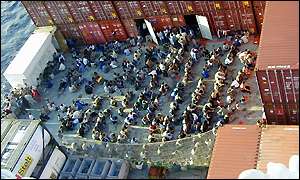
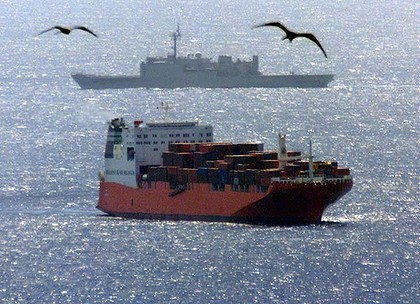
Today, 26 August, marks the ten year anniversary of the beginning of the Tampa affair in Australia.  On 26 August 2001, the Norwegian cargo ship Tampa responded to a distress call issued by the Australian Rescue Coordination Centre and rescued over 430 Afghan asylum seekers from a sinking migrant boat.  Australian Prime Minister John Howard’s government refused to permit the Tampa to offload the rescued asylum seekers on Christmas Island, the closest place of safety.  After a several day stand-off, the Tampa’s captain declared an emergency and entered Australian territorial waters.  Australian SAS special forces boarded the Tampa and took control of the ship.  The asylum seekers were eventually transferred to a naval vessel and sent to Nauru where they were detained.  The incident marked the beginning of Australia’s so-called Pacific Solution policy.

Here is an excerpt from UNHCR’s 2006 State of the World’s Refugees report describing the incident:

“A recent renowned rescue at sea was carried out by the Norwegian merchant ship Tampa in August 2001. Sailing from Perth, Australia under the command of Captain Arne Rinnan, the freighter of the Wallenius Wilhelmsen Line received a call for assistance from the Rescue Coordination Centre of the Australian Maritime Safety Authority. The Tampa changed course and was guided by an Australian coastal search airplane to reach an Indonesian boat crowded with passengers and in acute distress. The boat was breaking up in heavy seas as the Tampa arrived just in time to transfer the 433 people on board to its own decks. The Norwegian ship had facilities on board for only 50 people, including its crew of 27.

The closest port to the site of the rescue was on Christmas Island, an Australian territory, but Australia’s Immigration Department forbade the Tampa to enter Australian territorial waters. The Australian government was determined to stop unauthorized arrivals of asylum seekers, and so refused to disembark the Tampa‘s passengers and permit the vessel to proceed on its scheduled route. After long and tense negotiations – during which conditions on board the Tampa reached crisis proportions – a complicated and costly arrangement saw the passengers forcibly removed from the ship and dispersed to camps in Nauru, a small state nearby. Some 132 unaccompanied minors and families were accepted by New Zealand, where almost all received refugee status. None went directly to Australia. In this long process, the owners and agents of the Tampa incurred substantial losses.

At the time, the obligation to render assistance to vessels in distress was codified in international maritime law in such instruments as the UN Convention on the Law of the Sea (1982) and the International Convention on Maritime Search and Rescue (1979). The obligation to extend aid applies without regard to the nationality, status, or circumstances of the persons in distress. Under these rules, ship owners, ships masters, coastal nations and flag states (the states where ships are registered) all have responsibilities for search and rescue.

The International Convention on Search and Rescue mandates that a rescue is not complete until the rescued person is delivered to a place of safety. That could be the nearest suitable port, the next regular port of call, the ship’s home port, a port in the rescued person’s own country, or one of many other possibilities. The convention provides that ‘a situation of distress shall be notified not only to consular and diplomatic authorities but also to a competent international organ if the situation of distress pertains to refugees or displaced persons.’ The ship itself cannot be considered a ‘place of safety’ – indeed, carrying a large number of unscheduled passengers could endanger the crew and passengers themselves, owing to overcrowding, insufficient food and water and the tensions of life at close quarters.

The inability to disembark rescued passengers in a timely fashion and return to scheduled ports of call lead to strong reluctance in the maritime industry to engage actively in search and rescue missions. For their principled actions in the face of such profound disincentives, in 2002 UNHCR gave the captain, crew and owner of the Tampa its highest award, the Nansen Refugee Award.

The Tampa affair helped focus international attention on the question of who has responsibility for accepting asylum seekers rescued at sea, adjudicating their claims, and providing a place of safety for those who are confirmed in their need for international protection. In 2002, the general assembly of the International Maritime Organization (IMO) adopted a resolution seeking to identify any gaps, inconsistencies and inadequacies associated with the treatment of persons rescued at sea. IMO solicited the input of a number of UN agencies in a search for a coordinated approach to the issue.

Consequently, in 2004 IMO’s Maritime Safety Committee adopted pertinent amendments to the International Convention for Safety at Sea and the International Convention on Maritime Search and Rescue. (These amendments are to enter into force on 1 July 2006.) At the same session, the committee adopted the current Guidelines on the Treatment of Persons Rescued at Sea. The purpose of these amendments and the current guidelines is to ensure that persons in distress are assisted, while minimizing the inconvenience to assisting ships, and to safeguard the continued integrity of the International Convention on Maritime Search and Rescue.

The amendments impose upon governments an obligation to cooperate to ensure that captains of ships that have rescued persons in distress at sea are released from their obligations with the minimum further deviation from the ship’s intended route. The government or party responsible for maritime safety and rescue where survivors are recovered is responsible for ensuring that a place of safety is provided. The guidelines, on the other hand, aim to help governments and masters of ships fulfil their legal and humanitarian obligations to persons rescued at sea.”

Click here and here for articles.

Click here for Wikipedia entry on the Tampa Affair.

Click here for UNHCR 2006 State of the World’s Refugees report.
Leave a comment

Filed under Australia, Indian Ocean, News

Malmström’s Response to Dagens Nyheter Editorial Regarding EU’s Past Negotiations with Libya

Commissioner Cecilia Malmström posted a response on her blog to yesterday’s editorial in Dagens Nyheter regarding the EU’s efforts to negotiate a migration agreement with the Gaddafi government last year.  Her response is in Swedish and I reproduce below a Google English translation (slightly tweaked by me using my non-existent Swedish skills).  Please rely on the original Swedish text for accuracy.

Google translation:

“Conflict between principles

As I write today in [Dagens Nyheter] in reply to yesterday’s main leader, the purpose of the trip to Libya in 2010 was, among other things to try to get permission for cooperation in regard to the some 1.5 million migrants who were there. UNHCR had at that time determined that about 9000 of these were refugees and in need of help.

The partnership also included earmarked funding for UNHCR and IOM’s activities in Libya. The agreement also included cooperation on border control and better conditions for migrants and asylum seekers. For the first time we had with wording in an agreement on human rights and the concept of asylum, which was in the Libyan law.

Together with UNHCR and IOM, we tried from the EU side to find a means to protect the most vulnerable. Because of reluctance by the Libyan government to agree to our demands we made limited progress and shortly afterwards the civil war broke out.

It can later be viewed credulously [incredulously?] to believe that it would succeed, but the political situation that appeared at the time was the reality that we had to relate to in order to help these people. We can not ignore the realities, but must do whatever we can to help people who suffer abuse and unfair treatment. It is painful that sometimes this means we have to make exceptions to the principle of not negotiating with totalitarian states, but when there are no alternatives, the principle of humanity must be greatest.”

Original text:

“Konflikt mellan principer

Som jag idag skriver i DN, i replik till gårdagens huvudledare, var syftet med resan till Libyen 2010 att bla försöka få tillstånd ett samarbete rörande de omkring 1,5 miljoner migranter som fanns där.  UNHCR hade då hittills bedömt att omkring 9000 av dessa var konventionsflyktingar och i behov av hjälp.

Samarbetet innebar bland annat öronmärkt finansiering av UNHCR och IOM:s verksamhet i Libyen. Avtalet innefattade också samarbete kring frågor om gränskontroll och bättre villkor för migranter och asylsökande. För första gången någonsin fick vi med i avtalet formuleringar om mänskliga rättigheter och begreppet asyl, något som inte fanns i den libyska lagstiftningen.

Tillsammans med UNHCR och IOM försökte vi från EU:s sida hitta en möjlighet att skydda de allra mest utsatta. På grund av ovilja från den libyska regimen att gå med på våra krav kom samarbetet ingenvart och kort därefter bröt inbördeskriget ut.

Det kan i efterhand ses som godtroget att tro att det skulle lyckas, men som det politiska läget såg ut då var det den verklighet vi var tvungna att förhålla oss till för att kunna hjälpa dessa människor. Vi kan inte blunda för hur verkligheten ser ut utan måste göra vad vi kan för att hjälpa människor som utsätts för övergrepp och orättvis behandling. Det är smärtsamt att det ibland innebär att vi måste göra undantag från principerna om att inte förhandla med totalitära stater men då alternativ saknas måste principen om medmänsklighet vara störst.”

Click here for Malmström’s response.  (SV)

Click here for Dagens Nyheter editorial.  (SV)

Leave a comment

Filed under Analysis, European Union, Libya, Mediterranean

Italy Fears New Surge in People Fleeing Post-Qadhafi Libya

As I noted earlier this week, Italy hopes to re-implement the migration control provisions of the Italy-Libya Friendship Agreement with a new Libyan government as soon as possible.  This desire is motivated by fears of a new surge in refugees fleeing Libya.  In one of the articles to which I previously linked, Italian Undersecretary for Foreign Affairs Alfredo Mantica also said Italy fears that instability in a post-Qadhafi Libya will lead to increased numbers of Libyans and sub-Saharan Africans seeking to escape to Europe.  Father Moses Zerai, an Eritrean priest who heads the Agenzia Habeshia per la Cooperazione allo Sviluppo, also said in the article that he believes over the short to medium term many sub-Saharan Africans in Libya will likely try to flee to Italy and Europe.  Moses Zerai said that he is in contact with migrants in Tripoli who are fearful of treatment at the hands of the rebels.

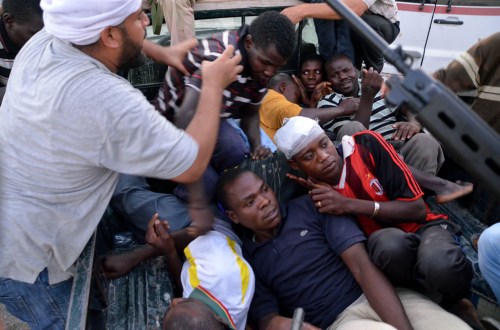
Images such as the one below demonstrate vividly why many sub-Saharan Africans in Libya may be fearful of reprisal or harm if they are suspected by rebel forces of being a Qadhafi mercenary.  This picture (Florent Marcie/AFP/Getty Images) was taken on 19 August in Zawiya and reportedly shows “suspected members of the Libyan regime forces [being] rounded up in a pick-up truck by Libyan rebel fighters in Zawiya.”

Click here for article.  (IT)

Click here for my previous post on re-implementing the migration control agreement.

Leave a comment

Filed under Italy, Libya, Mediterranean, News

Malmström’s “Unfortunate Voyage to Libya”

An editorial by Annika Ström Melin in Dagens Nyheter (Sweden) summarised by Presseurop:

“‘An unfortunate voyage to Libya’ headlines the Dagens Nyheter editorial, which looks back on European Commissioner for Home Affairs Cecilia Malmström’s visit to Libya in October 2010. [***] In practice [the agreement signed by the Commissioner in Libya] amounted to employing Gaddafi as an EU border guard, notes the Stockholm daily [***].  ‘It is easy to be clever with the benefit of hindsight,’ remarks the daily, ‘but the agreement with Gaddafi was already scandalous when it was signed. Today Cecilia Malmström will have to provide full information about the consequences of this meeting. Was there a dialogue? Where did the money go?’ In conclusion, Dagens Nyheter affirms that the entire EU should ask itself the question of how it came to sign a treaty with Gaddafi.”

Click here for Presseurop article.

Click here for Dagens Nyheter editorial.  (SV)

Click here and here for my previous posts on the Commissioner’s trip to Libya.

[UPDATE 25 August – Click here for Malmström’s response to the editorial.]

Leave a comment

Filed under Analysis, European Union, Libya, Mediterranean, News

Italy Hopes to Revive Libyan Friendship Treaty, Including Migration Control Provisions

Italian officials, including Defence Minister Ignazio La Russa, said yesterday that the Italian-Libyan friendship treaty signed in 2008 by Prime Minister Berlusconi and Gaddafi should be revived once a new government takes power in Libya.  The head of the Libyan National Transitional Council, Mustafa Abdel Jalil, has previously said that the provisions of the treaty, including the migration control provisions, would be respected by the new Libyan government.  Italian Under Secretary for Foreign Affairs, Alfredo Mantica, is quoted by ANSA as saying that “the first duty of Italy will be to update the part [of the treaty] relating to migration” as soon as the situation in Libya has stabilized. [“Mantica ha spiegato che ‘il primo dovere dell’Italia sarà quello di aggiornare la parte che riguarda i flussi migratori’ del Trattato di amicizia italo-libico, non appena la situazione in Libia si sarà stabilizzata.”]

Click here and here for articles. (IT)

Click here and here for previous posts about Libyan NTC’s statements regarding the treaty.

2 Comments

Filed under European Union, Italy, Libya, Mediterranean, News

Tunisia Restricts Border Crossings with Libya

The Tunisian side of the main border crossing with Libya at Ras Jedir was reportedly closed to routine crossing on Monday; sick and injured persons were allowed to cross in to Tunisia.  According to media reports, Tunisian authorities are fearful that militia fighters and mercenaries working for Kadhafi may seek to enter Tunisia.

Click here and here for articles.  (FR)

1 Comment

Filed under Libya, News, Tunisia

UNHCR Calls on All Sides in Libya to Protect Third-Country Nationals

From UNHCR: “UN High Commissioner for Refugees António Guterres today [22 August] called on all sides of the conflict in Libya to ensure that the thousands of third-country nationals trapped in Tripoli and other areas by the continuing fighting are properly protected from harm. ‘Thousands of third-country nationals in Libya will be feeling great fear and uncertainty at this time,’ he said. ‘We have seen at earlier stages in this crisis that such people, Africans especially, can be particularly vulnerable to hostility or acts of vengeance. It is crucial that humanitarian law prevails through these climactic moments and that foreigners – including refugees and migrant workers – are being fully and properly protected from harm.’…”

Click here for full press statement.

Leave a comment

Filed under Libya, News, UNHCR

IOM: Large Number of Migrants in Tripoli in Need of Urgent Evacuation

Full text of IOM statement:

19-08-2011

 Libya – IOM is working to evacuate the growing number of migrants in need of help in the Libyan capital, Tripoli.

The Organization has received several requests to evacuate foreign nationals in Tripoli who are increasingly vulnerable and now want to leave.

Large numbers of Egyptian migrants are still believed to be in Tripoli and in the western part of Libya, with many other nationalities still present in the capital. Exact numbers of the total migrant population in the capital area are unknown.  Thousands of Egyptians have now registered with their Embassy and are ready for evacuation.

As IOM actively prepares a foreign national evacuation plan taking into account the highly complex logistical, political and security challenges, the Organization will soon be in need of significant new funds to carry out this urgent humanitarian operation.

“A rapid response on this is critical to ensuring that in the small window of opportunity we have to get people out of Tripoli, we are not constrained by funding issues,” says Pasquale Lupoli, Regional Director for the Middle East and North Africa, in Cairo.

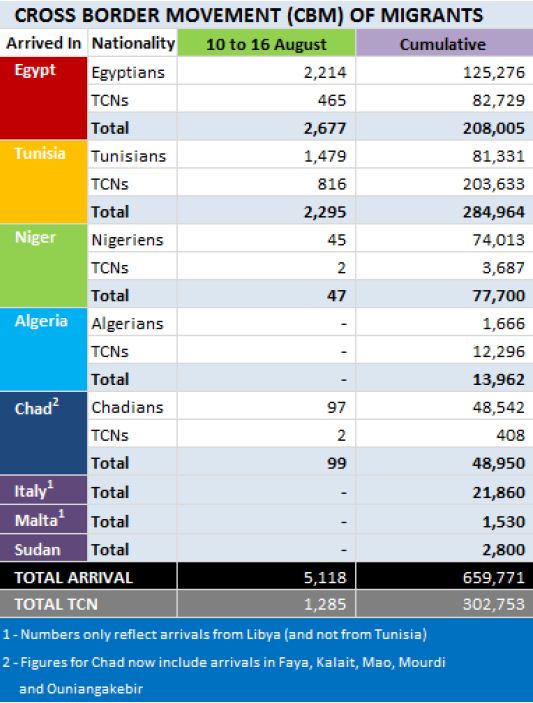
In addition to the many thousands of stranded migrants IOM has assisted elsewhere in Libya since the start of the crisis in late February, IOM has evacuated more than 10,000 migrants by road from Tripoli to the Tunisian border point at Ras Adjir. That evacuation route had eventually to be abandoned due to increased fighting between rebel and government forces.

As logistics for this special operation from Tripoli are put into place, the Organization is continuing to evacuate migrants elsewhere.

Today, another IOM-chartered ship will be leaving the eastern Libyan town of Benghazi for Misrata on the 15th mission to evacuate migrants, mainly from northern African. It is the first of two rotations to take place between now and mid next week.

More than 8,300 migrants and wounded civilians have so far been assisted by IOM on its Misrata operations with funding from the European Commission’s Humanitarian and Civil Aid department (ECHO), the Australian, British, German, Irish, Japanese and US governments. The Organization has also delivered several thousands of humanitarian aid to the port city.

Click here for statement.

Click here to donate to IOM.


Leave a comment

Filed under Data / Stats, Libya, Mediterranean, News

Malta Blocks Italian Navy Ship From Disembarking 334 Rescued Migrants

Malta yesterday refused permission to the Italian Navy ship Borsini to land in Malta for the purpose of disembarking 334 rescued migrants.  The migrants were rescued in the Maltese Search and Rescue Area south of Lampedusa on Saturday by several Italian coastguard patrol boats and transferred at sea to the Borsini.  The Borsini then sailed to Malta.  Malta refused permission because it said that Lampedusa or Tunisia were the closest safe locations.  The Italians sought to disembark the rescued migrants at Malta because Lampedusa was overwhelmed with the arrivals of approximately 2000 migrants over the past 36 hours.  The Borsini left Malta and is sailing to Taranto on the Italian mainland to disembark the migrants.

Click here and here for articles.

3 Comments

Filed under Italy, Libya, Malta, Mediterranean, News, Tunisia

2000 Migrants Land on Lampedusa

Approximately 2000 migrants in 11 boats reached Lampedusa and Pantelleria over the past 36 hours or so.  Most of the migrant boats were rescued by Italian authorities and most are believed to have travelled from Libya, though one small boat is believed to have left from Tunisia.  Good weather is again the likely reason for the latest surge in numbers.

Click here (IT) and here (EN) for articles.

Leave a comment

Filed under Italy, Libya, Mediterranean, News, Tunisia

Fortress Europe Calculates 1,931 Deaths in the Mediterranean During First 7 Months of 2011

According to calculations made by Fortress Europe, 2011 is the deadliest year in the Mediterranean since at least 1994.  1,931 people have died during the first seven months of 2011.  This number is higher than the total number of deaths in all of 2008, the year with the previous highest death toll of 1,274.  Fortress Europe estimates that 1,674 (87%) of the 1,931 deaths have occurred in the Sicilian Channel and that most of the deaths in the Sicilian Channel have involved migrants travelling from Libya towards Europe.

Click here for Fortress Europe post.  (IT)

Click here for Clandestina blog post.  (EN)

From Fortress Europe:

Vittime del Canale di Sicilia dal 2002 ai primi 7 mesi del 2011
Anno 2002 2003 2004 2005 2006 2007 2008 2009 2010 2011
Morti 236 413 206 437 302 556 1274 425 20 1674

Leave a comment

Filed under Data / Stats, European Union, Italy, Libya, Malta, Mediterranean, News, Tunisia

NATO Denies It Failed to Respond to Migrant Boat in Distress

NATO said yesterday that Italian authorities never directly requested assistance from NATO in regard to the disabled migrant boat discovered earlier in the week by a Cypriot tug boat.  NATO spokespersons said while NATO was informed that the migrant boat was in distress, Italian authorities also informed NATO that Italian patrol boats and a rescue helicopter were responding to the situation.  NATO spokesperson Carmen Romero said NATO had a history of responding to emergency situations and pointed by way of example to NATO’s response on 26 March to two migrant boats in distress.   A Canadian naval ship under NATO command in March rendered assistance to two migrant boats but, unlike the incident last month when a Spanish ship under NATO command rescued 100 migrants and was unable to offload the migrants for five days, the Canadian ship did not take the migrants on board.

Click here (EN), here (IT) and here (IT) for articles.

Click here and here for previous posts on topic.

Click here for previous post about 11 July incident.

Click here and here for previous posts about the 26 March incident.

Leave a comment

Filed under Italy, Libya, Mediterranean, News

Italy Calls for Formal Inquest Into “Presumed Failure” of NATO to Render Assistance to Disabled Migrant Boat and for Expansion of NATO Mandate to Include Rescue at Sea

Here is today’s full statement from the Italian Foreign Ministry:

Minister for Foreign Affairs Franco Frattini instructed the Italian Permanent Representative to NATO to call for a formal inquest into the dynamic regarding the presumed failure to come to the aid of boats carrying civilians fleeing Libya. Minister Frattini also asked Ambassador Sessa to urge discussion within the Atlantic Alliance of the possibility of adapting the mandate of the mission sanctioned by UN resolutions 1970 and 1973 to safeguard Libyan civilians, to the effect that the defence and aid of those fleeing the conflict by sea, and thereby risking their lives, be adequately taken into consideration.

In relazione alle polemiche circa il presunto mancato soccorso a battelli con clandestini a bordo in fuga dalla Libia, il Ministro degli Esteri Frattini ha dato istruzioni al Rappresentante Permanente italiano presso la NATO di chiedere un’inchiesta formale per l’accertamento della dinamica di quanto accaduto. Il Ministro Frattini ha anche chiesto all’Ambasciatore Sessa di sollecitare una discussione all’interno dell’Alleanza Atlantica per il possibile adeguamento del mandato della missione di salvaguardia delle popolazioni civili in Libia, sulla base delle risoluzioni delle Nazioni Unite 1970 e 1973, affinchè vengano opportunamente considerate la tutela e soccorso anche di coloro che per cause belliche sono costretti a fuggire su barconi mettendo a rischio la propria incolumità.

Click here (EN) and here (IT) for links.

Click here (EN), here (EN) and here (IT) for articles.

Click here for previous post.

2 Comments

Filed under Italy, Libya, Mediterranean, News

Italy Rescues 300 Migrants from Disabled Boat; Multiple Deaths May Have Occurred Before Rescue; Italy Seeks Clarification Regarding Possible Failure of NATO Ship to Render Assistance

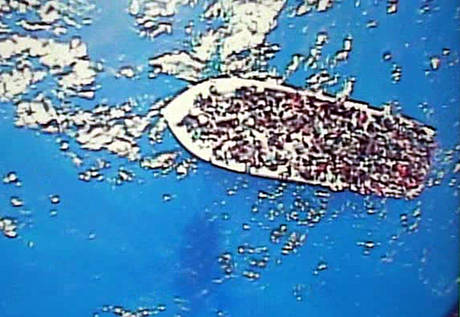
Italian patrol boats yesterday rescued approximately 300 migrants from a disabled boat 90 miles south of Lampedusa.  There are unconfirmed reports from survivors that before the rescue many people died and bodies were put in the sea.  The boat may have been drifting for one and a half days before the rescue.

The disabled migrant boat was reportedly first discovered by a Cyprus tug boat which was forced to move away from the disabled boat when some migrants jumped overboard and tried to swim to the tug.  An Italian helicopter which attempted to lower emergency supplies was forced to abandon its efforts when persons attempted to climb into the basket being used to drop supplies.

According to news reports, a NATO ship was located about 27 miles from the disabled migrant boat, but NATO reportedly failed to respond to a request by Italian authorities to render assistance.  Italian patrol boats were then forced to travel 90 miles from Lampedusa in order to reach the migrant boat.

The Italian government is seeking clarification from NATO regarding the possible failure to respond to the request to render assistance to the migrant boat.  A Spanish frigate under NATO command on 11 July rescued 100 migrants.  During the five day period that the migrants were on board the Spanish frigate, before the migrants were eventually transferred to Tunisian authorities, the Spanish frigate was removed from its NATO Operation Unified Protector embargo patrols due to the civilian passengers.

Click here, here, here, here, and here for articles. (IT)

Click here and here for articles.  (EN)

Click here for short AFP TV video from rescue helicopter.

Click here and here for previous posts on migrant rescue by Spanish frigate.

Image of migrant boat from monitor inside Italian rescue helicopter


3 Comments

Filed under Italy, Libya, Mediterranean, News

25 Persons Dead from Asphyxiation on Board Migrant Boat at Lampedusa

Italian authorities responded to a migrant boat in distress Sunday night near Lampedusa.  The boat was carrying about 270 migrants.  Seas were too rough to transfer the migrants to the Italian vessels and the migrant boat was escorted towards Lampedusa.  The boat broke down about one mile from Lampedusa and a transfer operation was begun this morning.  During the transfer 25 bodies were discovered in the boat.  It is believed that the deaths were probably caused by asphyxiation because the boat was overloaded and packed very tightly with passengers.

Click here, here, and here for articles.  (IT)

Leave a comment

Filed under Italy, Libya, Mediterranean, News