Category Archives: United Nations

Libya May Allow Eritreans to Remain – Italy Claims Credit for Decision

Libya has reportedly agreed to allow approximately 400 Eritreans to remain in Libya, though they will not be given refugee protection as Libya is not a signatory to the Refugee Convention.

ANSAmed reported that Italian officials have claimed credit for Libya’s decision, though the Italians have questioned whether any of the Eritreans have been mistreated and whether any of the Eritreans were subjected to Italy’s push-back practice.  Italian Foreign Ministry Undersecretary Stefania Craxi stated that ”the Italian government never backed away from raising awareness with[] Libyan authorities on the topic of human rights.”  Craxi said ”it is thanks to the Italian government [that] the UNHCR activities in Tripoli have started again, albeit in an informal and conditioned way.”  Foreign Minister Franco Frattini said ”it is unbelievable that Brussels did not even make a press release.  [Italy] worked in silence, without proclamations, sadly with the total and absolute absence of Europe. We asked for a compromise, a mediation and the result came.”

While it is good if the Italian Government did indeed work to arrive at a temporary and imperfect solution for this particular group of Eritreans and it is good that the Italian ministers speak of respecting human rights in Libya, the Italians should be equally if not more concerned with the human rights implications of their push-back practice in the Mediterranean.

Click here for article.

Leave a comment

Filed under European Union, Italy, Libya, Mediterranean, News, UNHCR

Hammarberg Makes Urgent Request of Italy for Information on Eritreans in Libya

COE Human Rights Commissioner Thomas Hammarberg has made an urgent request to the Italian Government for information on alleged human rights violations of Eritrean migrants in Libya, including Eritreans who may have been among persons intercepted at sea by Italy and forcibly returned to Libya without being afforded an opportunity to seek international protection.

In a letter to the Italian Foreign Minister, Commissioner Hammarberg wrote “[g]iven the recent decision of the Libyan authorities to discontinue UNHCR’s activities in the country, it is increasingly difficult to confirm the exact accuracy of these reports. However, given their consistency and the seriousness of the allegations, I hope that I can count on your cooperation to urgently clarify the situation with the Libyan authorities and be kept informed about the results of your investigations.”

The Foreign Minister and Interior Minister have written a joint letter to the Il Foglio newspaper where they say that the Italian Government “was mediating with Tripoli to identify the Eritreans and try to find them employment in Libya so that they would not be forcibly repatriated.”  According to Reuters, the ministers also said “it was necessary to respect Libyan sovereignty and [they] called for an international approach, involving the United Nations and other organizations” and that the “fate of these Eritrean citizens cannot be resolved only through our bilateral relationship (with Libya).”

Click here for the Commissioner’s letter to the Italian Foreign Minister.

Click here for the Commissioner’s letter to the Italian Interior Minister.

Click here for article.

Click here (IT) for Italian Ministers’ Reply to Il Foglio.

Leave a comment

Filed under Commissioner for Human Rights, Italy, Libya, Mediterranean, News, UNHCR

Libya to Permit UNHCR to Resume Limited Activities

The UNHCR announced on Friday that it has received permission to resume some activities in Libya.  The UNHCR said that “its operations will be restricted to only its current caseload” in Libya.

Libyan officials have offered several reasons for why the Libyan government ordered UNHCR to cease operations several weeks ago, including complaints that UNHCR entered into cooperation agreements with local NGOs within Libya without authorisation, rented office space without permission, displayed the UNHCR logo improperly, and, most recently, that one or more persons associated with UNHCR accepted bribes and/or sexual favours from persons in exchange for refugee status.

“UNHCR spokesperson Adrian Edwards stressed that the Libyan allegations remain unsubstantiated. He told journalists in Geneva that talks on the agency’s future in the country will resume shortly and that the expulsion order has not yet been formally lifted. ‘UNHCR does take very seriously any accusation against any UNHCR staff member from whatever source,’ he said. ‘We have a zero tolerance policy for misconduct. We have asked the Libyan Government to substantiate these particular claims. If and when we receive these indications, we will be in a position to investigate through our normal procedures.’”

Click here for UN statement.

Click here, here, here (EN) and here (AR) for articles.

Leave a comment

Filed under Libya, Mediterranean, News, UNHCR

Updated CARIM Overview of Migration Developments in Libya

CARIM just issued a short paper, Libya: The Migration Scene – Which implications for migrants and refugees?: “In the light of UNHCR’s announcement of the 8th of June 2010 that it was requested to close its offices in Libya, CARIM provides an overview of migration developments in Libya from sociopolitical, legal and demographic-economic perspectives.”

Click here for the document.

Leave a comment

Filed under Analysis, European Union, Libya, Mediterranean, UNHCR

Amnesty Int’l Report on Libya Criticises Libya and EU on Refugee Treatment

Amnesty International has released a comprehensive report on Libya entitled “Libya of Tomorrow – What Hope for Human Rights?”  The report covers a range of matters including the criminal justice system and the use of the death penalty.   Section 5 of the report (beginning at p 91) addresses the rights of refugees, asylum-seekers and migrants.  The report was finalised before the recent decision of the Libyan government to close the UNHCR office in Tripoli.

In regard to refugee issues, Amnesty is very critical of both Libya and the EU and calls upon EU member states to “ensure that any bilateral agreements with Libya in the area of migration and asylum, including the EU-Libya Framework Agreement currently being negotiated, are based on full respect for the rights of asylum-seekers, refugees and migrants.”

Excerpts from Section 5, “Rights of refugees, asylum-seekers and migrants”:

Members of the EU have been actively seeking the collaboration of Libya in controlling the flow of migrants to European shores – turning a blind eye to Libya’s dire human rights record, the absence of a functioning asylum system in Libya, and persistent reports of the abuse and ill-treatment of refugees, asylum-seekers and migrants.  The Treaty of Friendship, Partnership and Co-operation signed in August 2008 between Italy and Libya includes provisions for bilateral efforts to combat “illegal migration”, facilitated by the joint patrolling of the sea agreed upon in December 2007 in the “Protocol” and the “Additional Technical-Operational” Protocol”.

As part of the agreements, Italy promised to compensate Libya for its occupation of the country between 1911 and 1943. The Treaty of Friendship, Partnership and Co-operation involves a US$5bn package for construction projects, [and other items].  In return, Libya agreed, among other things, to tighten control of its territorial waters and accept disembarkation on its soil of individuals intercepted at sea by Italian vessels. Italy was also reported to have undertaken to provide resources, including technology, to control migrant flows through the southern borders of Libya. In fact, Italy has provided Libya with six motor patrol boats since the Treaty entered into force.

In the framework of these agreements, from May 2009 onwards Italy started returning refugees, asylum-seekers and migrants intercepted in international waters to Libya. On 6 May 2009, distress calls were sent from three vessels with an estimated 230 third-country nationals on board. Italian coastguard vessels intervened but transported the individuals to Tripoli, without stopping in an Italian port and without checking whether any individuals on board were in need of international protection or basic humanitarian assistance. Further interceptions and returns occurred in the subsequent months: according to official information from the Italian Ambassador to Libya, between 6 May and 3 September 2009, over 1,000 individuals were returned to Libya. They included nationals from Eritrea, Somalia and other sub-Saharan African countries. The Italian Minister of the Interior Roberto Maroni was reported to have called this action “an historic achievement after one year of bilateral negotiations with Libya”….

Despite these pleas by UNHCR and consistent reports of abuses suffered by refugees, asylum-seekers and migrants in Libya, the Italian authorities continue to intercept vessels at sea and send them back to other countries most notably Libya.  In January 2010, Italian Minister of the Interior Roberto Maroni stated that the number of migrants arriving to Italian shores was reduced by 74 per cent in 2009 compared to 2008, attributing the reduction to Italy’s bilateral agreements with Libya.

Italy is not alone in seeking Libya’s cooperation to control the flow of migrants to European shores. Negotiations between Libya and the EU over a Framework Agreement started in November 2008 covering the control of migration, among other issues, including potential readmission agreements for third-country nationals who have transited through Libya on their way to Europe….

UNHCR [prior to its recent expulsion from Libya] and its partners have also been involved in screening individuals pushed back to Libya from Italy. UNHCR declared that by October 2009, it had been able to screen 890 people and had registered 206 of them as refugees and secured their release from detention.  UNCHR also registered 80 individuals pushed back from Italy in November 2009, granting 40 of them refugee status. The remainder were awaiting their interviews for refugee status determination at the time of writing. UNHCR confirmed that a total of 685 individuals determined to be refugees or asylum-seekers were released from detention from 2008 to February 2010, including 450 Eritreans and 150 Somalis…..

Click here for the Report.

Click here for AI Press Release regarding the Report.

Leave a comment

Filed under European Union, Italy, Libya, Mediterranean, Reports, UNHCR

World Refugee Day 2010

UNHCR World Refugee Day 2010

Leave a comment

Filed under UNHCR

ECRE: Can EU Trust Libya With Refugee Protection?

ECRE issued a press release last week regarding Libya’s decision to expel the UNHCR:

“Bjarte Vandvik, Secretary General of the European Council on Refugees and Exiles (ECRE) said: ‘UNHCR’s expulsion from Libya will hopefully be temporary but it does reveal the unreliability of this regime, as well as its understanding of refugee protection. How will the EU ensure that Libya keeps its word regarding commitments towards human rights? How can the EU trust such a partner?’”

“ECRE calls on the EU to seriously reconsider its cooperation on asylum and refugee issues with Libya, a country that is not a party to the 1951 Geneva Refugee Convention. In particular, negotiations on an EU – Libya framework agreement must now be reviewed, as should any EU funding that supports Libyan authorities in intercepting refugees along their Southern border…. While UNHCR”s presence does not make Libya a safe place for refugees, the decision to prevent UNHCR from operating in the country once again illustrates the real intentions of the Libyan authorities when it comes to refugee protection. The EU cannot simply continue to ignore this reality but should make clear that the protection of refugees is still a fundamental value of the EU.”

(HT to Ana Lopez, ECRE’s Media and Information Officer).

Click here for full ECRE statement.

1 Comment

Filed under European Union, Libya, Mediterranean, Statements, UNHCR

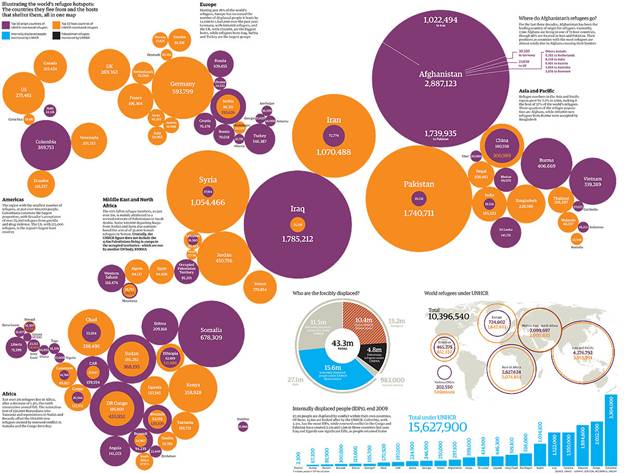
UNHCR Report: 2009 Global Refugee Trends & Guardian Data Map

The UNHCR released its annual report this week for last year: “2009 Global Trends- Refugees, Asylum-seekers, Returnees, Internally Displaced and Stateless Persons.”

The UNHCR estimates that approximately 43.3 million people were forcibly displaced at the end of 2009.  South Africa continued in 2009 to be the destination country receiving the largest number of new asylum seekers (222,000).  The US and France were second and third with less than 50,000 new asylum seekers.

The Guardian’s Data Blog published an interesting graphic with the UNHCR statistics.

Click here for UNHCR web article.

Click here for link to the UNHCR Report.

Click here for link to the Guardian’s map.

[UNHCR refugee statistics mapped. Illustration: Paul Scruton for the Guardian.]

Leave a comment

Filed under Data / Stats, Reports, UNHCR

Side Meeting on Boat People at Upcoming UNHCR-NGO Consultations

The annual UNHCR-NGO consultations will take place beginning 29 June (registration is closed).  Various side-meetings will also be held, including one on 1 July: “A hearing on Boat People: Different people, different needs and rights to protection.” Palais des Nations, Geneva, 13h15 – 14h45, Room XXII

“A hearing on Boat People: Different people, different needs and rights to protection.

Brief description: What are the needs of today’s boat people—and how can these needs be differentiated and matched to rights and practical responses of protection and assistance—among boat people arriving in Europe or Yemen from Africa; in the US from Haiti; in various parts of south and southeast Asia and Australia from Burma or Sri Lanka, or following other sea crossings? This session is organized as a hearing, not a series of presentations. It will begin with a brief introduction of the importance of differentiating needs and rights to protection and assistance among all the people arriving, (i.e., refugees, victims of human trafficking and smuggling, victims of torture, children, etc.) Conclusions from an experts roundtable in Tunis last year will then be offered as a reference, which participants will be invited to comment upon and at the end of the session, consider supporting. During the bulk of the session however, panelists from UNHCR, IOM, IFRC and UNODC will serve as a hearing board: listening, probing and recording the experience, concrete practices and recommendations of NGO participants who respond to boat people, either in Europe or in other parts of the world. Input will then be organized and submitted to the international organizations and to government policy makers, including the European Union and Council of Europe through the new EU-funded NGO partnership “DRIVE” (Differentiation for Refugee Identification and Vulnerability Evaluation).”

Click here for full Side Meeting agenda.

Leave a comment

Filed under Colloques / Conferences, UNHCR

Migreurop: What Price Will Europe Pay if Gaddafi Authorises UNHCR’s Return to Libya?

Migreurop takes the position that Libya’s recent decision to expel the UNHCR is a negotiating tactic that will be used to leverage more money and concessions from the European Union in the context of the ongoing EU-Libya partnership negotiations and poses the important question:  What Price Will Europe Pay if Gaddafi Again Authorises UNHCR’s Return to Libya?  The UNHCR’s presence in Libya has played an essential role in Europe’s immigration policy, specifically Europe’s migration management and border outsourcing:

“Thanks to UNHCR’s presence in Tripoli, Europe and Italy, which concluded its agreement with Libya in August 2008, were able to claim that the boat people who were forcibly returned to Libya could find a minimal level of security and protection. Everyone knows full well that this was a smokescreen: the conditions under which migrants are treated in Libya are well documented and well known to European authorities and institutions.”

“The presence of the UNHCR in Libya justified the policy of externalisation and deportation carried out by the EU. … Libya has now raised the stakes and the UNHCR is an accomplice in the sordid negotiations:  UNHCR’s return is already planned.…”

Click here or here for Migreurop’s full statement / analysis (FR).

Click here for previous post.

Leave a comment

Filed under Analysis, European Union, Italy, Libya, Mediterranean, UNHCR

More on Libya’s Decision to Expel UNHCR

Libya’s decision to expel the UNHCR from Libya was made public during the seventh round of Framework Agreement talks between the EU and Libya.  The talks concluded yesterday in Tripoli.  “[Libya’s Deputy Foreign Minister Mohammed Tahar] Sayala said the main stumbling blocks to progress were illegal immigration and the International Criminal Court (ICC), which Libya does not recognise.  [Sayala] said Libya wanted financing and equipment [from the EU] for the surveillance of its borders, both on land and sea.”

Amnesty International criticized the decision to expel the UNHCR and called on Libya to reverse the decision:

“[***] The move to expel the UNHCR came against the backdrop of the 7th round of negotiations, which started on 6 June in Tripoli, between Libya and the EU over a Framework Agreement, which addresses bilateral cooperation in the control of irregular migration, among other issues, including potential readmission agreements for third-country nationals, who have transited through Libya on their way to Europe. EU member states, most notably Italy, have been seeking Libya’s assistance in decreasing the flow of arrivals of asylum-seekers and migrants to European shores. The expulsion of the UNHCR further casts doubt on Libya’s commitment to respect its obligations under the Organization of African Unity Convention Governing the Specific Aspects of Refugee Problems in Africa. It also shows how essential it is to include effective human rights safeguards and adequate standards of protection in any bilateral agreements with Libya in the field of the control of migration. [***]”

The European Commission also expressed “concern” with Libya’s decision “but sees it as one more reason to engage in ‘dialogue’ with General Gaddafi’s country on immigration and asylum.”

And as noted by Michèle Morel on International Law Observer, even though Libya is not a signatory to the UN Refugee Convention, Libya is bound by customary international law which prohibits refoulement to countries where there is a risk of torture, “[t]herefore, while Libya itself has no asylum system for the examination of asylum seekers’ situations, refusing to allow UNHCR to carry out its activities in Libya would amount to a violation of international human rights law.”

Click here, here, here (EN), and here (AR) for articles.

Click here for Amnesty International’s statement.

Click here for link to ILO post.

3 Comments

Filed under European Union, Libya, Mediterranean, News, UNHCR

Libya Orders UNHCR Office Closed – Possible Link to EU-Libya Talks on Partnership Accord

The Libyan government has ordered the UNHCR office in Libya to halt all activities and to close it office.  UNHCR has been working in Libya since 1991 even though Libya is not a signatory to the UN Refugee Convention.

The UNHCR said it was not given a reason for the Libyan decision.  Reuters reported that Libya’s Foreign Ministry considers the UNHCR presence within Libya to be illegal since Libya is not a signatory to the Refugee Convention.  Reuters also says that JANA, the Libyan news agency, accused a UNHCR official of carrying out an unspecified illegal activity.

The Libyan newspaper Oya and other reports say that the EU is pressuring Libya in the ongoing EU-Libya Partnership Talks to sign the Refugee Convention and that illegal immigration is one of the main areas of disagreement in the current negotiations.

The UNHCR said in a press release “[i]n the absence of a national asylum system, UNHCR has carried out registration and refugee status determination, visiting detention facilities and providing medical and humanitarian assistance to detainees.”  Among the asylum seekers detained in Libya over the past year are persons who were forcibly returned to Libya by Italian authorities pursuant to the Italy-Libya migration agreement.

Click here for UNHCR press release.

Click here for Oya article (AR).

Click here, here, and here for articles (EN).

2 Comments

Filed under European Union, Libya, Mediterranean, News, UNHCR

UNHCR Criticises Delay by Italy and Malta in Launching Search and Rescue of Migrant Boat

“UNHCR is concerned about delays in a search-and-rescue operation on Sunday and Monday [6-7 June]  involving a boat carrying more than 20 people, mostly Eritreans, near Malta. Distress calls were received on Sunday evening, including by UNHCR, and passed to Maltese and Italian maritime authorities. It is unclear which country had search-and-rescue responsibility when the distress calls were first sent. According to information made available to UNHCR, the boat was only rescued late on Monday, and by Libyan vessels.”

The persons on board the boat have reportedly been taken to Libya.

Click here for UNHCR statement.

Click here and here for articles.

Leave a comment

Filed under Italy, Libya, Malta, Mediterranean, News, UNHCR

Spanish Court Rules that Schengen Treaty Prevents Asylees From Leaving Ceuta and Melilla

As noted on Diario de la Inmigración, a Spanish Court in Ceuta (el Juzgado Contencioso Administrativo número 2 de Ceuta) has ruled that persons granted asylum or subsidiary protection may not leave Ceuta for the Spanish peninsula.  The court agreed with the position of the Spanish government and ruled that the two autonomous cities of Ceuta and Melilla are not part of the Schengen area and that proper documentation is therefore required to enter the Schengen area from the cities.  The court concluded that the “yellow card” (“tarjeta amarilla”) issued to persons granted asylum or subsidiary protection is insufficient documentation to enter the Schengen area.

The UNHCR and CEAR have previously criticised the Spanish’s government new policy of restricting the free movement of persons in Ceuta and Melilla who have been granted asylum or subsidiary protection.  UNHCR believes that the restrictions on free movement violate article 5 of Spain’s 2009 asylum law (la ley 12/2009, de 30 de octubre).

Click here, here, and here for articles (all ES).

Leave a comment

Filed under European Union, Judicial, Mediterranean, News, Spain, UNHCR

EASO Regulation Published in EU Official Journal

Regulation (EU) No 439/2010 of the European Parliament and of the Council of 19 May 2010 establishing a European Asylum Support Office was published in the Official Journal of the EU on 29 May 2010.

Click here for the link to the Journal.

Leave a comment

Filed under European Union, News, UNHCR