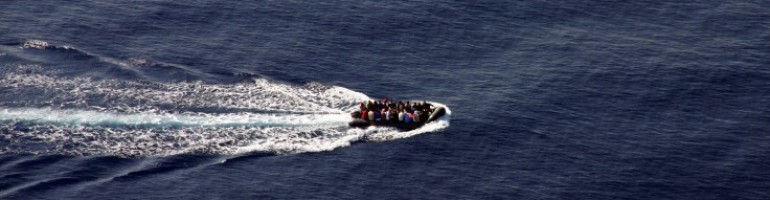
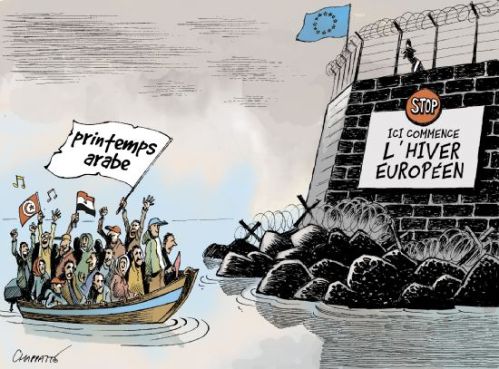
© Chappatte - http://www.globecartoon.com - Used by Migrants At Sea with permission.
Filed under Analysis, European Union, Frontex, Mediterranean
Gaddafi and other Libyan officials in recent weeks have made statements to the effect that Libya will no longer prevent irregular migrants from leaving Libya and have made threats that Libya will encourage irregular migration. (6 March, Gaddafi: “I want to make myself understood: if one threatens [Libya], if one seeks to destabilize [Libya], there will be chaos, Bin Laden, armed factions. That is what will happen. You will have immigration, thousands of people will invade Europe from Libya. And there will no longer be anyone to stop them….”)
Now that migrants boats are again leaving Libya and arriving in Italy and Malta, it is unclear what role, if any, the Libyan government may be playing. In an article in yesterday’s Times of Malta there is a short statement by an Eritrean man who had just arrived in Malta from Libya on a migrant boat. His statement suggests that the Libyan government may be facilitating the departures: “[a] man said he had been in Libya for five years and this was not the first time he had tried to escape. ‘The boats were organised by the same people,’ he said, referring to a Libyan racket which was widely believed to enjoy the support of the North African regime. The migrants said they paid between $500 and $1,000 for their journey – meaning that those who organised the boats were pocketing an average of $200,000.”
Click here for article.
Filed under Italy, Libya, Malta, Mediterranean, News
Here is a short AFP article about Father Mussie Zerai who is in frequent contact by satellite phone with African refugees in Libya and with those who are in the process of leaving Libya: “A few steps away from St Peter’s Basilica, an Eritrean Catholic priest is on the phone with boats in the middle of the Mediterranean filled with African refugees fleeing Libya. Mussie Zerai receives calls from satellite phones on the boats and co-ordinates the arrival of hundreds of Eritreans, Ethiopians and Somalis with Italy’s coast guard and the NATO warships imposing a naval embargo on Libya….”
Click here for article.
Father Zerai’s organisation’s blog: habeshia.blogspot.com/
UPDATE: If you have information about a family member or friend who may be on a boat or if you are seeking information, please consider contacting the Agenzia Habeshia per la Cooperazione allo Sviluppo in Italy at this email address: agenzia_habeshia@yahoo.it .
UPDATE: Click here for 19 April 2011 BBC article.
Filed under Eritrea, Italy, Libya, Mediterranean, News
Growing numbers of Tunisians are arriving in the Italian border town of Ventimiglia (Vintimille), on the border with France, and are attempting to enter France. 3500 Tunisians have reportedly arrived in recent weeks. Most of the newly arriving Tunisians appear to have passed through Lampedusa in recent weeks and were then relocated elsewhere in Italy to relieve the overcrowding on the island. Many of the Tunisians arriving in Lampedusa have been very clear about their desire to continue on to France due to family or linguistic ties.
France has reinstituted some border controls in the area in an effort to block the entry of the Tunisians. Additional controls are being instituted within French territory in Menton and Nice. La Stampa reports that “[p]eople smugglers, who had largely disappeared when border checkpoints [in the Schengen area] were closed down, are now increasingly common. [Smugglers] seek out the migrants at the station [in Ventimiglia] and offer to take them to France…” Le Point suggests that “by discretely allowing illegal immigrants to arrive in Ventimiglia, Italy is hoping that Europe will wake up and share the burden. Italian Foreign Minister Franco Frattini on Wednesday criticised France for returning Tunisians to Italy after crossing the border, accusing France of a lack of solidarity.
Click here (EN), here (FR), and here (FR) for articles.
Filed under European Union, France, Italy, Mediterranean, News, Tunisia
Italian Foreign Minister Franco Frattini has again criticised what he describes as the EU’s and European Commission’s failure to assist Italy with the migrant situation in Lampedusa. Minister Frattini singled out Commissioner Malmström for his criticism. A statement on the Italian Foreign Ministry web site says that “Italy continues to solicit Europe’s help in confronting the immigration emergency, not only in terms of economic aid but also in terms of a plan for the distribution of the refugees among Member States. ‘Europe has been totally inert in this period’, Minister Frattini asserted and, commenting on EU Home Affairs Commissioner Cecilia Malmström[‘s] observation that Italy had already received European funding for managing the influx, specified: ‘This is the typical expression of a European bureaucracy that thinks money alone solves everything’, but it is not enough, ‘there need to be policy interventions’. …[I]n addition to funds it is necessary to ‘invoke a European law clearly establishing the adoption of an extraordinary plan with any sudden influx of refugees toward one or more Member States, which includes the distribution of the refugees among Members within the temporary timeframe necessary to repatriate those who are not refugees, as in the case of the Tunisians, who are simply economic immigrants’.”
MEPs Simon Busuttil (Malta) and Salvatore Iacolino (IT) issued a press release calling on the Commission “to activate the Solidarity Mechanism envisaged in EU law in cases of mass influx of displaced persons. … ‘EU law already provides for a solidarity mechanism that can be triggered in the event of a mass influx of displaced persons (Council Directive 2001-55-EC)’ [and ‘we call upon the Commission to activate it’] Busuttil and Iacolino said.”
Click here for Italian Foreign Ministry statement.
Click here for MEPs Busuttil and Iacolino press release.
Click here for link to Temporary Protection Directive.
Filed under European Union, Italy, Libya, Malta, Mediterranean, News, Statements, Tunisia
Prime Minister Silvio Berlusconi visited Lampedusa this afternoon and said that all 6000 migrants now on the island would be moved to new locations within Italy, in Sicily and elsewhere, within 48-60 hours. He indicated that a navy ship and multiple civilian ferries would be used to transport the migrants. He promised a massive clean-up operation and beautification programme for the island, announced there would be a tax holiday for island residents, said Lampedusa would be nominated for the Nobel Peace Prize, and said that he had just purchased a personal home on Lampedusa.
Berlusconi said new unspecified measures were being taken to prevent new migrant arrivals. He seemed to say that some vessels that could be used for the transport of migrants from Tunisia have been purchased by Italy (or by him?). (“Abbiamo attuato anche misure imprenditoriali. Ve ne diro’ una variopinta: abbiamo comprato pescherecci affinche’ non possano essere utilizzati per le traversate.” “We have also implemented business measures. I will tell you [something] colorful: we bought vessels so they can not be used for the crossings.”)
There has been a lull in migrant arrivals to the island; no new boats from Tunisia or Libya arrived overnight.
Click here (IT), here (IT), here (IT), and here (EN) for articles.
Filed under Italy, Libya, Mediterranean, News, Tunisia
I posed several questions to NATO Maritime Command Naples asking what NATO’s policy is in regard to encounters between NATO ships and migrant boats leaving Libya. NATO Maritime Command Naples is responsible for enforcing the maritime embargo of Libya known as Operation Unified Protector. I also asked for more information about the encounter on 25-26 March between the Canadian navy ship, HMCS Charlottetown, and what was probably the first recent migrant boat from Libya. This particular migrant boat was subsequently taken to Linosa by the Italian Coast Guard.
Today’s response from NATO’s public affairs office is fairly straightforward and states that NATO ships will respond to vessels or persons in distress. The response suggests that NATO ships will otherwise not interfere with the passage of migrant boats unless a boat is suspected of carrying arms or mercenaries. Presumably NATO would also seek to stop and board migrant vessels suspected of carrying any persons of particular interest to NATO, e.g. Libyan officials.
Here are my questions and the responses from the Public Affairs Office at NATO Maritime Command Naples:
Q: Does Operation Unified Protector have plans or procedures in place regarding what to do in the situation where a NATO vessel encounters a boat or inflatable that is carrying irregular migrants or asylum seekers out of Libya and attempting to reach another country, e.g. Italy or Malta?
NATO: Operation Unified Protector is part of the broad international effort to protect civilians and civilian-populated areas under threat of attack. The maritime portion of the operation foresees NATO warships and aircraft patrolling the approaches to Libyan territorial waters to reduce the flow of arms, related material and mercenaries to Libya as called for in UN Security Council Resolution 1973. Issues of migration or asylum seekers are not within the mandate of this specific NATO operation.
Q: If there are plans or procedures for encounters with migrant boats, what do they provide for?
NATO: A master of a ship at sea which is in a position to be able to provide assistance on receiving information from any source that persons are in distress at sea, is bound to proceed with all speed to their assistance, if possible informing them or the search and rescue service that the ship is doing so. This obligation to provide assistance applies regardless of the nationality or status of such persons or the circumstances in which they are found.
Q: Additionally, can you provide details regarding what HMCS Charlottetown did on/about 26 March when it encountered a migrant boat carrying approximately 350 African migrants from Libya? Did HMCS Charlottetown request assistance in connection with this encounter from the Italian Coast Guard or Navy or from Frontex? What assistance, if any, was provided to the migrant boat?
NATO: On 25 and 26 of March 2011, NATO ships patrolling in International Waters attended a boat to ensure there was not a case of Safety of Life at Sea (SOLAS). Assistance was offered in the form of technical expertise and supplies. NATO ships monitored the situation constantly throughout the stated period. For action taken by Italy with regard to this event we recommend you contact the appropriate authorities.
Q: Does NATO anticipate that there may at some point be large numbers of non-Libyans or Libyans attempting to leave Libya by sea?
NATO: We do not feel that we can speculate on this matter.
Click here for link to NATO Maritime Command Naples and here for link to Operation Unified Protector.
Filed under Italy, Libya, Malta, Mediterranean, News
Commissioners Cecilia Malmström and Stefan Füle are scheduled to travel to Tunisia 30 and 31 March to assess the situation at the refugee camps along the Tunisia-Libya border, including the camp near Djerba, and for discussions with Tunisian Prime Minister Béji Caïd Essebsi and other officials. Among the topics to be discussed will be the Tunisian nationals who have come to Italy in recent weeks, but who are not in need of international protection and who therefore are likely to be sent back to Tunisia by Italy. Malmström will be discussing with the Tunisian transitional government how the returns could possibly be carried out.
Click here (SV), here (SV), and here (FR) for articles.
Filed under European Union, Italy, Libya, Mediterranean, News, Tunisia
Libyan rebel leader, Mustafa Abdel Jalil, president of the Libyan Transitional National Committee, has promised that a post-Gaddafi Libyan Government will respect “all agreements with Italy by the [Gaddafi] regime, including those involving combating illegal migration and oil contracts with Eni.” The promise was made during an interview yesterday on the Porta a Porta programme on Rai 1. According to ANSA, Jalil said he will “respect the Italian-Libyan Treaty signed by Prime Minister Silvio Berlusconi and Colonel Muammar Gaddafi. … Any treaty or agreement [which was done] we respect it” and “we will try to implement the treaties.” Jalil defected from the Gaddafi government last month. He was previously Gaddafi’s Minister of Justice.
Click here and here for articles. (IT)
Filed under Italy, Libya, Mediterranean, News
Malta Today reports that Justice and Home Affairs Minister Carm Mifsud Bonnici reaffirmed Malta’s detention law and disagrees with the comments made by COE Human Rights Commissioner Thomas Hammarberg. From Malta Today: “‘This [the detention policy] is compliant with Malta’s EU and other international obligations. As a matter of fact, the European Convention on Human Rights does not rule out detention,’ Mifsud Bonnici said, citing Article 5 (1)(f) of the Convention. … Mifsud Bonnici however said that the judgement in the [ECtHR’s] Massoud vs Malta case, ‘cannot, in any way be interpreted as constituting a condemnation of Malta’s detention policy. This has been proved and explained time and again.’”
Click here for article.
Click here for Commissioner Thomas Hammarberg’s statement.
300 migrants arrived in Malta this afternoon. A second group of approximately 250 is expected to arrive this evening. The migrants are believed to be Sub-Saharan asylum seekers from Libya.
Under Maltese law, the arriving asylum seekers will be detained. The law purports to authorise detention for up to 18 months. Malta’s detention centres are at present largely empty due to the lack of recent migrant arrivals. COE Human Rights Commissioner Thomas Hammarberg concluded a visit to Malta just last week. The Commissioner’s report pertaining to his visit has not yet been released, but a statement was released in which the Commissioner called for “the policy of mandatory detention of all irregular migrants, including asylum seekers, [to] be reconsidered.”
Excerpts from the Statement:
“‘Malta and Europe need each other if the challenges of migration are to be met in a manner that respects human rights,’ said the Council of Europe Commissioner for Human Rights, Thomas Hammarberg, following his visit to Malta from 23 to 25 March. According to the Commissioner, Malta needs to move away from a reactive approach to migration and establish a system that is fully in line with European standards concerning the human rights of immigrants and asylum seekers. At the same time, a much more generous and collegial approach is needed on the part of other European states, by accepting to host some of the persons to whom Malta has rightly accorded international protection. ‘However, with the exception of France and Germany – and further afield the US – this has not been the case so far.’
The Commissioner underlined that the current uncertainty related to the events in Libya and possible forced migration towards Malta and Europe should not deter the Maltese authorities from undertaking the necessary reforms. ‘Instead this is another reason for more European solidarity to support these reforms’ said the Commissioner, noting also that the substantial decrease in the number of irregular arrivals in Malta over the last two years has taken considerable pressure off Malta.
In this context, the policy of mandatory detention of all irregular migrants, including asylum seekers, should be reconsidered. The Commissioner notes that the mandatory detention of migrants can hardly be reconciled with the requirements set by the European Convention on Human Rights, as also reflected in a July 2010 judgment of the Strasbourg Court in the case of Louled Massoud, which found that Malta had violated the Convention by detaining an asylum seeker, whose claim had been rejected, for almost 18 months. ‘Malta should take all necessary legislative and other measures in order to implement fully and effectively this important judgment of the European Court of Human Rights’ said the Commissioner. Alternatives to the detention of migrants should be provided for in law, in accordance with the Council of Europe Parliamentary Assembly’s Resolution 1707 (2010). …”
Click here and here for articles.
Click here for the Commissioner’s full statement
Click here for link to Commissioner’s thematic web page on human rights of immigrants, refugees and asylum seekers.
Filed under Commissioner for Human Rights, Libya, Malta, Mediterranean, News, Statements
Italian Interior Minister Roberto Maroni said on Monday that “[i]f [the Tunisian Government] do[es] not send specific signals [and begin] keeping the promise of a commitment to stop the migration, Italy will proceed with the forced repatriations.” (“Se non manderà segnali concreti, mantenendo la promessa di un impegno per fermare i flussi migratori, l’Italia procederà con i rimpatri forzosi.”) Maroni also said “Tunisia had promised an immediate commitment to stop migration, but the boats continue to arrive. We are not subject to blackmail as with Libya for oil. [Tunisia is] dependent on us, especially in the tourism sector.”
Foreign Minister Frattini said that if Tunisian migrants do not agree to assisted returns to Tunisia, with the possible payment of €1500 using EU funds, “there is a second level of intervention for those who do not accept assisted repatriation, which is stated in the Bossi-Fini law: expulsion.”
Click here, here, here and here for articles. (IT)
Click here (EN), here (IT), and here (IT) for postings on the Foreign Ministry web site.
Filed under Frontex, Italy, Mediterranean, News, Tunisia
Over 1900 migrants have reached Lampedusa over the past 24 hour period. Approximately 3700 have arrived over the past 3 days. Fishermen have placed four empty migrant boats across the entry to the main harbour on the island in an effort to prevent the entry of migrant boats or Coast Guard boats carrying migrants. Officials say that by Wednesday of this week, ships with capacity to carry up to 10,000 people will arrive on Lampedusa in order to move many of the migrants now on the island to other locations.
Click here and here for articles. (IT)
From UNHCR’s statement summarizing the report which was released this morning:
“Asylum figures fall in 2010 to almost half their 2001 levels-
GENEVA – The number of asylum-seekers in the industrialized world continued to fall in 2010, bringing the figure down to nearly half the level at the start of the millennium.
This was among the main findings as the UN refugee agency today released its 2010 statistical overview of asylum applications in 44 industrialized countries. The report deals with new asylum claims and does not show how many individuals were granted refugee status.
According to the report, 358,800 asylum applications were lodged in industrialized countries last year – down 5 per cent from 2009, and some 42 per cent lower than the decade’s peak in 2001, when almost 620,000 asylum applications were made…
Numbers fall in most regions
Last year’s total number of new asylum claims was the fourth lowest in the last decade. Year-on-year decreases were reported in most regions, including in Europe, North America and North Asia. Within Europe, the largest decline was seen in southern Europe, where claims fell by 33 per cent compared to 2009. This was mainly because fewer people requested protection in Malta, Italy and Greece. However, this decline was offset by increases elsewhere, especially in Germany (49%), Sweden (32%), Denmark (30%), Turkey (18%), Belgium (16%) and France (13%). In the Nordic countries, the increases in Denmark and Sweden were offset by substantial declines in Norway (-42 per cent) and Finland (-32 per cent)….
US tops recipient list
Among individual countries, the United States remained the largest asylum recipient for the fifth consecutive year, accounting for one out of every six asylum applications in the industrialized countries covered in the report. The US saw an increase of 6,500 applications, partly due to a rise in the number of Chinese and Mexican asylum-seekers.
France maintained its position as host to the second-largest number of new applications, with 47,800 in 2010, largely from Serbian, Russian and Congolese asylum-seekers. Germany became the third-largest recipient country with a 49-percent rise. The increases can partly be attributed to a rise in asylum seekers from Serbia and the former Yugoslav Republic of Macedonia. That development is widely attributed to the introduction of visa-free entry to the European Union for nationals of these two countries since December 2009.
Sweden and Canada ranked fourth and fifth respectively. Together, the top five countries of asylum accounted for more than half (56 per cent) of all asylum applications covered in this report.
Most claims from Serbia
In terms of places of origin, the largest group of asylum-seekers in 2010 were from Serbia (28,900, including Kosovo). The country saw a 54 per cent increase compared to 2009, when it ranked sixth. Interestingly, the number of asylum applications in 2010 was comparable to 2001, soon after the Kosovo crisis.
Afghanistan slid to second place with a decrease of 9 per cent compared to the previous year. Unlike in 2009, when Afghan claims were mainly lodged in Norway and the United Kingdom, in 2010 more claims were filed in Germany and Sweden. Chinese asylum-seekers made up the third-largest asylum group in 2010, partly due to a substantial drop in the number of new applications from Iraq and Somalia. For the first time since 2005, Iraq was not one of the top two countries of origin of asylum-seekers. It dropped to fourth place, followed by the Russian Federation. Somalia, which occupied the third spot in 2009, fell to sixth in 2010….”
Click here for full report.
Click here for key graphs from report.
Filed under Data / Stats, European Union, News, Reports, UNHCR
The Italian government has tentatively considered the possibility of offering €1500 to any Tunisian who agrees to return to Tunisia. Foreign Minister Frattini said that Italy could pay the funds to those migrants willing to leave and that the funds would then be reimbursed to Italy by the EU Commission. The IOM would likely be asked to administer the program. The proposal was immediately and strongly criticised by Umberto Bossi the head of the Northern League and a fellow minister in the Berlusconi Government. Bossi called for the migrants to be returned to Tunisia. A statement posted later in the day on the Foreign Ministry web site said that the proposal would “be activated only in the presence of a full financing on the part of the European Union.”
The situation on Lampedusa continues to deteriorate. There were approximately 1000 new migrant arrivals yesterday. The migrant population on the island is approximately 5000 with 2500 people sleeping rough in makeshift tents made of plastic sheeting.
Click here and here for articles. (IT)
Click here for brief statement from Ministry of Foreign Affairs.
Filed under European Union, Italy, Mediterranean, News, Tunisia


 MIGRANTS AT SEA