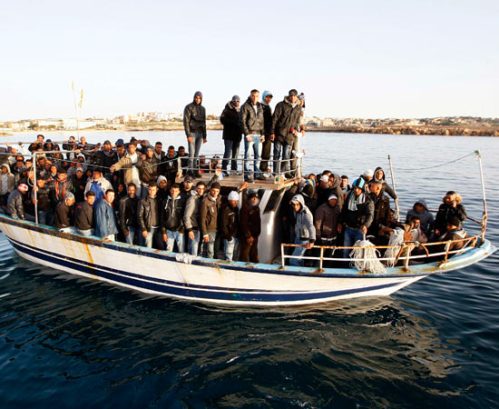
Hundreds of Tunisians Continue to Arrive in Lampedusa; Italian Navy Ship to Transport Migrants from Island to Relieve Overcrowding; Local Residents Block Migrant Landings

Hundreds of Tunisians continue to reach Lampedusa.  Conditions at the main migrant reception centre on the island are extremely bad due to massive overcrowding and hundreds of migrants are sleeping in the open under tarps.  The centre is currently holding about 3000 persons whereas its capacity is supposed to be limited to 800 persons.  An Italian navy ship was scheduled to arrive on the island late on the 19th or on the 20th of March and it is anticipated that the ship will transport at least 1000 migrants to other locations in Italy.

Some local residents protested the continuing arrival of migrant boats by preventing for several hours coast guard and Guardia di Fiananza boats carrying rescued migrants from docking and disembarking the migrants in port.

Click here (IT), here, (IT), here (IT), and here (EN) for articles.

Leave a comment

Filed under European Union, Frontex, Italy, Mediterranean, News, Tunisia

EP Foreign Affairs Committee Calls for Reinstatement of EU-Libya Migration Agreement Once New Libyan Govt in Power

While the likelihood of there being a new transitional government in Libya appears less and less likely every day, the European Parliament’s Foreign Affairs Committee yesterday, 16 March, called for the reinstatement of the EU-Libya cooperation agreement on migration, signed in Tripoli on 4 October 2010 by Commissioner Cecilia Malmström, as soon as a new transition government able to respect human rights is in place in Libya.

From the EP Press Release: “MEPs believe that the EU-Libya cooperation agreement on migration – currently suspended – should be reinstated as soon as a new transition government able to respect human rights is in place.  This move … [was] highlighted on Wednesday in a draft resolution by the Foreign Affairs Committee as the best way[] to tackle illegal immigration from conflict regions.   Regretting that ‘the only option available’ was the suspension of the EU-Libya Cooperation Agenda on migration, MEPs stress that the suspension ‘should be revoked as soon as there is a new transitional government willing to promote a democratic and human rights based implementation of the agreement’. Similar migration agreements should be reached with other EU neighbouring countries, said MEPs in the draft resolution, which was adopted by 53 votes to 1, with 3 abstentions.”

The Committee also called for a burden sharing plan “to help resettle refugees from the region and provide support for displaced persons.  This would require activation of Article 80 of the EU Treaty on the Functioning of the European Union (TFEU), which cites the principle of solidarity and fair burden-sharing among all Member States on policies to do with managing border checks, asylum and immigration, including their financial implications.”

Click here for EP Press Release.

Click here for article.

Click here for 18 Jan 2011 Draft Resolution (18.1.2011) and amendments considered (18.2.2011).

Leave a comment

Filed under European Union, Libya, Mediterranean, News

IMO: Final Link in Africa SAR Cover – Multi-lateral Agreement on North and West African Sub-regional Maritime Rescue Coordination Centre

From IMO: “Complete search and rescue cover around Africa’s coast was secured on Thursday (3 March 2011) with the signing, in the presence of representatives from Cape Verde, the Gambia, Guinea Bissau, Mauritania, Morocco and Senegal, of an ad-hoc multi-lateral co-operative agreement on the North and West African sub-regional Maritime Rescue Coordination Centre (MRCC), which establishes a new Morocco MRCC near Rabat, with its associated sub-centres.  The Morocco sub-regional MRCC, located at Bouznika, a seaside area 20 Km from Rabat, will join those already commissioned in Mombasa, Kenya, in 2006; in Cape Town, South Africa, in 2007; in Lagos, Nigeria, in 2008; and in Monrovia, Liberia, in 2009, thus completing the final link in the chain of sub-regional African MRCCs, each with its own network of associated sub-centres….”  IMO Secretary-General Mr. Efthimios E. Mitropoulos said “The sharing of information derived from the centres we establish will also play an important role in the fight against piracy, kidnap and ransom on the high seas – something, which IMO, and the whole maritime community, has pledged to tackle with renewed vigour during 2011 in line with this year’s World Maritime Day theme “Piracy: Orchestrating the response”.

Click here for link to IMO statement.

Leave a comment

Filed under Eastern Atlantic, Gambia, Guinea Bissau, Mauritania, Morocco, News, Senegal, United Nations

2000 Migrants Reach Lampedusa Over 24 Hour Period; Ship Carrying 1800 Remains in Int’l Waters in Need of Fuel

Approximately 2000 new migrants in more than 20 boats arrived in Lampedusa on 14-15 March.  Some were rescued and some reached Lampedusa on their own.  One boat is believed to have sunk near Tunisia and approximately 35 persons are believed to be missing.

According to a UNHCR briefing yesterday, just over 10,000 migrants, nearly all young Tunisian men, have arrived in Italy since mid-January.  UNHCR spokesperson Melissa Fleming said that “[t]he outflow from Tunisia is unrelated to the ongoing crisis in Libya. From our interactions with Tunisians arriving in Italy over past weeks, we believe that most are seeking employment and better economic opportunities, rather than international protection.   UN staff and partners in Tunisia report that some villages appear largely empty of their young male population, with only women, children and elderly people remaining. This type of outflow is not atypical of countries in transition, and we are well aware of the many demands on the Tunisian authorities at present. Solutions to this type of flow need to be found in dialogue between the concerned governments, including arrangements for the orderly and dignified return of persons who are found not to be in need of international protection, and the establishment of opportunities for labor migration which can meet the needs of countries on both sides of the Mediterranean.”

The standoff with the Moroccan ferry, the Mistral Express, continues.  The ship left Libya several days ago and is located in international waters about 20 miles from the port of Augusta, Sicily.  Italian authorities have refused to permit the ship to enter Italian waters and are considering providing fuel to the ship while it remains at sea in order to prevent any of the 1800+ mostly Moroccan passengers from attempting to leave the ship and enter Italy.

Click here for UNHCR press briefing.

Click here, here, here, here, and here for articles.  (IT)

Leave a comment

Filed under European Union, Frontex, Italy, Libya, Mediterranean, Morocco, News, Tunisia, UNHCR

Hirsi and Others v. Italy – ECtHR Grand Chamber Hearing Scheduled for 22 June

The case of Hirsi and others v Italy, Requête no 27765/09, has been scheduled for a hearing on 22 June 2011, 9.15 am, before the Grand Chamber of the European Court of Human Rights.

Proceedings before the Grand Chamber were initiated on 1 March 2011 when the Second Section of the Court relinquished jurisdiction.  On 17 November 2009 the Second Section of the Court communicated the case.  The case was filed on 26 May 2009 by 11 Somalis and 13 Eritreans who were among the first group of about 200 migrants interdicted by Italian authorities and summarily returned to Libya under the terms of the Libya-Italy agreement which took effect on 4 February 2009.  The Applicants were intercepted on 6 May 2009 approximately 35 miles south of Lampedusa.

The Applicants allege violations of numerous provisions of the European Convention on Human Rights:

Protocol 4, Art. 4 Prohibition of collective expulsion of aliens;

Art. 3 Torture;

Art. 1 (1) General undertaking/HPC;

Art. 13 Effective remedy/national authority; and

Art. 3 Inhuman or degrading treatment.

The Statement of facts, complaints and questions (EXPOSÉ DES FAITS et QUESTIONS AUX PARTIES ET DEMANDES D’INFORMATIONS) issued by the Second Section to the parties is available only in French:

GRIEFS

Invoquant l’article 3 de la Convention, lu en conjonction avec l’article 1 de la Convention, les requérants se plaignent de ce que les modalités de leur renvoi en Libye, ainsi que leur séjour dans ce pays ou leur rapatriement dans leurs pays respectifs les soumettrait au risque de subir des tortures ou des traitements inhumains et dégradants.

Invoquant l’article 4 du Protocole no 4, lu en conjonction avec l’article 1 de la Convention, ils affirment avoir fait l’objet d’une expulsion collective atypique et dépourvue de toute base légale.

Invoquant l’article 13, les requérants dénoncent l’impossibilité de contester devant les autorités italiennes leur renvoi en Libye et le risque de rapatriement dans leurs pays d’origine.

QUESTIONS AUX PARTIES ET DEMANDES D’INFORMATIONS

QUESTIONS

1.  Les faits dont les requérants se plaignent en l’espèce relèvent-ils de la juridiction de l’Italie ?

2.  La décision des autorités italiennes d’intercepter en haute mer les embarcations et de renvoyer immédiatement les requérants, compte tenu notamment des informations provenant de sources internationales et concernant les conditions des migrants clandestins en Libye, a-t-elle exposé les requérants au risque d’être soumis à des traitements contraires à l’article 3 de la Convention dans ce pays ?

3.  Compte tenu des allégations des requérants (voir formulaire de requête annexé), y a-t-il des motifs sérieux de craindre que le rapatriement dans leurs pays d’origine, soit la Somalie et l’Érythrée, les exposerait à des traitements contraires à l’article 3 ?

4.  Le renvoi des requérants en Libye de la part des autorités italiennes s’analyse-t-il en une expulsion contraire à l’article 4 du Protocole no 4 ?

5.  Les intéressés ont-ils eu accès à un recours effectif devant une instance nationale garanti par l’article 13 de la Convention pour faire valoir leurs droits garantis par les articles 3 et 4 du Protocole no 4 ?

DEMANDES D’INFORMATIONS

Le gouvernement défendeur est également invité à fournir à la Cour toute information disponible concernant :

– Le nombre de migrants irréguliers arrivés mensuellement sur les côtes italiennes, et en particulier à Lampedusa, au cours des dernières années ;

– L’entité et l’origine du phénomène migratoire en Libye ; la législation en la matière en vigueur dans ce pays ; le traitement réservé par les autorités libyennes aux migrants irréguliers arrivés en Libye directement ou suite au renvoi depuis l’Italie.

Le Gouvernement est également invité à produire à la Cour les textes des accords signés par les gouvernement italien et le gouvernement libyen les 27 décembre 2007 et 4 février 2009.

Il est enfin invité à expliquer à la Cour le rapport existant entre les opérations prévues par les accords bilatéraux avec la Libye et l’activité de l’ « Agence européenne pour la gestion de la coopération opérationnelle aux frontières extérieures des États membres de l’Union européenne (Frontex) ».

Click here (FR) for EXPOSÉ DES FAITS et QUESTIONS AUX PARTIES ET DEMANDES D’INFORMATIONS.

Click here, here, and here for my previous posts on the case.

1 Comment

Filed under European Court of Human Rights, Italy, Judicial, Libya, Mediterranean, News

Prof. Goodwin-Gill: ‘The Right to Seek Asylum: Interception at Sea and the Principle of Non-Refoulement’

On 16 February Professor Guy S. Goodwin-Gill presented the inaugural lecture of the Fondation Philippe Wiener – Maurice Anspach, Chaire W. J. Ganshof van der Meersch.  The lecture was entitled ‘The Right to Seek Asylum: Interception at Sea and the Principle of Non-Refoulement’.  The complete text of the lecture is available at this link: Goodwin-Gill: The Right to Seek Asylum-Interception at Sea and the Principle of Non-Refoulement.  The complete text also contains a helpful reference list.

I have reproduced several excerpts below:

“Looking at the interception and return measures adopted in the Mediterranean and off the west coast of Africa … one may rightly wonder what has happened to the values and principles considered fundamental to the Member States of the European Union….  [***]

… [I]t is all the more surprising when [European] governments, ministers and officials either pretend that the rules [- including Article 78(1) of the TFEU which requires the Union to develop a common asylum policy with regard to ‘any third country national requiring international protection and ensuring compliance with the principle of non-refoulement’ – policy which ‘must be in accordance with the Geneva Convention… and other relevant treaties’-] do not apply, or seek ways to avoid their being triggered.

In my view, the problems begin at the beginning, just as they commonly do also at the national level. A policy or goal is identified – in this case, reducing the number of irregular migrants, including asylum seekers, leaving the north African coast and heading for Europe – and then belatedly some attempt is made to bend implementation of the policy to fit in with principle and rule. A better approach, in my view, would be to begin with a clear understanding of the applicable law – the prohibition of discrimination, of refoulement, of inhuman or degrading treatment – and then to see what can be done by working within the rules.

Of course, this approach is premised on the assumption that States generally seek to work within the rule of law. It will not likely influence the State determined to deal with the migrant and the asylum seeker arbitrarily, and without reference to principle. Such cases must be confronted head-on, by way of judicial and political mechanisms of control.  [***]

… The problem, though, lies not in formal recognition of protection principles but, as ever, in operationalising the rules – in making protection a reality at the point of enforcement. On the plus side stands a substantial body of legislation: the Frontex regulation itself; the RABIT amendment, with its express insistence on compliance with fundamental rights and conformity with Member States’ protection and non-refoulement obligations; and the Schengen Borders Code, Article 3 of which requires the Code to be applied, ‘without prejudice to the rights of refugees… in particular as regards non-refoulement’. Add to this the April 2010 Council Decision supplementing the Code and dealing specifically with the surveillance of maritime borders and Frontex operations; it is currently being challenged by the Parliament on vires grounds, and it was also objected to by Malta and Italy, mainly for its proposal that in the last resort, rescue cases should be disembarked in the State hosting the Frontex operation. The Decision’s formulation of the applicable law in the matter of protection, however, is unremarkable, restating the principle of non-refoulement and the need to avoid indirect breach, but also providing for those intercepted to have an opportunity to set out reasons why they might be at risk of such a violation of their rights….  [***]

What do we know about either unilateral or Frontex-led interception operations so far? Not as much as we might expect as citizens of a democratic Union bounded by the rule of law and basic principles of good governance, such as transparency and accountability….  [***]

Exactly what Frontex does in an interception context has been questioned. Human Rights Watch has claimed that Frontex has been involved in facilitating interception, though this has been denied. Amnesty International and ECRE note that Frontex has stated that it does not know whether any asylum applications were submitted during interception operations, as it does not collect the data. How, then, should we approach what appears to be wilful ignorance? In the Roma Rights Case in 2004, discrimination on racial grounds was alleged in the conduct of immigration procedures by British officials at Prague Airport, which were intended to prevent potential asylum seekers leaving for the United Kingdom. There, too, the authorities did not keep any records of the ethnic origin of those they interviewed. Finding on the evidence that the government had acted in violation of relevant legislation, the House of Lords called attention to the importance of gathering information, ‘which might have helped ensure that this high-risk operation was not being conducted in a discriminatory manner…’

Given the secrecy attaching to interception operations, and the fact that no data are gathered or retained, it is reasonable to infer that some level of Frontex involvement has occurred, and that, absent evidence to the contrary, the relevant principles of international and EU law have not been observed.  [***]

… The object and purpose of EU operations in maritime areas, therefore, should be first and foremost to ensure protection, and secondarily to manage and prevent irregular migration….

In the absence of effective and verifiable procedures and protection in countries of proposed return, the responsibility to ensure protection remains that of the EU agency or Member State. In practice, this will require that they identify all those intercepted, and keep records regarding nationality, age, personal circumstances and reasons for passage. Given protection as the object and purpose of interception operations, an effective opportunity must be given for objections and fears to be expressed; these must then be subject to rational consideration, leading to the formulation of written reasons in explanation of the next steps. Where this entails return to or disembarkation in a non-EU State, a form of judicial control is required as a necessary safeguard against ill-treatment and the abuse of power – exactly what form of judicial control calls for an exercise of juristic imagination. In the nature of things, such oversight should be prompt, automatic, impartial and independent, extending ideally to the monitoring of interception operations overall….”

Click here or on the following link for complete text: Guy S. Goodwin-Gill, ‘The Right to Seek Asylum: Interception at Sea and the Principle of Non-Refoulement’

I thank Prof. Goodwin-Gill for permitting me to post the text of his lecture.


1 Comment

Filed under Aegean Sea, Analysis, Eastern Atlantic, European Union, Frontex, Mediterranean, UNHCR

Le Pen in Lampedusa: Migrants Should Be Stopped At Sea

Marine Le Pen, the head of France’s Front National, visited Lampedusa yesterday.  She was critical of the EU’s efforts to stop illegal migration and called for the use of bi-lateral agreements between Italy, France, and Spain and North African states to prevent migration.  She also suggested that migrants should be prevented from reaching European territory by being intercepted at sea, though in such cases humanitarian assistance in the form of food and water should be provided to the migrants at sea rather than on Lampedusa as is now the case.

Click here (IT), here (EN), here (EN) and here (IT) for articles.

Leave a comment

Filed under European Union, France, Italy, Libya, Mediterranean, News, Tunisia

Italy Blocks Ship from Libya with 1800 Persons from Entering Italian Waters

A large ferry, the Mistral Express, carrying approximately 1800 persons was prevented yesterday from entering Italian waters near Sicily by Italian navy or coast guard boats.   The ship apparently left the Libyan port of Misurata and most of its passengers are Moroccan.  The ship may have been planning to sail to Morocco and may have tried to divert to Italy for purposes of refueling, but the media reports are unclear.  It is also unclear who chartered the ship.  Italian authorities confirm that they prevented the ship from entering Italian waters due to uncertainty regarding the identities of the passengers.  An Italian government spokesperson reportedly said it was unclear whether the passengers were “genuine evacuees” from Libya.  It is also unclear whether the ship then tried to sail to Malta.  Some media reports say that Malta refused the ship permission to enter Maltese waters.  Maltese authorities are reported as saying that this did not occur but according to media reports Maltese authorities said that they would prevent the ship from landing in Malta if it tried to do so for the same reasons advanced by Italy.

Click here (EN), here (IT), here (IT), and here (ES) for articles.

1 Comment

Filed under Italy, Libya, Malta, Mediterranean, Morocco, News

Migrants Being Prevented from Leaving Libya

According to several media reports, Libyan soldiers have prevented up to 30,000 migrant workers from fleeing Libya to Tunisia.  “The migrant workers were rounded up and apparently held in Libyan immigration buildings near the Tunisian border last week, Ibrahim Osman of the International Federation of Red Cross and Red Crescent Societies told The Associated Press.”  If this information is correct, it would explain the sudden drop in the numbers of persons trying to cross in to Tunisia in recent days.  According to IOM, as of 8 March, 224,661 migrants have reached Libya’s borders with Tunisia, Egypt, Niger and Algeria.

Click here and here for articles.  (EN)

Leave a comment

Filed under Algeria, Egypt, Libya, Mediterranean, News, Niger, Tunisia

“Non-Stop” Boat Arrivals Continue in Lampedusa; Maroni Says Libyan Smuggling Organisations Now Operating From Tunisia

Boats containing over 1000 Tunisians arrived in Lampedusa on Monday.  The boats are reportedly leaving Tunisia from the southern coast from the port of Zarsis and the island of Djerba, an area near the border with Libya.

Interior Minister Roberto Maroni said on Monday that “we know that criminal organizations that operated by moving illegal immigrants from Libya have reappeared and are now repositioning themselves in the south of Tunisia.  (“Al ministro dell’Interno Roberto Maroni che parla di altre ‘migliaia e migliaia di persone pronte a partire’ e lancia un allarme: ‘abbiamo notizia – spiega – che sono riapparse le organizzazioni criminali che operavano prima in Libia facendo partire i clandestini e che adesso si stanno riposizionando nel sud della Tunisia’.)  Maroni said that “Italian intelligence had reported ‘thousands and thousands of young people’ heading for … Zarzis and Djerba, and that it would require a ‘significant commitment’ from EU countries to block their departure.”

Click here (IT), here (IT), here (IT), and here (EN) for articles.


Credit: Lampedusa, ancora sbarchi dalla Tunisia-FOTOGALLERY- LASTAMPA.it:


Leave a comment

Filed under European Union, Frontex, Italy, Libya, Mediterranean, News, Tunisia

Marine Le Pen to Visit Rome and Possibly Lampedusa, to Denounce Lack of EU Migration Controls

Taking full advantage of her rise in the French presidential opinion polls (recent opinion polls give her 23-24% of the vote in the first round of the 2012 presidential election, outpolling Sarkozy and DSK among others), Ms. Marine Le Pen, the head of France’s Front National, announced that she will travel to Rome next week and, if possible, she will also visit Lampedusa for the purpose of denouncing what she characterises as a lack of EU migratory controls.  (“Lors de son déplacement [en Italie], elle entend dénoncer «l’incapacité de l’Union européenne à juguler le déferlement migratoire qui frappe l’île de Lampedusa» après la révolution tunisienne. La candidate FN à l’Élysée envisage également de se rendre ultérieurement sur l’île de Lampedusa. «Si je peux me rendre à Lampedusa, j’irai, bien sûr», a-t-elle assuré.”)

Le Pen has referred to the Tunisians who have reached Italy in recent weeks as “the vanguard of a new massive wave of immigration.”  (“d’«éclaireurs d’une nouvelle vague migratoire gigantesque».”)  Her official web site contains an updated press release on the situation in Lampedusa: “Lampedusa : pendant que les clandestins sont accueillis, le maire est poursuivi !”

Click here (FR) for article.

Click here (FR) for link to Le Pen’s web site.

Leave a comment

Filed under European Union, France, Italy, Mediterranean, News, Tunisia

Over 1000 New Migrants Reach Lampedusa

Migrant arrivals in Italy continue with over 1000 migrants reaching Lampedusa in at least 11 different boats on Sunday.

Click here (IT) and here (IT) for articles.

Leave a comment

Filed under European Union, Frontex, Italy, Mediterranean, News, Tunisia

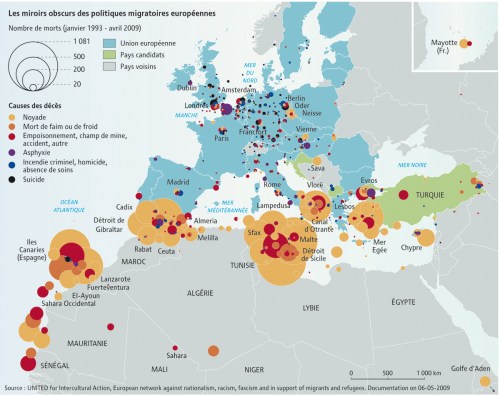
Interactive Map: Deaths at Europe’s Borders

From OWNI.eu:  an interactive map showing the 14,000 persons who have died trying to reach Europe since 1988.  “[A]n interactive map as an electronic memorial for these tragedies.”

Click here for link.  The map copied below is not the new Interactive Map.  Click on link for the Interactive Map

Mourir aux portes de l’Europe (carte d’Olivier Clochard)

1 Comment

Filed under Aegean Sea, Data / Stats, Eastern Atlantic, English Channel / La Manche, European Union, Frontex, Mediterranean, News

Gaddafi: If Libya is Threatened, Thousands of Immigrants Will Invade Europe from Libya

The 6 March edition of Le Journal du Dimanche contains an exclusive interview with Gaddafi.  After calling upon France to block foreign intervention in Libya, Gaddafi states that all is well in Libya and warns of the consequences if his regime were to collapse:

“The regime here in Libya is fine.  It is stable. I want to make myself understood: if one threatens [Libya], if one seeks to destabilize [Libya], there will be chaos, Bin Laden, armed factions.  That is what will happen. You will have immigration, thousands of people will invade Europe from Libya. And there will no longer be anyone to stop them.  Bin Laden will base himself in North Africa and will leave Mullah Omar in Afghanistan and Pakistan. You will have Bin Laden at your door step.”

(“Le régime ici, en Libye, va bien. Il est stable. Je veux bien me faire comprendre: si on menace, si on déstabilise, on ira à la confusion, à Ben Laden, à des groupuscules armés. Voilà ce qui va arriver. Vous aurez l’immigration, des milliers de gens qui iront envahir l’Europe depuis la Libye. Et il n’y aura plus personne pour les arrêter. Ben Laden viendra s’installer en Afrique du Nord et laissera le mollah Omar en Afghanistan et au Pakistan. Vous aurez Ben Laden à vos portes.”)

Click here (FR) for full article from Le Journal du Dimanche.

Click here and here for related articles in JDD.

And I may as well add this link – click here – BHL (Bernard-Henri Lévy) is writing from eastern Libya as well…

2 Comments

Filed under European Union, Libya, Mediterranean, News

Agenda Items for 11 March Extraordinary Meeting of European Council

Discussion topics will include:

  • – measures to help overcome the dramatic events unfolding in Libya;
  • – mobilisation of further resources to meet the humanitarian situation created by the influx of returnees from Libya;
  • – challenges to the EU posed by irregular migration;
  • – the evacuation of EU citizens;
  • – support to the political transitions underway in Tunisia, Egypt and the broader region.

Click here for President Van Rompuy’s invitation letter.

Leave a comment

Filed under Egypt, European Union, Libya, Mediterranean, News, Tunisia