African migrants and their desperate ploy for a better life – Times Online

From The Sunday Times Magazine, 22 November 2009:

“Meet the survivors, bereaved families from Gambia and Senegal, and a man who smuggles the people — at a colossal price.”

“… The routes [African migrants] take are many and varied. From west Africa, migrants trek through the pitiless Sahara to Libya, from there to brave the Mediterranean — or, more perilous yet, strike out for the Canary Islands in fragile canoes known as ‘pirogues’.  If they then cross to the Spanish mainland they will probably do so in tiny, open Spanish fishing boats. An estimated one in every eight migrants who try to travel across the ocean to Europe don’t make it, their bodies carried out into the cold Atlantic. Those who perish are identified only by chance, their skeletons dredged from the sea by Italian and Spanish trawlers, or their bodies washed on to beaches used by holidaymakers…”

Full article:  African migrants and their desperate ploy for a better life – Times Online.

Leave a comment

Filed under Eastern Atlantic, Gambia, Italy, Libya, Malta, Mediterranean, News, Senegal, Spain

Libya’s Selective Immigration Enforcement and Italy’s Foreign Policy Concessions

Dr Emanuela Paoletti, a junior research fellow at Somerville College, Oxford, has an article in the electronic journal Pambazuka News discussing “Libya’s selective enforcement of restrictive immigration policies as a means of gaining foreign policy concessions from Italy.”

“Since the late 1990s, immigration from Libya to Italy had increased significantly, from less than 5,000 in 2000 to 30,000 in 2008. In May 2009, Gaddafi made his first trip to Italy, which was followed by a second visit on the occasion of the meeting of the G20. Concomitant with these visits, there was a drastic reduction in migration from Libya. From 1 May 2008 to 31 August 2008, 15,000 people arrived to Italy from Libya; in the same period in 2009 only 1,400 have landed on Italian shores. The Italian minister of interior, Roberto Maroni could recently announce, immigration from Libya in 2009 has decreased by 90 per cent compared to 2008. What explains the drastic decrease in ‘illegal’ migration from Libya to Italy?”

Click here for the full article.

Leave a comment

Filed under Analysis, Italy, Libya, Mediterranean

Frontex and Other EU Agencies to Coordinate Maritime Surveillance

According to identical news releases issued by Frontex and the Community Fisheries Control Agency (CFCA), Frontex, the CFCA, and the European Maritime Safety Agency (EMSA) have entered into an agreement “with a view to cooperate, in accordance with their respective mandates, in the field of maritime surveillance that will be mutually beneficial for the three agencies.”

The press release goes on to state:

“The Cooperation Agreement will allow for the exchange of information and of expertise as well as of for the exploration of joint use of assets as relevant, optimising the functioning of the European Union as a whole regarding Maritime Surveillance. The cooperation will result in an improvement of the control of external maritime borders of the EU (competence of Frontex), an increase in the maritime safety (competence of EMSA) and an enhancement of the coordination of fisheries control and inspection activities by the Member States (competence of CFCA).

“The main activities comprised in the agreement are the following:

• Exchange of information and data on matters of common interest
• Explore synergies in the use of the maritime surveillance and information systems
• Explore the possibilities of joint use of assets
• Investigate potential cooperation in the field of maritime surveillance directed to the protection of external maritime borders and fisheries control
• Expand mutual collaboration between the Agencies in areas such as coordination of inspections, research and development, training, etc.

Contacts:

  • • EMSA: Pete Thomas, Senior Communication Officer
    Peter.THOMAS@emsa.europa.eu, Tel. +351 21 1209 281
  • • Frontex: Izabella Cooper, Spokesperson,
    izabella.cooper@frontex.europa.eu , Tel. +48 22 544 95 35
  • • CFCA: Patricia Sánchez Abeal, Communication Officer
    patricia.sanchezabeal@cfca.europa.eu , Tel. +34 986 12 06 17”

Click here and here for links to the press releases.

3 Comments

Filed under European Union, Frontex, News

Exposition: Boat people, bateaux de l’exil, Musée de Bretagne, Rennes

‘Boat people, bateaux de l’exil,’ l’exposition au Musée de Bretagne, Rennes, France, 3/12/09 – 2/5/10.

“La migration de populations par la mer, par bateaux, entre une terre qui est quittée et un pays encore inconnu est un phénomène particulièrement fréquent dans l’Histoire des hommes. Aujourd’hui encore, ces flux migratoires sont extrêmement d’actualité sur plusieurs points du globe. Ils sont massifs comme jamais.”

Click here for more information.

Leave a comment

Filed under France, News

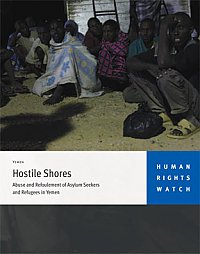
Human Rights Watch: Hostile Shores- Abuse and Refoulement of Asylum Seekers and Refugees in Yemen

Human Rights Watch has issued a new report detailing the treatment refugees arriving in Yemen from the Horn of Africa.

“This report documents the harsh treatment of refugees traveling to Yemen and calls on the Yemeni government to stop systematically arresting Ethiopian asylum seekers and forcibly returning them home. The 53-page report also calls on the United Nations High Commissioner for Refugees (UNHCR) to put more pressure on the Yemeni government to meet its obligations toward all asylum seekers and refugees.”

Click here for report.

Leave a comment

Filed under Gulf of Aden, Reports, UNHCR, Yemen

Australia’s Christmas Island Migrant Detention Centre at Full Capacity

Australia’s off-shore detention centre on Christmas Island is at capacity.  Authorities have expanded the centre’s capacity by erecting tents.

So far this year Australian authorities have intercepted 55 boats carrying approximately 2700 people. 1447 people are detained on the island.  The use of tents has reportedly expanded detention capacity to 1560.

The migrant flow is expected to slow in January with the onset of the typhoon season in the waters north of Australia.

Click here and here for articles.

Leave a comment

Filed under Australia, Data / Stats, News

Migrant Arrivals in Malta Lowest in 5 Years

Di-ve.com reports that migrant arrivals in Malta in 2009 were the lowest since 2004.

“Sources close to Frontex … believe that a number of factors helped …  Frontex’s Nautilus patrols, the strengthening of border controls in the Central Mediterranean and tighter inland measures in member states certainly discouraged movement of migrants. … The agreement between Italy and Libya for migrants to be returned to Libya also had an impact but …there are also agreements in place with Algeria and Tunisia, while Libya also reached an agreement with Niger, which is another popular transit country for migrants heading towards Europe. There has been a shift towards the eastern Mediterranean, with Turkey and the Aegean islands seeing numbers increase, the sources said.”

2002 2003 2004 2005 2006 2007 2008 2009
Boats 21 12 53 48 57 68 84 17
Migrants 1686 502 1388 1822 1780 1702 2775 1475

Click here for full article.

Leave a comment

Filed under Data / Stats, Frontex, Malta, Mediterranean, News

UNHCR Migration and Border Recommendations to the Incoming Spanish EU Presidency

UNHCR’s recommendations to the Spanish EU presidency include the following”

“Migration and border management

Spain has affirmed that reinforcing Frontex and ensuring that EU migration policy is accompanied by close cooperation with migrants’ countries of origin and transit will be priorities of its Presidency. A review of the Frontex mandate will take place in 2010.

UNHCR encourages the Spanish Presidency to pursue its migration agenda with due regard for international refugee and human rights norms. This includes:

a) Inclusion of refugee protection safeguards in migration control measures generally;

b) Development of clear guidance with respect to the disembarkation of persons intercepted at sea;

c) Attention to the potential protection needs of victims of trafficking;

d) With respect to the return of people found not to need international protection, measures to ensure that such return is safe, dignified and sustainable.

– calling for safeguards in border management activities, including under Frontex’s auspices, with the revision of that body’s mandate foreseen in early 2010;  a call for more focus on protection needs of victims of trafficking as part of anti-trafficking measures.”

Click here for full recommendations.

Leave a comment

Filed under European Union, Spain, Statements, UNHCR

UNHCR Estimates 74,000 Africans Crossed Gulf of Aden to Yemen in 2009

The UNHCR released its most recent estimates of the numbers of Africans who have crossed the Gulf of Aden and Red Sea to Yemen in 2009.  UNHCR believes over 74,000 people made the crossing which is estimated to be a 50% increase over last year.

Ethiopians (42,000) now make up the largest group of migrants making the crossing.  In previous years Somalis were the largest group.

“According to the latest UNHCR statistics, at least 309 people drowned or did not survive the trip this year. In 2008, some 590 people died during the crossing. Many more people went missing and are presumed dead. The mixed migration route through the Gulf of Aden and the Red Sea is presently the busiest and the deadliest one in the world.”

“While virtually all arriving Somalis approach the two, strategically positioned reception centres in Mayfaa and Ahwar, where they receive protection and assistance, only some 9,000 Ethiopians went to these venues this year. Most press on towards the Persian Gulf states in search of job opportunities.”

Click here for UNHCR press release.

Leave a comment

Filed under Data / Stats, Ethiopia, Gulf of Aden, News, Somalia, UNHCR, Yemen

JRS Malta – “Do They Know? Asylum Seekers Testify to Life in Libya”

The Jesuit Refugee Service Malta released a report entitled “Do They Know? Asylum Seekers Testify to Life in Libya.”

“Since May 2009, some 1409 migrants, attempting to reach a place where they could obtain protection or the possibility to live in safety and dignity, were pushed back to Libya.  These actions were widely criticised and held by many to be a violation of international law, as Libya does not have the mechanisms in place to grant protection to those who need it and there is evidence that those returned would be at risk of harm.”

“JRS Malta believes that returning migrants to Libya, where they cannot obtain effective protection if they need it and where they face a real risk of serious harm, violates international law. We therefore call upon the government to:

• Ensure that all asylum seekers within Malta’s effective jurisdiction are allowed to apply for protection.

• Rescue migrants intercepted by the AFM if they have requested assistance, as otherwise their safety cannot be guaranteed

• Ensure that all those rescued within Malta’s Search and Rescue Area are disembarked at a safe port, where those in search of protection can seek asylum

• Refrain from actions that will result, directly or indirectly, in the return of migrants to a country where they risk suffering serious violations of their fundamental human rights.”

Click here for copy of JRS Malta statement.

Click here for the report “Do They Know? Asylum Seekers Testify to Life in Libya.”

Leave a comment

Filed under Italy, Libya, Malta, Mediterranean, Reports

Frontex to Expand Operations in Aegean Sea in 2010

Frontex’s director, Ilkka Laitinen, met with Greek Citizens’ Protection Minister Michalis Chrysochoidis and reportedly said that Frontex enforcement operations in the eastern Aegean Sea will be further expanded in 2010.

Minister Chrysochoidis stated that 75% of the arrests for illegal entry from the EU’s sea borders in 2009 year took place in the Aegean.

Director Laitinen said that “[Frontex Operation] Poseidon continues to be our most important operation” and that Frontex’s largest border monitoring operation will take place in the eastern Aegean in 2010.

Click here for article.

Leave a comment

Filed under Aegean Sea, Frontex, Greece, News, Turkey

Frontex Warns Malta About Refugee Resettlement Consequences

MaltaToday reported last month that Frontex officials have warned Malta that resettlement agreements between Malta and the USA and other countries are being used by organised criminal smuggling organisations to market Malta as a preferred destination.

The information was provided at a “Frontex debriefing meeting held in Caltanisetta in Sicily, where military and governmental officials from EU Member States were given details about the recent Nautilus IV mission held in the Mediterranean during this summer…  Senior military sources told MaltaToday that Frontex officials spoke of intelligence that showed how criminals behind the lucrative illegal migration trade were ‘actually marketing Malta as the right destination to direct migrants,’ given that it has now become public that the US is accepting migrants from Malta.”

Over 400 refugees have been resettled from Malta to the USA, France, and other countries.

Click here for article.

Leave a comment

Filed under Frontex, Malta, Mediterranean

ECtHR Communicates Case of ‘Hirsi et Autres c. Italie’ Relating to Italy’s Summary Migrant Interdiction Programme

On 17 November the Second Section of the European Court of Human Rights communicated the case of Hirsi and others v Italy, Requête no 27765/09.  The case was filed on 26 May 2009 by 11 Somalis and 13 Eritreans who were among the first group of about 200 migrants interdicted by Italian authorities and summarily returned to Libya under the terms of the Libya-Italy agreement which took effect on 4 February 2009.  The Applicants were intercepted on 6 May 2009 approximately 35 miles south of Lampedusa.

The Applicants allege violations of numerous provisions of the European Convention on Human Rights including:

Protocol 4 Art. 4 Prohibition of collective expulsion of aliens;

Art. 3 Torture;

Art. 1 (1) General undertaking/HPC;

Art. 13 Effective remedy/national authority; and

Art. 3 Inhuman or degrading treatment.

The Statement of facts, complaints and questions put by the Court to the parties is currently available only in French:

GRIEFS

Invoquant l’article 3 de la Convention, lu en conjonction avec l’article 1 de la Convention, les requérants se plaignent de ce que les modalités de leur renvoi en Libye, ainsi que leur séjour dans ce pays ou leur rapatriement dans leurs pays respectifs les soumettrait au risque de subir des tortures ou des traitements inhumains et dégradants.

Invoquant l’article 4 du Protocole no 4, lu en conjonction avec l’article 1 de la Convention, ils affirment avoir fait l’objet d’une expulsion collective atypique et dépourvue de toute base légale.

Invoquant l’article 13, les requérants dénoncent l’impossibilité de contester devant les autorités italiennes leur renvoi en Libye et le risque de rapatriement dans leurs pays d’origine.

QUESTIONS AUX PARTIES ET DEMANDES D’INFORMATIONS

QUESTIONS

1.  Les faits dont les requérants se plaignent en l’espèce relèvent-ils de la juridiction de l’Italie ?

2.  La décision des autorités italiennes d’intercepter en haute mer les embarcations et de renvoyer immédiatement les requérants, compte tenu notamment des informations provenant de sources internationales et concernant les conditions des migrants clandestins en Libye, a-t-elle exposé les requérants au risque d’être soumis à des traitements contraires à l’article 3 de la Convention dans ce pays ?

3.  Compte tenu des allégations des requérants (voir formulaire de requête annexé), y a-t-il des motifs sérieux de craindre que le rapatriement dans leurs pays d’origine, soit la Somalie et l’Érythrée, les exposerait à des traitements contraires à l’article 3 ?

4.  Le renvoi des requérants en Libye de la part des autorités italiennes s’analyse-t-il en une expulsion contraire à l’article 4 du Protocole no 4 ?

5.  Les intéressés ont-ils eu accès à un recours effectif devant une instance nationale garanti par l’article 13 de la Convention pour faire valoir leurs droits garantis par les articles 3 et 4 du Protocole no 4 ?

DEMANDES D’INFORMATIONS

Le gouvernement défendeur est également invité à fournir à la Cour toute information disponible concernant :

– Le nombre de migrants irréguliers arrivés mensuellement sur les côtes italiennes, et en particulier à Lampedusa, au cours des dernières années ;

– L’entité et l’origine du phénomène migratoire en Libye ; la législation en la matière en vigueur dans ce pays ; le traitement réservé par les autorités libyennes aux migrants irréguliers arrivés en Libye directement ou suite au renvoi depuis l’Italie.

Le Gouvernement est également invité à produire à la Cour les textes des accords signés par les gouvernement italien et le gouvernement libyen les 27 décembre 2007 et 4 février 2009.

Il est enfin invité à expliquer à la Cour le rapport existant entre les opérations prévues par les accords bilatéraux avec la Libye et l’activité de l’ « Agence européenne pour la gestion de la coopération opérationnelle aux frontières extérieures des États membres de l’Union européenne (Frontex) ».

Click here for “The Statement of facts, complaints and questions put by the Court.”
5 Comments

Filed under European Court of Human Rights, Italy, Judicial, Mediterranean

Italian Court Upholds Prison Sentence for Deaths of 283 Migrants in 1996 (News)

The Italian Court of Cassation (La Quinta sezione penale della Cassazione) on 9 December upheld a 30 year prison sentence for a Lebanese ship captain found responsible for the deaths of 283 migrants on 26 December 1996 when two smuggling ships collided between Malta and Sicily.  Most of the migrants were from Pakistan, India, and Sri Lanka.  The captain is still at large.

Click here and here (Italian) for articles.

Leave a comment

Filed under Italy, Malta, Mediterranean, News

Stockholm Programme’s Web Site

The Swedish Presidency of the EU maintains a web site containing links to documents and information pertaining to the Stockholm Programme.

It is unclear whether this web site will be maintained after the Swedish Presidency concludes, but for the moment the site is avaialble here.

Leave a comment

Filed under EU and EU Organizations, European Union, News