EU Stockholm Programme Adopted

EU heads of state and government have adopted the framework for the Stockholm Programme to be implemented during the 2010-2014 period.

Portions of the newly adopted programme relevant to migrants include the following (emphasis added):

[***]

5. Access to Europe in a globalised world

5.1 Integrated management of the external borders

The Union must continue to facilitate legal access to the territory of the Member States while in parallel taking measures to counteract illegal immigration and cross-border crime and maintaining a high level of security. The strengthening of border controls should not prevent access to protection systems by those persons entitled to benefit from them, and especially people and groups that are in vulnerable situations. In this regard, priority will be given to the needs of international protection and reception of unaccompanied minors. It is essential that the activities of Frontex and of the European Asylum Support Office are coordinated when it comes to the reception of migrants at the EU’s external borders. The European Council calls for the further development of integrated border management, including the reinforcement of the role of Frontex in order to increase its capacity to respond more effectively to changing migration flows.

The European Council therefore

▪ requests the Commission to put forward proposals no later than early 2010 to clarify the mandate and enhance the role of FRONTEX, taking account of the results of the evaluation of the Agency and the role and responsibilities of the Member States in the area of border control. Elements of these proposals could contain preparation of clear common operational procedures containing clear rules of engagement for joint operations at sea, with due regard to ensuring protection for those in need who travel in mixed flows, in accordance with international law; increased operational cooperation between Frontex and countries of origin and transit and examination of the possibility of regular chartering financed by Frontex[.] In order to promote the proper enforcement of the applicable statutory framework for Frontex operations, the Commission should consider including a mechanism for reporting and recording incidents that can be satisfactorily followed up by the relevant authorities,

▪ invites FRONTEX itself to consider, within its mandate, establishing regional and/or specialised offices to take account of the diversity of situations, particularly for the land border to the East and the sea border to the South; creating such offices should on no account undermine the unity of the Frontex agency; before creating such offices, Frontex should report to the Council on its intentions,

▪ invites the Commission to initiate a debate on the long-term development of FRONTEX. This debate should include, as was envisaged in the Hague programme, the feasibility of the creation of a European system of border guards,

▪ invites the EASO to develop methods to better identify those who are in need of international protection in mixed flows, and to cooperate with Frontex wherever possible,

▪ considers that the evaluation of the Schengen area will continue to be of key importance and that it therefore should be improved by strengthening the role of Frontex in this field,

▪ invites the Council and the Commission to support enhanced capacity building in third countries so that they can control efficiently their external borders.

[***]

6. A Europe of responsibility, solidarity and partnership in migration and asylum matters

The European Council recognises both the opportunities and challenges posed by increased mobility of persons, and underlines that well-managed migration can be beneficial to all stakeholders. [***]  Furthermore, the European Council recalls that the establishment of a Common European Asylum System (CEAS) by 2012 remains a key policy objective for the EU.

The European Council calls for the development of a comprehensive and sustainable European migration and asylum policy framework, which in a spirit of solidarity can adequately and proactively manage fluctuations in migration flows and address situations such as the present one at the Southern external borders. Serious efforts are needed to build and strengthen dialogue and partnership between the EU and third countries, regions and organisations in order to achieve an enhanced and evidence-based response to these situations, taking into account that illegal immigration enters the Union also via other borders or through misuse of visa. An important objective is to avoid the recurrence of tragedies at sea. When tragic situations unfortunately happen, ways should be explored to better record and, where possible, identify migrants trying to reach the EU.

[***]

6.2 Asylum: a common area of protection and solidarity

The European Council remains committed to the objective of establishing a common area of protection and solidarity based on a common asylum procedure and a uniform status for those granted international protection. While the Common European Asylum System (CEAS) should be based on high protection standards, due regard should also be given to fair and effective procedures capable of preventing abuse. It is crucial that individuals, regardless of the Member State in which their application for asylum is lodged, are offered an equivalent level of treatment as regards reception conditions, and the same level as regards procedural arrangements and status determination. The objective should be that similar cases should be treated alike and result in the same outcome.

6.2.1 A common area of protection

There are still significant differences between national provisions and their application. In order to achieve a higher degree of harmonisation, the establishment of a Common European Asylum System (CEAS), should remain a key policy objective for the EU. Common rules, as well as a better and more coherent application of them, should prevent or reduce secondary movements within the EU, and increase mutual trust between Member States.

The development of a Common Asylum Policy should be based on a full and inclusive application of the Geneva Convention on the status of refugees and other relevant international treaties. Such a policy is necessary in order to maintain the long-term sustainability of the asylum system and to promote solidarity within the EU. Subject to a report from the Commission on the legal and practical consequences, the European Union should seek accession to the Geneva Convention and its 1967 Protocol.

[***]

6.2.3 The external dimension of asylum

The EU should act in partnership and cooperate with third countries hosting large refugee populations. A common EU approach can be more strategic and thereby contribute more efficiently to solving protracted refugee situations. Any development in this area needs to be pursued in close cooperation with the UNHCR and, if appropriate, other relevant actors. The European Asylum Support Office should be fully involved in the external dimension of the CEAS. In its dealings with third countries, the EU has the responsibility to actively convey the importance of acceding to, and implementing of, the 1951 Geneva Convention on Refugees and its Protocol.

Promoting solidarity within the EU is crucial but not sufficient to achieve a credible and sustainable common asylum policy. It is therefore important to further develop instruments to express solidarity with third countries in order to promote and help building capacity to handle migratory flows and protracted refugee situations in these countries.

The European Council invites

• the Council and the Commission to enhance capacity building in third countries, in particular their capacity to provide effective protection, and to further develop and expand the idea of Regional Protection Programmes, on the basis of the forthcoming evaluations. Such efforts should be incorporated into the Global Approach to Migration, and should be reflected in national poverty reduction strategies and not only be targeting refugees and internally displaced persons but also local populations.

▪ the Council, the European Parliament and the Commission to encourage the voluntary participation of Member States in the joint EU resettlement scheme and increase the total number of resettled refugees, taking into consideration the specific situation in each Member State,

▪ the Commission to report annually to the Council and the European Parliament on the resettlement efforts made within the EU, to carry out a mid-term evaluation during 2012 of the progress made, and to evaluate the joint EU resettlement programme in 2014 with a view to identifying necessary improvements,

▪ the Council and the Commission to find ways to strengthen EU support for the UNHCR,

▪ the Commission to explore, in that context and where appropriate, new approaches concerning access to asylum procedures targeting main transit countries, such as protection programmes for particular groups or certain procedures for examination of applications for asylum, in which Member States could participate on a voluntary basis.

[***]

7.3 Continued thematic priorities with new tools

The European Council considers that the key thematic priorities identified in the previous strategy remain valid, i.e. the fight against terrorism, organised crime, corruption, drugs, the exchange of personal data in a secure environment and managing migration flows. The fight against trafficking in human beings and smuggling of persons needs to be stepped up.

Building on the Strategy for Justice, Home Affairs and External Relations adopted in 2005 and other relevant acquis in this field, such as the Global Approach to Migration, EU external cooperation should focus on areas where EU activity provides added value, in particular:

– Migration and asylum, with a view to increasing EU dialogue and cooperation with countries of origin and transit in order to improve their capacity to carry out border control, to fight against illegal immigration, to better manage migration flows and to ensure protection as well as to benefit from the positive effects of migration on development; return and readmission is a priority in the EU’s external relations,

[***]

The European Council invites the Commission to

▪ examine whether ad hoc cooperation agreements with specific third countries to be identified by the Council could be a way of enhancing the fight against trafficking and smuggling of persons and making proposals to that end. In particular, such agreements could involve full use of all leverage available to the Union, including the use of existing financing programmes, cooperation in the exchange of information, judicial cooperation and migration tools.

[***]

7.5 Geographical priorities and international organisations

[***]

As regards the Union for the Mediterranean, it will be necessary to enhance the work started in the context of the Barcelona process and the Euro-Mediterranean Partnership, in particular regarding migration (maritime), border surveillance, preventing and fighting drug trafficking, civil protection, law enforcement and judicial cooperation. The European Council invites the Commission in cooperation with the High Representative to submit such a plan in 2010 and asks Coreper to prepare as soon as possible the decisions to be taken by the Council. The European Council will review the Plan by the end of 2012, and in particular to assess its impact on the ground.

As regards the situation in the Mediterranean area, the European Council considers that a stronger partnership with third countries of transit and origin is necessary, based on reciprocal requirements and operational support, including border control, fight against organised crime, return and readmission. Rapid action to face the challenges in this region is a priority.

[***]

The European Council notes that the 2007 EU-Africa Joint Strategy and Action Plan define the scope of cooperation in the areas of counter-terrorism, transnational crime and drug trafficking. Both within the EU-Africa Partnership on Mobility, Migration and Employment (MME) and the EU Global Approach to Migration, and the follow up process of the Rabat, Paris and Tripoli conferences, the dialogue on migration should be deepened and intensified with African Partners, focussing on countries along the irregular migration routes to Europe with a view to assisting those countries in their efforts to draw up migration policies and responding to illegal immigration at sea and on the borders. Efforts should be made to enhance cooperation, including the swift conclusion of re-admission agreements, with Algeria, Morocco and Egypt, and, in line with the European Council conclusions in October 2009, with Libya.

West Africa has recently developed into a major hub for drug trafficking from South America to Europe and will require enhanced attention and assistance to stem drug trafficking as well as other transnational crime and terrorism (within the Sahel).

[***]

Click here for full text.

Leave a comment

Filed under Communiqués, European Union, Frontex

Libya Interdicts Migrants in Maltese Waters for First Time (News)

On 23 November a Libyan patrol boat intercepted approximately 80 Eritrean and Somali migrants in Maltese waters near Sicily.  The migrants were returned directly to Libya and reportedly taken to a Libyan detention centre.  This may have been the first time that Libyan authorities intercepted migrants in Maltese waters.

The UNHCR expressed concern over the incident.  “’This practice of getting the Libyan authorities to come directly [into non-Libyan waters] reduces even further the guarantees given to migrants arriving in Europe,’ said [UNHCR spokesperson Laura] Boldrini.”

Click here and here for articles.

Leave a comment

Filed under Italy, Libya, Malta, Mediterranean, News

COE Commissioner for HR Releases Letters to Italy and Malta (Statements)

Council of Europe Commissioner for Human Rights, Thomas Hammarberg, released copies of two letters he sent last August to the Minister of Interior of Italy, Roberto Maroni, and to the Minister for Justice and Home Affairs, of Malta, Carmelo Mifsud Bonnici in regard to the incident in August when a boat carrying over 70 migrants was left adrift for over two weeks.  Most of the migrants died.

A statement on the Commissioner’s web page states as follows:

“I publish these letters in order to reopen the discussion on the need to fully align migration practices with human rights standards. This serious incident should be effectively investigated” said the Commissioner. “Four of the five survivors have been granted refugee status in Italy and one is waiting for the decision on her application. This is good news. However, there is still an urgent need to take all necessary measures to prevent the recurrence of such tragedies. Regrettably, the authorities have not replied so far.”

In his letters, the Commissioner also underlined that the responsibility to rescue persons at sea appeared to have been neglected. He therefore recommended that both countries concerned engage in a constructive cooperation to develop sea patrolling which is duly respectful of human rights and humanitarian principles.

“The protection of the human rights of migrants needs urgent attention” said the Commissioner. “Every European country should act in a spirit of solidarity towards other countries, discharge its responsibilities under international law and effectively protect migrants, whose fundamental rights are at serious risk.”

Relevant excerpts from the letters:

Letter to Italian Minister Maroni, Ministry of the Interior – 25 August 2009

“[O]ne element is already evident: these people have not benefited from international humanitarian protection. In particular, the responsibility to rescue persons at sea appears to have been neglected. The Italian Coast Guard and other agencies – as well as fishermen – have shown until recently a laudable record of rescuing at sea hundreds of irregular migrants attempting to reach Italy. What happened this time? Have the provisions set out in the new security package played a deterrent role? Is the cooperation with the Coast Guards of other countries not functioning properly, thereby preventing boats in distress from being spotted and rescued?”

“Indeed, many migrants are human beings in dire circumstances who deserve our attention and respect. A substantial number of them are fleeing persecution or violence; this necessitates the provision of international protection. All European countries, not only Italy, must grant protection to migrants and cooperate more effectively to handle migration flows in a coherent manner, with full regard to humanitarian principles.

I hope that the Italian government will take all necessary measures to avoid such tragedies in the future. In this context, a constructive cooperation with the authorities in Malta, to develop sea patrolling which is duly respectful of human rights and humanitarian principles, would be highly beneficial.”

“The survivors of such tragedies should of course not be criminalised. Instead, they should be provided with all the necessary assistance. Their right to apply for asylum should be fully respected, and their request examined with the utmost attention. The situation of their country of origin and of departure should also be taken into account.

I deeply believe that it is both wrong and counterproductive to politicise migration issues. It is much more in keeping with our common values – and, ultimately, more effective – to address them based on a comprehensive and cooperative approach, guided by human rights and humanitarian principles.”

Click here for the Italian letter.

Letter to Maltese Minister Bonnici, Justice and Home Affairs Ministry – 26 August 2009

“[T]he people on the ill-fated boat have not benefited from international

humanitarian protection. In particular, the responsibility to rescue persons at sea appears to have been neglected. What happened? Is the cooperation with the Coast Guards of other countries not functioning properly, thereby preventing boats in distress from being spotted and rescued?”

“Migratory flows present major challenges to many European countries. A common European approach is therefore needed to meet those challenges. I have raised the issue with the Swedish Presidency of the European Union. There is a need for responsibility-sharing, where every country is ready to contribute in a spirit of solidarity, not only with regard to the reception capacities of other countries, but also vis-à-vis migrants themselves. Many migrants are human beings in dire circumstances who deserve our attention and respect. A substantial number of them are fleeing persecution or violence and deserve international protection.”

“I hope that the Maltese government will take all necessary measures for such tragedies to be avoided in the future. A constructive cooperation with the authorities in Italy, to develop sea patrolling which is duly respectful of human rights and humanitarian principles, would be highly beneficial. I hope it will be possible to address these crucial issues with a cooperative approach, guided by human rights norms.”

Click here for the Maltese letter.

Leave a comment

Filed under Council of Europe, Italy, Libya, Malta, Mediterranean, Statements

France: Frontex Nautilus IV Operation is a Failure (News)

French Immigration Minister Eric Besson has characterized Frontex’s ongoing Nautilus IV operation which is based in Malta as “a complete failure.”  He said the legal uncertainty regarding member state responsibility for intercepted boats hampered the operation and caused some member states to withdraw from the operation.

Italy, for example, has refused to contribute assets to the Nautilus IV operation due to a dispute over where intercepted migrants should be taken.  Italy of course is unilaterally returning migrants who it intercepts directly to Libya without offering the intercepted migrants an opportunity to make asylum or other claims for protection.

Click here and here for articles.

Leave a comment

Filed under France, Frontex, Italy, Malta, Mediterranean, News

Italian Court in Sicily Acquits Germans Who Rescued Migrants at Sea (News)

A Court in Sicily acquitted three Germans from the humanitarian organization Cap Anamur of criminal charges that they aided illegal immigrants by bringing a group of migrants they rescued to shore in Sicily in 2004.

Click here, here, and here for articles.

Click here for link to Cap Anamur’s web page.

Leave a comment

Filed under Italy, Mediterranean, News

50% Increase in Gulf of Aden Crossings (News, Stats)

The UNHCR estimates that over 50,000 migrants in approximately 994 boats have crossed the Gulf of Aden from Somalia to Yemen so far this year.  UNHCR says there has been a 50% increase in crossings compared with the same period last year.  September and October are usually the busiest months due to favourable sea conditions.

Click here for article.

Leave a comment

Filed under Data / Stats, Gulf of Aden, News, Somalia, Yemen

Italy Responds to EC Request for Information on Push-Back Practice (News)

The Italian Government formally responded to the EC request for details regarding its push-back policy that has been in effect since May.  The response is contained in a letter dated 8 September and released to the media today.

Italy claims that none of the 757 migrants intercepted since May and subsequently forcibly returned to Libya made a request for asylum: none of the immigrants taken to Libya between May 6 and August 30 ”made any request for international protection or mention of persecution in their own country”.

The claim by Italy that not a single migrant asked for protection strains credulity.  It is inconsistent with among other things the incident in August when 75 Somali migrants who were intercepted by the Italians used a satellite telephone to call a BBC reporter in Italy to request help before they were turned over to Libyan authorities.  One caller told the BBC reporter ”we told the Italian military that we wanted to request asylum and asked them not to hand us over to the Libyans because we were afraid of going to jail, but they wouldn’t listen to us.”   Click here for the article regarding this incident.

The Italian letter also seeks to counter criticism that Libya does not protect the rights of asylum seekers and is not a signatory to the UN Refugee Protocol by noting that Libya has ratified an African Union Convention on refugees ”obliging it to guarantee protection of anyone facing persecution”.

Click here for article.

Leave a comment

Filed under European Union, Italy, Libya, Mediterranean, News

New Somalia Refugee Crisis Warning From UNHCR (News)

UNHCR has issued a new warning about the steadily deteriorating situation in Somalia that is forcing thousands of Somalis to flee fighting.  250,000 Somalis have been forced out of their homes in Mogadishu since May, many are seeking shelter in internal camps and in neighboring countries.

UNHCR spokesperson Andrej Mahecic said that “[u]sing unscrupulous smugglers, thousands risk their lives and take the perilous journey across the Gulf of Aden and the Red Sea to reach Yemen or the Mediterranean Sea to get to Europe”.

“So far this year over 900 boats carrying around 47,000 people have attempted to get to Yemen from the Horn of Africa, with 322 people drowned or presumed dead, and just last week 16 people died and 49 others are thought to have drowned in the Gulf of Aden.”

Click here for UNHCR statement and here for article.

Leave a comment

Filed under Gulf of Aden, News, Somalia, UNHCR, Yemen

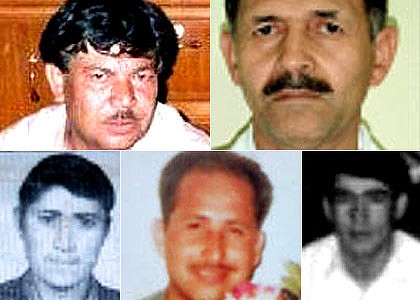
Photos of Afghans Killed in Australian Boat Explosion Released (News)

Clockwise from top:  Muzafar Ali Safarali, Mohammad Ali Ayubi, Baquer Husani, Mohammed Amini Zamen and Awaz Nader.

Clockwise from top: Muzafar Ali Safarali, Mohammad Ali Ayubi, Baquer Husani, Mohammed Amini Zamen and Awaz Nader.

Australian authorities have released photographs of the five Afghan asylum seekers who were killed in April in an explosion on their boat shortly after it was intercepted by Australian authorities near Ashmore Reef.  The boat was attempting to travel to Australia from Indonesia.  Some survivors of the blast were severely burned.

An investigation into the deaths is still in progress.  Video of the incident reportedly shows Australian Defence personnel pushing survivors back into the water as they tried to swim to a rescue boat.  The Northern Territory Coroner which is conducting an investigation has prevented the video footage from being made public.

Click here for article.

2 Comments

Filed under Australia, News

Italian Public Prosecutor Challenges Constitutionality of Italy’s New Anti-Immigration Law (News)

The Public Prosecutor’s Office in Agrigento, Sicily, has asked for a halt of the criminal trial of 21 migrants who landed illegally in Sicily and who are being criminally prosecuted under Italy’s new anti-immigration laws which, among other things, make it a criminal offense to enter the country illegally.   The Public Prosecutor is asking that the question of the law’s constitutionality be submitted to Italy’s Constitutional Court.  The criminal court judge is considering the request.

According to the Public Prosecutor’s Office, the law is inconsistent with the Italian Constitution and the UN Protocol Against the Smuggling of Migrants by Land, Sea and Air which obligates states to assist and protect migrants in difficulty, not to criminally prosecute such migrants.

Click here for article.

Leave a comment

Filed under Italy, Mediterranean, News

Frontex Concedes it “May Be Helping” with Italian Push-Back Practice (News)

A Frontex spokesperson has modified Frontex’s strong denial several days ago that it had no involvement in or responsibility for the Italian push-back practice in the Mediterranean.

Frontex now concedes that it is assisting the Italians with the detection and interception of migrant boats, but that Frontex has no information regarding what happens to intercepted migrants after the Italian coastguard intercepts them.

“In an interview with European Voice [reporter Judith Crosbie], [Frontex spokesperson Gil] Arias-Fernández said: ‘Technically speaking, assets co-ordinated by Frontex are taking part in operations in the area and … these people could be sent back to their country of origin.’ But he said to hold Frontex responsible for the return of migrants to Libya was ‘far from reality’. ‘We can’t be accountable for decisions taken by Italy,’ he said.”  Arias- Fernández, however, conceded that Frontex might bear some moral responsibility for the push-back practice.

Click here for article.

Leave a comment

Filed under Frontex, Italy, Libya, Mediterranean, News

Italian Official: Migrants Forcibly Returned to Libya Never Ask For Asylum (News)

The Italian Government has rejected the ongoing criticism by HRW and others of its push back policy.

News24 reports that Interior undersecretary Alfredo Mantovano, stated that Italian authorities “have never denied” intercepted migrants the right to ask for asylum.  “Each operation to escort migrants back to Libya lasted more than 10 hours during which none of the people involved, asked to be recognised as refugees, nor did they say they were fleeing from persecution in their countries of origin, Mantovano said.”

According to Mantovano, 757 migrants have been forcibly returned to Libya between May 6 and August 30.

Click here for article.

Leave a comment

Filed under Data / Stats, Italy, Libya, Mediterranean, News

Frontex Issues Response to HRW Report (Communiqués)

Frontex has denied responsibility for and involvement in the Italian push-back practice.

Full text of the Frontex press release:

“By way of response to statements included in the Human Rights Watch report “Pushed Back, Pushed Around” Frontex would like to state categorically that the agency has not been involved in diversion activities to Libya (these are based on a bilateral agreement which Italy signed with Libya in May this year).

“The Frontex operation referred to in the report, Operation Nautilus 2009, was underway on June 18th 2009, but in a different operational area. Though German helicopters did participate in this operation, they were at no time involved in the incident described in the report (on the basis of two press reports, one from ANSA and one from Malta Today).

“In general, Frontex would like to point out that the task of helicopters involved in joint operations coordinated by the agency is only to patrol the operational area, not to divert. “

Click here for press release.

Leave a comment

Filed under Communiqués, Frontex, Italy, Libya, Mediterranean

Perejil Survivors Expelled from Morocco (News)

The 11 rescued survivors from the boat that sank near the Spanish island of Perejil this past Saturday have been deported from Morocco.  AFP quoted a Moroccan official saying “By order of the prosecutor, the 11 African escapees left Tangiers at about 2100 GMT (on Sunday) during an expulsion operation.”  The survivors, from Niger and Senegal, were probably expelled into Algeria.  While Moroccan officials believe there were 42 migrants on the boat, the Spanish Red Cross estimates the number at approximately 60.

Click here for article.

Leave a comment

Filed under Mediterranean, Morocco, News, Spain

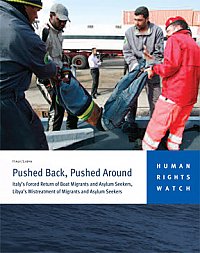
HRW Report: Italy’s Forced Return of Boat Migrants and Asylum Seekers, Libya’s Mistreatment of Migrants and Asylum Seekers (Reports)

Blog - HRW Cover

Human Rights Watch has released a report regarding Italy’s forcible push-back policy:

Pushed Back, Pushed Around – Italy’s Forced Return of Boat Migrants and Asylum Seekers, Libya’s Mistreatment of Migrants and Asylum Seekers

“On May 6, 2009, for the first time in the post-World War II era, a European state ordered its coast guard and naval vessels to interdict and forcibly return boat migrants on the high seas without doing any screening whatsoever to determine whether any passengers needed protection or were particularly vulnerable. The interdicting state was Italy; the receiving state was Libya.  Italian coast guard and finance guard patrol boats towed migrant boats from international waters without even a cursory screening to see whether some might be refugees or whether others might be sick or injured, pregnant women, unaccompanied children, or victims of trafficking or other forms of violence against women. The Italians disembarked the exhausted passengers on a dock in Tripoli where the Libyan authorities immediately apprehended and detained them.”

HRW’S Recommendations include:

“To the Government of Italy

  • Immediately cease interdicting and summarily returning boat migrants to Libya.
  • Investigate allegations that Italian naval personnel beat and used electric shocks to force interdicted boat migrants onto Libyan vessels and prosecute naval or coast guard officials who abused their authority, including those with command responsibility.
  • Stop cooperating with the Libyan authorities on the interdiction and interception of third-country nationals trying to leave Libya.
  • Make public all treaties and agreements between the governments of Italy and Libya.
  • Cease to fund or provide other bilateral support to Libya aimed at increasing that country’s effectiveness at intercepting asylum seekers and migrants before they take to the sea or before they reach Italian waters. Redirect such support into multilateral efforts, especially through UNHCR and OHCHR, to ensure that fundamental human rights standards relating to the treatment of such persons in Libya are observed.
  • Ensure access to full and fair asylum procedures, including the right to raise fear of treatment contrary to article 3 of the ECHR, for every person in the control of the Italian authorities, including those interdicted or rescued at sea.”

“To European Union Institutions and EU Member States

  • Demand that Italy not violate article 3 of the European Convention on Human Rights by its interdiction and summary return of migrants to a place where they are subjected to inhuman and degrading treatment.
  • Ensure access to full and fair asylum procedures, including the right to raise fear of treatment contrary to article 3 of the ECHR, for every person in the control of any EU member state, including those interdicted or rescued at sea.
  • Adopt clear, consistent, and binding rules on EU member states establishing responsibility for disembarking migrants rescued at sea.
  • Refrain from expelling third-country (non-Libyan) nationals to Libya, either directly or as partners in Frontex-coordinated operations, until Libya’s treatment of migrants, asylum seekers and refugees fully meets European standards in relation to persecution or risk of treatment contrary to article 3 ECHR. Under current conditions, the return of third-country nationals breaches European nonrefoulement obligations not to return people to inhuman or degrading treatment.
  • Encourage Libya to 1) ratify the 1951 Refugee Convention and its 1967 Protocol; 2) adopt a national asylum law; and 3) formally recognize UNHCR.
  • Display greater transparency in negotiations with Libya on all matters relating to migration and border controls.
  • Ensure  that the human rights clause in the Libya-EU Framework Agreement, being negotiated at the time of this writing, and in agreements flowing from it, contain explicit reference to the rights of asylum seekers and migrants as a prerequisite for any cooperation on migration-control schemes.
  • Refrain from encouraging Libya from establishing any reception regime which falls below the European reception condition standards
  • Quickly admit UNHCR-identified refugees in need of resettlement from Libya. Do so, however, only as a supplement rather than as a substitute for allowing spontaneous arrivals in EU territory to seek asylum.
  • Direct development assistance to improve respect for human rights and human dignity in migrants’ and asylum seekers’ countries of origin to address the root causes of forced migration.”

Click here for the report.

Leave a comment

Filed under European Union, Frontex, Italy, Libya, Mediterranean, Reports