Tag Archives: European Union

DIIS Seminar: “The Lesser Evil”? Policy Logics and Practices of Removal and Detention in the Euro-Mediterranean Area (Copenhagen, 6 Oct)

The Danish Institute for International Studies (DIIS) will hold a seminar (English) in Copenhagen on 6 October 2011, 14.00-17.00.  Advance registration is required.  Registration deadline is Wednesday, 5 October 2011 at 12.00 noon.  Click here for more information.

From the DIIS announcement:  “The arrival of more than 45,000 African boat migrants and asylum seekers in Italy this year has caused much public and political attention in Europe. One response is to call for increased sea patrols to prevent irregular crossings of the Mediterranean Sea. Another response is detention, deportation and forced removal of irregular migrants and rejected asylum seekers who have reached Europe. Such practices are already important objectives in European migration management and policies but are likely to become even more significant in coming negotiations with North African migrant sending and transit countries.

This seminar examines practices of deportation, readmission and detention from a policy and migrant perspective. It will address the following questions: What are the policy logics and readmission agreements in the Euro-Mediterranean area? How is detention and deportation of irregular migrants carried out? And how do deported migrants deal with their situation?”

Click here for more information.

Leave a comment

Filed under Colloques / Conferences, European Union, Mediterranean

Eurostat: Asylum Statistics for Q1 2011

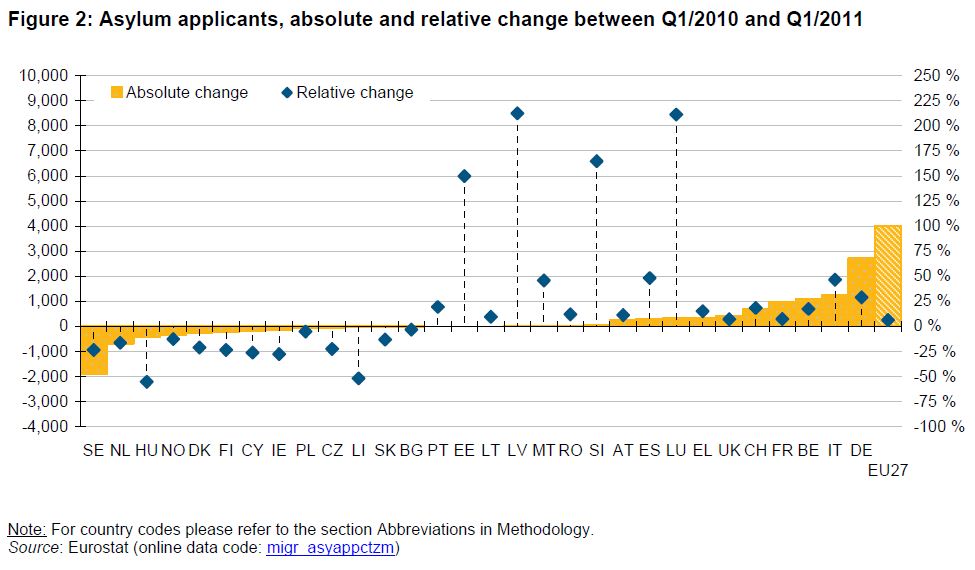
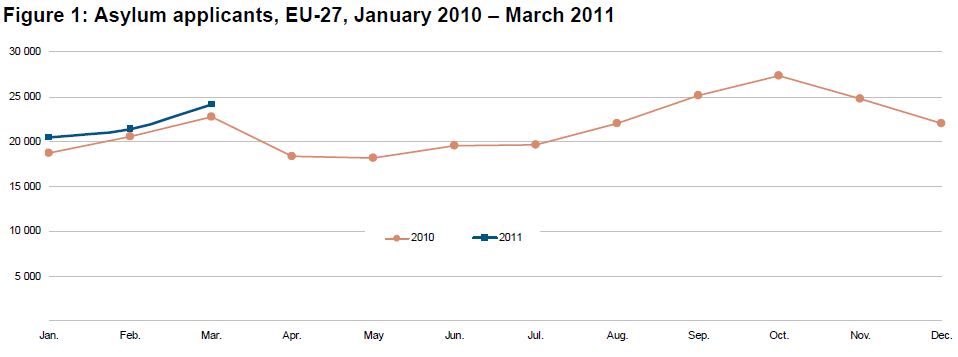
Eurostat has issued a statistical report regarding the number and makeup of asylum applicants in the 27 EU member states and Norway, Switzerland, and Lichtenstein for the First Quarter 2011.  The report documents the increased number of applications filed in Italy by Tunisians, but note that the report only addresses data through 31 March 2011.

Highlights include:

  • Nearly 66 000 persons sought asylum in one of the EU Member States during the first quarter of 2011, an increase of 4 000 compared with the same period of the previous year.
  • France and Germany remained the top destination countries of asylum applicants with 14 300 and 12 000 applicants respectively.  France and Germany received 40% of the total applications filed.
  • Germany (+ 2 700) and Italy (+1 300) recorded the highest increases in numbers of applicants in absolute terms compared to the first quarter of 2010, while Sweden (- 1 900) and the Netherlands (-700) recorded the largest falls.
  • In the first quarter of 2011, the main citizenships of people seeking asylum in the EU-27 were Afghans (5 800), followed by Russians (4 100) and Iraqis (3 800).
  • Tunisians (2 500) are now ranked eighth among the main countries of citizenship of asylum seekers.  90% of the Tunisian applications were made in Italy.
  • 55 600 first instance decisions on asylum applications were issued in the EU-27 during the first quarter of 2011. One out of four of such decisions was positive; in total 13 500 persons received some type of protection status, including refugee status (6 800 decisions), subsidiary protection (4 600 decisions) or authorisation to stay for humanitarian reasons (2 100 decisions).

Click here for Eurostat report.

\

Asylum applicants, absolute and relative change between Q1/2010 and Q1/2011

Asylum applicants, EU-27, January 2010 – March 2011

Leave a comment

Filed under Analysis, Data / Stats, European Union, General, News

More Evidence that Gaddafi Government Facilitated Migrant Boat Departures from Libya

There has been evidence for many months that the Gaddafi regime was facilitating migrant boat departures from Libya towards Italy and Malta; here are two recent articles on the topic from the Los Angeles Times and the Telegraph.

LA Times: “… During its life as a military base, the impromptu camp [at Janzour / Zanzour] was heavily guarded, but in recent in months, several people from the area said, Kadafi’s government facilitated the entry of Africans hoping to migrate by boat to Europe. … The military base was run by a Kadafi operative named Zuhair, according to several people familiar with its operation. As rebels approached Tripoli, they said, Zuhair was seen taking off in a speedboat, accompanied by his top aide and two bodyguards. … [The base] is also the scene of one of Muammar Gaddafi’s most bizarre and cynical plans; an operation to flood Europe with black African illegal immigrants in revenge for Nato’s bombing campaign. For months until the uprising in Tripoli two weeks ago, men in uniform were seen around the port directing the loading of immigrants onto leaky boats bound for Italy. Africans who landed this summer on the tiny island of Lampedusa – a speck of rock south of Sicily – said they had paid nothing for their passage, in contrast to the $1,000 fee usually demanded by people smugglers. No boats have left since the rebels drove Gaddafi’s men out, but the human cargo is still stranded there; a thousand desperate black African men, women and children, clustered in the dirt under beached boats in utter squalor, hungry, scared, penniless, and desperate to escape….”

The Telegraph: “…[a] man, who would not give his name, claimed that the port [of Zanzour] had been controlled by a shadowy official called Zuhair, who had vanished when the rebels arrived. ‘He is a Palestinian originally, with several passports,’ the man said. ‘He had people under him and they sent the boats to Lampedusa.’ There seems little likelihood that the operation was being conducted without official sanction; Zanzour is located not on some remote, unpoliced stretch of coast but within an old military base, only about ten miles west of Tripoli, an area which was firmly under Gaddafi’s control until recently. … Laura Boldrini, of UNHCR, warned that illegal immigration could get much worse in the months ahead, adding that nobody knew how the new government would deal with the problem. ‘What happens depends on security,’ she said. ‘If violence explodes in Libya, there is a danger of a massive new influx of people trying to escape.’”

Click here and here for articles.

Click on these links for some previous posts on the subject:

Is Libyan Government Facilitating Migrant Boat Departures from Libya? (31/03/11)

IOM Reports Migrants Were Forced by Libyan Soldiers to Board Boats (10/05/11)

Libya: Because of NATO Aggression, We Cannot Be Guards of Europe (11/05/11)

Guardian: Libya Official Admits Migrant Ships Being Allowed to Sail as Protest Against Nato (11/05/11)

Maltese JHA Minister Doubts Migrants Are Being Pushed to Flee Libya (13/05/11)

1 Comment

Filed under European Union, Italy, Libya, Malta, Mediterranean, News, UNHCR

Malmström’s “Unfortunate Voyage to Libya”

An editorial by Annika Ström Melin in Dagens Nyheter (Sweden) summarised by Presseurop:

“‘An unfortunate voyage to Libya’ headlines the Dagens Nyheter editorial, which looks back on European Commissioner for Home Affairs Cecilia Malmström’s visit to Libya in October 2010. [***] In practice [the agreement signed by the Commissioner in Libya] amounted to employing Gaddafi as an EU border guard, notes the Stockholm daily [***].  ‘It is easy to be clever with the benefit of hindsight,’ remarks the daily, ‘but the agreement with Gaddafi was already scandalous when it was signed. Today Cecilia Malmström will have to provide full information about the consequences of this meeting. Was there a dialogue? Where did the money go?’ In conclusion, Dagens Nyheter affirms that the entire EU should ask itself the question of how it came to sign a treaty with Gaddafi.”

Click here for Presseurop article.

Click here for Dagens Nyheter editorial.  (SV)

Click here and here for my previous posts on the Commissioner’s trip to Libya.

[UPDATE 25 August – Click here for Malmström’s response to the editorial.]

Leave a comment

Filed under Analysis, European Union, Libya, Mediterranean, News

Issue Brief- Cutting Off the Flow: Extraterritorial Controls to Prevent Migration

An Issue Brief, “Cutting Off the Flow: Extraterritorial Controls to Prevent Migration,” written by Eleanor Taylor-Nicholson, has been published by the Warren Institute for Law and Social Policy, University of California, Berkeley.  The issue brief was written as a background paper for a conference held by the Warren Institute at UC Berkeley Law School on 22 April 2011.

Excerpt: “… This issue brief explores the extent to which the United States, Europe and European governments have implemented different extraterritorial controls. Although we hear of such controls in the media, how common are they? Who is overseeing them? What do they involve? What are concerns with their use? To answer these questions, this brief presents information on key actors, including individual nation-states and their agents, and on the range of mechanisms used by both. A comparison of two major immigration destinations is included to consider similarities and differences in the use of extraterritorial controls by states.

A review of the literature and media reports finds that extraterritorial controls include a diverse range of measures by different actors, some of which have been extremely controversial, such as maritime interdiction and offshore detention, and others that are more accepted or less understood, such as visa controls and disruption of organized immigration crime. Further, while such controls are now ubiquitous in both regions, their design and implementation generally lack public oversight and accountability mechanisms. They may protect states from security threats, have the potential to provide early protection to people in need, and save traveling migrants in distress. But, if used primarily as an immigration deterrence mechanism, they can cause harm. Indeed they may provide states a means to evade their international obligations or lead to violations of international refugee law and human rights law.

In light of this, we recommend governments conduct a comprehensive and public review of the extraterritorial controls they have in place, taking into consideration international refugee and human rights commitments. We also urge governments to increase the transparency of their immigration control agreements with third parties, including private actors and other states….”

Click here for Issue Brief.

Leave a comment

Filed under Analysis, European Union, Frontex

CARIM: Libya Migration Profile

CARIM has published an updated Migration Profile for Libya.  The profile includes IOM data regarding migrant departures from Libya between 20 February and 26 May 2011 which again highlights the humanitarian burden imposed on Tunisia and Egypt relative to Italy and the EU.

Tunisia received 232,856 individuals from Libya during this period (185,442 of whom were TCNs) which is 43.8% of the total number of migrants who have fled Libya.  Egypt received 172,318 individuals (74,911 TCNs) which constitutes 32.4% of the migrants who have fled.  Italy received 13,110 individuals (all TCNs) which constitutes 2.5% of the total.   Niger received 13.1% of the total, Chad 5.1%, Algeria 2.3%, and Malta 0.3%.

Click here for the Profile.

Leave a comment

Filed under Algeria, Analysis, Data / Stats, Egypt, European Union, Italy, Libya, Malta, Mediterranean, Niger, Reports, Tunisia

UNODC Report: The Role of Organized Crime in the Smuggling of Migrants from West Africa to the EU

UNODC released a report on 30 May: The Role of Organized Crime in the Smuggling of Migrants from West Africa to the European Union.  From the UNODC web page: “… The new report by the United Nations Office on Drugs and Crime (UNODC) investigates the involvement of organized criminal groups in the smuggling of migrants from West Africa towards the European Union (EU).  The involvement of organized crime in the smuggling of migrants is a sensitive and controversial issue in West African countries, as the report discusses at various points. The publication contributes to better understand the underlying mechanisms and actors involved in this criminal process as a basis for policy reforms in countries affected.

Information in the report was compiled by a team of researchers from West Africa and Europe using both documentary studies and field research conducted in Mali, the Niger, Nigeria and Spain. …  UNODC, as guardian of the Protocol against the Smuggling of Migrants by Land, Sea and Air, supplementing the United Nations Convention against Transnational Organized Crime, possesses specific expertise and experience that could be put at the service of all countries affected to support them in matters linked to prevention, legislation, operations or prosecution.”

From the Report’s Summary:  “The United Nations Office on Drugs and Crime (UNODC), through the European Union-funded ‘Law enforcement capacity-building to prevent and combat smuggling of migrants in the ECOWAS region and Mauritania (Impact)’, undertook to investigate the role played by organized criminal groups in the smuggling of migrants from West Africa to Europe.

The present report is aimed primarily at decision makers, law enforcement and judicial officials, but also at a wider audience interested in irregular migration. It contributes to a better understanding of the underlying mechanisms and actors involved in this criminal process as a basis for policy reforms in the West African countries concerned.  This report was prepared through desk and field research, conducted in Mali, Morocco, the Niger, Nigeria, Senegal and Spain. Interviews were conducted with over 200 people in Africa and Europe belonging to three main groups: migrants, national authorities and non-governmental organizations, and smugglers.

Four main findings can be mentioned:

• Transnational organized criminal groups are generally involved in the smuggling of migrants from West Africa to Europe. However, there are important differences among them in terms of specialization and professionalism. With regard to trafficking in persons and the smuggling of non-African irregular migrants, criminal groups are clearly well organized and structured, and keep close contacts with operatives in several countries. On the other hand, other would-be migrants in West Africa have to deal with loose networks that are not permanently structured. Various groups of actors usually collaborate for one particular operation, and there are no exclusive relationships between those criminal groups.

• Specialization and the building of transnational criminal networks usually come as a result of increased efficiency in border interdiction. Within West Africa, freedom of movement gives little incentive, if any, to engage in the smuggling of migrants. However, the situation changes when there are natural obstacles, such as the sea, or man-made obstacles, such as surveillance

• In most cases, smugglers are migrants themselves. Realizing that their knowledge acquired through (often painful) experience may be used by other migrants in exchange for remuneration, some migrants decide to enter the business of smuggling of migrants. They may then become specialized professional smugglers, or they use their knowledge to finance the completion of their journey to Europe.

• Irregular migrants generally do not see themselves as victims, and smugglers do not see themselves as criminals. A complex relationship exists between irregular migrants and smugglers. The latter have an interest in maintaining the flow and feeding youngsters with dreams of success. These dreams are also kept alive in some West African countries by families and circles where important social value is attached to those who decide to leave, as well as by those who have made it to Europe, be it legally or illegally, even though their situation in Europe is often worse than it was at home….”

Click here for Report.

Click here for article on UNDOC web page.

Leave a comment

Filed under Analysis, Eastern Atlantic, European Union, Mauritania, Mediterranean, Morocco, Niger, Reports, Senegal, Spain, United Nations, UNODC

European Commission: Annual Report on Immigration and Asylum for 2010

The Commission released its second Annual Report on Immigration and Asylum for 2010 on 24 May (COMMUNICATION FROM THE COMMISSION TO THE EUROPEAN PARLIAMENT AND THE COUNCIL).  Accompanying the 12 page Report is an 82 page Staff Working Paper.  Excerpts from the Commission press release regarding the Report:

“On Asylum:

  • Negotiations on all asylum legislative proposals must be finalised by the end of 2012, as agreed by the European Council.
  • The recent events in the Southern Mediterranean confirm the necessity of having in place a common asylum system at EU level. This implies better EU legislation, strengthened practical cooperation coordinated by the European Asylum Support Office (EASO), concrete solidarity between Member States and increased cooperation with third countries.
  • Agreement must be reached by the European Parliament and the Council on the EU joint resettlement scheme.
  • The EU relocation pilot project with Malta, the legislative reforms adopted by Greece and the ongoing support the country has received in the implementation of the Action Plan are concrete examples of the combination of responsibility and solidarity that are needed to build the Common European Asylum System.”

“On preventing irregular migration:

  • Member States must fully transpose the Employer Sanctions Directive by July 2011, which is essential for preventing irregular migration and for the credibility of legal migration.
  • Member States must step up measures against trafficking in human beings, including assistance given to victims under Directive 2004/81/EC with a view to dismantling networks of traffickers while strengthening rights of the victims.
  • Member States must fully transpose and implement the Return Directive and continue to make use of the opportunity offered by this Directive to foster voluntary departure as the preferred return option.
  • The use of joint return flights should be continued, by making full use of the European Return Fund and FRONTEX coordination, and including the presence of forced return monitors as required under the Return Directive.
  • Member States should systematically add entry bans in the Schengen Information System in order to give full effect to the European dimension of entry bans issued under the Return Directive.”

“On effective Border Control:

  • The European Parliament and the Council must agree on the proposed amendment to the FRONTEX Regulation as soon as possible, to provide a proper legal basis to strengthen the functioning of the agency.
  • All Schengen border-crossing points should be properly equipped, border surveillance properly ensured, and border guards trained to use new IT tools, as stipulated in the Schengen Border Code.
  • The feasibility of setting up a European Borders Guard System should be considered.
  • Local Schengen cooperation must be fully exploited in order to ensure a fully harmonised and streamlined visa procedure, in particular for the benefit of bona fide travellers.
  • Member States should continue to prepare the ground for establishing EUROSUR, the entry/exit system and the registered traveller programme.
  • To better coordinate the checks at the external borders the Commission will present proposals in 2012, in order to improve interagency cooperation between FRONTEX, EUROPOL, national customs and police authorities.”

I have reproduced about half of the Annual Report here, but have not had time to begin reading the Staff Working Paper.

Excerpts from Annual Report on Immigration and Asylum (2010):

“[***]

The present Annual Report is presented in response to the request made by the European Council when adopting the 2008 Pact on Immigration and Asylum[1] and covers the developments during 2010 in the implementation of the Pact and the relevant priorities of the Stockholm Programme adopted in 2009[2], both at the EU and the national level. The report has been prepared on the basis of Member States’ contributions and other information, in particular reports from the National Contact Points (NCPs) of the European Migration Network (EMN).

The report summarises and assesses developments at the EU and the national level[3], and puts forward recommendations for future action.

II. Entering and Residing in the EU

[***]

1. Legal migration – ensuring a legal way to enter the EU

[***]

2. Asylum – granting international protection and ensuring solidarity

In 2009 Member States recorded 266 400 asylum applications, the number in 2010 was 257 815, a slight decrease of 3%. While Poland, Italy, Hungary and Malta received less asylum-seekers in 2010 than in 2009, significant increases were recorded in Germany, Belgium and Sweden.

In 2010, the most important countries of citizenship of asylum-seekers in the EU were, in order: Afghanistan (20 580), Russia (18 500), Serbia (17 715, excluding Kosovo*[4]), Iraq (15 800) and Somalia (14 350).

In 2010, 55 095 asylum-seekers received a protection status in the EU at first instance (refugee, subsidiary protection or humanitarian). Protection was therefore granted in 25% of decisions taken in first-instance procedures.

In 2009, 7 147 refugees were resettled in the EU from third countries. The figure for 2010 was [until Q3] 3 848.

Legislative progress was slow and difficult in the field of asylum in 2010. The co-legislators agreed on the extension of the scope of the Long-Term Residents Directive to beneficiaries of international protection, and made some progress on the Dublin and Eurodac Regulations as well as on the Qualification Directive. To give an impulse to the stalled negotiations on the Reception Conditions and Asylum Procedures Directives, the Commission will adopt modified proposals on these two instruments in June 2011.

The adoption in 2010 of the Regulation for the creation of the European Asylum Support Office (EASO) was a significant development. The Commission is working actively so that the EASO becomes operational in June this year in view of boosting practical cooperation.

Solidarity among Member States is needed as one of the components of the Common European Asylum System (CEAS). A pilot project for the relocation from Malta to ten Member States of approx. 250 beneficiaries of international protection is running and will be extended beyond its originally intended duration so as to facilitate the relocation of recently-arrived migrants in need of international protection.

Following the submission of an Action Plan to the European Commission in August 2010, Greece has embarked on a comprehensive overhaul of its asylum and migration system, and has received support from the Commission, the Member States, Norway, the UNHCR and other EU partners. Asylum Expert Teams coordinated by the EASO are now deployed there. Important new legislation has already been adopted by Greece in 2010, and its implementation is underway.

Existing Regional Protection Programmes (RPPs) in Tanzania and Eastern Europe continued; the implementation of a new RPP in the Horn of Africa region started in September, in close cooperation with the UNHCR; and work advanced on the development of another RPP in North-Eastern Africa (Egypt, Libya and Tunisia).

Resettlement is equally essential in this context. Negotiations on the creation of a Joint EU Resettlement Programme must come to an operational and positive end. A strategic approach and political steering on the use of resettlement is needed.

  • Negotiations on all asylum legislative proposals must be finalised by the 2012 deadline.
  • The recent events in the Mediterranean and the need to restructure the asylum systems of some Member States confirm the necessity of creating a common procedure and a uniform status at EU level. This implies better EU legislation, strengthened practical cooperation coordinated by the EASO, a concrete multifaceted commitment to solidarity and an increased investment in cooperation with third countries.
  • Agreement must be reached by the European Parliament and the Council on the EU Joint resettlement scheme.
  • The EU relocation pilot project with Malta, the legislative reforms which have been adopted by Greece and the ongoing support it has received in the implementation of the Action Plan are concrete examples of the combination of responsibility and solidarity that are needed to build the CEAS.

3. Integration – a key element both for migrants and receiving societies

[***]

III. Addressing irregular migration to facilitate regular migration

In 2009, the number of irregularly staying third country nationals apprehended in the EU-27 was about 570 000 (7% less than in 2008). Member States returned about 253 000 third country nationals (4.7% more than in 2008).

In 2010 63% (i.e. about 20 000 detections) of illegal border-crossings into the EU were detected in 3Q2010 at the Greek/Turkey land border.

Effective measures aimed at preventing irregular immigration and at securing safe borders are an essential component of a coherent and credible EU immigration policy, but this policy must be fair and human rights must be respected.

1. Instruments for fighting irregular migration

Two legal key instruments have been adopted in recent years – the Return Directive 2008/115/EC and the Employer Sanctions’ Directive 2009/52/EC. They are in place now, but their state of transposition is far from satisfactory, in particular with respect to the Return Directive, where the implementation deadline passed on 24 December 2010. That is why its full and timely transposition is essential. Those provisions, which directly confer rights on migrants, may be, and already are, invoked in proceedings before national courts, and directly applied at the national level, regardless of whether national transposition legislation is in place.

Reinforced border control and cooperation with third countries, notably via readmission agreements, have already proved their effectiveness, as demonstrated in some Member States which have reported on their deterrent effect and on better-functioning return arrangements. However, there remains room for improving the effectiveness of readmission agreements at the EU level, as set out in the Commission’s Communication on the Evaluation of EU Readmission Agreements (COM(2011)76). It is also clear that the higher number of joint return flights coordinated by Frontex in 2010 have been a success, earning the agency further support and increased financial means. Moreover, the 29 measures agreed by the Council to reinforce the protection of the external borders and combating illegal immigration are now being implemented. In its Staff Working Document[5] on the fulfilment of these 29 measures, the Commission reported in detail on progress achieved with regard to each measure, putting a special emphasis on the role played by Frontex, the development of EUROSUR and the ongoing dialogue on migration with main countries of origin and transit as part of the implementation of the Global Approach. These measures need to be accelerated and given priority.

The Directive on preventing and combating trafficking in human beings, and protecting victims, the EU Anti-Trafficking Coordinator appointed by the Commission and a website on fight against trafficking in human beings[6] launched in 2010 have equipped the EU with new powers and ways to fight against this modern form of slavery. The recently adopted implementation report on Directive 2004/81/EC[7] on residence permits for victims of trafficking also called for their more effective protection, which should also help to dismantle networks of traffickers.

  • Member States must fully transpose the Employer Sanctions Directive by July 2011, essential for fighting irregular migration and for the credibility of legal migration.
  • Member States must step up measures against trafficking in human beings, including assistance given to victims under Directive 2004/81/EC with a view to dismantling networks of traffickers while strengthening rights of the victims.
  • The Return Directive must be fully transposed and implemented by the Member States who should continue to make use of the opportunity offered by this Directive to foster voluntary departure as the preferred return option.
  • The use of joint return flights should be continued, by making full use of the European Return Fund and FRONTEX coordination, and including the presence of forced return monitors as required under the Return Diretcive.
  • Member States should systematically add entry bans in the SIS in order to give full effect to the European dimension of entry bans issued under the Return Directive.

2. Effective border control

In 2010 the Commission proposed a Regulation on the establishment of an evaluation mechanism to verify the correct application of the Schengen acquis. In the light of recent experiences, its adoption must be a priority, so that the EU is better equipped to enforce a uniform application of the rules and take the appropriate measures if this would not be the case. Development of the Visa Information System (VIS) continued with the completion of the second and third major testing phases out of a total of four. Final agreement was reached on the technical specifications for the interaction of SIS II with the national systems. Member States continued to prepare the ground for establishing EUROSUR in line with the roadmap. EUROSUR will gradually establish a mechanism whereby Member States’ authorities carrying out border surveillance can cooperate and share operational information with each other and with Frontex, in order to reinforce the control of the external border of the Schengen area, especially its southern maritime and eastern land borders, and step up the fight against irregular migration and cross border crime. During the past year, the EU has faced critical situations at its borders, where it was confronted with high inflows of irregular migrants. This has been, and continues to represent, a major a test for the EU’s ability to react quickly and efficiently, while the Member States most directly concerned by migratory movements have required assistance in a spirit of solidarity. The achievements of Frontex are now broadly recognised and there is widespread agreement on the need to upgrade its role in order to enable it to be more effective.

The results of concerted EU action to tackle border-related crises have been mixed. On the one hand, the EU and the Member States have demonstrated that they are capable of responding decisively to address specific challenges faced by a Member State in effectively controlling its external borders. For the first time, following a request made by Greece related to the pressure on its land borders with Turkey, use was made of Frontex’s Rapid Border Intervention Teams (RABIT). The swift deployment of the RABIT, strongly supported by participating Member States, stabilised the situation and brought down the number of arrivals compared to the peaks in 2010. Malta has recently requested deployment of the RABIT in view of the situation in the southern Mediterranean.

On the other hand, one of the lessons learnt from these events is that both increased cooperation and uniform application of the acquis must be better and more effectively ensured by all Member States. Coordinated preventive EU action vis à vis countries of origin is still slow and weak.

  • The European Parliament and the Council must agree on the proposed amendment to the FRONTEX Regulation as soon as possible, to provide a proper legal basis to strengthen the functioning of the agency.
  • All Schengen border-crossing points should be properly equipped, border surveillance properly ensured, and border guards trained to use new IT tools, as stipulated in the Schengen Borders Code.
  • The proposed Schengen evaluation mechanism must be adopted, in order to foster mutual trust between Member States and EU institutions on the correct, uniform and coherent application of the Schengen Acquis.
  • The feasibility of setting up a European Border Guard System should be considered.
  • Local Schengen cooperation must be fully exploited in order to ensure a fully harmonised and streamlined visa procedure in particular for the benefit of bona fide travellers.
  • With a view to developing a fully reliable system of EU border control, Member States should continue to prepare the ground for establishing EUROSUR, and explore the desirability of putting in place an entry/exit system and a registered traveller programme.
  • To better coordinate the checks at the external borders the Commission will present proposals in 2012, in order to improve interagency cooperation between FRONTEX, EUROPOL, national customs and police authorities.

IV. Unaccompanied minors – a specific challenge

[***]

V. The External Dimension of EU migration Policy – The Global Approach

[***]

[1]               http://register.consilium.europa.eu/pdf/en/08/st13/st13440.en08.pdf.

[3]               A Commission Staff Working Paper provides more detail.

[4]               * Under UNSCR 1244/1999.

[5]               SEC (2010) 1480 final of 26.11.2010.

[7]               COM(2010) 493.”

Click here for Annual Report on Immigration and Asylum (2010)

Click here for Staff Working Paper.

Click here for Press Release.

Click here for 2009 Annual Report on Immigration and Asylum.

Leave a comment

Filed under European Union, Frontex, Reports

Migreurop Report: “Frontex: Which Guarantees for Human Rights”

Migreurop has released a 48 page report (EN and FR) entitled “Frontex Agency: Which Guarantees for Human Rights.”  The Report was prepared with a view to the revision of the Frontex mandate.  Here are the Report’s conclusion and recommendations:

“It is not enough to decree that fundamental rights must be respected: it is also necessary to provide the legal means and democratic safeguards needed to achieve this. The proposal for a Regulation amending the Regulation establishing the FRONTEX Agency does neither of these things. Over the five years in which the Agency has been operating, many questions have been asked about the compatibility of its functioning with respect for the rights of individuals. The Commission’s proposed Regulation only addresses a very few of these questions, and raises many more. Until the Agency’s objectives are fundamentally reviewed and seen in the context of the threats the Agency poses to respect for rights, it is questionable whether FRONTEX itself is compatible with human rights.  In the meantime, a number of measures should be introduced into the amended Regulation to bring the rules governing the functioning of FRONTEX more closely into line with standards on fundamental rights:

— There should be a clear division of responsibilities between Member States and FRONTEX in line with the Agency’s expanded role, ensuring that FRONTEX has full legal responsibility for acts committed during the operations that it coordinates, wherever they take place.

— It should be explicitly stated that all operations coordinated by FRONTEX must comply with EU directives on asylum, in particular Directive 2003/9 (on reception) and Directive 2005/85 (on procedures), as well as the principle of non-refoulement, including during interventions at sea wherever they take place, and during interventions involving officials acting under the authority of FRONTEX and liaison officers deployed by the Agency.

— It should be explicitly stated that operations coordinated by and/or involving officers placed under the authority of FRONTEX outside EU territory must be consistent with respect for the right to leave any country, including one’s own (Article 12.2 ICCPR).

— Independent monitoring mechanisms should be implemented during operations coordinated by FRONTEX (joint operations, joint return operations, deployment of liaison officers), and the conclusions and follow-up of monitoring operations should be communicated regularly to the European Parliament and made public.

— For monitoring of joint return operations, enough personnel should be made available to ensure that monitoring can take place at every stage, including inside the places of detention where deportees are held, onboard aircraft, and when deportees are handed over to the authorities of the country of return.

— The Code of Conduct for return operations should be made binding.

— Decisions taken by FRONTEX in relation to joint operations and pilot projects that it coordinates should be made available to the European Parliament.

— There should be mandatory consultation of the European Parliament whenever negotiations are opened between FRONTEX and a third country or the authorities of that country, and any agreement reached by FRONTEX during the negotiations should be submitted to the Parliament before being concluded.”

(While the Report was just added to the Migreurop web site, it may be that the French version of the report was released late last year.)

Click here (EN) or here (FR) for Report.

Leave a comment

Filed under Analysis, European Union, Frontex

Interview with Frontex Deputy ED Gil Arias

EurActiv.es conducted an interview in Spanish with Frontex Deputy Executive Director Gil Arias where he speaks about several topics, including Frontex’s response to the current situation in North Africa, the possible implications for Spain should unrest spread to Algeria or Morocco, Frontex’s budget shortfall and need for supplemental funding, and the problems experienced by Frontex when it attempts to negotiate cooperation or training agreements with third countries.

Click here for interview. (ES)

Leave a comment

Filed under Egypt, European Union, Frontex, Greece, Italy, Libya, Malta, Mediterranean, News, Spain, Tunisia

EJML Article, Stefanie Grant: “Recording and Identifying European Frontier Deaths”

The latest edition of the European Journal of Migration and Law, Volume 13, Number 2, contains an article by Stefanie Grant, University of Sussex, entitled “Recording and Identifying European Frontier Deaths.”

Abstract: “Migrant deaths at EU maritime borders have more often been seen in the context of national border control, than in terms of migrant protection and human rights. The 2009 Stockholm Programme accepted the need for action to avoid tragedies at sea, and to `record’ and `identify’ migrants trying to reach the EU. But it did not specify how this should be done. There are parallels between these migrant deaths, and deaths which occur in conflict and humanitarian disaster. The principles of human rights and humanitarian law which apply in these situations should be developed to create legal and policy frameworks for use in the case of migrants who are missing or who die on EU sea frontiers. The purpose would be to enable evidence of identity to be preserved, to protect the rights of families to know the fate of their relatives, and to create common national and international procedures.”

“This article draws on publications by the author, including: ‘Migration and frontier deaths: a right to identity’, in Marie Bénédicte-Dembour and Tobias Kelly (eds.), Are Human Rights for Migrants?: Critical Reflections on the Status of Irregular Migrants in Europe and the United States, Abingdon, Routledge, 2011 [in press]; ‘The Legal Protection of Stranded Migrants’, in Ryszard Cholewinski, Richard Perruchoud and Euan Macdonald (eds.), International Migration Law: Developing Paradigms and Key Challenges, The Hague, T.M.C. Asser Press, 2007, pp. 29–48; and ‘International Migration and Human Rights’; expert paper for the Global Commission on International Migration (GCIM), 2005.”

Click here for link.  (Subscription or payment required.)

Leave a comment

Filed under Analysis, Eastern Atlantic, European Union, Mediterranean

CoE Report Regarding Accession of EU to ECHR

“The seventh working meeting of the CDDH informal working group on the accession of the European Union to the European Convention on Human Rights (CDDH UE) with the European Commission was held in Strasbourg on 10-13 May 2011” and the report of the meeting was released on 16 May.  The meeting report includes a Draft Revised Accession Agreement (see Appendix III in meeting report).  (HT to @echrnews.)

Click here for meeting report.

Click here for link to web page of CoE Informal Group on Accession of the European Union to the Convention (CDDH-UE).

Click here for submission by the AIRE Centre and Amnesty International to the working group.

Leave a comment

Filed under Council of Europe, European Union, News

Análisis del Real Instituto Elcano: La crisis en el Norte de África y su impacto en la inmigración irregular a la Unión Europea (by Frontex Dep. ED Gil Arias)

Real Instituto Elcano has published an analysis regarding the situation in North Africa and its impact on irregular immigration to the EU.  The analysis was written by Frontex’s Deputy Executive Director Gil Arias.

Of particular interest is the analysis regarding what Frontex believes might occur in regard to migrant flows from Libya under two different scenarios: Gadafi remaining in power or ultimately being removed from power (see Google translation of excerpt below):

“… En el caso de que el régimen de Gadafi recupere el control, la UE y sus Estados Miembros no podrán reanudar la cooperación con un régimen totalmente desacreditado. Se producirá el cese en la aplicación de acuerdos de cooperación policial que en el pasado (desde mayo de 2009) sirvieron para detener los flujos de inmigración irregular desde Libia hacia Italia y Malta. La posibilidad de que ciudadanos de otros países africanos bloqueados en Libia sean obligados o “ayudados” a emigrar a la UE no debe descartarse. De hecho, Gadafi ha amenazado con “abrir la puerta” de la inmigración ilegal hacia Europa.

La OIM estima la cifra de extranjeros presentes en Libia entre 0,5 y 1,5 millones. No obstante, no todos serian candidatos a la inmigración ilegal. Se trata fundamentalmente de trabajadores empleados por empresas extranjeras asentadas en el país, por lo que su intención primaria no sería la emigración a la UE y por otra parte una buena parte de ellos ya han abandonado Libia.

En el peor de los casos, la consecuencia de ese “abrir la puerta” sería la reactivación de los flujos por vía marítima hacia Lampedusa y Malta (eventualmente también Creta, que se encuentra a 200 km de distancia de la costa libia) en un escenario similar al de 2008 (40.000 inmigrantes llegaron a Italia y Malta, con origen en las costas libias) agravado por el efecto adicional de la inestabilidad en el país. Su destino principal serían los países con presencia importante de ciudadanos norteafricanos (Italia, Francia, España, Bélgica y el Reino Unido). El destino de los nacionales de países subsaharianos se encontraría más repartido por toda la UE.

Si Gadafi es derrocado resultará clave la capacidad y rapidez de la oposición para reorganizarse. La oposición se encuentra, por el momento, bastante desorganizada y es probable que se produzcan luchas internas por el poder, especialmente por el control de los campos petrolíferos. Ello podría conducir a un estado persistente de disturbios y a una ausencia de control por un largo periodo de tiempo.

La eventual reactivación de las rutas migratorias hacia la UE dependerá de la capacidad del nuevo régimen para imponer la ley y el orden en el país así como el control efectivo sobre los 2.000 km de costas y 4.000 km de fronteras terrestres libias. En el peor de los escenarios podría darse una situación similar a la de Somalia.

En este escenario, la economía libia puede deteriorarse y elevarse los niveles de desempleo. Actualmente se desconoce la tasa de desempleo en Libia, pero se presume baja. Previsiblemente, la mayoría de los trabajadores desempleados intentará regresar a sus países, pero parte de ellos (sobre todo los nacionales de países inseguros) buscaran otras oportunidades, entre ellas la emigración clandestina a la UE.

La ausencia de ley y orden, especialmente la ausencia de control sobre las fronteras marítimas, llevará rápidamente a las mafias al tráfico de inmigrantes hacia la UE. Los candidatos serían primariamente trabajadores desempleados no deseosos de volver a sus países (mayormente de África Occidental y Oriental, pero eventualmente también libios, egipcios, argelinos y tunecinos). Esta situación impediría, por otra parte, el retorno de quienes fuesen detectados cruzando ilegalmente las fronteras exteriores de la UE.

En tales circunstancias se puede prever un flujo constante de inmigración ilegal durante meses, mayoritariamente por vía marítima, pero también por vía aérea a través de Turquía. La duración en el tiempo de este escenario dependerá de la rapidez con la que la UE o los Estados Miembros y las nuevas autoridades sean capaces de restablecer la cooperación. En este sentido, serán determinantes los acuerdos de readmisión efectivos.

Por último, ha de tenerse también en cuenta el riesgo marginal de que los vencedores realicen acciones de persecución sobre los partidarios de Gadafi, lo que provocaría la huida de éstos del país en busca de refugio….”

Google translation of the above excerpts (NB – this is only a rough translation):

“…In the case of Qaddafi’s regime  regaining control, the EU and its Member States shall not resume cooperation with a discredited regime. Termination will occur in the implementation of agreements on police cooperation in the past (May 2009) served to stop the flow of illegal immigration from Libya to Italy and Malta. The possibility for citizens from other African countries locked in Libya are forced or “helped” to migrate to the EU can not be ruled out. In fact, Gaddafi has threatened to “open the door” of illegal immigration into Europe.

The IOM estimates the number of foreigners in Libya between 0.5 and 1.5 million. However, not all candidates would be illegal immigration. These are mainly employed by foreign companies settled in the country, so that their primary intention would not be the migration to the EU and, moreover, a good portion of them have already left Libya.

In the worst case, the consequence of this “open door” would be the reactivation of the flows by sea to Lampedusa and Malta (and possibly Crete, which is 200 km away from the Libyan coast) in a scenario similar to that of 2008 (40.000 immigrants arrived in Italy and Malta, departing from the Libyan coast) aggravated by the additional effect of instability in the country. Its main destination countries would be a significant presence of North African citizens (Italy, France, Spain, Belgium and the UK). The fate of the national sub-Saharan countries would be more distributed throughout the EU.

If Gadhafi is overthrown will be key capacity and speed of the opposition to regroup. The opposition is, at present, quite disorganized and is likely to produce internal power struggles, especially for control of the oilfields. This could lead to a persistent state of unrest and a lack of control over a long period of time.

The eventual recovery of migratory routes towards the EU depends on the ability of the new regime to impose law and order in the country as well as effective control over the 2,000 km of coastline and 4,000 km of land borders Libya. In the worst case scenario could be a situation similar to Somalia.

In this scenario, the Libyan economy may deteriorate and unemployment levels rise. Currently unknown unemployment rate in Libya, but presumably low. Predictably, most unemployed workers try to return to their countries, but some of them (especially insecure country nationals) to seek other opportunities, including illegal migration to the EU.

The absence of law and order, especially the lack of control over maritime borders, whisk the trafficking mafias immigrants into the EU. Candidates would be primarily unemployed workers eager to return to their countries (mostly from West and East Africa, but also possibly Libyans, Egyptians, Algerians and Tunisians). This would prevent, on the other hand, the return of those who were detected illegally crossing the external borders of the EU.

In such circumstances, can provide a steady flow of illegal immigration for months, mostly by sea, but also by air through Turkey. The long life of this scenario depends on the speed with which the EU or the Member States and the new authorities are able to restore cooperation. In this regard, will determine the effective readmission agreements.

Finally, it must also take into account the marginal risk that the winners perform acts of persecution on Gaddafi’s supporters, causing them to flee the country in search of refuge….”

Click here for the Analysis. (ES)

Leave a comment

Filed under Algeria, Analysis, Egypt, European Union, France, Frontex, Greece, Italy, Libya, Malta, Mediterranean, Morocco, Spain, Tunisia, Turkey

Frontex Issues 2011 Annual Risk Analysis

Frontex posted its 2011 Annual Risk Analysis to its web site yesterday. [Update 9 May 2012: 2011 Annual Risk Analysis also available here: frontex_annual_risk_analysis_2011 ]

From the Frontex web page: “Frontex’s Annual Risk Analysis 2011 records the main trends in regular and irregular migration into the European Union in 2010 and offers predictions for the coming year’s trends. Regarding irregular migration, the sharp decrease reported in 2009 (of around a third on 2008) stabilised in 2010; Member States and Schengen Associated Countries reported a total of 104,049 detections of illegal border crossing at the sea and land external borders, a total almost identical to the 2009 figure of 104,599….”

Executive Summary:  “Irregular migration represents a small proportion of the total movement of persons across the borders, three quarters of which are EU nationals. Over 100 nationalities require a visa to enter the EU, accounting for more than 80% of the non-EU population, while about 1 billion nationals from 37 countries do not require a visa. As yet, there are no precise statistics available on passenger flows for 2010, but it is widely regarded to have recovered somewhat from the decline of 2009.

Regarding irregular migration, the sharp decreasing trend reported in 2009 stabilised in 2010; Member States and Schengen Associated Countries reported 104 049 detections of illegal border-crossing at the sea and land external borders, a total almost identical to 2009.

Irregular migration through western African, western Mediterranean and central Mediterranean routes continued to decrease, thus reducing the overall detection of irregular migration of West Africans who, in the past, used to be the most commonly detected migrants on those routes. By contrast, there was an abrupt increase in detections of illegal border-crossing at the land border between Turkey and Greece. Consequently, in 2010 the eastern Mediterranean route became the main channel of irregular migration into the EU, and Turkey – the main transit country for irregular migrants.

The sudden increase in detections of illegal border-crossings along a small section of the Greek-Turkish land border in October 2010 was due to facilitators exploiting variations in the vulnerability of the external border. This development triggered the first deployment of the Rapid Border Intervention Team (RABIT) in November 2010.

At EU level, refusals of entry decreased marginally in 2010; however, trends differed extensively between nationalities. Ukrainians continued to be the main nationality refused entry at EU Member States’ external borders in 2010, mostly at the Ukrainian border with Poland which is one of the busiest border sections along the EU’s external borders. Furthermore, Serbians became the second most frequently refused nationality at the external land borders, with more than an 80% increase, following the visa liberalisation process in the Western Balkans. At the external air borders, Brazilians continued to be the nationality most often refused despite the fact that these refusals declined by more than 20% compared to 2009.

At the end of 2010, the detection of false documents at entry points to the EU reached their highest level since data collection began in early 2009. Apart from this increase, there are reports of widespread abuse of authentic documents by unauthorised users known as impostors.

Looking ahead, regular passenger flows across the external borders will increase due to rising global mobility, possible visa-liberalisation procedures for the EU’s eastern European partners and new local border-traffic agreements along the eastern borders. These developments will increase the workload of border-control authorities in preventing the use of legal channels for overstaying. In addition, Europe will host two major sporting events – the Olympic Games in London and the UEFA Euro 2012 in Poland/Ukraine.

Consistent with the increasing flow of passengers, the growing number of registered traveller programmes (RTP) should further facilitate bona fide passenger flows and will put additional emphasis on risk analysis-driven border checks in order to ensure the smooth flow of legitimate passengers.

There might be changes in the external Schengen and EU borders in 2011 or 2012, with the possible entry of Romania and Bulgaria into the Schengen area and Croatia’s possible accession to the EU.

The most likely high-pressure points for illegal border-crossings in 2012 will be along the Mediterranean coast and the land border with Turkey. Migrants with relatively easy access to Turkey or North Africa will continue to typify the flow.”

Click here for the Frontex statement.

Click here for the 2011 Annual Risk Analysis.  [Update 9 May 2012: 2011 Annual Risk Analysis also available here: frontex_annual_risk_analysis_2011 ]

2 Comments

Filed under Analysis, Data / Stats, European Union, Frontex, News, Reports

Europol 2011 Organised Crime Threat Assessment – Illegal Immigration and THB

Europol just issued its 2011 Organised Crime Threat Assessment (OCTA) (OCTA_2011-1).  The report contains Europol’s assessments regarding “current and expected trends in organised crime affecting the European Union.”  Among the topics discussed are the facilitation of illegal immigration and trafficking in human beings.

The report notes that the increased control of the external borders of the EU, combined with other immigration controls, has resulted in irregular migrants turning to organised crime groups to facilitate their entry to the EU.  The report notes that increased enforcement activities which successfully reduce illegal immigration in certain areas may result in substantial increases in illegal immigration in other areas.

The report indicates that organised criminal groups are exploiting and will continue to exploit the social and political unrest in North Africa and that organised crime groups are responsible for facilitating the movement of the thousands of Tunisians who have entered Italy.

The report notes that the accession of Bulgaria and Romania to the Schengen zone “may yield increased illicit traffic through these countries and the possible displacement of illegal immigration flows from the Turkish-Greek border.”

Excerpts from the 38 page report pertaining to the facilitation of illegal immigration:

“[I]ncreasing control of external borders, the introduction of higher quality travel documents and other protective measures implemented by destination countries are making illegal immigration more difficult for individual migrants, forcing them to seek the services of organised crime groups.

International agreements and coordinated law enforcement activities have a significant impact on the flows of illegal immigrants along established routes. In 2010, a sharp reduction in the use of sea routes was accompanied by a substantial increase in illegal overland entries, overwhelmingly concentrated on the Turkish-Greek border.

Besides being the natural gateway for immigrants from the Middle East and Asia, Turkey is now the final step towards the EU for migrants with many other origins, including North and West Africans. Its geographical position, the presence of historical smuggling routes and the comparative ease with which entry visas may be obtained have transformed Turkey into the main nexus point for illegal immigrants on their way to Europe.

[***]

Legislation aimed at safeguarding certain inalienable individual or social rights is manipulated by organised crime groups with specialist expertise. Political asylum requests, and family reunions following marriages of convenience with EU citizens, are among the most frequently abused procedures. In addition, a prevalent tactic is to exploit loopholes and the lack of harmonisation in current legislation.

[***]

Criminal Groups

Organised crime groups involved in the facilitation of illegal immigrants tend to be structured in loose networks of smaller groups with ethnic or other cultural connections to customers. By the same token, illegal immigrants tend to be recruited by, or approach facilitators from, the same ethnic background. However, few criminal groups have the capacity to manage all stages from source to destination country. The further migrants get from their country of origin, the greater the chance that their facilitators will be of an ethnic origin different from their own. Along the route, small local criminal groups receive and house transiting illegal immigrants, facilitating their passage to the next stage. In the often extended time between stages, transiting migrants are frequently exploited in illicit labour, thus marking a point of contact between illegal immigration and trafficking in human beings (THB).

Organised crime groups in destination countries play a fundamental role in the smuggling of migrants. Criminals, often legitimately resident in the EU, facilitate the last step of the migrants’ journey, in some cases collecting final instalments of transportation fees, and are in an ideal position to profit from newly arrived migrants, sometimes employing forms of exploitation typical of THB.

The most widely reported organised crime groups involved in the facilitation of illegal immigration are of Chinese, Turkish, Albanian, Indian, Iraqi, and Russian origin. Chinese, Vietnamese, Indian, Pakistani, and some West African groups are among the most capable, managing all successive phases of illegal immigration from source to destination countries. Although these groups may sub-contract part of the transportation or the production of falsified documents, they maintain effective control over the illegal immigrants throughout.

The growing importance of Turkey as a nexus point for migrants is likely to be further exploited by Turkish organised crime groups already extremely skilled in managing routes for illicit commodities and will make the most of their resources and contacts in the EU to maximise profits from this lucrative criminal market….

[***]

Criminal hubs

Political and legislative initiatives impact on regional dynamics, resulting in frequent shifts between hubs and preferred nexus points outside the EU.

Migrant flows across the Mediterranean Sea and illicit entries at the Eastern land borders have both significantly decreased. Greece is now the focus for illegal entry to the EU, and while levels of illegal migration connected with seasonal work patterns between Albania and Greece have decreased in the last year, illicit entries of migrants from Turkey have increased by over 500 per cent between 2009 and 2010

The South East criminal hub is therefore under the heaviest pressure. As a result also of its proximity to the Western Balkans, the hub’s centre of gravity for this criminal problem is currently Greece.

[***]

The Southern criminal hub is a landing zone for many immigrants who have entered the EU through Greece, and who either remain in Italy or proceed to other MS. Illegal immigrants are often exploited or employed by organised crime groups active in the hub.

Emerging and Future Issues

The social and political unrest pervading North Africa since January 2011 is likely to have a significant impact on the internal security of Southern Europe. By exploiting the present political vacuum and the diminution of police capability to maintain public order and combat criminal activity, organised crime groups are facilitating several thousands of illegal immigrants, mainly of Tunisian origin, in their attempt to cross the Mediterranean and reach Europe. This carries an inherent risk to the internal security of the EU.

The large and growing number of illegal immigrants from countries and regions in which Islamist terrorist groups are active – such as Chechnya, Afghanistan, Iraq, Pakistan and Somalia – raises the possibility that channels for illegal immigration will be used increasingly by those seeking to engage in terrorist activity in the EU.

In the absence of any significant harmonisation of standards with regards to visa issue for a variety of purposes (including settlement for marriage and family reunions) a further increase in the abuse of legitimate migration procedures is likely.

The possible accession of Romania and Bulgaria to the Schengen Zone will greatly widen the Eastern green and blue borders. This has the potential to release the pressure on the Turkish-Greek border, and lead to increased targeting of Bulgaria and the Black Sea coast by illegal immigrants and their facilitators.

Turkish organised crime groups, currently in a dominant position at the biggest nexus point for migrants, will exploit further opportunities for delivering illegal immigrants to the EU by means of the Black Sea and the flourishing Turkish diaspora in Bulgaria….

[***]

… The role of the Western Balkans as a logistical hub will be sustained and may even grow further, while the proposed accession of Bulgaria and Romania to the Schengen zone may yield increased illicit traffic through these countries and the possible displacement of illegal immigration flows from the Turkish-Greek border. In this event, Member States in South East Europe may require additional operational support. In light of the continued prominence throughout the EU of Albanian speaking criminal groups, strategic and operational partnerships with authorities in the Western Balkans will be increasingly important.

Ongoing political instability in countries close to the borders of the EU and transit areas for illicit commodities has the potential to alter trafficking routes and create new illegal migration flows. In countries such as Tunisia and Egypt the process by which serving regimes are replaced may result in power and investment vacuums in both the public and private sectors. Some of these could be filled by those with sufficient resources to exploit the instability for criminal ends, including EU organised crime groups. In politically fragile environments organised crime can also prosper by providing essential services such as transport infrastructure, and food and fuel supply. The effects of illegal immigration as a result of instability in North Africa – already experienced by Italy – are likely to spread if levels of unrest persist or increase. Should living conditions deteriorate in the longer term, the EU is likely to see an increase also in victims of THB from this region….

[***]”

Click on this link OCTA_2011-1 for OCTA report.

Click here for Europol press release.

Leave a comment

Filed under Aegean Sea, Analysis, Black Sea, Eastern Atlantic, European Union, Mediterranean, News, Reports