Tag Archives: Frontex

Italy and Malta Question Need for Frontex Sea Patrols

Italy and Malta held a one day summit yesterday that focused on “Strategic Mediterranean” themes.  The two countries are calling for a reassessment of Frontex’s role in the Mediterranean, suggesting that Frontex may be best suited for repatriation operations and not for sea patrols.  Maltese Foreign Minister Tonio Borg said that even Italy questioned the need for ongoing Frontex missions fearing that such missions might upset the Italy-Libya migration agreement which has almost eliminated irregular migration from Libya.  A statement issued by the Italian Foreign Ministry described the Italy-Libya migration agreement as a model that is “exemplary for extension to other African countries.”

Malta also reaffirmed that it would not reconsider its decision not to host Frontex missions unless the Frontex rule addressing where intercepted migrants are to be taken is changed.

Click here and here for articles.

Click here for Italian Foreign Ministry statement.

1 Comment

Filed under Frontex, Italy, Libya, Malta, Mediterranean, News

EP Refers Frontex Sea Borders Rule to ECJ

On 23 June the JURI committee (Committee on Legal Affairs) voted in camera to refer the question of the validity of the Frontex rule regarding the surveillance of the sea external borders to the European Court of Justice (Council Decision 2010/252/EU (“Frontex / Sea borders”)).  The referral requests the Court “to preserve the effects of the measure until a new legislative act has been adopted.”

Maltese MEP Simon Busuttil, the EPP Coordinator in the Civil Liberties Committee, was quoted as saying: “we have given notice to the Commission that not all is fine with these Frontex guidelines and it is time for a rethink. We want to ensure that Parliament’s role is defended and that we can have our say. We want these rules to be fair. In their current version they are not.”

Both the LIBE and JURI committees believe that the European Commission exceeded its power when it presented the new Frontex rule under the comitology procedure as opposed to using the ordinary legislative procedure which would have given the Parliament the ability to amend the rule.  Malta has strongly objected to provisions within the rule.  Malta has said that its decision not to host Frontex’s Central Mediterranean enforcement operation this year, Operation Chronos, was due to the disembarkation provisions contained in the new Frontex rule.  Malta believes that the rule would require intercepted migrants to be taken to Malta.

Click here for article.

Click here for statement on MEP Simon Busuttil’s web site.

Click here for EPP Group press release.

Click here and here for earlier posts.

4 Comments

Filed under European Union, Frontex, Judicial, Malta, Mediterranean, News

Frontex: Collaboration With African Countries Contributed to Reduction in Irregular Migrants in 2009

Speaking at a press conference in Athens earlier this week, Gil Arias Fernandez, Frontex’s deputy executive director, credited the global recession as the key factor in 2009 for the reduced numbers of migrants seeking to enter the EU.  He also credited “good collaboration from the African countries where immigrants usually depart[,]” referring to measures taken by Libya, Mauritania and Senegal to prevent migrants from leaving the countries.

Click here and here for articles.

Click here and here for earlier posts on Frontex’s 2009 General Report.

Leave a comment

Filed under Data / Stats, European Union, Frontex, Libya, Mauritania, News, Senegal, Statements

Frontex’s 5th Anniversary

Yesterday, 25 May, marked Frontex’s fifth anniversary.  Frontex marked the occasion by holding a conference, European Day for Border Guards, “publicising the work of 400,000 border guards in Europe [and] providing a forum for discussion and the exchange of best practices.”

Here is an interesting and thoughtful post on the Frontex anniversary by Professor J. Peter Burgess:

“… FRONTEX is quickly and quietly evolving into a kind of moral testing ground for Europe. It is here that the airy principles of European construction meet the pavement, where decisions are made about the role of rights and responsibilities in the management of Europe’s most dilemma-ridden challenge: the management of its external borders.  Border control is the operational theater where Europe meets its others: other worlds, other human beings, other values. It is here where the aspirations of those who long to embrace Europe, to be European, live under the protection of Europe’s social and economic well-being are confronted with European ideals of tolerance and universal rights. It’s also the place where Europe meets its ‘other’ other: trafficking, smuggling and other forms of cross-border criminality. The coherence with which Europe manages its others in both these forms is one measure of the success of the European project.….”

Click here for the full post.

Leave a comment

Filed under Analysis, European Union, Frontex, News

Spain and Senegal Renew Agreement Permitting Frontex to Operate From Dakar

Spain and Senegal have renewed a bi-lateral agreement permitting Frontex to operate from a base in Dakar for another year.

The Frontex mission in Senegal currently consists of two Spanish Guardia Civil patrol boats, a Spanish National Police helicopter, and a private airplane leased by the Spanish Defence Ministry.  One Frontex patrol boat also operates from Nuadibú, Mauritania.

Spanish Interior Minister Alfredo Pérez Rubalcaba said that France and Italy will soon be deploying additional assets and personnel to the Frontex mission in Senegal consisting of a ship and plane from Italy and a French security force team.  Rubalcaba stated that this new assistance demonstrates that “Spain is not alone” in the fight against the mafias responsible for the illegal boat arrivals to the coast this country. (“España no está sola” en la lucha contra las mafias responsables de las llegadas de embarcaciones irregulares a las costas de este país.)

Senegalese Interior Minister Ousmane Ngom, said that so far this year a total of 101 canoes from the coast of Senegal with 450 people aboard have been identified by the patrols. In 2006, the figures were 901 boats, with 35,490 irregular migrants.

Click here for article.  (ES)

1 Comment

Filed under Data / Stats, Eastern Atlantic, France, Frontex, Italy, Mauritania, News, Senegal, Spain

UNHCR to Frontex: Information on Operational Activities at Sea Are Limited

UNHCR has had a liaison officer assigned to work with Frontex since 2007.  The current UNHCR senior liaison officer is Michele Simone.  In a Q&A interview posted on the UNHCR web site Mr Simone expressed some concerns about Frontex operations at sea (in addition to speaking on other topics):

“It remains difficult to evaluate the impact of [UNHCR’s asylum and protection] training [of border officials] while information on operational activities at the borders, especially at sea, remains rather limited.”

“Frontex operations should ensure disembarkation of those intercepted at sea to a place where they are not only safe physically, but where their basic rights – including the rights to seek asylum and receive protection – are respected. This is spelled out in the recently adopted European Union guidelines for maritime border operations. In any event, the operations should anticipate that some of those intercepted at sea will be particularly vulnerable, notably unaccompanied children, women and torture victims. At this time, we believe there are not enough qualified staff at sea or land entry points to identify and support such vulnerable cases. To assist border guards in this identification process, UNHCR is currently discussing with Frontex the elaboration of ad hoc protection guidelines for some selected joint operations.”

Click here for full interview.

1 Comment

Filed under Frontex, News, UNHCR

Details from Frontex General Report 2009 (Post 2 of 2)

Last week I posted a summary of the first part of Frontex’s 2009 General Report.  This second post summarizes the portion of the Report pertaining to Frontex’s sea operations.

The General Report 2009 provides selective information regarding the six major Joint Operations conducted at the sea borders.  With only one exception, no information or data is provided regarding the specific numbers of intercepted migrants or vessels.

Instead of numbers, the Report provides various descriptive terms which could mean almost anything.  For example, Operation Hera led to a “drastic decrease of migrants,” during Operation Nautilus there was a “remarkable decrease” in migrants, and during Operation Hermes, the numbers of migrants arriving and dying at sea “decreased dramatically.” The one exception is for Operation Indalo where the Report states that 750 irregular migrants and 10 facilitators were detected.

When desired, the Report provides details and numbers.  For example, Operation Poseidon utilized 4 open sea vessels, 6 coastal patrol vessels, 13 coastal patrol boats, six airplanes, 4 helicopters, and 152 experts who delivered 2680 man days of operational activities, but no data regarding the total number of irregular migrants intercepted at sea is provided.

Here is a summary of the information provided in the Report for each of the six major Joint Operations:

Poseidon 2009, Eastern Mediterranean (365 Days)

Poseidon was conducted along land borders as well as at sea.  Interpreters were deployed on board ships to facilitate the identification process of intercepted migrants.  Less than 10% of the interviewed migrants claimed their original nationality.  There was an overall reduction in migrant flow of 16% (land and sea) compared to 2008.  “The main operational objectives of the joint operation were achieved but there is a clear need for closer cooperation between local authorities.”

Hera 2009, Atlantic Ocean waters between North Western African countries and Canary Islands (365 Days)

Due to the permanent implementation of Joint Operation Hera and better cooperation from “involved African countries”, there was a notable reduction in migrants reaching the Canary Islands, 2280 in 2009 compared with 9200 in 2008.  Aerial and maritime surveillance conducted close to the territory of Senegal and Mauritania and local cooperation from police led to the decrease in migrants.  “Despite these clear successes, participation of more member States would greatly increase effectiveness and outcomes.”  [NF- While the Report does provide migrant arrival data for the Canary Islands, it is silent on the number of migrants intercepted at sea or within Senegal or Mauritania.]

Nautilus 2009, Central Mediterranean (172 Days)

There was a remarkable decrease in migrant arrivals in Malta.  A “significant obstacle to the effectiveness of the Joint Operation lay in the contrasting interpretations of the International Law of the Sea by Member States….”  The effectiveness of the operation compared with 2008 was not improved.

Hermes 2009, Central Mediterranean (184 Days)

“Due to the bilateral agreement between Italy and Libya, the number of people arriving from Libya, as well as the number of migrants died at sea, decreased dramatically….”  “In addition, the first examples of co-operation with Algeria should also be considered as promising.”  As with Nautilus, “differing interpretations of the International Law of the Sea led to a limited contribution by the Member States to the joint operation by maritime surface means.”  The effectiveness of the operation compared with 2008 can be considered as increased.

Minerva 2009, Western Mediterranean (39 Days)

The launch of the operation was delayed in 2009.  Its effectiveness compared with 2008 has remained the same.

Indalo 2009, Western Mediterranean (50 Days)

The lack of cooperation from Algeria is an obstacle for operational activities.  10 Facilitators and 750 irregular migrants were identified.

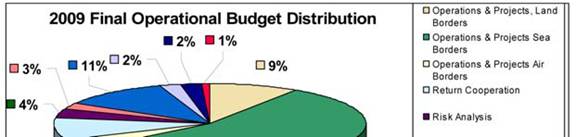
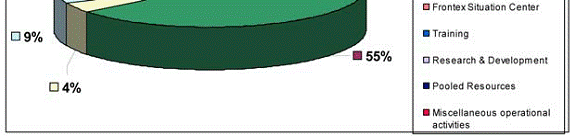
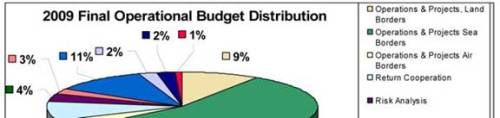
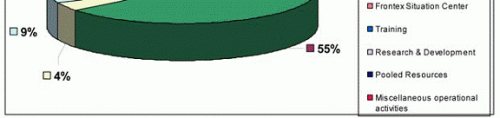
And as I noted in my earlier post, Frontex continued to devote the biggest single portion of its expenditures to maritime enforcement.  Almost 40% of Frontex’s total budget, over € 34 million, was spent on sea operations in 2009, constituting 55% of the operational budget.

This chart from the Report (p 23) shows the breakdown of expenditures within the 2009 Operational Budget (which was 71% of the total 2009 Frontex budget).
Click here for previous post.

Click here for the Frontex General Report 2009.
2 Comments

Filed under Aegean Sea, Algeria, Data / Stats, Eastern Atlantic, Frontex, Greece, Italy, Libya, Malta, Mauritania, Mediterranean, Reports, Senegal, Spain

EU-Libya Association Agreement Negotiations

A Reuters article from 11 May reports that the EU and Libya may sign a cooperation pact known as an Association Agreement before the end of the year and that the pact would address matters such as trade and the control illegal immigration.   An EU mission will likely be opened in Libya before the end of the year according to Reuters.

Commissioner Cecilia Malmström during an interview with the Times of Malta several weeks ago referred to her efforts to begin immigration discussions with Libya:

“Libya is not exactly the easiest government to cooperate with and you know that much better being neighbours. It’s a complicated but important country and we will try to move forward. I’ve already written a letter to the Libyan Foreign Minister suggesting that we should sit together and identify areas where we can cooperate more in the field of migration.”

And Frontex’s 2009 General Report states that one of Frontex’s “overriding priorit[ies]” for 2010 is the development of “structured operational co-operation with neighbouring Mediterranean countries.”  Presumably Frontex desires such an agreement with Libya.

Click here and here for articles.

2 Comments

Filed under European Union, Frontex, Libya, Mediterranean, News

LIBE Votes to Refer Frontex Sea Border Rules to JURI

At its meeting on 10 May, the LIBE committee voted to send a request to the JURI committee regarding the Council Decision pertaining to the procedures to be applied during Frontex surveillance and interdiction operations at sea.  The request asks the JURI committee to refer the Council Decision to the European Court of Justice on the procedural ground that the Council Decision should not have been dealt with as a comitology measure but instead should be grounded on a legal basis.

I have not yet been able to find a copy of the LIBE committee’s letter to JURI, but a video of the LIBE committee meeting can be found on the EP Multimedia Library here or here.  The vote and the brief discussion occurs at approximately 16:44 in the video.

Click here for an earlier post.

2 Comments

Filed under European Union, Frontex, Judicial, News

Italy Will Try to Convince Malta to Resume Frontex Patrols

A bi-lateral meeting between Italy and Malta is scheduled for Thursday, 13 May.  Italy’s Interior Minister Roberto Maroni reportedly has said that he will try to convince Malta to recommit to the Frontex sea patrols.  Maroni expressed concern that the lack of participation by Malta in the patrols will have negative consequences because it will create a break in what was a united front in the Mediterranean.

Click here (EN) and here (IT) for articles.

1 Comment

Filed under Frontex, Italy, Malta, Mediterranean, News

Details from Frontex General Report 2009 (Post 1 of 2)

There is nothing really unexpected in the Frontex General Report for 2009.  If anything, it disappoints with its limited information.

The number of illegal border crossings at EU borders was smaller by a third in 2009 compared to 2008 and Frontex’s budget increased by 25% to € 88.3 million.

Frontex continued to devote the biggest single portion of its expenditures to maritime enforcement.  Almost 40% of Frontex’s total budget, over € 34 million, was spent on sea operations in 2009.  This constitutes 55% of the operational budget.  The Report notes that this cost is due to the high operating costs of ships and surveillance aircraft.

Expenditures for Frontex facilitated return operations sharply increased by 500% in 2009 to almost € 5.5 million.

Limited Information in the Report – The Report explains that Frontex made a decision in 2008 to decrease the level of detail provided in the General Report.  Frontex’s justification is that the Report “is mainly directed towards the general public” and the reduced level of detail “is more suited to this audience.”  This practice was unfortunately continued in the 2009 Report.

General Statistics – Overall there were 106,200 “detections of illegal border-crossings” at EU external land and sea borders in 2009.  This represents a 33% decrease in overall detected crossings relative to 2008, with a 23% reduction of detections at sea and a 43% reduction at land borders.

The reductions are attributed by Frontex to the economic crisis and to bilateral “collaboration agreements with third countries of departure” such as Libya, Senegal, and Mauritania.

Applications for international protection within the EU were 2% fewer in number than in 2008 and were approximately 50% of the 2001-2002 peak when 420,000 applications for international protection were filed.

Cooperation with Non-EU / Non-Schengen Countries – The Report states that cooperation with third countries, including neighbouring countries and countries of origin, is the critical element in “integrated border management.”   It describes Operation HERA as Frontex’s most successful joint operation due to close cooperation with West African countries, particularly Senegal and Mauritania.  On other fronts, “considerable progress” was made with Turkey consisting of Turkey’s appointment of a “first point of contact for Frontex related coordination issues” and preparation of a draft text of a possible Working Arrangement agreement.  “Ad hoc operational co-operation” was pursued when a targeted country was not willing or able to enter into a formal Working Arrangement with Frontex.  An “overriding priority” for Frontex in 2010 is the development of “structured operational co-operation with neighbouring Mediterranean countries.”  The Report acknowledges the existence of the bilateral migration agreement between Italy and Libya, but says nothing about its provisions other than to say that there were “contrasting interpretations of the International Law of the Sea” between Member States.  There is no criticism in the Report whatsoever of the Italian push-back practice.  It is obviously difficult for Frontex to criticise Italy, but was it not possible to note that most people and organizations who have considered the push-back practice have concluded that the practice violates international law?

New Partner Organisations – Frontex formalised a co-operation plan with Europol in October, a Working Arrangement with Interpol in May, a co-operation plan with IOM in February, and made a tripartite agreement with the European Maritime Safety Agency (EMSA) and the Community Fisheries Control Agency (CFCA) relating to maritime surveillance.

More to follow: I will post a second summary with additional information from the General Report pertaining to the specific sea operations for which information is provided within the next day or two.

Click here for the Report.

2 Comments

Filed under Aegean Sea, Data / Stats, Eastern Atlantic, European Union, Frontex, Greece, Italy, Libya, Malta, Mauritania, Mediterranean, Reports, Senegal, Spain, Turkey

Icelandic Coast Guard-Frontex Ship Delivers Charity Supplies to Senegal

The Icelandic Coast Guard ship Ægir will be participating in Frontex patrols off the Senegalese coast from May to October.  Iceland will also provide at least one surveillance plane, a TF-SIF, to the Frontex mission. While not an EU member (at least not yet), Iceland is a Schengen country.  The Coast Guard will reportedly use funds paid by Frontex for the mission to also partially fund helicopter rescue services in Iceland.

Before starting its Frontex patrols, the ship delivered charitable donations from Iceland for ABC Children’s Aid, an Icelandic charity with programmes in Dakar.

Click here, here, and here for articles.

Leave a comment

Filed under Eastern Atlantic, Frontex, Iceland, News, Senegal

LIBE Vote Scheduled for 10 May re Challenge to Frontex Sea Border Surveillance Rule

LIBE members are scheduled to vote on Monday, 10 May, regarding a request to the JURI committee to approve an ECJ challenge to the new Frontex sea border surveillance rules.  Draft Agenda item 4: “Comitology measure on sea border surveillance (FRONTEX): Request to JURI concerning referral to European Court of Justice.”  The vote is scheduled to follow a report by Commissioner Cecilia Malmström to LIBE regarding the Commission’s work since its entry into office.

Click here for draft agenda.

1 Comment

Filed under European Union, Frontex, News

Publication of Council Decision re Rules for Sea Border Operations Coordinated by Frontex

The Council decision on the surveillance of  sea external borders has been published in the EU Official Journal: “COUNCIL DECISION of 26 April 2010 supplementing the Schengen Borders Code as regards the surveillance of the sea external borders in the context of operational cooperation coordinated by the European Agency for the Management of Operational Cooperation at the External Borders of the Member States of the European Union.”

Malta has strenuously objected to certain provisions within the new rule and has said that its decision not to host Frontex’s Central Mediterranean enforcement operation, Operation Chronos, was due to the disembarkation provisions contained in the new Frontex rule.  It should be noted that Malta has more recently said that its decision not to participate in Operation Chronos was due to the lack of need for the operation given the “success” of Italy’s push-back practice.

Malta’s objection to the guidelines is largely focused on the following provision in the rule for sea border operations:

“2. Disembarkation

2.1. The operational plan should spell out the modalities for the disembarkation of the persons intercepted or rescued, in accordance with international law and any applicable bilateral agreements. The operational plan shall not have the effect of imposing obligations on Member States not participating in the operation.  Without prejudice to the responsibility of the Rescue Coordination Centre, and unless otherwise specified in the operational plan, priority should be given to disembarkation in the third country from where the ship carrying the persons departed or through the territorial waters or search and rescue region of which that ship transited and if this is not possible, priority should be given to disembarkation in the host Member State unless it is necessary to act otherwise to ensure the safety of these persons.”

Commissioner Cecilia Malmström pointed out during her recent official visit to Malta that the rule could be interpreted by the member states participating in an operation so as to provide for disembarkation of migrants at a location other than the host state.

(HT to Steve Peers (Univ. of Essex) via Bernard Ryan on Migration and Law Network list serve.)

Click here for the Council Decision.

4 Comments

Filed under European Union, Frontex, Malta, Mediterranean, News

Spanish Parliamentary Delegation Visits Senegal to Discuss Immigration

A Spanish parliamentary delegation from the Foreign Affairs Committee has completed an official visit to Senegal where they visited the Spanish-Frontex mission based in Dakar and met with Senegalese government officials.  The Spanish delegation included Josep Antoni Duran i Lleida, Chair of the Standing Committee on Foreign Affairs of the Congress of Deputies, and Jorge Moragas, coordinator of the Presidency and International Relations for the Partido Popular.

Duran i Lleida noted that no boat has succeeded in reaching the Canary Islands in recent months and that this is due to the Spanish presence in Senegal in the form of the National Police and Civil Guard.  The Spanish presence in Senegal along with support from Frontex carries out ongoing surveillance and patrols known as Operation Hera.

Duran i Lleida is quoted as saying that “Thanks to the work of the Spanish National Police and Civil Guard and collaboration with security forces, Senegal has managed to curb illegal immigration.”  He writes on his blog (in Catalan) that “for many years, Senegal is a country that has exported more illegal immigration. … Spanish authorities decided to negotiate with Senegal the conditions for ending illegal immigration. … Here in Dakar there is a unit of the Guardia Civil and [Spanish] police force with naval and air means that control, in collaboration with the Senegalese, the possible departures of illegal immigrants.”

Click here (ES), here (ES), and here (ES) for articles.

1 Comment

Filed under Eastern Atlantic, Frontex, News, Senegal, Spain