Tag Archives: Frontex

Malta Objects to Proposed Changes in Frontex High-Seas Interception Guidelines

The Government of Malta has reportedly objected to proposed changes to Frontex operational guidelines and has threatened to possibly end its participation in patrols overseen by Frontex.

The proposed changes to the Frontex guidelines were made by the European Council and will be considered by the European Parliament.  The changes would require that migrants intercepted at sea be sent to the country hosting the Frontex mission if the migrants could not be returned to the country from which they last departed.  Currently intercepted migrants are to be taken to the nearest port.

“In terms of the new guidelines, should Malta host a Frontex mission, as it has done in the past two years, it will have to take all the immigrants rescued, even if they were picked up outside its search and rescue region and closer to other countries. ‘We will still continue to follow our international obligations to the letter as we’ve always done but we will not accept changes to these international obligations,’ a Malta government spokesman said.

Even if Frontex guidelines were to be changed, Italy will presumably continue its policy of forcibly returning to Libya migrants intercepted by Italian authorities.

Click here for full article.

Leave a comment

Filed under European Union, Frontex, Malta, Mediterranean, News

Besson appelle l’UE à accélérer le renforcement de l’agence européenne Frontex et la surveillance des frontières européennes

“Les corps de neuf migrants morts noyés en tentant de gagner la Grèce à partir de la Turquie ont été découverts depuis cinq jours au large du port grec d’Alexandroupolis….

“Alors que les frontières extérieures de l’Union Européenne sont soumises en Grèce à une pression sans précédent des filières d’immigration irrégulière, plus de la moitié des entrées illégales dans l’espace Schengen ayant été enregistrées en 2009 à la frontière turco-grecque, Eric BESSON appelle l’Union Européenne à renforcer la surveillance des frontières européennes notamment en Méditerranée.

“Eric BESSON interviendra dans les prochains jours auprès du Commissaire européen chargé de l’immigration pour demander que les décisions prises par les Chefs d’Etat et de Gouvernement européens pour le renforcement de l’agence européenne Frontex soient mises en oeuvre sans délai.

“Ces décisions, adoptées sur proposition de la France par le Conseil européen du 30 octobre 2009, portent en particulier sur :

  • L’adoption de règles d’engagement claires pour les opérations de contrôle maritimes.
  • Une coopération opérationnelle accrue entre Frontex et les pays d’origine et de transit, notamment la Libye et la Turquie.
  • La possibilité d’affréter régulièrement des vols conjoints financés par Frontex pour des opérations groupées d’éloignement au niveau européen.

“Eric BESSON demandera également que la coopération de la Turquie dans la lutte contre les filières d’immigration irrégulière soit placée au centre des relations entre l’Union Européenne et ce pays.

“Eric BESSON proposera enfin à la présidence espagnole de l’Union Européenne que la prochaine réunion des Ministres européens en charge de l’immigration, le 21 janvier à Tolède, permette de définir une feuille de route précise pour l’application des décisions du Conseil européen et les relations avec la Turquie dans le domaine de la circulation des personnes.”

Click here for full Statement.

Leave a comment

Filed under Aegean Sea, European Union, France, Frontex, Greece, Mediterranean, Statements, Turkey

Canary Islands – Migrant arrivals at 10 year low

2,242 migrants arrived in the Canary Islands in 2009 compared with approximately 9,000 in 2008.  This was the lowest number of migrant arrivals since 1999 when 2,165 migrants arrived. There were 32 confirmed migrant deaths in 2009 compared to 45 in 2008.

The largest number of migrant arrivals took place in 2006 when 31,859 migrants arrived.  Coordinated Frontex operations were expanded beginning in May 2006.  Since 1994 there have been over 96,000 recorded arrivals.

Click here (EN), here (FR) and here (ES) for articles.

Leave a comment

Filed under Data / Stats, Eastern Atlantic, Frontex, News, Spain

Le nombre de clandestins arrivés en Espagne soit retombé à 7.000

“Le chef du gouvernement espagnol José Luis Rodriguez Zapatero s’est félicité … que le nombre de clandestins arrivés en Espagne soit retombé à 7.000 en 2009 contre 14.000 en 2008, estimant être en train de ‘gagner le combat’ contre l’immigration illégale.”

“Selon des statistiques encore provisoires, le nombre des clandestins subsahariens arrivés cette année dans des embarcations de fortune sur le seul l’archipel espagnol des Canaries, au large de l’Afrique, est retombé à environ 2.250, contre plus de 9.000 en 2008 et un record de 31.600 en 2006.  Le nombre de clandestins arrivés cette année sur les côtes d’Andalousie, en provenance notamment du Maghreb, a en revanche augmenté.”

Zapatero “a attribué cette baisse globale aux accords de coopération conclus avec les pays d’origine en Afrique et au renforcement des moyens de lutte contre l’immigration clandestine, notamment le dispositif européen Frontex au large des côtes africaines.”

Click here for article.

Leave a comment

Filed under Data / Stats, Eastern Atlantic, Frontex, Mediterranean, News, Spain

Workshop: “The Human Costs of Border Control in the Context of EU Maritime Migration Systems”

VU University Amsterdam held a three day Exploratory Workshop in October 2009 on “The Human Costs of Border Control in the Context of EU Maritime Migration Systems.”

Executive Summary of the Workshop’s Goals:

“The ongoing European harmonisation of migration and border control policies has as a side-effect unclear, but definitely rising numbers of fatalities at European borders (different estimates suggest anything between 1.000 and 10.000 annually). This process has considerable consequences for EU institutions, governments, the administrations of EU Member States, for migrants and people assisting migrants, and neighbouring countries. The consequences are diverse in nature, concerning policy, institutions, social cohesion and conflict, and law. However, while these consequences of the Europeanisation of migration policy are the subject of numerous academic studies, until now, the human costs of border control has received only isolated academic attention. There are insufficient data, and a comprehensive analysis is lacking. This workshop aims at bringing together leading European academics from different disciplines working on this issue. The immediate aim of the workshop is to integrate the analyses of those academics, with a view to developing a comprehensive analysis. The ultimate aim is to create a network engaging in comprehensive data gathering and analysis, leading to concrete suggestions to limit the undesirable side-effects of European migration policies.”

Draft workshop papers (which are not to be quoted or cited to without prior consent of the author) included the following:

Martin Baldwin-Edwards
The Human Costs of Border Control: Greece

Anat Ben-Dor
The un-checked dangers of the Israeli-Egyptian Sinai border

Hein de Haas
Trans-Saharan and Trans-Mediterranean migration – Questioning the transit hypothesis

María Hernández-Carretero
Boat migrants’ perspectives on risk

Ernesto Kiza
The Human Costs of Border Control at the External EU Borders between 1999 and 2004

Silja Klepp
A double bind: Malta and the rescue of unwanted migrants at sea

Mehdi Lahlou
The Human and Political Costs of Irregular Migration: Morocco case

Jorrit J. Rijpma
Frontex: successful blame shifting of the Member States?

Click here for more of the Workshop’s working materials.

Leave a comment

Filed under Colloques / Conferences

Frontex and Other EU Agencies to Coordinate Maritime Surveillance

According to identical news releases issued by Frontex and the Community Fisheries Control Agency (CFCA), Frontex, the CFCA, and the European Maritime Safety Agency (EMSA) have entered into an agreement “with a view to cooperate, in accordance with their respective mandates, in the field of maritime surveillance that will be mutually beneficial for the three agencies.”

The press release goes on to state:

“The Cooperation Agreement will allow for the exchange of information and of expertise as well as of for the exploration of joint use of assets as relevant, optimising the functioning of the European Union as a whole regarding Maritime Surveillance. The cooperation will result in an improvement of the control of external maritime borders of the EU (competence of Frontex), an increase in the maritime safety (competence of EMSA) and an enhancement of the coordination of fisheries control and inspection activities by the Member States (competence of CFCA).

“The main activities comprised in the agreement are the following:

• Exchange of information and data on matters of common interest
• Explore synergies in the use of the maritime surveillance and information systems
• Explore the possibilities of joint use of assets
• Investigate potential cooperation in the field of maritime surveillance directed to the protection of external maritime borders and fisheries control
• Expand mutual collaboration between the Agencies in areas such as coordination of inspections, research and development, training, etc.

Contacts:

  • • EMSA: Pete Thomas, Senior Communication Officer
    Peter.THOMAS@emsa.europa.eu, Tel. +351 21 1209 281
  • • Frontex: Izabella Cooper, Spokesperson,
    izabella.cooper@frontex.europa.eu , Tel. +48 22 544 95 35
  • • CFCA: Patricia Sánchez Abeal, Communication Officer
    patricia.sanchezabeal@cfca.europa.eu , Tel. +34 986 12 06 17”

Click here and here for links to the press releases.

3 Comments

Filed under European Union, Frontex, News

Migrant Arrivals in Malta Lowest in 5 Years

Di-ve.com reports that migrant arrivals in Malta in 2009 were the lowest since 2004.

“Sources close to Frontex … believe that a number of factors helped …  Frontex’s Nautilus patrols, the strengthening of border controls in the Central Mediterranean and tighter inland measures in member states certainly discouraged movement of migrants. … The agreement between Italy and Libya for migrants to be returned to Libya also had an impact but …there are also agreements in place with Algeria and Tunisia, while Libya also reached an agreement with Niger, which is another popular transit country for migrants heading towards Europe. There has been a shift towards the eastern Mediterranean, with Turkey and the Aegean islands seeing numbers increase, the sources said.”

2002 2003 2004 2005 2006 2007 2008 2009
Boats 21 12 53 48 57 68 84 17
Migrants 1686 502 1388 1822 1780 1702 2775 1475

Click here for full article.

Leave a comment

Filed under Data / Stats, Frontex, Malta, Mediterranean, News

Frontex to Expand Operations in Aegean Sea in 2010

Frontex’s director, Ilkka Laitinen, met with Greek Citizens’ Protection Minister Michalis Chrysochoidis and reportedly said that Frontex enforcement operations in the eastern Aegean Sea will be further expanded in 2010.

Minister Chrysochoidis stated that 75% of the arrests for illegal entry from the EU’s sea borders in 2009 year took place in the Aegean.

Director Laitinen said that “[Frontex Operation] Poseidon continues to be our most important operation” and that Frontex’s largest border monitoring operation will take place in the eastern Aegean in 2010.

Click here for article.

Leave a comment

Filed under Aegean Sea, Frontex, Greece, News, Turkey

Frontex Warns Malta About Refugee Resettlement Consequences

MaltaToday reported last month that Frontex officials have warned Malta that resettlement agreements between Malta and the USA and other countries are being used by organised criminal smuggling organisations to market Malta as a preferred destination.

The information was provided at a “Frontex debriefing meeting held in Caltanisetta in Sicily, where military and governmental officials from EU Member States were given details about the recent Nautilus IV mission held in the Mediterranean during this summer…  Senior military sources told MaltaToday that Frontex officials spoke of intelligence that showed how criminals behind the lucrative illegal migration trade were ‘actually marketing Malta as the right destination to direct migrants,’ given that it has now become public that the US is accepting migrants from Malta.”

Over 400 refugees have been resettled from Malta to the USA, France, and other countries.

Click here for article.

Leave a comment

Filed under Frontex, Malta, Mediterranean

EU Stockholm Programme Adopted

EU heads of state and government have adopted the framework for the Stockholm Programme to be implemented during the 2010-2014 period.

Portions of the newly adopted programme relevant to migrants include the following (emphasis added):

[***]

5. Access to Europe in a globalised world

5.1 Integrated management of the external borders

The Union must continue to facilitate legal access to the territory of the Member States while in parallel taking measures to counteract illegal immigration and cross-border crime and maintaining a high level of security. The strengthening of border controls should not prevent access to protection systems by those persons entitled to benefit from them, and especially people and groups that are in vulnerable situations. In this regard, priority will be given to the needs of international protection and reception of unaccompanied minors. It is essential that the activities of Frontex and of the European Asylum Support Office are coordinated when it comes to the reception of migrants at the EU’s external borders. The European Council calls for the further development of integrated border management, including the reinforcement of the role of Frontex in order to increase its capacity to respond more effectively to changing migration flows.

The European Council therefore

▪ requests the Commission to put forward proposals no later than early 2010 to clarify the mandate and enhance the role of FRONTEX, taking account of the results of the evaluation of the Agency and the role and responsibilities of the Member States in the area of border control. Elements of these proposals could contain preparation of clear common operational procedures containing clear rules of engagement for joint operations at sea, with due regard to ensuring protection for those in need who travel in mixed flows, in accordance with international law; increased operational cooperation between Frontex and countries of origin and transit and examination of the possibility of regular chartering financed by Frontex[.] In order to promote the proper enforcement of the applicable statutory framework for Frontex operations, the Commission should consider including a mechanism for reporting and recording incidents that can be satisfactorily followed up by the relevant authorities,

▪ invites FRONTEX itself to consider, within its mandate, establishing regional and/or specialised offices to take account of the diversity of situations, particularly for the land border to the East and the sea border to the South; creating such offices should on no account undermine the unity of the Frontex agency; before creating such offices, Frontex should report to the Council on its intentions,

▪ invites the Commission to initiate a debate on the long-term development of FRONTEX. This debate should include, as was envisaged in the Hague programme, the feasibility of the creation of a European system of border guards,

▪ invites the EASO to develop methods to better identify those who are in need of international protection in mixed flows, and to cooperate with Frontex wherever possible,

▪ considers that the evaluation of the Schengen area will continue to be of key importance and that it therefore should be improved by strengthening the role of Frontex in this field,

▪ invites the Council and the Commission to support enhanced capacity building in third countries so that they can control efficiently their external borders.

[***]

6. A Europe of responsibility, solidarity and partnership in migration and asylum matters

The European Council recognises both the opportunities and challenges posed by increased mobility of persons, and underlines that well-managed migration can be beneficial to all stakeholders. [***]  Furthermore, the European Council recalls that the establishment of a Common European Asylum System (CEAS) by 2012 remains a key policy objective for the EU.

The European Council calls for the development of a comprehensive and sustainable European migration and asylum policy framework, which in a spirit of solidarity can adequately and proactively manage fluctuations in migration flows and address situations such as the present one at the Southern external borders. Serious efforts are needed to build and strengthen dialogue and partnership between the EU and third countries, regions and organisations in order to achieve an enhanced and evidence-based response to these situations, taking into account that illegal immigration enters the Union also via other borders or through misuse of visa. An important objective is to avoid the recurrence of tragedies at sea. When tragic situations unfortunately happen, ways should be explored to better record and, where possible, identify migrants trying to reach the EU.

[***]

6.2 Asylum: a common area of protection and solidarity

The European Council remains committed to the objective of establishing a common area of protection and solidarity based on a common asylum procedure and a uniform status for those granted international protection. While the Common European Asylum System (CEAS) should be based on high protection standards, due regard should also be given to fair and effective procedures capable of preventing abuse. It is crucial that individuals, regardless of the Member State in which their application for asylum is lodged, are offered an equivalent level of treatment as regards reception conditions, and the same level as regards procedural arrangements and status determination. The objective should be that similar cases should be treated alike and result in the same outcome.

6.2.1 A common area of protection

There are still significant differences between national provisions and their application. In order to achieve a higher degree of harmonisation, the establishment of a Common European Asylum System (CEAS), should remain a key policy objective for the EU. Common rules, as well as a better and more coherent application of them, should prevent or reduce secondary movements within the EU, and increase mutual trust between Member States.

The development of a Common Asylum Policy should be based on a full and inclusive application of the Geneva Convention on the status of refugees and other relevant international treaties. Such a policy is necessary in order to maintain the long-term sustainability of the asylum system and to promote solidarity within the EU. Subject to a report from the Commission on the legal and practical consequences, the European Union should seek accession to the Geneva Convention and its 1967 Protocol.

[***]

6.2.3 The external dimension of asylum

The EU should act in partnership and cooperate with third countries hosting large refugee populations. A common EU approach can be more strategic and thereby contribute more efficiently to solving protracted refugee situations. Any development in this area needs to be pursued in close cooperation with the UNHCR and, if appropriate, other relevant actors. The European Asylum Support Office should be fully involved in the external dimension of the CEAS. In its dealings with third countries, the EU has the responsibility to actively convey the importance of acceding to, and implementing of, the 1951 Geneva Convention on Refugees and its Protocol.

Promoting solidarity within the EU is crucial but not sufficient to achieve a credible and sustainable common asylum policy. It is therefore important to further develop instruments to express solidarity with third countries in order to promote and help building capacity to handle migratory flows and protracted refugee situations in these countries.

The European Council invites

• the Council and the Commission to enhance capacity building in third countries, in particular their capacity to provide effective protection, and to further develop and expand the idea of Regional Protection Programmes, on the basis of the forthcoming evaluations. Such efforts should be incorporated into the Global Approach to Migration, and should be reflected in national poverty reduction strategies and not only be targeting refugees and internally displaced persons but also local populations.

▪ the Council, the European Parliament and the Commission to encourage the voluntary participation of Member States in the joint EU resettlement scheme and increase the total number of resettled refugees, taking into consideration the specific situation in each Member State,

▪ the Commission to report annually to the Council and the European Parliament on the resettlement efforts made within the EU, to carry out a mid-term evaluation during 2012 of the progress made, and to evaluate the joint EU resettlement programme in 2014 with a view to identifying necessary improvements,

▪ the Council and the Commission to find ways to strengthen EU support for the UNHCR,

▪ the Commission to explore, in that context and where appropriate, new approaches concerning access to asylum procedures targeting main transit countries, such as protection programmes for particular groups or certain procedures for examination of applications for asylum, in which Member States could participate on a voluntary basis.

[***]

7.3 Continued thematic priorities with new tools

The European Council considers that the key thematic priorities identified in the previous strategy remain valid, i.e. the fight against terrorism, organised crime, corruption, drugs, the exchange of personal data in a secure environment and managing migration flows. The fight against trafficking in human beings and smuggling of persons needs to be stepped up.

Building on the Strategy for Justice, Home Affairs and External Relations adopted in 2005 and other relevant acquis in this field, such as the Global Approach to Migration, EU external cooperation should focus on areas where EU activity provides added value, in particular:

– Migration and asylum, with a view to increasing EU dialogue and cooperation with countries of origin and transit in order to improve their capacity to carry out border control, to fight against illegal immigration, to better manage migration flows and to ensure protection as well as to benefit from the positive effects of migration on development; return and readmission is a priority in the EU’s external relations,

[***]

The European Council invites the Commission to

▪ examine whether ad hoc cooperation agreements with specific third countries to be identified by the Council could be a way of enhancing the fight against trafficking and smuggling of persons and making proposals to that end. In particular, such agreements could involve full use of all leverage available to the Union, including the use of existing financing programmes, cooperation in the exchange of information, judicial cooperation and migration tools.

[***]

7.5 Geographical priorities and international organisations

[***]

As regards the Union for the Mediterranean, it will be necessary to enhance the work started in the context of the Barcelona process and the Euro-Mediterranean Partnership, in particular regarding migration (maritime), border surveillance, preventing and fighting drug trafficking, civil protection, law enforcement and judicial cooperation. The European Council invites the Commission in cooperation with the High Representative to submit such a plan in 2010 and asks Coreper to prepare as soon as possible the decisions to be taken by the Council. The European Council will review the Plan by the end of 2012, and in particular to assess its impact on the ground.

As regards the situation in the Mediterranean area, the European Council considers that a stronger partnership with third countries of transit and origin is necessary, based on reciprocal requirements and operational support, including border control, fight against organised crime, return and readmission. Rapid action to face the challenges in this region is a priority.

[***]

The European Council notes that the 2007 EU-Africa Joint Strategy and Action Plan define the scope of cooperation in the areas of counter-terrorism, transnational crime and drug trafficking. Both within the EU-Africa Partnership on Mobility, Migration and Employment (MME) and the EU Global Approach to Migration, and the follow up process of the Rabat, Paris and Tripoli conferences, the dialogue on migration should be deepened and intensified with African Partners, focussing on countries along the irregular migration routes to Europe with a view to assisting those countries in their efforts to draw up migration policies and responding to illegal immigration at sea and on the borders. Efforts should be made to enhance cooperation, including the swift conclusion of re-admission agreements, with Algeria, Morocco and Egypt, and, in line with the European Council conclusions in October 2009, with Libya.

West Africa has recently developed into a major hub for drug trafficking from South America to Europe and will require enhanced attention and assistance to stem drug trafficking as well as other transnational crime and terrorism (within the Sahel).

[***]

Click here for full text.

Leave a comment

Filed under Communiqués, European Union, Frontex

France: Frontex Nautilus IV Operation is a Failure (News)

French Immigration Minister Eric Besson has characterized Frontex’s ongoing Nautilus IV operation which is based in Malta as “a complete failure.”  He said the legal uncertainty regarding member state responsibility for intercepted boats hampered the operation and caused some member states to withdraw from the operation.

Italy, for example, has refused to contribute assets to the Nautilus IV operation due to a dispute over where intercepted migrants should be taken.  Italy of course is unilaterally returning migrants who it intercepts directly to Libya without offering the intercepted migrants an opportunity to make asylum or other claims for protection.

Click here and here for articles.

Leave a comment

Filed under France, Frontex, Italy, Malta, Mediterranean, News

Frontex Concedes it “May Be Helping” with Italian Push-Back Practice (News)

A Frontex spokesperson has modified Frontex’s strong denial several days ago that it had no involvement in or responsibility for the Italian push-back practice in the Mediterranean.

Frontex now concedes that it is assisting the Italians with the detection and interception of migrant boats, but that Frontex has no information regarding what happens to intercepted migrants after the Italian coastguard intercepts them.

“In an interview with European Voice [reporter Judith Crosbie], [Frontex spokesperson Gil] Arias-Fernández said: ‘Technically speaking, assets co-ordinated by Frontex are taking part in operations in the area and … these people could be sent back to their country of origin.’ But he said to hold Frontex responsible for the return of migrants to Libya was ‘far from reality’. ‘We can’t be accountable for decisions taken by Italy,’ he said.”  Arias- Fernández, however, conceded that Frontex might bear some moral responsibility for the push-back practice.

Click here for article.

Leave a comment

Filed under Frontex, Italy, Libya, Mediterranean, News

Frontex Issues Response to HRW Report (Communiqués)

Frontex has denied responsibility for and involvement in the Italian push-back practice.

Full text of the Frontex press release:

“By way of response to statements included in the Human Rights Watch report “Pushed Back, Pushed Around” Frontex would like to state categorically that the agency has not been involved in diversion activities to Libya (these are based on a bilateral agreement which Italy signed with Libya in May this year).

“The Frontex operation referred to in the report, Operation Nautilus 2009, was underway on June 18th 2009, but in a different operational area. Though German helicopters did participate in this operation, they were at no time involved in the incident described in the report (on the basis of two press reports, one from ANSA and one from Malta Today).

“In general, Frontex would like to point out that the task of helicopters involved in joint operations coordinated by the agency is only to patrol the operational area, not to divert. “

Click here for press release.

Leave a comment

Filed under Communiqués, Frontex, Italy, Libya, Mediterranean

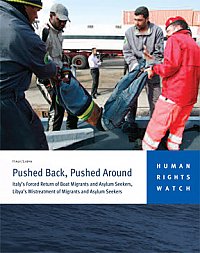
HRW Report: Italy’s Forced Return of Boat Migrants and Asylum Seekers, Libya’s Mistreatment of Migrants and Asylum Seekers (Reports)

Blog - HRW Cover

Human Rights Watch has released a report regarding Italy’s forcible push-back policy:

Pushed Back, Pushed Around – Italy’s Forced Return of Boat Migrants and Asylum Seekers, Libya’s Mistreatment of Migrants and Asylum Seekers

“On May 6, 2009, for the first time in the post-World War II era, a European state ordered its coast guard and naval vessels to interdict and forcibly return boat migrants on the high seas without doing any screening whatsoever to determine whether any passengers needed protection or were particularly vulnerable. The interdicting state was Italy; the receiving state was Libya.  Italian coast guard and finance guard patrol boats towed migrant boats from international waters without even a cursory screening to see whether some might be refugees or whether others might be sick or injured, pregnant women, unaccompanied children, or victims of trafficking or other forms of violence against women. The Italians disembarked the exhausted passengers on a dock in Tripoli where the Libyan authorities immediately apprehended and detained them.”

HRW’S Recommendations include:

“To the Government of Italy

  • Immediately cease interdicting and summarily returning boat migrants to Libya.
  • Investigate allegations that Italian naval personnel beat and used electric shocks to force interdicted boat migrants onto Libyan vessels and prosecute naval or coast guard officials who abused their authority, including those with command responsibility.
  • Stop cooperating with the Libyan authorities on the interdiction and interception of third-country nationals trying to leave Libya.
  • Make public all treaties and agreements between the governments of Italy and Libya.
  • Cease to fund or provide other bilateral support to Libya aimed at increasing that country’s effectiveness at intercepting asylum seekers and migrants before they take to the sea or before they reach Italian waters. Redirect such support into multilateral efforts, especially through UNHCR and OHCHR, to ensure that fundamental human rights standards relating to the treatment of such persons in Libya are observed.
  • Ensure access to full and fair asylum procedures, including the right to raise fear of treatment contrary to article 3 of the ECHR, for every person in the control of the Italian authorities, including those interdicted or rescued at sea.”

“To European Union Institutions and EU Member States

  • Demand that Italy not violate article 3 of the European Convention on Human Rights by its interdiction and summary return of migrants to a place where they are subjected to inhuman and degrading treatment.
  • Ensure access to full and fair asylum procedures, including the right to raise fear of treatment contrary to article 3 of the ECHR, for every person in the control of any EU member state, including those interdicted or rescued at sea.
  • Adopt clear, consistent, and binding rules on EU member states establishing responsibility for disembarking migrants rescued at sea.
  • Refrain from expelling third-country (non-Libyan) nationals to Libya, either directly or as partners in Frontex-coordinated operations, until Libya’s treatment of migrants, asylum seekers and refugees fully meets European standards in relation to persecution or risk of treatment contrary to article 3 ECHR. Under current conditions, the return of third-country nationals breaches European nonrefoulement obligations not to return people to inhuman or degrading treatment.
  • Encourage Libya to 1) ratify the 1951 Refugee Convention and its 1967 Protocol; 2) adopt a national asylum law; and 3) formally recognize UNHCR.
  • Display greater transparency in negotiations with Libya on all matters relating to migration and border controls.
  • Ensure  that the human rights clause in the Libya-EU Framework Agreement, being negotiated at the time of this writing, and in agreements flowing from it, contain explicit reference to the rights of asylum seekers and migrants as a prerequisite for any cooperation on migration-control schemes.
  • Refrain from encouraging Libya from establishing any reception regime which falls below the European reception condition standards
  • Quickly admit UNHCR-identified refugees in need of resettlement from Libya. Do so, however, only as a supplement rather than as a substitute for allowing spontaneous arrivals in EU territory to seek asylum.
  • Direct development assistance to improve respect for human rights and human dignity in migrants’ and asylum seekers’ countries of origin to address the root causes of forced migration.”

Click here for the report.

Leave a comment

Filed under European Union, Frontex, Italy, Libya, Mediterranean, Reports