Tag Archives: Greece

Frontex Announces Expansion of Joint Operation Poseidon Sea to Include Crete and Eastern Portions of Central Mediterranean

Two days after announcing the extension of Joint Operation Hermes and the westward expansion of the operational area of JO Hermes to include the waters around Sardinia, Frontex on 26 March announced the expansion of the operational area of Joint Operation Poseidon Sea to include the waters around Crete.  The expansion is due to the “highly volatile situation in North Africa” and was called for by the European Council’s Conclusions issued at the end of the Council meeting of 24/25 March: “the Commission will make additional resources available in support to [Frontex’s] 2011 Hermes and Poseidon operations and Member States are invited to provide further human and technical resources.”

Excerpts from the Frontex statement:  “March 26, 2011 — Responding to the highly volatile situation in North Africa Frontex extends operational area of its on-going Joint Operation (JO) Poseidon Sea. In the first four weeks of deployment Joint Operation Poseidon Land sees decreasing numbers of arrivals across the land border with Turkey.   In view of potential migratory flows from Libya operational area of JO Poseidon Sea, which covers the Greek islands in the Aegean sea, has been widened to include Crete. On Thursday, 24 February Romanian maritime surveillance vessel and a Portuguese plane were deployed to increase patrolling intensity in this region. [***]”

Click here for Frontex Poseidon Sea press release.

Click here for the Frontex Hermes press release.

Click here for the Council Conclusions.

Click here for previous post on the expansion of JO Hermes.

Leave a comment

Filed under Aegean Sea, European Union, Frontex, Greece, Italy, Libya, Mediterranean, News, Tunisia

Update from Today’s LIBE Committee’s Discussions re Central Mediterranean

The Hungarian Presidency and LIBE have released summaries regarding today’s LIBE Committee meeting.  Here are some points from the two summaries:

  • Commissioner Malmström emphasized that, so far, migrants had not started coming to Europe from Libya, but the EU had to prepare for this possibility;
  • Frontex Director Laitinen made it clear that the region should not be seen as a whole, but as separate countries with separate problems;
  • Laitinen underlined that from Tunisia only economic migration could be seen so far, but for the moment, as Tunisian authorities have regained control of the migration flow, this had stopped, as well. Since 26 February, no migrants had arrived to Lampedusa.
  • Laitinen also stressed that Italy was not the only entry point for migrants from North-Africa. Greece should not be forgotten in this context.  Low-cost flights from North-Africa to Istanbul were operating, bringing many migrants who then were trying to enter the Schengen area through the Greek-Turkish border;
  • Laitinen said that the possibility of extending Hermes to address Malta’s needs was being examined. More money and staff might be needed if the current emergency persists;
  • MEPs urged Member States to accelerate work on the “asylum package” and stressed the need for solidarity as regards relocating migrants;
  • Malmström said that most of the current migration from Tunisia to Lampedusa appears to be for economic reasons;
  • Malmström said that “Frontex and Member States may not push away people in need of international protection”;
  • MEP Simon Busuttil (EPP, MT) said the three main priorities in Libya are halting violence, sending humanitarian aid and planning for a possible immigration emergency. “What if a mass influx turns into Europe, is there a plan in the drawer to be pull out if this happens?” “Member States show no appetite for relocation.”

Click here and here for the two articles.

Leave a comment

Filed under European Union, Frontex, Greece, Hungary, Italy, Libya, Malta, Mediterranean, News, Tunisia, Turkey

ASIL Insight article about M.S.S. v. Belgium & Greece

ASIL has just published an Insight article about M.S.S. v. Belgium & Greece written by Tom Syring, Co-chair of the ASIL International Refugee Law Interest Group, who currently serves at the Norwegian Immigration Appeals Board.

Excerpt from the conclusion:  “Apart from criticizing Greece for the current conditions of detention and subsistence awaiting asylum seekers, and Belgium for ‘intentional blindness’ for failing to properly scrutinize the adequacy of protection against refoulement in Greece, despite the fact that circumstances had called for application of the sovereignty clause, the Grand Chamber’s judgment exposes flaws in the current European asylum regime.

The judgment acknowledges … challenges [posed by CEAS and the Dublin regulation], yet underlines that neither uneven burden-distribution (Greece) nor a state’s minimalist reading of the Dublin Regulation (Belgium) absolves Member States of their responsibilities vis-à-vis the Convention or other applicable international treaties, including the 1951 Refugee Convention. As long as the EU and CEAS are comprised of individual Member States, as opposed to a ‘United States of Europe,’ individual states will be held responsible for independently assessing each case for the risk of direct or indirect refoulement.   While the Grand Chamber judgment uncovered a number of deficiencies in the current European asylum system, solutions to CEAS may have to be found outside the ‘Dublin world.’”

Click here for full article.

1 Comment

Filed under Analysis, Belgium, European Union, General, Greece, Judicial

JHA Council Meets 24-25 Feb – Meeting Topics Include North African Migrants, EASO, Greek Asylum Reform, EU-Turkey Readmission Agreement, and Frontex 2011 Work Programme

The two day JHA Council meeting begins today in Brussels.  According to the Background Note, “ministers will discuss the major influx of migrants from Northern Africa, particularly from Tunisia, to Southern EU member states, especially Italy. They will also look at the state of play on three other important internal border and migration issues:  the implementation of Greece’s National Action Plan on Migration Management and Asylum Reform; [and] the EU-Turkey readmission agreement. In this context, the Communication will present an evaluation and future strategy for EU readmission agreements;…  Ministers will then have exchange of views with the High Commissioner for Refugees (UNHCR) as well as with the Executive Director of the recently established European Asylum Support Office (EASO).”  Additionally, “FRONTEX will present to the committee its work programme for 2011.”

Click here for Background Note and here for Agenda.

Leave a comment

Filed under Aegean Sea, European Union, Frontex, Greece, Italy, Libya, Malta, Mediterranean, News, Tunisia, Turkey, UNHCR

Times of Malta: Frontex Preparing for “Unprecedented” Migrant Flow from Libya

The Times of Malta reports today that Frontex “has been given instructions to start preparing for a possible unprecedented influx of immigrants and asylum seekers fleeing Libya towards the EU, particularly through Malta and Lampedusa.” “‘The fact that the Libyan regime does not seem to be in control of the huge expanse of the 2,000-km long Libyan coastline might already pose a big danger of a flood of asylum seekers crossing by rogue boats towards Malta, Lampedusa and Sicily,’ the sources said.”  According to the article the planned response to a massive flow would involve all 27 member states.  EU spokesman for Home Affairs Michele Cercone confirmed that Frontex was engaged in planning for a migrant flow from Libya, but said he would not “speculate on details and suppositions.”  The article also states that “six EU Mediterranean member states [Malta, France, Cyprus, Spain, Greece, and Italy] will meet in Rome tomorrow in an urgent minisummit to devise a common stance on the immigration crisis facing the southern Mediterranean region, a day before official talks of EU justice ministers in Brussels.”

Click here article.

1 Comment

Filed under Cyprus, European Union, France, Frontex, Greece, Italy, Libya, Malta, Mediterranean, News, Spain

Video of Yesterday’s EP Plenary Session Addressing Common EU Asylum System and the Italian Migration Emergency

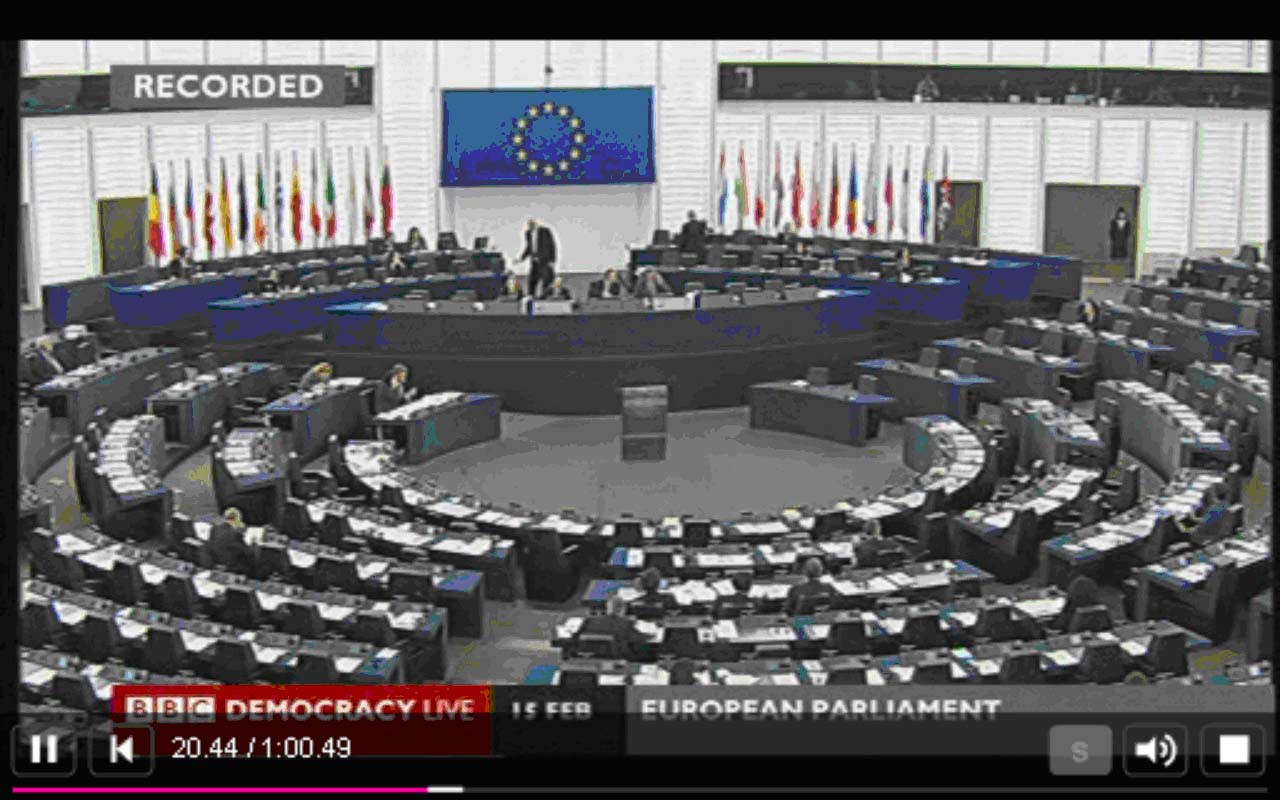
Of possible interest to a few, here are two links to the portions of yesterday’s plenary session of the European Parliament where the Common EU Asylum System and the migration emergency in Italy were discussed by a few MEPs and Commissioner Malmström.  As you can see from my screen shot below of the debate regarding the migration emergency, very few MEPs were in attendance.

Click here (Common EU Asylum System) and here (migration emergency) for link to the BBC’s Democracy Live site with the video.

Leave a comment

Filed under European Union, Frontex, Greece, Italy, Mediterranean, News, Tunisia, Turkey

EP Plenary Session on 15 Feb Will Consider the Question of “Immediate EU measures in support of Italy and other MS affected by exceptional migratory flows”

The agenda for the Tuesday, 15 February, plenary session of the European Parliament will include the following two items:

  • State of European asylum system, after the recent decision of the European Court of Human Rights – Commission statement [2011/2579(RSP)]
  • Immediate EU measures in support of Italy and other Member States affected by exceptional migratory flows – Commission statement [2011/2582(RSP)]

These agenda items are scheduled to be considered at 16:00 or at the end of the preceding debate.

Click here for agenda.

1 Comment

Filed under European Union, Italy, Mediterranean, News, Tunisia

Euro-Africa Conference on Illegal Immigration, Human Trafficking, Drug Trafficking, and Terrorism (Napoli, 7-9 February)

The Italian Interior Ministry and the Direzione Centrale dell’Immigrazione e della Polizia delle Frontiere are conducting a three day conference, beginning today, in Napoli, 7-9 February.  In attendance will be top police officials from 45 African countries, 25 EU countries as well as officials from agencies including Interpol, Europol, Frontex and, as observers, representatives of the US FBI and Dept. of Homeland Security.  Among those scheduled to attend are Rodolfo Ronconi, Direttore Centrale dell’Immigrazione e della Polizia delle Frontiere, Interior Minister Roberto Maroni, INTERPOL Secretary General Ronald Noble, EUROPOL Director Rob Wainwright, and Frontex Director Ilkka Laitinen.

According to a draft agenda for the conference, discussion topics will include:

  • Immigration Group – The African continent as a source and place of transit for migratory flows towards Europe across the Mediterranean Sea.  Internal migration within African. Threat assessment, ongoing bilateral initiatives, multilateral initiatives, and methods of law enforcement;
  • Group on human trafficking and organized crime – Criminal networks involved in smuggling: prevention and law enforcement investigative techniques, with particular reference to flows from Greece and Central Africa to Europe;
  • Drug Trafficking Group – African continent: new narcotrafficking directed towards Europe;
  • Group on Terrorism – Cyberspace as a new platform for radicalization: comparing experiences.

Original Italian:

  • Gruppo Immigrazione – Il  Continente africano quale origine e transito dei flussi migratory diretti in Europa attraverso il Mar Mediterraneo.  I fenomeni migratori interni al Continente africano.  Valutazione della minaccia, iniziative bilaterali, multilaterali e metodologie di contrasto;
  • Gruppo Tratta degli esseri umani e criminalità organizzata sul tema “Le reti criminali coinvolte nel traffico di migranti: tecniche di investigazione preventiva e repressiva, con particolare riferimento ai flussi provenienti dalla Grecia e dal Centro Africa verso l’Europa”;
  • Gruppo Traffico di Stupefacenti sul tema “Il Continente africano: nuovo crocevia del narcotraffico diretto verso l’Europa?”;
  • Gruppo Terrorismo sul tema “Il Cyberspazio quale nuova piattaforma per la radicalizzazione: esperienze a confronto”;

Click here (IT) for short article.

Click here (IT) for draft agenda.

I would love to know more about the substance of the conference – if anyone has any information or documents to share, please do so. ( nfrenzen@law.usc.edu ).

2 Comments

Filed under Aegean Sea, Colloques / Conferences, European Union, Frontex, Greece, Italy, Mediterranean, News

COE CPT Completes Ad Hoc Mission to Greece

The Committee for the Prevention of Torture and Inhuman or Degrading Treatment or Punishment (CPT) released a statement yesterday that it had completed a one week (20-27 Jan.) ad hoc mission to Greece “to assess the concrete steps taken by the Greek authorities to implement long-standing recommendations, in particular those contained in the reports on the CPT’s visits of September 2005, February 2007, September 2008 and September 2009.   In the course of the visit, the CPT’s delegation examined the treatment and conditions of detention of migrants held in aliens detention centres and in police and border guard stations, particularly in the Attica and Evros regions….”  The CPT report to the Greek government is scheduled to be delivered in March 2011.

Among the detention centres visited by the CPT were several Border Guard stations in Evros and the “Filakio Special holding facility for illegal immigrants” where many of persons apprehended along the land border of Greece and Turkey are being detained in deplorable conditions.  Doctors Without Borders released a press statement last week describing the conditions at the Greek detention centres in Evros as unbearable, inhumane, and having reached an emergency situation.

Click here for CPT Press Release.

Click here for Doctors Without Borders Press Release.

1 Comment

Filed under Aegean Sea, Council of Europe, European Committee for the Prevention of Torture and Inhuman or Degrading Treatment or Punishment, Frontex, Greece, News, Turkey

Frontex 3rd Quarter Report

On 16 January the Frontex Risk Analysis Unit released its Report for the Third Quarter of 2010 (July-Sept.).  The report contains data, charts, and graphs detailing detections of migrants, asylum seekers, false document use, detections of facilitators, and other information.  The deployment of Frontex’s RABIT force to the Greek-Turkey border did not begin until 2 November 2010, so the effects of the RABIT deployment do not appear in the Third Quarter.

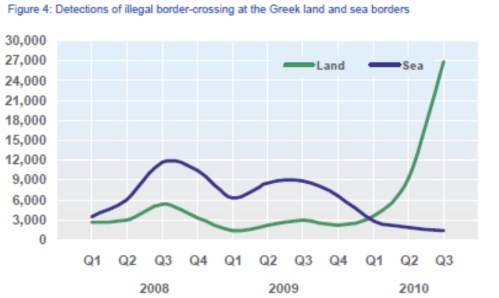
The Report notes that the “unprecedented peak in illegal border-crossings at the Greek land border with Turkey is the result of a shift from the sea to the land border” coupled with a “large increase in the absolute number of migrants” using Turkey as an EU entry point.  The Report states that there has been an eight-fold increase in the number Maghreb nationals detected at the Greek land border which “is thought to be the result of a displacement effect from the West Africa and Western Mediterranean routes.”

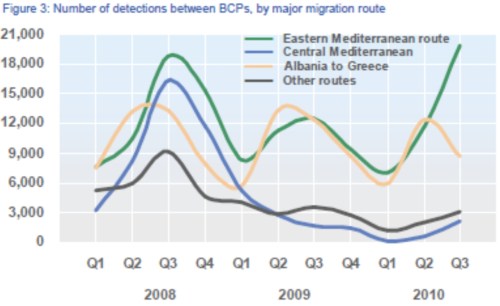
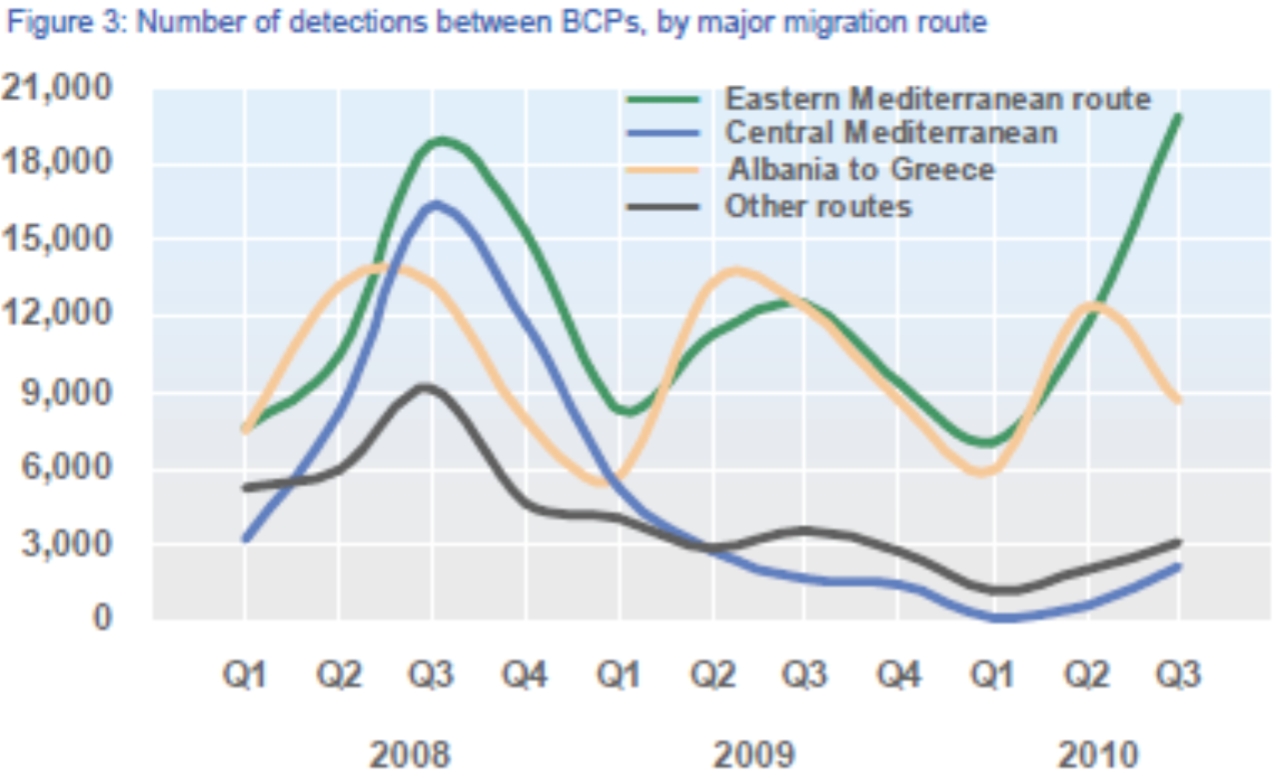
The Report also notes an increase in the number of detections on the Central and Western Mediterranean sea routes compared to Q2 which may be attributable to seasonal variations or “may be indicative of reorganized modi operandi in these areas in response to Frontex Joint Operations, more effective border controls and bilateral agreements implemented in 2008.”  See Figure 3 below.

Excerpts from the Report:

“Detections of illegal border-crossing”

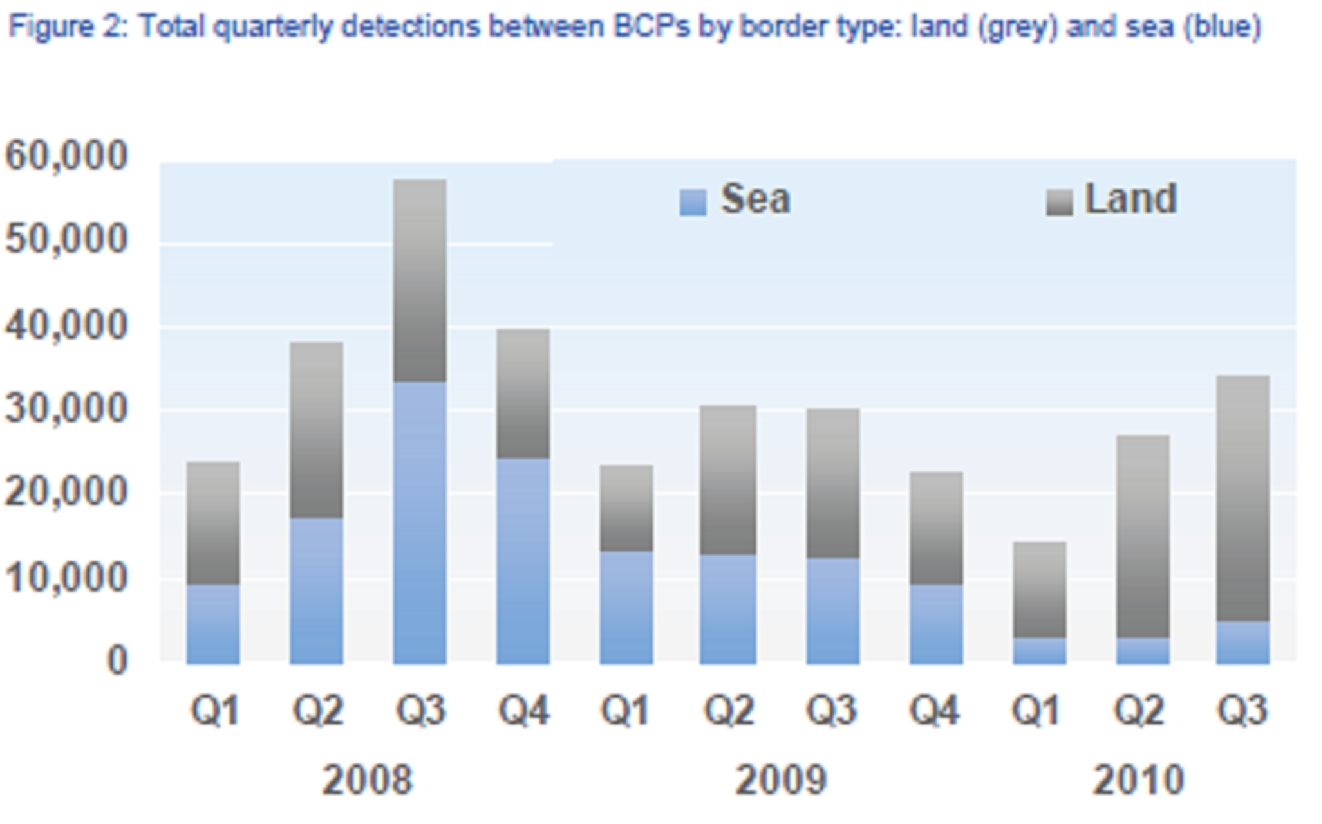
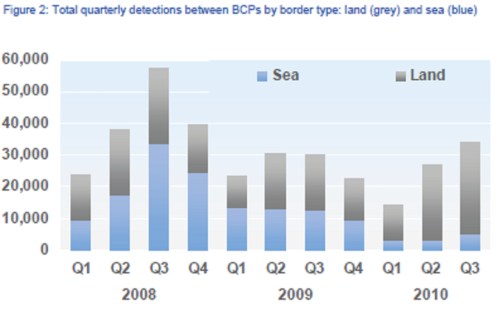
“…  Fig. 2 [see below] shows quarterly detections at the land and sea borders of the EU since the beginning of 2008. The 30% increase in the number of detections between the previous and present quarters is comprised of a 60% increase at the sea borders (although from a lower base) and a 23% increase at the land borders. This means that the shift from sea to land borders has not continued to same extent as in the previous quarters.  Nevertheless in Q3 2010, there were some 29 000 detections of illegal border-crossing at the external land border of the EU, which constitutes 85% of all the detections at the EU level, and the highest number of detections at the land border since data collection began in early 2008….”

“Eastern Mediterranean route”

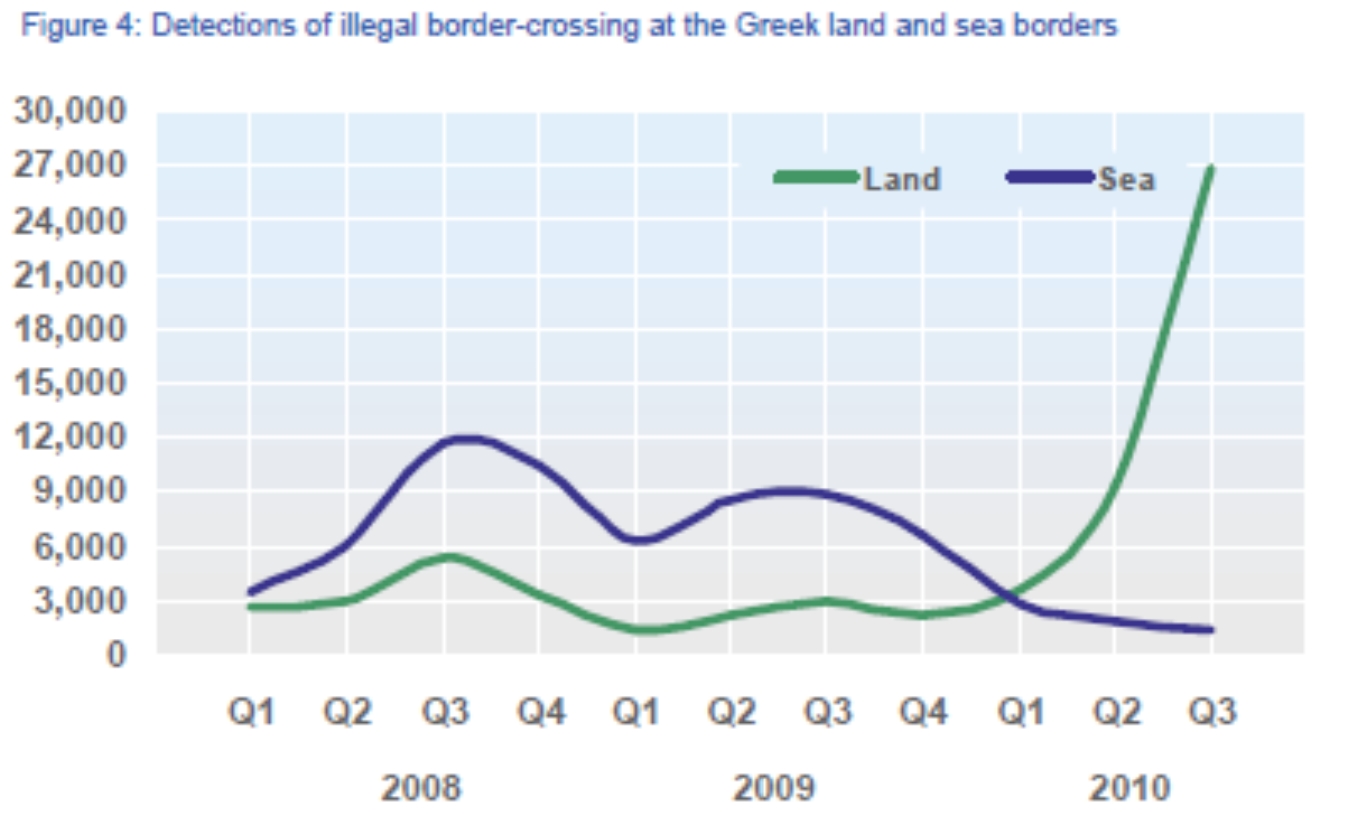
The Report observes that there has been a shift in illegal crossings from the Greece-Turkey maritime border to the Greece-Turkey land border and notes an increase in the number of nationals from Maghreb countries apprehended at the Greece-Turkey land border.  “This route [being taken by Maghreb nationals] is very indirect, but is thought to be the result of a displacement effect from the West Africa and Western Mediterranean routes….”

See Figure 4 below which shows that detections of illegal border crossers at the land border of Greece have exceeded detections at the sea border since Q1 of 2010.

“Central Mediterranean route”

“There were 2 157 detections of illegal border-crossing during Q3 2010. This is more than a three-fold increase compared to the previous quarter and a third higher than the same period last year. However despite this apparently large increase, detections still remain massively reduced compared to the peak of around 16 000 during the same period in 2008 (Fig. 3)….”

“The JO Hermes 2010 which was operational between June and October 2010, focused on illegal migratory flows departing from Algeria to the southern borders of the EU, specifically to Sardinia. In 2010, there were fewer detections than in previous years….”

“Departures from Libya also remained low. In June 2010, a new law was implemented to serve more severe punishments for facilitating illegal immigration. Ambassadors of the countries of origin were called into the Ministry of Foreign Affairs in Tripoli to be informed about the consequences of the new law, which suggests that this may be a serious implementation.”

“Western Mediterranean route”

“In general, irregular immigration to southern Spain has decreased massively since the beginning of 2006. However, in Q3 2010 there were 2 200 detections of illegal border crossing in the Western Mediterranean, more than twice that of the previous quarter and around a third higher than the same period in 2009. There is growth in the number of detections of a wide range of African nationalities, nine of which more than doubled in number between Q2 and Q3 2010. The most detected nationalities were Algerian, Moroccan, Cameroonian and Guinean.”

“Western Africa route”

“The cooperation and bilateral agreements between Spain and the rest of the Western African countries (Mauritania, Senegal and Mali) are developing steadily, and are one of the main reasons for the decrease in arrivals, as is the presence of patrolling assets near the African coast.”

“According to data collected during JO Hera, the numbers of arrivals in the Canary Islands and detections in West Africa are very low compared to the same time last year. The main nationality and place of departure is from Morocco, to where migrants are returned within a few days.”

Click here for the 3rd Quarter 2010 Report.

Click here for the 2nd Quarter 2010 Report.

Click here for the 1st Quarter 2010 Report.

Click here for my previous post regarding the 2nd Quarter Report.


Leave a comment

Filed under Aegean Sea, Algeria, Data / Stats, Eastern Atlantic, European Union, Frontex, General, Greece, Italy, Libya, Malta, Mauritania, Mediterranean, Morocco, News, Reports, Senegal, Spain, Tunisia, Turkey

Greece requests 2d extension of Frontex RABIT deployment due to events in Egypt

Kathimerini reported on 1 February that Greece requested an additional extension of the Frontex RABIT deployment in Greece due to the situation in Egypt and a fear that there may be a surge in migration towards Greece.  The current RABIT deployment is scheduled to end on 3 March.  The deployment was originally scheduled to end in November 2010 and was extended until March 2011.  The Kathimerini article said that Frontex’s initial informal response to the requested extension was positive.

Click here (EL) and here (EN) for articles.

1 Comment

Filed under Aegean Sea, Egypt, European Union, Frontex, Greece, Mediterranean, News, Turkey

PACE President Çavusoglu: ECtHR Decision “explodes myth that Europe is able to protect the rights of refugees”

PACE President Mevlüt Çavusoglu issued a statement regarding today’s Grand Chamber decision in the CASE OF M.S.S. v. BELGIUM AND GREECE (Application no. 30696/09) (also FR):

“‘The European Court of Human Rights today delivered a milestone judgment damning how Europe is protecting its refugees, asylum seekers and irregular migrants,’ today said Council of Europe Parliamentary Assembly (PACE) President Mevlüt Çavusoglu.

‘While the M.S.S. v. Belgium and Greece judgment is only against two member states, the implications of the judgment will be rippling through the capitals of Europe,’ he added. ‘The myth that European Union member states are safe places to return asylum seekers has been exploded by the European Court of Human Rights.’

The President stated that the Court had found massive deficiencies in detention conditions in Greece and in the procedures and remedies designed to safeguard the rights of asylum seekers, refugees and irregular migrants in Europe. He commented that Greece was not alone in failing on detention safeguards and that the Assembly had recently addressed recommendations to all member states on steps to improve detention facilities in Europe.

‘What is also clear from this judgment is that the so-called EU ‘Dublin system’ for determining the state responsible for deciding an asylum decision has to be changed as a matter of urgency. It is based on the false premise that EU member states are all safe and able to cope. They are not, and the ‘Dublin system’ creates enormous burdens on front-line states, such as Greece,’ the President declared.

He called on the EU to work with the Council of Europe, UNHCR and others, to solve the problem of returns under the “Dublin system” and reiterated a concern repeatedly highlighted by the Assembly that Europe needs to make its asylum systems fairer (see PACE Resolution 1695 (2009)) and needs clear rules on detention of irregular migrants and asylum seekers (see PACE Resolution 1707 (2010)).

‘Europe has European Prison Rules applying to criminals, but we still do not have similar rules for irregular migrants and asylum seekers who have committed no crime,’ he concluded.”

2 Comments

Filed under Belgium, Council of Europe, European Court of Human Rights, European Union, Greece, News, Statements

Decision from Grand Chamber of ECtHR: Returning Asylum Seekers to Greece Violates European Conv. on Human Rights

The Grand Chamber of the European Court of Human Rights issued a decision today in the CASE OF M.S.S. v. BELGIUM AND GREECE (Application no. 30696/09) (also FR) and concluded that Belgium should not have returned an Afghan asylum seeker to Greece under the Dublin II regulation which mandates that asylum claims are to be considered in the state where the asylum seeker first entered Europe.

This is the first decision from the ECtHR addressing the application of the Dublin II regulation.  According to European Voice, the “Court [currently] has around 960 cases pending that relate to the Dublin regulation, against the Netherlands, Finland, Belgium, the United Kingdom and France, most of them concerning expulsions to Greece.”

I have not had a chance to read the decision closely yet, but here is some basic information about today’s decision (more to follow in a subsequent post):

Excerpts from the Court’s Press Release (click here for FR):

“In today’s Grand Chamber judgment in the case M.S.S. v. Belgium and Greece (application no. 30696/09), which is final, the European Court of Human Rights held, by a majority, that there had been:

A violation of Article 3 (prohibition of inhuman or degrading treatment or punishment) of the European Convention on Human Rights by Greece both because of the applicant’s detention conditions and because of his living conditions in Greece;

A violation of Article 13 (right to an effective remedy) taken together with Article 3 by Greece because of the deficiencies in the asylum procedure followed in the applicant’s case;

A violation of Article 3 by Belgium both because of having exposed the applicant to risks linked to the deficiencies in the asylum procedure in Greece and because of having exposed him to detention and living conditions in Greece that were in breach of Article 3;

A violation of Article 13 taken together with Article 3 by Belgium because of the lack of an effective remedy against the applicant’s expulsion order.”

ECRE released a statement describing the decision as a “major blow to the Dublin system.”  Excerpts from the ECRE statement:

“Bjarte Vandvik, ECRE Secretary General, stated: ‘This judgment is a major blow to the Dublin system. The assumption that all EU Member States respect fundamental rights and that it is therefore safe to automatically transfer asylum seekers between EU countries no longer stands. Europe must seriously rethink the Dublin system and replace it with a regime that ensures the rights of asylum seekers are respected’.

This judgment will affect many asylum seekers in Europe. In 2010 alone, EU countries requested Greece to examine the applications of almost 7,000 asylum seekers who had entered the EU through Greece. Their situation will now need to be re-examined in light of this ruling.

Bjarte Vandvik [also] stated: ‘European countries must comply with the Court’s ruling, stop sending asylum seekers back to Greece, and examine asylum applications themselves until a fair asylum system is in place in Greece’.

The Dublin system fails refugees and Member States and needs to be changed.  This ruling reflects the serious shortcomings in the asylum procedure in Greece and in Belgium and it also highlights the flaws in the Dublin system itself. ECRE has long stressed that Dublin shifts responsibility for asylum seekers to states at Europe’s frontiers. Also, it allows refugees to be sent back to European countries where their fundamental rights are not respected.

As a first step in the right direction, ECRE supports the Commission proposal to review the Dublin Regulation, as it introduces significant humanitarian reforms and important procedural safeguards. For example, the proposal makes it easier for asylum seekers to join family members living in Europe, protects the rights of children who have arrived alone and ensures the continuity of care for vulnerable persons.

However, these are only temporary measures that do not solve the sometimes devastating impact of the Dublin system on asylum seeker’s human rights. Ultimately the Dublin Regulation should be abolished and replaced by a more humane and equitable system that considers the connections between individual asylum seekers and particular Member States.”

Click here for full ECRE Statement on the decision.

Click here (ECHR Blog) and here (Free Movement Blog) for some initial additional thoughts about the decision.

Click here, here, and here for articles.

3 Comments

Filed under Belgium, Commissioner for Human Rights, European Court of Human Rights, European Union, Frontex, Greece, Judicial, News

Greece May Use Dutch “Ships” to Detain Migrants

Following its announcement that it was considering building a wall along portions of its land border with Turkey, Greek officials announced earlier this month that they are considering the acquisition of two floating migrant detention centres from the Netherlands.  The two vessels would be leased and would have the capacity to hold approximately 1000 persons.  Greece reportedly was considering using passenger ships to detain migrants, but decided that floating detention centres used by Dutch authorities in Rotterdam are a better option.  The floating detention centres would be used in conjunction with prefabricated detention facilities that are being constructed on land to detain the large numbers of migrants being detained by Greek and Frontex authorities along the Greek-Turkish land border.

Click here and here for articles. (EL)  (Read with Google translate)

1 Comment

Filed under Aegean Sea, European Union, Frontex, Greece, Netherlands, News, Turkey

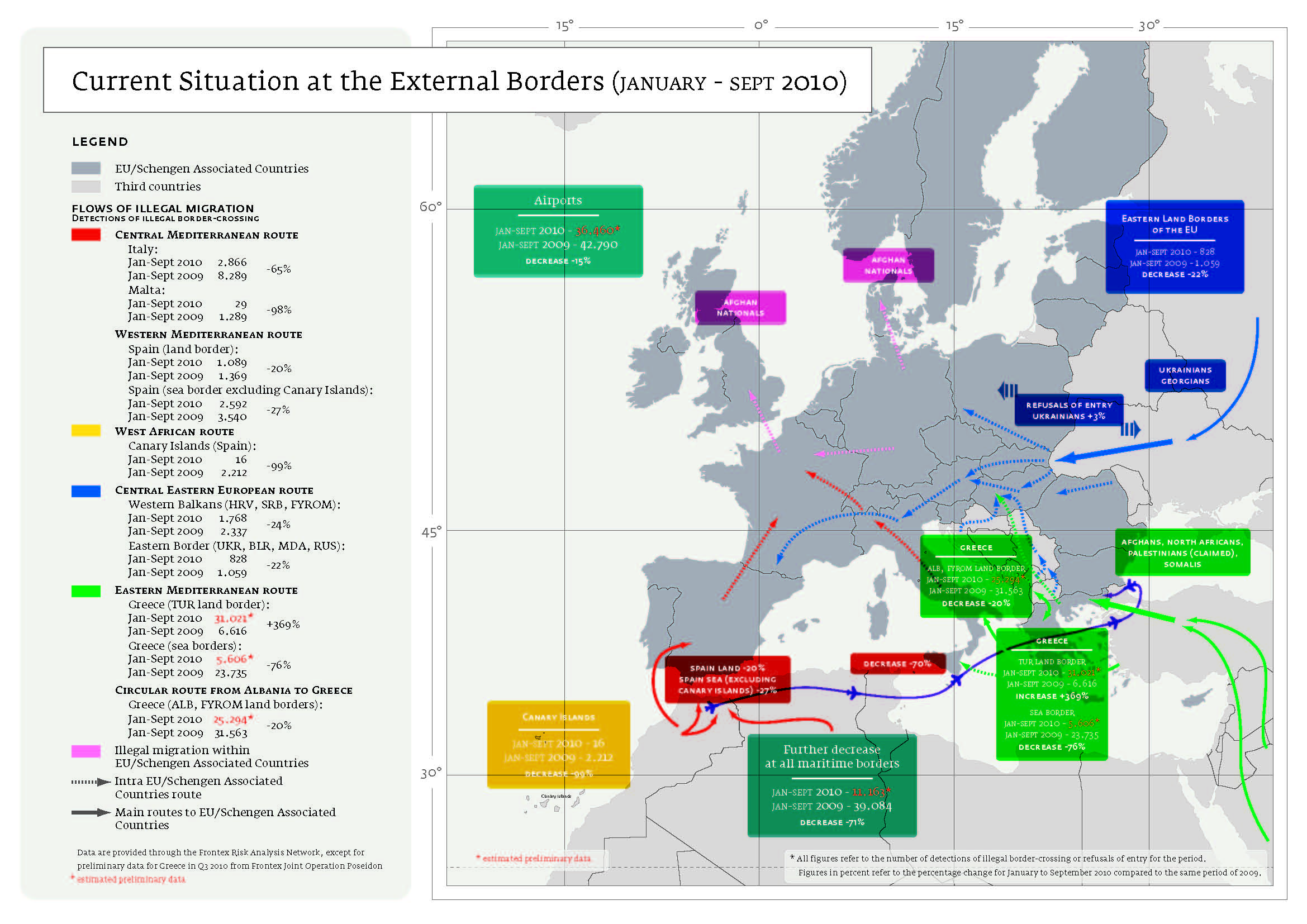
Frontex Map: Current Situation at the External Borders (JANUARY – SEPT 2010)

Frontex has released an updated Third Quarter map, January-September 2010, showing data regarding the situation at the external borders.   Note the information on the map pre-dates the deployment of the Frontex RABIT forces to the Greek border in October/November.  The data shows a 369% increase in detected irregular crossings along the Greek-Turkey land border over the first three quarters of 2010 compared to 2009.

The significant reduction in migrants detected at maritime borders continues:

  • Jan-Sept 2010:   11.163 (estimated preliminary data)
  • Jan-Sept 2009:   39.084
  • 71% reduction

Data by route:

Central Mediterranean route

  • Italy:
    • Jan-Sept 2010:     2.866
    • Jan-Sept 2009:    8.289
    • 65% reduction
  • Malta:
    • Jan-Sept 2010:    29
    • Jan-Sept 2009:    1.289
    • 98% reduction

Western Mediterranean route

Spain (land border):

  • Jan-Sept 2010:   1.089
  • Jan-Sept 2009:   1.369
  • 20% reduction

Spain (sea border excluding Canary Islands):

  • Jan-Sept 2010:   2.592
  • Jan-Sept 2009:   3.540
  • 27% reduction

West African route – Canary Islands (Spain):

  • Jan-Sept 2010:   16
  • Jan-Sept 2009:   2.212
  • 99% reduction

Eastern Mediterranean route

Greece (TUR land border):

  • Jan-Sept 2010:   31.021 (estimated preliminary data)
  • Jan-Sept 2009:   6.616
  • 369% increase

Greece (sea borders):

  • Jan-Sept 2010:   5.606 (estimated preliminary data)
  • Jan-Sept 2009:   23.735
  • 76% decrease

Click here to view Jan-Sept 2010 Map.

Click here for link to Jan-June 2010 Map.

Click here for link to 2009 Map.

1 Comment

Filed under Aegean Sea, Data / Stats, Eastern Atlantic, European Union, Frontex, Greece, Italy, Libya, Malta, Mediterranean, News, Spain, Turkey