Tag Archives: Maritime Interdiction

ECRE and CIR: Ill-treatment of Refugees in Libya: the EU, a Silent Accomplice

ECRE and CIR released a statement on 7 July criticising Italy and the EU in regard to the plight of over 200 Eritrean refugees, some of whom may have been subject to Italy’s push-back practice and who are now detained under dangerous conditions in Libya.

The two organisations “call upon all authorities involved to ensure that refugees are not repatriated to Eritrea where they are at risk of torture and ill- treatment. … ‘We strongly repeat our plea to the Italian Government to resettle the refugees to Italy’, says Christopher Hein, Director of the Italian Council for Refugees (CIR). ‘Some of those who are being mistreated now by the Libyan authorities have been pushed back there by Italy one year ago. Refugees are suffering the consequences of Italy’s violation of its legal obligations and EU Member States’ consenting silence’, added Bjarte Vandvik, ECRE’s Secretary General.”

Click here for the full statement.

Leave a comment

Filed under European Union, Italy, Libya, Mediterranean, Statements

EP Refers Frontex Sea Borders Rule to ECJ

On 23 June the JURI committee (Committee on Legal Affairs) voted in camera to refer the question of the validity of the Frontex rule regarding the surveillance of the sea external borders to the European Court of Justice (Council Decision 2010/252/EU (“Frontex / Sea borders”)).  The referral requests the Court “to preserve the effects of the measure until a new legislative act has been adopted.”

Maltese MEP Simon Busuttil, the EPP Coordinator in the Civil Liberties Committee, was quoted as saying: “we have given notice to the Commission that not all is fine with these Frontex guidelines and it is time for a rethink. We want to ensure that Parliament’s role is defended and that we can have our say. We want these rules to be fair. In their current version they are not.”

Both the LIBE and JURI committees believe that the European Commission exceeded its power when it presented the new Frontex rule under the comitology procedure as opposed to using the ordinary legislative procedure which would have given the Parliament the ability to amend the rule.  Malta has strongly objected to provisions within the rule.  Malta has said that its decision not to host Frontex’s Central Mediterranean enforcement operation this year, Operation Chronos, was due to the disembarkation provisions contained in the new Frontex rule.  Malta believes that the rule would require intercepted migrants to be taken to Malta.

Click here for article.

Click here for statement on MEP Simon Busuttil’s web site.

Click here for EPP Group press release.

Click here and here for earlier posts.

4 Comments

Filed under European Union, Frontex, Judicial, Malta, Mediterranean, News

Amnesty Int’l Report on Libya Criticises Libya and EU on Refugee Treatment

Amnesty International has released a comprehensive report on Libya entitled “Libya of Tomorrow – What Hope for Human Rights?”  The report covers a range of matters including the criminal justice system and the use of the death penalty.   Section 5 of the report (beginning at p 91) addresses the rights of refugees, asylum-seekers and migrants.  The report was finalised before the recent decision of the Libyan government to close the UNHCR office in Tripoli.

In regard to refugee issues, Amnesty is very critical of both Libya and the EU and calls upon EU member states to “ensure that any bilateral agreements with Libya in the area of migration and asylum, including the EU-Libya Framework Agreement currently being negotiated, are based on full respect for the rights of asylum-seekers, refugees and migrants.”

Excerpts from Section 5, “Rights of refugees, asylum-seekers and migrants”:

Members of the EU have been actively seeking the collaboration of Libya in controlling the flow of migrants to European shores – turning a blind eye to Libya’s dire human rights record, the absence of a functioning asylum system in Libya, and persistent reports of the abuse and ill-treatment of refugees, asylum-seekers and migrants.  The Treaty of Friendship, Partnership and Co-operation signed in August 2008 between Italy and Libya includes provisions for bilateral efforts to combat “illegal migration”, facilitated by the joint patrolling of the sea agreed upon in December 2007 in the “Protocol” and the “Additional Technical-Operational” Protocol”.

As part of the agreements, Italy promised to compensate Libya for its occupation of the country between 1911 and 1943. The Treaty of Friendship, Partnership and Co-operation involves a US$5bn package for construction projects, [and other items].  In return, Libya agreed, among other things, to tighten control of its territorial waters and accept disembarkation on its soil of individuals intercepted at sea by Italian vessels. Italy was also reported to have undertaken to provide resources, including technology, to control migrant flows through the southern borders of Libya. In fact, Italy has provided Libya with six motor patrol boats since the Treaty entered into force.

In the framework of these agreements, from May 2009 onwards Italy started returning refugees, asylum-seekers and migrants intercepted in international waters to Libya. On 6 May 2009, distress calls were sent from three vessels with an estimated 230 third-country nationals on board. Italian coastguard vessels intervened but transported the individuals to Tripoli, without stopping in an Italian port and without checking whether any individuals on board were in need of international protection or basic humanitarian assistance. Further interceptions and returns occurred in the subsequent months: according to official information from the Italian Ambassador to Libya, between 6 May and 3 September 2009, over 1,000 individuals were returned to Libya. They included nationals from Eritrea, Somalia and other sub-Saharan African countries. The Italian Minister of the Interior Roberto Maroni was reported to have called this action “an historic achievement after one year of bilateral negotiations with Libya”….

Despite these pleas by UNHCR and consistent reports of abuses suffered by refugees, asylum-seekers and migrants in Libya, the Italian authorities continue to intercept vessels at sea and send them back to other countries most notably Libya.  In January 2010, Italian Minister of the Interior Roberto Maroni stated that the number of migrants arriving to Italian shores was reduced by 74 per cent in 2009 compared to 2008, attributing the reduction to Italy’s bilateral agreements with Libya.

Italy is not alone in seeking Libya’s cooperation to control the flow of migrants to European shores. Negotiations between Libya and the EU over a Framework Agreement started in November 2008 covering the control of migration, among other issues, including potential readmission agreements for third-country nationals who have transited through Libya on their way to Europe….

UNHCR [prior to its recent expulsion from Libya] and its partners have also been involved in screening individuals pushed back to Libya from Italy. UNHCR declared that by October 2009, it had been able to screen 890 people and had registered 206 of them as refugees and secured their release from detention.  UNCHR also registered 80 individuals pushed back from Italy in November 2009, granting 40 of them refugee status. The remainder were awaiting their interviews for refugee status determination at the time of writing. UNHCR confirmed that a total of 685 individuals determined to be refugees or asylum-seekers were released from detention from 2008 to February 2010, including 450 Eritreans and 150 Somalis…..

Click here for the Report.

Click here for AI Press Release regarding the Report.

Leave a comment

Filed under European Union, Italy, Libya, Mediterranean, Reports, UNHCR

Malta: Italian Sea Patrols are Secretive But Effective

A Malta Today article quotes an unidentified source within the Armed Forces of Malta as saying that Italy’s anti-migrant operations are effective but are veiled in a suspicious secrecy:

“‘Nothing is happening [in regard to migrants], because the Italians are effective with joint patrolling, donations of sea vessels, and hands-on training,’ an informed officer said.  Developments on the Libyan sea-front, where the Italian army is engaged in joint repatriations of migrant traffic, seem to be veiled in a suspicious secrecy. The same officer said ‘we don’t know what the Italians are doing’, and as the first months of 2010 saw no significant migrant arrivals, observers feel the situation may not alter radically.  There seems to be consensus that the deal forged between the Italian and Libyan leaders has stemmed the migrant tide in the Mediterranean.”

Click here for article.

Leave a comment

Filed under Italy, Libya, Malta, Mediterranean, News

Concerns Over Italy’s Push-Back Practices in HRC’s UPR Report

The 14th regular session of the Human Rights Council begins on 31 May.   The report of the Working Group on Universal Period Review on Italy will be considered by the Council on 9 June.

The Working Group’s report identifies concerns with Italy’s treatment of migrants and asylum seekers, including whether migrants or asylum-seekers have been transferred to another country without proper assessment of the need for refugee or other protection and whether persons intercepted at sea have access to proper assessment of their asylum claims in accordance with international human rights standards.

Italy’s general response to date has been that “in cases of human trafficking, international law permitted the return of migrants to their countries of origin, unless they were in need of urgent medical assistance and had not expressed the intent to apply for asylum or other forms of international protection.”

Excerpts from the Report of the Working Group:

A. Presentation by the State under review [***]

11. Over the past few years, the country had been exposed to a massive inflow of migrants, which increased by 250 per cent over the last few years, and could, in some instances, affect public order. Italy is at the forefront of efforts to rescue migrants and asylum-seekers on the high seas. It affirmed that, in cases of human trafficking, international law permitted the return of migrants to their countries of origin, unless they were in need of urgent medical assistance and had not expressed the intent to apply for asylum or other forms of international protection. [***]

B. Interactive dialogue and responses by the State under review [***]

52. Italy noted that it had a comprehensive system of asylum and that new arrivals were regularly informed about their right to international protection. With nearly 50 per cent positive responses to all applications made, Italy’s rate of acceptance was above the EU average. Italy once again highlighted its efforts to provide rescue at sea, not only in its own waters, but also beyond. [***]

72. Denmark asked Italy to elaborate on criticism regarding the transfer of migrants and asylum-seekers to another country without proper assessment of the need for refuge and other protection. ***  [***]

76. New Zealand *** requested details on measures taken by Italy to ensure the individual circumstances of each asylum-seeker are genuinely considered. *** [***]

II. Conclusions and/or recommendations

84. The following recommendations will be examined by Italy, which will provide responses in due time, but no later than the fourteenth session of the Human Rights Council: [***]

67. To strengthen efforts to protect asylum-seekers and refugees (Yemen); to continue the implementation of laws on migration and amendments, to ensure that the laws are always fully in line with international standards (Kyrgyzstan); to make additional efforts in work with refugees and migrants (Kyrgyzstan); and to take further steps to ensure the full respect of the fundamental rights of migrants, asylum-seekers and refugees (Sweden);

68. To strengthen cooperation with UNHCR in order to guarantee access to a just procedure in identifying the protection needs of those travelling to or are in Italian territory (Mexico);

69. With regard to the concerns expressed in the Italian-Libyan agreement to prevent ships with immigrants from sailing to Italy, to ensure that intercepted persons have access to proper assessment of their asylum claims in accordance with international human rights standards (Netherlands);

70. To ensure satisfactory asylum procedures for all migrants and asylum seekers rescued at sea (Denmark);

71. To review its legislation and practices, ensuring that they comply fully with the principle of non-refoulement, and to ensure the accountability of persons responsible for any violation thereof (Czech Republic);

72. To take appropriate legislative measures to decriminalize irregular entry and stay in Italy (Brazil); to eliminate the provision criminalizing irregular entry and stay on Italian territory as contained in law No. 94 of 2009, as well as those provisions that regard non-documented status as an aggravating circumstance in the commission of criminal offence, and the creation of vigilante groups, as contained in law No. 125 of 2008 (Mexico); [***]

77. To increase the transparency of arrival and return procedures concerning immigrants and refugees (Japan);

78. To intensify efforts in the resettlement of refugees, especially with regard to the protracted refugee situations identified by UNHCR (Morocco);

79. To ensure the full enjoyment of human rights for those hoping to find a better life in Italy, especially by strengthening structures to guarantee the rights of migrants (Burkina Faso);

80. To strengthen respect for the human rights of migrants, including those in detention centres (Cuba);

81. To repeal all discriminatory laws against irregular migrants and take action to investigate and prosecute discriminatory acts by public and security officials, in particular where racial and religious motives are aggravating factors (Pakistan);

82. To continue close cooperation with countries of origin and transit in finding an effective solution to the problem of illegal immigration (Viet Nam);

83. To continue measures to end trafficking in human beings (Yemen); and to strengthen further its efforts to end trafficking in women and children, and to take effective measures to prosecute and punish trafficking in persons (Canada);

84. To increase measures to identify women and child victims of trafficking effectively in order to provide them with adequate assistance, and to consider not penalizing them for crimes committed as a direct result of being trafficked (Philippines);

85. To strengthen efforts to combat trafficking in women and children, and to take effective measures to prosecute and punish trafficking in persons, as raised by the Committee on the Rights of the Child and the Committee against Torture (Japan); and to take effective measures to prosecute and punish trafficking and the exploitation of persons, as recommended by the Committee against Torture (Israel); [***]

Click here for the Report of the WG.
Leave a comment

Filed under Human Rights Council, Italy, Mediterranean, News, Reports

European–US–African Joint Military Exercises

16 years after withdrawing its military forces from Equatorial Guinea, Spanish armed forces members are now present in Mali, Mauritania, Senegal and Nigeria.  Spanish forces recently completed a three week multinational military exercise known as Flintlock 10 along with forces from other EU countries (France, Germany, the UK, and the Netherlands), the US, and 7 African countries.  Flintlock 10 was conducted in coordination with the US military’s Africa Command, Africom. (If you are not familiar with the US Military’s Africa Command, a quick look at its “2009 Posture Statement” will give you a feel for its very very extensive activities within Africa.)

Spain’s decision to resume a military presence in Africa was identified in its Africa Plan (“el Plan África”), adopted in 2006, which was intended to provide “‘a comprehensive approach to relations with neighbouring continent,’ sa[id] one expert, ‘but [also to] respond[ ] to the urgent need to curb the wave at the source of illegal immigration.’”  (Click here for the 2009Plan África.)

A joint maritime military exercise known as Exercise Phoenix Express 2010 began last week.  This exercise includes training of the Moroccan and Senegalese military by US and Spanish military personnel.  According to an Africom press release, Moroccan and Senegalese Maritime Interdiction Operations Teams are being trained on tactics, techniques, and procedures associated with Maritime Interdiction Operations.  Last month Spanish and US naval forces were involved in similar training exercises off the coast of Senegal under Africom’s Africa Partnership Station.

The current exercise, according to Africom, includes a focus on maritime interdiction operations.  Participating forces “will track and board suspect vessels carrying suspicious cargo, and Maritime Patrol Aircraft and Automated Identification Systems, along with MIOs like SARs and Visit, Board, Search and Seizures will be performed.”

Click here for El Pais article about Spain’s military’s return to Africa.

Click here and  here for Africom press releases.

Click here for US Naval Forces Africa press release.

1 Comment

Filed under Eastern Atlantic, Mauritania, Mediterranean, News, Senegal, Spain, United States

UPR of Spain Largely Ignores Interdiction and Readmission Practices

Spain was one of 15 countries whose records were reviewed during the 8th session of the Human Rights Council’s Universal Periodic Review (UPR) Working Group from 3-15 May 2010.  While reference is made to the treatment of asylum seekers and migrants who reach Spanish territory, little attention was directed (at least not in the national report or the Working Group’s Draft report) to the treatment of migrants intercepted at sea before reaching Spanish territory in the Canary Islands or elsewhere.  Likewise little attention was paid to the provisions and implementation of Spain’s several bilateral readmission agreements with various countries such as Senegal.

According to the Draft report, Spain agreed with a general recommendation to “[t]ake all measures necessary to ensure that actions related to unaccompanied minors (migrants, asylum seekers, refugees, victims of trafficking) are in line with international standards.” [Section II, Para. 84(54).]  But Spain did not agree to several more specific recommendations, instead agreeing only to “examine” and “provides responses” to the recommendations no later than September 2010 when the Human Rights Council meets for its 15th session.

Three of the more detailed recommendations were:

  • “Respect fully the principle of non-refoulement and ensure effective access to asylum procedures, taking into account the objectives of UNHCR’s 10-Point Plan on Mixed Migration” (New Zealand);
  • “Undertake a review of its readmission agreements with respect to refugees and asylum-seekers, and amend them as necessary to ensure that they contain human rights guarantees in line with international standards” (Canada); and
  • “Consider access to asylum procedures for victims of trafficking (Costa Rica).

[Section II, Para. 86(28-30).]

Click here for link to UPR site for Spain.

Click here for the Draft report of the Working Group.

Click here for Spain’s national report submitted to the Working Group.

Leave a comment

Filed under Eastern Atlantic, Mediterranean, News, OHCHR, Reports, Spain, UNHCR

Large Drop in Irregular Algerian Migrants Arriving in Italy in 2009

Italy’s Ambassador to Algeria, Giampaolo Cantini, held a press conference this week and said that the number of harragas, irregular migrants, who were found attempting to enter Italy from Algeria dropped from 1599 in 2008 to 804 in 2009.  The press coverage described the reduction as a 70% reduction, but given the cited numbers, it seems the drop is about 50%.  Cantini noted that not a single migrant departing Algeria for Italy has been detected since 30 April 2010.

Cantini attributed the reduction to the increased level of bilateral cooperation between Italy and Algeria on the migration issue and the increased surveillance of the Algerian coast by Algerian authorities.

Click here and here for articles (both FR).

Leave a comment

Filed under Algeria, Data / Stats, Italy, Mediterranean, News

UNHCR to Frontex: Information on Operational Activities at Sea Are Limited

UNHCR has had a liaison officer assigned to work with Frontex since 2007.  The current UNHCR senior liaison officer is Michele Simone.  In a Q&A interview posted on the UNHCR web site Mr Simone expressed some concerns about Frontex operations at sea (in addition to speaking on other topics):

“It remains difficult to evaluate the impact of [UNHCR’s asylum and protection] training [of border officials] while information on operational activities at the borders, especially at sea, remains rather limited.”

“Frontex operations should ensure disembarkation of those intercepted at sea to a place where they are not only safe physically, but where their basic rights – including the rights to seek asylum and receive protection – are respected. This is spelled out in the recently adopted European Union guidelines for maritime border operations. In any event, the operations should anticipate that some of those intercepted at sea will be particularly vulnerable, notably unaccompanied children, women and torture victims. At this time, we believe there are not enough qualified staff at sea or land entry points to identify and support such vulnerable cases. To assist border guards in this identification process, UNHCR is currently discussing with Frontex the elaboration of ad hoc protection guidelines for some selected joint operations.”

Click here for full interview.

1 Comment

Filed under Frontex, News, UNHCR

Details from Frontex General Report 2009 (Post 2 of 2)

Last week I posted a summary of the first part of Frontex’s 2009 General Report.  This second post summarizes the portion of the Report pertaining to Frontex’s sea operations.

The General Report 2009 provides selective information regarding the six major Joint Operations conducted at the sea borders.  With only one exception, no information or data is provided regarding the specific numbers of intercepted migrants or vessels.

Instead of numbers, the Report provides various descriptive terms which could mean almost anything.  For example, Operation Hera led to a “drastic decrease of migrants,” during Operation Nautilus there was a “remarkable decrease” in migrants, and during Operation Hermes, the numbers of migrants arriving and dying at sea “decreased dramatically.” The one exception is for Operation Indalo where the Report states that 750 irregular migrants and 10 facilitators were detected.

When desired, the Report provides details and numbers.  For example, Operation Poseidon utilized 4 open sea vessels, 6 coastal patrol vessels, 13 coastal patrol boats, six airplanes, 4 helicopters, and 152 experts who delivered 2680 man days of operational activities, but no data regarding the total number of irregular migrants intercepted at sea is provided.

Here is a summary of the information provided in the Report for each of the six major Joint Operations:

Poseidon 2009, Eastern Mediterranean (365 Days)

Poseidon was conducted along land borders as well as at sea.  Interpreters were deployed on board ships to facilitate the identification process of intercepted migrants.  Less than 10% of the interviewed migrants claimed their original nationality.  There was an overall reduction in migrant flow of 16% (land and sea) compared to 2008.  “The main operational objectives of the joint operation were achieved but there is a clear need for closer cooperation between local authorities.”

Hera 2009, Atlantic Ocean waters between North Western African countries and Canary Islands (365 Days)

Due to the permanent implementation of Joint Operation Hera and better cooperation from “involved African countries”, there was a notable reduction in migrants reaching the Canary Islands, 2280 in 2009 compared with 9200 in 2008.  Aerial and maritime surveillance conducted close to the territory of Senegal and Mauritania and local cooperation from police led to the decrease in migrants.  “Despite these clear successes, participation of more member States would greatly increase effectiveness and outcomes.”  [NF- While the Report does provide migrant arrival data for the Canary Islands, it is silent on the number of migrants intercepted at sea or within Senegal or Mauritania.]

Nautilus 2009, Central Mediterranean (172 Days)

There was a remarkable decrease in migrant arrivals in Malta.  A “significant obstacle to the effectiveness of the Joint Operation lay in the contrasting interpretations of the International Law of the Sea by Member States….”  The effectiveness of the operation compared with 2008 was not improved.

Hermes 2009, Central Mediterranean (184 Days)

“Due to the bilateral agreement between Italy and Libya, the number of people arriving from Libya, as well as the number of migrants died at sea, decreased dramatically….”  “In addition, the first examples of co-operation with Algeria should also be considered as promising.”  As with Nautilus, “differing interpretations of the International Law of the Sea led to a limited contribution by the Member States to the joint operation by maritime surface means.”  The effectiveness of the operation compared with 2008 can be considered as increased.

Minerva 2009, Western Mediterranean (39 Days)

The launch of the operation was delayed in 2009.  Its effectiveness compared with 2008 has remained the same.

Indalo 2009, Western Mediterranean (50 Days)

The lack of cooperation from Algeria is an obstacle for operational activities.  10 Facilitators and 750 irregular migrants were identified.

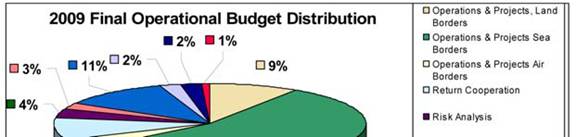
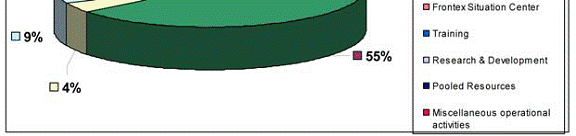
And as I noted in my earlier post, Frontex continued to devote the biggest single portion of its expenditures to maritime enforcement.  Almost 40% of Frontex’s total budget, over € 34 million, was spent on sea operations in 2009, constituting 55% of the operational budget.

This chart from the Report (p 23) shows the breakdown of expenditures within the 2009 Operational Budget (which was 71% of the total 2009 Frontex budget).

Click here for previous post.

Click here for the Frontex General Report 2009.

2 Comments

Filed under Aegean Sea, Algeria, Data / Stats, Eastern Atlantic, Frontex, Greece, Italy, Libya, Malta, Mauritania, Mediterranean, Reports, Senegal, Spain

1 Year Anniversary of Italy’s Push-Back Practice

This month marks the first anniversary of the implementation of Italy’s push-back practice with Libya.  The practice is based primarily on the Italy-Libya Treaty of Friendship, August 2008, and the Supplementary Protocol of 4 February 2009.

The first push-back operation occurred on 6 May.  As a reminder, here is the European Committee for the Prevention of Torture’s (CPT) description of the first operation:

Operation of 6 May 2009

According to data provided by the Italian authorities, 231 migrants (191 men and 40 women) were aboard three vessels in distress. The information collected from other sources indicates that among the migrants there were unaccompanied minors and four pregnant women. Following the interception of the boats by two Coast Guard vessels and one vessel of the Guardia di Finanza, the migrants were transferred onto the three Italian vessels and returned to Libya. The CISOM [Order of Malta Italian Relief Corps] personnel and a journalist, who was aboard the vessel of the Guardia di Finanza, indicated that they were not aware that the migrants would be pushed back to Libya, and that the captains of the Italian vessels only received an order to do so in the course of the operation.

The delegation was unable to interview the migrants pushed back to Libya or, given the authorities’ refusal to provide their names, the captains of the Italian vessels involved in the operation. However, reliable information collected by the delegation would indicate that, during the operation, which lasted around 12 hours, the 74 persons on the Guardia di Finanza vessel were provided insufficient water and no food or blankets; further, physical violence, in particular with kicks, punches and blows with an oar, was allegedly used against a number of migrants by Libyan police at the harbour in Tripoli, to force them to disembark from the two Coast Guard vessels.

Click here (IT) for article and podcast from AMISnet: “Un anno di respingimenti.”

Click here for earlier post.

Click here for the full CPT Report.

Click here for the Response of the Italian Government.

1 Comment

Filed under European Committee for the Prevention of Torture and Inhuman or Degrading Treatment or Punishment, Italy, Libya, Mediterranean, News

LIBE Votes to Refer Frontex Sea Border Rules to JURI

At its meeting on 10 May, the LIBE committee voted to send a request to the JURI committee regarding the Council Decision pertaining to the procedures to be applied during Frontex surveillance and interdiction operations at sea.  The request asks the JURI committee to refer the Council Decision to the European Court of Justice on the procedural ground that the Council Decision should not have been dealt with as a comitology measure but instead should be grounded on a legal basis.

I have not yet been able to find a copy of the LIBE committee’s letter to JURI, but a video of the LIBE committee meeting can be found on the EP Multimedia Library here or here.  The vote and the brief discussion occurs at approximately 16:44 in the video.

Click here for an earlier post.

2 Comments

Filed under European Union, Frontex, Judicial, News

Maroni: Migration Agreement with Libya is a Success

During an interview yesterday, Italian Interior Minister Roberto Maroni again described the bi-lateral migration agreement between Italy and Libya as effective saying that 850 migrants were successfully intercepted and returned last year.  He contrasted the 850 intercepted migrants with the 37,000 migrants who reached Italian shores in the previous year.  He said that the thousands of would be migrants who have been prevented from reaching Italy have been stopped by Libyan authorities in Libya.  He described this as the “fruit of the cooperation agreement with Libya.” (E’ il frutto dell’accordo di cooperazione fra Italia e Libia.”)

Click here (IT) for article.

1 Comment

Filed under Data / Stats, Italy, Libya, Mediterranean, News