Tag Archives: Maritime migration

Statewatch Analysis: The EU’s self-interested response to unrest in north Africa: the meaning of treaties and readmission agreements between Italy and north African states

Statewatch released an Analysis by Yasha Maccanico entitled “The EU’s self-interested response to unrest in north Africa: the meaning of treaties and readmission agreements between Italy and north African states.”  The Analysis provides a description of Italy’s responses to the migrant arrivals in 2011 caused by the unrest in North Africa.

Excerpts:  “The ‘crisis’ reveals questionable practices and routine abuses – The measures adopted in response to the increasing number of migrants arriving from north African countries serve to highlight a number of practices that have become commonplace in Italy in recent years.

The first of these is a widening of the concept of ‘emergency.’ Calling an emergency gives the government a wider remit to derogate from specified laws so as to resolve situations that cannot be dealt with through ordinary measures….

Although the situation in north Africa was worrying, the emergency was called when slightly over 5,000 migrants had arrived. An analysis by Massimiliano Vrenna and Francesca Biondi Dal Monte for ASGI notes that the government has repeatedly called and extended states of emergency since 2002 to deal with immigration, which is treated as though it were a “natural calamity” even when there is a wholly predictable influx of people from third countries. The urgent need specified in decrees declaring a state of emergency is to conduct ‘activities to counter the exceptional – later referred to as massive – influx of immigrants on Italian territory’ (as happened on 11 December 2002, 7 November 2003, 23 December 2004, 28 October 2005, 16 March 2007, 31 December 2007, 14 February 2008 for Sicily, Calabria and Apulia and was extended to the whole nation on 25 July 2008 and 19 November 2009), stemming from a prime ministerial decree of 20 March 2002. Thus, Vrenna and Biondi Dal Monte’s observation that the emergency is ‘structural’ appears well-founded. It has serious repercussions for the treatment of migrants (see below) and the awarding of contracts outside of normal procedures, with the involvement of the civil protection department whose competencies have been expanding considerably.

The second practice involves the expulsion, refoulement or deportation of migrants outside the limits and procedures established by legislation for this purpose. The failure to identify people, to issue formal decisions on an individual basis to refuse them entry or expel them, or to give them the opportunity to apply for asylum or other forms of protection, was a key concern when boats were intercepted at sea and either the vessels or their passengers were taken back to Libya between May and September 2009, when 1,329 people were returned. These rights were also denied to people arriving from Egypt and Tunisia in application of readmission agreements in the framework of the fight against illegal migration. Their presumed nationality was deemed sufficient to enact expulsions to these countries, because ongoing cooperation and good relations with Italy appeared sufficient to indicate that they were not in need of protection, regardless of the situation in their home countries. ….

The third practice is the ill-treatment of migrants held in detention centres. Without dealing with this issue in depth, it is worth noting that what could be viewed as arbitrary detention is occurring on a large scale, in the absence of formal measures decreeing detention and without the possibility of appealing against decisions. In fact, after landing, migrants are summarily identified as either ‘illegal’ migrants or asylum seekers, largely on the basis of their nationality….”

Click here for Analysis.

1 Comment

Filed under Analysis, Egypt, European Union, Frontex, Italy, Libya, Mediterranean, Tunisia

UNODC Issue Paper: Smuggling of Migrants by Sea

UNODC yesterday released an Issue Paper entitled “Smuggling of Migrants by Sea.” The paper, drafted by Ms Marika McAdam under the supervision of Ms Morgane Nicot (UNODC), is based largely on “answers received to questionnaires and discussions that took place in the context of an expert group meeting held in Vienna, Austria on the 13th to the 15th of September 2011.”

Excerpts from UNODC statement: “While the smuggling of migrants by sea accounts for only a small proportion of the total number of migrants smuggled worldwide, it accounts for the highest number of deaths among smuggled migrants. … The paper covers the international legal framework relating to the smuggling of migrants by sea, current responses to and challenges posed by such smuggling and recommendations to strengthen responses. … It is hoped that the practical experiences of responding to the smuggling of migrants by sea, addressed by the issue paper from the perspectives of countries of origin, countries of transit and countries of destination, will help other Member States in formulating their responses to suit their local contexts.”

Executive Summary: “Smuggling of migrants is defined by Article 3 of the Migrant Smuggling Protocol supplementing the United Nations Transnational Organized Crime Convention (UNTOC), as ‘…the procurement, in order to obtain, directly or indirectly, a financial or other material benefit, of the illegal entry of a person into a state party of which the person is not a national.’ The specific nature of the sea-based component of the smuggling journey resulted in a dedicated section on the issue in the Migrant Smuggling Protocol. While smuggling by sea accounts only for a small portion of overall migrant smuggling around the world, the particular dangers of irregular travel at sea make it a priority for response; though more migrant smuggling occurs by air, more deaths occur by sea.

The journey of the migrant smuggled by sea often starts a significant distance away from the coast of departure. Some journeys to the coast may take mere days, but others can take place over years during which the migrant must work en route to raise money for his passage. Arduous desert crossings and victimization by smugglers and other criminals en route mean that some do not survive overland journeys to the coast. Contrasted with these extreme experiences, economically empowered migrants can afford a higher level of smuggling service and may experience no particular hardship, simply travelling through various international airport hubs toward the coastal country from where their sea journey commences.

The type and size of vessel used to smuggle migrants by sea depends on the time, place and financial capacity of migrants undertaking the smuggling journey. In some countries, boats of only a handful of passengers are commonly intercepted by authorities, while in others vessels of several hundred people have been used. While voyages may be comfortable when conditions at sea are mild and the vessel is equipped with adequate food, water and sanitation, the journey is a harrowing one for the majority of migrants who report rough conditions, terrible cold and scarce food and water.

The nature of the crime and its relationship with smuggling of migrants by land and by air means that it is a successful crime type that yields high profits for smugglers with all the risks being borne by migrants. Indeed, migrant smuggling by sea can be understood as a criminal business, which is competitively run as such. Smuggling by sea is generally carried out by flexible criminal groups or individuals operating on the basis of repeated contractual arrangements, rather than by hierarchical organizations.

There are two methods used when vessels approach coasts of destination. One aims to reach land by evading detection by authorities, the other sets out to be detected and intercepted or rescued by authorities in territorial waters of destination coastal countries. In both situations, detecting smuggling vessels at sea is a key challenge for coastal states which may have limited resources and large search and rescue areas of responsibility.

Upon detecting vessels, the key challenge is to balance objectives with obligations at international law, including the Migrant Smuggling Protocol. Smugglers are generally well‐informed about states’ protection obligations and act to exploit them, instructing migrants what to do upon interception to increase their chances of gaining entry into and remaining in countries of destination. For instance, officials responsible for intercepting vessels at sea have been faced with situations of people sabotaging their own vessels to force authorities to carry out rescues. Suggestions made in respect of encountering migrant smuggling at sea include increased support of coastal states through joint patrols and provision of resources, and increased compliance with international legal standards and obligations in carrying out interceptions of smuggling vessels at sea.

While responding to the situation at hand and ensuring that persons on board are appropriately assisted, a key challenge is to seize evidentiary opportunities to investigate smuggling‐related crimes. The complex nature of migrant smuggling networks and their modus operandi means that smugglers cannot be identified purely by looking to smugglers who may be on board boats; the transnational criminal network itself must be traced from a smuggling vessel, back to the coast of embarkation, and from there back to countries of transit and origin. Suggestions made for improved investigation and prosecution of migrant smuggling by sea include harmonizing domestic legislation with the UNTOC and the Migrant Smuggling Protocol. Further it is suggested that sentences imposed for smuggling offences be publicized as a means of deterring would-be smugglers. Capacity building measures are also suggested so as to increase identification of smugglers on vessels, and to better link sea-based crimes with land-based smugglers.

Preventing migrant smuggling by sea requires states to balance their obligations in international law with their legitimate interests in protecting state sovereignty from violation by organized crime groups. But law enforcement efforts alone are not adequate to prevent migrant smuggling by sea; the Migrant Smuggling Protocol stresses that prevention efforts must address root causes that lead a person into the hands of smugglers in the first place. Suggestions made for preventing migrant smuggling at sea include raising awareness about the dangers of sea smuggling journeys and the criminality of smuggling. Suggestions are also made to raise awareness of those who influence political and policy decisions, so policies put in place protect state sovereignty, uphold international obligations, and are not vulnerable to exploitation by smugglers. Also emphasised is the responsibility of coastal states of departure to intercept smuggling vessels before they embark on sea journeys. Beyond this, comprehensive data collection, analysis and research are suggested to strengthen evidence-based responses.

Experts from countries of origin, transit and destination unanimously agree that the most essential ingredient for effective and comprehensive response to migrant smuggling by sea is strengthened international cooperation to remove areas of impunity for smugglers along smuggling routes. Suggestions made for cooperating in response to migrant smuggling at sea include aligning activities with the Migrant Smuggling Protocol and increasing the role of UNODC in facilitating cooperative response. The value of bilateral and regional cooperation arrangements is stressed, with emphasis on flexible cooperative networks for effective and efficient on-the-ground response. Regular coordination meetings and joint operations are suggested to improve strategic and operational interagency coordination, as is the empowerment of central designated authorities to address migrant smuggling by sea.

In short, while it is difficult to make generalizations about migrant smuggling by sea, two key points hold true around the world. Firstly, migrant smuggling by sea is the most dangerous type of smuggling for the migrants concerned, making it a priority concern for State response. Secondly, efforts to combat smuggling of migrants will be unsuccessful unless cooperation is strengthened not only between countries of sea departure and arrival, but also among the countries of origin, transit and destination along the entire smuggling route.”

Click here for Issue Paper.

Click here for UNODC statement.

2 Comments

Filed under Analysis, Reports, UNODC

Migrant Boat Reaches Lampedusa

A rubber dinghy carrying 69 sub-Saharan migrants landed on Saturday on Lampedusa without having been intercepted.  The migrants are believed to be Somali.  At least one media report states that the migrants are believed to have departed from Tunisia.  Several of the boat’s passengers were hospitalized.  The main migrant detention centre on Lampedusa remains closed.

Click here and here for articles. (IT)

Leave a comment

Filed under Italy, Mediterranean, News, Somalia, Tunisia

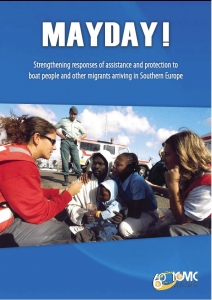
ICMC Europe Report: “MAYDAY! Strengthening responses of assistance and protection to boat people and other migrants arriving in Southern Europe”

ICMC has released a 150+ page report entitled “MAYDAY! Strengthening responses of assistance and protection to boat people and other migrants arriving in Southern Europe.”  I have just started reading the report and may post some additional excerpts in the coming days.  Here is an excerpt from the Foreword and Introduction:

“In the first months of 2011 alone, more than 2,000 migrants have died crossing the Mediterranean Sea. More than 2,500 unaccompanied children arrived just on Italian shores. Tragic, chronic figures like these are urgent and continuous reminders of the need for another approach to human mobility that goes far beyond simple enforcement and fundamentally recognises the rights to life and protection for all.

It is not so much the arrivals of migrants and refugees that should be put to question, but rather the response mechanisms which very often fail as much in the fields of prevention and rescue as in the processes deciding where and how people are permitted to move, disembark, stay or return. Protection today is provided only for a limited number of boat people who need it, and governed by systems of access and identification that are far too limited. Correct identification, differentiation and referral systems are needed for all migrants in distress and from the very moment of their arrival, not only because they are human beings, but also because such approaches reflect the quality of our societies….”

Scope of this report – Gathering the results of nearly a half thousand surveys of first responders and other actors as well as the migrants themselves, this report examines what happens—or does not happen— to identify migrants in need of protection and assistance upon their arrival in Europe. In particular, it sheds light on the mechanisms developed, and gaps both in practice and in policy in responses to boat people and other migrants arriving in mixed migratory movements in four countries at Europe’s Southern door: Greece, Italy, Malta and Spain.

Although rescue at sea at one end and voluntary or enforcement-related return at the other are highly relevant topics and areas of research per se, DRIVE has focused on the situation of migrants at point of arrival. As such, the project and this report look at first responses in the phase immediately upon and surrounding arrival, and then to identification, differentiation and referral mechanisms for legal protection and/or further assistance in subsequent phases following arrival.

The principal focus of the project was on boat arrivals, but the shift in routes in Greece during the project period and the sharp increase in land border crossings there compelled reflection upon responses to migrants crossing land borders as well as those arriving by sea. While the project maintained its focus on arrivals by sea, one of its findings is that most of the laws, policies, procedures and responses applicable to boat people pertain equally to those arriving across land borders—in particular, steps on identification, differentiation and referral for protection and assistance.

The DRIVE project set out to promote protection of the rights of all migrants in these situations, especially the most vulnerable, regardless of their immigration status. Nevertheless, the project has highlighted four groups whose members have come to be defined to a varying extent as having specific rights or special needs under international and European legal instruments: asylum seekers, victims of human trafficking, children, and victims of torture. It merits emphasising however, that other migrants also have special needs because of particular vulnerabilities,- notably people with serious health problems, disabled people, elderly people, pregnant women, single parents with minor children and persons who have been subjected to or witnessed torture, rape or other serious forms of psychological, physical or sexual violence.

Structure of this report – The report is composed of four main parts, plus annexes:

Part 1: Building policy responses to boat people and others arriving in mixed migration flows – Within this first part, Chapter 1 provides a brief history of the policy evolution and the organizations involved in the area of mixed migration. Chapter 2 gives an overview of legal obligations relating to the rights of the migrants composing these arrivals. The third chapter provides an analysis of the EU policy and legal framework with regards to mixed migration arrivals at its borders.

Part 2: A focus on post-arrival identification, differentiation and referral for assistance and protection – The first chapter explains what is meant and implied by “identification, differentiation and referral”in mixed migration contexts, the concept at the core of the DRIVE study. The second chapter seeks to focus on the legal obligations of member states to conduct identification of people in need of protection at the border, with in-depth legal analysis of the rights and state obligations that international and EU law articulate for asylum seekers, children, and victims of human trafficking and torture.

Part 3: What happens to people arriving irregularly by boat in Greece, Italy, Malta and Spain? – The first chapter gives a snapshot of the trends and figures of arrivals in the Mediterranean region. In Chapter 2, the summaries of the four country reports (each presented in its entirety in an annex) then provide a look at the procedures and practices on the ground for first reception, identification and referral. The third chapter presents the results of the extensive migrants surveys that the DRIVE project conducted in the four countries in an effort to give voice to the beneficiaries themselves. Chapter 4 concludes with a comparative analysis identifying the main gaps and challenges in those countries.

Part 4: Conclusions and recommendations – The focus on the four countries enabled consideration of practices and procedures which could either improve the quality of the process or prevent people from accessing protection and assistance. Recommendations therefore seek to address how identification, differentiation and referral can be improved in the Mediterranean, including how the international and European legal and policy framework can address this question in a more comprehensive manner.

Annexes: Detailed mapping of the situation in Greece, Italy, Malta and Spain are attached in the annexes, as well as a presentation of some relevant tools and guidelines….”

Click here for Report.

1 Comment

Filed under Analysis, Data / Stats, Eastern Atlantic, European Union, Greece, Italy, Malta, Mediterranean, Reports, Spain

Libyan Interception of Migrant Boat Carrying 400 May Have Been Staged

Libyan officials yesterday claimed that Libya intercepted a migrant boat shortly after it left Libya attempting to sail to Italy.  The boat was carrying over 400 migrants from sub-Saharan countries including Ethiopia, Ghana, Ivory Coast, and Nigeria.  Journalists who interviewed some of the arrested migrants reported the incident appeared to have been staged.  Some migrants who “spoke briefly to Reuters said they had paid more than $1,000 each for the trip, and many believed the boat’s captain had had no intention of ever making for the European coast, but had handed them straight to the Libyan authorities. ‘We were deceived by these people, Libyans,’ said Isaac Okyere, a 27 year-old Ghanaian.  ‘They marched us to the Navy people,’ he said, adding that the boat was intercepted about 45 minutes after setting sail.”  Libyan officials denied the arrests were staged, but did admit that the boat’s captain (who apparently was not arrested) alerted officials in advance of the boat’s departure.  It was not reported where the arrested migrants have been taken or what will now happen to them.

Interior Minister Fawzi Abd al All told a news conference that the interception and arrests showed the new government was serious about stopping illegal migration to Europe:  “Despite a lack of means, we were able to prevent illegal immigration of people who were heading for Italy. … Illegal immigration was a means of pressure used by the former regime to blackmail Europe. Now this issue will be treated differently. …We expect support from the world” in preventing such trafficking.

Click here (EN), here (EN), here (IT), and here (FR) for articles.

Click here for video.

Leave a comment

Filed under European Union, Italy, Libya, Mediterranean, News

Chatham House Briefing Paper: Responding to Migration from Complex Humanitarian Emergencies: Lessons Learned from Libya

A new Chatham House Briefing Paper by Dr Khalid Koser entitled “Responding to Migration from Complex Humanitarian Emergencies: Lessons Learned from Libya” has been released.

Summary:

  • At its peak during the Libyan conflict, migration to Tunisia and Egypt was massive, even in the context of a region where large-scale migration has become the norm.
  • In the case of Libya, at least five categories of migration can be distinguished: evacuating migrant workers, Libyan nationals moving into Egypt and Tunisia, ‘boat people’ arriving in the EU, internally displaced persons (IDPs), and asylum-seekers and refugees.
  • The international policy response in Libya was hampered by restricted access. IDPs therefore received limited assistance and protection, and migrant workers, especially from sub-Saharan Africa, experienced harassment and abuse.
  • The policy response in neighbouring states, especially Egypt and Tunisia, was far more robust.
  • The political response in the EU to the relatively small proportion of migrants who reached Europe is considered by many commentators to have been disproportionate.
  • The crisis has highlighted a gap in the international regime for protecting IDPs, and in particular migrant workers. It has also called into question the relevance to modern humanitarian crises of a dated refugee definition. More positively, the response has demonstrated how international agencies can cooperate, and there has been unprecedented cooperation between IOM and UNHCR to respond to ‘mixed flows’ from Libya.
  • Responsibility for managing migration now falls to the new government in Libya.

Click here for paper.

1 Comment

Filed under Analysis, European Union, Libya, Mediterranean, UNHCR

6 Month Temporary Residency Permits Issued in April by Italy to 12,000 Tunisian Migrants Set to Expire

In April of this year Italy issued temporary residency permits to most of the Tunisian migrants who arrived in Italy between 1 January and 6 April.  Accelerated return procedures facilitated by a new bi-lateral agreement with Tunisia were implemented for Tunisians who arrived in Italy on or after 6 April.  The issuance of the temporary residency permits triggered the temporary closures of internal EU borders by France and other Schengen countries.

Approximately 11,800 temporary permits were issued by Italy and they are now beginning to expire.  Everyone Group reported over the weekend that a decision has been reached by the Italian government to extend the residency permits for an additional six month period.

Click here and here for articles. (IT)

Click here for report from Everyone Goup. (EN)

Click here for my previous post on the temporary residency permits.

Leave a comment

Filed under European Union, Italy, Mediterranean, News, Tunisia

PACE Report: Lampedusa Reception Centres Not Suitable Holding Facilities for Migrants

The PACE Ad Hoc Sub-Committee on the large-scale arrival of irregular migrants, asylum-seekers and refugees on Europe’s southern shores has issued a report on the migrant reception centres on Lampedusa.  A delegation of the sub-committee members visited Lampedusa in May of this year.

From the PACE Press Release:  “The reception centres in Lampedusa are not suitable holding facilities for irregular migrants, in particular Tunisians. In practice, they are imprisoned there without access to a judge, according to the Parliamentary Assembly of the Council of Europe (PACE) Ad Hoc Sub-Committee on the large-scale arrival of irregular migrants, asylum-seekers and refugees on Europe’s southern shores, in its report on its visit to Lampedusa*, which was declassified today [3 October 2011]. ‘The reception centres should remain just that and not be turned into holding centres,’ said Christopher Chope (United Kingdom, EDG), Chair of the ad hoc sub-committee and of the PACE Committee on Migration, Refugees and Population.  In this context, the ad hoc sub-committee is concerned by the tensions on the island, which have increased exponentially: arson in the main reception centre on 20 September caused serious damage and led to an upsurge in violence, leading the Italian authorities to declare Lampedusa an ‘unsafe port’. ‘These acts of violence are to be strongly condemned. They do not acknowledge the efforts of both the local population of Lampedusa and the Italian coastguards, who day after day do their utmost to rescue people at sea and to offer them temporary shelter on the island,’ declared the members of the ad hoc sub-committee….”

Excerpts from the Report:

“XV. Conclusions and recommendations

82. Much of the work observed by the delegation on Lampedusa warrants admiration, praise and broad support, even if some of the images provided in the media in the past have conveyed a rather more negative image. However some of the underlying problems noted by the delegation during its visit have manifested themselves in recent events, notably the arson attacks on the centre and the rising violence. Unfortunately what happened recently was foreseeable by the authorities and was inherent in the challenges of handling mixed flows of migrants and asylum seekers in the context of detention in a centre designed for reception.

83. What’s done is done, but lessons can usefully be learnt from the episode which has been painful both for Lampedusa and for the migrants, refugees and asylum-seekers who have been subjected to appalling conditions.

84. Lampedusa is still in the front line for arrivals of mixed migration flows by sea, in particular from Libya. The arrivals have not decreased in intensity and Italy and Europe must be ready to face up to a potentially even larger influx.

85. However, if we look at the number of arrivals so far, this is not a crisis for Italy or for Europe, but it is for Lampedusa.

86. In the immediate future, as soon as the situation is settled and the port is again considered safe, Lampedusa must remedy its limited reception capacity as the centres are immediately saturated by the arrival of boats with more and more people on board.

87. In the possibly very near future, if the number and frequency of arrivals increase, reception capacities in Italy will have to be brought into line. At the time of the visit, the Vice-Prefect and the Mayor were optimistic and convinced that the transfer system put in place was working, and that the situation would not deteriorate to the point reached earlier in the year. Furthermore, they considered that the transfer capacity could be increased through the planned provision of an additional boat. The members of the Sub-Committee at the time was confident that the Italian authorities would continue to do everything necessary to manage arrivals, even if their number were to increase. However, these measures – mostly designed for dealing with refugees and asylum-seekers fleeing Libya – have been proved insufficient to handle the challenge of handling the situation of the Tunisian migrants.

88. The Ad Hoc Sub-Committee wishes to voice its concern regarding a new agreement which the Italian authorities are reported to have signed with the authorities in Benghazi in Libya. The situation in Libya is not safe enough for people to be returned there and UNHCR’s position on this question remains unchanged. Furthermore, any attempt to deny access to persons entitled to international protection (and there are many of them in Libya) would be a clear breach of Italy’s international obligations.

89. There remains the issue of minimising loss of lives at sea and the need to ensure that all states fulfill their obligations of rescue at sea and the provision of access to international protection following any intervention.

90. Due to its proximity to North-Africa, Lampedusa is a key island to avoid even greater deaths at sea. If the boat people cannot hope to reach Lampedusa, their already highly dangerous journeys will become longer and therefore even more unsafe. To avoid more tragedies, Lampedusa’s reception capacities must be rebuild and improved as soon as possible.

91. The Ad Hoc Sub-Committee urges the Italian national, regional and local authorities to maintain their co-ordinated effort to manage arrivals of mixed migration flows in Lampedusa while complying with the relevant international standards and in co-operation with the international organisations and NGOs present on the island.

92. On the basis of its observations, the Ad Hoc Sub-Committee calls on the Italian authorities:

  • i. to continue to comply immediately and without exception with their obligation to rescue persons in distress at sea and to guarantee international protection, including the right of asylum and nonrefoulement;
  • ii. to introduce flexible measures for increasing reception capacities on Lampedusa;
  • iii. to improve conditions at the existing centres, and in particular the Loran base, while ensuring as a matter of priority that health and safety conditions meet existing standards – even when the centres are overcrowded – and carrying out strict and frequent checks to ensure that the private company responsible for running the centres is complying with its obligations;
  • iv. to ensure that new arrivals are able to contact their families as quickly as possible, even during their stay on Lampedusa, particularly at the Loran base, where there are problems in this regard;
  • v. to provide appropriate reception facilities for unaccompanied minors, ensuring that they are not detained and are kept separate from adults;
  • vi. to clarify the legal basis for the de facto detention in the reception centres in Lampedusa;
  • vii. where Tunisians in particular are concerned, only to keep irregular migrants in administrative detention under a procedure prescribed by law, authorised by a judicial authority and subject to periodic judicial review;
  • viii. to continue to guarantee the rapid transfer of new arrivals to reception centres elsewhere in Italy, even if their number were to increase;
  • ix. to consider the requests by the population of Lampedusa for support commensurate with the burden it has to bear, particularly in economic terms;
  • x. not to conclude bilateral agreements with the authorities of countries which are not safe and where the fundamental rights of the persons intercepted are not properly guaranteed, as in Libya.

93. Recalling the Assembly’s Resolution 1820 (2011) on “Asylum-seekers and refugees in Europe: sharing responsibilities”, the Ad Hoc Sub-Committee also recommends that all Council of Europe member states, and particularly the European Union member states, display greater solidarity by providing direct assistance to the countries, including Italy, which are currently faced with arrivals from the southern Mediterranean, and by accepting relocations within Europe where appropriate.

94. The Sub-Committee also urges member states to follow the example of the close co-operation between the Italian authorities and the member organisations of the “Praesidium Project” (UNHCR, IOM and the Red Cross) in managing arrivals and reception centres.

95. The Ad Hoc Sub-Committee invites the Italian authorities, through the Italian Delegation to the Parliamentary Assembly, to keep the Committee on Migration, Refugees and Population, appraised of progress on the 10 specific issues raised above on a six monthly basis.”

Click here for Report.

Click here for PACE Press Release.

Click here for my previous post.

Leave a comment

Filed under Analysis, Council of Europe, Italy, Libya, Mediterranean, News, Reports, Tunisia

Frontex Quarterly Reports for 2011 Q1 and Q2

The Frontex Risk Analysis Unit (RAU) released its 2nd Quarter Report (April-June) for 2011 on 4 October.  The 1st Quarter Report (Jan-March 2011) was released on 21 July.  As always, while the information is a few months old, the reports contain a significant amount of information, graphs, and statistical tables regarding detections of illegal border crossings, irregular migration routes, detections of facilitators, detections of illegal stays, refusals of entry, asylum claims, and more.

Here are extensive excerpts from the Q2 Report:

“Executive summary

In Q2 2011, all Frontex irregular-migration indicators increased compared to the previous quarter. The most important indicator, detections of illegal border-crossing, increased to a level not seen since Q3 2008 and correspondingly asylum applications are now at nearly the highest level since data collection began. What’s more, migration pressure at the border from migrants attempting to enter and stay in the EU increased even more than EU-level figures suggest, as they are offset against extensive reductions in Albanian circular migration.

In 2011 there were major and extensive developments in irregular-migration pressure at the external border of the EU, resulting from two simultaneous but independent hotspots of illegal border-crossings: the first was seasonally increased activity at the Greek land border with Turkey, where a wide variety of migrants continued to be detected at very high levels. The second, and the undeniable hotspot for illegal border-crossing into the EU in Q2 2011, was in the Central Mediterranean, where vast numbers of sub-Saharan migrants landed in Italy and Malta mostly having been forcibly expelled from Libya. [***]

4. Main points Q2 2011

  • All irregular migration indicators increased relative to the previous quarter
  • Compared to a year ago, there were significant EU-level increases in several irregular migration indicators, such as detections of illegal border-crossing, clandestine entries, and refusals of entry. There were also increased asylum applications
  • Despite detections of Afghan migrants falling by a third compared to last year, they were still the most common nationality detected illegally crossing the EU external border. Most were previously resident as refugees in Iran
  • In contrast, detections of all the other highly-ranked nationalities (Tunisians, Nigerians, Pakistanis, Ghanaians) increased massively relative to the same period last year
  • In total there were over 40 000 detections of illegal border-crossings, a 50% increase compared to Q2 2010. These were the result of two simultaneous but independent routes of irregular migration: the Eastern Mediterranean and the Central Mediterranean routes:

1. In the Eastern Mediterranean:

– There were over 11 000 detections of illegal border-crossing, almost exclusively at the Greek land border with Turkey, which is comparable with the same period in 2010

– This flow currently attracts migrants from north Africa, sub-Saharan Africa and Asia

– Groups of Dominicans were detected travelling to Turkey to enter the EU via the Greek land border

– Secondary movements are assumed from detections of (i) illegal border-crossings in the Western Balkans, (ii) false documents on flights to major EU airports from Turkey as well as Greece, and (iii) landings in southern Italy from Greece, Turkey and Albania

2. In the Central Mediterranean:

– Following a bilateral return-agreement between Italy and Tunisia, the massive influx of Tunisians to Lampedusa reported in the previous quarter decreased, but remained significant

– A very wide range of sub-Saharan Africans were detected on this route, some having been forcibly departed from Libya

– Italy reported more detections of illegal border-crossing in Sicily than ever before, a three-fold increase compared to the previous quarter; the increased flow was composed of migrants from Côte d’Ivoire as well as Tunisia and a range of other nationalities

– There were also increased detections of Egyptian migrants and facilitators landing in Sicily and Southern Italy from Egypt

– Italy and Malta reported huge increases in the number of asylum applications submitted by sub-Saharan African migrants. In Italy increases were particularly marked for Nigerians and Ghanaians

  • Following their new visa-free status, fewer Albanians were detected illegally crossing the EU border, and illegally staying within the EU (both mainly in Greece). Instead they were increasingly refused entry to Greece and they were also increasingly detected at the UK border, either as clandestine entry or using false documents
  • There was an increased flow of Georgian migrants towards Belarus (air and land), with increased illegal entries and asylum applications in Poland and Lithuania
  • In Q2, Libya was the most significant source of irregular migration to the EU. However, more recently the ability of the Gaddafi regime to forcibly expel its migrant population to the EU has become compromised; the situation remains dynamic and uncertain[.]

4.1 Detections of illegal border-crossing

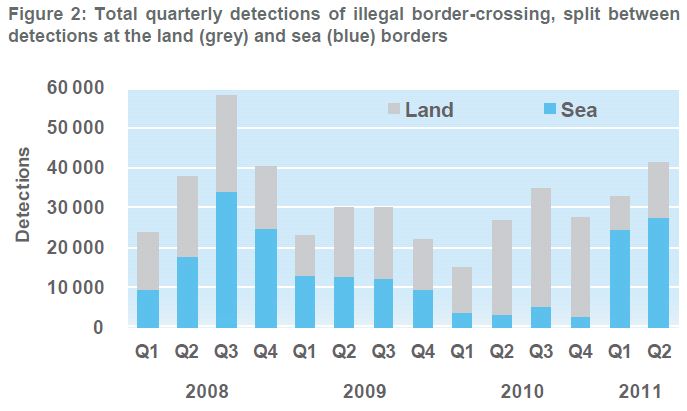
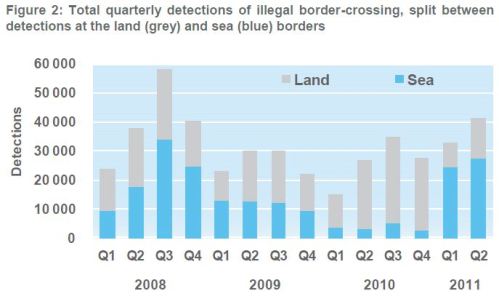
At the EU level, in Q2 2011 there were more detections of illegal border-crossing since Q3 2008. The total of 41 245 detections during this reporting period is a 25% increase compared the previous quarter and a 53% increase compared to the same period last year (Fig. 2). Without question there were major and extensive developments in illegal migration pressure at the external border of the EU, resulting from two simultaneous but independent hotspots of illegal border-crossings. The first was increased activity at the Greek land border with Turkey, where a range of Asian, north African and sub-Saharan African migrants were increasingly detected at very high levels. The second, and the undisputed hotspot for illegal border-crossing into the EU in Q2 2011, was at the Italian islands in the Central Mediterranean, where vast numbers of Tunisians, Nigerians and other sub-Saharan migrants landed in small sea vessels, the majority of which in Q2 had been forcibly departed from Libya.

Figure 2 shows the evolution of the FRAN indicator 1A – detections of illegal border-crossing, and the proportion of detections between the land and sea borders of the EU per quarter since the beginning of 2008. In Q2 2011 there were more detections of illegal border-crossing since the peak of Q3 2008 nearly three years ago. Compared to a year ago, detections at the EU land border decreased by 42% to 13 742 in Q2 2011, almost exclusively due to fewer detections of Albanian nationals following their new visa-free status; elsewhere at the land border (including Greece) trends were roughly stable. In contrast, at the sea border detections increased nine-fold to some 27 500 detections (Fig. 2), the vast majority of which (95%) were in the central Mediterranean, forming the major development in irregular migration to the EU in 2011.
[***]

At the EU level, detections of illegal border-crossing increased by 53% compared to a year ago (Fig. 3). However, this level masks a lot of variation among Member States. First, and most importantly to the current situation, was a 4 200% increase in detections of almost exclusively African migrants in Italy. Related to this central Mediterranean flow, was a concurrent and massive increase in detections reported from Malta (from 0 to 710), and also increases further west into Spain (+61%). As a result, all these countries have seen increases in other indicators such as asylum applications of the most common nationalities (see relevant sections). [***]

Routes

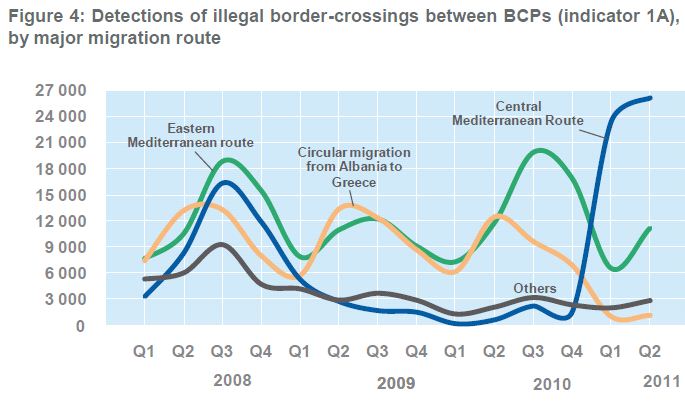
As illustrated in Figure 4, for just the second time since records began in early 2008, in Q2 2011 detections of illegal border-crossings on the Central Mediterranean route, which comprises the blue borders of Italy and Malta, exceeded those reported from both the (i) Eastern Mediterranean route of the land and sea borders of Greece, Bulgaria and Cyprus, and (ii) circular migration from Albania to Greece.
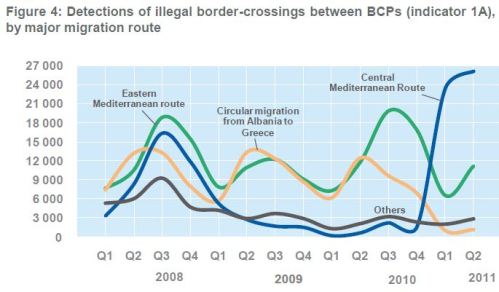
Without question, in Q2 2011 the single most important irregular-immigration route in terms of detections of illegal border-crossing was the Central Mediterranean route, where detections increased in the beginning of 2011 to previously unprecedented levels (Fig. 4). In the first quarter of 2011, and uniquely compared to previous surges of illegal immigration, this flow was restricted to a single nationality – Tunisian, most of whom were responding to civil unrest in their home country by leaving towards the Italian Island of Lampedusa. In response to this almost unmanageable influx of irregular migration at a single and isolated location, a bilateral return agreement was signed between Italy and Tunisia, which allowed for the accelerated repatriation of newly arrived individuals. Hence, during the current reporting period, the flow of Tunisian migrants fell from over 20 200 in the previous quarter to 4 300 in Q2 2011.

However, civil uprising commonly referred to as the Arab Spring, and its effects on migration in the area, was not limited to Tunisia. For example according to multiple sources, in next-door Libya, migrants from sub-Saharan countries were in Q2 2011 being coerced to move towards the EU by the Gaddafi regime in response to the NATO Operation Unified Protector which commenced on March 27 under United Nations Security Council Resolution 1973. Thus, in Q2 2011, besides some continued departures from Tunisia, the flow in the central Mediterranean was composed of a single flow of large numbers migrants from sub-Saharan countries departing Libya in small vessels. [***]

4.1.1 Eastern Mediterranean route

Detections of illegal border-crossings on this route increased seasonally and in line with previous years, from 6 504 in Q1 2011 to 11 137 in Q2 2011, almost exclusively due to a massive increase in detections at the Greek land border with Turkey, where detections increased from 6 057 to 10 582. [***]

4.1.2 Central Mediterranean route

In Q2 2011 there were 26 167 detections of illegal border-crossings on the Central Mediterranean route, a 10% increase even compared to the ‘peak’ reported during the previous quarter, and evidently a massive increase compared to the negligible detections throughout all of 2010. The vast majority of detections on this route were reported from Italy (25 500) where detections increased by 13% even compared to the ‘influx’ of migrants reported during Q1 2011. In Italy, Central African, Tunisian, Nigerian and Ghanaian were the mostly commonly detected nationalities, 90% of which were detected in the Pelagic Islands (14 300), most notably Lampedusa (Fig. 7). However, in Q2 2011 there were also more detections of illegal border-crossing reported from Sicily (2 260) than ever before; this figure is nearly three times bigger than that reported in the previous quarter and more than twenty times higher than during the same period last year (100). Compared to the previous quarter, in Sicily there were more detections of migrants from a very wide range of countries such as Egypt, Côte d’Ivoire and Tunisia. There were also over 710 detections reported from Malta, which is a sustained peak from the previous quarter (820) and extremely high compared to the negligible detections throughout 2010. In Malta there were much fewer detections of Somalis and Eritreans but there were increased detections of Nigerians and migrants from Côte d’Ivoire. However, migrants from Tunisia, Algeria and Egypt often claim to originate from sub-Saharan Africa in an attempt to appear as refugees, a fact which may render such comparisons of nationalities somewhat misleading.

In the previous FRAN Quarterly (Q1 2011) it was reported a surge of irregular immigration (20 000 detections) on the Central Mediterranean route that was almost entirely restricted to a single nationality: Tunisian (Fig. 8). As a result of this influx, on 20 February the JO EPN-Hermes Extension 2011 commenced in the central Mediterranean, and a bilateral agreement was reached between Italy and Tunisia on 5 April 2011, which resulted in the strengthening of police surveillance along the Tunisian coast and regular repatriations of Tunisian nationals from Italy. For example, according to data collected under JO Hermes 2011, some 1 696 Tunisians were repatriated between 5 April and 23 August 2011. The repatriation agreement is probably an effective deterrent, combining as it does, returns and surveillance, however some migrants have reported their boats being spotted by military patrols that did not take any action. According to the FRAN data, in Q2 2011 some 4 286 Tunisian migrants were still detected illegally crossing the border into Italy. Although a massive reduction, this still represents a very large and significant flow of irregular migrants into the EU.

In comparison to the reduction in flow from Tunisia, in Q2 2011 there was a large increase in migrants who had departed from Libya (Fig. 9). The migrants departing from Libya were mostly nationals from countries in the Horn of Africa, the sub-Saharan and Central African regions and, to a lesser extent, Asia. According to intelligence collected during JO EPN-Hermes Extension 2011, most of these migrants had already been in Libya for over a year, originally heading to Tripoli via the traditional routes for sub-Saharan and Central African migrants. In Q2 2011, migrants tended to reach Italy on large fishing vessels that had departed directly from Tripoli or the nearby ports of Medina and Janzour. Most of these deported African nationals did not want to leave the country as their standard of living in Libya was high compared to their home countries. Several even stated that they would choose to return to Libya after the war. In Q2 2011 reports suggest that some migrants were instructed to reach embarkation areas on their own but had been caught by the military or police and then detained in camps or disused barracks until they were transported to embarkation areas and onto vessels bound for Italy. In each case the migrants were searched by the military before boarding and all their belongings were confiscated. According to reports, nationals of the sub-Saharan and Central African regions as well as from Horn of African countries have been recruited by the Libyan army/police to manage their compatriot migrants at gathering places or camps. In some cases the destination of vessels from Libya was Sicily, where the flow was characterised by waves of landings. For example there were around 11 landings on 13 May and 7 between 11 and 29 June, with the majority of boats arriving from Libya and Egypt. [***]

4.1.3 Western Mediterranean route

In Q1 2011 there were 1 569 detections of illegal border-crossings on this route to Southern Spain, which is nearly double compared to the previous quarter (890), and more than a 50% increase compared to a year ago (973). Some of this increase is due to better weather conditions at this time of year, but irregular migration pressure on this route is clearly higher than it was at the same time last year. [***]

In the longer-term, irregular immigration to southern Spain has been consistently decreasing since the beginning of 2006. Commonly cited reasons are Frontex Joint Operations in the area, effective bilateral agreements and more recently rising unemployment in Spain, particularly in sectors typified by migrants.* Nationalities traditionally associated with this route were Algerian, Moroccan and Ghanaian. [***]

4.1.4 Western African route

The cooperation and bilateral agreements between Spain and the rest of the Western African countries (Mauritania, Senegal and Mali) are developing steadily. They are one of the main reasons for the decrease in arrivals on this route over the last year, as are the presence of patrolling assets near the African coast. In Q4 2010 Frontex reported a slight increase in the number of detections of illegal border-crossing at the Canary Islands, from a maximum of 50 during each of the previous 4 quarters, to 113 in Q4 2010. This increased level of detections persisted into the first quarter of this year (154), exclusively due to Moroccan nationals (152) displaced after the dismantling of migrant camps near the dispute Western Saharan region. However, during the current reporting period detections on this route decreased massively to a negligible 24 detections. [***]”

Click here for 2011 Q2 Report.

Click here for Frontex Statement regarding 2011 Q2 Report.

Click here for 2011 Q1 Report.

Click here for Frontex Statement regarding 2011 Q1 Report.

3 Comments

Filed under Aegean Sea, Algeria, Analysis, Cyprus, Data / Stats, Eastern Atlantic, Egypt, European Union, Frontex, General, Greece, Italy, Libya, Malta, Mauritania, Mediterranean, Morocco, News, Reports, Senegal, Spain, Tunisia, Turkey

42,000 Migrant Landings in Italy in First 5 Months of 2011

Italian officials report that 42,807 migrants landed in Italy during the first five months of 2011.  The arrivals involved 507 separate landings.  This number contrasts with 4,406 arrivals in all of 2010 involving 159 separate landings.

Most of the migrants in 2011 have been Tunisian nationals (24,356) whereas Afghans (1699) were the largest group in 2010.  Most migrants crossed the Adriatic in 2010 whereas the central Mediterranean is now the location of most migrant voyages.

2010:   Afghanistan (1699), Tunisia (650), Egypt (551), Algeria (297), Iraq (161), Iran (159) , Palestine (128), Turkey (112), Syria (100), Somalia (61), Eritrea (55).

January–May 2011:   Tunisia (24,356), Somalia, Eritrea, Ethiopia (combined total of 4,157), Nigeria (1689), Ghana (1312), Mali (1134), Bangladesh (827), Egypt (761), Côte d’Ivoire (730), Afghanistan (713), Pakistan (530).

Click here and here for articles.  (IT)

1 Comment

Filed under Data / Stats, Italy, Mediterranean, News