Tag Archives: Maritime Surveillance

Reports of First Post-Gaddafi Migrant Boat [UPDATED 2345 GMT – Lampedusa “Closed” for SAR Operations]

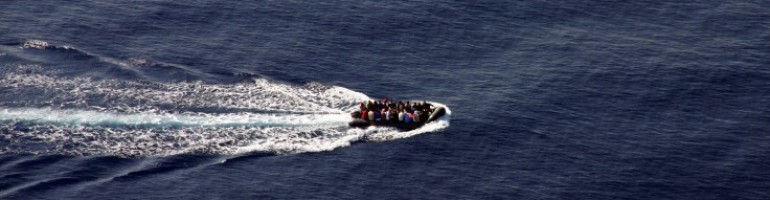
Italian media is reporting this afternoon that a satellite telephone distress call has been received from a disabled migrant boat carrying about 50 persons from Libya.  A search in the Maltese SAR zone is being undertaken.  The boat is reportedly drifting about 70 miles south of Lampedusa.  If the report is accurate, this would appear to be the first known migrant boat to have left Libya since the overthrow of Gaddafi.

Click here and here for articles.  (IT)  Click here for article. (EN)

[UPDATE 23:45 GMT – A Malta Today report suggests, as has been the case before, there may be  disagreement between Maltese and Italian officials regarding who has responsibility for coordinating SAR operations.  Malta Today reports that Malta is now coordinating SAR operations due to the “closure” of Lampedusa by Italian officials.  Click here for article.]

Leave a comment

Filed under European Union, Frontex, Italy, Libya, Malta, Mediterranean, News

Frontex Quarterly Reports for 2011 Q1 and Q2

The Frontex Risk Analysis Unit (RAU) released its 2nd Quarter Report (April-June) for 2011 on 4 October.  The 1st Quarter Report (Jan-March 2011) was released on 21 July.  As always, while the information is a few months old, the reports contain a significant amount of information, graphs, and statistical tables regarding detections of illegal border crossings, irregular migration routes, detections of facilitators, detections of illegal stays, refusals of entry, asylum claims, and more.

Here are extensive excerpts from the Q2 Report:

“Executive summary

In Q2 2011, all Frontex irregular-migration indicators increased compared to the previous quarter. The most important indicator, detections of illegal border-crossing, increased to a level not seen since Q3 2008 and correspondingly asylum applications are now at nearly the highest level since data collection began. What’s more, migration pressure at the border from migrants attempting to enter and stay in the EU increased even more than EU-level figures suggest, as they are offset against extensive reductions in Albanian circular migration.

In 2011 there were major and extensive developments in irregular-migration pressure at the external border of the EU, resulting from two simultaneous but independent hotspots of illegal border-crossings: the first was seasonally increased activity at the Greek land border with Turkey, where a wide variety of migrants continued to be detected at very high levels. The second, and the undeniable hotspot for illegal border-crossing into the EU in Q2 2011, was in the Central Mediterranean, where vast numbers of sub-Saharan migrants landed in Italy and Malta mostly having been forcibly expelled from Libya. [***]

4. Main points Q2 2011

  • All irregular migration indicators increased relative to the previous quarter
  • Compared to a year ago, there were significant EU-level increases in several irregular migration indicators, such as detections of illegal border-crossing, clandestine entries, and refusals of entry. There were also increased asylum applications
  • Despite detections of Afghan migrants falling by a third compared to last year, they were still the most common nationality detected illegally crossing the EU external border. Most were previously resident as refugees in Iran
  • In contrast, detections of all the other highly-ranked nationalities (Tunisians, Nigerians, Pakistanis, Ghanaians) increased massively relative to the same period last year
  • In total there were over 40 000 detections of illegal border-crossings, a 50% increase compared to Q2 2010. These were the result of two simultaneous but independent routes of irregular migration: the Eastern Mediterranean and the Central Mediterranean routes:

1. In the Eastern Mediterranean:

– There were over 11 000 detections of illegal border-crossing, almost exclusively at the Greek land border with Turkey, which is comparable with the same period in 2010

– This flow currently attracts migrants from north Africa, sub-Saharan Africa and Asia

– Groups of Dominicans were detected travelling to Turkey to enter the EU via the Greek land border

– Secondary movements are assumed from detections of (i) illegal border-crossings in the Western Balkans, (ii) false documents on flights to major EU airports from Turkey as well as Greece, and (iii) landings in southern Italy from Greece, Turkey and Albania

2. In the Central Mediterranean:

– Following a bilateral return-agreement between Italy and Tunisia, the massive influx of Tunisians to Lampedusa reported in the previous quarter decreased, but remained significant

– A very wide range of sub-Saharan Africans were detected on this route, some having been forcibly departed from Libya

– Italy reported more detections of illegal border-crossing in Sicily than ever before, a three-fold increase compared to the previous quarter; the increased flow was composed of migrants from Côte d’Ivoire as well as Tunisia and a range of other nationalities

– There were also increased detections of Egyptian migrants and facilitators landing in Sicily and Southern Italy from Egypt

– Italy and Malta reported huge increases in the number of asylum applications submitted by sub-Saharan African migrants. In Italy increases were particularly marked for Nigerians and Ghanaians

  • Following their new visa-free status, fewer Albanians were detected illegally crossing the EU border, and illegally staying within the EU (both mainly in Greece). Instead they were increasingly refused entry to Greece and they were also increasingly detected at the UK border, either as clandestine entry or using false documents
  • There was an increased flow of Georgian migrants towards Belarus (air and land), with increased illegal entries and asylum applications in Poland and Lithuania
  • In Q2, Libya was the most significant source of irregular migration to the EU. However, more recently the ability of the Gaddafi regime to forcibly expel its migrant population to the EU has become compromised; the situation remains dynamic and uncertain[.]

4.1 Detections of illegal border-crossing

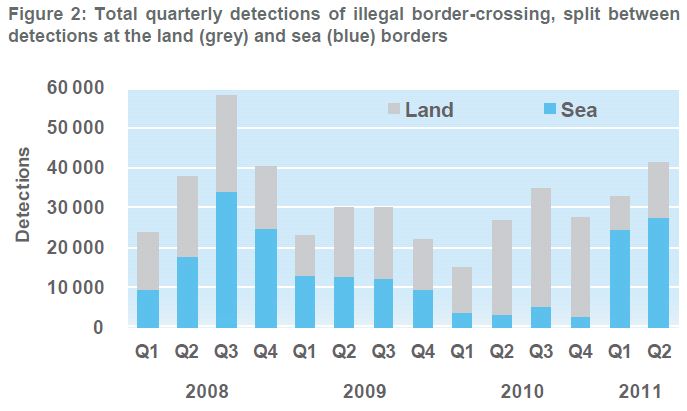
At the EU level, in Q2 2011 there were more detections of illegal border-crossing since Q3 2008. The total of 41 245 detections during this reporting period is a 25% increase compared the previous quarter and a 53% increase compared to the same period last year (Fig. 2). Without question there were major and extensive developments in illegal migration pressure at the external border of the EU, resulting from two simultaneous but independent hotspots of illegal border-crossings. The first was increased activity at the Greek land border with Turkey, where a range of Asian, north African and sub-Saharan African migrants were increasingly detected at very high levels. The second, and the undisputed hotspot for illegal border-crossing into the EU in Q2 2011, was at the Italian islands in the Central Mediterranean, where vast numbers of Tunisians, Nigerians and other sub-Saharan migrants landed in small sea vessels, the majority of which in Q2 had been forcibly departed from Libya.

Figure 2 shows the evolution of the FRAN indicator 1A – detections of illegal border-crossing, and the proportion of detections between the land and sea borders of the EU per quarter since the beginning of 2008. In Q2 2011 there were more detections of illegal border-crossing since the peak of Q3 2008 nearly three years ago. Compared to a year ago, detections at the EU land border decreased by 42% to 13 742 in Q2 2011, almost exclusively due to fewer detections of Albanian nationals following their new visa-free status; elsewhere at the land border (including Greece) trends were roughly stable. In contrast, at the sea border detections increased nine-fold to some 27 500 detections (Fig. 2), the vast majority of which (95%) were in the central Mediterranean, forming the major development in irregular migration to the EU in 2011.
[***]

At the EU level, detections of illegal border-crossing increased by 53% compared to a year ago (Fig. 3). However, this level masks a lot of variation among Member States. First, and most importantly to the current situation, was a 4 200% increase in detections of almost exclusively African migrants in Italy. Related to this central Mediterranean flow, was a concurrent and massive increase in detections reported from Malta (from 0 to 710), and also increases further west into Spain (+61%). As a result, all these countries have seen increases in other indicators such as asylum applications of the most common nationalities (see relevant sections). [***]

Routes

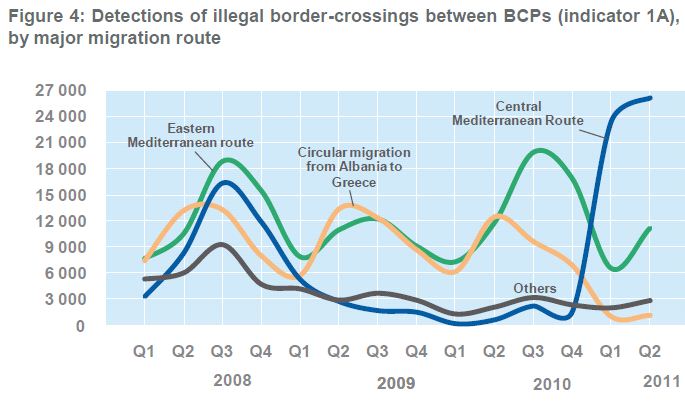
As illustrated in Figure 4, for just the second time since records began in early 2008, in Q2 2011 detections of illegal border-crossings on the Central Mediterranean route, which comprises the blue borders of Italy and Malta, exceeded those reported from both the (i) Eastern Mediterranean route of the land and sea borders of Greece, Bulgaria and Cyprus, and (ii) circular migration from Albania to Greece.
Without question, in Q2 2011 the single most important irregular-immigration route in terms of detections of illegal border-crossing was the Central Mediterranean route, where detections increased in the beginning of 2011 to previously unprecedented levels (Fig. 4). In the first quarter of 2011, and uniquely compared to previous surges of illegal immigration, this flow was restricted to a single nationality – Tunisian, most of whom were responding to civil unrest in their home country by leaving towards the Italian Island of Lampedusa. In response to this almost unmanageable influx of irregular migration at a single and isolated location, a bilateral return agreement was signed between Italy and Tunisia, which allowed for the accelerated repatriation of newly arrived individuals. Hence, during the current reporting period, the flow of Tunisian migrants fell from over 20 200 in the previous quarter to 4 300 in Q2 2011.

However, civil uprising commonly referred to as the Arab Spring, and its effects on migration in the area, was not limited to Tunisia. For example according to multiple sources, in next-door Libya, migrants from sub-Saharan countries were in Q2 2011 being coerced to move towards the EU by the Gaddafi regime in response to the NATO Operation Unified Protector which commenced on March 27 under United Nations Security Council Resolution 1973. Thus, in Q2 2011, besides some continued departures from Tunisia, the flow in the central Mediterranean was composed of a single flow of large numbers migrants from sub-Saharan countries departing Libya in small vessels. [***]

4.1.1 Eastern Mediterranean route

Detections of illegal border-crossings on this route increased seasonally and in line with previous years, from 6 504 in Q1 2011 to 11 137 in Q2 2011, almost exclusively due to a massive increase in detections at the Greek land border with Turkey, where detections increased from 6 057 to 10 582. [***]

4.1.2 Central Mediterranean route

In Q2 2011 there were 26 167 detections of illegal border-crossings on the Central Mediterranean route, a 10% increase even compared to the ‘peak’ reported during the previous quarter, and evidently a massive increase compared to the negligible detections throughout all of 2010. The vast majority of detections on this route were reported from Italy (25 500) where detections increased by 13% even compared to the ‘influx’ of migrants reported during Q1 2011. In Italy, Central African, Tunisian, Nigerian and Ghanaian were the mostly commonly detected nationalities, 90% of which were detected in the Pelagic Islands (14 300), most notably Lampedusa (Fig. 7). However, in Q2 2011 there were also more detections of illegal border-crossing reported from Sicily (2 260) than ever before; this figure is nearly three times bigger than that reported in the previous quarter and more than twenty times higher than during the same period last year (100). Compared to the previous quarter, in Sicily there were more detections of migrants from a very wide range of countries such as Egypt, Côte d’Ivoire and Tunisia. There were also over 710 detections reported from Malta, which is a sustained peak from the previous quarter (820) and extremely high compared to the negligible detections throughout 2010. In Malta there were much fewer detections of Somalis and Eritreans but there were increased detections of Nigerians and migrants from Côte d’Ivoire. However, migrants from Tunisia, Algeria and Egypt often claim to originate from sub-Saharan Africa in an attempt to appear as refugees, a fact which may render such comparisons of nationalities somewhat misleading.

In the previous FRAN Quarterly (Q1 2011) it was reported a surge of irregular immigration (20 000 detections) on the Central Mediterranean route that was almost entirely restricted to a single nationality: Tunisian (Fig. 8). As a result of this influx, on 20 February the JO EPN-Hermes Extension 2011 commenced in the central Mediterranean, and a bilateral agreement was reached between Italy and Tunisia on 5 April 2011, which resulted in the strengthening of police surveillance along the Tunisian coast and regular repatriations of Tunisian nationals from Italy. For example, according to data collected under JO Hermes 2011, some 1 696 Tunisians were repatriated between 5 April and 23 August 2011. The repatriation agreement is probably an effective deterrent, combining as it does, returns and surveillance, however some migrants have reported their boats being spotted by military patrols that did not take any action. According to the FRAN data, in Q2 2011 some 4 286 Tunisian migrants were still detected illegally crossing the border into Italy. Although a massive reduction, this still represents a very large and significant flow of irregular migrants into the EU.

In comparison to the reduction in flow from Tunisia, in Q2 2011 there was a large increase in migrants who had departed from Libya (Fig. 9). The migrants departing from Libya were mostly nationals from countries in the Horn of Africa, the sub-Saharan and Central African regions and, to a lesser extent, Asia. According to intelligence collected during JO EPN-Hermes Extension 2011, most of these migrants had already been in Libya for over a year, originally heading to Tripoli via the traditional routes for sub-Saharan and Central African migrants. In Q2 2011, migrants tended to reach Italy on large fishing vessels that had departed directly from Tripoli or the nearby ports of Medina and Janzour. Most of these deported African nationals did not want to leave the country as their standard of living in Libya was high compared to their home countries. Several even stated that they would choose to return to Libya after the war. In Q2 2011 reports suggest that some migrants were instructed to reach embarkation areas on their own but had been caught by the military or police and then detained in camps or disused barracks until they were transported to embarkation areas and onto vessels bound for Italy. In each case the migrants were searched by the military before boarding and all their belongings were confiscated. According to reports, nationals of the sub-Saharan and Central African regions as well as from Horn of African countries have been recruited by the Libyan army/police to manage their compatriot migrants at gathering places or camps. In some cases the destination of vessels from Libya was Sicily, where the flow was characterised by waves of landings. For example there were around 11 landings on 13 May and 7 between 11 and 29 June, with the majority of boats arriving from Libya and Egypt. [***]

4.1.3 Western Mediterranean route

In Q1 2011 there were 1 569 detections of illegal border-crossings on this route to Southern Spain, which is nearly double compared to the previous quarter (890), and more than a 50% increase compared to a year ago (973). Some of this increase is due to better weather conditions at this time of year, but irregular migration pressure on this route is clearly higher than it was at the same time last year. [***]

In the longer-term, irregular immigration to southern Spain has been consistently decreasing since the beginning of 2006. Commonly cited reasons are Frontex Joint Operations in the area, effective bilateral agreements and more recently rising unemployment in Spain, particularly in sectors typified by migrants.* Nationalities traditionally associated with this route were Algerian, Moroccan and Ghanaian. [***]

4.1.4 Western African route

The cooperation and bilateral agreements between Spain and the rest of the Western African countries (Mauritania, Senegal and Mali) are developing steadily. They are one of the main reasons for the decrease in arrivals on this route over the last year, as are the presence of patrolling assets near the African coast. In Q4 2010 Frontex reported a slight increase in the number of detections of illegal border-crossing at the Canary Islands, from a maximum of 50 during each of the previous 4 quarters, to 113 in Q4 2010. This increased level of detections persisted into the first quarter of this year (154), exclusively due to Moroccan nationals (152) displaced after the dismantling of migrant camps near the dispute Western Saharan region. However, during the current reporting period detections on this route decreased massively to a negligible 24 detections. [***]”

Click here for 2011 Q2 Report.

Click here for Frontex Statement regarding 2011 Q2 Report.

Click here for 2011 Q1 Report.

Click here for Frontex Statement regarding 2011 Q1 Report.
3 Comments

Filed under Aegean Sea, Algeria, Analysis, Cyprus, Data / Stats, Eastern Atlantic, Egypt, European Union, Frontex, General, Greece, Italy, Libya, Malta, Mauritania, Mediterranean, Morocco, News, Reports, Senegal, Spain, Tunisia, Turkey

Issue Brief- Cutting Off the Flow: Extraterritorial Controls to Prevent Migration

An Issue Brief, “Cutting Off the Flow: Extraterritorial Controls to Prevent Migration,” written by Eleanor Taylor-Nicholson, has been published by the Warren Institute for Law and Social Policy, University of California, Berkeley.  The issue brief was written as a background paper for a conference held by the Warren Institute at UC Berkeley Law School on 22 April 2011.

Excerpt: “… This issue brief explores the extent to which the United States, Europe and European governments have implemented different extraterritorial controls. Although we hear of such controls in the media, how common are they? Who is overseeing them? What do they involve? What are concerns with their use? To answer these questions, this brief presents information on key actors, including individual nation-states and their agents, and on the range of mechanisms used by both. A comparison of two major immigration destinations is included to consider similarities and differences in the use of extraterritorial controls by states.

A review of the literature and media reports finds that extraterritorial controls include a diverse range of measures by different actors, some of which have been extremely controversial, such as maritime interdiction and offshore detention, and others that are more accepted or less understood, such as visa controls and disruption of organized immigration crime. Further, while such controls are now ubiquitous in both regions, their design and implementation generally lack public oversight and accountability mechanisms. They may protect states from security threats, have the potential to provide early protection to people in need, and save traveling migrants in distress. But, if used primarily as an immigration deterrence mechanism, they can cause harm. Indeed they may provide states a means to evade their international obligations or lead to violations of international refugee law and human rights law.

In light of this, we recommend governments conduct a comprehensive and public review of the extraterritorial controls they have in place, taking into consideration international refugee and human rights commitments. We also urge governments to increase the transparency of their immigration control agreements with third parties, including private actors and other states….”

Click here for Issue Brief.

Leave a comment

Filed under Analysis, European Union, Frontex

Call for a Humanitarian Flotilla to Stop Deaths in the Mediterranean

A coalition of migrants’ rights organisations, including Migeurop, Cimade, Gisti, FIDH, and others hope to organise a humanitarian “flotilla which will undertake maritime surveillance so that assistance is finally provided to people in danger. The participatory organisations call on European bodies and governments on both sides of the Mediterranean to establish relations within this common area on the basis of exchange and reciprocity. This flotilla will embark political figures, journalists, artists, and representatives of the organisations involved in the project.  Any organisation, trade-union, political representative, seafarer, journalist, artist or other individual interested in this initiative may join this mailing list : « Mediterranean Intervention ».” To subscribe to the mailing list, please send an email to migreurop07@yahoo.it.

Click here for full Migreurop statement.

Leave a comment

Filed under European Union, Frontex, Italy, Libya, Malta, Mediterranean, News, Statements, Tunisia

PACE Migration Committee to Designate Rapporteur to Conduct Inquiry into Deaths of Boat People

PACE President Mevlüt Cavusoglu announced today that the PACE Migration Committee will conduct an inquiry into the incident that occurred in April when 61 migrants died at sea after leaving Libya.  Survivors from the boat reported that several ships, including naval ships, ignored their calls for assistance.  The Committee will designate a Rapporteur this week who will look into this incident as well as “other cases where better interception and rescue co-ordination could have saved human lives.”

Click here and here for PACE press statements.

Click here and here for previous posts.

Leave a comment

Filed under Council of Europe, Libya, Mediterranean, News

Gisti Calls for NATO to Use Its Surveillance Capabilities to Prevent Migrant Deaths at Sea

From Gisti:

“…  Faced with hundreds of fatal wrecks in the Mediterranean, can we simply denounce the deafening silence in which lives are lost at our doors? Should we accept being powerless in the face of immigration politics which we cannot change? Those who have drowned are not the victims of natural disasters, but of political decisions carried out by persons whose responsibility must be marked. In response to these attacks on the most fundamental right – the right to life – we must ensure that procedures are undertaken and that justice is done. We must stop this carnage. [***] These wrecks, sinking boats transformed into floating coffins of men, women and children, deaths from exposure,  hunger and thirst after drifting at sea, have become commonplace.  [***] But things have changed since an international coalition and NATO forces intervened in Libya. Today, AWACS, drones, planes, helicopters, radar, and warships watch everything that moves in the Mediterranean. They can not fail to see the boats of exiles from sub-Saharan Africa who seek to flee from Libya. [***] By not intervening, they are guilty of failing to assist persons in danger. This can not go unpunished. [***]>>

<<[***] Face aux centaines de naufrages mortels en Méditerranée, peut-on se contenter de dénoncer le silence assourdissant dans lequel des vies disparaissent à nos portes ? Doit-on se résoudre à l’impuissance devant des politiques migratoires auxquelles on ne pourrait rien changer ? Ces noyées ne sont pas les victimes de catastrophes naturelles, mais de décisions politiques mises en œuvre par des exécutants dont les responsabilités doivent être pointées. Devant ces atteintes au droit le plus fondamental – le droit à la vie – il faut que des procédures soient engagées et que justice soit rendue. Il faut mettre fin à cette hécatombe. [***]  De ces naufrages, des épaves transformées en cercueils flottants d’hommes, de femmes et d’enfants morts d’épuisement, de faim et de soif après de longues dérives en mer, l’opinion a pris l’habitude. [***]  Mais la donne a changé depuis qu’une coalition internationale et les forces de l’OTAN interviennent en Libye. Aujourd’hui, awacs, drones, avions, hélicoptères, radars et bâtiments de guerre surveillent tout ce qui bouge en Méditerranée. Ils ne peuvent pas ne pas voir les bateaux des exilés originaires d’Afrique subsaharienne qui cherchent à fuir la Libye. [***] En n’intervenant pas, ils se rendent coupables de non-assistance à personne en danger. Ceci ne peut rester impuni. [***] >>

Click here for full statement.  (FR)

2 Comments

Filed under European Union, Frontex, Italy, Libya, Mediterranean, Statements, Tunisia

1500+ Migrants Land in Lampedusa / NATO Helicopters Report Migrant Boat Sightings to Maltese SAR Authorities

Seven migrant boats from Libya carrying over 1500 migrants arrived in Lampedusa over a 12 hour period Friday night to Saturday.  The large number of arrivals follows an 11 day period when there where no arrivals on Lampedusa.  Improved sea conditions are again believed to be the main explanation for the timing of arrivals.

According to Maltese news reports, NATO Headquarters in Naples informed Maltese SAR authorities that a helicopter operating from a NATO vessel had sighted several of the migrant boats sailing north from Libya and search operations for the migrants boats were begun as a result.

It would be helpful if NATO’s press office would include information on NATO’s search and rescue activities and sightings of migrant boats in its daily Unified Protector Operational Media Update.  The Update already includes a daily tally of NATO air operations (sorties and strike sorties), hits, maritime arms embargo activities (hailings, boardings, interdictions), and humanitarian assistance movements.

Click here (EN), here (IT), here (IT), and here (IT) for articles.

1 Comment

Filed under Italy, Libya, Malta, Mediterranean, News

CoE HR Commissioner: Europe should increase air surveillance to spot and rescue migrant boats

Council of Europe Human Rights Commissioner Thomas Hammarberg issued a new Comment, “African migrants are drowning in the Mediterranean,” in which he voices the concern that “preventing migrants from coming [to Europe] has become more important than saving lives” and calls for a dramatic increase in “surveillance – from the air – along the Libyan coast and further out in order to spot any fragile [migrant] vessels at sea and safely prepare a rescue.”

Excerpts:

“The drowning tragedies in the Mediterranean are not a new phenomenon; … [European deterrent measures] ha[ve] not prevented people from trying to reach Europe, but it has made the journey more dangerous and given the smugglers a reason to increase their prices. The boats have become more and more overcrowded and more of them have capsized.  Smugglers have a responsibility; they take on board much too many migrants in much too unsuitable boats – and thereby put lives at risk. …

Europe has a role in this. The imperative principle of ‘rescue at sea’ must not only be respected for those close to a sinking ship; there is also a need to increase dramatically surveillance – from the air – along the Libyan coast and further out in order to spot any fragile vessels at sea and safely prepare a rescue.  In view of the ongoing military operations it would be difficult to argue that there are no resources for such reconnaissance activity. Indeed, the escalation of the armed conflict has contributed to the acute situation of the sub-Saharan migrants.

European governments and institutions have more responsibility for this crisis than they have demonstrated so far. Their silence and passivity are difficult to accept. When preventing migrants from coming has become more important than saving lives, something has gone dramatically wrong.”

Click here (EN) or here (FR) for full statement.

Leave a comment

Filed under Council of Europe, Italy, Libya, Malta, Mediterranean, Statements, Tunisia

UNHCR Calls on EU to Improve Rescue at Sea Measures; NATO Should Also Actively Participate in Rescue at Sea in Regard to All Overcrowded Boats

UNHCR issued a statement on Friday, 8 April, calling “on the European Union to urgently put into place more reliable and effective mechanisms for rescue-at-sea” in the aftermath of last week’s disaster that saw “[m]ore than 220 Somali, Eritrean and Ivorian refugees drowned early on Wednesday morning when their boat capsized some 39 nautical miles south of the Italian island of Lampedusa. This is the worst such incident in the Mediterranean in recent years.  ‘It is hard to comprehend that at a time when tens of thousands are fleeing the Libyan conflict and pouring across the land borders into Tunisia and Egypt where they enjoy safety and receive shelter and aid, the protection of people fleeing via Libya’s maritime border does not appear to have the same priority’ said Assistant High Commissioner for Protection Erika Feller.” “‘We also appeal to shipmasters to continue to render assistance to those in distress at sea. Any overcrowded boat leaving Libya these days should be considered to be in distress’ [, said Feller.]”

While NATO was not mentioned in the UNHCR statement, the call for improved measures to save the lives of migrants who flee North Africa by boat should also be heard and considered by the NATO Maritime Command Naples which is conducting the maritime embargo of Libya known as Operation Unified Protector.   NATO has a significant naval force patrolling the area through which migrant boats leaving Libya are passing and this force should be actively engaged in protecting fleeing civilians.  (Click here for earlier post regarding NATO’s maritime embargo.)

While UN Security Council Resolution 1973 does not speak directly to this issue, it does call for the protection of civilians.  Relevant portions from Security Council Resolution 1973:

  • “Expressing [the Security Council’s] determination to ensure the protection of civilians and civilian populated areas and the rapid and unimpeded passage of humanitarian assistance and the safety of humanitarian personnel, [***];
  • Reiterating [the Security Council’s] concern at the plight of refugees and foreign workers forced to flee the violence in the Libyan Arab Jamahiriya, welcoming the response of neighbouring States, in particular Tunisia and Egypt, to address the needs of those refugees and foreign workers, and calling on the international community to support those efforts, [***];
  • Protection of civilians – 4. Authorizes Member States that have notified the Secretary-General, acting nationally or through regional organizations or arrangements, and acting in cooperation with the Secretary-General, to take all necessary measures, notwithstanding paragraph 9 of resolution 1970 (2011), to protect civilians and civilian populated areas under threat of attack in the Libyan Arab Jamahiriya,… [***].”

As with UNHCR’s call to EU states, NATO ships should also render assistance to any migrant boat detected by NATO forces – any overcrowded boat leaving Libya should be considered to be in distress.

Click here for UNHCR statement.

Click here for article.

Leave a comment

Filed under European Union, Italy, Libya, Malta, Mediterranean, News, UNHCR

Frontex Announces Expansion of Joint Operation Poseidon Sea to Include Crete and Eastern Portions of Central Mediterranean

Two days after announcing the extension of Joint Operation Hermes and the westward expansion of the operational area of JO Hermes to include the waters around Sardinia, Frontex on 26 March announced the expansion of the operational area of Joint Operation Poseidon Sea to include the waters around Crete.  The expansion is due to the “highly volatile situation in North Africa” and was called for by the European Council’s Conclusions issued at the end of the Council meeting of 24/25 March: “the Commission will make additional resources available in support to [Frontex’s] 2011 Hermes and Poseidon operations and Member States are invited to provide further human and technical resources.”

Excerpts from the Frontex statement:  “March 26, 2011 — Responding to the highly volatile situation in North Africa Frontex extends operational area of its on-going Joint Operation (JO) Poseidon Sea. In the first four weeks of deployment Joint Operation Poseidon Land sees decreasing numbers of arrivals across the land border with Turkey.   In view of potential migratory flows from Libya operational area of JO Poseidon Sea, which covers the Greek islands in the Aegean sea, has been widened to include Crete. On Thursday, 24 February Romanian maritime surveillance vessel and a Portuguese plane were deployed to increase patrolling intensity in this region. [***]”

Click here for Frontex Poseidon Sea press release.

Click here for the Frontex Hermes press release.

Click here for the Council Conclusions.

Click here for previous post on the expansion of JO Hermes.

Leave a comment

Filed under Aegean Sea, European Union, Frontex, Greece, Italy, Libya, Mediterranean, News, Tunisia

2000 Migrants Reach Lampedusa Over 24 Hour Period; Ship Carrying 1800 Remains in Int’l Waters in Need of Fuel

Approximately 2000 new migrants in more than 20 boats arrived in Lampedusa on 14-15 March.  Some were rescued and some reached Lampedusa on their own.  One boat is believed to have sunk near Tunisia and approximately 35 persons are believed to be missing.

According to a UNHCR briefing yesterday, just over 10,000 migrants, nearly all young Tunisian men, have arrived in Italy since mid-January.  UNHCR spokesperson Melissa Fleming said that “[t]he outflow from Tunisia is unrelated to the ongoing crisis in Libya. From our interactions with Tunisians arriving in Italy over past weeks, we believe that most are seeking employment and better economic opportunities, rather than international protection.   UN staff and partners in Tunisia report that some villages appear largely empty of their young male population, with only women, children and elderly people remaining. This type of outflow is not atypical of countries in transition, and we are well aware of the many demands on the Tunisian authorities at present. Solutions to this type of flow need to be found in dialogue between the concerned governments, including arrangements for the orderly and dignified return of persons who are found not to be in need of international protection, and the establishment of opportunities for labor migration which can meet the needs of countries on both sides of the Mediterranean.”

The standoff with the Moroccan ferry, the Mistral Express, continues.  The ship left Libya several days ago and is located in international waters about 20 miles from the port of Augusta, Sicily.  Italian authorities have refused to permit the ship to enter Italian waters and are considering providing fuel to the ship while it remains at sea in order to prevent any of the 1800+ mostly Moroccan passengers from attempting to leave the ship and enter Italy.

Click here for UNHCR press briefing.

Click here, here, here, here, and here for articles.  (IT)

Leave a comment

Filed under European Union, Frontex, Italy, Libya, Mediterranean, Morocco, News, Tunisia, UNHCR

Prof. Goodwin-Gill: ‘The Right to Seek Asylum: Interception at Sea and the Principle of Non-Refoulement’

On 16 February Professor Guy S. Goodwin-Gill presented the inaugural lecture of the Fondation Philippe Wiener – Maurice Anspach, Chaire W. J. Ganshof van der Meersch.  The lecture was entitled ‘The Right to Seek Asylum: Interception at Sea and the Principle of Non-Refoulement’.  The complete text of the lecture is available at this link: Goodwin-Gill: The Right to Seek Asylum-Interception at Sea and the Principle of Non-Refoulement.  The complete text also contains a helpful reference list.

I have reproduced several excerpts below:

“Looking at the interception and return measures adopted in the Mediterranean and off the west coast of Africa … one may rightly wonder what has happened to the values and principles considered fundamental to the Member States of the European Union….  [***]

… [I]t is all the more surprising when [European] governments, ministers and officials either pretend that the rules [- including Article 78(1) of the TFEU which requires the Union to develop a common asylum policy with regard to ‘any third country national requiring international protection and ensuring compliance with the principle of non-refoulement’ – policy which ‘must be in accordance with the Geneva Convention… and other relevant treaties’-] do not apply, or seek ways to avoid their being triggered.

In my view, the problems begin at the beginning, just as they commonly do also at the national level. A policy or goal is identified – in this case, reducing the number of irregular migrants, including asylum seekers, leaving the north African coast and heading for Europe – and then belatedly some attempt is made to bend implementation of the policy to fit in with principle and rule. A better approach, in my view, would be to begin with a clear understanding of the applicable law – the prohibition of discrimination, of refoulement, of inhuman or degrading treatment – and then to see what can be done by working within the rules.

Of course, this approach is premised on the assumption that States generally seek to work within the rule of law. It will not likely influence the State determined to deal with the migrant and the asylum seeker arbitrarily, and without reference to principle. Such cases must be confronted head-on, by way of judicial and political mechanisms of control.  [***]

… The problem, though, lies not in formal recognition of protection principles but, as ever, in operationalising the rules – in making protection a reality at the point of enforcement. On the plus side stands a substantial body of legislation: the Frontex regulation itself; the RABIT amendment, with its express insistence on compliance with fundamental rights and conformity with Member States’ protection and non-refoulement obligations; and the Schengen Borders Code, Article 3 of which requires the Code to be applied, ‘without prejudice to the rights of refugees… in particular as regards non-refoulement’. Add to this the April 2010 Council Decision supplementing the Code and dealing specifically with the surveillance of maritime borders and Frontex operations; it is currently being challenged by the Parliament on vires grounds, and it was also objected to by Malta and Italy, mainly for its proposal that in the last resort, rescue cases should be disembarked in the State hosting the Frontex operation. The Decision’s formulation of the applicable law in the matter of protection, however, is unremarkable, restating the principle of non-refoulement and the need to avoid indirect breach, but also providing for those intercepted to have an opportunity to set out reasons why they might be at risk of such a violation of their rights….  [***]

What do we know about either unilateral or Frontex-led interception operations so far? Not as much as we might expect as citizens of a democratic Union bounded by the rule of law and basic principles of good governance, such as transparency and accountability….  [***]

Exactly what Frontex does in an interception context has been questioned. Human Rights Watch has claimed that Frontex has been involved in facilitating interception, though this has been denied. Amnesty International and ECRE note that Frontex has stated that it does not know whether any asylum applications were submitted during interception operations, as it does not collect the data. How, then, should we approach what appears to be wilful ignorance? In the Roma Rights Case in 2004, discrimination on racial grounds was alleged in the conduct of immigration procedures by British officials at Prague Airport, which were intended to prevent potential asylum seekers leaving for the United Kingdom. There, too, the authorities did not keep any records of the ethnic origin of those they interviewed. Finding on the evidence that the government had acted in violation of relevant legislation, the House of Lords called attention to the importance of gathering information, ‘which might have helped ensure that this high-risk operation was not being conducted in a discriminatory manner…’

Given the secrecy attaching to interception operations, and the fact that no data are gathered or retained, it is reasonable to infer that some level of Frontex involvement has occurred, and that, absent evidence to the contrary, the relevant principles of international and EU law have not been observed.  [***]

… The object and purpose of EU operations in maritime areas, therefore, should be first and foremost to ensure protection, and secondarily to manage and prevent irregular migration….

In the absence of effective and verifiable procedures and protection in countries of proposed return, the responsibility to ensure protection remains that of the EU agency or Member State. In practice, this will require that they identify all those intercepted, and keep records regarding nationality, age, personal circumstances and reasons for passage. Given protection as the object and purpose of interception operations, an effective opportunity must be given for objections and fears to be expressed; these must then be subject to rational consideration, leading to the formulation of written reasons in explanation of the next steps. Where this entails return to or disembarkation in a non-EU State, a form of judicial control is required as a necessary safeguard against ill-treatment and the abuse of power – exactly what form of judicial control calls for an exercise of juristic imagination. In the nature of things, such oversight should be prompt, automatic, impartial and independent, extending ideally to the monitoring of interception operations overall….”

Click here or on the following link for complete text: Guy S. Goodwin-Gill, ‘The Right to Seek Asylum: Interception at Sea and the Principle of Non-Refoulement’

I thank Prof. Goodwin-Gill for permitting me to post the text of his lecture.


1 Comment

Filed under Aegean Sea, Analysis, Eastern Atlantic, European Union, Frontex, Mediterranean, UNHCR

Over 1000 New Migrants Reach Lampedusa

Migrant arrivals in Italy continue with over 1000 migrants reaching Lampedusa in at least 11 different boats on Sunday.

Click here (IT) and here (IT) for articles.

Leave a comment

Filed under European Union, Frontex, Italy, Mediterranean, News, Tunisia

Migrant Arrivals in Lampedusa Resume; 10 Boats–500 Migrants Arrive During 24 Hour Period

After a week or so without any migrants arriving in Lampedusa, ten boats carrying approximately 500 persons arrived in Lampedusa and nearby Italian islands over a 24 hour period 1st-2nd March.  Improved weather conditions are the most likely explanation for the new boat arrivals.  Highlighting the difficulties of maritime surveillance, one of the migrant boats with 22 migrants landed on the island of Linosa, roughly halfway between Lampedusa and Malta, without being detected.

According to Interior Minister Roberto Maroni, to date 2,000 Tunisians have applied for some form of protection; less than 400 asylum requests have been made.  According to Maroni, most of the Tunisians have expressed a desire to go to other European countries, generally France or Germany.

Maroni said that Italy’s agreement with Tunisia limits repatriation of Tunisians to four persons per day and Italy is therefore currently negotiating with Tunisia to increase the number of persons who may be repatriated.  If the daily limit is not changed it would take years to return the thousands who have arrived in Italy.

Click here (IT), here (IT), and here (EN) for articles.

Leave a comment

Filed under Frontex, Italy, Libya, Mediterranean, News, Tunisia

Laitinen in Malta Visit; Malta Still Not Willing to Host New Frontex Mission; Frontex Preparing Multiple Contingency Plans

Malta’s Home Affairs Minister Carm Mifsud Bonnici met with Frontex Executive Director Ilkka Laitinen.  Mifsud Bonnici said Malta is unwilling to host a new Frontex mission due to its fear that intercepted or rescued migrants would be taken to Malta.  During a press conference (click here for article and short video), Laitinen said that Frontex was not willing to give estimates of the numbers of migrants it believes may seek to leave Libya, but said it was preparing plans for seven different scenarios.  The plans “could include strengthening air and maritime surveillance, increased capacity to deal with those seeking protection at ports and airports and an improved repatriation mechanism for those who did not meet the criteria for humanitarian protection.”  Laitinen reiterated that “push backs and diversions are not an option for people seeking protection.”  Laitinen did not address the burden sharing question other than to say that it was a political question that did not involve Frontex.

Click here, here, and here for articles.

1 Comment

Filed under European Union, Frontex, Libya, Malta, Mediterranean, News