Tag Archives: Migrants

El SIVE sólo detectó cuatro de quince pateras

“El Gobierno ha reconocido en una respuesta parlamentaria en el Senado que el Sistema de Vigilancia Exterior -SIVE- sólo detectó cuatro de las quince pateras y embarcaciones de traficantes que llegaron a Alicante hasta Navidad.  …  El Gobierno recuerda que el SIVE ha sido diseñado para conseguir “una vigilancia más eficaz de la costa” mediante una red de radares y cámaras con sensores de infrarrojos. “Este sistema, no obstante, presenta también alguna limitación como la derivada del alcance de sus sensores y la existencia de zonas de sombra en ciertos puntos próximos a la costa, debido a la accidentalidad geográfica (que no se detallan por motivos de seguridad)”, apunta la respuesta.”

Click here for full article.

Leave a comment

Filed under Eastern Atlantic, Mediterranean, News, Spain

Frontex Programme of Work 2010

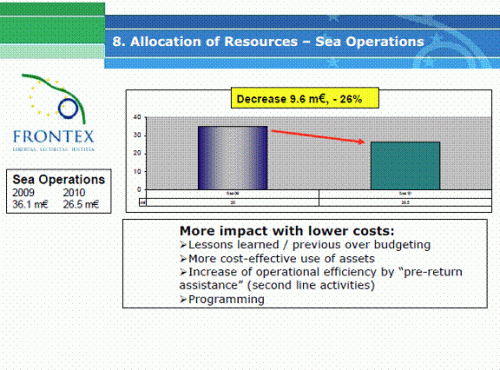
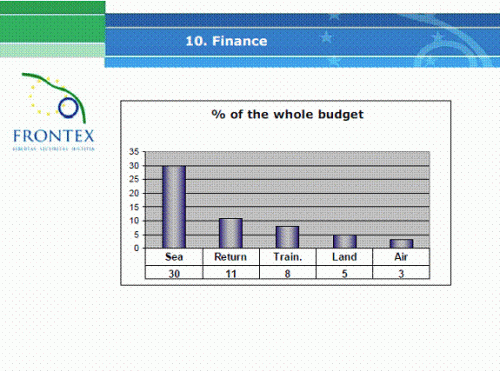
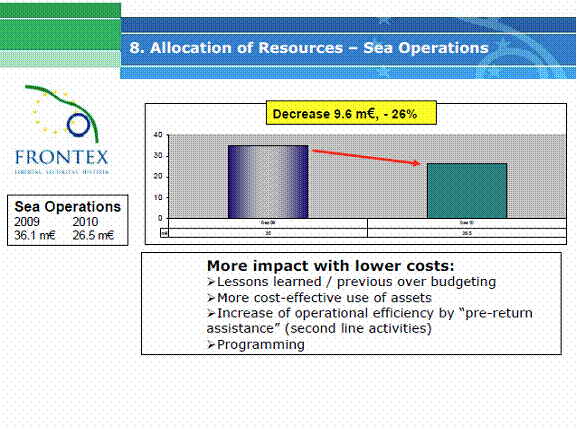
Frontex issued its 2010 Work Programme some time in late 2009.  I have not taken the time to closely read the full 90 page document, but it is worth noting that Frontex sea operations continue to constitute the largest share of the Frontex operational budget, over 26.5 M €.  Due to delayed payments from member states, Frontex is planning on cutting its sea operation budget by 9.7 M € in 2010.

Here are some excerpts from the Programme for Work relevant to sea operations:

“Executive Summary – Frontex’ Programme of Work 2010, as the output of a cyclical planning process, is the operative plan of the Agency to be used as reference for the governance process of assessing and evaluating operational activities carried out during 2010. Frontex’ Programme of Work also seeks to ensure the highest possible level of transparency towards the citizen of the European Union. [***]

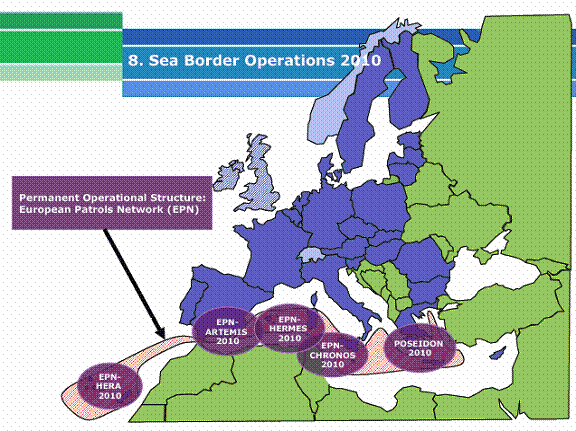
Sea Borders has the biggest share of the budget for operational activities: 26.5 M €. This is a decrease of 9.7 M €. Based on experiences from 2007 and 2008 the budget allocated to Sea Borders has been reduced as payments have been lagging seriously behind and it seems logical that the level of ambition has to be (at least temporarily) adjusted downward. However, the presently foreseen budget does give sufficient room for 7 to 9 projects within the EPN European Patrols Network and 6-7 joint operations in different geographical areas to decrease the illegal immigration flows and to detect facilitators (26.3 M €). Other activities carried out by Sea Borders will be:

– Improved working conditions and improved operational value of interrogation experts (0.1 M €);

– Improved level of awareness in ICCs and regional centers during JOs. (0.1 M €). [***]”

“1.6. Outlook for the situation at the external borders in 2010

General trends –  [***] In May 2009 Libya agreed to direct repatriation of illegal migrants, increasing in the process the deterrent effect of Frontex coordinated Joint Operations in the area. Likewise, Joint Operation Poseidon 2009 has introduced pilot measures to gauge the magnitude of the phenomenon of nationality swapping. When extended and systematized, this measure will facilitate return, determination of illegal migration routes correctly and spotting any displacement in a more timely manner. [***]”

“External maritime borders of the Member States – With significantly lower number of migrants departing from Libya and a decreasing trend of arrivals in the Canary Islands, the relative importance of Algeria, Morocco, Tunisia and possibly Egypt as departure points is likely to grow throughout 2009 and 2010. Efforts by authorities there against illegal migration will be crucial for limiting the flow towards Italy and Spain.  Gambia is expected to take over from Senegal the role of a major embarkation point on the West African coast. That said, in absolute numbers the Aegean Sea (at the border between Turkey and Greece) is expected to remain the main entry point at external sea borders in 2010 should cooperation with Turkey continue to be limited. With the strengthening of the southern EU maritime borders, migrants who initially considered sea crossing might opt for alternative way of entry. One of them might be the use of air borders, either with forged documents or after obtaining visa on false pretence.  At the moment, such a shift has not yet been detected and the risk is considered rather low for 2010, but the situation at the air border should nevertheless continue to be monitored with vigilance. [***]”

“1.7.1. Priority locations by border type

(1) At the external sea borders, operational cooperation should continue to focus on the southern maritime areas where large number of illegal migrants have been detected and where migrants’ life is most at risk, namely the maritime areas leading to: the Canary Islands, the Spanish south-eastern Mediterranean coast, the Island of Lampedusa, Malta—taking into account possible displacement to Sicily and/or Crete—, Sardinia and the Greek Islands close to the Turkish coasts (Lesvos, Chios, Samos, Patmos, Leros and Kos).

Even though decreases detections of illegal border crossing have been reported during the first semester 2009 on the West African and Central Mediterranean routes, operational cooperation should continue to include these areas, on the one hand because the decrease might only be temporary, and on the other because Frontex coordinated Joint Operations in these areas as one factor have contributed to the decrease. [***]”

“1.7.2.2. Recommendations for operational cooperation at the sea borders

(18) All efforts, from diplomatic to technical ones, should continue to be explored to break the deadlock situation of illegal migrants, as advised by facilitators, purposely turning sea surveillance patrols into rescue operations, thereby using surveillance measures as part of their modus operandi. As of mid-2009, such situation was still prevailing in the Aegean Sea.

(19) Joint Operations at the sea borders should aim at developing a permanent linguistic expertise pool, combined with debriefing techniques. Alternatively, language expertise could be outsourced to vetted private sector.

(20) At the sea borders where migrants arrive in big groups, special attention should be given to the rapid identification of victims of THB, especially women and children, with a view to gaining information leading to the identification and prosecution of the traffickers. In this process victim protection should be paramount. [***]”

Click here for a link to the full document.  Note that the document is 90 pages in length but for some reason the 90 page document available at this link is in triplicate, i.e. it is 270 pages in length.  But it is the same 90 page document thrice.

Click here for a link to Slides used by Frontex to summarize some aspects of the Programme.

Leave a comment

Filed under Aegean Sea, Eastern Atlantic, Frontex, Mediterranean, News, Reports

Conference de l’Ucad: «Migrations entre le Sénégal et l’Espagne: défis et opportunités»

“Les premières journées hispano-sénégalaises qui portaient sur le thème « Migrations entre le Sénégal et l’Espagne : défis et opportunités » ont été clôturées, … à Dakar. Une occasion saisie par le Pr. Saïdou Nourou Tall, vice doyen de la Faculté des Sciences juridiques et politiques de l’Ucad, par ailleurs coordonnateur du Master du droit des migrations pour faire le diagnostic du dispositif du Frontex (dispositif de lutte contre l’émigration clandestine)…. le Pr. Saïdou Nourou Tall a déclaré …« On a fait un diagnostic, beaucoup de choses ont été faites. Mais il existe un certain nombre de problèmes dans ce dispositif du Frontex qui nous interpelle tous », a-t-il précisé. Est-ce que les milliards que reçoivent nos gouvernants dans la lutte contre cette émigration clandestine atteignent les cibles », s’est-il interrogé. Pour lui, le constat illustre la recrudescence du phénomène de l’émigration clandestine. La solution, de l’avis du coordonnateur du Master des Migrations de la faculté de Droit, est de « promouvoir l’unité africaine ». Pour cela, a-t-il dit, « il faut faire de l’Afrique un grand marché où les Africains trouveront du travail sans être obligés de risquer leur vie sur des pirogues de fortune ».”

Cliquez ici pour l’article complet.

Leave a comment

Filed under Colloques / Conferences, Eastern Atlantic, Frontex, Senegal, Spain

Daily Mail: from Kabul to the UK by way of Samos

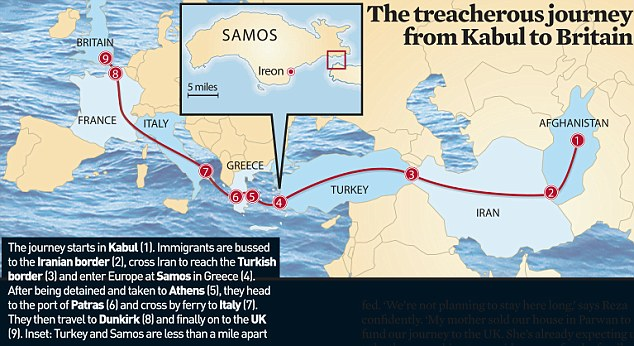
The Daily Mail has a special report detailing the experiences and routes of irregular Afghan migrants traveling from Afghanistan to the UK by way of Turkey and Greece.

Click here for the full article.

Leave a comment

Filed under Aegean Sea, Greece, News, UK

Besson et Frattini: renforcement des frontières “urgent”

“La France et l’Italie veulent un renforcement ‘urgent’ des frontières extérieures de l’UE afin de lutter contre les filières d’immigration clandestine…. Paris et Rome veulent un ‘développement des capacités opérationnelles de … Frontex en vue de mettre en place la police européenne aux frontières prévue par le Pacte européen sur l’immigration et l’asile’ et une ‘généralisation des accords de coopération opérationnelle et de réadmission avec les principaux Etats tiers d’origine et de transit’.”

“Les ministres de l’UE en charge de l’immigration doivent tenir le 25 février à Bruxelles une réunion extraordinaire convoquée par Eric Besson après la découverte de 123 Kurdes sur une plage corse en janvier.”

Cliquez ici pour l’article.

Leave a comment

Filed under European Union, France, Frontex, Italy, Mediterranean, News

Más patrullas para prevenir llegada de barcas neumáticas a la costa andaluza

“El Ministerio del Interior ha intensificado las patrullas de la Guardia Civil y las tareas de inteligencia para prevenir la llegada de embarcaciones neumáticas que cruzan el Estrecho de Gibraltar hasta las costas andaluzas, según consta en una respuesta aportada por el Gobierno al senador Eugenio Jesús Gonzalvez (PP), a la que tuvo acceso Europa Press….”

“Por otra parte, recuerda que en los meses de septiembre y octubre se puso en marcha el dispositivo Indalo, coordinado por la Agencia Europea de Fronteras (Frontex), consistente en el despliegue de medios marítimos y aéreos, complementado con personal de varios países en distintos puntos de la costa, entre las provincias de Murcia y Granada.”

“Asimismo, Interior indica que el Sistema Integral de Vigilancia Exterior (SIVE) se mantiene a la “máxima operatividad” en toda la costa del Mediterráneo, donde también continúa la realización de patrullas mixtas marítimas….”

Click here and here for articles.

Leave a comment

Filed under Eastern Atlantic, Frontex, Mediterranean, News, Spain

La primera embarcación de “sin papeles” que arriba a Canarias del año

“Un grupo de cuatro inmigrantes de origen africano arribó ayer a la isla de Gran Canaria a bordo de una pequeña lancha ….  Es la primera embarcación de «sin papeles» que arriba a Canarias en lo que llevamos de este año 2010, y llegó a las costas del Archipiélago sin ser detectada.”

“[L]a embarcación … no fue detectada por el Sistema Integrado de Vigilancia Exterior (SIVE)…”

Click here and here for articles.

Leave a comment

Filed under Data / Stats, Eastern Atlantic, News, Spain

Malmström: Non-Refoulement Must be Respected in the Mediterranean

Speaking at the first meeting of the new European Commission (Barroso 2), Cecila Malmström made remarks about Frontex:

“We have evaluated Frontex, how it works, we will strengthen it, we will increase the coordination capacities and make it a better tool in order to work with the Member States on handling irregular immigration but also on making sure that the rule of law and the principle of ‘non-refoulement’ is respected on the Mediterranean.”

“Nous avons évalué le dispositif Frontex, son fonctionnement, et nous allons le renforcer, a-t-elle déclaré. Nous allons augmenter les capacités de coordination et en faire un meilleur outil pour faire en sorte, avec les Etats, de contrôler l’immigration mais aussi pour s’assurer que la primauté du droit et que le principe de non-refoulement soient respectés autour de la Méditerranée.”

Click here for article in English.

Cliquez ici pour l’article en francais.

Leave a comment

Filed under European Union, Frontex, Italy, Mediterranean, News

Le Temps d’Algérie: Les maffias de l’immigration clandestine en Afrique de l’ouest se tournent vers le narcotrafic

“Les ministres de l’Intérieur des pays d’Afrique occidentale se réunissent aujourd’hui [14 février] à Dakar avec leurs homologues de France et d’Espagne pour examiner la délicate question de l’ouverture, dans cette région située dans le prolongement direct du Sahel, d’une «nouvelle route» spécialisée dans le narcotrafic. … Cette région était jusque-là considérée, exclusivement, comme la «route» de l’immigration clandestine vers l’Europe. … Près de 40 000 Subsahariens ont pu atteindre les côtes espagnoles. Mais le dispositif mis en place par l’Espagne dès 2007, avec le concours les unités du Frontex …a sensiblement découragé ce phénomène. Cette «route» a progressivement cessé d’être rentable pour ces maffias de l’immigration clandestine en Afrique de l’Ouest. … Les maffias de l’immigration clandestine auraient alors choisi de se tourner vers une activité plus risquée mais beaucoup plus rentable, le narcotrafic.”

Cliquez ici pour l’article complet.

Cliquez ici pour un autre article: “Lutte contre la drogue en Afrique de l’ouest : La France met sa marine à la disposition de la sous-région.”

Leave a comment

Filed under Eastern Atlantic, France, News, Senegal, Spain

New Statewatch Report: NeoConOpticon- The EU Security-Industrial Complex

Statewatch and the Transnational Institute have published a comprehensive new report.

The report, “NeoConOpticon, The EU Security-Industrial Complex”, is a “follow-up [to Arming Big Brother, 2006] [and] contains new research showing how the European Security Research Programme [ESRP] continues to be shaped by prominent transnational defence and security corporations and other vested interests. Though technically a Research and Development (R&D) programme, the ESRP is heavily focused on the application of security technologies (rather than objective research per se), and is increasingly aligned with EU policy in the fields of justice and home affairs (JHA, the ‘third pillar’), security and external defence (CFSP, the ‘second pillar’).”

The Report includes a discussion of maritime immigration enforcement.  Excerpt:

“Having fortified many of the traditional entry points to Europe, the focus of the ‘war on migration’ has shifted to the islands of the Mediterranean and the coastlines of Africa and the Middle East. For FRONTEX, the newly created EU border management agency, this ‘southern maritime frontier’ is the ‘first line of defence’ of ‘Europe’s borders’. Since 2003 FRONTEX has coordinated a host of joint police and naval missions to combat ‘illegal’ immigration by sea and is now in the process of setting up a permanent European Patrols Network for the Mediterranean and a corps of Rapid Border Intervention Teams (RABITs) for deployment to ‘illegal immigration hotspots’.

This militarised approach to immigration control is part of a broader EU maritime security and defence strategy. In 2005, following the lead of the USA’s ‘SeaPower21’ strategy, the Chiefs of European Navies (CHENS) launched a 20-year ‘Vision for the Future Role of European Maritime Forces’ to meet the demands of the European Security Strategy (2003) and enhanced NATO Maritime Joint Operations. The rationale behind the CHENS strategy is that the sea: ‘has already been used for terror attacks by boats armed with rockets and small arms’ and ‘for logistic support to terrorism’. The sea is also a potential conduit for CBRN material and “criminal activity including narcotics, human trafficking and piracy’, all of which is ‘increasing in sophistication and volume.’ …”

Click here for Executive Summary.

Click here for full report.

Leave a comment

Filed under Eastern Atlantic, European Union, Frontex, Mediterranean, Reports

Besson veut créer des zones d’attente ad hoc pour les clandestins

“Une nouvelle fois, la cinquième en six ans, le code de l’entrée et du séjour des étrangers (Ceseda) va être modifié. … Eric Besson s’apprête à faire voter une nouvelle loi. … Suite à l’arrivée sur les plages corses, le mois dernier, d’un groupe de 123 Kurdes, le ministre … avait annoncé une loi pour faire face à des «situations d’urgence» et des «afflux massifs» comme à Bonifacio…. ”

“L’article 1 prévoit que, «lorsqu’il est manifeste qu’un ou plusieurs étrangers viennent d’arriver à la frontière en dehors d’un point de passage frontalier», une zone d’attente sera créée qui s’étendra «du lieu de découverte des intéressés jusqu’au point de passage frontalier le plus proche où sont effectués les contrôles».”

“Pour Pierre Henry, directeur général de France terre d’asile (FTDA), «Eric Besson a vraiment un art de la mathématique assez incertain. Il trouve justification à un nouveau projet de loi dans l’arrivée de 123 Kurdes sur le territoire – qu’il qualifie de brutale et de massive – alors que la présence de milliers d’Afghans [à Paris et sur le littoral du Calaisis, ndlr] pour qui nous réclamons protection est jugée de peu d’ampleur». «On crée une fiction selon laquelle ces étrangers ne sont pas encore sur le territoire national»”

Cliquez ici et ici pour les articles complets.

Cliquez ici pour le position de France Terre d’Asile.

Leave a comment

Filed under France, Mediterranean, News

Yemen: We have a moral obligation to accept refugees

The Los Angeles Times has a new article on the refugee situation in Yemen.

“… The poorest country in the Arab world, Yemen can barely accommodate its own, much less the dispossessed from other lands. ‘Right now, we are torn,’ said Ali Muthana Hassan, Yemen’s deputy foreign minister. ‘We have many problems of our own in Yemen — we have war, Al Qaeda, our own citizens do not have jobs. But we have a moral obligation to accept them. And right now, we don’t have a choice. Next year, more will come. Many more will come.’”

Click here for Los Angeles Times article.

Leave a comment

Filed under Ethiopia, Gulf of Aden, News, Somalia, Yemen

Libya Opposes Blocking Peoples’ Freedom of Movement

Speaking at the 10 February ceremony in Gaeta, Italy marking the transfer of three patrol boats from Italy to Libya, The Libyan Ambassador to Italy reportedly said that  “Libya is against human trafficking and it is at the same time against the exploitation that stems from imposing any blockade on peoples’ freedom of movement around the world as it is a natural phenomenon throughout history.”

Click here for article and click here for link to earlier post with Italian Interior Minister Maroni’s comments made at the same ceremony.

Leave a comment

Filed under Italy, Libya, Mediterranean, News

L’exode vers le Yémen : un entretien avec le HCR, le PAM et l’OIM

Grotius.fr : “Au Yémen, l’année 2009 a été marquée par un record des flux migratoires en  provenance de la corne africaine : plus de 77.000 entrées sur le territoire, des Somaliens, mais un nombre d’Ethiopiens en forte augmentation. [***]

Et les migrants non somaliens devraient avoir beaucoup de difficultés à légaliser leur situation.  Les trois principales agences en charge de la question des migrants au Yémen, le PAM, le HCR et l’OIM, ont accepté d’aborder pour Grotius.fr ce dossier «brûlant».  Entretien réalisé à Sanaa par François-Xavier Trégan avec Gian Carlo Cirri, Directeur du Programme Alimentaire Mondial au Yémen, Samer Haddadin, Senior Protection Officer, Haut Commissariat pour les  Réfugiés au Yémen et Stefano Tamagnini, Directeur de l’Organisation Internationale pour les Migrations au Yémen.”

Cliquez ici pour l’article complet.

Leave a comment

Filed under Ethiopia, Gulf of Aden, News, Somalia, UNHCR, Yemen

Somalis Were Largest Group of Irregular Migrant Arrivals in Malta

According to an article appearing in DI-VE, over 35% of the 9,554 migrants who arrived in Malta over the past 5 years were Somali.  “The second largest group [was] from Eritrea (1,259), followed by Egypt (755), Nigeria (652) and Sudan (596).”

Total Irregular Migrant Arrivals in Malta:

2005 2006 2007 2008 2009 Total
1,822 1,780 1,702 2,775 1,475 9,554

Click here for article.

Leave a comment

Filed under Data / Stats, Malta, Mediterranean, News