Tag Archives: Refugees

Eurostat 2009 Asylum Statistics Released

Eurostat released asylum statistics for 2009 showing that the largest total numbers of applicants were in France, Germany, and UK and the largest per capita numbers of applicants (relative to member state population) were in Malta, Cypress, and Sweden.

From the Press Release:

“In 2009, there were nearly 261 000 asylum applicants registered in the EU27, or 520 applicants per million inhabitants. The main countries of citizenship of these applicants were Afghanistan (20 400 or 8% of the total number of applicants), Russia (20 100 or 8%), Somalia (19 100 or 7%), Iraq (18 700 or 7%) and Kosovo under UN Security Council Resolution 1244 (14 200 or 5%).”

“In 2009, the highest number of applicants were registered in France (47 600 applicants) followed by Germany (31 800), the United Kingdom3 (30 300), Sweden (24 200), Belgium (21 600), Italy (17 500), the Netherlands (16 100), Greece (15 900) and Austria (15 800).  When compared with the population of each Member State, the highest rates of applicants registered were recorded in Malta (5 800 applicants per million inhabitants), Cyprus4 (3 300), Sweden (2 600), Belgium (2 000) and Austria (1 900).”

“In some Member States, a large proportion of the applicants came from a single country. The Member States with the highest concentrations were Malta (60% of the applicants came from Somalia), Lithuania (54% from Russia), Poland (54% from Russia), Hungary (38% from Kosovo under UN Security Council Resolution 1244) and the Netherlands (37% from Somalia).”

Click here for Eurostat News Release.

Click here for Times of Malta article.

1 Comment

Filed under Data / Stats, European Union, News

Int’l Law Observer: Italy’s Asylum Policy Violates Int’l Law

Some additional comments on the Council of Europe CPT’s condemnation of Italy’s push-back practice in the Mediterranean can be found in a post by Michèle Morel on International Law Observer.

The “conclusion of the CPT is highly important in the light of the coming decision of the European Court of Human Rights on Italy’s asylum policy. It is a powerful signal, not only towards Italy but also towards other European countries carrying out the practice of intercepting and returning migrants without human rights guarantees, such as Spain and Greece.”

Click here for the complete post.

1 Comment

Filed under Analysis, Council of Europe, European Committee for the Prevention of Torture and Inhuman or Degrading Treatment or Punishment, Italy, Libya, Mediterranean

LIBE Considering Legal Challenge to Council and Commission Over New Frontex Guidelines

Times of Malta reported on Monday that Maltese MEP and LIBE Committee member, Simon Busuttil, who is the EPP coordinator on LIBE, has received a positive legal response to his question regarding whether sufficient grounds exist to bring a legal challenge against the Council and the Commission in regard to the recently approved Frontex sea operation Guidelines.  This report follows by a few days Commissioner  Malmström’s first visit to Malta and the reaffirmation by Malta that it will not host Frontex’s Operation Chronos.

The Times of Malta states that “The EP’s legal unit advised there were enough grounds to take the EU Council and European Commission to court on the basis that the rules exceed the two institutions’ powers under the EU Treaties.”  MEP Busuttil was quoted as saying “I have already gone on record saying that I will not let this one go and this legal advice opens the way to court proceedings to invalidate these rules. I am reasonably confident that the European Parliament has a good case and the European Commission would do well to take this possibility into account and start thinking about Plan B.”

Click here for article.

1 Comment

Filed under European Union, Frontex, Malta, Mediterranean, News

Malmström: Frontex Sea Operation Guidelines May Be Re-Negotiated by Participating Member States

Commissioner Cecilia Malmström was in Malta on 30 April for meetings with Maltese officials.  Malta recently reaffirmed its decision not to host Frontex’s Operation Chronos.  Malmström trip was planned before Malta’s announcement.  There is no indication that Malta changed its position during Malmström’s visit.

Malmström was interviewed during her visit by the Times of Malta and said that the new guidelines governing Frontex enforcement operations at sea could be negotiated by member states on a mission by mission basis.  The new guidelines require that intercepted migrants be taken to the country hosting the Frontex mission, but  Malmström said there is the possibility before a mission starts that the participating member states agree on different rules of engagement, which might include the sharing of responsibility where not all intercepted migrants would be brought to country hosting the mission.

Presumably participating member states would not be permitted to negotiate substantive mission by mission changes to the guidelines so as to undercut the very reasons for which the guidelines were recently adopted.

Click here for Times of Malta article.
Click here for video of Times of Malta Interview.

Click here, here, and here for other articles regarding the visit.

1 Comment

Filed under European Union, Frontex, Malta, Mediterranean, News

UNHCR Research Paper: Les violences faites aux femmes pendant leur voyage clandestin: Algérie, France, Espagne, Maroc

Un nouveau rapport du HCR (UNHCR Research Paper) par Smaïn Laacher a été publié: “Les violences faites aux femmes  pendant leur voyage clandestin: Algérie, France, Espagne, Maroc.”

Extraits:

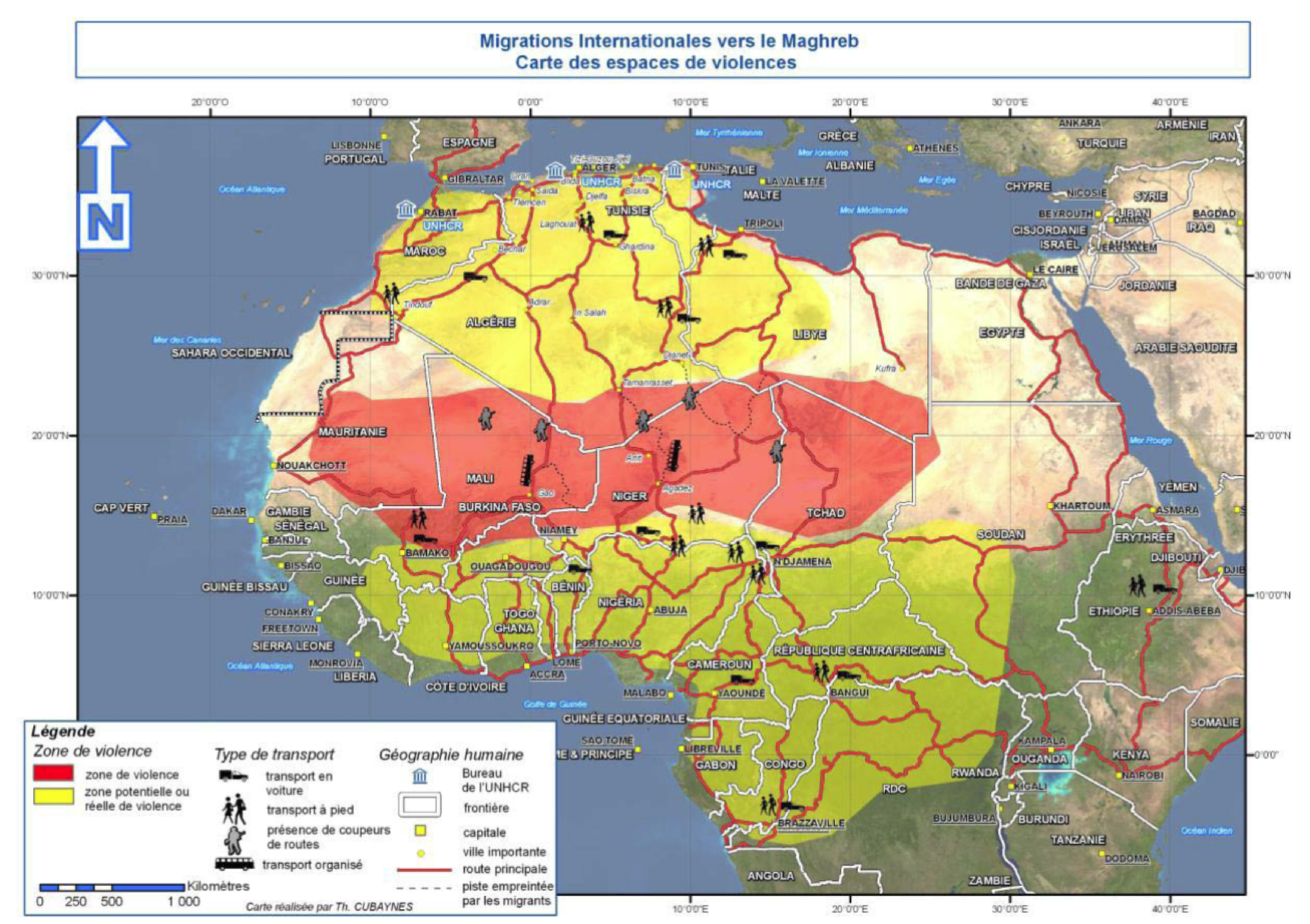
“L‟objet de notre mission a porté sur les violences faites aux femmes migrantes pendant leur voyage clandestin. Les femmes qui constituent la population de notre étude sont des femmes qui ont quitté illégalement leur pays et ont voyagé jusqu‟au Maroc, en Algérie, en Espagne, et en France. *** Les violences subies par les femmes pendant leur voyage clandestine … , dont la plus destructrice est la violence sexuelle, visent principalement des êtres sans défense, c‟est-à-dire des femmes qui n‟ont pu ou qui ne peuvent pas être défendues, précisément parce qu‟elles n‟existent pour personne, si ce n‟est que pour elles-mêmes et pour leurs agresseurs. ***”

Cliquez ici pour télécharger le rapport.

Cliquez ici pour télécharger le rapport.

1 Comment

Filed under Algeria, France, Morocco, Reports, Spain, UNHCR

Malmström: Right to Seek Asylum At Sea Should Be Respected

Commissioner Cecilia Malmström held meetings in Italy yesterday and has meetings in Malta today.  In her meeting with Italian Foreign Minister Franco Frattini she suggested that any possible future migration agreement between the EU and Tripoli ”would not follow the model of the [current migration] agreement between Italy and Libya.”  ANSA reported she said that while it is ”important to try and begin dialogue” with Tripoli, ”if there is an agreement, it is clear that the fundamental condition for Libya must be adherence to the Geneva Convention or the equivalent among African states ”on the rights of political refugees.”

In regard to current practices, Malmström said that the right to seek asylum should be respected even when one is already at sea. (”Bisogna comunque – ha concluso la Malmstrom – rispettare il diritto di chiedere asilo quando si e’ gia’ in mare”.)

Click here (IT), here (EN), and here (IT) for articles.

Leave a comment

Filed under European Union, Italy, Libya, Malta, Mediterranean, News

Council of Europe’s Committee for the Prevention of Torture Report is Highly Critical of Italy’s Push-Back Practice

The Council of Europe’s Committee for the Prevention of Torture and Inhuman or Degrading Treatment or Punishment (CPT) published on 28 April its report on its visit to Italy in July 2009 and the official response to the report from the Italian Government.

In the CPT’s view, “Italy’s [push-back] policy, in its present form, of intercepting migrants at sea and obliging them to return to Libya or other non-European countries, violates the principle of non-refoulement, which forms part of Italy’s obligations under Article 3 of the European Convention on Human Rights.”

“The so-called push-back policy, as pursued by the Italian authorities and described in this report, does not meet [the] requirements [ of the ECHR]. The CPT urges the Italian authorities to substantially review forthwith the current practice of intercepting migrants at sea, so as to ensure that all persons within Italy’s jurisdiction – including those intercepted at sea outside Italian territorial waters by Italian-controlled vessels – receive the necessary humanitarian and medical care that their condition requires and that they have effective access to procedures and safeguards capable of guaranteeing respect for the principle of non-refoulement.”

The CPT is also very critical of the lack of cooperation received from the Italian Government: “Regrettably, the co-operation received at the central level [of the Italian Government] was, in certain respects, unsatisfactory. The delegation was denied access to some documents and information it had requested, which did not facilitate its task. Other information requested by the delegation prior to and in the course of the visit was not provided in a timely manner and when eventually furnished was, moreover, incomplete.”

“For instance, information requested pertaining, inter alia, to the logbooks from each push-back operation and the names of personnel responsible for the operations, which the authorities undertook to provide to the delegation, was subsequently refused on grounds of confidentiality. Also, the Italian authorities denied the existence of a list/inventory of objects seized from migrants in the course of a push-back operation, a copy of which the delegation had requested, and yet certain representatives of the Navy had told the delegation that such a list had indeed been compiled.”

“Further, the CPT’s delegation learned from the press, and not from the Italian authorities, that during the visit, on 29-30 July 2009, a push-back operation took place. … In the Committee’s view, when a CPT delegation carries out a visit to a Party to the Convention focussing on a specific issue made known in advance, the State authorities should, in a spirit of co-operation, endeavour to keep the visiting delegation informed of significant events pertaining to that same issue.”

Click here for CPT Press Release.

Click here for the CPT Report.

Click here for the Response of the Italian Government.

1 Comment

Filed under European Committee for the Prevention of Torture and Inhuman or Degrading Treatment or Punishment, Italy, Libya, Mediterranean, Reports

MSF: Violence sexuelle et migration sur la route de l’Europe

Comme indiqué sur le blog EuroMed-MigrAsyl: Un nouveau rapport a été publié par la section espagnole de Médecins Sans Frontières: “Violence sexuelle et migration: La réalité cachée des femmes subsahariennes arrêtées au Maroc sur la route de l’Europe.”

“Ce document vise à faire connaître la problématique de la violence sexuelle subie par les femmes migrantes d’origine subsaharienne qui arrivent au Maroc alors qu’elles tentent de gagner l’Europe. Au travers des données et témoignages recueillis lors de ses projets d’action médico-humanitaire, Médecins Sans Frontières souhaite contribuer à la recherche d’une réponse globale à cette problématique qui touche toujours plus de femmes, et des femmes de plus en plus jeunes.”

“La violence est toujours présente et dans les mêmes proportions que dans les années précédentes : 39 % des [des migrants subsahariens] interrogés pendant  le recensement ont reconnu avoir subi une agression.”

Cliquez ici pour télécharger l’article.

3 Comments

Filed under Data / Stats, Morocco, Reports

Thomas More Institute: Towards a Sustainable Security in the Maghreb – An Opportunity for the Region

The Thomas More Institute has released a report, “Towards a Sustainable Security in the Maghreb –  An Opportunity for the Region, a Commitment for the European Union.”  The report was released on 7 April at the “Maghreb and the European Union: Enhancing the partnership for a sustainable security” conference in Brussels.

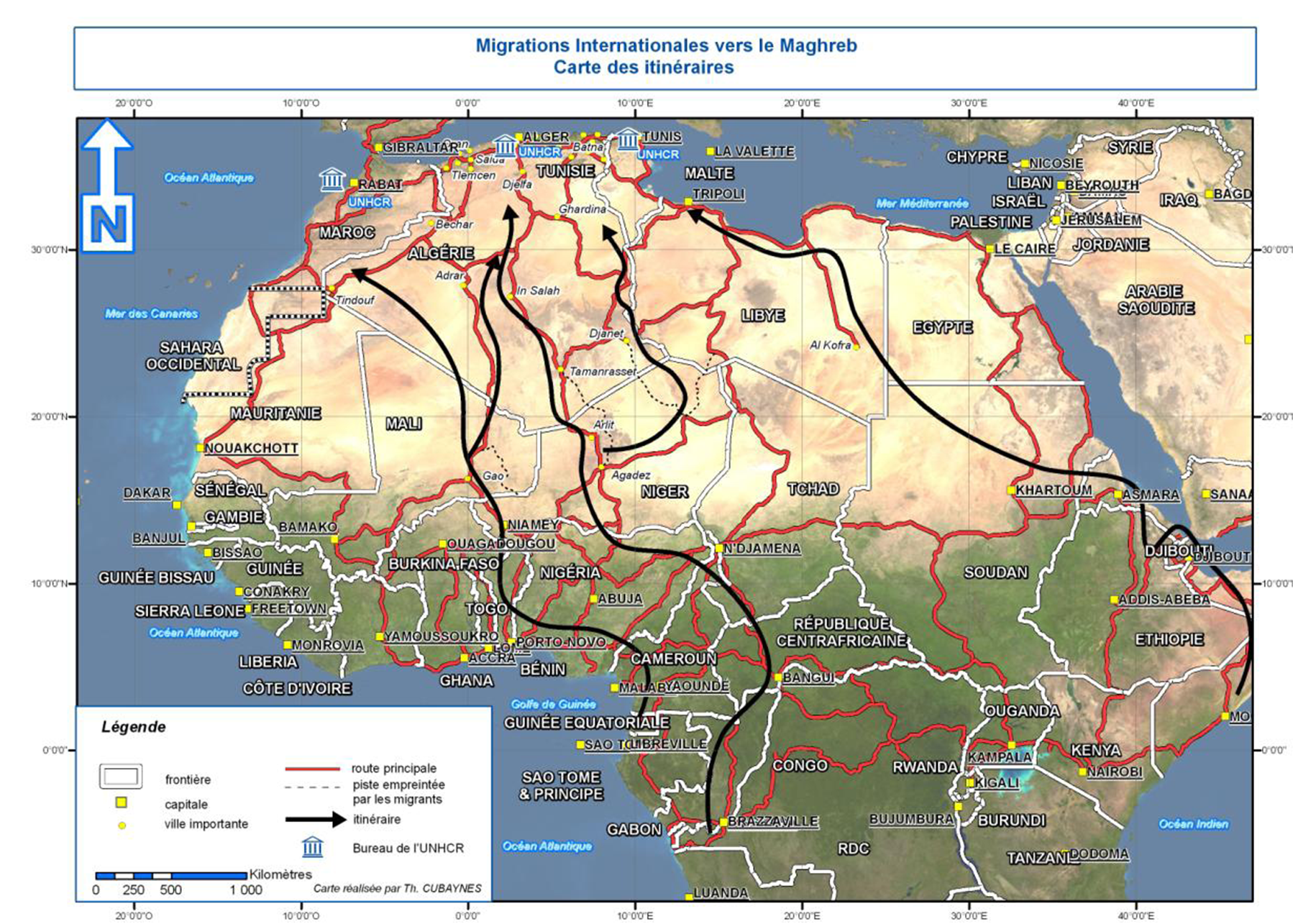
From the Executive Summary:  “The relationship between Europe and the Maghreb is a complex, multidimensional and somewhat passionate one. The two areas share a common history and are bound by common interests. United against a number of joint challenges (economic development, regional stability, fight against terrorism, migration, sustainable development), it is time for the two shores of the Mediterranean to reconsider the basis for their cooperation. [***] The EU is well aware of what is at stake and must now look for ways of making a more active commitment in the region, particularly on sensitive issues such as human rights and migration. [***] The question of migration, which extends as far as the Sahelian area, is another area of cooperation which needs to be looked into in more depth, since the EU’s policy of limiting migratory flows can no longer be restricted to the northern border of the Maghreb. Reinforcing the role of the European agency FRONTEX throughout the area, for example by opening regional offices and assigning resources, is one possible solution. Intensifying efforts to coordinate development assistance policies between the EU and Maghreb countries to help Sub-Saharan African countries that represent sources of immigration is another solution that should not be ignored.”

A further excerpt: “A need for increased cooperation between the European Union and the Maghreb – Europe’s policy on migration is based on the principle that the great era of mass migrations is over, replaced by a new international division of labour, whereby a foreign workforce is substituted for the national workforce, and by policies that involve returning and rehabilitating non-Europeans in their countries of origin and internal mobility for Europeans within an area with no interior borders. European countries – and the Community, followed by the EU – concentrated their efforts on border control, in a securitarian view dictated by the migratory risk and concerns about the challenges of integration. Schengen relegated the countries of the Maghreb, and others, to the status of “outsider countries”, with which human circulation is restricted. This logic was maintained by the militarisation of borders which started in 1988 when barriers were built around the Spanish enclaves of Ceuta and Melilla, then as of 2002 by the installation of the Integrated System of External Vigilance (SIVE) around Gibraltar and later along the Spanish coasts – including the Canary isles – comprising twenty-five detection points, a dozen mobile radar and ten or so patrol units. The attacks perpetrated on September 11th reinforced the security component and, following the creation of FRONTEX (European Agency for the Management of Operational Cooperation at the External Borders) in 2005, other areas were militarised, with preventive sea and air patrols in the Mediterranean and even in the Atlantic, near the Canary isles. The EU also provides its members with technical assistance. [***] The Maghreb has made a real effort to contribute and cooperate with the EU in the fight against immigration.  In February 2004, Morocco and Spain started joint patrols and in 2008, cooperation was reinforced by improving controls in the ports of Tangier and Algeciras.  According to the Spanish authorities, the result was an overall drop of 60% in illegal immigration originating in Morocco between 2007 and 2008.  The decrease in illegal Moroccans was reportedly around 38%. However, reinforced controls caused a shift in migratory routes. According to the Italian Ministry of the Interior, the number of illegal immigrants arriving in Italy by sea rose by 75% between 2007 and 2008. 14 000 people arrived in Italy illegally in 2007, whereas the figure was in excess of 40 000 in 2008. Following the signature of the Benghazi treaty between Italy and Libya on 30th August 2008, Italy obtained greater assistance from Tripoli in the form of bilateral cooperation on illegal immigration and the application of the December 2007 agreement on joint patrols off the Libyan coasts, plus the installation of radars by Finmeccanica at Libya’s southern borders.”

Click here for full Report.

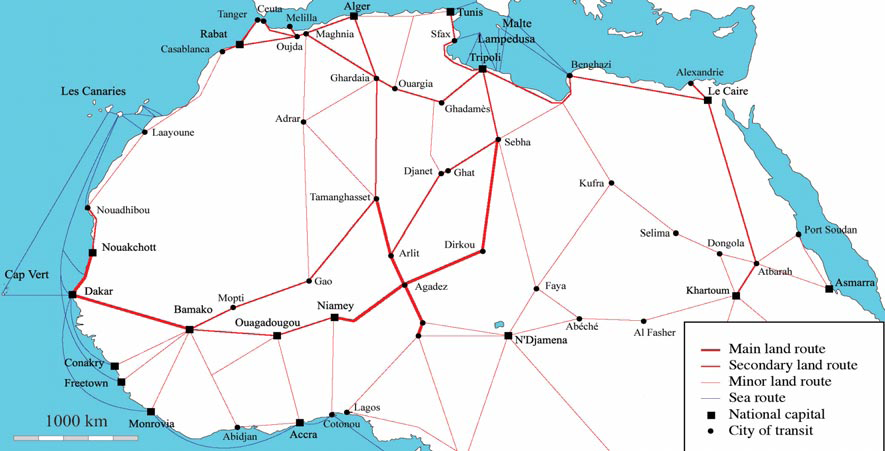
Main routes of present-day Trans-Saharan migrations

1 Comment

Filed under Algeria, Analysis, Data / Stats, Eastern Atlantic, European Union, Frontex, Italy, Libya, Malta, Mauritania, Mediterranean, Morocco, Spain

Spain Adds New SIVE Radar Stations

The Spanish Ministry of Interior is investing €3.8 million to expand the SIVE network in Valencia.  The two new SIVE radar stations are in addition to the four SIVE radar stations that operate on the Alicante coast in Cabo Roig, Santa Pola, Sierra Frost, and Denia.  According to ABC, the Ministry of Interior acknowledges that SIVE has numerous problems and that since its entry into operation last September in Alicante, SIVE has detected only four of the fifteen illegal boats discovered on the coast.

ABC also reports that despite the problems with SIVE on the Alicante coast, Frontex’s coming summer enforcement operation, Operation Indalo, will not extend to Alicante.  Operation Indalo, using patrol boats and helicopters from Spain, Portugal, France, Italy, Malta and Luxembourg, will be deployed along the Spanish coast from Granada to Murcia.

Click here (ES) for article.

1 Comment

Filed under France, Frontex, Libya, Luxembourg, Malta, Mediterranean, News, Portugal, Spain

MEPs Lambert and Iacolino on CEAS

MEP Jean Lambert (Green – UK) writes in New Europe in regard to the Common European Asylum System (CEAS) that  the Greens “want to see a fair and efficient system which will deliver consistent and high quality decisions for those in need of protection. Amongst the major challenges at present are the inconsistencies across the EU in both the practical delivery of Member State’s asylum systems and the outcomes of their decisions. It would be fair to refer to the ‘European Asylum lottery’ when faced with statistics on the divergences in protection rates between Member States – 73.2 % of Iraqi applicants were granted subsidiary protection at first instance in Sweden in the first quarter of 2007 compared with 0% in Greece.”

Click here for full article.

MEP Salvatore Iacolino, Vice Chair of LIBE, (Christian Democrat – Italy) writes “we must ensure, on the one hand, access to efficient and streamlined procedures for persons seeking international protection, and, on the other, consistent application of rules in order to build mutual trust between Member States.  We cannot just think of a national dimension for the strategies for immigration and asylum, but it is essential to create a mechanism for equitable sharing of responsibilities.”

Click here for full article.

1 Comment

Filed under European Union, Italy, News, UK

LIBE-Odysseus Network Round Table (26 April) and LIBE Meeting Agenda

A Round Table on “Towards a Common European Asylum System: A study on some horizontal issues” will be held on 26 April at 15.00 – 18.30. The meeting is organised by the LIBE Committee and the Policy Department Citizens’ Rights and Constitutional Affairs with the participation of the National Parliaments and the Odysseus Network.  The Round Table meeting precedes the two day meeting, 27-28 April, of the LIBE Committee which will be considering numerous agenda topics including:

  • Creation of an immigration liaison officers network;
  • The establishment of a joint EU resettlement programme;
  • Discussion concerning the European Refugee Fund; and
  • Institutional aspects of accession by the European Union to the European Convention for the Protection of Human Rights and Fundamental Freedoms.

The final agenda item is a Meeting with UN High Commissioner for Refugees, Antonió Guterres on matters relating to asylum policy, co-chaired by the Committee on Development and the Subcommittee on Human Rights.

Click here for Round Table agenda.

Click here for LIBE meeting documents.

Leave a comment

Filed under Colloques / Conferences, European Union, News, UNHCR

France Agrees to Accept 92 Refugees from Malta for Resettlement

French Ambassador Daniel Rondeau announced that France will shortly accept 92 additional refugees from Malta as part of the EU voluntary resettlement programme.  The Times of Malta reports that the Ambassador said “These people are prepared to die to live anywhere except their country; so many die in the Mediterranean Sea. It is really a tragedy and Malta was affected by it… we have to share this tragedy with the Maltese and with the immigrants. It’s our sea and it’s at our door, we cannot look the other way.”  France resettled 95 refugees from Malta last year.  Several other countries, including Germany and the UK have voluntarily accepted refugees from Malta.

Click here for article.

1 Comment

Filed under European Union, France, General, Malta, Mediterranean, News

Italian Prosecutor Brings Charges Against Heads of Immigration Directorate and Guardia di Finanza in Connection with Push-Back Operation to Libya

The Syracuse Prosecutor’s Office (La Procura della Repubblica di Siracusa) has brought criminal charges against Rodolfo Ronconi, the head of the Italian Immigration Directorate and Border Police (la direzione centrale dell’immigrazione e la polizia delle Frontiere) and Vincenzo Carrarini, the head of the Finance Police (Guardia di Finanza) in connection with the forcible return of 75 migrants who were intercepted at sea in international waters by a Guardia di Finanza ship in August 2009 and returned to Libya pursuant to the Italy-Libya migration agreement.

Charges were not brought against individual Guardia di Finanza military personnel who carried out the interception and push-back of the migrants on the grounds that they were acting under orders from superiors and that those orders were not manifestly illegal (per ordini superiori non manifestamente illegittimi).

The charges allege that the two officials were complicit in private violence (concorso in violenza private).  According to the Prosecutor’s Office, the charges are not based on the act of refoulement, but rather are based on the failure to apply Italian law.  After being intercepted, the 75 migrants were brought aboard the Guardia di Finanza ship which then transported them to Libya.  According to the Prosecutor, Italian laws applied once the migrants were taken onto the Guardia di Finanza ship because the ship is the equivalent of Italian territory.  The charges are based on allegations that the migrants were taken to Libya against their will and were denied access to procedures for the protection of refugees and prevented from exercising other rights available to them under domestic law and international law incorporate within domestic law.

At least nine similar interdiction operations were conducted by Italy in 2009 in the Channel of Sicily which resulted in the forcible return of at least 834 migrants to Libya.  The first such interdiction operation in May 2009 is at issue in the case of of Hirsi and others v Italy, Requête no 27765/09 now pending before the European Court of Human Rights.

The other interdiction operations consist of the following:

  • 7 May – About 230 migrants intercepted in three boats in the Strait of Sicily and returned to Libya.
  • 8 May – A boat with about 80 people in difficulty off the coast of Libya was towed to Tripoli.
  • 10 May – A naval patrol returned more than 200 people to Libya who were intercepted in the Channel of Sicily.
  • 19 June – A boat with 76 migrants near Lampedusa, intercepted by a Coast Guard patrol, and the immigrants, including women and children, were then transferred to a Libyan patrol boat and returned to Tripoli.
  • 1 July – 89 migrants (including 9 women and 3 children) located on a raft about 30 miles from Lampedusa were taken on board a Navy ship and transferred to an Agip oil platform off the coast of Libya. From there a Libyan patrol boat took them to Tripoli.
  • 5 July – About 40 migrants rescued near Lampedusa by a patrol boat of the Guardia di Finanza.  Many of whom were later reported to be in Tripoli.
  • 29 July – A boat with 14 people was rescued by a patrol boat of the Guardia di Finanza. Passengers were taken to Tripoli.
  • 30 August – A boat with 75 migrants on board (among them 15 women and 3 children) was intercepted south of Capo Passero. Passengers were transferred to a patrol boat of the Guardia di Finanza and returned to Libya.

Click here (IT) and here (IT) for articles.

Click here for previous post on Hirsi and others v Italy.

Leave a comment

Filed under Data / Stats, Italy, Judicial, Libya, Mediterranean, News

Migreurop: Rencontre internationale d’ISTANBUL, 27-29 mai

Migreurop: Rencontre internationale d’ISTANBUL – “Au programme de cette rencontre seront traités les enjeux et les conséquences des accords de réadmission, la situation dans les camps de rétention pour étrangers dans l’UE et à ses frontières extérieures, ainsi que le rôle de l’agence Frontex. Large espace sera donnée aux discussions sur les actions et revendications des associations, leurs réalisations et possibilités d’intervention.”

Pour en savoir plus, cliquez ici.

Leave a comment

Filed under Colloques / Conferences, Frontex, Turkey