Tag Archives: Rescue at Sea

2500+ New Migrant Landings in Lampedusa; Italy and Malta in New Diplomatic Dispute Over Search and Rescue Responsibilities

Migrant boats carrying over 2500 persons arrived in Lampedusa over the weekend.  The boats are all believed to have departed from Libya.  Improving sea conditions are thought to be responsible for the new surge in migrant boats.  Italy has said it will lodge a formal diplomatic complaint with Malta over what it says was Malta’s failure to rescue a migrant boat in distress.  The migrant boat in question was apparently closer to Lampedusa than to Malta, but was within the Maltese SAR zone when a distress call was made.  Maltese authorities said they were unable to send their patrol boats to the boat that was in distress due to bad sea conditions.  Italian coast guard boats eventually provided assistance while NATO and Armed Forces of Malta aircraft provided air surveillance.

Click here (IT), here (EN), here (EN) and here (EN) for articles.

2 Comments

Filed under Frontex, Italy, Libya, Malta, Mediterranean, News

Cyprus, Greece, Italy, Malta, & Spain Issue Joint Communiqué Regarding Response to North African Migration

Ministers of Home Affairs and Internal Security from Cyprus, Greece, Italy, Malta, and Spain, met in Nicosia on 19 April and issued a Joint Communiqué.  Here is the full text (HT to EASO Monitor):

“Joint Communiqué II

(Nicosia, 19 April, 2011)

Following the meeting in Rome on the 23rd February 2011, the Home Affairs and Internal Security Ministers of Cyprus, Greece, Italy and Malta as well as the representative of the Minister of Interior of Spain, met again today in Nicosia and discussed the continuing dramatic developments in the Southern Mediterranean region. At the end of the meeting it was decided to issue the following Joint Communiqué.

The Home Affairs and Internal Security Ministers of the Mediterranean Member States of the EU:

Recalling our February 23rd,2011 Joint Communiqué, we have repeated our utmost concern for the unfolding events in relation to the humanitarian situation as well as to the massive illegal immigration flows and movements of possible beneficiaries of international protection that affect our countries;

Taking into account that the escalating events in countries of Northern Africa and the greater Middle East are destabilising the region and acknowledging that political reforms and democratic transitions will not take effect immediately and that their outcome is still uncertain;

Bearing in mind Europe’s longstanding tradition and commitment to the provision of international protection to people in need, in accordance with the Geneva Convention and in line with humanitarian principles and full respect of human rights;

Underlying that security and stability in the Mediterranean is directly linked to the security and stability of the EU as a whole and that effective response to this challenge requires joint efforts, commitment and solidarity from all EU Member States;

Stressing that the current emergency situation with regard to the massive illegal immigration flows and movements of possible beneficiaries of international protection brings upon the Mediterranean Member States additional social, economic, administrative and demographic burden, to that already prevailing;

Recalling the already existing intense and continuous migratory pressure at the south eastern external borders of the EU;

Expressing deep concern about the conflict in Libya and its consequences in terms of sufferings of countless human beings and growing number of displaced persons fleeing the war and taking into account that huge number of people in need of international protection could arrive at the most exposed Mediterranean Member States in the immediate future;

Emphasizing that the possible prolongation of such influxes of illegal migrants and asylum seekers to the Mediterranean Member States, cannot be managed without the concrete and substantial support and solidarity from the rest of the EU’s Member States; alternatively, the situation will seriously jeopardize our ability, and subsequently the Union’s ability, to manage the displaced persons and provide those in need with international protection as well as undermine our common security;

Stressing that the arising situation will challenge and undermine the efforts of those Member States to reform their overburdened national asylum systems;

Reaffirming the urgent necessity for EU to provide concrete and immediate support to Member States on the EU southern external borders;

Stressing the need for additional actions and policies with a view to implement the EU principle of solidarity and fair sharing of responsibility as expressed in the Treaty on the Functioning of the European Union and in line with the Stockholm Programme, the European Pact on Immigration and Asylum, the Global Approach to Migration, the relevant European Council Declaration of 11 March 2011 and Conclusions of 24 and 25 March 2011, the JHA Council Conclusions of 11and 12 April 2011 on the management of migration from the Southern Neighbourhood and the JHA Council Conclusions of 25 and 26 February 2010 on 29 measures for reinforcing the protection of the external borders and combating illegal immigration;

Therefore we, the Ministers of Home Affairs and Internal Security of the EU Mediterranean Countries, have adopted a common position on the emerging situation in our region and urge the European Union to practically offer operational as well as financial support to Member States which face mass and disproportionate mixed migration flows, by fully mobilizing all available EU assets, instruments and capabilities, either existing or additional ones,.

Particularly, as the competent Ministers of the EU Mediterranean Member States, urge the European Union to:

Urgently present and implement proposals on the Global Approach to Migration as well as on Mobility Partnerships, in a spirit of genuine cooperation with the countries of the Southern Neighbourhood Region, also to effectively control and manage the current and the anticipated mass migration flows as well as situation-specific schemes on return and readmission.

Call on FRONTEX to immediately implement the provisions set out in section 5 of the JHA Council Conclusions of 11 April 2011, to speed up negotiations with the countries of the region – and in particular with Tunisia – with a view to concluding operational working arrangements, and organising joint patrolling operations in cooperation with Tunisian authorities and in application of all relevant international Conventions, in particular the UN Convention on the Law of the Sea (“the Montego Bay Convention”).

Call on FRONTEX to intensify the monitoring of the situation based on risk analysis and encourage Member States to provide the Agency with further human and technical resources so as to continue its ongoing operations (Joint Operation Hermes, Joint Operation Poseidon Land and Sea and the possible deployment of a RABIT operation in Malta) in the light of the emerging situation. Furthermore, call FRONTEX to expand its operations, where and when necessary, to prevent illegal flows in the eastern Mediterranean area of Egypt and Syria. To this end, further adequate financing of FRONTEX should be considered so as to increase the Organization’s capabilities to fulfil successfully its tasks.

Enhance the operational capacity and the coordinating role of the FRONTEX Operational Office in Piraeus in order to effectively deal with the situation;

Accelerate work on the FRONTEX Amending Regulation with a view to an agreement by June 2011 which will strengthen its capacity, make it truly operational and improve its synergy with other bodies.

Promote practical cooperation with the countries of origin or transit of illegal migrants in the region in preventing and fighting illegal migration flows, inter alia by concluding Readmission Agreements, developing Voluntary Return Programmes, enhancing their capacity of border management and surveillance, expanding the Immigration Liaison Officers Network, promoting legal migration by exploring the possibility of concluding mobility partnerships;

Encourage Member States to expedite discussions on the proposal for recasting the Dublin II Regulation, including a mechanism to suspend the transfers to Member States facing particular pressure on their national asylum systems.

Urgently mobilize all available financial assistance through the External Borders Fund and European Refugee Fund and in addition, as section 4 of the JHA Council Conclusions of 11 April, 2011 reads, activate supplementary funds that can be made available to Member States or FRONTEX at short notice when needed. In this vein establish a special solidarity Fund, when necessary, to tackle exceptional emergency situations and humanitarian crisis.

Deploy every available possibility by the European Asylum Support Office to offer practical support to the Member States of the Mediterranean Region in need. A permanent specialised mechanism should be set up through the EASO, which, at exceptional emergency situations, will provide Member States in need with the necessary logistical and technical support.

As a matter of priority, present a proposal for implementing a coherent and comprehensive mechanism for distributing responsibilities, on a voluntary basis, specifically regarding the relocation of beneficiaries of international protection among member states, in case of European countries faced with particular pressures, as a consequence of their geographical or demographic situation, especially when facing the sudden arrival of third country nationals in need of international protection.

Commit to the work on establishing a Common European Asylum System with a view to respect the 2012 deadline.

We the Ministers of the Mediterranean Member States of the EU agreed to meet again soon, at a date to be agreed, in order to further coordinate our efforts before the European Council of June this year.”

Click here for document.
2 Comments

Filed under Cyprus, Egypt, European Union, Frontex, Greece, Italy, Libya, Malta, Mediterranean, News, Statements, Tunisia

Italy Refused to Allow Maltese Patrol Boat to Disembark Rescued Migrants in Lampedusa

On Thursday last week, a Maltese AFM patrol boat searching for survivors from Wednesday’s sinking of the migrant boat near Lampedusa encountered another migrant boat with 171 migrants and removed the migrants from the overcrowded boat.  The rescue occurred approximately 54 nautical miles from Lampedusa and 91 nautical miles from Malta.  The Maltese patrol boat attempted to disembark the migrants at the closer port in Lampedusa but was denied entry into the port.  The migrants were then taken to Malta – an eight hour sail from Lampedusa.  Carmelo Mifsud Bonnici, Malta’s Interior Minister, accused Italy of reneging on its “legal and humanitarian obligations” due to its failure to allow the migrants to be taken to the closer port.  The migrants involved have said they are Eritrean and Libyan.  If accurate, these may be the first Libyans to have been detected leaving by sea.

Click here, here, and here for articles.

1 Comment

Filed under Eritrea, Italy, Libya, Malta, Mediterranean, News

UNHCR Calls on EU to Improve Rescue at Sea Measures; NATO Should Also Actively Participate in Rescue at Sea in Regard to All Overcrowded Boats

UNHCR issued a statement on Friday, 8 April, calling “on the European Union to urgently put into place more reliable and effective mechanisms for rescue-at-sea” in the aftermath of last week’s disaster that saw “[m]ore than 220 Somali, Eritrean and Ivorian refugees drowned early on Wednesday morning when their boat capsized some 39 nautical miles south of the Italian island of Lampedusa. This is the worst such incident in the Mediterranean in recent years.  ‘It is hard to comprehend that at a time when tens of thousands are fleeing the Libyan conflict and pouring across the land borders into Tunisia and Egypt where they enjoy safety and receive shelter and aid, the protection of people fleeing via Libya’s maritime border does not appear to have the same priority’ said Assistant High Commissioner for Protection Erika Feller.” “‘We also appeal to shipmasters to continue to render assistance to those in distress at sea. Any overcrowded boat leaving Libya these days should be considered to be in distress’ [, said Feller.]”

While NATO was not mentioned in the UNHCR statement, the call for improved measures to save the lives of migrants who flee North Africa by boat should also be heard and considered by the NATO Maritime Command Naples which is conducting the maritime embargo of Libya known as Operation Unified Protector.   NATO has a significant naval force patrolling the area through which migrant boats leaving Libya are passing and this force should be actively engaged in protecting fleeing civilians.  (Click here for earlier post regarding NATO’s maritime embargo.)

While UN Security Council Resolution 1973 does not speak directly to this issue, it does call for the protection of civilians.  Relevant portions from Security Council Resolution 1973:

  • “Expressing [the Security Council’s] determination to ensure the protection of civilians and civilian populated areas and the rapid and unimpeded passage of humanitarian assistance and the safety of humanitarian personnel, [***];
  • Reiterating [the Security Council’s] concern at the plight of refugees and foreign workers forced to flee the violence in the Libyan Arab Jamahiriya, welcoming the response of neighbouring States, in particular Tunisia and Egypt, to address the needs of those refugees and foreign workers, and calling on the international community to support those efforts, [***];
  • Protection of civilians – 4. Authorizes Member States that have notified the Secretary-General, acting nationally or through regional organizations or arrangements, and acting in cooperation with the Secretary-General, to take all necessary measures, notwithstanding paragraph 9 of resolution 1970 (2011), to protect civilians and civilian populated areas under threat of attack in the Libyan Arab Jamahiriya,… [***].”

As with UNHCR’s call to EU states, NATO ships should also render assistance to any migrant boat detected by NATO forces – any overcrowded boat leaving Libya should be considered to be in distress.

Click here for UNHCR statement.

Click here for article.

Leave a comment

Filed under European Union, Italy, Libya, Malta, Mediterranean, News, UNHCR

Italy Criticises Malta Regarding Search and Rescue Response

Italian Interior Minister Maroni has criticised Malta for failing to immediately deploy rescue ships to assist the migrant boat that sank near Lampedusa.  The Armed Forces of Malta said that the migrant boat did not capsize until after two Italian coast guard boats had responded and were on scene attempting to render assistance.  The AFM said the first call for assistance was received Wednesday at 0025, the Rescue Co-ordination Centre of the AFM notified Italian Coast Guard headquarters in Rome and NATO headquarter in Naples at 0120, two Italian coast guard boats and an Italian fishing vessel, the Cartagine, were on scene by 0416, and the migrant boat capsized around 0535.  The migrant boat was closer to Italian territory than to Malta, but was located within Malta’s large Search and Rescue Area.  Italy and Malta have had past disputes over the boundaries of the SAR with Italy calling for the Maltese SAR to be reduced in size.

The Secretary-General of International Maritime Organization, Efthimios E. Mitropoulos, issued a statement saying that “[i]t was ironic that the devastating news of this latest tragedy reached us while we were holding a [Legal Committtee] meeting with representatives of Italy and Spain to consider what measures countries in the Mediterranean Basin should take to deal with the increasing number of persons leaving north African and eastern Mediterranean countries to seek refuge in Europe.”

The statement also said that “IMO is in contact with Italy, Malta and the UN High Commissioner for Refugees (UNHCR).  The [Legal Committee] meeting mentioned above was hosted by IMO and held against a background of increasing movement of persons by sea for political and socio-economic reasons or as a result of armed conflict.  It was part of an on-going process aimed at improving existing provisions for rescuing migrants at sea and disembarking them at a place of safety, in accordance with the International Convention on Maritime Search and Rescue (SAR Convention) and the International Convention for the Safety of Life at Sea (SOLAS Convention).”

Click, here, here, here, and here for articles. (EN)

Click here for article. (IT)

Click here for map the SARs.

Click here for IMO Statement.

1 Comment

Filed under Italy, Libya, Malta, Mediterranean, News

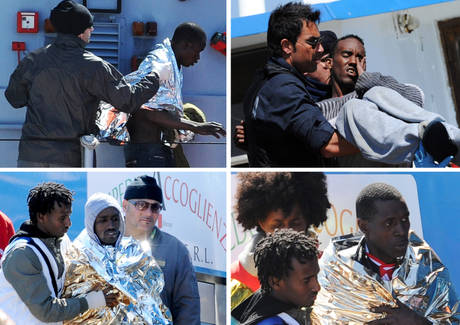
Rescued Migrants Arriving at Lampedusa (Pictures)

53 survivors have been rescued from today’s accident.  The total number of dead and missing is not known.  Dozens of bodies, including those of children, have been observed in the sea by a Guardia di Finanza helicopter.

Click here for article. (IT)

© Copyright ANSA - Tutti i diritti riservati - Rescued migrants arriving at Lampedusa.


1 Comment

Filed under Italy, Libya, Mediterranean, News

200 or More Now Feared Dead in Migrant Boat Sinking Off Lampedusa – Boat Was Likely Coming from Libya, Not Tunisia

It now appears that the boat that capsized earlier this morning off of Lampedusa was carrying Sub-Saharan Africans and that it had sailed from Libya not from Tunisia. The boat departed from Zuwarah in western Libya according to the Times of Malta.  Woman and children were on board and are likely among the victims.  The accident occurred around 4:00 AM local time in very rough seas.  A call for help was made by satellite phone to Malta SAR.  ANSA reported a short time ago that 48 people have been rescued and approximately 20 bodies have been recovered.  IOM said that based on interviews with survivors there may have been as many as 300 people on board the boat.

Click here (EN), here (IT), and here (IT) for articles.


3 Comments

Filed under Italy, Libya, Malta, Mediterranean, News

Migrant Boat Capsizes Near Lampedusa – 150 Missing

There are reports that a boat carrying approximately 200 migrants believed to be Tunisians capsized during a rescue operation this morning.  The incident occurred 39 miles southwest of Lampedusa.  As of early this morning approximately 45 people have been rescued and 150 are missing.  Italian Coast Guard boats are searching for survivors.

Click here and here for articles.  (IT)

Leave a comment

Filed under Italy, Mediterranean, News, Tunisia

Libyan Migrant Boats Carrying Over 400 People Missing; Reports of Deaths

There have been reports in recent days from the UNHCR and others about at least two boats that are believed to have left Libya over the past 10-14 days carrying persons from Eritrea, Ethiopia, Somalia, and possible other countries.  Family members and friends of people who are believed to be on the boats have been calling for assistance in searching for the boats.  Reuters reported that “[o]ne of the boats was reported to have left Libya on March 22 with 335 people on board.  Italian media said 68 people on the other boat had almost certainly died during the journey, although there was no official confirmation. The top Vatican official in Tripoli, Bishop Giovanni Innocenzo Martinelli, said 10 bodies of African migrants were at the capital’s morgue on [4 April]. … He said there were reports of ‘many more bodies’ of migrants washed up on the shores of Garaboulli, some 40 km from Tripoli.”  Father Mussie Zerai, who is based in Rome, “said he had last spoken to migrants on board the smaller boat, an inflatable, by satellite phone on 26 March before the line went dead.  ‘I have meanwhile had no contact with the larger boat, but family members of those on board have called us from Canada, Sweden and Switzerland to tell us they left.’”

Click here and here for articles. (EN)

There have been confirmed deaths among migrants who have left Tunisia in recent weeks.  At least 27 bodies had been recovered as of last week in Kerkennah.  The dead were probably on board boats that sank on the 13th and 27th of March off the Tunisian coast.

Click here for article.

UPDATE:  If you have information about a family member or friend who may be on a boat or if you are seeking information, please consider contacting the Agenzia Habeshia per la Cooperazione allo Sviluppo in Italy at this email address: agenzia_habeshia@yahoo.it .


4 Comments

Filed under European Union, Frontex, Italy, Libya, Mediterranean, News, Tunisia, UNHCR

NATO Policy Regarding Migrant Boats Leaving Libya

I posed several questions to NATO Maritime Command Naples asking what NATO’s policy is in regard to encounters between NATO ships and migrant boats leaving Libya.  NATO Maritime Command Naples is responsible for enforcing the maritime embargo of Libya known as Operation Unified Protector.  I also asked for more information about the encounter on 25-26 March between the Canadian navy ship, HMCS Charlottetown, and what was probably the first recent migrant boat from Libya.  This particular migrant boat was subsequently taken to Linosa by the Italian Coast Guard.

Today’s response from NATO’s public affairs office is fairly straightforward and states that NATO ships will respond to vessels or persons in distress.  The response suggests that NATO ships will otherwise not interfere with the passage of migrant boats unless a boat is suspected of carrying arms or mercenaries.  Presumably NATO would also seek to stop and board migrant vessels suspected of carrying any persons of particular interest to NATO, e.g. Libyan officials.

Here are my questions and the responses from the Public Affairs Office at NATO Maritime Command Naples:

Q:  Does Operation Unified Protector have plans or procedures in place regarding what to do in the situation where a NATO vessel encounters a boat or inflatable that is carrying irregular migrants or asylum seekers out of Libya and attempting to reach another country, e.g. Italy or Malta?

NATO:  Operation Unified Protector is part of the broad international effort to protect civilians and civilian-populated areas under threat of attack. The maritime portion of the operation foresees NATO warships and aircraft patrolling the approaches to Libyan territorial waters to reduce the flow of arms, related material and mercenaries to Libya as called for in UN Security Council Resolution 1973. Issues of migration or asylum seekers are not within the mandate of this specific NATO operation.

Q:  If there are plans or procedures for encounters with migrant boats, what do they provide for?

NATO:  A master of a ship at sea which is in a position to be able to provide assistance on receiving information from any source that persons are in distress at sea, is bound to proceed with all speed to their assistance, if possible informing them or the search and rescue service that the ship is doing so. This obligation to provide assistance applies regardless of the nationality or status of such persons or the circumstances in which they are found.

Q:  Additionally, can you provide details regarding what HMCS Charlottetown did on/about 26 March when it encountered a migrant boat carrying approximately 350 African migrants from Libya?  Did HMCS Charlottetown request assistance in connection with this encounter from the Italian Coast Guard or Navy or from Frontex?  What assistance, if any, was provided to the migrant boat?

NATO:  On 25 and 26 of March 2011, NATO ships patrolling in International Waters attended a boat to ensure there was not a case of Safety of Life at Sea (SOLAS). Assistance was offered in the form of technical expertise and supplies. NATO ships monitored the situation constantly throughout the stated period. For action taken by Italy with regard to this event we recommend you contact the appropriate authorities.

Q:  Does NATO anticipate that there may at some point be large numbers of non-Libyans or Libyans attempting to leave Libya by sea?

NATO:  We do not feel that we can speculate on this matter.

Click here for link to NATO Maritime Command Naples and here for link to Operation Unified Protector.

3 Comments

Filed under Italy, Libya, Malta, Mediterranean, News

Hundreds of Tunisians Continue to Arrive in Lampedusa; Italian Navy Ship to Transport Migrants from Island to Relieve Overcrowding; Local Residents Block Migrant Landings

Hundreds of Tunisians continue to reach Lampedusa.  Conditions at the main migrant reception centre on the island are extremely bad due to massive overcrowding and hundreds of migrants are sleeping in the open under tarps.  The centre is currently holding about 3000 persons whereas its capacity is supposed to be limited to 800 persons.  An Italian navy ship was scheduled to arrive on the island late on the 19th or on the 20th of March and it is anticipated that the ship will transport at least 1000 migrants to other locations in Italy.

Some local residents protested the continuing arrival of migrant boats by preventing for several hours coast guard and Guardia di Fiananza boats carrying rescued migrants from docking and disembarking the migrants in port.

Click here (IT), here, (IT), here (IT), and here (EN) for articles.

Leave a comment

Filed under European Union, Frontex, Italy, Mediterranean, News, Tunisia

New Paper: M Tondini, “Fishers of Men? The Interception of Migrants in the Mediterranean Sea and Their Forced Return to Libya”

A new legal paper by Dr Matteo Tondini entitled “Fishers of Men? The Interception of Migrants in the Mediterranean Sea and Their Forced Return to Libya” is available.  This paper should be read by anyone with any interest in Italy’s current push-back practice with Libya.  Dr Tondini is currently a post-doctoral researcher at the Vrije Universiteit AmsterdamFaculty of Social SciencesDepartment of Governance Studies.  The paper has been produced as part of the INEX Project, financed by the EC under the FP7 (http://www.inexproject.eu).

The paper refers to some unpublished material and interviews. Here is the abstract:

“This paper presents an extensive account and assesses the legality of the recent naval constabulary operations – undertaken by Italian and Libyan military vessels – in the central Mediterranean Sea, aimed at intercepting boat people in international waters and returning them to the Northern African coasts. If considered as a border control operation, the interception of migrants and their debarkation in a third country often lacks a valid legal basis. The latter is easier to be found under maritime law, by ‘labelling’ interceptions as rescue missions. Nevertheless, such operations must be conducted according to state obligations under human rights law and refugee law (especially the non-refoulement rule), which only allow Italian vessels to disembark boat people to a ‘safe third country’. The paper concludes that since Libya cannot be considered a ‘safe third country’ in this sense, the interception of migrants on the high seas and their forced return to Tripoli may entail violations of maritime, human rights, migration and refugee law at both an international, European and domestic level.”

Click here or here to access the paper.

(Thank you to Dr Tondini for bringing this paper to my attention.)

Leave a comment

Filed under Analysis, European Union, Frontex, Italy, Libya, Mediterranean

Dutch Govt Position on Asylum Requests Made at Sea

The Dutch Minister of Justice, E.M.H. Hirsch Ballin, recently outlined the Dutch government’s position regarding the proper handling of asylum requests made by migrants who are intercepted at sea during Frontex coordinated operations.  The position is contained in a letter sent by the Justice Minister to the Chairman of the Dutch Senate on 3 September 2010.

This recent statement was brought to my attention by Dr Matteo Tondini, Vrije Universiteit Amsterdam, who succinctly summarized the Dutch Government’s position as follows:

  1. Dutch vessels are not a portion of Dutch territory;
  2. Asylum requests of migrants made on board Dutch vessels must be assessed by a competent authority (not by Dutch authorities, however, but possibly by the host nation); and
  3. The Netherlands considers this as a conditio sine qua non for its participation in FRONTEX operations at sea.

The Minister’s letter refers to provisions of the Council Decision re Rules for Sea Border Operations Coordinated by Frontex the validity of which is now being consider by the European Court of Justice pursuant to a challenge by the European Parliament.

I reproduce here an English translation of the Justice Minister’s letter provided by Dr  Tondini:

“21 501-28  Defense Council – Nr. 61  Letter from the Minister of Justice

To the President of the House of Representatives, The Hague, September 3, 2010

With this letter I keep my promise, made during the debate on 18 June 2008, to brief your House about the operational requirements for Frontex operations at sea. I also come here after the commitment undertaken by the then State Secretary for European Affairs on 16 June 2009 to your Chamber, about the procedure to be followed if a request for asylum is made on a Dutch ship during Frontex operations at sea.

Introduction

FRONTEX coordinates the operational cooperation between independent States which are competent for the management of external borders. Different operations of member states under the coordination of Frontex have been carried out in this framework. Due to a call by the European Council for clear rules and uniformity in the implementation of Frontex operations at sea, in 2007 the Commission was mandated to draw the requirements for the Agency’s maritime operations.

Operational requirements for Frontex operations at sea

The creation of these rules was a laborious and lengthy process. Based on the results of an extensive debate within a group of experts from the European Commission, the European Commission has drafted rules for Frontex operations at sea in the context of the surveillance of the external borders, in order to prevent illegal migration. The attached decision that embeds these rules, is a supplement to the Schengen Borders Code and applies since 4 May 2010.

In Part I of the Annex, the Decision contains a number of mandatory requirements for the interception of migrants in the contiguous zone and on the high seas. Part II of the Annex to the decision includes a number of non-binding rules on the search and rescue of people in distress during Frontex operations at sea, concerning the safe debarkation of survivors.

These requirements are a specification of the international norms and regulations on the interception and the search and rescue of people in distress at sea, contained in the UN Convention on the Law of the Sea, the International Convention for the Safety of Life at Sea and the International Convention on Maritime Search and Rescue.

In the Decision it is stated that these requirements are included and elaborated in the operational plans for each operation set up by the Agency. The arrangements for the rescue and debarkation of migrants in distress are also included in the operational plan. Furthermore, Section No. 1.2 of the Annex I to the Decision explicitly indicates the principle of non-refoulement.

The rules contained in the decision will contribute to create a greater uniformity of action between Member States during FRONTEX maritime operations and will make it possible to address Member States when they deviate from the norms concerning the activities related to the interception and the search and rescue of people at sea.

Procedure to request asylum on Dutch ships during Frontex operations at sea

An asylum request can only be submitted to the responsible authority of the state in which territory – including the territorial waters – the application is made. A Dutch ship is not part of the Dutch territory and on a Dutch ship there is no authority responsible for handling applications, being the commander of the ship not entitled to receive them. However, on a Dutch ship the Dutch jurisdiction applies.

In this regard, it is the responsibility of a Dutch ship’s commander that if a migrant on board expresses a wish to submit an application, this is not left without consequences. This requires that an alien who thinks to need protection has to be returned only after his/her request has been assessed and there is no reason to grant the protection in question. These migrants should therefore be given the opportunity to submit an application to a competent authority.

In the operational requirements for Frontex maritime operations it is provided that Member States should clarify in the operational plan for Frontex operations the steps to be taken with regard to intercepted or rescued people who are in need of protection and the place of their debarkation, according to international law and all the applicable bilateral agreements.

This means that the operational plan may include an explicit provision on that it is the host nation which is responsible for handling the applications of intercepted or rescued migrants made on board the Dutch ship. The Netherlands considers the inclusion of this provision as a condition to participate in a Frontex operation.

Member States are always bound by the principle of non-refoulement under the 1951 Refugee Convention and the European Convention for the Protection of Human Rights and Fundamental Freedoms (ECHR).

In addition, during the training provided by Frontex much attention is given to the preparation of border guards in the field of asylum and refugee law, focusing in particular on the identification of asylum seekers within mixed migration flows. Courses are aimed to even better prepare border guards to properly identify the protection needs of refugees.

The Minister of Justice, E.M.H. Hirsch Ballin”

Click here for the Letter (NL).

(I thank Dr Tondini for this information and the translation.  -nwf)

Leave a comment

Filed under European Union, Frontex, Netherlands, News, Statements

IMO Information Resources on Stowaways/Illegal Migrants/Treatment of Persons Rescued at Sea – update

The International Maritime Organization’s (IMO) Maritime Knowledge Centre updated in August its  Information Resources document on “Stowaways / Illegal Migrants / Treatment of Persons Rescued at Sea.”

The document contains information, citations, and links to IMO documents, publications, circulars, and reports, as well as non-IMO citations and / or links to many other resources, including relevant UN reports, resolutions, and treaties.

Click here for the document.

Leave a comment

Filed under General, Reports

FRA Call for tender: Treatment of third country nationals at the EU’s external borders

The EU’s Fundamental Rights Agency has issued a call for tender.

From FRA:  The overall objective of the project is to examine the treatment of third-country nationals at the external borders of the European Union in light of the existing fundamental rights framework. The project will not cover all fundamental rights issues that may emerge in the context of management of external borders, but focus on 2 specific components.

The first component of the project focuses on the southern maritime borders of the European Union. The second component of the project will analyse the treatment of third-country nationals at border crossing points.”

The first part of the fieldwork (relating to interception and rescue at sea) will be carried out in Cyprus, Greece, Italy, Malta and Spain and the second part in 10 border crossing points to be identified among those with the highest number of entries of third country nationals into the Schengen area.

Duration: 23 months; Budget: 760.000,00 EUR;

Deadline for submission of proposals: 13 September 2010.

(Noted earlier today on the Migration and Law Network listserve.)

Click here for full information.

Leave a comment

Filed under Aegean Sea, European Union, Mediterranean, News