Tag Archives: Turkey

Greece requests 2d extension of Frontex RABIT deployment due to events in Egypt

Kathimerini reported on 1 February that Greece requested an additional extension of the Frontex RABIT deployment in Greece due to the situation in Egypt and a fear that there may be a surge in migration towards Greece.  The current RABIT deployment is scheduled to end on 3 March.  The deployment was originally scheduled to end in November 2010 and was extended until March 2011.  The Kathimerini article said that Frontex’s initial informal response to the requested extension was positive.

Click here (EL) and here (EN) for articles.

1 Comment

Filed under Aegean Sea, Egypt, European Union, Frontex, Greece, Mediterranean, News, Turkey

Greece May Use Dutch “Ships” to Detain Migrants

Following its announcement that it was considering building a wall along portions of its land border with Turkey, Greek officials announced earlier this month that they are considering the acquisition of two floating migrant detention centres from the Netherlands.  The two vessels would be leased and would have the capacity to hold approximately 1000 persons.  Greece reportedly was considering using passenger ships to detain migrants, but decided that floating detention centres used by Dutch authorities in Rotterdam are a better option.  The floating detention centres would be used in conjunction with prefabricated detention facilities that are being constructed on land to detain the large numbers of migrants being detained by Greek and Frontex authorities along the Greek-Turkish land border.

Click here and here for articles. (EL)  (Read with Google translate)

1 Comment

Filed under Aegean Sea, European Union, Frontex, Greece, Netherlands, News, Turkey

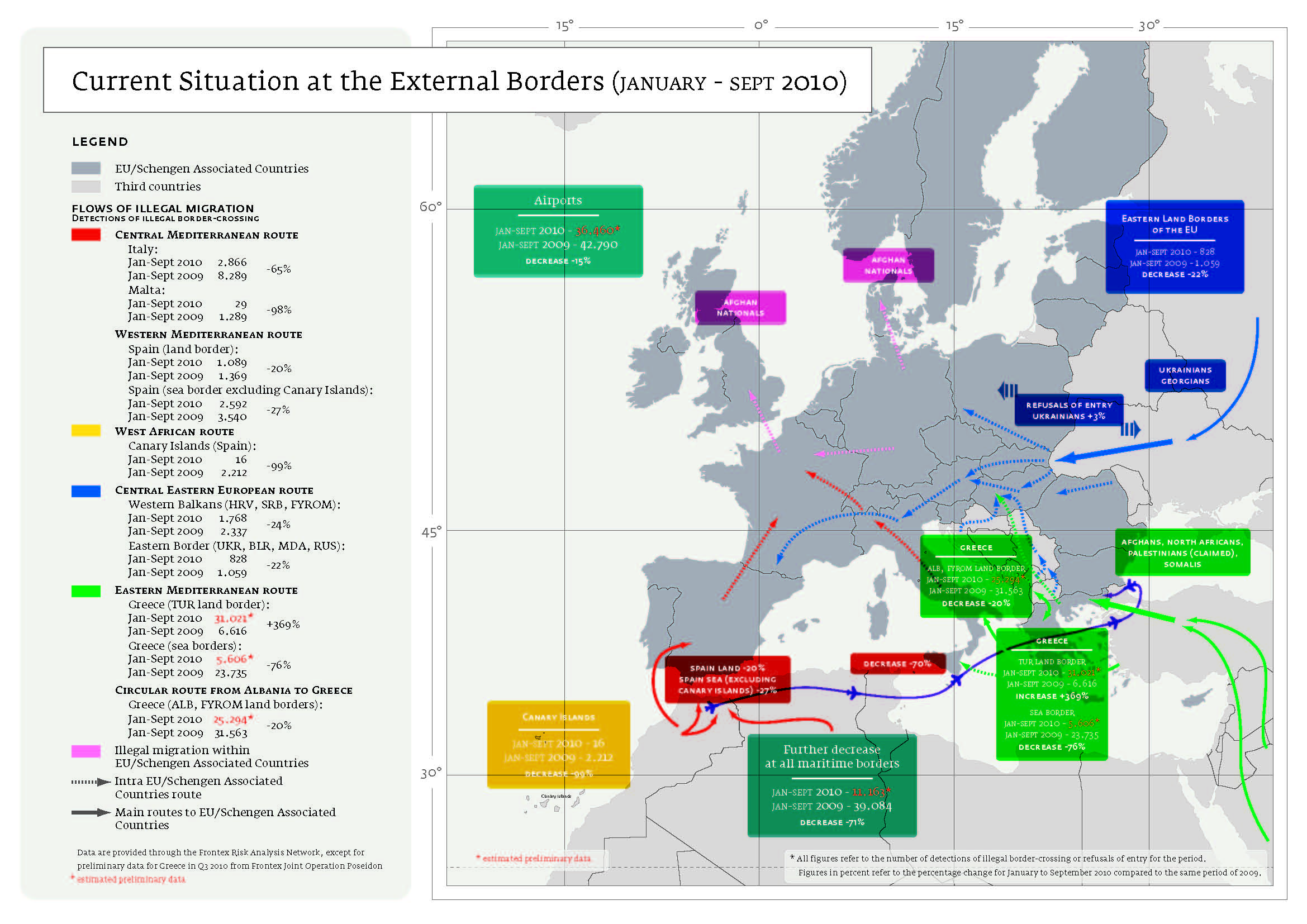
Frontex Map: Current Situation at the External Borders (JANUARY – SEPT 2010)

Frontex has released an updated Third Quarter map, January-September 2010, showing data regarding the situation at the external borders.   Note the information on the map pre-dates the deployment of the Frontex RABIT forces to the Greek border in October/November.  The data shows a 369% increase in detected irregular crossings along the Greek-Turkey land border over the first three quarters of 2010 compared to 2009.

The significant reduction in migrants detected at maritime borders continues:

  • Jan-Sept 2010:   11.163 (estimated preliminary data)
  • Jan-Sept 2009:   39.084
  • 71% reduction

Data by route:

Central Mediterranean route

  • Italy:
    • Jan-Sept 2010:     2.866
    • Jan-Sept 2009:    8.289
    • 65% reduction
  • Malta:
    • Jan-Sept 2010:    29
    • Jan-Sept 2009:    1.289
    • 98% reduction

Western Mediterranean route

Spain (land border):

  • Jan-Sept 2010:   1.089
  • Jan-Sept 2009:   1.369
  • 20% reduction

Spain (sea border excluding Canary Islands):

  • Jan-Sept 2010:   2.592
  • Jan-Sept 2009:   3.540
  • 27% reduction

West African route – Canary Islands (Spain):

  • Jan-Sept 2010:   16
  • Jan-Sept 2009:   2.212
  • 99% reduction

Eastern Mediterranean route

Greece (TUR land border):

  • Jan-Sept 2010:   31.021 (estimated preliminary data)
  • Jan-Sept 2009:   6.616
  • 369% increase

Greece (sea borders):

  • Jan-Sept 2010:   5.606 (estimated preliminary data)
  • Jan-Sept 2009:   23.735
  • 76% decrease

Click here to view Jan-Sept 2010 Map.

Click here for link to Jan-June 2010 Map.

Click here for link to 2009 Map.

1 Comment

Filed under Aegean Sea, Data / Stats, Eastern Atlantic, European Union, Frontex, Greece, Italy, Libya, Malta, Mediterranean, News, Spain, Turkey

Migreurop Report: European borders- Controls, detention and deportations

Migreurop has released its second report on Europe’s borders: “European borders- Controls, detention and deportations.”  Migreurop describes the report as a “[denunciation of] the « externalization » process of the European union migratory policy [which] shows how third countries are obliged, through the threat of the reconsideration of cooperation agreements and development aid, not only to readmit the migrants chased from Europe, but also to keep them on their own territory from travelling towards its doors.   From Calais area in France to the edge of Turkey and the Adriatic sea, from the surroundings of Gibraltar to the Sahel Saharan desert and the new member states of eastern Europe, a subcontracting of migratory control is carried out in series, sometimes very far away from the Union but also within its territory, especially when it deals with sending asylum seekers from country to country considered as unwanted. A large population of exiles, from both sides of the European borders, is subjected to arbitrary incarceration, wandering, and the constant humiliation of a hostile environment….”

Here is the Table of Contents:

Introduction

  • What have migrants become 3

Ceuta, a gilded prison

  • A murderous border 7
  • A legal limbo 8
  • The situation of migrants in detention 8
  • The situation of migrants in the CETI (open centre) 9
  • Deportations and expulsions 12
  • Surviving without resources 14

Sahel-Saharan countries, Europe’s new sentries

  • I – European interference in inter-African migrations – the case of Mauritania 18
    • The “crisis of the cayucos” 18
    • 1. Cooperation instigated by Europe 18
    • 2. Mauritania tramples on its own principles and conforms 21
    • 3. Subcontracting repression and endangering foreigners 22
  • II – Bargaining between Libya and Europe: migrants as an exchange currency –the case of Niger 33
    • 1. A reciprocal exploitation 34
    • 2. An increasingly repressive control of borders 37
    • 3. Arrests and detention in Libyan territory 39
    • 4. A deadly expulsion policy 42
  • Conclusion: the real face of Kadhafi’s pan-Africanism 44

Poland, Romania: how to be good state members in the enlarged EU

  • I – At the new frontiers: the screening of migration 47
    • 1. Reducing the transit and deserving Schengen 48
    • 2. The border police, Frontex and cooperation with other European states 48
  • II – Reception and detention centres 52
    • 1. The detention of foreigners 52
    • 2. Reception centres: isolating asylum seekers 60
    • 3. “Dublinized” asylum seekers 61
  • III – Returns 63
  • IV – Intolerance towards migrants and refugees 66
  • V – Embryonic mobilizations 70

The Ionian and Adriatic seas: forced returns between Italy and Greece

  • A new migration route at Europe’s gates 73
  • I – Controlling and blocking 75
    • 1. Controls in Greece 75
    • 2. Controls at sea 77
    • 3. Controls in Italian ports 78
  • II – Turning back and readmission 82
    • 1. Arbitrary practices and violation of rights 82
    • 2. The port of Venice: collective returns 83
    • 3. The port of Ancona 86
    • 4. Forced return to Greece 86
  • III – Detention 88
    • 1. At the borders and at sea: areas beyond legality 88
    • 2. Detention in Italy 89
    • 3. Detention in Greece 90
  • IV – Some cruel situations 93
    • 1. In Greece 93
    • 2. In Italy 96
  • V – Mobilizations 97
    • 1. In Venice 97
    • 2. In Ancona 97
    • 3. In Greece 98

Ping-pong at the Greco-Turkish border

  • Selective expulsions and random readmissions 106
  • Reactions to a degrading and sometimes murderous situation 107
  • Assistance, support, resistance 108

Dismantling the Calais jungle: a deceptive operation

  • I – The declared objectives of the 22 September 2009 operation 112
  • II – The real objectives of dismantling the jungle 113
  • III – The Modus Operandi: brutality and trickery 115
  • IV – What next? 116

Migreurop network 121

Annexes 122

  • Knocking down walls and defending the right to migrate 122
  • UNHCR-Libya : the bid is rising, migrants pay the price 124
  • All for the closure of camps for migrants, in Europe and beyond 125
  • Italia and Libya: hand in hand 127
  • Roma people victims of the French government xenophobia 128

Click here for the report (EN), or  here (FR), or here (ES).

Click here for article (ES) in Periodismo Humano about the report.

1 Comment

Filed under Aegean Sea, Eastern Atlantic, English Channel / La Manche, European Union, France, Frontex, Italy, Libya, Mauritania, Mediterranean, Morocco, Niger, Reports, Spain, Turkey, UNHCR

Increased Human Smuggling to Cyprus

According to an article in the Turkish newspaper Today’s Zaman, Turkish Interior Ministry data indicates that human smuggling in Turkey has decreased since 2007, but that one consequence of increased enforcement within Turkey has been a diversion of human smuggling to the Turkish controlled northern portion of Cyprus.

“According to the ministry, the total number of illegal immigrants, asylum seekers and immigrants caught at land and sea borders with Syria, Iran, Iraq, Georgia, Greece and Bulgaria declined to 28,355 in 2009.”  This number is in contrast to the 50,800 migrants reportedly arrested in 2008 and 7,465 arrested over the first six months of 2010.

The Ministry also reported a decline in known deaths: “In line with the drop in the number of immigrants trying to get to the West through Turkey, there has been a decline in the number of illegal immigrant deaths. In 2007, 82 immigrants died in accidents on the Aegean Sea and 102 went missing. The number of deaths dropped to 76 in 2008 and to 43 in 2008. The number of deaths in the first half of 2010 was nine.”

According to the article, there has been a diversion of smuggling operations towards Turkish controlled Cyprus and as a result the “KKTC [the self-declared Turkish Republic of Northern Cyprus] [is] facing the biggest migration move ever in its history.”  “In 2008, the number [of irregular migrants] doubled and increased to 568. It continued to increase in 2009. According to estimates, 750 migrants entered the island in 2009. … Illegal immigrants are brought by ships to Cyprus during the night and left in places that are far from settlement areas in Dipkarpaz and the İskele region. In addition to the KKTC, a similar number of immigrants are brought to Greek Cyprus.  It is believed that illegal immigrants pay between $2,000-$3,000 on average to human smugglers to enter the KKTC. In the latest smuggling cases in Turkey, they pay $5,000-$10,000.”

Click here for article.

Click here Turkish Ministry of Foreign Affairs web site on Illegal Migration.

1 Comment

Filed under Aegean Sea, Cyprus, Data / Stats, Greece, Mediterranean, News, Turkey

EU-Turkey Readmission Agreement Negotiations Continuing

The Turkish paper, Today’s Zaman, reported that Turkey and the EU have reached agreement on 19 articles of a draft readmission agreement, but have been unable to reach agreement on 5 articles.

The news article states that Turkey wants “the readmission agreement [to include] strong funding from the EU, mirroring similar funding that is available to member states under the “resettlement policies” within the European Refugee Fund (ERF), which was established to support and improve the efforts of member states to grant refugee or asylum status to beneficiaries.”

“The [Turkish] government also fears that, without a strong and clear readmission agreement in place, vetting thousands of immigrants and asylum seekers in reception centers while awaiting deportation will open a Pandora’s box for Turkey in the European Court of Human Rights (ECtHR). Turkey ranks second after Russia in terms of the number of cases ending up in the ECtHR and is trying to reduce them by introducing constitutional changes on fundamental rights, due to be submitted to a referendum on Sept. 12.”

“In April, for example, the ECtHR decided in three out of four cases involving refugees recognized by the UN High Commissioner for Refugees (UNHCR) that Turkey would violate Article 3 of the European Convention on Human Rights (ECHR) if the expulsion orders were enforced. The court also criticized the unlawfulness and the conditions of their detention in a police station and in some of the detention centers where they had been held awaiting deportation.”

Click here for article.

Leave a comment

Filed under Aegean Sea, European Court of Human Rights, European Union, Greece, News, Turkey

Greek – Turkish Migration Agreement

Greece and Turkey signed a series of agreements on 14 May, including a new agreement on immigration.  Turkish Prime Minister Recep Tayyip Erdogan traveled to Athens to sign the agreements.

The immigration agreement will facilitate Greece’s ability to return irregular migrants who enter Greece from Turkey.  Pursuant to the agreement Turkey will designate a port in or near Izmir within three months as the location to which irregular migrants may be returned by Greece.  Turkey also agreed to accept up to 1,000 readmission requests per year.

Click here (EL) for Press Release from Greek Ministry of Citizen Protection.

Click here (EN) for article.

1 Comment

Filed under Aegean Sea, Greece, News, Turkey

IMO Biannual Reports on “Unsafe Practices Associated with the Trafficking or Transport of Migrants by Sea”

The International Maritime Organization (IMO) has been collecting data on “unsafe practices associated with the trafficking or transport of illegal migrants by sea” since 1999.

Two times a year it releases a biannual report regarding incidents which are reported to the IMO by Member Governments.  The IMO describes the basis for the reporting as follows: “The Maritime Safety Committee, at its seventieth session (7 to 11 December 1998), in approving MSC/Circ.896 on Interim measures for combating unsafe practices associated with the trafficking or transport of illegal migrants by sea, invited Member Governments to promptly convey to the Organization reports on relevant incidents and measures taken to enable the updating or revising of the circular.”

In recent years (and perhaps since 1999), by far most of the reported incidents are provided by Greece.  Italy and Turkey have only reported a small number of incidents in recent years.  It is clear that most Member Governments do not routinely provide data for these biannual reports.

Even though a substantial number of incidents are not being reported and are therefore not documented in the reports, the biannual reports do contain an extensive amount of information dating back to 1999 regarding 2,030 incidents where 77,853 migrants were rescued or intercepted.

The reported data, when provided, include:

  • Ship’s name or description
  • Date and time of incident
  • Position of incident
  • Description of incident
  • Measures taken
  • Migrants (number and nationality; gender; adults/minor)

Click here for the Biannual Report issued 18 February 2010.

Click here for the Biannual Report issued 2 November 2009.

Leave a comment

Filed under Data / Stats, Greece, Italy, Reports, Turkey

Research Suggests 30,000 Drowning Deaths Since 1988 in Aegean and Mediterranean

The Turkish newspaper Today’s Zaman reports that “Research conducted on migration patterns by a group of journalists has revealed that more than 34,000 illegal migrants drowned in the Aegean and Mediterranean seas between 1988 and 2009.”

Click here for article.

Leave a comment

Filed under Aegean Sea, Data / Stats, Mediterranean, News, Turkey

JHA Council Conclusions on 29 measures for Reinforcing External Borders and Combating Illegal Immigration

Here are excerpts from the Justice and Home Affairs Council conclusions adopted on 25 February 2010:

“Council conclusions on 29 measures for reinforcing the protection of the external borders and combating illegal immigration

2998th JUSTICE and HOME AFFAIRS Council meeting – Brussels, 25 and 26 February 2010

The Council adopted the following conclusions:

The Council:

a) Taking into account the momentum created for the further development of the area of freedom, security and justice represented by the entry into force of the Lisbon Treaty and by the political priorities included in the Stockholm Programme, the European Pact on Immigration and Asylum, the Global Approach to Migration and the European Council Conclusions of June and October 2009; [***]

d) Stressing the need to share and assess analysis of the continuing illegal arrivals of migrants at the southern maritime borders, as well as the eastern land borders, as shown in particular by recent events in the Mediterranean area, and of the smuggling of migrants and trafficking in human beings, which often have tragic consequences; and to take a series of measures immediately, in the short term and medium term, in order to address the challenges;

e) Underlining that all measures and actions taken as a consequence of these conclusions shall fully respect human rights, the protection of persons in need of international protection and the principle of non-refoulement; [***]

Concerning the activities of FRONTEX, the Council has agreed:

1. To seek agreement as a matter of urgency on the Commission proposal for a Regulation of the European Parliament and of the Council amending the FRONTEX Regulation, in order to reinforce the capabilities of the FRONTEX Agency. [***]

4. To improve operational cooperation with third countries of origin and transit, in order to improve joint patrolling on land and at sea, upon consent of the Member State concerned, return, and collection and exchange of relevant information within the applicable legal framework, and other effective preventive measures in the field of border management and illegal immigration.

5. To underline the importance of the role of the European Asylum Support Office (EASO) in developing methods to better identify those who are in need of international protection in mixed flows and in cooperating with FRONTEX where ever possible, and to welcome the development of the regional protection programs and the enhancement of the dialogue and cooperation on international protection with third countries. [***]

9. To invite FRONTEX to implement its decision to carry out a pilot project for the creation of an operational office in the eastern Mediterranean, in Piraeus, as soon as possible in 2010. The Council takes note that Frontex has agreed that, on the basis of an independent external evaluation, it may decide whether to pursue the pilot project and/or establish other Frontex operational offices as appropriate, and invites FRONTEX to report to Council on the matter.

Concerning the development of the European Surveillance System – EUROSUR, the Council has agreed:

10. To call on the Member States to implement the phases and steps laid down for the development of EUROSUR as soon as possible, in order to reinforce cooperation and Member States’ border surveillance capabilities. The Council invites the European Commission to report on EUROSUR progress on mid-2010.

11. To urge relevant Member States to establish or further develop a single national border surveillance system and a single national Coordination Centre. A network of national Coordination Centres, compatible with the FRONTEX Information System, and available on a 24/7 basis in real time, should be fully operational on a pilot basis as of 2011, involving as many Member States of the southern and eastern external borders as possible. The Commission is invited to present legislative proposals if necessary to consolidate the network of Member States by 2013.

12. To create a Common pre-frontier intelligence picture in order to provide the Coordination Centres with pre-frontier information provided by Member States, Frontex and third countries. To this end, the Council invites Frontex, in close cooperation with the Commission and the Member States to take the necessary measures to implement the study carried out by the Commission in 2009.

13. To encourage cooperation by neighbouring third countries in border surveillance. It is essential that within the territorial scope of EUROSUR and in the current financial framework, financial and logistic support from the European Union and its Member States be made available to the third countries whose cooperation could significantly contribute to controlling illegal immigration flows, in order to improve their capacity to manage their own borders.

14. To invite the Commission to report before the end of 2010 on how the conclusions of the Global Monitoring for Environment and Security (GMES) border surveillance group on common application of surveillance tools, such as satellites, could be implemented in the EU land and sea borders. [***]

Concerning solidarity and the integrated management of external borders by the Member States, the Council has agreed:

17. To request Frontex and the Member States concerned to further develop the European Patrols Network (EPN) in order to generalize bilateral joint maritime patrols, in particular between neighbouring Member States at the southern and eastern maritime borders, taking into account the experience gained on joint police patrols in the context of the Prüm Decision, and to ensure the full integration of the EPN in the EUROSUR network. [***]

Concerning the cooperation with third countries, the Council has agreed:

22. To ensure that the migration policy objectives are at the centre of the political dialogue with relevant third countries of origin and transit, with a view to the strategic, evidence based and systematic implementation of the Global Approach to Migration in all its dimensions, i.e. legal migration, illegal immigration and migration and development. This also requires, as a matter of principle, that all parties concerned assume their responsibilities in terms of return and readmission of migrants entering or staying illegally, including those migrants who have entered or tried to enter the European Union illegally from their territory. [***]

24. To enhance in particular the implementation of the Global Approach in the dialogue on migration with the main countries of origin and transit, such as, in accordance with the Stockholm Programme, those of the Mediterranean area, the East and South-Eastern Europe and Africa. This process may cover, on a case by case basis, all aspects of migration, including also cooperation on and support of border management, return and readmission, and, where appropriate, mobility issues. In doing so, the EU will promote human rights and the full respect for relevant international obligations. Dialogue and cooperation should be further developed also with other countries and regions such as those in Asia and Latin America on the basis of the identification of common interests and challenges.

25. To implement actively the European Council Conclusions of June and October 2009, including in particular by taking forward the dialogue on migration with Libya, with a view to setting up in the short term an effective cooperation. The Commission is invited to explore, as a matter of urgency, a cooperation agenda between the European Union and Libya with a view to including initiatives on maritime cooperation, border management (including possibilities for the development of an integrated surveillance system), international protection, effective return and readmission of irregular migrants and issues of mobility of persons.

26. To welcome the constructive resumption of the formal negotiations on a EU/Turkey readmission agreement, which makes provision for the return of third country nationals, and to call for its conclusion as a matter of urgency, and to stress that adequate implementation of already existing bilateral readmission agreements remains a priority. Building on the dialogue now under way with Turkey, the Council invites the Commission, the Member States and Turkey to further develop cooperation on migration, international protection and mobility issues. The Commission is also invited, in the context of the existing Instrument for Pre-accession Assistance (IPA) financial framework, to explore possibilities to provide adequate financial means to improve Turkish capacity to tackle illegal migration, including support to the implementation of the Turkish integrated border management system.

27. To underline the importance of swift finalisation of the negotiation of Article 13 of the Cotonou Agreement, the revision of which should seek to reinforce the three dimensions of the Global Approach, and in particular the effectiveness of readmission obligations.

28. To invite the Commission to identify the necessary means to support enhanced capacity building and infrastructures in relevant third countries, so that they can control efficiently their external borders and tackle illegal immigration, taking also into account the assessments made by FRONTEX.

29. To invite the Commission to report on the implementation of these Conclusions by the end of 2010.”

Click here for full Document.
Leave a comment

Filed under Aegean Sea, Eastern Atlantic, European Union, Frontex, Libya, Mediterranean, News, Turkey

First “Frontex Operational Office” to be Based in Greece

The Frontex Management Board has taken the decision to establish Frontex’s first Operational Office (“FOO”) in Piraeus, Greece.  According to the Frontex press release, the purpose of the office is to provide regionally-based support for Frontex coordinated activities such as joint operations and enhanced situational awareness.  If this pilot project is successful, it is expected that future FOOs would be established elsewhere such as the Western Mediterranean, the Western Balkans and Black Sea, and Eastern land borders.

According to the Frontex press release, Frontex Executive Director Laitinen said the establishment of this FOO “supports the possible enhancement of [the] Frontex mandate highlighted in the Stockholm Programme … I can even say this decision anticipates potential enlargement of the EU and Schengen zone. It gives Frontex a possibility to offer more support for the operational involvement of third countries, something that is essential for effective border management.”

Click here for Frontex statement.

Click here for the Final Report on the “Study on the feasibility of establishing specialised branches of Frontex.”  The specific functions of the new FOO are based in part on this feasibility study which was prepared in 2009.

Leave a comment

Filed under Aegean Sea, Frontex, Greece, Mediterranean, News, Turkey

Greece Seeks Talks With Turkey Over Migrants

Greek Citizen Protection Minister Michalis Chryssohoidis has written to Turkish Interior Minister Beşir Atalay asking for talks within the next month on the illegal immigration issue.

“ ‘Only systematic and close cooperation between Greece and Turkey can curb the flow of illegal immigration to the European Union,’ Chrysochoidis reportedly wrote in the letter. According to sources, Chrysochoidis has invited Atalay to Athens to discuss a set of proposals. These include the closer cooperation of Greek and Turkish coast guard officials to ensure that a bilateral pact for the repatriation of migrants is enforced. Turkish vessels currently make no effort to stop smuggling ships, the Greek coast guard says.”

Click here, here, and here for articles.

Leave a comment

Filed under Aegean Sea, Greece, News, Turkey

Besson appelle l’UE à accélérer le renforcement de l’agence européenne Frontex et la surveillance des frontières européennes

“Les corps de neuf migrants morts noyés en tentant de gagner la Grèce à partir de la Turquie ont été découverts depuis cinq jours au large du port grec d’Alexandroupolis….

“Alors que les frontières extérieures de l’Union Européenne sont soumises en Grèce à une pression sans précédent des filières d’immigration irrégulière, plus de la moitié des entrées illégales dans l’espace Schengen ayant été enregistrées en 2009 à la frontière turco-grecque, Eric BESSON appelle l’Union Européenne à renforcer la surveillance des frontières européennes notamment en Méditerranée.

“Eric BESSON interviendra dans les prochains jours auprès du Commissaire européen chargé de l’immigration pour demander que les décisions prises par les Chefs d’Etat et de Gouvernement européens pour le renforcement de l’agence européenne Frontex soient mises en oeuvre sans délai.

“Ces décisions, adoptées sur proposition de la France par le Conseil européen du 30 octobre 2009, portent en particulier sur :

  • L’adoption de règles d’engagement claires pour les opérations de contrôle maritimes.
  • Une coopération opérationnelle accrue entre Frontex et les pays d’origine et de transit, notamment la Libye et la Turquie.
  • La possibilité d’affréter régulièrement des vols conjoints financés par Frontex pour des opérations groupées d’éloignement au niveau européen.

“Eric BESSON demandera également que la coopération de la Turquie dans la lutte contre les filières d’immigration irrégulière soit placée au centre des relations entre l’Union Européenne et ce pays.

“Eric BESSON proposera enfin à la présidence espagnole de l’Union Européenne que la prochaine réunion des Ministres européens en charge de l’immigration, le 21 janvier à Tolède, permette de définir une feuille de route précise pour l’application des décisions du Conseil européen et les relations avec la Turquie dans le domaine de la circulation des personnes.”

Click here for full Statement.

Leave a comment

Filed under Aegean Sea, European Union, France, Frontex, Greece, Mediterranean, Statements, Turkey

Frontex to Expand Operations in Aegean Sea in 2010

Frontex’s director, Ilkka Laitinen, met with Greek Citizens’ Protection Minister Michalis Chrysochoidis and reportedly said that Frontex enforcement operations in the eastern Aegean Sea will be further expanded in 2010.

Minister Chrysochoidis stated that 75% of the arrests for illegal entry from the EU’s sea borders in 2009 year took place in the Aegean.

Director Laitinen said that “[Frontex Operation] Poseidon continues to be our most important operation” and that Frontex’s largest border monitoring operation will take place in the eastern Aegean in 2010.

Click here for article.

Leave a comment

Filed under Aegean Sea, Frontex, Greece, News, Turkey

EC Spokesperson Says Turks Did Not Warn Frontex Helicopter (News)

EU Commission spokesperson Amadeu Altafaj Tardio responded to Greek media reports earlier in the week that Turkey had interfered with or warned a Frontex helicopter operating on a patrol from Greek territory during Frontex’s ongoing Operation Poseidon 2009.

The statement said that the Frontex helicopter had  “never violated Turkish airspace” and that it “had never received threats from Turkish authorities.”  The statement said the Turkish radar controller “had tried to establish contact with the [Frontex] helicopter pilot and had been unable to do so due to the use of different radar frequencies.”

The spokesperson “added that the EU is still continuing negotiations with Turkey over a joint framework in operational cooperation in border management and that it had informed Turkish officials about operation Poseidon 2009.”

Click here for article

Leave a comment

Filed under Aegean Sea, Frontex, Greece, News, Turkey