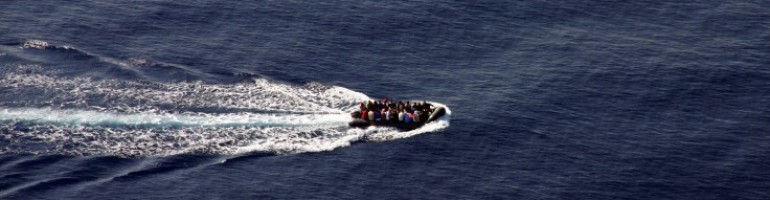

Times of Malta (numbers as of 14 July 2009)
Click here for Times of Malta article.
Filed under Data / Stats, Malta, Mediterranean
“On 27 June, Frontex established a basis for cooperation with the International Center for Migration Policy Development (ICMPD) via an exchange of letters between Ilkka Laitinen, the Executive Director of Frontex and Gottfried Zurcher, Director General of ICMPD. The aim of the agreement is to enhance cooperation between the two organizations in the promotion, development and implementation of integrated border management projects in EU Member States and Third Countries” – said Ilkka Laitinen.”
“The two organisations will focus on improving the management of migratory flows via cooperation in the field of training, research and capacity-building activities for the border guards of EU Member States or those of third countries.”
Click here for Frontex press release.
“The International Centre for Migration Policy Development (ICMPD) was founded in 1993, upon the initiative of Austria and Switzerland. The organisation was created to serve as a support mechanism for informal consultations, and to provide expertise and efficient services in the newly emerging landscape of multilateral co-operation on migration and asylum issues.”
“ICMPD today is an international organisation with eleven Member States (Austria, Bulgaria, Croatia, Czech Republic, Hungary, Poland, Portugal, Slovakia, Slovenia, Sweden and Switzerland), sixty staff members at its Vienna Headquarters, a mission in Brussels and regional offices and representatives throughout Europe, CIS, Northern Africa and the Middle East. ICMPD holds UN observer status. The purpose of ICMPD is to promote innovative, comprehensive and sustainable migration policies and to function as a service exchange mechanism for governments and organisations.”
Click here for ICMPD web site.
“In 1992, after a crackdown on corruption in the Bangkok airport (where snakeheads procured fake documents), the smugglers turned to boats, or what was known as the “bucket business.” Most ships were barely seaworthy; some had as many as a hundred cabins and packed the bodies in. Routes were byzantine: the FBI tracked one group of migrants from Fuzhou to Hong Kong, Bangkok, Kuala Lumpur, Singapore, Dubai, Frankfurt, and then Washington. Keefe puts it this way: “In the minds of the snakeheads, humans were ultimately a form of cargo like any other, subject to the economies of scale.” Like the global trade in more ordinary goods, shipping on the sea worked, leaving U.S. authorities in its wake for quite a while.”
Click here for review.
Filed under Books, China, United States
“Nous vous invitons à venir à Lesbos du 25 au 31 août 2009, là où le système de contrôle des frontières européennes est flagrant, pour que nous échangions nos expériences dans le domaine des lignes de frontières, pour discuter, se coordonner et lutter ensemble.” Coordination NO BORDER Lesvos 2009
Click here and here for more information.
Filed under Aegean Sea, Colloques / Conferences, Greece
“Le Sénégal et l’Espagne [qui] collaborent depuis 2006 dans le contrôle des flux d’émigrés clandestins vers l’Europe … ont signé mardi à Dakar un accord prolongeant d’un an la coopération de leurs deux pays dans le contrôle de l’émigration clandestine…. ”
“Avec le FRONTEX, nous avons pu réduire considérablement ce fléau’’, a affirmé Cheikh Tidiane Sy [le ministre sénégalais de l’Intérieur].”
“Le FRONTEX, avec lequel collabore la police sénégalaise, a permis de réduire fortement les flux d’émigrés clandestins en provenance d’Afrique subsaharienne, pour rejoindre l’Europe.”
Click here for article.
While migrants and asylum seekers have long sought entry to the US from the Caribbean Sea, efforts to reach the US mainland from Mexico via the Pacific Ocean have been less common. The US Department of Homeland Security reports that increasing numbers of migrants are seeking to enter the US (California) by sea from Mexico.
“[US Coast Guard] Commander Pearce and other officials in the Department of Homeland Security say those sporadic efforts have accelerated to unprecedented levels recently — a doubling in the number of illegal immigrants — more than 300 in the last two years — caught on boats or beaches….”
“New smuggling rings have also emerged, operating out of beach towns south of the border and islands off the Mexican coast, convincing migrants that the passage is safe and the ocean too wide open for maritime law enforcement to catch them.”
“The authorities arrested 136 illegal immigrants sneaking in by sea in the fiscal year that ended Oct. 30, double the 66 marine arrests in 2007. Since October, more than 100 illegal immigrants have been arrested….”
Click here for article.
Filed under Data / Stats, Mexico, News, Pacific Ocean, United States
Approximately 900 migrants have been intercepted near Australia so far this year. This is four times the number of migrants who were found in all of 2008.
“In the latest case, about 73 asylum seekers are being taken to the Australian territory of Christmas Island in the middle of the Indian Ocean for processing. Most of the migrants trying to reach Australia this year are escaping fighting in Afghanistan, Iraq, Pakistan and Sri Lanka. Most travel to Malaysia or Indonesia where people smugglers [operate].”
Click here for article.
Filed under Australia, Data / Stats, News
Only 1,318 people reached the Canary Islands by boat over the first six months of 2009. This low number contrasts with the record number of 31,678 who reached the Canary Islands on approximately 600 boats in 2006 and 9,181 migrants who arrived in 2008.
“The Spanish government credits the decline on increased maritime surveillance and agreements with several African nations that allows it to send migrants back.”
“Under the EU’s Frontex programme, Spain’s Civil Guard police patrol the waters off West Africa, in partnership with the authorities from Senegal and Mauritania. In the first six months of 2009, these patrols diverted 762 migrants back to their points of departure. Additionally, a single, satellite communications network, called Sea Horse, pools information between the two continents.”
Click here and here for articles.
Filed under Data / Stats, Eastern Atlantic, Frontex, Mauritania, News, Senegal, Spain
Further to the previous post, in the same press conference, Frontex’s Arias-Fernandez seemed to characterise the repatriation agreement in a completely positive manner and, while conceding that the fate of migrants returned to Libya is unknown, Arias-Fernandez apparently did not express concern over the fact that migrants who are forcibly repatriated to Libya have no procedure by which to seek protection under international refugee law, EU subsidiary protections, or the European Convention on Human Rights.
Arias-Fernandez: ”From January 1 2009 to July 5, there were 333 illegal arrivals [by boat in Italy] according to our people in the field. For the same period last year there were 776. As for Sicily, including Lampedusa, the [number of migrants] passed from last year’s 14,806 to 6,760 this year.”
“From May 15 on … when the [Italy-Libya] agreements became effective, [Frontex] agents noticed even more of a decrease. The decrease in this last month and a half may have even reached -70%. Based on our statistics, we are able to say that the agreements have had a positive impact. On the humanitarian level, fewer human lives have been put at risk, due to fewer departures. But our agency does not have the ability to confirm if the right to request asylum as well as other human rights are being respected in Libya.”
Click here for ANSA article.
Filed under Frontex, Italy, Libya, Mediterranean, News
Frontex deputy director Gil Arias Fernandez said that the economic crisis has caused a drop in the number of migrants coming to the EU and that the Italy-Libya migration agreement has also had “a very strong dissuading effect.” “When you see people who have spent a lot of money on their journey, who have faced great danger during the sea crossing, come back having been expelled from the country of arrival, you think twice before undertaking a similar voyage.”
Frontex reports a 16% reduction in the overall number of irregular migrants stopped at EU borders over the past year. Sicily and Lampedusa experienced a 54% reduction in migrants over the first six months of 2009 compared with 2008 figures, 6,760 vs. 14,800.
Click here for article.
Filed under Data / Stats, European Union, Frontex, Italy, Libya, News
In an interview with the program “BBC Parliament’s The Record Europe”, Nick Griffin, the leader of the extremist right-wing British National Party, and a recently elected MEP from North-West England, said:
“If there’s measures to set up some kind of force or to help, say the Italians, set up a force which actually blocks the Mediterranean then we’d support that. But the only measure, sooner or later, which is going to stop immigration and stop large numbers of sub-Saharan Africans dying on the way to get over here is to get very tough with those coming over. Frankly, they need to sink several of those boats.”
In a subsequent interview with “BNP News” after the BBC interview, Griffin said sinking migrant boats would save lives:
“Thousands of Africans drown every year in their attempts to cross the Mediterranean in their rickety unseaworthy boats. They undertake this hazardous journey because they are convinced that if they get to Europe, they will be allowed in. If they get the message very clearly that they will under no circumstances be allowed in, they will stop coming. Ultimately, it is the only solution to this ongoing problem.”
Click here for the BBC article and link to the BBC interview.
Click here for a link to the BNP website and the “BNP News” interview.
Filed under Mediterranean, News, UK
From Al Watan:
“[300 harraga] sont actuellement détenus dans des centres de rétention secrets. Ces centres seraient au nombre de 11 puisqu’en contrepartie de sa coopération dans la lutte contre l’immigration clandestine, l’Italie s’était engagée à aider son partenaire tunisien et ce, dans le cadre du premier accord bilatéral sur l’immigration qu’ils ont signé en 1998.
“… 13 camps d’enfermement [ont été construits] dont un près de Tunis, un autre entre Gabes et la frontière libyenne. « Où sont les 11 autres camps ? » Cela a toujours été un secret….
” [D]ans [un second accord signé le 27 janvier 2009], il est question de la définition d’un plan qui permet la simplification et l’accélération des procédures d’identification des migrants tunisiens enfermés dans les centres de rétention italiens et l’expulsion « graduelle et constante » des migrants…. En réalité, indiquent ces sources, Tunis a accepté l’expulsion de 500 migrants, à la condition qu’elle soit étalée dans le temps 150 migrants expulsés par mois les deux premiers mois succédant l’entrée en vigueur de l’accord, ensuite 100 personnes par mois par petits groupes de 7 personnes maximum.
“Le nombre de personnes expulsées dans le cadre de cet accord n’est pas clair, vu qu’aucun chiffre officiel n’est donné. …
“[L]’un des points de l’accord … prévoient … la réadmission, par la Tunisie, de ses citoyens mais aussi de ressortissants de pays tiers entrés illégalement sur le territoire italien en provenance des côtes tunisiennes… ainsi que l’intensification des contrôles des forces de l’ordre des deux pays le long des côtes tunisiennes. ”
Click here for article.
Filed under Algeria, Italy, Mediterranean, News, Tunisia
Following a bi-lateral meeting, the UK and French governments have released a declaration regarding actions to be taken in regard to migrants seeking to enter the UK from the Channel and North Sea coast of France.
Excerpts from the Declaration:
“At bilateral level, the French and British governments undertake to: Systematise operational co-ordination in action against illegal immigration networks, especially by exchanging information, conducting joint cross-channel police operations, and working together upstream in Europe and countries of source and transit. A joint intelligence centre charged with the exchange and operational use of information and intelligence, and the co-ordination of its tasking, will be established in Kent (United Kingdom) with a view to becoming operational by August 2009. …
“At European level, the French and British governments will act together to: … Strengthen the operational role of Frontex, in the spirit of the European Pact on Immigration and Asylum, especially through developing operational co-operation between Frontex and third countries, establishing joint European return flights and ensuring adequate resources.
“Initiate innovative forms of co-operation between the European Union, transit countries and the High Commissioner for Refugees, by building on the EU’s Regional Protection Programmes. …
“Develop co-operation with third countries, of origin or transit, and with a specific focus on key North and West African countries, including through co-development and capacity-building measures as well as conclusion and implementation of readmission agreements, within the Global Approach to Migration that represents the European Union’s roadmap according to the European Pact on Immigration and Asylum….
“The administrative arrangement [is] signed today by the Minister for Immigration, Integration, National Identity and Co-development, for the French government, and by the Home Office Minister of State for Borders and Immigration, for the British government….”
Click here for full English text.
Click here for the French text: Déclaration franco-britannique sur l’immigration.
Filed under Communiqués, English Channel / La Manche, France, UK
 Doctors Without Borders/Médecins Sans Frontières has issused a short report on its activities in Italy, Greece, Malta, and Morocco: “Migrants, Refugees and Asylum Seekers: Vulnerable People at Europe’s Doorstep”.
Click here for the link.
The numbers of migrants reaching Malta and Italy are significantly smaller than last year’s numbers. UNHCR spokeswoman Laura Boldrini said that the current situation is “so calm it’s almost unnatural.” The assumption is that the recent Libya-Italy agreement and resulting (and unknown) actions by Libya are a cause of the reduced numbers.
MaltaToday reports that “[b]etween April and May, just two vessels carrying a total of 99 migrants arrived [in Malta and] no landings occurred in June. Over the same period in 2008, some 872 African migrants landed on Malta…”
“Similarly, at …Lampedusa, [Italy] arrivals have declined 33% and 95% in April and May respectively, compared to the same period in 2008, according to UNHCR.”
“A source from the [Maltese] Ministry of Justice and Home Affairs told MaltaToday that recent crackdowns had led to a drop in illegal immigration. Among these were reports in the Italian media that Libyan boat factories had been shut down by the authorities there, leading to criminal organisations making use of rubber dinghies and fishing vessels, an indication of a more haphazard trafficking organisation.”
“[I]t is not yet certain what sort of action is being taken by joint [Italian-Libyan] patrols and Frontex operations, and whether immigrants are being forcibly returned – in breach of international law – to Libya without being given the right to apply for asylum.”
Click here for article.


 MIGRANTS AT SEA