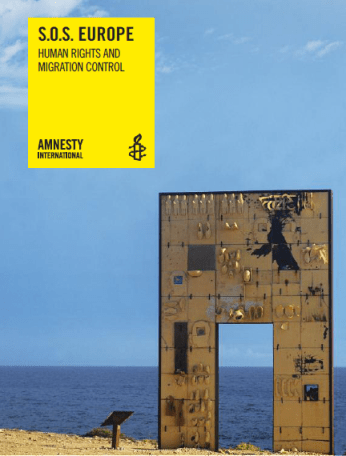
 Amnesty International today has released a report, “S.O.S. Europe: Human Rights and Migration Control,” examining “the human rights consequences for migrants, refugees and asylum-seekers that have occurred in the context of Italy’s migration agreements with Libya.”
The Report is accompanied by the “the launch of Amnesty International’s ‘When you don’t exist campaign‘, which … seeks to hold to account any European country which violates human rights in enforcing migration controls. When you don’t exist aims to defend the rights of migrants, refugees and asylum-seekers in Europe and around its borders. … Today, Europe is failing to promote and respect the rights of migrants, asylum-seekers and refugees. Hostility is widespread and mistreatment often goes unreported. As long as people on the move are invisible, they are vulnerable to abuse. Find out more at www.whenyoudontexist.eu.”
Excerpts from S.O.S. Europe Report:
“WHAT IS EXTERNALIZATION?
Over the last decade, European countries have increasingly sought to prevent people from reaching Europe by boat from Africa, and have “externalized” elements of their border and immigration control. …
European externalization measures are usually based on bilateral agreements between individual countries in Europe and Africa. Many European countries have such agreements, but the majority do not publicize the details. For example, Italy has co-operation agreements in the field of “migration and security” with Egypt, Gambia, Ghana, Morocco, Niger, Nigeria, Senegal and Tunisia,2 while Spain has co-operation agreements on migration with Cape Verde, Gambia, Guinea, Guinea-Bissau, Mali and Mauritania.3
At another level, the European Union (EU) engages directly with countries in North and West Africa on migration control, using political dialogue and a variety of mechanisms and financial instruments. For example in 2010, the European Commission agreed a cooperation agenda on migration with Libya, which was suspended when conflict erupted in 2011. Since the end of the conflict, however, dialogue between the EU and Libya on migration issues has resumed.
The European Agency for the Management of Operational Co-operation at the External Borders of the Member States of the EU (known as FRONTEX) also operates outside European territory. FRONTEX undertakes sea patrols beyond European waters in the Mediterranean Sea, and off West African coasts, including in the territorial waters of Senegal and Mauritania, where patrols are carried out in cooperation with the authorities of those countries.
The policy of externalization of border control activities has been controversial. Critics have accused the EU and some of its member states of entering into agreements or engaging in initiatives that place the rights of migrants, refugees and asylum-seekers at risk. A lack of transparency around the various agreements and activities has fuelled criticism.
This report examines some of the human rights consequences for migrants, refugees and asylum seekers that have occurred in the context of Italy’s migration agreements with Libya. It also raises concerns about serious failures in relation to rescue-at-sea operations, which require further investigation. The report is produced as part of wider work by Amnesty International to examine the human rights impacts of European externalization policies and practices.
[***]
AGREEMENTS BETWEEN ITALY AND LIBYA
[***]
The implementation of the agreements between Libya and Italy was suspended in practice during the first months of the conflict in Libya, although the agreements themselves were not set aside. While the armed conflict was still raging in Libya, Italy signed a memorandum of understanding with the Libyan National Transitional Council in which the two parties confirmed their commitment to co-operate in the area of irregular migration including through “the repatriation of immigrants in an irregular situation.”8 In spite of representations by Amnesty International and others on the current level of human rights abuses, on 3 April 2012 Italy signed another agreement with Libya to “curtail the flow of migrants”.9 The agreement has not been made public. A press release announced the agreement, but did not include any details on the measures that have been agreed, or anything to suggest that the present dire human rights predicament confronting migrants, refugees and asylum-seekers in Libya will be addressed.
[***]
HUMAN RIGHTS OBLIGATION BEYOND BORDERS
Human rights and refugee law requires all states to respect and protect the rights of people within their jurisdiction: this includes people within the state’s territorial waters, and also includes a range of different contexts where individuals may be deemed to be within a certain state’s jurisdiction.
[***]
States must also ensure that they do not enter into agreements – bilaterally or multilaterally – that would result in human rights abuses. This means states should assess all agreements to ensure that they are not based on, or likely to cause or contribute to, human rights violations. In the context of externalization, this raises serious questions about the legitimacy of European involvement – whether at a state-to-state level or through FRONTEX – in operations to intercept boats in the territorial waters of another state, when those intercepted would be at a real risk of human rights abuses.
A state cannot deploy its official resources, agents or equipment to implement actions that would constitute or lead to human rights violations, including within the territorial jurisdiction of another state.
CONCLUSION
Agreements between Italy and Libya include measures that result in serious human rights violations. Agreements between other countries in Europe and North and West Africa, and agreements and operations involving the EU and FRONTEX, also need to be examined in terms of their human rights impacts. However, with so little transparency surrounding migration control agreements and practices, scrutiny to date has been limited.
[***]
RECOMMENDATIONS
Amnesty International urges all states to protect the rights of migrants, refugees and asylum-seekers, according to international standards, This report has focused on Italy.
THE ITALIAN GOVERNMENT SHOULD:
- set aside its existing migration control agreements with Libya;
- not enter into any further agreements with Libya until the latter is able to demonstrate that it respects and protects the human rights of refugees, asylum seekers and migrants and has in place a satisfactory system for assessing and recognizing claims for international protection;
- ensure that all migration control agreements negotiated with Libya or any other countries are made public.
EUROPEAN COUNTRIES AND THE EU SHOULD:
- ensure that their migration control policies and practices do not cause, contribute to, or benefit from human rights violations;
- ensure their migration control agreements fully respect international and European human rights and refugee law, as well as the law of the sea; include adequate safeguards to protect human rights with appropriate implementation mechanisms; and be made public;
- ensure their interception operations look to the safety of people in distress in interception and rescue operations and include measures that provide access to individualized assessment procedures, including the opportunity to claim asylum;
- ensure their search-and-rescue bodies increase their capacity and co-operation in the Mediterranean Sea; publicly report on measures to reduce deaths at sea; and that Search and Rescue obligations are read and implemented in a manner that is consistent with the requirements of refugee and human rights law.”
Click here (EN), here (EN), or here (FR) for Report.
See also www.whenyoudontexist.eu





 MIGRANTS AT SEA