Author Archives: Niels Frenzen

Niels Frenzen's avatar

About Niels Frenzen

Clinical Professor of Law, Gould School of Law, University of Southern California, Los Angeles, USA. Contact: frenzen@usc.edu; @migrantsatsea

Increased Human Smuggling to Cyprus

According to an article in the Turkish newspaper Today’s Zaman, Turkish Interior Ministry data indicates that human smuggling in Turkey has decreased since 2007, but that one consequence of increased enforcement within Turkey has been a diversion of human smuggling to the Turkish controlled northern portion of Cyprus.

“According to the ministry, the total number of illegal immigrants, asylum seekers and immigrants caught at land and sea borders with Syria, Iran, Iraq, Georgia, Greece and Bulgaria declined to 28,355 in 2009.”  This number is in contrast to the 50,800 migrants reportedly arrested in 2008 and 7,465 arrested over the first six months of 2010.

The Ministry also reported a decline in known deaths: “In line with the drop in the number of immigrants trying to get to the West through Turkey, there has been a decline in the number of illegal immigrant deaths. In 2007, 82 immigrants died in accidents on the Aegean Sea and 102 went missing. The number of deaths dropped to 76 in 2008 and to 43 in 2008. The number of deaths in the first half of 2010 was nine.”

According to the article, there has been a diversion of smuggling operations towards Turkish controlled Cyprus and as a result the “KKTC [the self-declared Turkish Republic of Northern Cyprus] [is] facing the biggest migration move ever in its history.”  “In 2008, the number [of irregular migrants] doubled and increased to 568. It continued to increase in 2009. According to estimates, 750 migrants entered the island in 2009. … Illegal immigrants are brought by ships to Cyprus during the night and left in places that are far from settlement areas in Dipkarpaz and the İskele region. In addition to the KKTC, a similar number of immigrants are brought to Greek Cyprus.  It is believed that illegal immigrants pay between $2,000-$3,000 on average to human smugglers to enter the KKTC. In the latest smuggling cases in Turkey, they pay $5,000-$10,000.”

Click here for article.

Click here Turkish Ministry of Foreign Affairs web site on Illegal Migration.

1 Comment

Filed under Aegean Sea, Cyprus, Data / Stats, Greece, Mediterranean, News, Turkey

Global Migration Group Statement on the Human Rights of Migrants in Irregular Situation

The Global Migration Group (GMG) issued a Statement on the Human Rights of Migrants in Irregular Situation on 30 September.  Excerpts from the Statement follow:

“The Global Migration Group is deeply concerned about the human rights of international migrants in an irregular situation around the globe….

Too often, States have addressed irregular migration solely through the lens of sovereignty, border security or law enforcement, sometimes driven by hostile domestic constituencies. Although States have legitimate interests in securing their borders and exercising immigration controls, such concerns cannot, and indeed, as a matter of international law do not, trump the obligations of the State to respect the internationally guaranteed rights of all persons, to protect those rights against abuses, and to fulfill the rights necessary for them to enjoy a life of dignity and security….

The GMG calls upon States to review the situation of migrants in an irregular situation within their territories and to work towards ensuring that their laws and regulations conform with and promote the realization of the applicable international human rights standards and guarantees at all stages of the migration process. The GMG recognizes the difficulties many States face and stands ready to continue to support them in their efforts to ensure the effective implementation of appropriate legislation, including through capacity development….

The irregular situation which international migrants may find themselves in should not deprive them either of their humanity or of their rights….”

GMG is an inter-agency group bringing together 12 UN agencies, the World Bank, and the International Organization for Migration to promote the application of relevant international instruments and norms relating to migration, and to encourage the adoption of more coherent, comprehensive and better coordinated approaches to the issue of international migration.

(As noted by Prof. William Schabas on his blog.)

Click here for the full Statement.

Leave a comment

Filed under News, Statements, United Nations

Frontex 2nd Quarter Report

The Frontex Risk Analysis Unit has released its Report for the Second Quarter of 2010 (April-June).  It is a 30+ page report containing data, charts, and graphs detailing entry routes, detections of migrants, detections of facilitators, and other information.

Excerpts from the Report’s Executive Summary:

Illegal migration pressure in the EU underwent a foreseeable seasonal increase during the second quarter of 2010, but is still clearly in a period of decline.…

The widespread decline in illegal migration pressure is probably due to two key factors. The first is decreased employment opportunities in the EU …  [and the] second is stricter migration and asylum policies in Member States, supported by much more effective collaboration with key third countries. For example, stricter migration and asylum policies in Norway and the UK have reduced the number of applications in these Member States…. Similarly, bilateral agreements between Italy and Libya, and between Spain and both Senegal and Mauritania, continue to control, for the time being at least, most illegal migration via the Central Mediterranean and West African routes, respectively.

Notwithstanding the general decline in detections, there were two emerging trends in the second quarter (Q2) of 2010: a continued and intensified shift from the Greek sea border to the Greek land border with Turkey….  In the beginning of 2009 illegal crossings of the EU external border between Greece and Turkey were divided roughly equally between the land and sea borders.  However, there has been a gradual and recently intensified shift to the land border. Reasons for this shift from sea to land borders are linked to the effectiveness of the Frontex activities in the Aegean Sea, combining surveillance activities with identification of illegal migrants, and opening the possibility of return to origin countries for detected migrants. ….

Main trends:

  • There is a general decline in illegal migration to the EU compared to a year ago;
  • For the time being, Turkey is the main transit country for illegal migration to the EU….;
  • In the Eastern Mediterranean route, there has been a gradual and recently intensified shift from the Greek-Turkish sea border to the land border, where 90% of detections were made….   At the Greek-Turkish land border around 60% of detections were made at the Border Control Unit (BCU) Orestiada which is under the biggest pressure. Air connections to Turkey are increasingly used by migrants from North Africa, who then illegally cross the EU external border with Turkey. As well as effective Frontex-coordinated joint operations at the sea border, potential explanations for this shift include cheaper facilitation costs, a lower risk crossing, lower detection rates…;
  • There were increased detections on the Central Mediterranean route, probably due to the recent re-organisation of criminal groups in response to effective bilateral agreements in the area. In June 2010 Libya expelled the United Nations High Commissioner for Refugees (UNHCR), with whom 9,000 refugees and 4,000 asylum-seekers were registered and who, in the absence of protection, may now attempt entry to the EU.

Click here for the 2nd Quarter Report.

Click here for the 1st Quarter Report.

2 Comments

Filed under Aegean Sea, Analysis, Data / Stats, Eastern Atlantic, European Union, Frontex, Greece, Italy, Libya, Malta, Mauritania, Mediterranean, News, Reports, Senegal, Spain, Turkey

EU Official Journal Notice re ECJ Challenge to Frontex Sea Border Rule

The European Court of Justice published a routine notice and summary in the Official Journal regarding the EP’s pending challenge to the validity of the Frontex rule regarding the surveillance of the sea external borders (Council Decision 2010/252/EU (“Frontex / Sea borders”)).

I reproduce the Notice here in full:

Action brought on 14 July 2010 — European Parliament v Council of the European Union

(Case C-355/10) (2010/C 246/58)

Language of the case: English

Parties

Applicant: European Parliament (represented by: M. Dean, A. Auersperger Matić, Agents)

Defendant: Council of the European Union

The applicant claims that the Court should:

— Annul Council Decision 2010/252/EU ( 1 ) of 26 April 2010 supplementing the Schengen Borders Code as regards the surveillance of the sea external borders in the context of operational cooperation coordinated by the European Agency for the Management of Operational Cooperation at the External Borders of the Member States of the European Union;

— Order that the effects of the Council Decision be maintained until it is replaced;

— order Council of the European Union to pay the costs.

Pleas in law and main arguments

Parliament seeks the annulment of the contested Decision on the grounds that it exceeds the scope of the implementing power in Article 12(5) of the Schengen Borders Code ( 2 ) in that it introduces rules on ‘interception’, ‘search and rescue’ and ‘disembarkation’ which cannot be considered to be within the scope of ‘surveillance’ as defined by Article 12 of the Schengen Borders Code and which cannot be considered to be non-essential elements, and modifies the essential elements of the Schengen Borders Code which are reserved to the legislator. Moreover, the contested Decision modifies the obligations of the EU Member States relating to Frontex operations, which are laid down in the Frontex Regulation ( 3 ).  Should the Court annul the contested Decision, Parliament nonetheless considers it would be desirable that the Court exercise its discretion to maintain the effects of the contested Decision, in accordance with Article 264 (2) TFEU, until such time as it is replaced.

( 1 ) Council Decision of 26 April 2010 supplementing the Schengen Borders Code as regards the surveillance of the sea external borders in the context of operational cooperation coordinated by the European Agency for the Management of Operational Cooperation at the External Borders of the Member States of the European Union OJ L 111, p. 20

( 2 ) Regulation (EC) No 562/2006 of the European Parliament and of the Council of 15 March 2006 establishing a Community Code on the rules governing the movement of persons across borders (Schengen Borders Code) OJ L 105, p. 1

( 3 ) Council Regulation (EC) No 2007/2004 of 26 October 2004 establishing a European Agency for the Management of Operational Cooperation at the External Borders of the Member States of the European Union OJ L 349, p. 1

Click here for link to EU OJ.

Click here and here for earlier posts on the case.

2 Comments

Filed under European Union, Frontex, Judicial, News

Frontex: Current Situation at the External Borders (JANUARY – JUNE 2010)

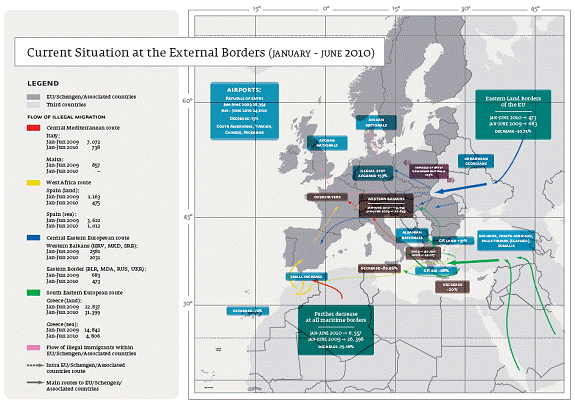
Frontex posted this map to its web site this week.  According to Frontex, “[t]he map describes the current migratory situation at the external borders of the EU, including the main entry routes of irregular migration into the European Union.”

Note the significant reductions in migrants detected at all maritime borders:

  • Jan-June 2010 – 6.557
  • Jan-June 2009 – 26.398
  • Decrease of 75%

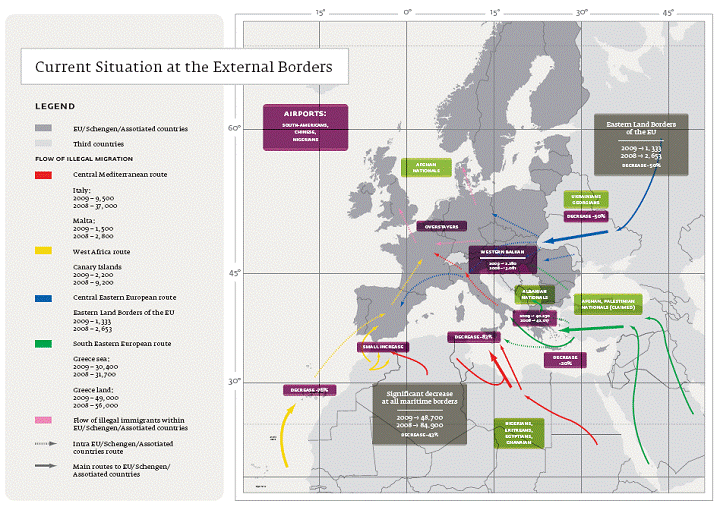
This 75% decrease over the first six months of 2010 compared with the first six months of 2009 is on top of the 43% reduction in migrants detected at maritime borders in 2009 relative to 2008:

  • 2009 – 48.700
  • 2008 – 84.900
  • Decrease of 43%

Note the further breakdown of the figures in the Legends of the two maps.  You probably need to click on the links to view higher quality images of the maps.

Click here for link to Jan-June 2010 Map.

Click here for link to 2009 Map.

Current Situation at the External Borders (January - June 2010)

Current Situation at the External Borders (January - June 2010)

Situation at the External Borders (2009)

Situation at the External Borders (2009)

1 Comment

Filed under Aegean Sea, Data / Stats, Eastern Atlantic, European Union, Frontex, Mediterranean, News

Les pirogues de fortune – CARIM Note

A CARIM Analytic and Synthetic Note by Serigne Mansour TALL and Aly TANDIAN was issued in July entitled “Regards sur la migration irrégulière des Sénégalais : vouloir faire fortune en Europe avec des pirogues de fortune.”

Résumé – Ce papier met en exergue le voyage des sénégalais qui utilisent des pirogues de fortune dans l’espoir d’atteindre l’Europe via les îles canaries. L’auteur analyse les motivations sous-tendant ces itinéraires « irréguliers » ou « illégaux » et met en lumière les stratégies ainsi que les ressources que ces migrants utilisent pour partir.

[Abstract (the paper is only in French) – The paper focuses on the Senegalese who embark on “fortune seeking pirogues”, hoping to reach Europe via the Canary Islands. The author analyses the motivations of these ‘irregular’ or illegal migratory itineraries and sheds light on the strategies and resources that they employ in order to leave.]

Click  here (FR) or here (FR) for Note.

Leave a comment

Filed under Analysis, Eastern Atlantic, Reports, Senegal, Spain

Libyan Court Delays Ruling in Mass Trafficking Trial

According to the Libyan newspaper Oya (or Oea), the State Security Court has delayed its ruling in the mass human trafficking trial involving approximately 520 defendants until 17 October.

Click here for article. (AR)

Click here for previous post.

Leave a comment

Filed under Italy, Judicial, Libya, Mediterranean, News

INTERSOS Update on Mixed Migration in the Gulf of Aden

INTERSOS has released a short report on the movement of migrants from the Horn of African to Yemen during the first half of 2010.  The report notes a more than 50% reduction in the number of Somalis arriving in Yemen compared with the same period in 2009.  The number of non-Somalis (mostly Ethiopians) arriving in Yemen has remained the same compared to the same period last year.  The report observes that increased efforts by Puntland authorities to halt traffickers and the increased turmoil within Somalia making movement within the country difficult may partially explain the reduced numbers.  The report notes that a reduction in the outward migration flow of Somalis into Kenya has also occurred, though there has been in increase in the numbers of Somalis entering Ethiopia.

Click here for the Report.

Leave a comment

Filed under Data / Stats, Ethiopia, Gulf of Aden, News, Somalia, Yemen

2010 Report of the Special Rapporteur on the HR of Migrants

The Report of the Special Rapporteur on the human rights of migrants (Jorge Bustamante) was released in August over the summer break and I am just seeing it now.  This report was submitted to the General Assembly.  Here is the partial Index:

III. Issue in focus: the impact of the criminalization of migration on the protection and enjoyment of human rights

  • A. The impact of the criminalization on the enjoyment of human rights
  • B. The impact of the criminalization of migration on specific groups
  • C. Examples of good practices and alternatives to the criminalization of irregular migration

IV. Conclusions and recommendations

  • A. A rights-based approach to migration governance
  • B. Decriminalizing and managing irregular migration

[79. States should ensure that their border control and anti-smuggling efforts are carried out in a manner that respects and protects human rights, does not interfere with search and rescue obligations, and does not block access to asylum procedures and the identification of trafficked victims….
81. The detention of children and adolescents through border control measures, such as interception at sea, should be addressed through a child protection approach. Similarly, migration authorities responsible for the mistreatment of children should be held fully accountable.]

C. Preventing ethnic profiling of migrant communities, hate crimes, racism, racial discrimination, xenophobia and related intolerance

D. Finding alternatives to immigration detention

E. Protecting specific groups

F. Information-sharing, data and analysis

G. Recommendations on international cooperation

The 2008 Report of the Special Rapporteur is also very worthy of note.  The 2008 Report discussed in depth, among other topics, the increased criminalization of irregular migration, the abuses of migrants during the  migration process, the externalization of migration control policies, and violations against irregular migrants pertaining to interception and rescue at sea.

Click here for 2010 Report.

Click here for 2008 Report.

Leave a comment

Filed under Human Rights Council, News, Reports, United Nations

ECRE and AI Joint Briefing on Commission Proposal to Amend Frontex Regulation

On 21 September ECRE and Amnesty International released a 30+ page joint briefing on the 24 February 2010 European Commission “Proposal for a REGULATION OF THE EUROPEAN PARLIAMENT AND THE COUNCIL amending Council Regulation (EC) No 2007/2004 establishing a European Agency for the Management of Operational Cooperation at the External Borders of the Member States of the European Union (FRONTEX),” COM(2010) 61 final.

The joint briefing presents detailed views on the proposal and makes numerous specific recommendations for possible amendments.  I have not had time to read the full briefing closely, but here are several excerpts from the Summary:

“1. Role and responsibilities of Frontex vis-à-vis Member States –  [***] Amnesty International and ECRE recommend that Frontex be subject to full accountability by the enhancement of democratic oversight of the Agency before the European Parliament, in addition to judicial oversight by the European Courts for legal protection against unlawful actions, and by effective implementation of the requirement to give access to prompt, objective and reliable information on its activities. In particular, accountability should be enhanced by providing for the following: 1) Relevant information, including risk analysis, should be transmitted to the European Parliament to enable adequate scrutiny of Frontex activities; 2) Independent observation should be enabled at the meetings of the Management Board; 3) Frontex programme of work should be subject to public consultation. [***]

2. The legal framework governing Frontex –  The proposal clarifies the legal framework of Frontex operations by stating explicitly that its activities are subject to the Schengen Borders Code and should be undertaken in accordance to relevant international and EU law, obligations related to international protection and fundamental rights. Sea border surveillance activities fall within the remit of the Schengen Borders Code, even if implemented in the high seas, and as such must be conducted without prejudice of the rights of refugees and other persons demanding international protection. The Council Decision setting out rules which apply to join sea operations further clarifies that all aspects of these operations, including interception and disembarkation, are subject to international obligations arising from refugee and human rights law.

While meant to deal with Member States’ disputes over responsibility, the Council Decision also includes non-binding guidelines, which must form part of the operational plan drawn up for each Frontex operation and state modalities for disembarkation of persons intercepted or rescued. Yet, these are not detailed enough to ensure that sea operations will meet the requisite standards.

Amnesty International and ECRE recommend that the new Frontex Regulation includes an explicit requirement that the rules for interception at sea operations be formalized in the operational plan. Moreover, they should be accompanied with detailed measures to ensure that disembarkation meets the requisite standards, in particular by specifying the place of disembarkation and as regards the provision of food, shelter and medical care, as well as access to asylum and protection from refoulement.

Although the extent of the extraterritorial application of the EU acquis remains to be determined, Member States intercepting individuals beyond their territorial waters cannot operate in a legal vacuum. In addition, when border surveillance activities take place in the territorial waters of a third country, Member States and Frontex appear to attribute responsibility for any possible human rights breaches to the third country concerned. Adequate measures must also be in place to ensure that those involved in joint operations are able to guarantee refugee and human rights protections in a practical way, both when they act within a territory or territorial waters, as well as extraterritorially Amnesty International and ECRE recommend that the proposal sets out the concrete measures by which States can effectively meet their obligations, when these are engaged both territorially and extraterritorially. These should include at a minimum the following: 1) Individuals have the possibility of explaining their circumstances during a personal interview; 2) Those who wish to apply for asylum are helped to access the asylum procedure, including through interpretation and independent legal advice. International cooperation should never be construed as releasing EU Member States from fundamental rights obligations in relation to those intercepted or diverted in the territorial sea of the third state in question. [***]”

Click here for the Joint Briefing.

Click here for the Proposed Amendment to the Regulation.

Leave a comment

Filed under Analysis, Communiqués, European Union, Frontex, News

HRW Calls on Libya to Halt Firing on Migrant Boats

Human Rights Watch on 16 September called on the Libyan government to “immediately end what appears to be a policy that allows shooting at boats carrying migrants from Libya to Italy.”  HRW also called for Italy to stop participating in joint patrols with Libya.

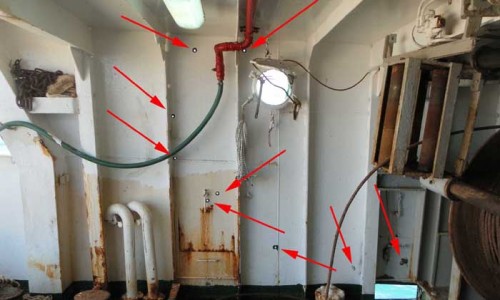
The request was made as a result of the incident on 12 September when a Libyan patrol boat fired on an Italian fishing vessel.  After the incident, Italian Interior Minister Roberto Maroni suggested that the Libyans “perhaps…confused the fishing boat for a boat with illegal migrants.” [”Posso immaginare che i libici abbiano confuso il peschereccio con una imbarcazione con immigrati irregolari, ma posso immaginare soltanto.”]

Bill Frelick, Refugee Program director at Human Rights Watch, said “the Libyans and Italians appear to agree that it was a mistake to shoot at Italian fishermen, but imply that it’s OK to shoot at migrants. The bullet-riddled boat shows a reckless use of potentially lethal force that would have been just as bad if it had actually targeted nonthreatening migrants.  This incident shows once again the dangers when an EU member outsources its border controls to third countries.  Italy should immediately end its agreement with Libya aimed at intercepting migrants trying to leave Libya.”

Click here for full HRW statement.

Click here and here (IT) for articles.

The arrows indicate the holes left by shots fired from a machine gun against a Libyan patrol boat fishing boat fleet of Mazara del Vallo, Aries (Ansa)

Click here for photo source.

Leave a comment

Filed under Italy, Libya, Mediterranean, News

Libyan State Security Court Expected to Rule Soon in Human Trafficking Trial Involving 500+ Defendants

The Libyan newspaper Oya (or Oea) reported this past week that the State Security Court is expected to issue a ruling on 26 September in a mass human trafficking trial involving approximately 520 defendants.  The trials have been ongoing since at least May 2010.  The defendants reportedly include members of the armed forces, public security, and Navy. They have been charged with offences relating to human trafficking and facilitating illegal immigration from Libya to Italy.

Click here for article. (AR) (Recently I have not been able to get Google Translate to work with Arabic.  I am therefore “reading” Arabic via these two sites: http://www.appliedlanguage.com/web_translation.shtml?s=dd and http://translation.babylon.com/ .)

Click here and here for previous posts on the trial.

2 Comments

Filed under Italy, Judicial, Libya, Mediterranean, News

European Patrol Network Meeting, 23-24 Sept.

The quarterly meeting of the European Patrol Network (EPN) will be held 23 and 24 September in Bruges.  EPN was established by Frontex and unites the members of the agency’s operational branch of the ‘Joint Maritime Operations’.

According to the Belgian Police EU Presidency Newsletter, 7th Edition, the purpose of the meeting is to “allow the participating countries to ensure better coordination of the operations….  A number of technical points will come up for discussion, but for instance also the progress of the [Frontex] 2010 Joint Operations, the creation of a national coordination centre, the issue of the interpreters, as well as the Eurosur project. At present the efforts of the EPN are mostly focused on the Mediterranean, due to the immigration pressure from this region.”  (The Newsletter says the meeting is scheduled for October, but the Belgian Integrated Police – Belgian Presidency of the EU website indicates the meeting is 23-24 September.)

Leave a comment

Filed under Belgium, European Union, Frontex, Mediterranean, News

RSQ Article: Refugees, Europe, Camps/State of Exception: “Into The Zone”, the EU and Extraterritorial Processing of Migrants, Refugees, and Asylum-seekers

The latest issue of Refugee Survey Quarterly has been released (2010; Vol. 29, No. 1).  An article by Dr. Carl Levy (Reader in European Politics, Department of Politics at Goldsmiths College, University of London) is of particular interest.

Here is the Abstract:  This article outlines the debate over extraterritorial processing in the European Union (EU) from the Treaty of Amsterdam (1997) to the Treaty of Lisbon (2009). It will briefly outline the historical precedents, the evolution of policy within the EU, and the role of other models (Australian, American, etc.). This article emphasizes the contested understandings of how these zones might be manifested in practice. It uses evidence from the political history and policy-making of the EU to question Giorgio Agamben’s concept of the state of exception. In fact, the promotion of extraterritorial zones was not merely sold as necessary, if unfortunate, choices. Likewise, the more sinister interpretation of these zones as a regression from the Liberal State to the universe of camps failed accurately to capture what was happening in reality. Firstly, supranational extraterritorial processing was beyond the constitutional or political capacity of the EU. Secondly, at times, the unintended consequences might have led to a liberalization of so-called “Fortress Europe” and caused certain politicians to become disenchanted precisely because the proposed form of extraterritorial processing threatened to institute a rigorous form of burden sharing.

Click here for link to Journal.  (Subscription required.)

Leave a comment

Filed under Analysis, European Union, Frontex

ECRE Statement Re EU Conference on Quality and Efficiency in the Asylum Process

ECRE released a statement at the conclusion of this week’s EU Ministerial Conference on Quality and Efficiency in the Asylum Process:

“… Since its peak in the early 1990s, the number of asylum applications lodged within the European Union has experienced a sharp decline, despite the increase in some individual Member States. However, a difficult political and economic environment in Europe is fuelling little appetite for welcoming foreigners, which is translated into a slow progress at the table of negotiations to build a Common European Asylum System.

ECRE believes that initiatives to increase practical cooperation, such as this conference and the establishment of a European Asylum Support Office, which will soon be up and running in Malta, will help to make the asylum system fairer and more efficient. For instance, yesterday’s discussions have provided examples of how to improve the treatment of children or traumatised asylum seekers. Also, pooling resources with regard to information about the home countries of asylum seekers, interpretation services and training can contribute to better decisions.

Bjarte Vandvik, ECRE’s Secretary General, said: ‘The current EU asylum system is failing both Member States and people who arrive to Europe fleeing war or persecution. Practical cooperation is part of the solution but will not be enough. European Member States also need to resolve the impasse in the negotiations and work together to agree on fairer common asylum rules’.

Asylum seekers still have hugely different chances of being granted international protection depending on the EU country that will examine their application. For instance, in 2009, virtually no Iraqis were recognised as refugees in Greece, while in Germany, 77% of Iraqi asylum seekers were granted international protection and could rebuild their lives. A harmonised asylum system with higher standards of protection would not be only fairer; it would also be more efficient and less costly in the longer term.”

Click here for information on the Conference organised by the Belgian Presidency.

Click here for Commissioner Cecilia Malmström’s statement at the conference.

Leave a comment

Filed under European Union, News, Statements