Category Archives: Council of Europe

PACE Rapporteur to Begin Fact-Finding Mission to Italy to Investigate Mediterranean Migrant Deaths

Tineke Strik (Netherlands, SOC) will begin a two day fact-finding trip to Italy on 6 September as Rapporteur for the PACE Migration Committee (Parliamentary Assembly of the Council of Europe).  She is investigating the deaths of boat people who have died in the Mediterranean since January 2011.

From the PACE press statement of 2 September:  “Meetings are scheduled with survivors of a shipwreck, officers of Italian coastguard units, representatives of NGOs active in the field and representatives of the Office of the United Nations High Commissioner for Refugees.  During her visit the rapporteur will in particular look into the way boats are intercepted – or not intercepted – by national coastguard forces, or by military vessels under either NATO or national command.  Further to reports that migrants and refugees have perished after their distress calls were ignored, the PACE Committee on Migration, Refugees and Population appointed Ms Strik in June to conduct an inquiry into these matters.”

From the PACE press statement issued in June 2011: “‘There have been allegations that migrants and refugees are dying after their appeals for rescue have been ignored,’ said Mrs Strik. ‘Such a grave allegation must be urgently investigated.  I intend to look into the manner in which these boats are intercepted – or not – by the different national coastguards, the EU’s border agency FRONTEX, or even military vessels. I also intend to speak to witnesses directly involved in reported incidents, and put questions to national authorities, the UNHCR, FRONTEX and NATO, among others.’  On 8 May, the Guardian newspaper reported that 61 boat people escaping from Libya had died after their appeals for rescue had been ignored by armed forces operating in the Mediterranean. The following day PACE President Mevlüt Çavusoglu called for ‘an immediate and comprehensive enquiry’ into the incident.”

Presumably Ms. Strik’s investigation will also seek information from Maltese authorities.  The Maltese Rescue Coordination Centre run by the Armed Forces of Malta is in possession of relevant information pertaining to incidents within the Maltese Search and Rescue Area where many (perhaps most?) of the migrant deaths have occurred.

Click here and here for COE press statements.

Click here for link to COE’s web page regarding “PACE’s Response to Migrants and refugees arriving from North Africa.”

Click here and here for my previous posts on the topic.

1 Comment

Filed under Council of Europe, European Union, Frontex, Italy, Libya, Malta, Mediterranean, News, Reports, Tunisia

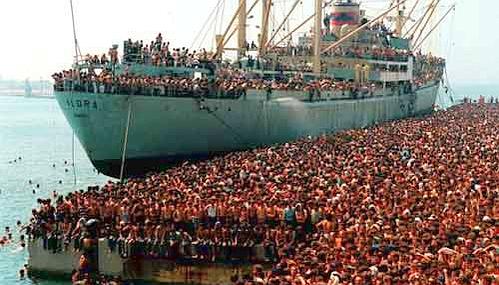
20th Anniversary of the Arrival at Bari, Italy of 15,000 Albanian Boat People

Twenty years ago, on 8 August 1991, several ships carrying approximately 15,000 Albanian migrants succeeded in entering the port of Bari, Italy.  The Italian government’s response was harsh.  Most of the Albanians were detained in a sports stadium without adequate food, water, or access to bathrooms.  Italian authorities dropped supplies to the detained migrants by helicopter.  Within several weeks most of the migrants were deported to Albania.  Their harsh treatment was criticised by human rights organisations and the Pope, but was justified by the Italian government as necessary to deter further irregular migration from Albania.

Excerpts from the 27 January 1992 PACE Report on the Exodus of Albanian Nationals:

“[***]

THE MASS EXODUS FROM ALBANIA

13.       Albania’s forty years of isolation from the rest of the world, combined with its disastrous economic, social and political situation, have had a traumatic effect on its citizens. They feel overwhelmed by hopelessness in the face of Albania’s domestic situation, and although their knowledge of other countries is based solely on what they have heard, or seen on Italian television, they long for the opportunity to start a new life abroad.

14.       This general mood became evident after mid-1990 when increasing numbers of asylum-seekers started to leave the country. Distressing images reminded the public in the rest of Europe of a part of the continent which they had forgotten existed.

15.       In July 1990, Western embassies in Tirana were besieged by large numbers of Albanian nationals. Some 5 000 people sought to leave the country. Thanks to the mediation of international organisations, and after intensive negotiations, a large number of them managed to obtain visas and were granted political asylum in several European countries, particularly Germany, Italy and France. Some have apparently since returned to Albania.

16.       At the end of 1990, some 3 000 Albanian nationals had arrived in Greece by crossing the border between the two countries without meeting any resistance from Albanian border guards. By mid-March 1991, 20 000 Albanians, many of them of Greek ethnic origin, were estimated to have entered Greece. Some of these Albanian nationals have applied to the Greek authorities for political asylum. However, interviews of asylum-seekers have shown clearly that the exodus was not politically motivated but directly linked to the difficult situation prevailing in Albania. The Greek authorities granted work permits to those who found a job and temporary residence permits to the others. Repatriation programmes for all those wishing to return voluntarily were carried out in close co-operation with the Office of the United Nations High Commissioner for Refugees (UNHCR).

17.       On 5 March 1991, a large number of Albanians gathered before the German, French, Greek and Italian Embassies in Tirana, where it was rumoured that visas were going to be distributed. The following day (according to various sources), several boats left the Albanian port of Durres with 20 000 Albanians on board.

18.       On 7 March 1991, Albanian ships began arriving at ports in southern Italy (Brindisi, Bari, Otranto and Monopoli). In spite of the Italian authorities’ public refusal to allow the Albanians to land, many managed to do so.

19.       On the following day, 8 March 1991, hygiene on the boats had deteriorated to such an extent that landing was unavoidable. Crowds of Albanians settled on the quays of Italian ports to await aid which took several days to arrive, as the Italian authorities were overwhelmed by their sheer number.

20.       The Italian authorities claim that 20 000 Albanians arrived in Italy between 7 and 10 March 1991. Negotiations between the authorities in Tirana and Rome subsequently brought the exodus to an end, and Italy has undertaken to discuss with Albania how to eliminate its root causes.

21.       Also in March 1991, an undetermined number of Albanians of Serbian and Montenegrin origin attempted to enter Yugoslavia illegally.

22.       In June 1991, the Albanian authorities requested the United Nations Development Programme to organise an interagency mission in order to undertake an assessment of Albania’s urgent humanitarian needs. In the field of migration, the mission concluded that the great majority of Albanians who had left the country were seeking improved economic conditions and recommended to the Albanian government that it provide incentives so as to encourage Albanians to remain in their country.

23.       During the first days of August 1991 thousands of Albanians reached the western port of Durres and the southern port of Vlora, in the hope of going on board ships that would take them to Italy.

24.       The Albanian authorities tried in vain to prevent its citizens from leaving the country by putting the ports under military control and halting passenger trains.

25.       On 8 August 1991 an estimated 10 000 Albanian nationals aboard several ships forced their way into the port of Bari in the south-east of Italy and approximately 1 000 into the port of Otranto. Moreover, 675 Albanians aboard two other ships who tried unsuccessfully to land at ports in Sicily, were diverged to Malta and later returned to Albania.

26.       After several hours of waiting in the port of Bari, the Italian authorities allowed the Albanians to disembark for humanitarian reasons and led them to La Vittoria Sports Stadium. As the Italian authorities started forced repatriation using military transport planes and ferries, clashes broke out between policemen and Albanians. The Albanians barricaded themselves in the stadium refusing to return to their country; some 300 succeeded in escaping.

27.       The Italian authorities offered the Albanians 50 000 lire (40 US dollars) each and new clothes if they would return home. As this offer did not attract the Albanians, forced repatriation continued.

28.       At the same time the Italian Government increased its financial aid to Albania. Right after the repatriation operations food and emergency aid was sent to Albania. On 12 August 1991, the European Community announced an extra 2,3 million US dollars of emergency aid to be used to buy food and medicines.

29.       The large majority of Albanians arriving in Italy were claiming to be looking for work and escaping the poor economic situation in their country. The failure to repatriate the 7 000 Albanians who arrived in March 1991 as well as rumours of an immigration agreement between Albania and Italy seemed to encourage this last flow.

30.       All of Europe witnessed the dramatic scenes, captured on television news, showing the Albanians being expelled by Italian officials. Although repatriation was legally justified, the way in which the operation was conducted was problematic. The vast majority of the Albanians, according to their accounts of the exodus, fled their country because they felt “buried alive” there. They explained that when the news spread like wildfire that it was possible to leave Albania, lorries were seized in the ensuing rush, ships commandeered, and their crews forced to set sail. It was a form of mass psychosis. It is difficult to determine whether this psychosis was triggered deliberately; rumours suggest that this was the case, but there is no conclusive evidence to support this.

31.       The Albanians’ deportation from Italy was beset with problems, and on a number of occasions the police were deployed. The Albanians were particularly distressed to find that despite promises from the Italian authorities to allow some of them to travel to new homes in Italy, they were still sent straight back to Albania.

32.       It should be noted, however, that the Italian authorities provided the Albanians with food, clothing and some money.

33.       Although there was remarkable sympathy for the Albanians in Italy, the official Italian position was that these persons were seeking economic betterment in Italy and consequently could not be considered as political refugees.

34.       From 15 to 17 August the International Organisation for Migration (IOM) and UNHCR sent a joint mission to Albania. It discussed with the Albanian authorities issues related to migration, such as:

–       the continuation of voluntary return projects from neighbouring countries;

–       the planned and orderly emigration of a small number of Albanians to work in industrialised countries;

–       the implementation of an information project aimed at informing Albanians of the economic and social situation in neighbouring countries;

–       the need to promote, in the mid-term, the reinsertion of returning Albanians, through appropriate vocational training before their return.

35.       It must also be recalled that, at the request of the Italian authorities, IOM and UNHCR, in conjunction with the Italian Red Cross, established a programme of voluntary return. As at the end of August 1991, 1 130 Albanians had been assisted by IOM in their voluntary return. The programme was financed by the Italian Government.

36.       By the end of December 1991 more than 200 000 Albanians were estimated to have left their country since the exodus began in July 1990. However, the UNHCR considers this figure could be substantially higher.

[***]”

Click here for 27 January 1992 PACE Report on the Exodus of Albanian Nationals:

Click here and here for articles about events in Bari marking the anniversary. (IT)

32 Comments

Filed under Council of Europe, Italy, News

PACE Appoints Tineke Strik as Rapporteur to Investigate Mediterranean Sea Deaths

The Migration Committee of the Parliamentary Assembly of the Council of Europe has appointed Tineke Strik (Netherlands, SOC) to prepare a report on the deaths of boat people who have died in the Mediterranean since January 2011.

From the PACE press statement: “‘There have been allegations that migrants and refugees are dying after their appeals for rescue have been ignored,’ said Mrs Strik. ‘Such a grave allegation must be urgently investigated.  I intend to look into the manner in which these boats are intercepted – or not – by the different national coastguards, the EU’s border agency FRONTEX, or even military vessels. I also intend to speak to witnesses directly involved in reported incidents, and put questions to national authorities, the UNHCR, FRONTEX and NATO, among others.’  On 8 May, the Guardian newspaper reported that 61 boat people escaping from Libya had died after their appeals for rescue had been ignored by armed forces operating in the Mediterranean. The following day PACE President Mevlüt Çavusoglu called for ‘an immediate and comprehensive enquiry’ into the incident.”

Click here for PACE press statement.

1 Comment

Filed under Council of Europe, Frontex, Italy, Libya, Malta, Mediterranean, News, Tunisia

PACE Adopts Resolution and Recommendation Regarding the Interception and Rescue at Sea of Asylum Seekers, Refugees and Irregular Migrants

On 21 June 2011, PACE adopted Resolution 1821 and Recommendation 1974 both relating to “the interception and rescue at sea of asylum seekers, refugees and irregular migrants.” 

Here are extensive excerpts:

Provisional edition – The interception and rescue at sea of asylum seekers, refugees and irregular migrants – Resolution 1821 (2011)1

“1.       The surveillance of Europe’s southern borders has become a regional priority. The European continent is having to cope with the relatively large-scale arrival of migratory flows by boat from Africa, reaching Europe mainly through Italy, Malta, Spain, Greece and Cyprus.

[***]

5.       The Assembly notes that measures to manage these maritime arrivals raise numerous problems, of which five are particularly worrying:

5.1.       Despite several relevant international instruments satisfactorily setting out the rights and obligations of states and individuals applicable in this area, interpretations of their content appear to differ. Some states do not agree on the nature and extent of their responsibilities in specific situations and some states also call into question the application of the principle of non-refoulement on the high seas;

5.2.       While the absolute priority in the event of interception at sea is the swift disembarkation of those rescued to a “place of safety”, the notion of “place of safety” does not appear to be interpreted in the same way by all member states. Yet it is clear that the notion of “place of safety” should not be restricted solely to the physical protection of people, but necessarily also entails respect for their fundamental rights;

5.3.       Divergences of this kind directly endanger the lives of the persons to be rescued, in particular by delaying or preventing rescue measures, and are likely to dissuade seafarers from rescuing people in distress at sea. Furthermore, they could result in a violation of the principle of non-refoulement in respect of a number of persons, including some in need of international protection;

5.4.       Although the European Agency for the Management of Operational Cooperation at the External Borders of the Member states of the European Union (Frontex) plays an ever increasing role in interception at sea, the guarantees of respect for human rights and obligations arising under international and European Union law in the context of the joint operations it co-ordinates are inadequate;

5.5.       Finally, these sea arrivals place a disproportionate burden on the states located on the southern borders of the European Union. The goal of responsibilities being shared more fairly and greater solidarity in the migration sphere between European states is far from being attained.

6.       The situation is rendered more complex by the fact that these migratory flows are of a mixed nature and therefore call for specialised and tailored protection-sensitive responses in keeping with the status of those rescued. To respond to sea arrivals adequately and in line with the relevant international standards, the states must take account of this aspect in their migration management policies and activities.

[***]

8.       Finally and above all, the Assembly reminds the member states that they have both a moral and legal obligation to save persons in distress at sea without the slightest delay, and unequivocally reiterates the interpretation given by the Office of the United Nations High Commissioner for Refugees (UNHCR), which states that the principle of non-refoulement is equally applicable on the high seas. The high seas are not an area where states are exempt from their legal obligations, including those emerging from international human rights law and international refugee law.

9.       Accordingly, the Assembly calls on the member states, when conducting maritime border surveillance operations, whether in the context of preventing smuggling and trafficking in human beings or in connection with border management, be it in the exercise of de jure or de facto jurisdiction, to:

9.1.       fulfil without exception and without delay their obligation to save people in distress at sea;

9.2.       ensure that their border management policies and activities, including interception measures, recognise the mixed make-up of flows of individuals attempting to cross maritime borders;

9.3.       guarantee for all intercepted persons humane treatment and systematic respect for their human rights, including the principle of non-refoulement, regardless of whether interception measures are implemented within their own territorial waters, those of another state on the basis of an ad hoc bilateral agreement, or on the high seas;

9.4.       refrain from any practices that might be tantamount to direct or indirect refoulement, including on the high seas, in keeping with the UNHCR’s interpretation of the extraterritorial application of that principle and with the relevant judgements of the European Court of Human Rights;

9.5.       carry out as a priority action the swift disembarkation of rescued persons to a “place of safety” and interpret a “place of safety” as meaning a place which can meet the immediate needs of those disembarked and in no way jeopardises their fundamental rights, since the notion of “safety” extends beyond mere protection from physical danger and must also take into account the fundamental rights dimension of the proposed place of disembarkation;

9.6.       guarantee access to a fair and effective asylum procedure for those intercepted who are in need of international protection;

9.7.       guarantee access to protection and assistance, including to asylum procedures, for those intercepted who are victims of human trafficking or at risk of being trafficked;

9.8.       ensure that the placement in a detention facility of those intercepted – always excluding minors and vulnerable categories –, regardless of their status, is authorised by the judicial authorities and occurs only where necessary and on grounds prescribed by law, that there is no other suitable alternative and that such placement conforms to the minimum standards and principles set forth in Assembly Resolution 1707 (2010) on the detention of asylum seekers and irregular migrants in Europe;

9.9.       suspend any bilateral agreements they may have concluded with third states if the human rights of those intercepted are not appropriately guaranteed therein, particularly the right of access to an asylum procedure, and wherever these might be tantamount to a violation of the principle of non-refoulement, and conclude new bilateral agreements specifically containing such human rights guarantees and measures for their regular and effective monitoring;

9.10.       sign and ratify, if they have not already done so, the aforementioned relevant international instruments and take account of the Guidelines of the International Maritime Organisation (IMO) on the Treatment of Persons rescued at Sea;

9.11.       sign and ratify, if they have not already done so, the Council of Europe Convention on Action against Trafficking in Human Beings (CETS No. 197) and the so-called “Palermo Protocols” to the United Nations Convention against Transnational Organized Crime (2000);

9.12.       ensure that maritime border surveillance operations and border control measures do not affect the specific protection afforded under international law to vulnerable categories such as refugees, stateless persons, women and unaccompanied children, migrants, victims of trafficking or at risk of being trafficked, or victims of torture and trauma.

10.       The Assembly is concerned about the lack of clarity regarding the respective responsibilities of European Union states and Frontex and the absence of adequate guarantees for the respect of fundamental rights and international standards in the framework of joint operations co-ordinated by that agency. While the Assembly welcomes the proposals presented by the European Commission to amend the rules governing that agency, with a view to strengthening guarantees of full respect for fundamental rights, it considers them inadequate and would like the European Parliament to be entrusted with the democratic supervision of the agency’s activities, particularly where respect for fundamental rights is concerned.

[***]”

Provisional edition – The interception and rescue at sea of asylum seekers, refugees and irregular migrants – Recommendation 1974 (2011)1

“[***]

4.       [***] the Assembly reminds the Committee of Ministers of its dual responsibility: to support those member states that are in need, but also to make sure that all human rights obligations are complied with in the context of the interception and rescue at sea of asylum seekers, refugees and irregular migrants, including by guaranteeing to those intercepted access to a fair and efficient asylum procedure.

5.       The Assembly therefore calls on the Committee of Ministers to:

5.1.       include in the training material all necessary elements to enable the trained persons to proceed to a screening assessment of the international protection needs of intercepted persons and to ensure that staff involved in the operations of the European Agency for the Management of Operational Cooperation at the External Borders of the Member states of the European Union (Frontex) are trained accordingly;

5.2.       define, in close co-operation with the Office of the United Nations High Commissioner for Refugees (UNHCR), guidelines and standard operating procedures, when interception and rescue at sea takes place, determining minimum administrative procedures to guarantee that those persons with international protection needs are identified and provided with the appropriate protection;

5.3.       continue monitoring the situation of large-scale arrivals of irregular migrants and asylum seekers, and in particular the issue of interception and rescue at sea, including by holding extraordinary meetings on the situation, where appropriate, and use the good offices of the UNHCR with its representative at the Council of Europe, where relevant.”

Click here for full text of Resolution 1821 (2011).

Click here for full text of Recommendation 1974 (2011).

Click here  for speech by Tineke Strik (Netherlands, SOC) presenting the Resolution. (Scroll down page for the English text of speech.)

1 Comment

Filed under Aegean Sea, Council of Europe, Cyprus, Frontex, Greece, Italy, Libya, Malta, Mediterranean, News, Spain, Statements, UNHCR

Hirsi v Italy: UNHCR’s Oral Intervention Before ECtHR Grand Chamber

UNHCR released the text of its oral submission as a third party intervener before the ECtHR Grand Chamber in Hirsi and others v Italy, Requête no 27765/09.  The oral submission was made by Madeline Garlick, Head of Policy and Legal Support Unit, Bureau for Europe.

Note UNHCR’s disagreement with the Government of Italy’s position on the extraterritorial applicability of Article 4 of Protocol 4’s prohibition of collective expulsion:  “Although it is of primary importance to this case, UNHCR today will not address Article 4 of Protocol 4 of the European Convention on Human Rights, since the Office of the United Nations High Commissioner for Human Rights covers it comprehensively in its written submission. UNHCR supports and shares the views expressed in that submission, holding that the prohibition of collective expulsion is at stake in this case including in relation to extraterritorial acts.”

Click here for the full text of UNHCR’s oral submission.

1 Comment

Filed under Council of Europe, European Court of Human Rights, Italy, Judicial, Libya, Mediterranean, News, OHCHR, UNHCR

Hirsi v Italy: Summary of Oral Submission made by Govt. of Italy to Grand Chamber ECtHR

I have watched a portion of the web cast of yesterday’s oral submissions before the ECtHR Grand Chamber in Hirsi and others v Italy, Requête no 27765/09.  Here is a summary of the oral submissions made on behalf of the Respondent Government of Italy by Mrs. Silvia Coppari, Co-Agent, and Mr. Giuseppe Albenzio, Adviser.  NB while I think my notes are accurate, do not rely on them for exact quotes of any of the oral remarks.

Oral Submission by Mrs. Silvia Coppari, Co-Agent, Government of Italy

Introductory Remarks Critical of Applicants:

Coppari began her oral submission by saying that the Italian government did not intend to enter into the controversy raised by Applicants in their written submissions where the Italian government and its representatives were insulted and provoked by the Applicants’ statements that the arguments relied upon by the Italian government were purely formal or quite absurd and tendentious.  Coppari described the Applicants’ written submission as a political and ideological manifesto against the government and its policy.

Questioning Why Italy Was Singled Out:

Coppari said that the issues raised by the Applicants related to European public policy in general and therefore all EU Member States should be involved in the case.  Italy’s policies and actions were adopted and carried out in a manner consistent with the guidelines, objectives, and guidance set by the EU to curb illegal migration.

Reminding Court that Case is Limited to the Events of 6 May 2009 and is Not a Challenge to Italy’s Migration Policies:

Coppari emphasised that the Application was lodged only with respect to the events that took place on 6 May 2009 when the push-back operation involving the Applicants occurred and that the Application does not deal with the public policy or practices of the Government.

Admissibility Challenge No. 1:

Coppari recalled that the allegations lacked specific supporting evidence and noted that the Applicants themselves have not testified in any domestic proceedings and have not otherwise personally participated in the case. Coppari expressed misgivings about the validity and authenticity of the authorisations given to the Applicants’ legal representatives.  Coppari said there was no certainty as to the identity of the Applicants and therefore no likelihood of individually assigning a particular alleged offence to them or a possible violation of their rights under Art. 34 of the Convention.

Admissibility Challenge No. 2:

Coppari made a second inadmissibility objection due to the failure of the Applicants to lodge an appeal with the Italian courts in line with Art. 13.  The pursuit of such domestic remedies would have given the Italian authorities the opportunity to check whether those who were rescuing illegal migrants on the high seas were possibly liable for any rights violations.  Coppari emphasised that at present there are criminal proceedings underway at the domestic level in cases very similar to the instant case and that these cases will determine whether there was compliance with national and international standards and whether there was effective access to procedures for international protection for unidentified migrants intercepted at high seas and transported to Italian vessels. The existence of these ongoing domestic cases proves that domestic remedies do exist which were not pursued by the Applicants.

The Events of 6 May 2009:

Coppari said that the operations carried out on 6 May 2009 to intercept 3 makeshift migrant vessels were done to protect the migrants from danger and to control the flows of illegal migration towards Europe.  The migrant vessels were in distress on high seas in the Maltese SAR zone.  The migrants were rescued and returned to Libya on board Italian military vessels.  There is no evidence suggesting that requests for international protection were made to Italian authorities.  The migrants were in fact welcomed upon arrival in Libya.  The returns did not breach any basic rights of the Applicants.

Prohibition Against Collective Expulsions Does Not Apply Extraterritorially:

Coppari said that prohibition of collective expulsions provided by Art. 4 of Protocol 4 is not applicable to the case.  Coppari said that the use of the word “expulsion” is an obstacle to its application in the case of extraterritorial exercise of state jurisdiction.  Not only is it an apparent obstacle, it is in fact a logical obstacle which cannot be circumvented because an “expulsion” can only happen to people who are already on national territory or who have illegally crossed the border.  The transfer to a vessel on the high seas cannot be equated with entry upon national territory or permanent residence on national territory.

Giuseppe Albenzio, Adviser, Government of Italy

Introductory Remarks – Italy’s Policies Consistent with EU Principles:

Italy has acted in respect of principles handed down by the EU. The European pact on immigration and asylum provides for limits on migratory flows, the need to control illegal immigration by ensuring that illegal immigrants are returned to the country of origin or to a country of transit, the need to make border controls more effective, and to make partnerships with countries of origin or transit.

At the Time of the Events in Question, Libya Was a Country with an Adequate Protection System in Place:

Italy’s bi-lateral agreements with Libya at the time they were implemented recalled the general principles of international law and of human rights and therefore in face of these principles recognised in the agreements, the misgivings regarding Libya’s non-subscription to the UN Refugee Convention should not exist and are not justified especially since Libya has signed the similar African Union Convention for refugees.  It should also be underlined that at the time of the events in question, the UNHCR and IOM were both active in Tripoli and the operations that were carried out in the months after the bilateral treaty was implemented should be seen in this context.

After the first phase of the implementation of the bi-lateral treaty when Italian authorities took note of the fact that Libyan authorities had ordered the UNHCR office in Tripoli to close, which in turn made it difficult to guarantee the protection of fundamental rights on its territory, Italy’s methods for rescuing migrants on the high seas were modified and people who were on vessels coming from Libya would be accompanied to Italian soil after rescue.

The web cast of the hearing is available here.  (I was able to view this with IE but not with Firefox.)

1 Comment

Filed under Council of Europe, European Court of Human Rights, European Union, Italy, Judicial, Libya, Mediterranean, News, UNHCR

22 June, 09.15 CEST, ECtHR Grand Chamber Hearing in Hirsi and Others v. Italy

[Update:  A web cast of the hearing is available here (I was able to view this with IE but not with Firefox.)]

The case of Hirsi and others v Italy, Requête no 27765/09, will be heard by the Grand Chamber of the European Court of Human Rights today, 22 June, 09.15 am CEST.

Given the events in Libya and the resulting halt to the Italian push-back practice, there may have been a moment some weeks ago when the question of mootness of the case might have been considered, but given the recently executed Memorandum of Understanding between Italy and the Libyan National Transitional Council and the public promises made by the leadership of the NTC to respect and implement the migration and other agreements made by the Gaddafi government, it would appear Italy hopes to revive the push-back practice at some point in the future.

From the Registrar’s Press Release:

“The case concerns a group of Somalian and Eritrean migrants travelling from Libya who were intercepted at sea by the Italian authorities and sent back to Libya. The applicants are eleven Somalian and thirteen Eritrean nationals. They were part of a group of about 200 people who left Libya in 2009 on board three boats bound for Italy. Among them were women who were pregnant at the time and children. On 6 May 2009, when the boats were 35 miles south of Lampedusa (Agrigento), in waters under Maltese jurisdiction for search and rescue purposes, they were intercepted by Italian Customs and Coastguard vessels. The passengers were transferred to the Italian military vessels and taken to Tripoli. The applicants say that during the journey the Italian authorities did not tell them where they were being taken, or check their identity. Once in Tripoli they were handed over to the Libyan authorities. At a press conference on 7 May 2009 the Italian Minister of the Interior explained that the interception of the vessels on the high seas and the return of the migrants to Libya was in accordance with the bilateral agreements with Libya that entered into force on 4 February 2009, marking a turning point in the fight against illegal immigration. The applicants consider that their case falls within the jurisdiction of Italy. Relying on Article 3 of the Convention (prohibition of inhuman or degrading treatment), they argue that the decision of the Italian authorities to intercept the vessels on the high seas and send the applicants straight back to Libya exposed them to the risk of ill-treatment there, as well as to the serious threat of being sent back to their countries of origin (Somalia and Eritrea), where they might also face ill-treatment. They also complain that they were subjected to collective expulsion prohibited by Article 4 of Protocol No. 4 (prohibition of collective expulsion of aliens). Lastly, relying on Article 13 of the Convention (right to an effective remedy), they complain that they had no effective remedy against the alleged violations of Articles 3 of the Convention and 4 of Protocol No. 4. The application was lodged with the European Court of Human Rights on 26 May 2009. The Chamber to which the case was assigned relinquished jurisdiction in favour of the Grand Chamber on 15 February 2011.”

From my previous post of 16 March:

The case of Hirsi and others v Italy, Requête no 27765/09, has been scheduled for a hearing on 22 June 2011, 9.15 am, before the Grand Chamber of the European Court of Human Rights.

Proceedings before the Grand Chamber were initiated on 1 March 2011 when the Second Section of the Court relinquished jurisdiction.  On 17 November 2009 the Second Section of the Court communicated the case.  The case was filed on 26 May 2009 by 11 Somalis and 13 Eritreans who were among the first group of about 200 migrants interdicted by Italian authorities and summarily returned to Libya under the terms of the Libya-Italy agreement which took effect on 4 February 2009.  The Applicants were intercepted on 6 May 2009 approximately 35 miles south of Lampedusa.

The Applicants allege violations of numerous provisions of the European Convention on Human Rights:

Protocol 4, Art. 4 Prohibition of collective expulsion of aliens;

Art. 3 Torture;

Art. 1 (1) General undertaking/HPC;

Art. 13 Effective remedy/national authority; and

Art. 3 Inhuman or degrading treatment.

The Statement of facts, complaints and questions (EXPOSÉ DES FAITS et QUESTIONS AUX PARTIES ET DEMANDES D’INFORMATIONS) issued by the Second Section to the parties is available only in French:

GRIEFS

Invoquant l’article 3 de la Convention, lu en conjonction avec l’article 1 de la Convention, les requérants se plaignent de ce que les modalités de leur renvoi en Libye, ainsi que leur séjour dans ce pays ou leur rapatriement dans leurs pays respectifs les soumettrait au risque de subir des tortures ou des traitements inhumains et dégradants.

Invoquant l’article 4 du Protocole no 4, lu en conjonction avec l’article 1 de la Convention, ils affirment avoir fait l’objet d’une expulsion collective atypique et dépourvue de toute base légale.

Invoquant l’article 13, les requérants dénoncent l’impossibilité de contester devant les autorités italiennes leur renvoi en Libye et le risque de rapatriement dans leurs pays d’origine.

QUESTIONS AUX PARTIES ET DEMANDES D’INFORMATIONS

QUESTIONS

1.  Les faits dont les requérants se plaignent en l’espèce relèvent-ils de la juridiction de l’Italie ?

2.  La décision des autorités italiennes d’intercepter en haute mer les embarcations et de renvoyer immédiatement les requérants, compte tenu notamment des informations provenant de sources internationales et concernant les conditions des migrants clandestins en Libye, a-t-elle exposé les requérants au risque d’être soumis à des traitements contraires à l’article 3 de la Convention dans ce pays ?

3.  Compte tenu des allégations des requérants (voir formulaire de requête annexé), y a-t-il des motifs sérieux de craindre que le rapatriement dans leurs pays d’origine, soit la Somalie et l’Érythrée, les exposerait à des traitements contraires à l’article 3 ?

4.  Le renvoi des requérants en Libye de la part des autorités italiennes s’analyse-t-il en une expulsion contraire à l’article 4 du Protocole no 4 ?

5.  Les intéressés ont-ils eu accès à un recours effectif devant une instance nationale garanti par l’article 13 de la Convention pour faire valoir leurs droits garantis par les articles 3 et 4 du Protocole no 4 ?

DEMANDES D’INFORMATIONS

Le gouvernement défendeur est également invité à fournir à la Cour toute information disponible concernant :

– Le nombre de migrants irréguliers arrivés mensuellement sur les côtes italiennes, et en particulier à Lampedusa, au cours des dernières années ;

– L’entité et l’origine du phénomène migratoire en Libye ; la législation en la matière en vigueur dans ce pays ; le traitement réservé par les autorités libyennes aux migrants irréguliers arrivés en Libye directement ou suite au renvoi depuis l’Italie.

Le Gouvernement est également invité à produire à la Cour les textes des accords signés par les gouvernement italien et le gouvernement libyen les 27 décembre 2007 et 4 février 2009.

Il est enfin invité à expliquer à la Cour le rapport existant entre les opérations prévues par les accords bilatéraux avec la Libye et l’activité de l’ « Agence européenne pour la gestion de la coopération opérationnelle aux frontières extérieures des États membres de l’Union européenne (Frontex) ».

Click here (FR) for EXPOSÉ DES FAITS et QUESTIONS AUX PARTIES ET DEMANDES D’INFORMATIONS.

Click here, here, and here for my previous posts on the case.

Also, click here for a post by Costanza Hermanin, an Open Society Justice Initiative consultant.

Leave a comment

Filed under Council of Europe, European Court of Human Rights, Italy, Judicial, Libya, Mediterranean, News

PACE Migration Committee to Designate Rapporteur to Conduct Inquiry into Deaths of Boat People

PACE President Mevlüt Cavusoglu announced today that the PACE Migration Committee will conduct an inquiry into the incident that occurred in April when 61 migrants died at sea after leaving Libya.  Survivors from the boat reported that several ships, including naval ships, ignored their calls for assistance.  The Committee will designate a Rapporteur this week who will look into this incident as well as “other cases where better interception and rescue co-ordination could have saved human lives.”

Click here and here for PACE press statements.

Click here and here for previous posts.

Leave a comment

Filed under Council of Europe, Libya, Mediterranean, News

Moreno-Lax, Int J Refugee Law, “Seeking Asylum in the Mediterranean: Against a Fragmentary Reading of EU Member States’ Obligations Accruing at Sea”

The latest edition of the International Journal of Refugee Law, contains an article by Violeta Moreno-Lax (PhD Candidate at Université catholique de Louvain; Visiting Fellow 2010-11 at Refugee Studies Centre, University of Oxford) entitled “Seeking Asylum in the Mediterranean: Against a Fragmentary Reading of EU Member States’ Obligations Accruing at Sea.”

Abstract: “Although both international and EU law impose a number of obligations on the EU Member States with regard to persons in distress at sea, their effective implementation is limited by the manner in which they are being interpreted. The fact that the persons concerned are migrants, who may seek asylum upon rescue, has given rise to frequent disputes and to episodes of non-compliance. Frontex missions and the Italian 2009 push-back campaign illustrate the issue. With the objective of clarifying the scope of common obligations and to establish minimum operational arrangements for joint maritime operations, the EU has adopted a set of common guidelines for the surveillance of the external maritime borders. On the basis of the principle of systemic interpretation, this article intends to contribute to the clarification of the main obligations in international and European law binding upon the EU Member States when they operate at sea.”

This is a revised and updated version of the paper presented at the 12th IASFM Conference held in Nicosia, 28 June-2 July 2009.  [The article was written and sent for typesetting before the various uprisings in North Africa – IJRL Editor, 4 March 2011]

Click here for link.  (Subscription or payment required.)

Leave a comment

Filed under Analysis, Eastern Atlantic, European Court of Human Rights, European Union, Frontex, Greece, Italy, Libya, Malta, Mauritania, Mediterranean, Senegal, Spain

CoE HR Commissioner: Europe should increase air surveillance to spot and rescue migrant boats

Council of Europe Human Rights Commissioner Thomas Hammarberg issued a new Comment, “African migrants are drowning in the Mediterranean,” in which he voices the concern that “preventing migrants from coming [to Europe] has become more important than saving lives” and calls for a dramatic increase in “surveillance – from the air – along the Libyan coast and further out in order to spot any fragile [migrant] vessels at sea and safely prepare a rescue.”

Excerpts:

“The drowning tragedies in the Mediterranean are not a new phenomenon; … [European deterrent measures] ha[ve] not prevented people from trying to reach Europe, but it has made the journey more dangerous and given the smugglers a reason to increase their prices. The boats have become more and more overcrowded and more of them have capsized.  Smugglers have a responsibility; they take on board much too many migrants in much too unsuitable boats – and thereby put lives at risk. …

Europe has a role in this. The imperative principle of ‘rescue at sea’ must not only be respected for those close to a sinking ship; there is also a need to increase dramatically surveillance – from the air – along the Libyan coast and further out in order to spot any fragile vessels at sea and safely prepare a rescue.  In view of the ongoing military operations it would be difficult to argue that there are no resources for such reconnaissance activity. Indeed, the escalation of the armed conflict has contributed to the acute situation of the sub-Saharan migrants.

European governments and institutions have more responsibility for this crisis than they have demonstrated so far. Their silence and passivity are difficult to accept. When preventing migrants from coming has become more important than saving lives, something has gone dramatically wrong.”

Click here (EN) or here (FR) for full statement.

Leave a comment

Filed under Council of Europe, Italy, Libya, Malta, Mediterranean, Statements, Tunisia

PACE Delegation Completes Visit to Lampedusa

A delegation from the PACE Committee on Migration, Refugees and Population has just completed a two day visit to Lampedusa.  The members of the delegation were Christopher Chope (United Kingdom, EDG), Chair of the Migration Committee, Giacomo Santini (Italy, EPP/CD), First Vice-Chair of the Migration Committee, Tineke Strik (Netherlands, SOC), Chair of the Sub-Committee on Refugees, Tina Acketoft (Sweden, ALDE), and Annette Groth (Germany, UEL).  The delegation reported that while the situation in Lampedusa in regard to newly arriving migrants is under control when compared with the situation earlier in the year, the “reception facilities on Lampedusa were inadequate for longer stays – especially for vulnerable groups such as unaccompanied children – and that transfers to better-equipped centres elsewhere in Italy should be carried out within days: ‘In particular, the situation of the Tunisians that have been on the island in detention-like conditions for almost three weeks should be dealt with as soon as possible.’”

The delegation also said that “[t]he arrivals to Lampedusa are not the sole responsibility of a tiny island. There have been enough calls for responsibility-sharing and for solidarity. It is time that Europe acted on them. … Too many have already died at sea trying to reach Europe.  …  Europe must try to protect asylum seekers and refugees in a way that they are not forced to risk their lives first.”

Click here for PACE statement.

Click here for earlier announcement of the visit.

1 Comment

Filed under Council of Europe, Italy, Libya, Mediterranean, News, Reports, Tunisia

CoE Report Regarding Accession of EU to ECHR

“The seventh working meeting of the CDDH informal working group on the accession of the European Union to the European Convention on Human Rights (CDDH UE) with the European Commission was held in Strasbourg on 10-13 May 2011” and the report of the meeting was released on 16 May.  The meeting report includes a Draft Revised Accession Agreement (see Appendix III in meeting report).  (HT to @echrnews.)

Click here for meeting report.

Click here for link to web page of CoE Informal Group on Accession of the European Union to the Convention (CDDH-UE).

Click here for submission by the AIRE Centre and Amnesty International to the working group.

Leave a comment

Filed under Council of Europe, European Union, News

PACE President Calls for Inquiry into Europe’s Role in Deaths of 61 Boat People

Full Text:

“Strasbourg, 09.05.2011 – Mevlüt Çavusoglu, President of the Parliamentary Assembly of the Council of Europe (PACE), today expressed his distress and deep concern following reports that 61 boat people have died after their appeals for rescue were ignored. Reportedly, their boat was left to drift in the Mediterranean for 16 days.

‘If this grave accusation is true – that, despite the alarm being raised, and despite the fact that this boat, fleeing Libya, had been located by armed forces operating in the Mediterranean, no attempt was made to rescue the 72 passengers aboard, then it is a dark day for Europe as a whole,’ he declared.

‘I call for an immediate and comprehensive inquiry into the circumstances of the deaths of the 61 people who perished, including babies, children and women who – one by one – died of starvation and thirst while Europe looked on,’ he added.

‘At the same time, we have also witnessed acts of solidarity: over 400 boat people were rescued yesterday by the Italian coastguard, with the help of Lampedusa’s inhabitants,’ he said. ‘This is something Europe should be proud of.’

‘Finally, Europe should stop exaggerating the impact of these arrivals. Libya’s neighbouring countries, mainly Egypt and Tunisia, are dealing with over 650 000 refugees who have fled the conflict there. In a spirit of solidarity and of burden-sharing, the 27 EU member states should at least be able to deal, in a humane way and in compliance with their international obligations, with the arrival by boat of several thousand,’ Mr Çavusoglu added.

‘Our Assembly will be sending a delegation to Lampedusa on 23-24 May 2011 to evaluate the situation there, ahead of two major debates – possibly in June – on the rescue of boat-people and the need for Europe to share responsibility. The Assembly has produced a string of critical reports on these matters, and will continue to urgently insist on the humane and lawful treatment of asylum-seekers, refugees and irregular migrants coming to Europe.'”

Click here for link to statement.

2 Comments

Filed under Council of Europe, Mediterranean, News, Statements

COE Parliamentary Assembly Adopts Resolution Regarding North African Migrants & Asylum Seekers

Earlier today PACE approved a resolution based on a report by Tineke Strik (Netherlands, SOC) addressing the large influx of migrants and asylum seekers on Europe’s southern borders.  From the PACE press statement: the Assembly “welcomed the efforts so far of the ‘frontline states’ to provide humanitarian assistance in line with their international obligations, and urged other European countries to ‘show solidarity’ with them, including by agreeing to resettle refugees and other persons with international protection needs. Malta was in a ‘particularly difficult situation’ given its small size, high population and limited resources… If the current wave of arrivals in Europe increases because of an even greater exodus of persons from Libya, in particular Libyans fleeing terror from Colonel Gaddafi’s regime or an entrenched civil war, the EU should consider applying its temporary protection directive….”

Excerpts from PACE Resolution 1805 (2011):

The large-scale arrival of irregular migrants, asylum seekers and refugees on Europe’s southern shores

“[***]

6.       The Parliamentary Assembly recognises that one of the first priorities is to deal with the humanitarian and international protection needs of those who have arrived on Europe’s shores, primarily in Italy and Malta. Member states, the European Union, international organisations, civil society and others all have a contribution to make and need to show solidarity with the front-line states. This solidarity and willingness to share responsibility needs to extend to the coast of North Africa and the many thousands of refugees and displaced persons still seeking ways to return home after fleeing from Libya. It should also extend to those migrants and refugees who are trapped in Libya awaiting the chance to flee.

7.       The Assembly notes that while there has been a wave of arrivals, there has not yet been the feared total deluge. This distinction is important because it has not always been clearly made by politicians, the media and others, leading to heightened fear and misunderstanding among the general public and calls for exaggerated responses.

8.       The Assembly recognises the pressure that the front-line countries of the Council of Europe are under, and welcomes their efforts to provide humanitarian assistance in line with international obligations and encourages them to continue with these efforts. The Assembly reminds states of their international obligations not to push back boats which are carrying persons with international protection needs.

[***]

12.       The Assembly, recognising that events in North Africa are of concern to all member states of the Council of Europe, therefore calls on member states to:

12.1.        acknowledge that the arrival of a large number of irregular immigrants on the southern shores of Europe is the responsibility of all European states and requires a solution which envisages the need to share this responsibility collectively. The Assembly reminds member states of the repeated appeals of the Council of Europe Commissioner for Human Rights for the need for effective responsibility sharing;

12.2.       provide urgent humanitarian aid and assistance to all those persons arriving on Europe’s southern shores and other borders, including through the provision of adequate accommodation, shelter and health care, as highlighted previously in Assembly Resolution 1637 (2008) on Europe’s boat people: mixed migration flows by sea into southern Europe;

12.3.       refrain from automatic detention and have recourse to detention only where there is no other reasonable alternative, ensuring that conditions comply with minimum human rights standards as outlined in Assembly Resolution 1707 (2010) on detention of asylum seekers and irregular migrants in Europe;

12.4.       ensure that vulnerable persons, including women and children, victims of torture, victims of trafficking, and the elderly, are not detained and receive appropriate care and assistance;

12.5.       guarantee the right of asylum and non-refoulement through, inter alia:

12.5.1.       ensuring that states give access to their territory to persons in need of international protection;

12.5.2.       assuring the quality and consistency of asylum decisions in line with Assembly Resolution 1695 (2009) on improving the quality and consistency of asylum decisions in the Council of Europe member states;

12.6.       ensure that, in screening arrivals and carrying out asylum determinations, these are carried out without delay, but that speed is not given preference over fairness;

12.7.       provide full support to the Office of the United Nations High Commissioner for Refugees (UNHCR), International Organisation for Migration (IOM), International Committee of the Red Cross (ICRC) and other international and national organisations providing humanitarian and other assistance, both in North Africa and in the European countries of arrival, and generously take part in resettlement programmes for refugees stranded in North African countries;

12.8.       show solidarity in the challenges faced, which includes sharing responsibility with front-line states, including by:

12.8.1.       giving further support to the European Agency for the Management of Operational Cooperation at the External Borders of the Member States of the European Union (Frontex) and the newly established European Asylum Agency (EASO), and encouraging further use of European Union funding available through the External Borders Fund, the Return Fund, the European Refugee Fund and the Integration Fund;

12.8.2.       looking into the possibility of taking on commitments for resettlement of those with international protection needs from the European countries of arrival and on suspending the application of the Dublin Regulations or on considering other forms of responsibility sharing, through the use of existing mechanisms provided for in the Dublin Regulation, including the solidarity clause in Article 3(2) and the humanitarian clause in Article 15;

12.8.3.       working together, including with the European Union, on the issue of voluntary and forced returns, taking into account necessary human rights safeguards when relying on readmission agreements in line with Assembly Resolution 1741 (2010) on readmission agreements: a mechanism for returning irregular migrants;

12.8.4.        acknowledging the particularly difficult situation in which Malta finds itself, in view of the size of its territory, its high population density and limited human and material resources, and committing to the resettlement of those with international protection needs.

[***]

14.       If a mass exodus of Libyan refugees occurs because of increasing terror by Colonel Gaddafi or the emergence of a civil war, the Assembly encourages the European Union member states to consider applying the temporary protection directive (Council Directive 2001/55/EC of 20 July 2001 on minimum standards for giving temporary protection in the event of a mass influx of displaced persons and on measures promoting a balance of efforts between Member States in receiving such persons and bearing the consequences thereof). It is important, however, to ensure that no states are considering returning Libyans at this stage and that at least a form of temporary protection is provided in practice.

[***]”

Click here for Resolution. (Resolution 1805 (2011))

Click here for Recommendation. (REC 1967 (2011))

Click here for PACE press statement.

Click here for Report, Committee on Migration, Refugees and Population, Rapporteur: Ms Tineke STRIK, (Doc. 12581, 13 April 2011).


Leave a comment

Filed under Commissioner for Human Rights, Council of Europe, European Committee for the Prevention of Torture and Inhuman or Degrading Treatment or Punishment, European Union, Italy, Libya, Malta, Mediterranean, News, Tunisia, UNHCR

COE Parliamentary Assembly to Hold Urgent Debate on Large-Scale Migrant Arrivals in Southern Europe

From PACE:  “Spring session: 11-15 April 2011 – Debates on the arrival of irregular migrants and asylum seekers on Europe’s southern shores and on the situation in Northern Africa.

Adopting the final agenda of its plenary Spring Session, the Assembly today [11 April] decided to hold, on Thursday 14 April, an urgent debate on the large-scale arrival of irregular migrants on Europe’s southern shores and a current affairs debate on the situation in Northern Africa…..”  Agenda Working documents

From the Agenda:

Thursday 14 April 2011

8.30 a.m. Committees
10 a.m. 1. Debate under urgent procedure: 

The large-scale arrival of irregular migrants, asylum seekers and refugees on Europe’s southern shores (Doc. )

Rapporteur of the Committee on Migration, Refugees and Population:

Deadline for tabling amendments: Wednesday 13 April at 12 noon

Debate and vote on a …

2. Current affairs debate: 

The situation in Northern Africa

Discussion

1 p.m. End of the sitting

Click here for link to PACE news page.

Leave a comment

Filed under Council of Europe, Italy, Libya, Malta, Mediterranean, News, Tunisia