Category Archives: Frontex

ECRE and AI Joint Briefing on Commission Proposal to Amend Frontex Regulation

On 21 September ECRE and Amnesty International released a 30+ page joint briefing on the 24 February 2010 European Commission “Proposal for a REGULATION OF THE EUROPEAN PARLIAMENT AND THE COUNCIL amending Council Regulation (EC) No 2007/2004 establishing a European Agency for the Management of Operational Cooperation at the External Borders of the Member States of the European Union (FRONTEX),” COM(2010) 61 final.

The joint briefing presents detailed views on the proposal and makes numerous specific recommendations for possible amendments.  I have not had time to read the full briefing closely, but here are several excerpts from the Summary:

“1. Role and responsibilities of Frontex vis-à-vis Member States –  [***] Amnesty International and ECRE recommend that Frontex be subject to full accountability by the enhancement of democratic oversight of the Agency before the European Parliament, in addition to judicial oversight by the European Courts for legal protection against unlawful actions, and by effective implementation of the requirement to give access to prompt, objective and reliable information on its activities. In particular, accountability should be enhanced by providing for the following: 1) Relevant information, including risk analysis, should be transmitted to the European Parliament to enable adequate scrutiny of Frontex activities; 2) Independent observation should be enabled at the meetings of the Management Board; 3) Frontex programme of work should be subject to public consultation. [***]

2. The legal framework governing Frontex –  The proposal clarifies the legal framework of Frontex operations by stating explicitly that its activities are subject to the Schengen Borders Code and should be undertaken in accordance to relevant international and EU law, obligations related to international protection and fundamental rights. Sea border surveillance activities fall within the remit of the Schengen Borders Code, even if implemented in the high seas, and as such must be conducted without prejudice of the rights of refugees and other persons demanding international protection. The Council Decision setting out rules which apply to join sea operations further clarifies that all aspects of these operations, including interception and disembarkation, are subject to international obligations arising from refugee and human rights law.

While meant to deal with Member States’ disputes over responsibility, the Council Decision also includes non-binding guidelines, which must form part of the operational plan drawn up for each Frontex operation and state modalities for disembarkation of persons intercepted or rescued. Yet, these are not detailed enough to ensure that sea operations will meet the requisite standards.

Amnesty International and ECRE recommend that the new Frontex Regulation includes an explicit requirement that the rules for interception at sea operations be formalized in the operational plan. Moreover, they should be accompanied with detailed measures to ensure that disembarkation meets the requisite standards, in particular by specifying the place of disembarkation and as regards the provision of food, shelter and medical care, as well as access to asylum and protection from refoulement.

Although the extent of the extraterritorial application of the EU acquis remains to be determined, Member States intercepting individuals beyond their territorial waters cannot operate in a legal vacuum. In addition, when border surveillance activities take place in the territorial waters of a third country, Member States and Frontex appear to attribute responsibility for any possible human rights breaches to the third country concerned. Adequate measures must also be in place to ensure that those involved in joint operations are able to guarantee refugee and human rights protections in a practical way, both when they act within a territory or territorial waters, as well as extraterritorially Amnesty International and ECRE recommend that the proposal sets out the concrete measures by which States can effectively meet their obligations, when these are engaged both territorially and extraterritorially. These should include at a minimum the following: 1) Individuals have the possibility of explaining their circumstances during a personal interview; 2) Those who wish to apply for asylum are helped to access the asylum procedure, including through interpretation and independent legal advice. International cooperation should never be construed as releasing EU Member States from fundamental rights obligations in relation to those intercepted or diverted in the territorial sea of the third state in question. [***]”

Click here for the Joint Briefing.

Click here for the Proposed Amendment to the Regulation.

Leave a comment

Filed under Analysis, Communiqués, European Union, Frontex, News

European Patrol Network Meeting, 23-24 Sept.

The quarterly meeting of the European Patrol Network (EPN) will be held 23 and 24 September in Bruges.  EPN was established by Frontex and unites the members of the agency’s operational branch of the ‘Joint Maritime Operations’.

According to the Belgian Police EU Presidency Newsletter, 7th Edition, the purpose of the meeting is to “allow the participating countries to ensure better coordination of the operations….  A number of technical points will come up for discussion, but for instance also the progress of the [Frontex] 2010 Joint Operations, the creation of a national coordination centre, the issue of the interpreters, as well as the Eurosur project. At present the efforts of the EPN are mostly focused on the Mediterranean, due to the immigration pressure from this region.”  (The Newsletter says the meeting is scheduled for October, but the Belgian Integrated Police – Belgian Presidency of the EU website indicates the meeting is 23-24 September.)

Leave a comment

Filed under Belgium, European Union, Frontex, Mediterranean, News

RSQ Article: Refugees, Europe, Camps/State of Exception: “Into The Zone”, the EU and Extraterritorial Processing of Migrants, Refugees, and Asylum-seekers

The latest issue of Refugee Survey Quarterly has been released (2010; Vol. 29, No. 1).  An article by Dr. Carl Levy (Reader in European Politics, Department of Politics at Goldsmiths College, University of London) is of particular interest.

Here is the Abstract:  This article outlines the debate over extraterritorial processing in the European Union (EU) from the Treaty of Amsterdam (1997) to the Treaty of Lisbon (2009). It will briefly outline the historical precedents, the evolution of policy within the EU, and the role of other models (Australian, American, etc.). This article emphasizes the contested understandings of how these zones might be manifested in practice. It uses evidence from the political history and policy-making of the EU to question Giorgio Agamben’s concept of the state of exception. In fact, the promotion of extraterritorial zones was not merely sold as necessary, if unfortunate, choices. Likewise, the more sinister interpretation of these zones as a regression from the Liberal State to the universe of camps failed accurately to capture what was happening in reality. Firstly, supranational extraterritorial processing was beyond the constitutional or political capacity of the EU. Secondly, at times, the unintended consequences might have led to a liberalization of so-called “Fortress Europe” and caused certain politicians to become disenchanted precisely because the proposed form of extraterritorial processing threatened to institute a rigorous form of burden sharing.

Click here for link to Journal.  (Subscription required.)

Leave a comment

Filed under Analysis, European Union, Frontex

Dutch Govt Position on Asylum Requests Made at Sea

The Dutch Minister of Justice, E.M.H. Hirsch Ballin, recently outlined the Dutch government’s position regarding the proper handling of asylum requests made by migrants who are intercepted at sea during Frontex coordinated operations.  The position is contained in a letter sent by the Justice Minister to the Chairman of the Dutch Senate on 3 September 2010.

This recent statement was brought to my attention by Dr Matteo Tondini, Vrije Universiteit Amsterdam, who succinctly summarized the Dutch Government’s position as follows:

  1. Dutch vessels are not a portion of Dutch territory;
  2. Asylum requests of migrants made on board Dutch vessels must be assessed by a competent authority (not by Dutch authorities, however, but possibly by the host nation); and
  3. The Netherlands considers this as a conditio sine qua non for its participation in FRONTEX operations at sea.

The Minister’s letter refers to provisions of the Council Decision re Rules for Sea Border Operations Coordinated by Frontex the validity of which is now being consider by the European Court of Justice pursuant to a challenge by the European Parliament.

I reproduce here an English translation of the Justice Minister’s letter provided by Dr  Tondini:

“21 501-28  Defense Council – Nr. 61  Letter from the Minister of Justice

To the President of the House of Representatives, The Hague, September 3, 2010

With this letter I keep my promise, made during the debate on 18 June 2008, to brief your House about the operational requirements for Frontex operations at sea. I also come here after the commitment undertaken by the then State Secretary for European Affairs on 16 June 2009 to your Chamber, about the procedure to be followed if a request for asylum is made on a Dutch ship during Frontex operations at sea.

Introduction

FRONTEX coordinates the operational cooperation between independent States which are competent for the management of external borders. Different operations of member states under the coordination of Frontex have been carried out in this framework. Due to a call by the European Council for clear rules and uniformity in the implementation of Frontex operations at sea, in 2007 the Commission was mandated to draw the requirements for the Agency’s maritime operations.

Operational requirements for Frontex operations at sea

The creation of these rules was a laborious and lengthy process. Based on the results of an extensive debate within a group of experts from the European Commission, the European Commission has drafted rules for Frontex operations at sea in the context of the surveillance of the external borders, in order to prevent illegal migration. The attached decision that embeds these rules, is a supplement to the Schengen Borders Code and applies since 4 May 2010.

In Part I of the Annex, the Decision contains a number of mandatory requirements for the interception of migrants in the contiguous zone and on the high seas. Part II of the Annex to the decision includes a number of non-binding rules on the search and rescue of people in distress during Frontex operations at sea, concerning the safe debarkation of survivors.

These requirements are a specification of the international norms and regulations on the interception and the search and rescue of people in distress at sea, contained in the UN Convention on the Law of the Sea, the International Convention for the Safety of Life at Sea and the International Convention on Maritime Search and Rescue.

In the Decision it is stated that these requirements are included and elaborated in the operational plans for each operation set up by the Agency. The arrangements for the rescue and debarkation of migrants in distress are also included in the operational plan. Furthermore, Section No. 1.2 of the Annex I to the Decision explicitly indicates the principle of non-refoulement.

The rules contained in the decision will contribute to create a greater uniformity of action between Member States during FRONTEX maritime operations and will make it possible to address Member States when they deviate from the norms concerning the activities related to the interception and the search and rescue of people at sea.

Procedure to request asylum on Dutch ships during Frontex operations at sea

An asylum request can only be submitted to the responsible authority of the state in which territory – including the territorial waters – the application is made. A Dutch ship is not part of the Dutch territory and on a Dutch ship there is no authority responsible for handling applications, being the commander of the ship not entitled to receive them. However, on a Dutch ship the Dutch jurisdiction applies.

In this regard, it is the responsibility of a Dutch ship’s commander that if a migrant on board expresses a wish to submit an application, this is not left without consequences. This requires that an alien who thinks to need protection has to be returned only after his/her request has been assessed and there is no reason to grant the protection in question. These migrants should therefore be given the opportunity to submit an application to a competent authority.

In the operational requirements for Frontex maritime operations it is provided that Member States should clarify in the operational plan for Frontex operations the steps to be taken with regard to intercepted or rescued people who are in need of protection and the place of their debarkation, according to international law and all the applicable bilateral agreements.

This means that the operational plan may include an explicit provision on that it is the host nation which is responsible for handling the applications of intercepted or rescued migrants made on board the Dutch ship. The Netherlands considers the inclusion of this provision as a condition to participate in a Frontex operation.

Member States are always bound by the principle of non-refoulement under the 1951 Refugee Convention and the European Convention for the Protection of Human Rights and Fundamental Freedoms (ECHR).

In addition, during the training provided by Frontex much attention is given to the preparation of border guards in the field of asylum and refugee law, focusing in particular on the identification of asylum seekers within mixed migration flows. Courses are aimed to even better prepare border guards to properly identify the protection needs of refugees.

The Minister of Justice, E.M.H. Hirsch Ballin”

Click here for the Letter (NL).

(I thank Dr Tondini for this information and the translation.  -nwf)

Leave a comment

Filed under European Union, Frontex, Netherlands, News, Statements

ECJ Invites Council to Submit Statement of Defence re EP Challenge to Frontex Sea Borders Rule

In an Order issued on 28 July, the European Court of Justice invited the European Council to submit a statement of defence in:  Case No. C-355/10, European Parliament v. Council of European Union (Application under Article 263 TFEU for annulment of Council Decision 2010/252/EU).

Here are the relevant portions of the Order (several footnotes omitted):

“1. By application under Article 263 TFEU, notified to the Council on 26 July 2010, the European Parliament asked the Court to annul Council Decision 2010/252/EU of 26 April 2010 supplementing the Schengen Borders Code as regards the surveillance of the sea external borders in the context of operational cooperation coordinated by the European Agency for the Management of Operational Cooperation at the External Borders of the Member States of the European Union.

2. In support of its action for annulment, the European Parliament argues that the Council in adopting the contested decision exceeded the implementing powers set out in Article 12(5) of the Schengen Borders Code to adopt additional measures governing border surveillance.

3. The Council is invited to submit a statement of defence, in accordance with Article 40(1) and Article 81(2) of the Rules of Procedure of the Court of Justice.

[***]”

(Thank you to the editor at Blogging Portal.EU for bringing this new development to my attention – and now back to my vacation break.)

Click here for the full document from the ECJ.

Click here for previous post (with links to earlier posts).

4 Comments

Filed under European Union, Frontex, Judicial, Mediterranean

ECRE’s Recommendations to the Belgian EU Presidency

ECRE issued last week a letter and memorandum setting forth its recommendations to the Belgian EU Presidency in regard to the Common European Asylum System (CEAS), the European Asylum Support Office (EASO), and other related legislative files that will be considered during the Belgian Presidency.

Among the several important recommendations made by ECRE are the following:

“Access to protection – … [C]ooperation between the EASO, FRA and FRONTEX provide opportunities to develop mechanisms at EU level to guarantee that border control mechanisms are protection-sensitive in practice. The recently adopted guidelines for joint sea operations coordinated by FRONTEX restate the international human rights framework governing interception at sea and reaffirm the obligation of Member States to ensure that “no person shall be disembarked in, or otherwise handed over to the authorities of a country in contravention of the principle of non-refoulement, or from which there is a risk of expulsion or return to another country in contravention of that principle.”  They also explicitly require that “the person intercepted or rescued shall be informed in an appropriate way so that they can express any reasons for believing that disembarkation in the proposed place would be in breach of the principle of non-refoulement”. Whereas the guidelines merely restate these principles, they need to be implemented in practice. Given that the actual disembarkation of persons intercepted or rescued in the context of FRONTEX operations is dealt with in the non-binding part of the guidelines, it remains to be seen how effective this tool will be in order to ensure effective access to protection.

Recently the Commission proposed the third substantive revision of FRONTEX’ mandate. The Commission proposal unambiguously asserts that relevant EU standards, as well as international human rights and refugee law, are applicable to all border operations carried out by Member States under the auspices of Frontex and to all other activities entrusted to the Agency, which ECRE welcomes.

At the same time, while the intention of the Commission is to further clarify the role and responsibilities of FRONTEX vis-à-vis the Member States, the fundamental ambiguities about accountability for possible human rights violations during border control operations coordinated by FRONTEX are not resolved. ECRE believes that the respective roles and responsibilities of Member States’ guest officers, host Member State border officers, observers from third countries and FRONTEX personnel in those operations must be clearly established to avoid “accountability shifting” between the various actors involved. The enhanced role of FRONTEX in coordinating joint operations necessarily adds to FRONTEX’ responsibility and therefore further amendments to the Commission proposal are required to reinforce the Agency’s accountability.

Moreover, the proposed expansion of the role of FRONTEX in cooperating with third countries in border management, including through the posting of Immigration Liaison Officers, raises a number of concerns from a fundamental rights perspective, in particular regarding the ability of individuals to flee and find protection from persecution. Consequently, ECRE believes that additional safeguards are needed to ensure that FRONTEX activities will indeed not “prevent access to protection systems by persons in need of international protection” as required by the Stockholm Programme.

ECRE calls upon the Council and the European Parliament in particular to:

  • Support the proposed amendments to the FRONTEX Regulation reasserting the obligations under EU law and fundamental rights which are incumbent upon Member States when taking part in the Agency’s operations.
  • Establish mechanisms to reinforce FRONTEX accountability in view of the increasing responsibilities placed on the Agency.
  • Introduce the necessary safeguards to ensure that FRONTEX enhanced capacity to cooperate with third countries does not prevent access to protection systems by persons in need of international protection.”

Click here for the ECRE Memorandum.

Click here for the ECRE Letter to the Belgian EU Presidency.

Leave a comment

Filed under Belgium, Communiqués, European Union, Frontex, Statements

Frontex 2010 1st Quarter Report: Irregular Migration at Sea Borders Less Than 10% of Peak Levels

Frontex has released information from its 2010 First Quarter report by the Frontex Risk Analysis Network (FRAN).  A copy of the report itself has apparently not been released.  According to the summary provided, there have been significant reductions in irregular migration:

  • “[D]etections of irregular immigrants at [all EU] sea borders … were less than one-tenth of the peak level (for the third quarter of 2008) when roughly 33,600 detections were reported.”
  • “[D]etections at the Spanish and Italian sea borders became negligible…”
  • “[D]etections at the dominant Eastern Aegean Sea border between Greece and Turkey also fell by more than 60% to just under 2,300.”
  • “Detections at the Greek-Turkish land border were for the first time greater than those at the countries’ sea border.”
  • There were “only 150 detections of illegal border-crossing [in the Central Mediterranean], compared to 5,200 detections in the first quarter of 2009…”
  • There were “only 500 irregular immigrants detected [in the Western Mediterranean] (almost 72% down on the fourth quarter of 2009 …).”
  • There were “only five detections over the first three months of 2010 [on the West African/Canary Island route], in contrast to 31,700 detections in 2006…”

Click here for full statement.

Leave a comment

Filed under Aegean Sea, Algeria, Analysis, Data / Stats, Eastern Atlantic, European Union, Frontex, Greece, Italy, Libya, Malta, Mauritania, Mediterranean, Morocco, News, Reports, Senegal, Spain, Turkey

Frontex 2010 Annual Risk Analysis

Frontex’s Annual Risk Analysis (ARA) for 2010 was prepared in March 2010 and was posted to the Frontex web site on 7 July.  The public document only contains certain portions of the full ARA as recommendations and other “operationally sensitive details” have been redacted. While some of the ARA’s contents have previously been released by Frontex, this 35 page document contains a lot of data regarding irregular migration by land, sea, and air, and is worth a read.

Excerpts from the ARA relating to maritime migration include:

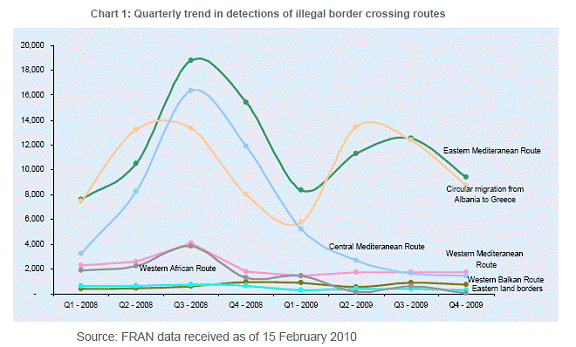
“Detections of illegal border crossing – In 2009, the [EU] Member States and Schengen Associated Countries reported a total of 106,200 detections of illegal border crossings at the sea and land borders of the EU. This represented a 33% decrease compared to 2008. The decrease is comprised of both a strong decrease reported from the sea borders (-23%), and land borders (-43%).”

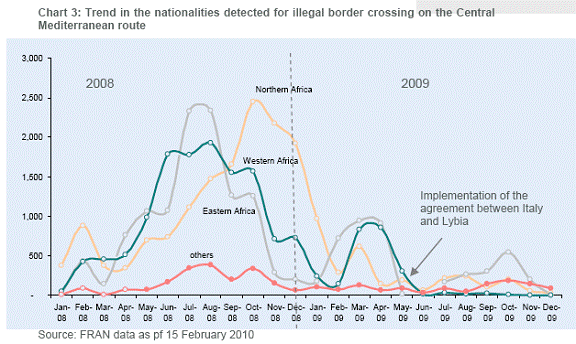
“The bilateral collaboration agreements with third countries of departure on the Central Mediterranean route (Italy with Libya) and the Western African route (which Spain signed with Senegal and Mauritania) had an impact on reducing departures of illegal migrants from Africa.”

“The agreements were made at a time when the economic crisis decreased the labour demand in the EU, thus simultaneously reducing the pull factor. The synchronisation of these events probably explains why no displacement has so far been noticed from the Central Mediterranean and Western African routes to other illegal migration routes in the statistics for detections.”

“However, intelligence suggests that the risk of displacement remains high, either with the emergence of new routes or the exploitation of existing ones by nationalities which used to be detected along the Central Mediterranean or the Western African routes.”

“As a corollary to the sharp decreases registered in Italy and Spain, the number of detections of illegal border crossing in Greece rose from 50% of the total EU detections to 75% of the total. In 2009, the Greek land border sections with Albania and FYROM represented the largest share of the EU total, with 36,600 detections (34% of the EU total), followed by 22,000 detections in the Aegean Sea with (21% of the EU total).”

“Eastern Mediterranean route – The Eastern Mediterranean route is the route taken by illegal migrants transiting through Turkey and entering the EU through eastern Greece, southern Bulgaria or Cyprus. Turkey, due to its geographical position near the EU, is the main nexus point on this route. From Istanbul, illegal migrants may reach the Greek islands in the Aegean Sea, or cross the land borders to Greece or to Bulgaria.”

“In 2009, illegal border crossing on the Eastern Mediterranean route totalled 41,500, or 39% of all EU detections. Most of the detections were reported from the Aegean Sea, followed by detections along the land border between Turkey and Greece. The number of detections reported by Bulgaria and Cyprus were considerably lower.”

“Central Mediterranean route – The Central Mediterranean route refers to illegal migration from northern Africa to Italy and to Malta. For the past two years, Libya has been a nexus point where migrants from the Horn of Africa and Western African routes and a small proportion of Asian nationals met before embarking.”

“Since the signing of a bilateral agreement with Libya, joint patrols by Libya and Italy have had a clear and measurable deterrent effect, with 3,200 detections in the seven months after the joint patrols (June to December), compared to 7,200 detections in the five months before the joint patrols (January to May), and almost 40,000 detections in the whole of 2008.”

“Western African route – The Western African route is primarily through Western African countries to Spain via the Canary Islands. The main embarkation points are in Senegal and Mauritania and the main countries of origin are Mali, Mauritania, Guinea Conakry and Senegal. Other African nationals have also been reported, and occasionally migrants from Asia. This route is now less favoured since the Spanish collaboration agreements with Senegal and Mauritania. The Frontex coordinated Joint Operation Hera plays a major role in maintaining effective surveillance in the area.”

“The Western Mediterranean route includes the sea route from Northern Africa to the Iberian Peninsula, and the land route through Ceuta and Melilla. It is mostly used by Northern African nationals (Algerian and Moroccan) travelling to Spain, France and Italy.”

“Maritime detections between Northern Africa and Spain are rising, with increasing detections of Algerian and to a lesser extent Sub Saharan nationals. Moroccan nationals are also regularly detected on this route. The lack of employment opportunities for the growing population of young people in Morocco continues to increase the incentives of migrating to the EU. The Spanish authorities recently reported an increasing number of attempts by Moroccan minors to get on the ferry link between Tanger and Spain. These cases do not seem connected with criminal networks; rather individual attempts are driven by poor employment prospects in Morocco.”

Click here for the ARA.

Click here for link to Frontex Map showing situation at External Borders.

[ARA page 18]

[ARA page 13]

1 Comment

Filed under Aegean Sea, Data / Stats, Eastern Atlantic, European Union, Frontex, Greece, Italy, Libya, Malta, Mauritania, Mediterranean, Morocco, Reports, Senegal, Spain, Turkey

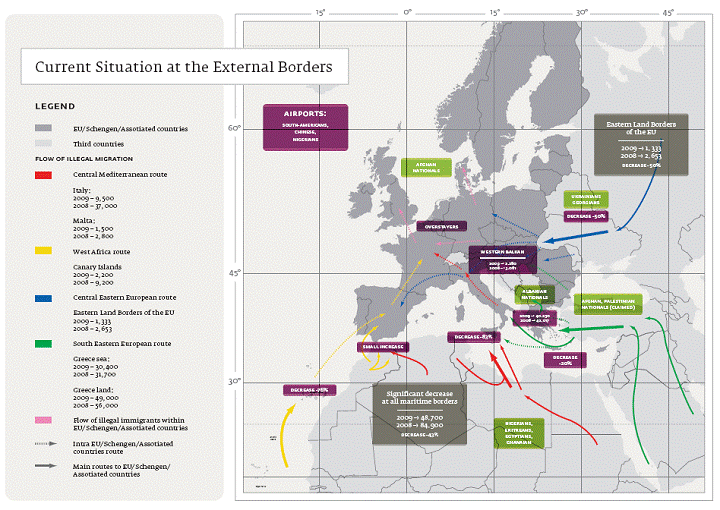
Frontex Map: 2009 Situation at External Borders

Frontex posted this map to its web site earlier this week.  The map “describes the … situation [as of the end of 2009] at the external borders of the EU, including the main entry routes of irregular migration into the European Union: West African route, via Canary islands, Central Mediterranean, including Italy and Malta, South Eastern European route (including Greek land and sea borders) as well as the Eastern land borders.”

Click here for link to the map.

1 Comment

Filed under Data / Stats, European Union, Frontex, News

Italy and Malta Question Need for Frontex Sea Patrols

Italy and Malta held a one day summit yesterday that focused on “Strategic Mediterranean” themes.  The two countries are calling for a reassessment of Frontex’s role in the Mediterranean, suggesting that Frontex may be best suited for repatriation operations and not for sea patrols.  Maltese Foreign Minister Tonio Borg said that even Italy questioned the need for ongoing Frontex missions fearing that such missions might upset the Italy-Libya migration agreement which has almost eliminated irregular migration from Libya.  A statement issued by the Italian Foreign Ministry described the Italy-Libya migration agreement as a model that is “exemplary for extension to other African countries.”

Malta also reaffirmed that it would not reconsider its decision not to host Frontex missions unless the Frontex rule addressing where intercepted migrants are to be taken is changed.

Click here and here for articles.

Click here for Italian Foreign Ministry statement.

1 Comment

Filed under Frontex, Italy, Libya, Malta, Mediterranean, News

EP Refers Frontex Sea Borders Rule to ECJ

On 23 June the JURI committee (Committee on Legal Affairs) voted in camera to refer the question of the validity of the Frontex rule regarding the surveillance of the sea external borders to the European Court of Justice (Council Decision 2010/252/EU (“Frontex / Sea borders”)).  The referral requests the Court “to preserve the effects of the measure until a new legislative act has been adopted.”

Maltese MEP Simon Busuttil, the EPP Coordinator in the Civil Liberties Committee, was quoted as saying: “we have given notice to the Commission that not all is fine with these Frontex guidelines and it is time for a rethink. We want to ensure that Parliament’s role is defended and that we can have our say. We want these rules to be fair. In their current version they are not.”

Both the LIBE and JURI committees believe that the European Commission exceeded its power when it presented the new Frontex rule under the comitology procedure as opposed to using the ordinary legislative procedure which would have given the Parliament the ability to amend the rule.  Malta has strongly objected to provisions within the rule.  Malta has said that its decision not to host Frontex’s Central Mediterranean enforcement operation this year, Operation Chronos, was due to the disembarkation provisions contained in the new Frontex rule.  Malta believes that the rule would require intercepted migrants to be taken to Malta.

Click here for article.

Click here for statement on MEP Simon Busuttil’s web site.

Click here for EPP Group press release.

Click here and here for earlier posts.

4 Comments

Filed under European Union, Frontex, Judicial, Malta, Mediterranean, News

Frontex: Collaboration With African Countries Contributed to Reduction in Irregular Migrants in 2009

Speaking at a press conference in Athens earlier this week, Gil Arias Fernandez, Frontex’s deputy executive director, credited the global recession as the key factor in 2009 for the reduced numbers of migrants seeking to enter the EU.  He also credited “good collaboration from the African countries where immigrants usually depart[,]” referring to measures taken by Libya, Mauritania and Senegal to prevent migrants from leaving the countries.

Click here and here for articles.

Click here and here for earlier posts on Frontex’s 2009 General Report.

Leave a comment

Filed under Data / Stats, European Union, Frontex, Libya, Mauritania, News, Senegal, Statements

Frontex’s 5th Anniversary

Yesterday, 25 May, marked Frontex’s fifth anniversary.  Frontex marked the occasion by holding a conference, European Day for Border Guards, “publicising the work of 400,000 border guards in Europe [and] providing a forum for discussion and the exchange of best practices.”

Here is an interesting and thoughtful post on the Frontex anniversary by Professor J. Peter Burgess:

“… FRONTEX is quickly and quietly evolving into a kind of moral testing ground for Europe. It is here that the airy principles of European construction meet the pavement, where decisions are made about the role of rights and responsibilities in the management of Europe’s most dilemma-ridden challenge: the management of its external borders.  Border control is the operational theater where Europe meets its others: other worlds, other human beings, other values. It is here where the aspirations of those who long to embrace Europe, to be European, live under the protection of Europe’s social and economic well-being are confronted with European ideals of tolerance and universal rights. It’s also the place where Europe meets its ‘other’ other: trafficking, smuggling and other forms of cross-border criminality. The coherence with which Europe manages its others in both these forms is one measure of the success of the European project.….”

Click here for the full post.

Leave a comment

Filed under Analysis, European Union, Frontex, News

Spain and Senegal Renew Agreement Permitting Frontex to Operate From Dakar

Spain and Senegal have renewed a bi-lateral agreement permitting Frontex to operate from a base in Dakar for another year.

The Frontex mission in Senegal currently consists of two Spanish Guardia Civil patrol boats, a Spanish National Police helicopter, and a private airplane leased by the Spanish Defence Ministry.  One Frontex patrol boat also operates from Nuadibú, Mauritania.

Spanish Interior Minister Alfredo Pérez Rubalcaba said that France and Italy will soon be deploying additional assets and personnel to the Frontex mission in Senegal consisting of a ship and plane from Italy and a French security force team.  Rubalcaba stated that this new assistance demonstrates that “Spain is not alone” in the fight against the mafias responsible for the illegal boat arrivals to the coast this country. (“España no está sola” en la lucha contra las mafias responsables de las llegadas de embarcaciones irregulares a las costas de este país.)

Senegalese Interior Minister Ousmane Ngom, said that so far this year a total of 101 canoes from the coast of Senegal with 450 people aboard have been identified by the patrols. In 2006, the figures were 901 boats, with 35,490 irregular migrants.

Click here for article.  (ES)

1 Comment

Filed under Data / Stats, Eastern Atlantic, France, Frontex, Italy, Mauritania, News, Senegal, Spain

CSDP and Maritime Surveillance

The May edition of the ISIS European Security Review contains an article reviewing the Spanish EU Presidency and the Common Security and Defence Policy (CSDP, formerly ESDP).  The article notes that a main priority of the Spanish Presidency has been an “Integrated Maritime Surveillance.” “[T]he Spanish Government has clearly followed the Swedish Presidency in many areas, especially in the creation of an Integrated Maritime Surveillance, probably the most notable accomplishment of this EU Presidency on defence policy. *** The attention paid by Spain to naval protection is not something new: Spanish interest in increasing patrolling across Europe’s coastlines has been proven during the last decade, especially through its support to FRONTEX assistance in the Mediterranean Sea and the Canary Islands. Beyond that, the project of a common management of external borders has resulted in a need for protection of European interests away from the official maritime borders, moving also to trade routes where the EU economic interest is at stake.”

Click here for the ISIS May 2010 Newsletter.

Leave a comment

Filed under Eastern Atlantic, European Union, Frontex, Mediterranean, News, Spain