Category Archives: EU and EU Organizations

DIIS Policy Brief: Europe Fighting Irregular Migration – Consequences of European non-entry policies for West African Mobility

A new Policy Brief from DIIS by Nauja Kleist, “Europe Fighting Irregular Migration – Consequences of European non-entry policies for West African Mobility.”

Abstract: “In collaboration with African countries, the EU is fighting irregular migration to Europe through border control and deportations. However, rather than halting irregular migration, such policies reconfigure mobility flows and make migration routes more dangerous and difficult. The phenomenon of migrants and asylum-seekers crossing the Mediterranean in boats to reach Europe is just one example of this phenomenon.

In this DIIS Policy Brief, Nauja Kleist explores the consequences of EU migration policies and the fight against irregular migration, focusing on West African migration. The overall policy tendency is a differentiation of African migration flows, making mobility easier for educated and privileged groups and more difficult and dangerous for the large majority of migrants. Likewise there is a tendency to conflate migration within Africa – by far the largest and most important aspect of West African migration – with migration towards Europe.

Examining some of the main routes and migration systems between West and North Africa, the brief recommends to ensure evidence-based and context-sensitive migration polices, to carefully consider the human and politics costs of externalizing border control, and to ensure further access to legal and safe migration.”

Click here for full document.

1 Comment

Filed under Analysis, Eastern Atlantic, ECOWAS, European Union, Frontex, Mauritania, Mediterranean, Morocco, Reports, Senegal, Spain

Frontex Quarterly Reports for 2011 Q1 and Q2

The Frontex Risk Analysis Unit (RAU) released its 2nd Quarter Report (April-June) for 2011 on 4 October.  The 1st Quarter Report (Jan-March 2011) was released on 21 July.  As always, while the information is a few months old, the reports contain a significant amount of information, graphs, and statistical tables regarding detections of illegal border crossings, irregular migration routes, detections of facilitators, detections of illegal stays, refusals of entry, asylum claims, and more.

Here are extensive excerpts from the Q2 Report:

“Executive summary

In Q2 2011, all Frontex irregular-migration indicators increased compared to the previous quarter. The most important indicator, detections of illegal border-crossing, increased to a level not seen since Q3 2008 and correspondingly asylum applications are now at nearly the highest level since data collection began. What’s more, migration pressure at the border from migrants attempting to enter and stay in the EU increased even more than EU-level figures suggest, as they are offset against extensive reductions in Albanian circular migration.

In 2011 there were major and extensive developments in irregular-migration pressure at the external border of the EU, resulting from two simultaneous but independent hotspots of illegal border-crossings: the first was seasonally increased activity at the Greek land border with Turkey, where a wide variety of migrants continued to be detected at very high levels. The second, and the undeniable hotspot for illegal border-crossing into the EU in Q2 2011, was in the Central Mediterranean, where vast numbers of sub-Saharan migrants landed in Italy and Malta mostly having been forcibly expelled from Libya. [***]

4. Main points Q2 2011

  • All irregular migration indicators increased relative to the previous quarter
  • Compared to a year ago, there were significant EU-level increases in several irregular migration indicators, such as detections of illegal border-crossing, clandestine entries, and refusals of entry. There were also increased asylum applications
  • Despite detections of Afghan migrants falling by a third compared to last year, they were still the most common nationality detected illegally crossing the EU external border. Most were previously resident as refugees in Iran
  • In contrast, detections of all the other highly-ranked nationalities (Tunisians, Nigerians, Pakistanis, Ghanaians) increased massively relative to the same period last year
  • In total there were over 40 000 detections of illegal border-crossings, a 50% increase compared to Q2 2010. These were the result of two simultaneous but independent routes of irregular migration: the Eastern Mediterranean and the Central Mediterranean routes:

1. In the Eastern Mediterranean:

– There were over 11 000 detections of illegal border-crossing, almost exclusively at the Greek land border with Turkey, which is comparable with the same period in 2010

– This flow currently attracts migrants from north Africa, sub-Saharan Africa and Asia

– Groups of Dominicans were detected travelling to Turkey to enter the EU via the Greek land border

– Secondary movements are assumed from detections of (i) illegal border-crossings in the Western Balkans, (ii) false documents on flights to major EU airports from Turkey as well as Greece, and (iii) landings in southern Italy from Greece, Turkey and Albania

2. In the Central Mediterranean:

– Following a bilateral return-agreement between Italy and Tunisia, the massive influx of Tunisians to Lampedusa reported in the previous quarter decreased, but remained significant

– A very wide range of sub-Saharan Africans were detected on this route, some having been forcibly departed from Libya

– Italy reported more detections of illegal border-crossing in Sicily than ever before, a three-fold increase compared to the previous quarter; the increased flow was composed of migrants from Côte d’Ivoire as well as Tunisia and a range of other nationalities

– There were also increased detections of Egyptian migrants and facilitators landing in Sicily and Southern Italy from Egypt

– Italy and Malta reported huge increases in the number of asylum applications submitted by sub-Saharan African migrants. In Italy increases were particularly marked for Nigerians and Ghanaians

  • Following their new visa-free status, fewer Albanians were detected illegally crossing the EU border, and illegally staying within the EU (both mainly in Greece). Instead they were increasingly refused entry to Greece and they were also increasingly detected at the UK border, either as clandestine entry or using false documents
  • There was an increased flow of Georgian migrants towards Belarus (air and land), with increased illegal entries and asylum applications in Poland and Lithuania
  • In Q2, Libya was the most significant source of irregular migration to the EU. However, more recently the ability of the Gaddafi regime to forcibly expel its migrant population to the EU has become compromised; the situation remains dynamic and uncertain[.]

4.1 Detections of illegal border-crossing

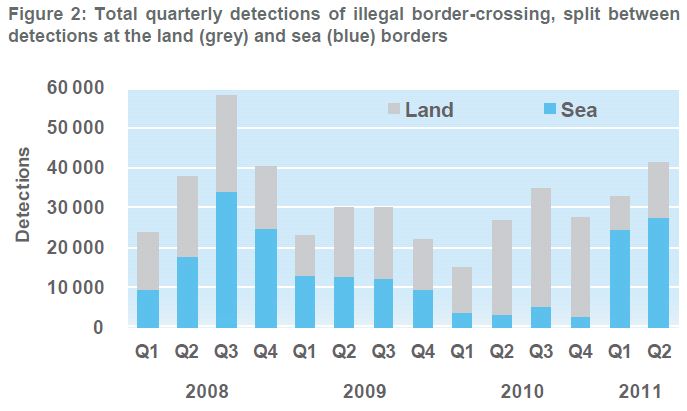
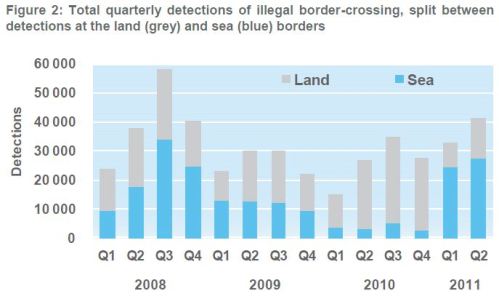
At the EU level, in Q2 2011 there were more detections of illegal border-crossing since Q3 2008. The total of 41 245 detections during this reporting period is a 25% increase compared the previous quarter and a 53% increase compared to the same period last year (Fig. 2). Without question there were major and extensive developments in illegal migration pressure at the external border of the EU, resulting from two simultaneous but independent hotspots of illegal border-crossings. The first was increased activity at the Greek land border with Turkey, where a range of Asian, north African and sub-Saharan African migrants were increasingly detected at very high levels. The second, and the undisputed hotspot for illegal border-crossing into the EU in Q2 2011, was at the Italian islands in the Central Mediterranean, where vast numbers of Tunisians, Nigerians and other sub-Saharan migrants landed in small sea vessels, the majority of which in Q2 had been forcibly departed from Libya.

Figure 2 shows the evolution of the FRAN indicator 1A – detections of illegal border-crossing, and the proportion of detections between the land and sea borders of the EU per quarter since the beginning of 2008. In Q2 2011 there were more detections of illegal border-crossing since the peak of Q3 2008 nearly three years ago. Compared to a year ago, detections at the EU land border decreased by 42% to 13 742 in Q2 2011, almost exclusively due to fewer detections of Albanian nationals following their new visa-free status; elsewhere at the land border (including Greece) trends were roughly stable. In contrast, at the sea border detections increased nine-fold to some 27 500 detections (Fig. 2), the vast majority of which (95%) were in the central Mediterranean, forming the major development in irregular migration to the EU in 2011.
[***]

At the EU level, detections of illegal border-crossing increased by 53% compared to a year ago (Fig. 3). However, this level masks a lot of variation among Member States. First, and most importantly to the current situation, was a 4 200% increase in detections of almost exclusively African migrants in Italy. Related to this central Mediterranean flow, was a concurrent and massive increase in detections reported from Malta (from 0 to 710), and also increases further west into Spain (+61%). As a result, all these countries have seen increases in other indicators such as asylum applications of the most common nationalities (see relevant sections). [***]

Routes

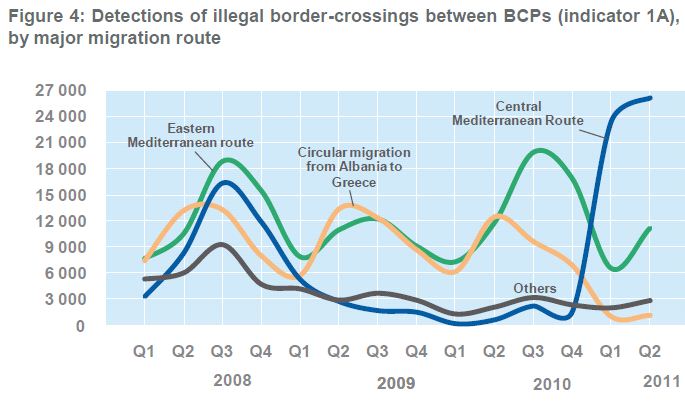
As illustrated in Figure 4, for just the second time since records began in early 2008, in Q2 2011 detections of illegal border-crossings on the Central Mediterranean route, which comprises the blue borders of Italy and Malta, exceeded those reported from both the (i) Eastern Mediterranean route of the land and sea borders of Greece, Bulgaria and Cyprus, and (ii) circular migration from Albania to Greece.
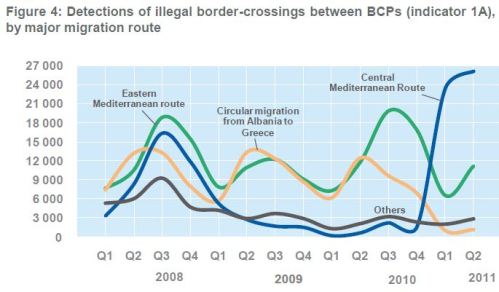
Without question, in Q2 2011 the single most important irregular-immigration route in terms of detections of illegal border-crossing was the Central Mediterranean route, where detections increased in the beginning of 2011 to previously unprecedented levels (Fig. 4). In the first quarter of 2011, and uniquely compared to previous surges of illegal immigration, this flow was restricted to a single nationality – Tunisian, most of whom were responding to civil unrest in their home country by leaving towards the Italian Island of Lampedusa. In response to this almost unmanageable influx of irregular migration at a single and isolated location, a bilateral return agreement was signed between Italy and Tunisia, which allowed for the accelerated repatriation of newly arrived individuals. Hence, during the current reporting period, the flow of Tunisian migrants fell from over 20 200 in the previous quarter to 4 300 in Q2 2011.

However, civil uprising commonly referred to as the Arab Spring, and its effects on migration in the area, was not limited to Tunisia. For example according to multiple sources, in next-door Libya, migrants from sub-Saharan countries were in Q2 2011 being coerced to move towards the EU by the Gaddafi regime in response to the NATO Operation Unified Protector which commenced on March 27 under United Nations Security Council Resolution 1973. Thus, in Q2 2011, besides some continued departures from Tunisia, the flow in the central Mediterranean was composed of a single flow of large numbers migrants from sub-Saharan countries departing Libya in small vessels. [***]

4.1.1 Eastern Mediterranean route

Detections of illegal border-crossings on this route increased seasonally and in line with previous years, from 6 504 in Q1 2011 to 11 137 in Q2 2011, almost exclusively due to a massive increase in detections at the Greek land border with Turkey, where detections increased from 6 057 to 10 582. [***]

4.1.2 Central Mediterranean route

In Q2 2011 there were 26 167 detections of illegal border-crossings on the Central Mediterranean route, a 10% increase even compared to the ‘peak’ reported during the previous quarter, and evidently a massive increase compared to the negligible detections throughout all of 2010. The vast majority of detections on this route were reported from Italy (25 500) where detections increased by 13% even compared to the ‘influx’ of migrants reported during Q1 2011. In Italy, Central African, Tunisian, Nigerian and Ghanaian were the mostly commonly detected nationalities, 90% of which were detected in the Pelagic Islands (14 300), most notably Lampedusa (Fig. 7). However, in Q2 2011 there were also more detections of illegal border-crossing reported from Sicily (2 260) than ever before; this figure is nearly three times bigger than that reported in the previous quarter and more than twenty times higher than during the same period last year (100). Compared to the previous quarter, in Sicily there were more detections of migrants from a very wide range of countries such as Egypt, Côte d’Ivoire and Tunisia. There were also over 710 detections reported from Malta, which is a sustained peak from the previous quarter (820) and extremely high compared to the negligible detections throughout 2010. In Malta there were much fewer detections of Somalis and Eritreans but there were increased detections of Nigerians and migrants from Côte d’Ivoire. However, migrants from Tunisia, Algeria and Egypt often claim to originate from sub-Saharan Africa in an attempt to appear as refugees, a fact which may render such comparisons of nationalities somewhat misleading.

In the previous FRAN Quarterly (Q1 2011) it was reported a surge of irregular immigration (20 000 detections) on the Central Mediterranean route that was almost entirely restricted to a single nationality: Tunisian (Fig. 8). As a result of this influx, on 20 February the JO EPN-Hermes Extension 2011 commenced in the central Mediterranean, and a bilateral agreement was reached between Italy and Tunisia on 5 April 2011, which resulted in the strengthening of police surveillance along the Tunisian coast and regular repatriations of Tunisian nationals from Italy. For example, according to data collected under JO Hermes 2011, some 1 696 Tunisians were repatriated between 5 April and 23 August 2011. The repatriation agreement is probably an effective deterrent, combining as it does, returns and surveillance, however some migrants have reported their boats being spotted by military patrols that did not take any action. According to the FRAN data, in Q2 2011 some 4 286 Tunisian migrants were still detected illegally crossing the border into Italy. Although a massive reduction, this still represents a very large and significant flow of irregular migrants into the EU.

In comparison to the reduction in flow from Tunisia, in Q2 2011 there was a large increase in migrants who had departed from Libya (Fig. 9). The migrants departing from Libya were mostly nationals from countries in the Horn of Africa, the sub-Saharan and Central African regions and, to a lesser extent, Asia. According to intelligence collected during JO EPN-Hermes Extension 2011, most of these migrants had already been in Libya for over a year, originally heading to Tripoli via the traditional routes for sub-Saharan and Central African migrants. In Q2 2011, migrants tended to reach Italy on large fishing vessels that had departed directly from Tripoli or the nearby ports of Medina and Janzour. Most of these deported African nationals did not want to leave the country as their standard of living in Libya was high compared to their home countries. Several even stated that they would choose to return to Libya after the war. In Q2 2011 reports suggest that some migrants were instructed to reach embarkation areas on their own but had been caught by the military or police and then detained in camps or disused barracks until they were transported to embarkation areas and onto vessels bound for Italy. In each case the migrants were searched by the military before boarding and all their belongings were confiscated. According to reports, nationals of the sub-Saharan and Central African regions as well as from Horn of African countries have been recruited by the Libyan army/police to manage their compatriot migrants at gathering places or camps. In some cases the destination of vessels from Libya was Sicily, where the flow was characterised by waves of landings. For example there were around 11 landings on 13 May and 7 between 11 and 29 June, with the majority of boats arriving from Libya and Egypt. [***]

4.1.3 Western Mediterranean route

In Q1 2011 there were 1 569 detections of illegal border-crossings on this route to Southern Spain, which is nearly double compared to the previous quarter (890), and more than a 50% increase compared to a year ago (973). Some of this increase is due to better weather conditions at this time of year, but irregular migration pressure on this route is clearly higher than it was at the same time last year. [***]

In the longer-term, irregular immigration to southern Spain has been consistently decreasing since the beginning of 2006. Commonly cited reasons are Frontex Joint Operations in the area, effective bilateral agreements and more recently rising unemployment in Spain, particularly in sectors typified by migrants.* Nationalities traditionally associated with this route were Algerian, Moroccan and Ghanaian. [***]

4.1.4 Western African route

The cooperation and bilateral agreements between Spain and the rest of the Western African countries (Mauritania, Senegal and Mali) are developing steadily. They are one of the main reasons for the decrease in arrivals on this route over the last year, as are the presence of patrolling assets near the African coast. In Q4 2010 Frontex reported a slight increase in the number of detections of illegal border-crossing at the Canary Islands, from a maximum of 50 during each of the previous 4 quarters, to 113 in Q4 2010. This increased level of detections persisted into the first quarter of this year (154), exclusively due to Moroccan nationals (152) displaced after the dismantling of migrant camps near the dispute Western Saharan region. However, during the current reporting period detections on this route decreased massively to a negligible 24 detections. [***]”

Click here for 2011 Q2 Report.

Click here for Frontex Statement regarding 2011 Q2 Report.

Click here for 2011 Q1 Report.

Click here for Frontex Statement regarding 2011 Q1 Report.

3 Comments

Filed under Aegean Sea, Algeria, Analysis, Cyprus, Data / Stats, Eastern Atlantic, Egypt, European Union, Frontex, General, Greece, Italy, Libya, Malta, Mauritania, Mediterranean, Morocco, News, Reports, Senegal, Spain, Tunisia, Turkey

Call for Support: Boats 4 People Project

From Migreurop:  “… thousands of migrants died in the Mediterranean this Summer in their attempts to reach Europe. Boats wandered adrift and shipwrecks took place in front of Coast Guard ships, surveillance patrols of Frontex and ships from the military coalition engaged operations in Libya under NATO command.  For the last several years, African and European organisations alike have been challenging governments about the number of deaths occurring at the borders of the European Union, but in vain. We have come to the conclusion that it is essential now to move to direct action in the light of the excessive number of shipwrecks taking place in the Mediterranean and the reluctance of Europe to concede entry to refugees. We call for a Mediterranean which is in solidarity with migrants and in opposition to repressive policies which seek to criminalise migration towards Europe more and more each day.

What are the concrete aims of the Boats 4 People initiative ?

  • To denounce the tragedy which is taking place in the Strait of Sicily
  • To exercise our right of access to the maritime regions in which these shipwrecks are taking place and to the centres in which migrants arriving in Italy are detained
  • To raise awareness about the requirements of the law of the sea in terms of assistance and to support citizens and sailors who rescue migrants and are criminalized.
  • To accuse state actors working at sea (border guards, Frontex, NATO) who are guilty of failing to assist migrants in difficulties and of refouling asylum seekers, against the provisions of the UN Convention on the Law of the Sea and the Geneva Convention
  • To strengthen Euro-African solidarity with regard to migration and the defence of migrant rights

Trip and organization of the project – The boats will leave for Spring 2012 from Rome, from where they will travel towards the south of Tunisia via Sicily, Malta, Lampedusa, Tunis, Sfax and Ben Guardane.  At the moment, we aim to use one or several motor/sail boats with a total capacity of around fifty passengers, including the crews. If you have one – or several ! – boats and would like to follow the flotilla for all or part of the journey, please contact the organisers.  The aim of the flotilla is to exert maximum pressure on the European authorities by carrying people likely to raise awareness of the situation in the Strait of Sicily and to denounce it to the greatest possible number of people. We also aim to allow the greatest number of people possible to participate by rotating passengers at each stop. If you are a Member of Parliament, journalist or artist and you wish to participate in a stage of the journey, please send your details to coord@boats4people.org. …”

Click here for full posting.

Leave a comment

Filed under European Union, Italy, Libya, Malta, Mediterranean, Statements, Tunisia

DIIS Seminar: “The Lesser Evil”? Policy Logics and Practices of Removal and Detention in the Euro-Mediterranean Area (Copenhagen, 6 Oct)

The Danish Institute for International Studies (DIIS) will hold a seminar (English) in Copenhagen on 6 October 2011, 14.00-17.00.  Advance registration is required.  Registration deadline is Wednesday, 5 October 2011 at 12.00 noon.  Click here for more information.

From the DIIS announcement:  “The arrival of more than 45,000 African boat migrants and asylum seekers in Italy this year has caused much public and political attention in Europe. One response is to call for increased sea patrols to prevent irregular crossings of the Mediterranean Sea. Another response is detention, deportation and forced removal of irregular migrants and rejected asylum seekers who have reached Europe. Such practices are already important objectives in European migration management and policies but are likely to become even more significant in coming negotiations with North African migrant sending and transit countries.

This seminar examines practices of deportation, readmission and detention from a policy and migrant perspective. It will address the following questions: What are the policy logics and readmission agreements in the Euro-Mediterranean area? How is detention and deportation of irregular migrants carried out? And how do deported migrants deal with their situation?”

Click here for more information.

Leave a comment

Filed under Colloques / Conferences, European Union, Mediterranean

Articles: European Journal of Int’l Law and Goettingen Journal of Int’l Law

Fighting Maritime Piracy under the European Convention on Human Rights, European Journal of International Law, Volume 22, Issue 3, by Stefano Piedimonte Bodini, Head of Division at the Programme and Budget Department of the Council of Europe (author’s opinions are strictly personal).  (subscription required)

Abstract: “On the basis of real examples of anti-piracy operations conducted in the Indian Ocean by European navies, the article examines the legal implications of such military actions and their judicial medium- and long-term consequences in the framework of the European Convention on Human Rights. The only existing authority directly addressing maritime piracy, although from the sole perspective of state jurisdiction, is the recent Grand Chamber judgment in Medvedyev and Others v. France. The Court’s approach and conclusions in Medvedyev will be analysed in section 2. Section 3 will explore other important issues likely to be raised under the Convention by anti-piracy operations. Section 4 will consider the question of state responsibility, i.e., jurisdiction and attribution, in the context of anti-piracy operations carried out on the high seas or on the territory of third states.”

Refugees on the High Seas: International Refugee Law Solutions to a Law of the Sea Problem,” Goettingen Journal of International Law, by Killian S. O’Brien. (open access)

Abstract: “Following in the aftermath of the Arab Spring, Europe’s southern marine borders have been the showplace of human tragedies previously unseen on this scale and the issue of refugees on the high seas has assumed a newfound importance. This article examines the flawed system provided by the ‘Constitution of the Oceans’, the UN Convention on the Law of the Sea for the protection of the lives of migrants at sea. It submits that international refugee law is well-equipped to assume a greater responsibility in ensuring the protection of those involved. Although the concept of non-refoulement cannot be stretched ad absurdum, it may still be reasonably interpreted as providing a temporary right to disembark for the purpose of processing possible asylum applications. In the long-term, a system of burden-sharing and permanent, yet flexible, reception agreements remain the only sustainable solution.”

Rights at the Frontier: Border Control and Human Rights Protection of Irregular International Migrants,” Goettingen Journal of International Law, by Julian M. Lehmann. (open access)

Abstract: “In light of recent events causing people’s movement into Europe, continued misuse of the term “migrant” in policy making and public discourse, and at the occasion of events celebrating the international regime of refugee protection, the human rights protection of irregular migrants is explored in relation to irregular migrants’ entry/admission and expulsion/deportation. The term “migrant” has, in contrast to the term “refugee”, no bearing on whether or not an international migrant has a need for international protection. While many irregular migrants have no such need, other migrants may be refugees or be in need of international protection “outside” the framework of the 1951 Convention relating to the Status of Refugees. The paper analyses the international human rights law framework applying to individuals with and without need for international protection, when their claims have a socio-economic dimension. The principle of non-refoulement remains the most important source of protection for irregular migrants; it is not concerned with the irregular status of a migrant and also has a bearing on procedural rights in status determination. Socio-economic motivations for flight are not a bar to being a refugee within the meaning of the 1951 Convention, if their underlying cause is persecution, or if motives are mixed. Refugee law can accommodate such claims and overcome a strict dichotomy but is currently only rarely and restrictively applied in this regard. In expulsion cases, virtually only the prohibition of torture, inhuman or degrading treatment is relevant. For individuals that have no need for international protection there are mitigating individual circumstances which a state has to take into account. All pertinent norms of international human rights law apply without distinction and irregular migrants may have, just as refugees may have, humanitarian needs that states should meet.”

Leave a comment

Filed under Analysis, European Court of Human Rights, European Union

EP Study on Implementation of EU Charter of Fundamental Rights and Impact on Frontex, Europol, and EASO

The European Parliament Policy Dept. C has released a study requested by the LIBE Committee entitled: “Implementation of the EU Charter of Fundamental Rights and its Impact on EU Home Affairs Agencies: Frontex, Europol and the European Asylum Support Office.”  The study is authored by Prof. Elspeth Guild, Dr. Sergio Carrera, Mr Leonhard den Hertog, and Ms Joanna Parkin.  The study will be presented in the 3 October 2011 LIBE meeting.

Abstract:  “This study sets out to examine the impact and implementation of the EU Charter of Fundamental Rights with respect to three EU Home Affairs agencies: Frontex, Europol and EASO. It assesses the relevance of the EU Charter when evaluating the mandates, legal competences and practices of these agencies, particularly in the fields of external border control and the management of migration.  After identifying specific fundamental rights guaranteed in the EU Charter that are potentially put at risk by the actions of these three agencies, and judicial obstacles that prevent individuals from obtaining effective legal remedies in cases of alleged fundamental rights violations, we present a set of policy recommendations for the European and national parliaments.”

Excerpts from the 100+ page study:

“KEY FINDINGS

  • EU home affairs agencies have confirmed themselves as distinct forms of EU regulatory agency. Their scope of action and tasks are not fully predetermined and defined in their founding regulations, at times allowing for the flexible accommodation, and sometimes extension, of their competences to new domains on an ad hoc basis. The three agencies have been granted important operational tasks that go beyond mere ‘regulatory activities’. Yet their dominant framing as depoliticised ‘coordinators’ or ‘facilitators’ of Member State actions has increased their relative autonomy, in some cases preventing a proper democratic scrutiny of the nature and impact of their activities and evading questions of accountability, responsibility and liability in cases of alleged unlawful actions, including potential fundamental rights breaches and risks. These observations are particularly pronounced in the cases of Frontex and Europol. It remains to be seen the extent to which the functioning and activities of EASO will follow a similar pattern.
  • Certain activities performed by Frontex, Europol and EASO as foreseen in their legal remits or developed through informal (de facto) practices present a sensitive relationship with specific fundamental rights provisions foreseen in the EU Charter. This is particularly relevant as regards three categories of actions common to each agency: 1) operational activities, 2) the exchange and processing of information and, in the case of Frontex and Europol, personal data (and the subsequent uses of this information) and 3) relations, cooperation (including so-called ‘capacity building’) and exchange of information with third countries through working arrangements and ‘soft law’. Inter-agency cooperation between Frontex, Europol and potentially in the future EASO, further magnifies the scope, and opens up new venues for, breaches of fundamental rights.
  • The relationship between Frontex, Europol (and to some extent) EASO and fundamental rights is further strained by their ‘home affairs focus’ and the legacy of cross-pillarisation which affects their policies, practices and political ambitions. A conflation of irregular migration with ‘insecurity’ and ‘threat’ legitimises the adoption of coercive policies which, together with a culture of secrecy and lack of transparency, exacerbates the vulnerable status of individuals targeted by the actions of these agencies.
  • There is a profound ‘knowledge gap’ concerning the added value, nature and impact of the activities by Frontex, Europol and EASO on the ground, as well as their full compatibility or coherency with EU internal and external policy priorities and legal frameworks. This report reveals a severe lack of information and monitoring of their actions, especially those of an ‘operational’ nature, which lead to legal uncertainties and accountability gaps that put the agencies at odds with the EU Charter and general rule-of-law principles of the European legal regime.
  • Finally, there is an anachronistic relationship between the overly-politicised nature of some of these EU home affairs agencies as a result of pressures applied by certain EU Member States and the European institutions to demonstrate the practical application of ‘the principle of solidarity’ and ‘mutual trust-based cooperation’ at EU level, and their weak democratic and public accountability. It is paradoxical that, despite the political drivers which steer the activities of EU Home Affairs agencies, their framing as ‘technical’ rather than political actors prevents a full and plural debate and accountability of their actions.

RECOMMENDATIONS

Recommendation 1: A new ‘model of agency-building’ should be ensured and mainstreamed across current and future EU Home Affairs agencies. The model should act as a ‘standard setter’ against which the European Parliament and national parliaments can evaluate and scrutinise the performance and functioning of agencies, while still respecting agencies’ specific characteristics. Given the dynamic evolution of EU Home Affairs agencies, the model could be taken into account if and when the legal mandates of the agencies are opened for re-negotiation. The components and features of this model should include:

  • A more direct involvement of the European Parliament in the appointment of agency Executive Directors by requiring a binding approval from the Parliament for selected candidates.
  • A stronger representation of the European Commission on the Management Boards of agencies (a minimum of 5 Commission representatives, increased weighting of their votes and the granting of veto rights for certain fundamental rights sensitive issues.)
  • Advisory boards or ‘consultative forums’ should be established in all EU Home Affairs agencies as an integral part of their governance structure.
  • Time limits on the confidential status of documents pertaining to agency activities, which oblige the automatic release of such documents to the public within a set time frame should be put in place to promote transparency and public accountability.
  • Institutional structures for individuals to access effective legal remedies in cases of fundamental rights violations should be revised and developed.
  • Codes of conduct and comprehensive training in fundamental rights for all staff involved in agency activities, particularly operational actions, should be streamlined across all Home Affairs agencies.
  • Mechanisms to strengthen compliance with fundamental rights obligations on the ground should be included in the legal mandates of EU Home Affairs agencies: fundamental rights strategies and implementation plans, an in-house fundamental rights officer and independent monitor responsible for initiating disciplinary measures in case of misconduct.
  • To support internal accountability an independent Board of Appeals could be established composed of independent lawyers. Any challenged actions should be frozen while under consideration by the Board of Appeals.
  • EU Home Affairs agencies should have the competence to suspend or terminate activities if violations of fundamental rights occur in the course of those activities.
  • Clear legal definitions should be provided for key concepts related to agency tasks; agency actions should not exceed their legal remits and competences.
  • Comprehensive provisions on data protection should be integral to the legal mandates of EU Home Affairs agencies accompanied by independent supervisory bodies empowered to issue binding opinions.

Recommendation 2: The Inter-Institutional Working Group (IIWG) charged with identifying rules to support a global framework for regulatory agencies should explicitly recognise the fundamental rights-related accountability gaps identified by this report in the activities of EU Home Affairs agencies and take these into account it its final declaration.

Recommendation 3: A closer democratic scrutiny of agencies functioning, planning and work should be ensured through the creation of a permanent inter-parliamentary body or committee dealing specifically with regulatory agencies. The body should be run by the European Parliament’s LIBE Committee and include representatives from the corresponding committees of national parliaments.

Recommendation 4: In order to improve access to justice and effective remedies for individuals regardless of their nationality and/or location, subject to actions by EU Home Affairs agencies, a new branch of the Court of Justice should be established – an Agencies Tribunal – following the same format as the EU Civil Service Tribunal. This body would deal with admissibility claims and complaints of a legal and administrative nature against the agencies and national authorities participating in agencies’ operations and activities.

Recommendation 5: the Commission should have the competence to freeze Agency activities in cases of actual, suspected or imminent breaches of fundamental rights, while the legality of the case is being examined in detail. For such an ex ante procedure to be fully effective, careful attention should be paid to ensuring its overall objectivity, impartiality and democratic accountability. The procedure would be activated by the European Commission (on its own initiative or that of the European Parliament) on the basis of evidence provided by impartial actors such as the EU Agency on Fundamental Rights (FRA) or a new external network of independent and interdisciplinary experts/academics working in close cooperation with civil society organisations based in the different member states.

Recommendation 6: A new piece of secondary law should be adopted specifying the access to rights and to justice by third country nationals subject to new border and migration controls (including those taking place ‘extraterritorially’). The tasks and competences of the EU Home Affairs agencies call for more legal certainty. Their remits and activities and allocation of responsibilities should be clearly defined in law. Any experimental governance activities should be avoided in order to ensure respect for the principles of legal certainty and accountability.

Recommendation 7: Particular attention should be paid to the practical implementation of EASO’s mandate, given the particularly sensitive nature of some of the agency’s tasks from a fundamental rights viewpoint. Guaranteeing the right to asylum envisaged in Article 18 of the EU Charter of Fundamental Rights should constitute an explicit priority for EASO and the agency’s work should be focused first and foremost around this objective.

Recommendation 8: The fundamental rights sensitivities of Europol’s work and safeguards should be taken into account when Europol’s mandate is re-opened for negotiation in 2013. DG Justice should play an active role during the preparation of the Commission’s proposal for a Europol Regulation to conduct a fundamental rights proofreading of the new legislation. Moreover, the European Parliament should ensure that the new ‘model of agency-building’ proposed in Recommendation 1 of this report would be mainstreamed to Europol to the largest extent.

Recommendation 9: The European Parliament should call upon Frontex to no longer conduct any joint operation in the maritime territory of third states, as the consistency of this practice is not only questionable with respect to the rule of law principles of legal certainty and accountability, but it is also at odds with fundamental rights foreseen in the EU Charter.”

Click here for Study.

1 Comment

Filed under Analysis, European Union, Frontex, Reports

HRW Report: Frontex Exposes Migrants to Abusive Conditions in Greece

Human Rights Watch yesterday issued a report entitled “The EU’s Dirty Hands: Frontex Involvement in Ill-Treatment of Migrant Detainees in Greece” which “assesses Frontex’s role in and responsibility for exposing migrants to inhuman and degrading detention conditions during four months beginning late in 2010 when its first rapid border intervention team (RABIT) was apprehending migrants and taking them to police stations and migrant detention centers in Greece’s Evros region. … ‘Frontex has become a partner in exposing migrants to treatment that it knows is absolutely prohibited under human rights law,’ said Bill Frelick, Refugee Program director at Human Rights Watch. ‘To end this complicity in inhuman treatment, the EU needs to tighten the rules for Frontex operations and make sure that Frontex is held to account if it breaks the rules in Greece or anywhere else.’ … ‘It’s a disturbing contradiction that at the same time that the European Court of Human Rights was categorically ruling that sending migrants to detention in Greece violated their fundamental rights, Frontex, an EU executive agency, and border guards from EU states were knowingly sending them there,’ Frelick said. … ‘As new migration crises emerge in the Mediterranean basin and as Frontex’s responsibilities expand, there is an urgent need to shift EU asylum and migration policy from enforcement-first to protection-first.’ Frelick said. ‘This is not only legally required, but the EU, its agencies, and member states can and should respect and meet the EU’s own standards.’”

As the HRW report notes, the humanitarian crisis on the Greece-Turkey land border was many years in the making, but among the contributing factors to the increased flow of migrants seeking to enter the EU at this location, which by November 2010 accounted for 90% of the detected illegal crossings at EU borders, were the enhanced migration control measures in the Central Mediterranean and West Africa, specifically the bi-lateral push-back practice being implemented at the time by Italy and Libya and Spain’s bi-lateral agreements with West African countries.  Increased sea patrols along Greece’s maritime borders also contributed to the shifting of the flow to the land border.

Frontex issued a statement (or click here) responding to the HRW report in which it welcomed the report and said it was “satisfied to note that its comments on the original draft were taken on board. The report now highlights an issue, which we agree, is of great importance. We would like to recall that Frontex fully respects and strives for promoting Fundamental Rights in its border control operations which, however, do not include organisation of, and responsibility for, detention on the territory of the Member States, which remains their exclusive remit. … Frontex was receiving signals of concern from national officers deployed to the region. The Agency has been extremely concerned with the conditions at the detention centres – a point which we raised on several occasions both with the Greek authorities and with the European Commission. Nevertheless, we continue to stress that at the practical level abandoning emergency support operations such as RABIT 2011 is neither responsible, nor does it do anything to help the situation of irregular migrants on the ground….”

Here is Cecilia Malmström’s comment from her blog on the HRW report (translated from Swedish by Google translate):

“I also had a long meeting [on 21 September] with Human Rights Watch who has published a highly critical report on the asylum system in Greece . They argue that the EU agency Frontex, by its presence legitimizes the poor conditions at the border of Greece. We are well aware of the totally unacceptable situation at the reception centres in Greece and I am very frustrated that the situation is so slow to improve, especially in Evros. But probably the situation would have been even worse if Frontex had not been in place. We continue to put pressure on Greece and the new regulatory framework for Frontex, which I have proposed and was adopted by Parliament last week to strengthen its work on human rights significantly. The report will also be discussed in the FRONTEX Agency board meeting next week.”   (“Jag hade också ett långt möte med Human Rights Watch som har publicerat en mycket kritisk rapport om asylsystemet i Grekland . De menar att EU-organet Frontex genom sin närvaro legitimerar de usla förhållandena vid gränsen i Grekland. Vi är väl medvetna om den helt oacceptabla situationen vid mottagningscentren i Grekland och jag är väldigt frustrerad över att det går så långsamt att förbättra situationen särskilt i Evros. Men troligen hade situationen varit ännu värre om inte Frontex hade varit på plats. Vi fortsätter att sätta press på Grekland och i det nya regelverk för Frontex som jag har föreslagit och som Europaparlamentet antog förra veckan stärks arbetet med mänskliga rättigheter väsentligt. Rapporten skall också diskuteras på Frontex styrelsemöte nästa vecka.”)

Excerpts from the HRW Report:

Key Recommendations

To the European Commission, the European Parliament and the European Council

  • Amend the Frontex Regulation to make explicit, and thereby reinforce, the obligation not to expose migrants and asylum seekers to inhuman and degrading detention conditions.
  • Amend proposed Frontex Regulation Art. 26a to empower the Fundamental Rights Officer to refer Frontex to the Commission for investigation and where appropriate infringement proceedings in the event that the Frontex executive director fails to suspend operations despite persistent and serious violations of the Charter and/or in the event that members states and their agents persistently violate the Charter during Frontex operations.

To Participating European States 

  • Suspend any participation in Frontex operations that fail to adhere to binding international human rights standards.
  • Instruct border guards deployed on Frontex missions on their obligations under international law. Ensure that border guards are trained and conversant regarding all rules and standards pertaining to the transfer and treatment of detainees.

To the Frontex Management Board

  • Suspend the deployment of EU border guards to Greece unless migrant detainees can be transferred to facilities elsewhere in Greece (or outside of Greece) that meet EU and international standards or until the conditions of detention in the Evros region where migrants are currently detained are improved and no longer violate European and international standards.
  • Intervene with Greek officials and monitor compliance to ensure that migrants apprehended by guest guards are transferred to detention facilities that comply with European and international standards.
  • Conduct thorough assessments of the risk that human rights violations may occur before engaging in joint operations or deploying RABIT forces.

To Greece

  • Implement the recently adopted asylum reform package as fully and as quickly as possible.
  • Ensure access to asylum procedures at the border and in the border region.
  • Reduce overcrowding by using alternative facilities and alternatives to detention as much as possible.
  • Immediately improve detention conditions, and immediately create open reception centers for asylum seekers and members of vulnerable groups, such as children.”

Click here for HRW Report.

Click here for HRW Press Release.

Click here or here for Frontex response.

Click here (EN) and here (EN) and here (FR) for articles.

Leave a comment

Filed under Aegean Sea, European Union, Frontex, Greece, News, Reports, Turkey

Eurostat: Asylum Statistics for Q1 2011

Eurostat has issued a statistical report regarding the number and makeup of asylum applicants in the 27 EU member states and Norway, Switzerland, and Lichtenstein for the First Quarter 2011.  The report documents the increased number of applications filed in Italy by Tunisians, but note that the report only addresses data through 31 March 2011.

Highlights include:

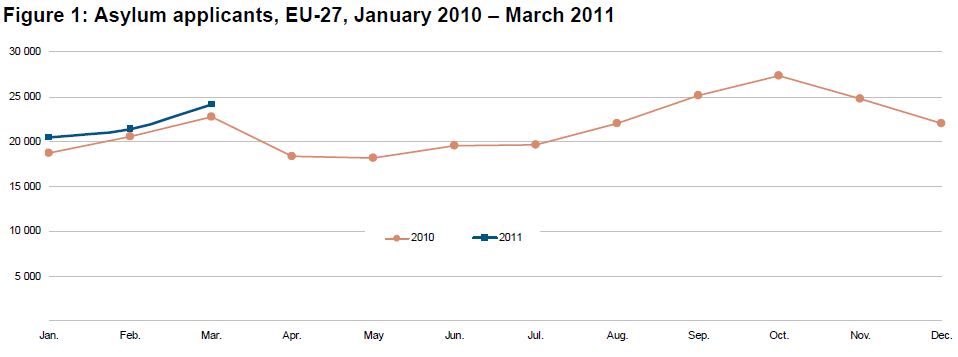
  • Nearly 66 000 persons sought asylum in one of the EU Member States during the first quarter of 2011, an increase of 4 000 compared with the same period of the previous year.
  • France and Germany remained the top destination countries of asylum applicants with 14 300 and 12 000 applicants respectively.  France and Germany received 40% of the total applications filed.
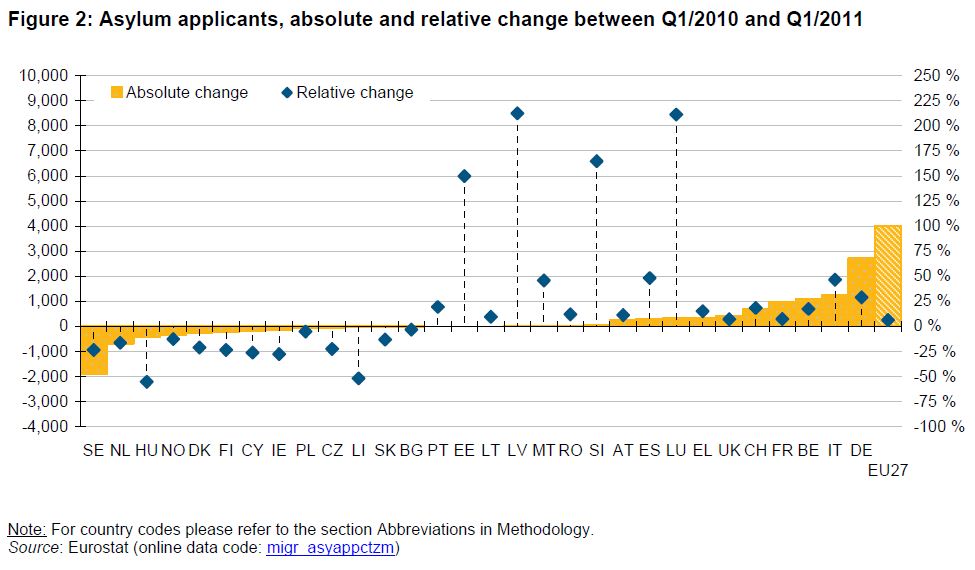
  • Germany (+ 2 700) and Italy (+1 300) recorded the highest increases in numbers of applicants in absolute terms compared to the first quarter of 2010, while Sweden (- 1 900) and the Netherlands (-700) recorded the largest falls.
  • In the first quarter of 2011, the main citizenships of people seeking asylum in the EU-27 were Afghans (5 800), followed by Russians (4 100) and Iraqis (3 800).
  • Tunisians (2 500) are now ranked eighth among the main countries of citizenship of asylum seekers.  90% of the Tunisian applications were made in Italy.
  • 55 600 first instance decisions on asylum applications were issued in the EU-27 during the first quarter of 2011. One out of four of such decisions was positive; in total 13 500 persons received some type of protection status, including refugee status (6 800 decisions), subsidiary protection (4 600 decisions) or authorisation to stay for humanitarian reasons (2 100 decisions).

Click here for Eurostat report.

\

Asylum applicants, absolute and relative change between Q1/2010 and Q1/2011

Asylum applicants, EU-27, January 2010 – March 2011

Leave a comment

Filed under Analysis, Data / Stats, European Union, General, News

AI: Refugees Forced Out of Libya Urgently Need Resettlement

Amnesty International released a briefing paper this morning describing the “totally inadequate response by EU states to refugees” who are stranded near Libya’s borders.  AI estimates that there are 5000 refugees currently living in limbo along the borders.

From the AI Press Release: “‘We have witnessed an abysmal response to the plight of displaced refugees on Europe’s doorstep,’ said Nicolas Beger, Director of Amnesty International’s European Institutions Office.  ‘This failure is particularly glaring given that some European countries, by participating in NATO operations in Libya, have been party to the very conflict that has been one of the main causes of the involuntary movement of people.  EU Home Affairs Ministers must urgently address the resettlement issue – they can start by putting it prominently on the agenda of the Justice & Home Affairs Council on 22 September.’… Australia, Canada and the USA have offered to resettle some of the refugees stranded at Libya’s borders.  But only eight European countries have offered to help, between them offering fewer than 700 slots. …”  “Amnesty International believes sub-Saharan Africans in Libya remain at high risk of abuse and arbitrary arrest by anti-Gaddafi forces and last week issued a major report calling on the [Libyan] NTC to do more to protect them from reprisal attacks.”

Click here for briefing paper.

Click here for press release.

Leave a comment

Filed under European Union, Libya, Mediterranean, Reports, Tunisia, UNHCR

PACE Rapporteur Conducts Interviews in Italy Regarding Mediterranean Migrant Deaths

Tineke Strik (Netherlands, SOC) concluded a two day fact-finding trip to Italy on 7 September as Rapporteur for the PACE Migration Committee.  She is investigating the deaths of boat people who have died in the Mediterranean since January 2011.  Strik interviewed Father Moses Zerai, an Eritrean priest, who was in satellite phone contact with several migrant boats during their voyages from Libya, including the disabled migrant boat that drifted for days in March-April this year and on which 61 persons are believed to have died.  In addition to Zerai, Strik interviewed three of the nine survivors from the boat, Italian Coastguard officials, and NGO and UNHCR staff.  Strik “is planning interviews with officials from Nato and the Maltese government, which the Italian coastguard says was alerted to the boat’s plight.”

From the PACE press statement: “‘There is an obligation to help all people in distress.  If anyone did not live up to this responsibility and deliberately did not assist them, they must not be allowed to get away with it. … The testimonies of witnesses directly involved in this incident are coherent, but we have to continue to collect more data and information on who was when and where in the area,’ Mrs Strik reported.  ‘My mission is to try to find out what went wrong, and if there was perhaps a gap in responsibility-sharing. The recommendation which will be contained in my report is aimed at establishing responsibilities and trying to determine how to deal with such incidents in the future. We have to draw the right lessons to prevent similar situations from occurring again.  … At the end of my inquiry, I expect national jurisdictions, governments and parliaments to carry on the investigations and I very much hope that the dynamic of truth … will pave the way,’ she concluded.”

Click here (EN), here (FR), and here (ES) for articles.

Click here for PACE press statement.

Click here for previous post.

2 Comments

Filed under Council of Europe, European Union, Frontex, Italy, Libya, Malta, Mediterranean, News, Tunisia, UNHCR

More Evidence that Gaddafi Government Facilitated Migrant Boat Departures from Libya

There has been evidence for many months that the Gaddafi regime was facilitating migrant boat departures from Libya towards Italy and Malta; here are two recent articles on the topic from the Los Angeles Times and the Telegraph.

LA Times: “… During its life as a military base, the impromptu camp [at Janzour / Zanzour] was heavily guarded, but in recent in months, several people from the area said, Kadafi’s government facilitated the entry of Africans hoping to migrate by boat to Europe. … The military base was run by a Kadafi operative named Zuhair, according to several people familiar with its operation. As rebels approached Tripoli, they said, Zuhair was seen taking off in a speedboat, accompanied by his top aide and two bodyguards. … [The base] is also the scene of one of Muammar Gaddafi’s most bizarre and cynical plans; an operation to flood Europe with black African illegal immigrants in revenge for Nato’s bombing campaign. For months until the uprising in Tripoli two weeks ago, men in uniform were seen around the port directing the loading of immigrants onto leaky boats bound for Italy. Africans who landed this summer on the tiny island of Lampedusa – a speck of rock south of Sicily – said they had paid nothing for their passage, in contrast to the $1,000 fee usually demanded by people smugglers. No boats have left since the rebels drove Gaddafi’s men out, but the human cargo is still stranded there; a thousand desperate black African men, women and children, clustered in the dirt under beached boats in utter squalor, hungry, scared, penniless, and desperate to escape….”

The Telegraph: “…[a] man, who would not give his name, claimed that the port [of Zanzour] had been controlled by a shadowy official called Zuhair, who had vanished when the rebels arrived. ‘He is a Palestinian originally, with several passports,’ the man said. ‘He had people under him and they sent the boats to Lampedusa.’ There seems little likelihood that the operation was being conducted without official sanction; Zanzour is located not on some remote, unpoliced stretch of coast but within an old military base, only about ten miles west of Tripoli, an area which was firmly under Gaddafi’s control until recently. … Laura Boldrini, of UNHCR, warned that illegal immigration could get much worse in the months ahead, adding that nobody knew how the new government would deal with the problem. ‘What happens depends on security,’ she said. ‘If violence explodes in Libya, there is a danger of a massive new influx of people trying to escape.’”

Click here and here for articles.

Click on these links for some previous posts on the subject:

Is Libyan Government Facilitating Migrant Boat Departures from Libya? (31/03/11)

IOM Reports Migrants Were Forced by Libyan Soldiers to Board Boats (10/05/11)

Libya: Because of NATO Aggression, We Cannot Be Guards of Europe (11/05/11)

Guardian: Libya Official Admits Migrant Ships Being Allowed to Sail as Protest Against Nato (11/05/11)

Maltese JHA Minister Doubts Migrants Are Being Pushed to Flee Libya (13/05/11)

1 Comment

Filed under European Union, Italy, Libya, Malta, Mediterranean, News, UNHCR

PACE Rapporteur to Begin Fact-Finding Mission to Italy to Investigate Mediterranean Migrant Deaths

Tineke Strik (Netherlands, SOC) will begin a two day fact-finding trip to Italy on 6 September as Rapporteur for the PACE Migration Committee (Parliamentary Assembly of the Council of Europe).  She is investigating the deaths of boat people who have died in the Mediterranean since January 2011.

From the PACE press statement of 2 September:  “Meetings are scheduled with survivors of a shipwreck, officers of Italian coastguard units, representatives of NGOs active in the field and representatives of the Office of the United Nations High Commissioner for Refugees.  During her visit the rapporteur will in particular look into the way boats are intercepted – or not intercepted – by national coastguard forces, or by military vessels under either NATO or national command.  Further to reports that migrants and refugees have perished after their distress calls were ignored, the PACE Committee on Migration, Refugees and Population appointed Ms Strik in June to conduct an inquiry into these matters.”

From the PACE press statement issued in June 2011: “‘There have been allegations that migrants and refugees are dying after their appeals for rescue have been ignored,’ said Mrs Strik. ‘Such a grave allegation must be urgently investigated.  I intend to look into the manner in which these boats are intercepted – or not – by the different national coastguards, the EU’s border agency FRONTEX, or even military vessels. I also intend to speak to witnesses directly involved in reported incidents, and put questions to national authorities, the UNHCR, FRONTEX and NATO, among others.’  On 8 May, the Guardian newspaper reported that 61 boat people escaping from Libya had died after their appeals for rescue had been ignored by armed forces operating in the Mediterranean. The following day PACE President Mevlüt Çavusoglu called for ‘an immediate and comprehensive enquiry’ into the incident.”

Presumably Ms. Strik’s investigation will also seek information from Maltese authorities.  The Maltese Rescue Coordination Centre run by the Armed Forces of Malta is in possession of relevant information pertaining to incidents within the Maltese Search and Rescue Area where many (perhaps most?) of the migrant deaths have occurred.

Click here and here for COE press statements.

Click here for link to COE’s web page regarding “PACE’s Response to Migrants and refugees arriving from North Africa.”

Click here and here for my previous posts on the topic.

1 Comment

Filed under Council of Europe, European Union, Frontex, Italy, Libya, Malta, Mediterranean, News, Reports, Tunisia

Malmström’s Response to Dagens Nyheter Editorial Regarding EU’s Past Negotiations with Libya

Commissioner Cecilia Malmström posted a response on her blog to yesterday’s editorial in Dagens Nyheter regarding the EU’s efforts to negotiate a migration agreement with the Gaddafi government last year.  Her response is in Swedish and I reproduce below a Google English translation (slightly tweaked by me using my non-existent Swedish skills).  Please rely on the original Swedish text for accuracy.

Google translation:

“Conflict between principles

As I write today in [Dagens Nyheter] in reply to yesterday’s main leader, the purpose of the trip to Libya in 2010 was, among other things to try to get permission for cooperation in regard to the some 1.5 million migrants who were there. UNHCR had at that time determined that about 9000 of these were refugees and in need of help.

The partnership also included earmarked funding for UNHCR and IOM’s activities in Libya. The agreement also included cooperation on border control and better conditions for migrants and asylum seekers. For the first time we had with wording in an agreement on human rights and the concept of asylum, which was in the Libyan law.

Together with UNHCR and IOM, we tried from the EU side to find a means to protect the most vulnerable. Because of reluctance by the Libyan government to agree to our demands we made limited progress and shortly afterwards the civil war broke out.

It can later be viewed credulously [incredulously?] to believe that it would succeed, but the political situation that appeared at the time was the reality that we had to relate to in order to help these people. We can not ignore the realities, but must do whatever we can to help people who suffer abuse and unfair treatment. It is painful that sometimes this means we have to make exceptions to the principle of not negotiating with totalitarian states, but when there are no alternatives, the principle of humanity must be greatest.”

Original text:

“Konflikt mellan principer

Som jag idag skriver i DN, i replik till gårdagens huvudledare, var syftet med resan till Libyen 2010 att bla försöka få tillstånd ett samarbete rörande de omkring 1,5 miljoner migranter som fanns där.  UNHCR hade då hittills bedömt att omkring 9000 av dessa var konventionsflyktingar och i behov av hjälp.

Samarbetet innebar bland annat öronmärkt finansiering av UNHCR och IOM:s verksamhet i Libyen. Avtalet innefattade också samarbete kring frågor om gränskontroll och bättre villkor för migranter och asylsökande. För första gången någonsin fick vi med i avtalet formuleringar om mänskliga rättigheter och begreppet asyl, något som inte fanns i den libyska lagstiftningen.

Tillsammans med UNHCR och IOM försökte vi från EU:s sida hitta en möjlighet att skydda de allra mest utsatta. På grund av ovilja från den libyska regimen att gå med på våra krav kom samarbetet ingenvart och kort därefter bröt inbördeskriget ut.

Det kan i efterhand ses som godtroget att tro att det skulle lyckas, men som det politiska läget såg ut då var det den verklighet vi var tvungna att förhålla oss till för att kunna hjälpa dessa människor. Vi kan inte blunda för hur verkligheten ser ut utan måste göra vad vi kan för att hjälpa människor som utsätts för övergrepp och orättvis behandling. Det är smärtsamt att det ibland innebär att vi måste göra undantag från principerna om att inte förhandla med totalitära stater men då alternativ saknas måste principen om medmänsklighet vara störst.”

Click here for Malmström’s response.  (SV)

Click here for Dagens Nyheter editorial.  (SV)

Leave a comment

Filed under Analysis, European Union, Libya, Mediterranean

Malmström’s “Unfortunate Voyage to Libya”

An editorial by Annika Ström Melin in Dagens Nyheter (Sweden) summarised by Presseurop:

“‘An unfortunate voyage to Libya’ headlines the Dagens Nyheter editorial, which looks back on European Commissioner for Home Affairs Cecilia Malmström’s visit to Libya in October 2010. [***] In practice [the agreement signed by the Commissioner in Libya] amounted to employing Gaddafi as an EU border guard, notes the Stockholm daily [***].  ‘It is easy to be clever with the benefit of hindsight,’ remarks the daily, ‘but the agreement with Gaddafi was already scandalous when it was signed. Today Cecilia Malmström will have to provide full information about the consequences of this meeting. Was there a dialogue? Where did the money go?’ In conclusion, Dagens Nyheter affirms that the entire EU should ask itself the question of how it came to sign a treaty with Gaddafi.”

Click here for Presseurop article.

Click here for Dagens Nyheter editorial.  (SV)

Click here and here for my previous posts on the Commissioner’s trip to Libya.

[UPDATE 25 August – Click here for Malmström’s response to the editorial.]

Leave a comment

Filed under Analysis, European Union, Libya, Mediterranean, News

Italy Hopes to Revive Libyan Friendship Treaty, Including Migration Control Provisions

Italian officials, including Defence Minister Ignazio La Russa, said yesterday that the Italian-Libyan friendship treaty signed in 2008 by Prime Minister Berlusconi and Gaddafi should be revived once a new government takes power in Libya.  The head of the Libyan National Transitional Council, Mustafa Abdel Jalil, has previously said that the provisions of the treaty, including the migration control provisions, would be respected by the new Libyan government.  Italian Under Secretary for Foreign Affairs, Alfredo Mantica, is quoted by ANSA as saying that “the first duty of Italy will be to update the part [of the treaty] relating to migration” as soon as the situation in Libya has stabilized. [“Mantica ha spiegato che ‘il primo dovere dell’Italia sarà quello di aggiornare la parte che riguarda i flussi migratori’ del Trattato di amicizia italo-libico, non appena la situazione in Libia si sarà stabilizzata.”]

Click here and here for articles. (IT)

Click here and here for previous posts about Libyan NTC’s statements regarding the treaty.

2 Comments

Filed under European Union, Italy, Libya, Mediterranean, News