Category Archives: Aegean Sea

JHA Council Conclusions on 29 measures for Reinforcing External Borders and Combating Illegal Immigration

Here are excerpts from the Justice and Home Affairs Council conclusions adopted on 25 February 2010:

“Council conclusions on 29 measures for reinforcing the protection of the external borders and combating illegal immigration

2998th JUSTICE and HOME AFFAIRS Council meeting – Brussels, 25 and 26 February 2010

The Council adopted the following conclusions:

The Council:

a) Taking into account the momentum created for the further development of the area of freedom, security and justice represented by the entry into force of the Lisbon Treaty and by the political priorities included in the Stockholm Programme, the European Pact on Immigration and Asylum, the Global Approach to Migration and the European Council Conclusions of June and October 2009; [***]

d) Stressing the need to share and assess analysis of the continuing illegal arrivals of migrants at the southern maritime borders, as well as the eastern land borders, as shown in particular by recent events in the Mediterranean area, and of the smuggling of migrants and trafficking in human beings, which often have tragic consequences; and to take a series of measures immediately, in the short term and medium term, in order to address the challenges;

e) Underlining that all measures and actions taken as a consequence of these conclusions shall fully respect human rights, the protection of persons in need of international protection and the principle of non-refoulement; [***]

Concerning the activities of FRONTEX, the Council has agreed:

1. To seek agreement as a matter of urgency on the Commission proposal for a Regulation of the European Parliament and of the Council amending the FRONTEX Regulation, in order to reinforce the capabilities of the FRONTEX Agency. [***]

4. To improve operational cooperation with third countries of origin and transit, in order to improve joint patrolling on land and at sea, upon consent of the Member State concerned, return, and collection and exchange of relevant information within the applicable legal framework, and other effective preventive measures in the field of border management and illegal immigration.

5. To underline the importance of the role of the European Asylum Support Office (EASO) in developing methods to better identify those who are in need of international protection in mixed flows and in cooperating with FRONTEX where ever possible, and to welcome the development of the regional protection programs and the enhancement of the dialogue and cooperation on international protection with third countries. [***]

9. To invite FRONTEX to implement its decision to carry out a pilot project for the creation of an operational office in the eastern Mediterranean, in Piraeus, as soon as possible in 2010. The Council takes note that Frontex has agreed that, on the basis of an independent external evaluation, it may decide whether to pursue the pilot project and/or establish other Frontex operational offices as appropriate, and invites FRONTEX to report to Council on the matter.

Concerning the development of the European Surveillance System – EUROSUR, the Council has agreed:

10. To call on the Member States to implement the phases and steps laid down for the development of EUROSUR as soon as possible, in order to reinforce cooperation and Member States’ border surveillance capabilities. The Council invites the European Commission to report on EUROSUR progress on mid-2010.

11. To urge relevant Member States to establish or further develop a single national border surveillance system and a single national Coordination Centre. A network of national Coordination Centres, compatible with the FRONTEX Information System, and available on a 24/7 basis in real time, should be fully operational on a pilot basis as of 2011, involving as many Member States of the southern and eastern external borders as possible. The Commission is invited to present legislative proposals if necessary to consolidate the network of Member States by 2013.

12. To create a Common pre-frontier intelligence picture in order to provide the Coordination Centres with pre-frontier information provided by Member States, Frontex and third countries. To this end, the Council invites Frontex, in close cooperation with the Commission and the Member States to take the necessary measures to implement the study carried out by the Commission in 2009.

13. To encourage cooperation by neighbouring third countries in border surveillance. It is essential that within the territorial scope of EUROSUR and in the current financial framework, financial and logistic support from the European Union and its Member States be made available to the third countries whose cooperation could significantly contribute to controlling illegal immigration flows, in order to improve their capacity to manage their own borders.

14. To invite the Commission to report before the end of 2010 on how the conclusions of the Global Monitoring for Environment and Security (GMES) border surveillance group on common application of surveillance tools, such as satellites, could be implemented in the EU land and sea borders. [***]

Concerning solidarity and the integrated management of external borders by the Member States, the Council has agreed:

17. To request Frontex and the Member States concerned to further develop the European Patrols Network (EPN) in order to generalize bilateral joint maritime patrols, in particular between neighbouring Member States at the southern and eastern maritime borders, taking into account the experience gained on joint police patrols in the context of the Prüm Decision, and to ensure the full integration of the EPN in the EUROSUR network. [***]

Concerning the cooperation with third countries, the Council has agreed:

22. To ensure that the migration policy objectives are at the centre of the political dialogue with relevant third countries of origin and transit, with a view to the strategic, evidence based and systematic implementation of the Global Approach to Migration in all its dimensions, i.e. legal migration, illegal immigration and migration and development. This also requires, as a matter of principle, that all parties concerned assume their responsibilities in terms of return and readmission of migrants entering or staying illegally, including those migrants who have entered or tried to enter the European Union illegally from their territory. [***]

24. To enhance in particular the implementation of the Global Approach in the dialogue on migration with the main countries of origin and transit, such as, in accordance with the Stockholm Programme, those of the Mediterranean area, the East and South-Eastern Europe and Africa. This process may cover, on a case by case basis, all aspects of migration, including also cooperation on and support of border management, return and readmission, and, where appropriate, mobility issues. In doing so, the EU will promote human rights and the full respect for relevant international obligations. Dialogue and cooperation should be further developed also with other countries and regions such as those in Asia and Latin America on the basis of the identification of common interests and challenges.

25. To implement actively the European Council Conclusions of June and October 2009, including in particular by taking forward the dialogue on migration with Libya, with a view to setting up in the short term an effective cooperation. The Commission is invited to explore, as a matter of urgency, a cooperation agenda between the European Union and Libya with a view to including initiatives on maritime cooperation, border management (including possibilities for the development of an integrated surveillance system), international protection, effective return and readmission of irregular migrants and issues of mobility of persons.

26. To welcome the constructive resumption of the formal negotiations on a EU/Turkey readmission agreement, which makes provision for the return of third country nationals, and to call for its conclusion as a matter of urgency, and to stress that adequate implementation of already existing bilateral readmission agreements remains a priority. Building on the dialogue now under way with Turkey, the Council invites the Commission, the Member States and Turkey to further develop cooperation on migration, international protection and mobility issues. The Commission is also invited, in the context of the existing Instrument for Pre-accession Assistance (IPA) financial framework, to explore possibilities to provide adequate financial means to improve Turkish capacity to tackle illegal migration, including support to the implementation of the Turkish integrated border management system.

27. To underline the importance of swift finalisation of the negotiation of Article 13 of the Cotonou Agreement, the revision of which should seek to reinforce the three dimensions of the Global Approach, and in particular the effectiveness of readmission obligations.

28. To invite the Commission to identify the necessary means to support enhanced capacity building and infrastructures in relevant third countries, so that they can control efficiently their external borders and tackle illegal immigration, taking also into account the assessments made by FRONTEX.

29. To invite the Commission to report on the implementation of these Conclusions by the end of 2010.”

Click here for full Document.

Leave a comment

Filed under Aegean Sea, Eastern Atlantic, European Union, Frontex, Libya, Mediterranean, News, Turkey

NGOs Urge EU to Respect Refugee Rights

ECRE, CEAR, and Amnesty International have released a joint statement urging EU governments to respect refugee rights as efforts are made to strengthen Frontex.

“Bjarte Vandvik, ECRE Secretary General said: ‘States have a legitimate right to control their borders, but this is not an excuse to ignore the fact that persons fleeing war or persecution are entitled to protection under international, European and national laws. As Frontex is being strengthened, its operations need to be monitored to ensure that human rights are respected’.”

“Regardless of where border controls take place and of who implements them, methods to prevent unauthorized entry must leave room for the identification of persons in need of international protection so they are not returned to any country where they will face persecution. Member States’ obligations under international and European refugee and human rights law do not stop at the physical boundaries of the EU. This responsibility is not only moral and political but also legal. EU Member States cannot abdicate their principles, values and commitments by doing outside their borders what would not be permissible in their territories.”

Click here for full statement.

Leave a comment

Filed under Aegean Sea, Eastern Atlantic, European Union, Frontex, Mediterranean, Statements

Malmström: Expand Frontex Powers and Respect Rights

On the eve of the 25-26 February meeting of the Council of Justice and Home Affairs, EC Home Affairs Commissioner Cecilia Malmström in her first press conference as Commissioner presented the Commission’s proposal to expand Frontex’s powers in several areas including giving it the authority to co-lead enforcement operations with member states.  The proposal would also introduce “an explicit requirement for all border guards taking part in operations to have been trained in fundamental rights, with the aim to safeguard that all immigrants are met with full respect of fundamental rights and in particular the principle of non-refoulement.”

Speaking of Italy’s forcible migrant return policy, Malmström said “I don’t exclude at all that errors were committed in the past, that’s why I’m so keen to really reinforce that all the people involved in Frontex operations have the adequate education and know exactly what to do. Because of course, these people [the migrants] are not criminals, they are in the search for a better life and they have the right to be treated in a dignified way.”

Click here and here for articles.

Click here for JHA Council 25-26 February Meeting Agenda.

Click here for JHA Council Meeting Background Note.

Leave a comment

Filed under Aegean Sea, Eastern Atlantic, European Union, Frontex, Italy, Libya, Mediterranean, News

Frontex Programme of Work 2010

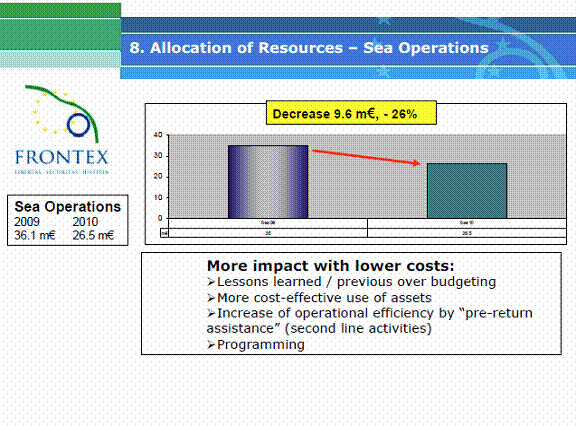
Frontex issued its 2010 Work Programme some time in late 2009.  I have not taken the time to closely read the full 90 page document, but it is worth noting that Frontex sea operations continue to constitute the largest share of the Frontex operational budget, over 26.5 M €.  Due to delayed payments from member states, Frontex is planning on cutting its sea operation budget by 9.7 M € in 2010.

Here are some excerpts from the Programme for Work relevant to sea operations:

“Executive Summary – Frontex’ Programme of Work 2010, as the output of a cyclical planning process, is the operative plan of the Agency to be used as reference for the governance process of assessing and evaluating operational activities carried out during 2010. Frontex’ Programme of Work also seeks to ensure the highest possible level of transparency towards the citizen of the European Union. [***]

Sea Borders has the biggest share of the budget for operational activities: 26.5 M €. This is a decrease of 9.7 M €. Based on experiences from 2007 and 2008 the budget allocated to Sea Borders has been reduced as payments have been lagging seriously behind and it seems logical that the level of ambition has to be (at least temporarily) adjusted downward. However, the presently foreseen budget does give sufficient room for 7 to 9 projects within the EPN European Patrols Network and 6-7 joint operations in different geographical areas to decrease the illegal immigration flows and to detect facilitators (26.3 M €). Other activities carried out by Sea Borders will be:

– Improved working conditions and improved operational value of interrogation experts (0.1 M €);

– Improved level of awareness in ICCs and regional centers during JOs. (0.1 M €). [***]”

“1.6. Outlook for the situation at the external borders in 2010

General trends –  [***] In May 2009 Libya agreed to direct repatriation of illegal migrants, increasing in the process the deterrent effect of Frontex coordinated Joint Operations in the area. Likewise, Joint Operation Poseidon 2009 has introduced pilot measures to gauge the magnitude of the phenomenon of nationality swapping. When extended and systematized, this measure will facilitate return, determination of illegal migration routes correctly and spotting any displacement in a more timely manner. [***]”

“External maritime borders of the Member States – With significantly lower number of migrants departing from Libya and a decreasing trend of arrivals in the Canary Islands, the relative importance of Algeria, Morocco, Tunisia and possibly Egypt as departure points is likely to grow throughout 2009 and 2010. Efforts by authorities there against illegal migration will be crucial for limiting the flow towards Italy and Spain.  Gambia is expected to take over from Senegal the role of a major embarkation point on the West African coast. That said, in absolute numbers the Aegean Sea (at the border between Turkey and Greece) is expected to remain the main entry point at external sea borders in 2010 should cooperation with Turkey continue to be limited. With the strengthening of the southern EU maritime borders, migrants who initially considered sea crossing might opt for alternative way of entry. One of them might be the use of air borders, either with forged documents or after obtaining visa on false pretence.  At the moment, such a shift has not yet been detected and the risk is considered rather low for 2010, but the situation at the air border should nevertheless continue to be monitored with vigilance. [***]”

“1.7.1. Priority locations by border type

(1) At the external sea borders, operational cooperation should continue to focus on the southern maritime areas where large number of illegal migrants have been detected and where migrants’ life is most at risk, namely the maritime areas leading to: the Canary Islands, the Spanish south-eastern Mediterranean coast, the Island of Lampedusa, Malta—taking into account possible displacement to Sicily and/or Crete—, Sardinia and the Greek Islands close to the Turkish coasts (Lesvos, Chios, Samos, Patmos, Leros and Kos).

Even though decreases detections of illegal border crossing have been reported during the first semester 2009 on the West African and Central Mediterranean routes, operational cooperation should continue to include these areas, on the one hand because the decrease might only be temporary, and on the other because Frontex coordinated Joint Operations in these areas as one factor have contributed to the decrease. [***]”

“1.7.2.2. Recommendations for operational cooperation at the sea borders

(18) All efforts, from diplomatic to technical ones, should continue to be explored to break the deadlock situation of illegal migrants, as advised by facilitators, purposely turning sea surveillance patrols into rescue operations, thereby using surveillance measures as part of their modus operandi. As of mid-2009, such situation was still prevailing in the Aegean Sea.

(19) Joint Operations at the sea borders should aim at developing a permanent linguistic expertise pool, combined with debriefing techniques. Alternatively, language expertise could be outsourced to vetted private sector.

(20) At the sea borders where migrants arrive in big groups, special attention should be given to the rapid identification of victims of THB, especially women and children, with a view to gaining information leading to the identification and prosecution of the traffickers. In this process victim protection should be paramount. [***]”

Click here for a link to the full document.  Note that the document is 90 pages in length but for some reason the 90 page document available at this link is in triplicate, i.e. it is 270 pages in length.  But it is the same 90 page document thrice.

Click here for a link to Slides used by Frontex to summarize some aspects of the Programme.

Leave a comment

Filed under Aegean Sea, Eastern Atlantic, Frontex, Mediterranean, News, Reports

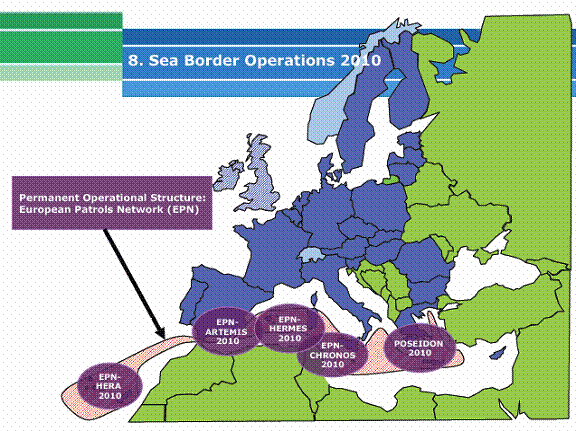
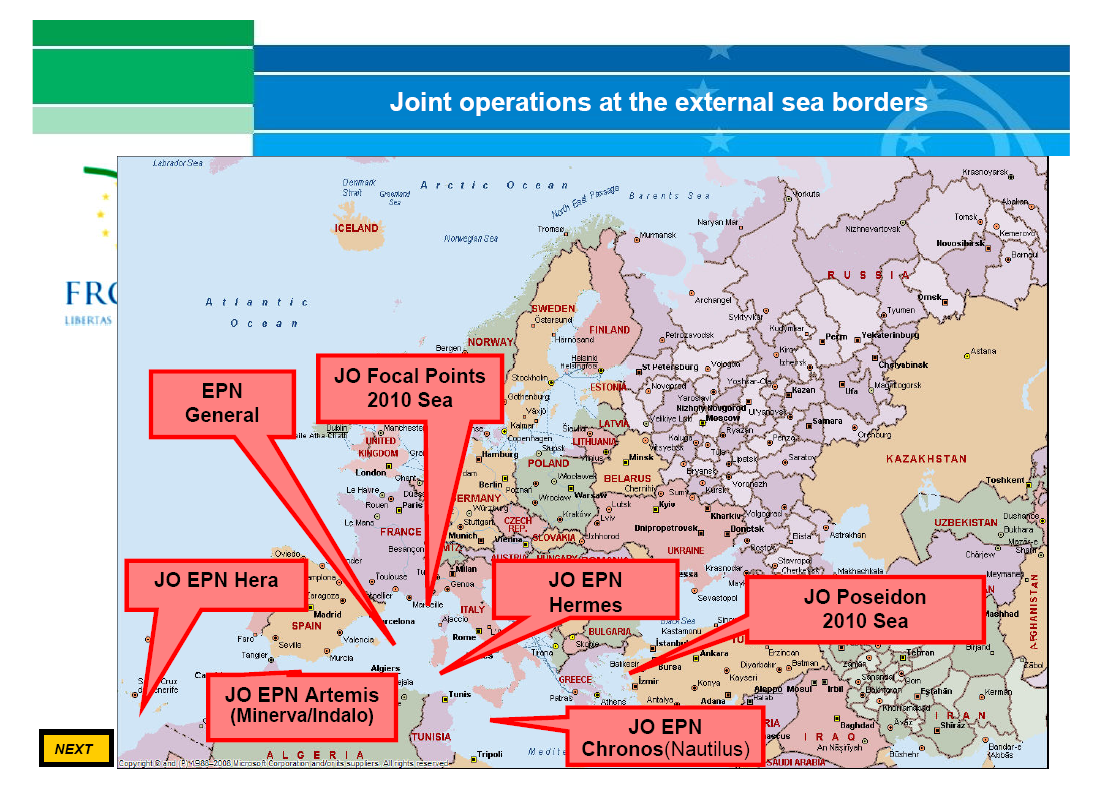
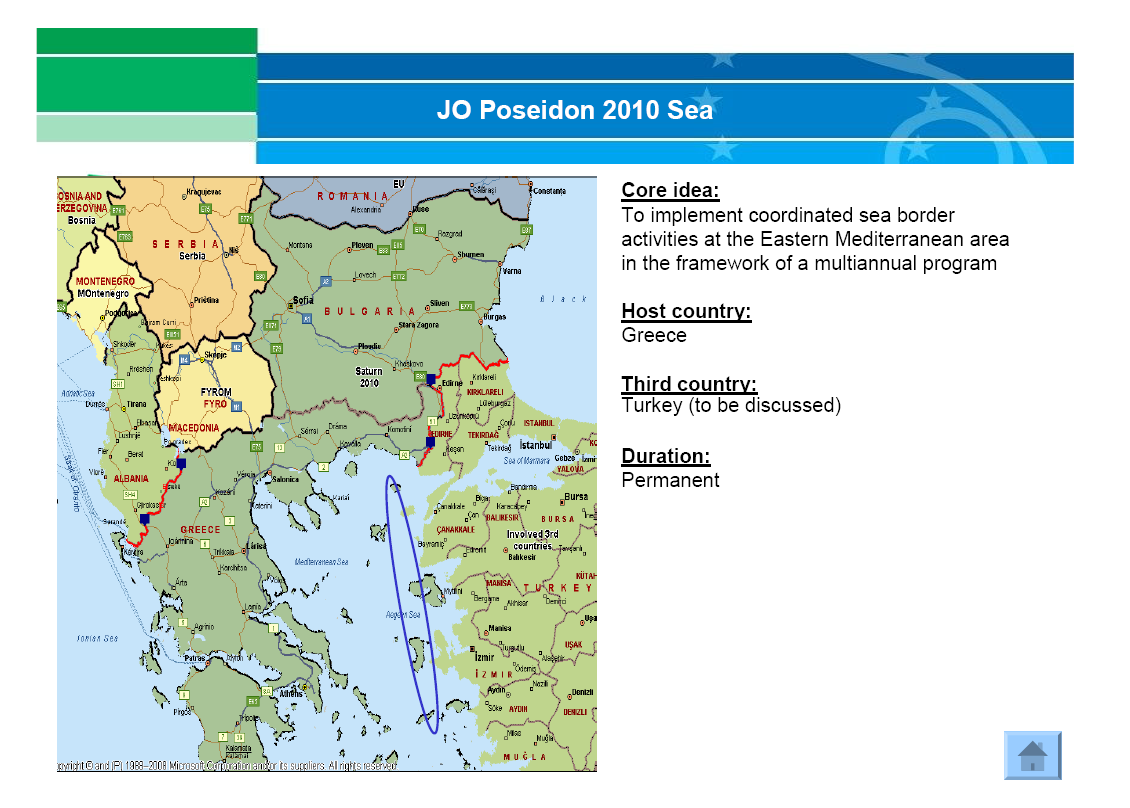
Frontex Presentation at European Defence Agency Annual Conference

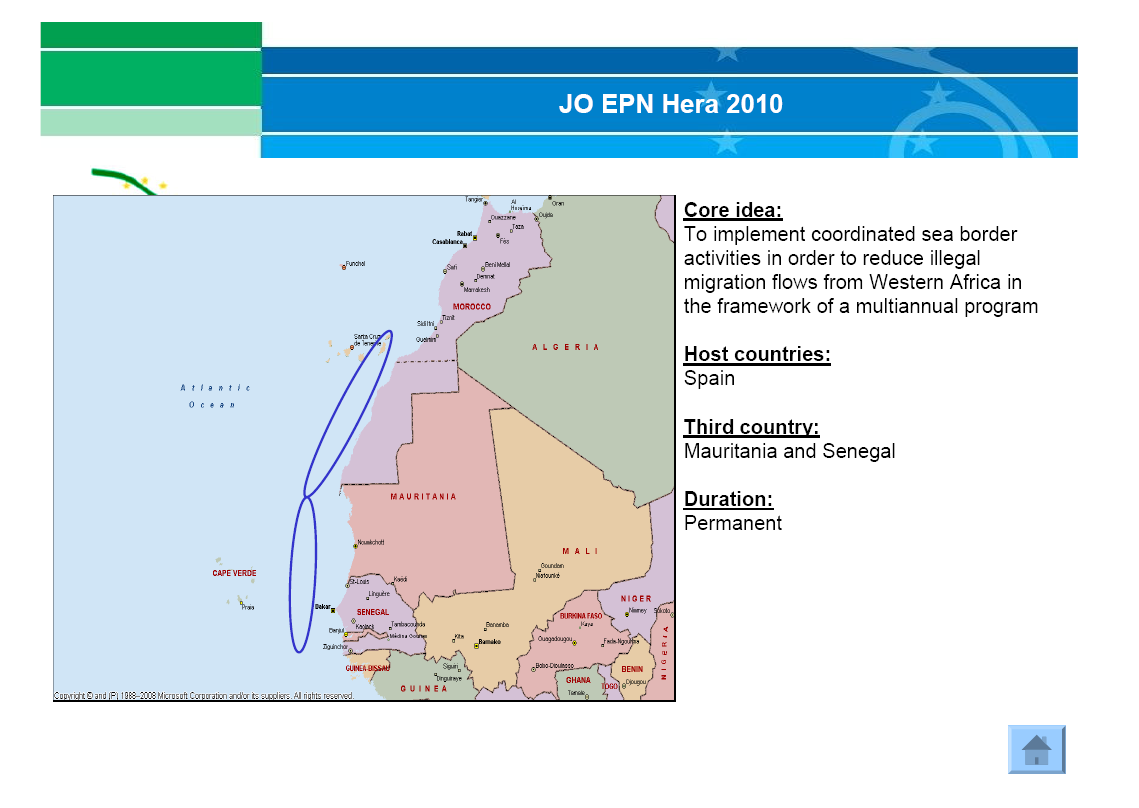
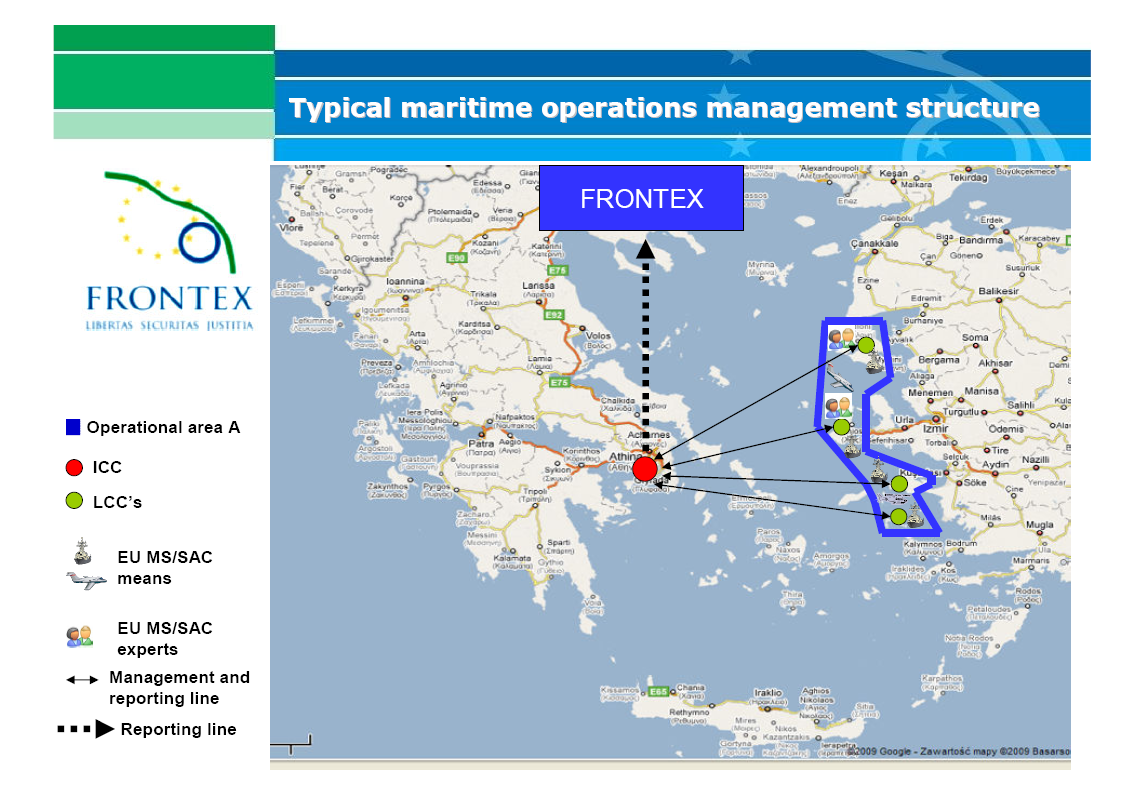
Rustamas Liubajevas, Head, Frontex Joint Operations Unit, presented a lecture entitled “Frontex within integrated Border management concept – Structural approach in planning capability” at the recent Annual Conference of the European Defence Agency.

Copies of some of his slides are reproduced here.

Click here for full slide presentation.

Leave a comment

Filed under Aegean Sea, Algeria, Colloques / Conferences, Eastern Atlantic, European Union, Frontex, Greece, Italy, Libya, Malta, Mauritania, Mediterranean, Morocco, News, Senegal, Spain, Turkey

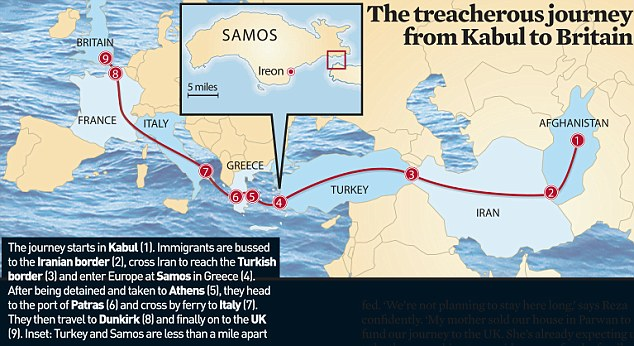
Daily Mail: from Kabul to the UK by way of Samos

The Daily Mail has a special report detailing the experiences and routes of irregular Afghan migrants traveling from Afghanistan to the UK by way of Turkey and Greece.

Click here for the full article.

Leave a comment

Filed under Aegean Sea, Greece, News, UK

Analysis of the Real Instituto Elcano: Controlling Migration in Southern Europe

Analysis of the Real Instituto Elcano: Controlling Migration in Southern Europe, Part 1: Fencing Strategies and Part 2: Gate-keeping Strategies by Anna Triandafyllidou.

“Part 1 Summary: Dealing with irregular migration has emerged as a policy priority at both the national and the EU level, although EU countries are not all affected by this phenomenon in the same way. Countries at the geographical periphery of the Union, and, in particular, southern EU member states that are close to important migration source and transit countries, face significant inflows from their land and sea borders.

This ARI discusses critically the policies adopted by different countries in southern Europe (Italy, Spain and Greece) for managing irregular migration, with a view to showing that reducing irregular migration cannot be achieved by tougher border controls only. Discourses of politicians and the media in announcing ‘floods’ or ‘waves’ of irregular migrants crossing the EU’s external borders and, on the basis of these ‘floods’, considering or indeed approving tougher border enforcement measures as the main means to effectively combat irregular migration need to be questioned by voters as well as by experts.”

Excerpt: “It is interesting to note that while sea-border patrolling and the related FRONTEX operation in the Atlantic Ocean in 2006 did not have substantial results (Triandafyllidou, 2007), the Spanish government’s diplomatic ‘offensive’ in West Africa did. Thus, during the last two years Spain has managed to sign re-admission agreements with Cape Verde, Mali, Guinea Conakry, Guinea Bissau and Nigeria and varied forms of cooperation agreements with other states in the region, with the result of a notable improvement in border management and hence a notable decrease of irregular arrivals from Africa (González Enríquez, 2009). Apprehensions of irregular migrants arriving at the Canary Islands have fallen from over 30,000 in 2006 to approximately 12,000 in 2007 (data from the Spanish Ministry of the Interior cited in Arango & Finotelli, 2008). This decrease is to some extent attributable to the intensification of sea-border patrols and joint FRONTEX operations in the area which led migrants and smugglers to try alternative routes.”

Click here for Part 1 and here for Part 2.

Leave a comment

Filed under Aegean Sea, Analysis, Eastern Atlantic, Greece, Italy, Mediterranean, Spain

First “Frontex Operational Office” to be Based in Greece

The Frontex Management Board has taken the decision to establish Frontex’s first Operational Office (“FOO”) in Piraeus, Greece.  According to the Frontex press release, the purpose of the office is to provide regionally-based support for Frontex coordinated activities such as joint operations and enhanced situational awareness.  If this pilot project is successful, it is expected that future FOOs would be established elsewhere such as the Western Mediterranean, the Western Balkans and Black Sea, and Eastern land borders.

According to the Frontex press release, Frontex Executive Director Laitinen said the establishment of this FOO “supports the possible enhancement of [the] Frontex mandate highlighted in the Stockholm Programme … I can even say this decision anticipates potential enlargement of the EU and Schengen zone. It gives Frontex a possibility to offer more support for the operational involvement of third countries, something that is essential for effective border management.”

Click here for Frontex statement.

Click here for the Final Report on the “Study on the feasibility of establishing specialised branches of Frontex.”  The specific functions of the new FOO are based in part on this feasibility study which was prepared in 2009.

Leave a comment

Filed under Aegean Sea, Frontex, Greece, Mediterranean, News, Turkey

Spanish EU Presidency: Frontex Needs More Resources and Clearer Rules

Spanish Interior Minister Alfredo Pérez Rubalcaba speaking at the 26th Frontex Management Board Meeting in Madrid called for providing Frontex with “more resources, clearer rules and specialist offices. … We are planning to promote FRONTEX, to equip it with more resources, its own resources, because when FRONTEX becomes more independent it will become more efficient; to provide it with mechanisms for jointly managing maritime operations, mechanisms that respect the laws and rights and clearly establish each country’s obligations. … FRONTEX has shown that it is probably the best tool we have for ensuring shared and jointly responsible border control.”

Click here for summary from Spanish EU Presidency web site.

Leave a comment

Filed under Aegean Sea, Eastern Atlantic, European Union, Frontex, Mediterranean, News, Spain

Greece Seeks Talks With Turkey Over Migrants

Greek Citizen Protection Minister Michalis Chryssohoidis has written to Turkish Interior Minister Beşir Atalay asking for talks within the next month on the illegal immigration issue.

“ ‘Only systematic and close cooperation between Greece and Turkey can curb the flow of illegal immigration to the European Union,’ Chrysochoidis reportedly wrote in the letter. According to sources, Chrysochoidis has invited Atalay to Athens to discuss a set of proposals. These include the closer cooperation of Greek and Turkish coast guard officials to ensure that a bilateral pact for the repatriation of migrants is enforced. Turkish vessels currently make no effort to stop smuggling ships, the Greek coast guard says.”

Click here, here, and here for articles.

Leave a comment

Filed under Aegean Sea, Greece, News, Turkey

Besson appelle l’UE à accélérer le renforcement de l’agence européenne Frontex et la surveillance des frontières européennes

“Les corps de neuf migrants morts noyés en tentant de gagner la Grèce à partir de la Turquie ont été découverts depuis cinq jours au large du port grec d’Alexandroupolis….

“Alors que les frontières extérieures de l’Union Européenne sont soumises en Grèce à une pression sans précédent des filières d’immigration irrégulière, plus de la moitié des entrées illégales dans l’espace Schengen ayant été enregistrées en 2009 à la frontière turco-grecque, Eric BESSON appelle l’Union Européenne à renforcer la surveillance des frontières européennes notamment en Méditerranée.

“Eric BESSON interviendra dans les prochains jours auprès du Commissaire européen chargé de l’immigration pour demander que les décisions prises par les Chefs d’Etat et de Gouvernement européens pour le renforcement de l’agence européenne Frontex soient mises en oeuvre sans délai.

“Ces décisions, adoptées sur proposition de la France par le Conseil européen du 30 octobre 2009, portent en particulier sur :

  • L’adoption de règles d’engagement claires pour les opérations de contrôle maritimes.
  • Une coopération opérationnelle accrue entre Frontex et les pays d’origine et de transit, notamment la Libye et la Turquie.
  • La possibilité d’affréter régulièrement des vols conjoints financés par Frontex pour des opérations groupées d’éloignement au niveau européen.

“Eric BESSON demandera également que la coopération de la Turquie dans la lutte contre les filières d’immigration irrégulière soit placée au centre des relations entre l’Union Européenne et ce pays.

“Eric BESSON proposera enfin à la présidence espagnole de l’Union Européenne que la prochaine réunion des Ministres européens en charge de l’immigration, le 21 janvier à Tolède, permette de définir une feuille de route précise pour l’application des décisions du Conseil européen et les relations avec la Turquie dans le domaine de la circulation des personnes.”

Click here for full Statement.

Leave a comment

Filed under Aegean Sea, European Union, France, Frontex, Greece, Mediterranean, Statements, Turkey

Frontex to Expand Operations in Aegean Sea in 2010

Frontex’s director, Ilkka Laitinen, met with Greek Citizens’ Protection Minister Michalis Chrysochoidis and reportedly said that Frontex enforcement operations in the eastern Aegean Sea will be further expanded in 2010.

Minister Chrysochoidis stated that 75% of the arrests for illegal entry from the EU’s sea borders in 2009 year took place in the Aegean.

Director Laitinen said that “[Frontex Operation] Poseidon continues to be our most important operation” and that Frontex’s largest border monitoring operation will take place in the eastern Aegean in 2010.

Click here for article.

Leave a comment

Filed under Aegean Sea, Frontex, Greece, News, Turkey

EC Spokesperson Says Turks Did Not Warn Frontex Helicopter (News)

EU Commission spokesperson Amadeu Altafaj Tardio responded to Greek media reports earlier in the week that Turkey had interfered with or warned a Frontex helicopter operating on a patrol from Greek territory during Frontex’s ongoing Operation Poseidon 2009.

The statement said that the Frontex helicopter had  “never violated Turkish airspace” and that it “had never received threats from Turkish authorities.”  The statement said the Turkish radar controller “had tried to establish contact with the [Frontex] helicopter pilot and had been unable to do so due to the use of different radar frequencies.”

The spokesperson “added that the EU is still continuing negotiations with Turkey over a joint framework in operational cooperation in border management and that it had informed Turkish officials about operation Poseidon 2009.”

Click here for article

Leave a comment

Filed under Aegean Sea, Frontex, Greece, News, Turkey

Frontex Helicopter Warned by Turks (News)

The Turkish military warned a Latvian helicopter on a Frontex mission near the Greek island of Farmakonissi in the Aegean Sea to leave the area.  Turkish authorities presumably believed that the helicopter had entered Turkish airspace.

Click here for article.

Leave a comment

Filed under Aegean Sea, Frontex, Greece, News, Turkey

Appel pour un camp No Border à Lesbos en Grèce du 25 au 31 août (Conferences)

“Nous vous invitons à venir à Lesbos du 25 au 31 août 2009, là où le système de contrôle des frontières européennes est flagrant, pour que nous échangions nos expériences dans le domaine des lignes de frontières, pour discuter, se coordonner et lutter ensemble.”   Coordination NO BORDER Lesvos 2009

Click here and here for more information.

Leave a comment

Filed under Aegean Sea, Colloques / Conferences, Greece