Category Archives: Analysis

Análisis del Real Instituto Elcano: La crisis en el Norte de África y su impacto en la inmigración irregular a la Unión Europea (by Frontex Dep. ED Gil Arias)

Real Instituto Elcano has published an analysis regarding the situation in North Africa and its impact on irregular immigration to the EU.  The analysis was written by Frontex’s Deputy Executive Director Gil Arias.

Of particular interest is the analysis regarding what Frontex believes might occur in regard to migrant flows from Libya under two different scenarios: Gadafi remaining in power or ultimately being removed from power (see Google translation of excerpt below):

“… En el caso de que el régimen de Gadafi recupere el control, la UE y sus Estados Miembros no podrán reanudar la cooperación con un régimen totalmente desacreditado. Se producirá el cese en la aplicación de acuerdos de cooperación policial que en el pasado (desde mayo de 2009) sirvieron para detener los flujos de inmigración irregular desde Libia hacia Italia y Malta. La posibilidad de que ciudadanos de otros países africanos bloqueados en Libia sean obligados o “ayudados” a emigrar a la UE no debe descartarse. De hecho, Gadafi ha amenazado con “abrir la puerta” de la inmigración ilegal hacia Europa.

La OIM estima la cifra de extranjeros presentes en Libia entre 0,5 y 1,5 millones. No obstante, no todos serian candidatos a la inmigración ilegal. Se trata fundamentalmente de trabajadores empleados por empresas extranjeras asentadas en el país, por lo que su intención primaria no sería la emigración a la UE y por otra parte una buena parte de ellos ya han abandonado Libia.

En el peor de los casos, la consecuencia de ese “abrir la puerta” sería la reactivación de los flujos por vía marítima hacia Lampedusa y Malta (eventualmente también Creta, que se encuentra a 200 km de distancia de la costa libia) en un escenario similar al de 2008 (40.000 inmigrantes llegaron a Italia y Malta, con origen en las costas libias) agravado por el efecto adicional de la inestabilidad en el país. Su destino principal serían los países con presencia importante de ciudadanos norteafricanos (Italia, Francia, España, Bélgica y el Reino Unido). El destino de los nacionales de países subsaharianos se encontraría más repartido por toda la UE.

Si Gadafi es derrocado resultará clave la capacidad y rapidez de la oposición para reorganizarse. La oposición se encuentra, por el momento, bastante desorganizada y es probable que se produzcan luchas internas por el poder, especialmente por el control de los campos petrolíferos. Ello podría conducir a un estado persistente de disturbios y a una ausencia de control por un largo periodo de tiempo.

La eventual reactivación de las rutas migratorias hacia la UE dependerá de la capacidad del nuevo régimen para imponer la ley y el orden en el país así como el control efectivo sobre los 2.000 km de costas y 4.000 km de fronteras terrestres libias. En el peor de los escenarios podría darse una situación similar a la de Somalia.

En este escenario, la economía libia puede deteriorarse y elevarse los niveles de desempleo. Actualmente se desconoce la tasa de desempleo en Libia, pero se presume baja. Previsiblemente, la mayoría de los trabajadores desempleados intentará regresar a sus países, pero parte de ellos (sobre todo los nacionales de países inseguros) buscaran otras oportunidades, entre ellas la emigración clandestina a la UE.

La ausencia de ley y orden, especialmente la ausencia de control sobre las fronteras marítimas, llevará rápidamente a las mafias al tráfico de inmigrantes hacia la UE. Los candidatos serían primariamente trabajadores desempleados no deseosos de volver a sus países (mayormente de África Occidental y Oriental, pero eventualmente también libios, egipcios, argelinos y tunecinos). Esta situación impediría, por otra parte, el retorno de quienes fuesen detectados cruzando ilegalmente las fronteras exteriores de la UE.

En tales circunstancias se puede prever un flujo constante de inmigración ilegal durante meses, mayoritariamente por vía marítima, pero también por vía aérea a través de Turquía. La duración en el tiempo de este escenario dependerá de la rapidez con la que la UE o los Estados Miembros y las nuevas autoridades sean capaces de restablecer la cooperación. En este sentido, serán determinantes los acuerdos de readmisión efectivos.

Por último, ha de tenerse también en cuenta el riesgo marginal de que los vencedores realicen acciones de persecución sobre los partidarios de Gadafi, lo que provocaría la huida de éstos del país en busca de refugio….”

Google translation of the above excerpts (NB – this is only a rough translation):

“…In the case of Qaddafi’s regime  regaining control, the EU and its Member States shall not resume cooperation with a discredited regime. Termination will occur in the implementation of agreements on police cooperation in the past (May 2009) served to stop the flow of illegal immigration from Libya to Italy and Malta. The possibility for citizens from other African countries locked in Libya are forced or “helped” to migrate to the EU can not be ruled out. In fact, Gaddafi has threatened to “open the door” of illegal immigration into Europe.

The IOM estimates the number of foreigners in Libya between 0.5 and 1.5 million. However, not all candidates would be illegal immigration. These are mainly employed by foreign companies settled in the country, so that their primary intention would not be the migration to the EU and, moreover, a good portion of them have already left Libya.

In the worst case, the consequence of this “open door” would be the reactivation of the flows by sea to Lampedusa and Malta (and possibly Crete, which is 200 km away from the Libyan coast) in a scenario similar to that of 2008 (40.000 immigrants arrived in Italy and Malta, departing from the Libyan coast) aggravated by the additional effect of instability in the country. Its main destination countries would be a significant presence of North African citizens (Italy, France, Spain, Belgium and the UK). The fate of the national sub-Saharan countries would be more distributed throughout the EU.

If Gadhafi is overthrown will be key capacity and speed of the opposition to regroup. The opposition is, at present, quite disorganized and is likely to produce internal power struggles, especially for control of the oilfields. This could lead to a persistent state of unrest and a lack of control over a long period of time.

The eventual recovery of migratory routes towards the EU depends on the ability of the new regime to impose law and order in the country as well as effective control over the 2,000 km of coastline and 4,000 km of land borders Libya. In the worst case scenario could be a situation similar to Somalia.

In this scenario, the Libyan economy may deteriorate and unemployment levels rise. Currently unknown unemployment rate in Libya, but presumably low. Predictably, most unemployed workers try to return to their countries, but some of them (especially insecure country nationals) to seek other opportunities, including illegal migration to the EU.

The absence of law and order, especially the lack of control over maritime borders, whisk the trafficking mafias immigrants into the EU. Candidates would be primarily unemployed workers eager to return to their countries (mostly from West and East Africa, but also possibly Libyans, Egyptians, Algerians and Tunisians). This would prevent, on the other hand, the return of those who were detected illegally crossing the external borders of the EU.

In such circumstances, can provide a steady flow of illegal immigration for months, mostly by sea, but also by air through Turkey. The long life of this scenario depends on the speed with which the EU or the Member States and the new authorities are able to restore cooperation. In this regard, will determine the effective readmission agreements.

Finally, it must also take into account the marginal risk that the winners perform acts of persecution on Gaddafi’s supporters, causing them to flee the country in search of refuge….”

Click here for the Analysis. (ES)

Leave a comment

Filed under Algeria, Analysis, Egypt, European Union, France, Frontex, Greece, Italy, Libya, Malta, Mediterranean, Morocco, Spain, Tunisia, Turkey

NY Times Commentary: The Killing Seas

Here is an op-ed article from Thursday’s New York Times by Hans Lucht, an anthropologist at the University of Copenhagen and author of the forthcoming “Darkness Before Daybreak: African Migrants Living on the Fringes in Southern Italy Today.” (Scheduled for release Dec. 2011.)

“…. In the long run, Europe should learn from the situation in Libya that paying dictators to make ‘problems’ disappear is not only morally bankrupt but also short-sighted. European leaders must seek commitments from any post-Qaddafi government to handle the challenges of international migration in an orderly and humane fashion. Instead of banishing asylum-seekers to detention camps in the desert, Europe should offer support to Tunisia and Egypt, which are struggling to assist refugees from Libya, and to southern European countries….”

Click here for article.

Leave a comment

Filed under Analysis, European Union, Ghana, Italy, Libya, Mediterranean

Follow-Up Report and Analysis Regarding Failure to Rescue Disabled Migrant Boat Resulting in 61 Deaths

UNHCR today released more information from three Ethiopian survivors of the migrant boat that left Tripoli on 25 March with 72 passengers and which, after becoming disabled and running out of food and water, washed ashore in Libya over two weeks later with only nine survivors.

Additionally, the Bruxelles2 blog in a recent post, “Un navire de réfugiés non secouru ? Retour sur un drame non élucidé,” has provided detailed analysis regarding the possible identities of the helicopter and warships that failed to render assistance to the migrant boat after it had become disabled.  (See more on this below.)

From UNHCR’s statement:

“[One surviving] refugee said that military vessels twice passed their boat without stopping, and that a military helicopter dropped food and water onto the boat at some point during the journey. The first boat refused their request to board. The second only took photos, he said. The man was not able to identify where the vessels came from.

UNHCR staff met with the three in Shousha camp in Tunisia. One spoke Arabic, while the others spoke Oromo. UNHCR interviewed the Arabic speaker. He said that they paid smugglers US$800 to make the journey. The passengers were expected to operate the boat on their own.

According to the refugee, when water ran out people drank sea water and their own urine. They ate toothpaste. One by one people started to die. He said that they waited for a day or two before dropping the bodies into the sea. There were 20 women and two small children on board. A woman with a two-year-old boy died three days before he died. The refugee described the anguish of the boy after his mother’s death.

After arrival on a beach near Zliten, between Tripoli and the Tunisian border, a woman died on the beach from exhaustion. The remaining 10 men walked to the town of Zliten where they were arrested by the Libyan police. They were taken to a hospital and then to a prison where they were given some water, milk and dates. After two days another survivor died.

After begging jail staff to take the remaining survivors back to hospital, they were taken to a hospital in al-Khums city. Doctors and nurses were said to have given the group water and told them to leave. They were returned to the prison and then taken to Twesha jail near Tripoli. Finally Ethiopian friends in Tripoli paid the prison US$900 to release the men. UNHCR is now providing them with assistance in Tunisia.”

Bruxelles2 notes that the survivors’ reports that the helicopter that dropped supplies had an “Army” marking on it would tend to suggest that the helicopter did not belong to France (“Marine”), Italy (“Marina”), the U.S. Navy (“Navy”), or the Royal Navy (“UK Navy”).  Bruxelles2 believes it is plausible that an “army” helicopter belonging to the US or UK could have been operating in the area, but US Army helicopters tend to be marked “United States.”  According to Bruxelles2 some British army helicopters do carry the “Army” marking.  (One other possibility I would note is that the survivors could simply be mistaken about the marking – they recall clearly that a military helicopter hovered over them and dropped supplies, but incorrectly remember, misread, or assumed that the marking on the side of the helicopter said “Army”.)

Bruxelles2 also suggests that there are other warships that might appear to be an aircraft carrier, especially when viewed from a small migrant boat.  Bruxelles2 points in particular to “the USS Kearsarge (LHD3), [an] amphibious ship [that] regularly hosts (and welcomed during the operations – which the U.S. Navy confirms) AV-8B Harrier vertical takeoff [aircraft].”

Bruxelles2 also notes that the time period when the migrant boat was disabled and drifting was a period when there was a shifting of commands for the multiple European and US naval and air forces operating off Libya.  NATO took command of the maritime embargo on 23 March; the no fly zone and the air attacks were initially under the control of an ad hoc coalition (France, UK, USA, Canada, Belgium, Denmark); full command did not shift to NATO until 31 March and even then it took several days for the transfers of command to occur; and some military vessels continued (and continue to this day) to operate under independent national command.

In short, NATO may be fully correct when it says that a vessel under its command during the time period in question did not encounter the disabled migrant boat.  Further investigation into responsibility is needed.

Click here for UNHCR statement.

Click here for Bruxelles2 post. (FR)

Leave a comment

Filed under Analysis, France, Italy, Libya, Mediterranean, News, UK, United States

Frontex Issues 2011 Annual Risk Analysis

Frontex posted its 2011 Annual Risk Analysis to its web site yesterday. [Update 9 May 2012: 2011 Annual Risk Analysis also available here: frontex_annual_risk_analysis_2011 ]

From the Frontex web page: “Frontex’s Annual Risk Analysis 2011 records the main trends in regular and irregular migration into the European Union in 2010 and offers predictions for the coming year’s trends. Regarding irregular migration, the sharp decrease reported in 2009 (of around a third on 2008) stabilised in 2010; Member States and Schengen Associated Countries reported a total of 104,049 detections of illegal border crossing at the sea and land external borders, a total almost identical to the 2009 figure of 104,599….”

Executive Summary:  “Irregular migration represents a small proportion of the total movement of persons across the borders, three quarters of which are EU nationals. Over 100 nationalities require a visa to enter the EU, accounting for more than 80% of the non-EU population, while about 1 billion nationals from 37 countries do not require a visa. As yet, there are no precise statistics available on passenger flows for 2010, but it is widely regarded to have recovered somewhat from the decline of 2009.

Regarding irregular migration, the sharp decreasing trend reported in 2009 stabilised in 2010; Member States and Schengen Associated Countries reported 104 049 detections of illegal border-crossing at the sea and land external borders, a total almost identical to 2009.

Irregular migration through western African, western Mediterranean and central Mediterranean routes continued to decrease, thus reducing the overall detection of irregular migration of West Africans who, in the past, used to be the most commonly detected migrants on those routes. By contrast, there was an abrupt increase in detections of illegal border-crossing at the land border between Turkey and Greece. Consequently, in 2010 the eastern Mediterranean route became the main channel of irregular migration into the EU, and Turkey – the main transit country for irregular migrants.

The sudden increase in detections of illegal border-crossings along a small section of the Greek-Turkish land border in October 2010 was due to facilitators exploiting variations in the vulnerability of the external border. This development triggered the first deployment of the Rapid Border Intervention Team (RABIT) in November 2010.

At EU level, refusals of entry decreased marginally in 2010; however, trends differed extensively between nationalities. Ukrainians continued to be the main nationality refused entry at EU Member States’ external borders in 2010, mostly at the Ukrainian border with Poland which is one of the busiest border sections along the EU’s external borders. Furthermore, Serbians became the second most frequently refused nationality at the external land borders, with more than an 80% increase, following the visa liberalisation process in the Western Balkans. At the external air borders, Brazilians continued to be the nationality most often refused despite the fact that these refusals declined by more than 20% compared to 2009.

At the end of 2010, the detection of false documents at entry points to the EU reached their highest level since data collection began in early 2009. Apart from this increase, there are reports of widespread abuse of authentic documents by unauthorised users known as impostors.

Looking ahead, regular passenger flows across the external borders will increase due to rising global mobility, possible visa-liberalisation procedures for the EU’s eastern European partners and new local border-traffic agreements along the eastern borders. These developments will increase the workload of border-control authorities in preventing the use of legal channels for overstaying. In addition, Europe will host two major sporting events – the Olympic Games in London and the UEFA Euro 2012 in Poland/Ukraine.

Consistent with the increasing flow of passengers, the growing number of registered traveller programmes (RTP) should further facilitate bona fide passenger flows and will put additional emphasis on risk analysis-driven border checks in order to ensure the smooth flow of legitimate passengers.

There might be changes in the external Schengen and EU borders in 2011 or 2012, with the possible entry of Romania and Bulgaria into the Schengen area and Croatia’s possible accession to the EU.

The most likely high-pressure points for illegal border-crossings in 2012 will be along the Mediterranean coast and the land border with Turkey. Migrants with relatively easy access to Turkey or North Africa will continue to typify the flow.”

Click here for the Frontex statement.

Click here for the 2011 Annual Risk Analysis.  [Update 9 May 2012: 2011 Annual Risk Analysis also available here: frontex_annual_risk_analysis_2011 ]

2 Comments

Filed under Analysis, Data / Stats, European Union, Frontex, News, Reports

Europol 2011 Organised Crime Threat Assessment – Illegal Immigration and THB

Europol just issued its 2011 Organised Crime Threat Assessment (OCTA) (OCTA_2011-1).  The report contains Europol’s assessments regarding “current and expected trends in organised crime affecting the European Union.”  Among the topics discussed are the facilitation of illegal immigration and trafficking in human beings.

The report notes that the increased control of the external borders of the EU, combined with other immigration controls, has resulted in irregular migrants turning to organised crime groups to facilitate their entry to the EU.  The report notes that increased enforcement activities which successfully reduce illegal immigration in certain areas may result in substantial increases in illegal immigration in other areas.

The report indicates that organised criminal groups are exploiting and will continue to exploit the social and political unrest in North Africa and that organised crime groups are responsible for facilitating the movement of the thousands of Tunisians who have entered Italy.

The report notes that the accession of Bulgaria and Romania to the Schengen zone “may yield increased illicit traffic through these countries and the possible displacement of illegal immigration flows from the Turkish-Greek border.”

Excerpts from the 38 page report pertaining to the facilitation of illegal immigration:

“[I]ncreasing control of external borders, the introduction of higher quality travel documents and other protective measures implemented by destination countries are making illegal immigration more difficult for individual migrants, forcing them to seek the services of organised crime groups.

International agreements and coordinated law enforcement activities have a significant impact on the flows of illegal immigrants along established routes. In 2010, a sharp reduction in the use of sea routes was accompanied by a substantial increase in illegal overland entries, overwhelmingly concentrated on the Turkish-Greek border.

Besides being the natural gateway for immigrants from the Middle East and Asia, Turkey is now the final step towards the EU for migrants with many other origins, including North and West Africans. Its geographical position, the presence of historical smuggling routes and the comparative ease with which entry visas may be obtained have transformed Turkey into the main nexus point for illegal immigrants on their way to Europe.

[***]

Legislation aimed at safeguarding certain inalienable individual or social rights is manipulated by organised crime groups with specialist expertise. Political asylum requests, and family reunions following marriages of convenience with EU citizens, are among the most frequently abused procedures. In addition, a prevalent tactic is to exploit loopholes and the lack of harmonisation in current legislation.

[***]

Criminal Groups

Organised crime groups involved in the facilitation of illegal immigrants tend to be structured in loose networks of smaller groups with ethnic or other cultural connections to customers. By the same token, illegal immigrants tend to be recruited by, or approach facilitators from, the same ethnic background. However, few criminal groups have the capacity to manage all stages from source to destination country. The further migrants get from their country of origin, the greater the chance that their facilitators will be of an ethnic origin different from their own. Along the route, small local criminal groups receive and house transiting illegal immigrants, facilitating their passage to the next stage. In the often extended time between stages, transiting migrants are frequently exploited in illicit labour, thus marking a point of contact between illegal immigration and trafficking in human beings (THB).

Organised crime groups in destination countries play a fundamental role in the smuggling of migrants. Criminals, often legitimately resident in the EU, facilitate the last step of the migrants’ journey, in some cases collecting final instalments of transportation fees, and are in an ideal position to profit from newly arrived migrants, sometimes employing forms of exploitation typical of THB.

The most widely reported organised crime groups involved in the facilitation of illegal immigration are of Chinese, Turkish, Albanian, Indian, Iraqi, and Russian origin. Chinese, Vietnamese, Indian, Pakistani, and some West African groups are among the most capable, managing all successive phases of illegal immigration from source to destination countries. Although these groups may sub-contract part of the transportation or the production of falsified documents, they maintain effective control over the illegal immigrants throughout.

The growing importance of Turkey as a nexus point for migrants is likely to be further exploited by Turkish organised crime groups already extremely skilled in managing routes for illicit commodities and will make the most of their resources and contacts in the EU to maximise profits from this lucrative criminal market….

[***]

Criminal hubs

Political and legislative initiatives impact on regional dynamics, resulting in frequent shifts between hubs and preferred nexus points outside the EU.

Migrant flows across the Mediterranean Sea and illicit entries at the Eastern land borders have both significantly decreased. Greece is now the focus for illegal entry to the EU, and while levels of illegal migration connected with seasonal work patterns between Albania and Greece have decreased in the last year, illicit entries of migrants from Turkey have increased by over 500 per cent between 2009 and 2010

The South East criminal hub is therefore under the heaviest pressure. As a result also of its proximity to the Western Balkans, the hub’s centre of gravity for this criminal problem is currently Greece.

[***]

The Southern criminal hub is a landing zone for many immigrants who have entered the EU through Greece, and who either remain in Italy or proceed to other MS. Illegal immigrants are often exploited or employed by organised crime groups active in the hub.

Emerging and Future Issues

The social and political unrest pervading North Africa since January 2011 is likely to have a significant impact on the internal security of Southern Europe. By exploiting the present political vacuum and the diminution of police capability to maintain public order and combat criminal activity, organised crime groups are facilitating several thousands of illegal immigrants, mainly of Tunisian origin, in their attempt to cross the Mediterranean and reach Europe. This carries an inherent risk to the internal security of the EU.

The large and growing number of illegal immigrants from countries and regions in which Islamist terrorist groups are active – such as Chechnya, Afghanistan, Iraq, Pakistan and Somalia – raises the possibility that channels for illegal immigration will be used increasingly by those seeking to engage in terrorist activity in the EU.

In the absence of any significant harmonisation of standards with regards to visa issue for a variety of purposes (including settlement for marriage and family reunions) a further increase in the abuse of legitimate migration procedures is likely.

The possible accession of Romania and Bulgaria to the Schengen Zone will greatly widen the Eastern green and blue borders. This has the potential to release the pressure on the Turkish-Greek border, and lead to increased targeting of Bulgaria and the Black Sea coast by illegal immigrants and their facilitators.

Turkish organised crime groups, currently in a dominant position at the biggest nexus point for migrants, will exploit further opportunities for delivering illegal immigrants to the EU by means of the Black Sea and the flourishing Turkish diaspora in Bulgaria….

[***]

… The role of the Western Balkans as a logistical hub will be sustained and may even grow further, while the proposed accession of Bulgaria and Romania to the Schengen zone may yield increased illicit traffic through these countries and the possible displacement of illegal immigration flows from the Turkish-Greek border. In this event, Member States in South East Europe may require additional operational support. In light of the continued prominence throughout the EU of Albanian speaking criminal groups, strategic and operational partnerships with authorities in the Western Balkans will be increasingly important.

Ongoing political instability in countries close to the borders of the EU and transit areas for illicit commodities has the potential to alter trafficking routes and create new illegal migration flows. In countries such as Tunisia and Egypt the process by which serving regimes are replaced may result in power and investment vacuums in both the public and private sectors. Some of these could be filled by those with sufficient resources to exploit the instability for criminal ends, including EU organised crime groups. In politically fragile environments organised crime can also prosper by providing essential services such as transport infrastructure, and food and fuel supply. The effects of illegal immigration as a result of instability in North Africa – already experienced by Italy – are likely to spread if levels of unrest persist or increase. Should living conditions deteriorate in the longer term, the EU is likely to see an increase also in victims of THB from this region….

[***]”

Click on this link OCTA_2011-1 for OCTA report.

Click here for Europol press release.

Leave a comment

Filed under Aegean Sea, Analysis, Black Sea, Eastern Atlantic, European Union, Mediterranean, News, Reports

New Study: Implementation of Article 80 TFEU on the principle of solidarity between MS in the field of border checks, asylum and immigration

The European Parliament’s Directorate-General for Internal Policies, Policy Department C, Citizens’ Rights and Constitutional Affairs, released a 120+ page study in April entitled “The Implementation of Article 80 TFEU on the principle of solidarity and fair sharing of responsibility, including its financial implications, between the Member States in the field of border checks, asylum and immigration.

The study was made by Prof. Dr. Dirk Vanheule, Project Director, Dr. Joanne van Selm, and Dr. Christina Boswell and was prepared at the request of the LIBE committee.

ABSTRACT:  “The study assesses the scope and implications of Article 80 TFEU, which relates to the principle of solidarity in the field of Border Checks, Asylum and Immigration. The study analyses primary and secondary sources of European law in order to identify the implications of Article 80 TFEU in terms of obligations and jurisdiction. It also discusses the results of a questionnaire that was administered to senior public officials in the EU, collecting their views on the scope and possible mode of implementation of Article 80 TFEU. The study’s conclusions outline some practical solutions for the implementation of new solidarity mechanisms in the field of EU immigration and asylum policies.”

Click here for the full study.

Leave a comment

Filed under Analysis, European Union, News, Reports

Tunisian Migrant Crisis vs. Italian Migrant Crisis – Comparing the Numbers

Since the collapse of Tunisian president Ben Ali’s rule on 14 January 2011, tens of thousands of people have been on the move as a result of the events in Tunisia and the ensuing events elsewhere in the Middle East and North Africa.  Many of those taking advantage of this transitional period are Tunisians who are leaving their country to seek better opportunity in Europe.   Most however, are people who have fled from Libya to neighbouring countries due to fighting and threats to their safety.

So far Italy has received about 20,000 migrants and a smaller number of asylum seekers.  The 20,000 migrants are almost all Tunisian nationals.  At the same time, Tunisia has received over 150,000 asylum seekers and others who have fled from Libya.

Based on the raw numbers alone – 20,000 vs. 150,000 – Tunisia has received 7.5 times as many people as Italy over the past 2 ½ months.  When you compare these numbers in light of the respective population of the two countries, the burden imposed on Tunisia is even more striking.  Italy has a current population of approximately 61.0 million people.  Tunisia’s current population is approximately 10.6 million.  Assuming my calculations are correct, Italy has received approximately 3.3 persons per 10,000 of its population and Tunisia has received approximately 141.5 persons per 10,000 of its population.  Tunisia has therefore received almost 43 times as many people per capita relative to Italy.  There is no comparison between the humanitarian crises faced by the two countries.  Tunisia is facing by far the greater burden.

Agence Tunis Afrique Press on Saturday attributed the statement below to an authorised source within the Tunisian Ministry of Foreign Affairs.  The statement notes the burden faced by Tunisia and asks Italy to show understanding and solidarity within the context of the ongoing migration talks between Tunisia and Italy.  Italian Prime Minister Silvio Berlusconi travels to Tunis today (Monday) for continuing migration talks with Tunisia.

Statement attributed to Tunisian Ministry of Foreign Affairs:  “While reaffirming the strong historical ties that bind [Tunisia] to the friendly country [of Italy], especially since the signing of the agreement of friendship and good neighborliness in 2003, Tunisia calls on the government and the people of Italy to show proof of their solidarity with the Tunisian people in this important transitional stage that this country is now experiencing, after the glorious revolution, and especially in light of the challenges posed by the current situation on the Tunisian-Libyan border, with the arrival of more than 150,000 displaced persons who have been welcomed by the Tunisian people in a unique showing of solidarity, despite the difficult conditions faced by Tunisia, as witnessed by several countries and international and humanitarian organizations.”

(“Tout en réaffirmant la solidité des liens historiques qui l’unissent à ce pays ami, notamment, depuis la signature de la convention d’amitié et de bon voisinage en 2003, la Tunisie elle appelle le gouvernement et le peuple italiens à faire preuve de solidarité avec le peuple tunisien en cette étape transitoire importante que vit le pays, après sa glorieuse révolution et, tout particulièrement, dans le contexte des défis que pose la situation actuelle sur les frontières tuniso-libyennes, avec l’arrivée de plus de 150.000 déplacés, qui ont été accueillis par le peuple tunisien dans un élan de solidarité sans pareil, en dépit des conditions difficiles auxquelles la Tunisie est confrontée, comme en témoignent plusieurs pays et organisations internationales et humanitaires.”)

Click here (FR) for TAP article.

Leave a comment

Filed under Analysis, Data / Stats, Italy, Libya, Mediterranean, Tunisia

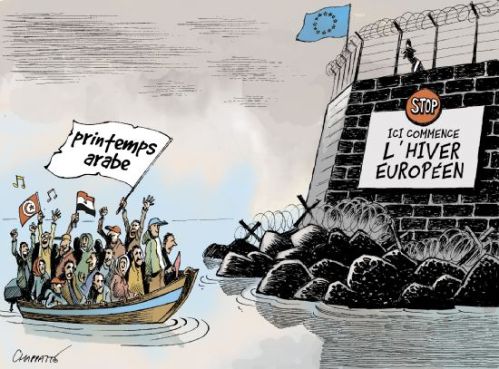
The Arab Spring meets the European Winter (by Chappatte)

© Chappatte - http://www.globecartoon.com - Used by Migrants At Sea with permission.


Leave a comment

Filed under Analysis, European Union, Frontex, Mediterranean

Prof. Goodwin-Gill: ‘The Right to Seek Asylum: Interception at Sea and the Principle of Non-Refoulement’

On 16 February Professor Guy S. Goodwin-Gill presented the inaugural lecture of the Fondation Philippe Wiener – Maurice Anspach, Chaire W. J. Ganshof van der Meersch.  The lecture was entitled ‘The Right to Seek Asylum: Interception at Sea and the Principle of Non-Refoulement’.  The complete text of the lecture is available at this link: Goodwin-Gill: The Right to Seek Asylum-Interception at Sea and the Principle of Non-Refoulement.  The complete text also contains a helpful reference list.

I have reproduced several excerpts below:

“Looking at the interception and return measures adopted in the Mediterranean and off the west coast of Africa … one may rightly wonder what has happened to the values and principles considered fundamental to the Member States of the European Union….  [***]

… [I]t is all the more surprising when [European] governments, ministers and officials either pretend that the rules [- including Article 78(1) of the TFEU which requires the Union to develop a common asylum policy with regard to ‘any third country national requiring international protection and ensuring compliance with the principle of non-refoulement’ – policy which ‘must be in accordance with the Geneva Convention… and other relevant treaties’-] do not apply, or seek ways to avoid their being triggered.

In my view, the problems begin at the beginning, just as they commonly do also at the national level. A policy or goal is identified – in this case, reducing the number of irregular migrants, including asylum seekers, leaving the north African coast and heading for Europe – and then belatedly some attempt is made to bend implementation of the policy to fit in with principle and rule. A better approach, in my view, would be to begin with a clear understanding of the applicable law – the prohibition of discrimination, of refoulement, of inhuman or degrading treatment – and then to see what can be done by working within the rules.

Of course, this approach is premised on the assumption that States generally seek to work within the rule of law. It will not likely influence the State determined to deal with the migrant and the asylum seeker arbitrarily, and without reference to principle. Such cases must be confronted head-on, by way of judicial and political mechanisms of control.  [***]

… The problem, though, lies not in formal recognition of protection principles but, as ever, in operationalising the rules – in making protection a reality at the point of enforcement. On the plus side stands a substantial body of legislation: the Frontex regulation itself; the RABIT amendment, with its express insistence on compliance with fundamental rights and conformity with Member States’ protection and non-refoulement obligations; and the Schengen Borders Code, Article 3 of which requires the Code to be applied, ‘without prejudice to the rights of refugees… in particular as regards non-refoulement’. Add to this the April 2010 Council Decision supplementing the Code and dealing specifically with the surveillance of maritime borders and Frontex operations; it is currently being challenged by the Parliament on vires grounds, and it was also objected to by Malta and Italy, mainly for its proposal that in the last resort, rescue cases should be disembarked in the State hosting the Frontex operation. The Decision’s formulation of the applicable law in the matter of protection, however, is unremarkable, restating the principle of non-refoulement and the need to avoid indirect breach, but also providing for those intercepted to have an opportunity to set out reasons why they might be at risk of such a violation of their rights….  [***]

What do we know about either unilateral or Frontex-led interception operations so far? Not as much as we might expect as citizens of a democratic Union bounded by the rule of law and basic principles of good governance, such as transparency and accountability….  [***]

Exactly what Frontex does in an interception context has been questioned. Human Rights Watch has claimed that Frontex has been involved in facilitating interception, though this has been denied. Amnesty International and ECRE note that Frontex has stated that it does not know whether any asylum applications were submitted during interception operations, as it does not collect the data. How, then, should we approach what appears to be wilful ignorance? In the Roma Rights Case in 2004, discrimination on racial grounds was alleged in the conduct of immigration procedures by British officials at Prague Airport, which were intended to prevent potential asylum seekers leaving for the United Kingdom. There, too, the authorities did not keep any records of the ethnic origin of those they interviewed. Finding on the evidence that the government had acted in violation of relevant legislation, the House of Lords called attention to the importance of gathering information, ‘which might have helped ensure that this high-risk operation was not being conducted in a discriminatory manner…’

Given the secrecy attaching to interception operations, and the fact that no data are gathered or retained, it is reasonable to infer that some level of Frontex involvement has occurred, and that, absent evidence to the contrary, the relevant principles of international and EU law have not been observed.  [***]

… The object and purpose of EU operations in maritime areas, therefore, should be first and foremost to ensure protection, and secondarily to manage and prevent irregular migration….

In the absence of effective and verifiable procedures and protection in countries of proposed return, the responsibility to ensure protection remains that of the EU agency or Member State. In practice, this will require that they identify all those intercepted, and keep records regarding nationality, age, personal circumstances and reasons for passage. Given protection as the object and purpose of interception operations, an effective opportunity must be given for objections and fears to be expressed; these must then be subject to rational consideration, leading to the formulation of written reasons in explanation of the next steps. Where this entails return to or disembarkation in a non-EU State, a form of judicial control is required as a necessary safeguard against ill-treatment and the abuse of power – exactly what form of judicial control calls for an exercise of juristic imagination. In the nature of things, such oversight should be prompt, automatic, impartial and independent, extending ideally to the monitoring of interception operations overall….”

Click here or on the following link for complete text: Guy S. Goodwin-Gill, ‘The Right to Seek Asylum: Interception at Sea and the Principle of Non-Refoulement’

I thank Prof. Goodwin-Gill for permitting me to post the text of his lecture.


1 Comment

Filed under Aegean Sea, Analysis, Eastern Atlantic, European Union, Frontex, Mediterranean, UNHCR

Human Rights First Backgrounder: States’ Obligations to Protect Refugees Fleeing Libya

Excerpts from the Backgrounder:

Currently, Tunisia and Egypt are experiencing an influx of people fleeing Libya. These persons include nationals of those two countries seeking to return home, as well as Libyans and smaller numbers of nationals of other countries in search of safety. Both Tunisia and Egypt, themselves emerging from turmoil, have kept their borders open and are receiving those fleeing Libya. …

All states affected by the ongoing crisis are bound to respect the following [core] principles governing the treatment of refugees….

Protection of refugees is a collective international responsibility. In practice, however, it is those countries that are closest to or most accessible from Libya and its neighbors that will be called upon to protect the majority of refugees who may seek international protection in the immediate term….

At a time when all countries in the region and their neighbors in the EU may see an increase in migration by people fleeing persecution and violence as well as worsening economic conditions, it is critically important that those who have a claim to international protection be given access to procedures to obtain it. The international community more broadly and the EU should assist those States that bear the brunt of this challenge in dealing with it in a way that is consistent with their international obligations. At the same time, Italy and other EU member states and institutions must refrain from pushing migrants back to Libya or any other country without identifying those in need of international protection and allowing those who need such protection to apply for it.

Click here for full document.

Leave a comment

Filed under Analysis, Egypt, European Union, Frontex, Italy, Libya, Malta, Mediterranean, Tunisia

EU migration control made by Gaddafi?

An article from OpenDemocracy by Prof. Gregor Noll (Lund University) and Mariagiulia Giuffré (doctoral candidate at the School of International Studies, University of Trento):

“[T]here is a far-reaching consensus that a government [such as the Gaddafi Government] that uses indiscriminate lethal force to retain power is, as the diplomatic phrasebook has it, “unacceptable”. Yet, over the past six years, it has been perfectly acceptable for EU governments to outsource its border protection to an authoritarian leader with a dismal human rights record…. We, the citizens of the EU, should also be reminded that for over three years now, we have relied on Gaddafi and his state apparatus to keep asylum seekers and other migrants away from our doors….”

Click here for article.

2 Comments

Filed under Analysis, European Union, Italy, Libya, Mediterranean

Blog du Monde Diplo: une démonstration de force navale; une petite armada converge en direction des côtes libyennes

Du blog de “Défense en ligne” écrit par Philippe Leymarie: “Guerre civile en Libye et options militaries.”

“Alors que le Conseil de sécurité de l’ONU réuni vendredi dernier a décidé d’un embargo sur les armes et de sanctions contre le régime Kadhafi, la violence de la répression en Libye a incité les pays européens, qui n’envisagent pas d’intervention militaire pour le moment, à entamer une démonstration de force… navale, qui a pris forme en quelques heures, avec une célérité inhabituelle. Une petite armada converge en direction des côtes libyennes, dans ce qui pourrait, à terme, devenir une véritable opération, mêlant la dissuasion à l’humanitaire. …

“Dans la pratique, le déploiement de cette petite armada pourrait également constituer un cordon de sécurité afin d’éviter une fuite en masse par la mer de Libyens ou d’immigrés africains vers l’Europe – donnant plus de consistance à l’opération de surveillance « Hermès », entamée (sous la pression notamment de l’Italie, en première ligne) par l’agence européenne Frontex….”

Cliquez ici pour l’article complet.

Leave a comment

Filed under Analysis, European Union, Frontex, Libya, Mediterranean, United Nations

ASIL Insight article about M.S.S. v. Belgium & Greece

ASIL has just published an Insight article about M.S.S. v. Belgium & Greece written by Tom Syring, Co-chair of the ASIL International Refugee Law Interest Group, who currently serves at the Norwegian Immigration Appeals Board.

Excerpt from the conclusion:  “Apart from criticizing Greece for the current conditions of detention and subsistence awaiting asylum seekers, and Belgium for ‘intentional blindness’ for failing to properly scrutinize the adequacy of protection against refoulement in Greece, despite the fact that circumstances had called for application of the sovereignty clause, the Grand Chamber’s judgment exposes flaws in the current European asylum regime.

The judgment acknowledges … challenges [posed by CEAS and the Dublin regulation], yet underlines that neither uneven burden-distribution (Greece) nor a state’s minimalist reading of the Dublin Regulation (Belgium) absolves Member States of their responsibilities vis-à-vis the Convention or other applicable international treaties, including the 1951 Refugee Convention. As long as the EU and CEAS are comprised of individual Member States, as opposed to a ‘United States of Europe,’ individual states will be held responsible for independently assessing each case for the risk of direct or indirect refoulement.   While the Grand Chamber judgment uncovered a number of deficiencies in the current European asylum system, solutions to CEAS may have to be found outside the ‘Dublin world.’”

Click here for full article.

1 Comment

Filed under Analysis, Belgium, European Union, General, Greece, Judicial

Jusqu’à quand la politique migratoire de l’UE, va-t-elle s’appuyer sur les dictatures du sud de la Méditerranée?

Migreurop: “Depuis le début des années 2000, l’Union européenne et ses États membres se sont appuyés sur les régimes du sud de la Méditerranée pour externaliser leur politique d’asile et d’immigration. Face aux révoltes populaires en Afrique du Nord et au Moyen-Orient, leurs réactions montrent que la « défense de la démocratie » et la « non ingérence » ne sont que rhétoriques quand il s’agit de réaffirmer les impératifs d’une fermeture des frontières attentatoire aux droits fondamentaux….”

Cliquez ici (FR) ou ici (ES) pour la déclaration complète.

1 Comment

Filed under Analysis, European Union, Libya, Mediterranean, Statements, Tunisia

ECRE Interview with Christopher Hein, CIR Director (Italian Refugee Council) Regarding Situation in Lampedusa

ECRE conducted an interview with Christopher Hein, Director of the Italian Refugee Council.  Here are some of the points he made regarding the migrant arrivals in Lampedusa and neighbouring islands:

  • The expeditious deportation of the group of Egyptians who arrived on Sicily earlier this week shows that the readmission agreement with Egypt continues to function whereas the agreement with Tunisia is not functioning at present;
  • CIR is concerned that if Frontex becomes involved with the current situation, Tunisian migrants may be returned indiscriminately;
  • EASO is not capable of assisting at present because it has no staff;
  • The migrants who have arrived need to be processed-  those seeking asylum should be subjected to asylum procedures, those seeking humanitarian protection should be subjected to the humanitarian procedures; and others, where appropriate, should be offered voluntary repatriation;
  • If much larger numbers of migrants were to continue to arrive, obligations under the EU Temporary Protection Direction might be triggered (COUNCIL DIRECTIVE 2001/55/EC of 20 July 2001 on minimum standards for giving temporary protection in the event of a mass influx of displaced persons and on measures promoting a balance of efforts between Member States in receiving such persons and bearing the consequences thereof).

Click here for full ECRE interview

1 Comment

Filed under Analysis, European Union, Frontex, Italy, Mediterranean, News, Tunisia