Category Archives: Data / Stats

Interactive Map: Deaths at Europe’s Borders

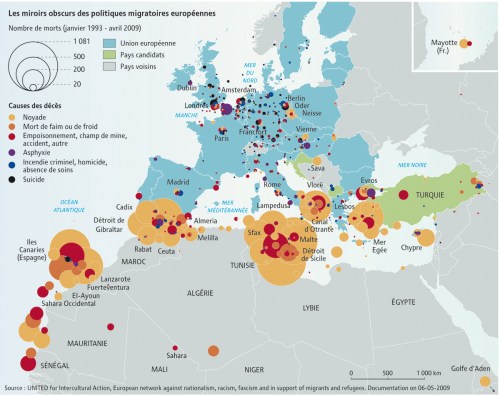
From OWNI.eu:  an interactive map showing the 14,000 persons who have died trying to reach Europe since 1988.  “[A]n interactive map as an electronic memorial for these tragedies.”

Click here for link.  The map copied below is not the new Interactive Map.  Click on link for the Interactive Map

Mourir aux portes de l’Europe (carte d’Olivier Clochard)

1 Comment

Filed under Aegean Sea, Data / Stats, Eastern Atlantic, English Channel / La Manche, European Union, Frontex, Mediterranean, News

UN OCHA Situation Report 4 on Libya / UNHCR Update

OCHA Situation Report 4 on Libya.  “HIGHLIGHTS/KEY PRIORITIES:

  • United Nations Secretary-General Ban Ki-moon convened a meeting of United Nations agencies and regional organizations to discuss a coordinated approach to the humanitarian situation in and around Libya. He intends to appoint a special envoy responsible for coordinating the relief effort;
  • According to IOM, 172,874 people, mainly migrant workers, have left Libya to date;
  • The OCHA-led joint United Nations rapid assessment reported little evidence of destruction between the Egyptian border and Benghazi. There are concerns over the implications a fuel-supply cut will have on the continuity of water and power supplies for critical infrastructure;
  • According to the Financial Tracking Service, US$35.6 million has been contributed and $10 million pledged from donors in response to the crisis.”

Click here for OCHA Situation Report.

Click here for OCHA Map and Data update.

UNHCR – “GENEVA, March 3 (UNHCR) – An operation to evacuate tens of thousands of people from the Tunisian border and fly them home was under way on Wednesday. Under a programme led by UNHCR and the International Organization for Migration (IOM), more than 50 flights were planned on Thursday to take migrant workers, mostly Egyptians, back home. UNHCR flew home 177 people to Egypt on a first flight Wednesday evening…..”

Click here for UNHCR update.

Leave a comment

Filed under Data / Stats, Egypt, Libya, Mediterranean, News, OCHA, Tunisia, UNHCR, United Nations

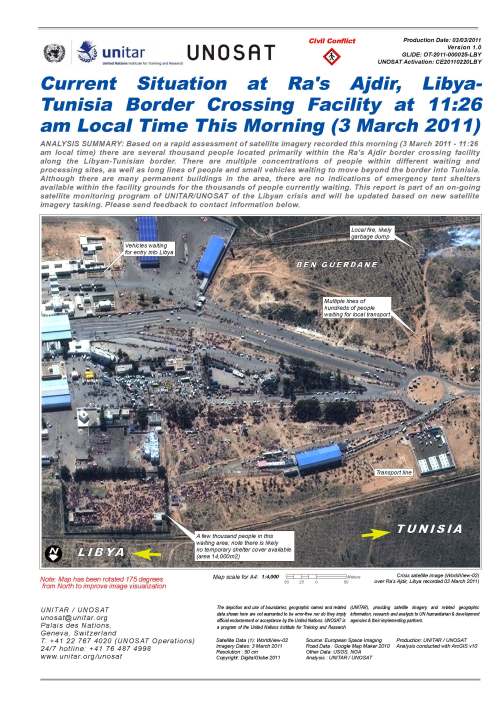
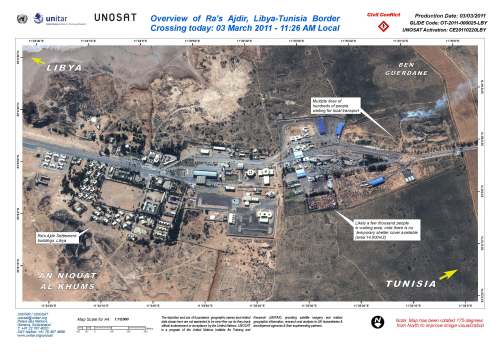
Satellite Imagery- Situation at Ra´s Ajdir, Libya-Tunisia Border Crossing Facility (3 MAR 2011)

From UNITAR/UNOSAT:  “Based on a rapid assessment of satellite imagery recorded this morning (3 March 2011 – 11:26 am local time) there are several thousand people located primarily within the Ra´s Ajdir border crossing facility along the Libyan-Tunisian border. There are multiple concentrations of people within different waiting and processing sites, as well as long lines of people and small vehicles waiting to move beyond the border into Tunisia. Although there are many permanent buildings in the area, there are no indications of emergency tent shelters available within the facility grounds for the thousands of people currently waiting. This report is part of an on-going satellite monitoring program of UNITAR/UNOSAT of the Libyan crisis and will be updated based on new satellite imagery tasking.”

Click on pictures below or here for links to images.


1 Comment

Filed under Data / Stats, Libya, Mediterranean, News, OCHA, Tunisia, United Nations

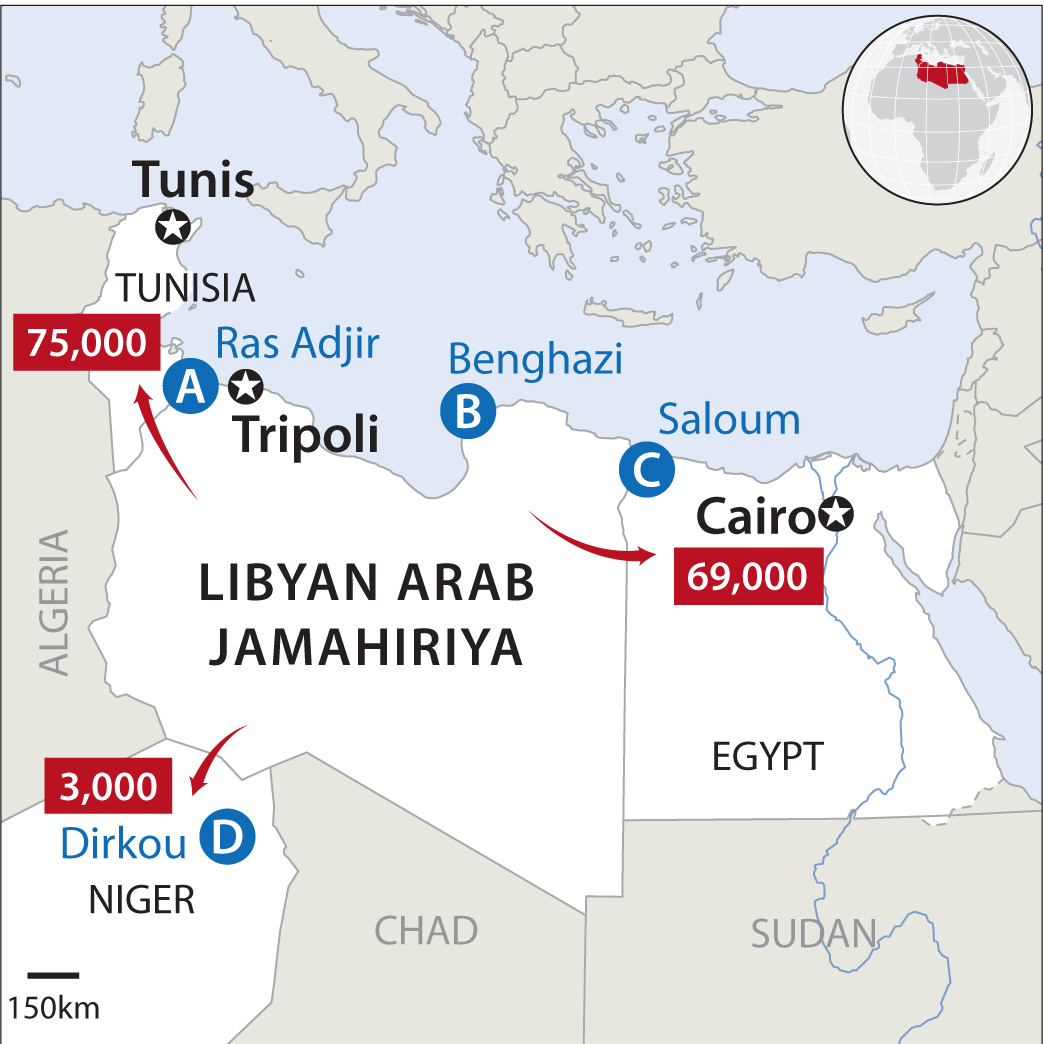
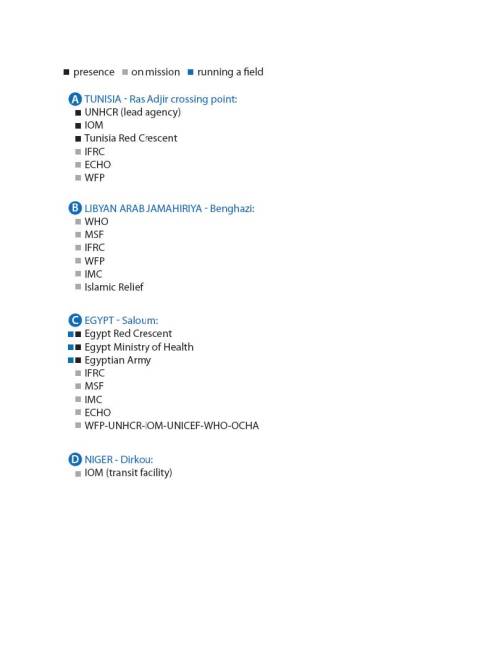
OCHA – Numbers of People Crossing into Neighbouring Countries from Libya

This report is produced by OCHA in collaboration with humanitarian partners. It was issued by Cairo and New York. It covers the period from 28 February to 1 March 2011.


IRIN - Numbers of People Crossing into Neighbouring Countries


Leave a comment

Filed under Data / Stats, Egypt, Libya, Mediterranean, Niger, Tunisia

Annual number of asylum applications in select countries, 2004-2009

From Migration Policy Institute’s MPI Data Hub: annual number of asylum applications in select countries.  I copied the data for years 2004-2009 below.  Click here for the data for the years 1980-2009, footnotes, and source information.

Countries of destination 2004 2005 2006 2007 2008 2009
Australia 3,201 3,204 3,515 3,980 4,771 6,170
Austria 24,634 22,461 13,349 11,921 12,841 15,830
Belgium 15,357 15,957 11,587 11,114 12,252 17,190
Canada 25,750 20,786 22,868 27,865 34,800 33,250
Denmark 3,235 2,260 1,918 1,852 2,360 3,750
Finland 3,861 3,574 2,324 1,505 4,016 5,910
France 58,545 49,733 30,748 29,387 35,404 41,980
Germany 35,613 28,914 21,029 19,164 22,085 27,650
Greece 4,469 9,050 12,267 25,113 19,884 15,930
Ireland 4,765 4,325 4,315 3,985 3,866 2,690
Italy 9,722 9,548 10,348 14,057 30,324 17,600
Netherlands 9,782 12,347 14,465 7,102 13,399 14,910
Norway 7,945 5,402 5,320 6,528 14,431 17,230
Spain 5,535 5,254 5,297 7,662 4,517 3,000
Sweden 23,161 17,530 24,322 36,373 24,353 24,190
United Kingdom 40,620 30,815 28,335 27,880 31,315 29,840
United States 44,972 39,240 41,101 40,449 39,362 38,968
             

Leave a comment

Filed under Australia, Belgium, Data / Stats, Denmark, European Union, France, Germany, Greece, Italy, Netherlands, Spain, Sweden, UK, United States

More Assets Dedicated to Frontex Joint Operation “Hermes Extension”; More EU and NATO Naval Forces Present in Central Mediterranean

The assets dedicated to Joint Operation Hermes Extension continue to increase, although at present there are only two coastal patrol boats (Italian) participating in the Frontex  mission.  Ten surveillance aircraft will soon be deployed.  See the table with the list of resources below.

While the naval assets dedicated to JO Hermes Extension are minimal, there is a growing number of EU and NATO naval ships in the Central Mediterranean.  Nicolas Gros-Verheyde (writing on the Bruxelles2 blog (FR)) has counted 14 naval ships from EU states that are present in the waters near Libya; the ships consist of destroyers, frigates, electronic surveillance ships, and supply and support ships.   Additionally, Turkey has two naval ships in the area.

Some of the naval ships have already been used to evacuate European and other non-Libyan nationals from Libya.  What additional activity the EU ships may engage in remains to be seen.  They may become involved in military activities (presumably with UN authority (?)) and/or they may play a yet undetermined role should there be a sudden flow of migrants and asylum seekers from Libya.  If there is a sudden and significant migratory flow, the naval ships should function in a search and rescue manner, but there is always the possibility that if faced with large numbers of migrants, the navy vessels may be used to interdict, blockade, or otherwise to try to prevent migrants from leaving Libya.

Click here for link to Frontex update regarding deployed assets.

Click here and here for Bruxelles2 postings. (FR)

Table: Resources available to JO Hermes Extension 2011 as of February 25, 2011.

Italy (HMS) 2 Coastal Patrol Vessel, 1 aircraft, 5 experts, 2 cultural mediators
Austria 1 expert
Belgium 2 experts
Denmark 3-5 experts
France 10 experts, 1 aircraft
Germany 2 experts, 2 aircrafts
Hungary 2 experts
the Netherlands 1 aircraft, 2 experts
Portugal 7 experts, 1 aircraft
Romania 6 experts
Sweden 1 expert
Switzerland 2 experts
Spain 4 experts, 1 aircraft (at a later stage)

Leave a comment

Filed under Algeria, Data / Stats, European Union, Frontex, General, Italy, Libya, Malta, Mediterranean, News, Tunisia

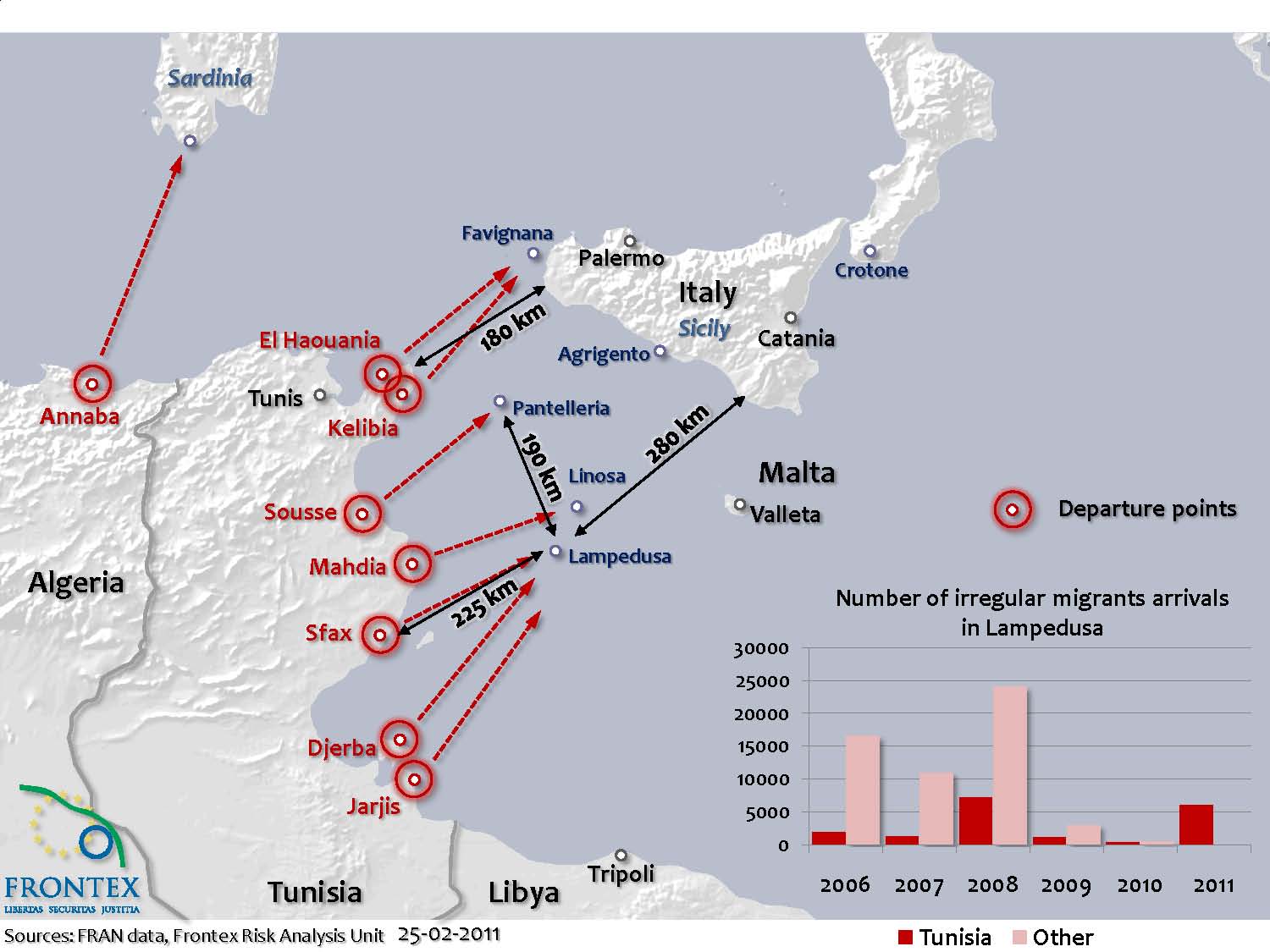
Frontex Lampedusa Situational Map

Frontex posted a situational map showing current and past information regarding migrant flows from Tunisia to Italy.  The map is dated 25 Feb. 2011.

1 Comment

Filed under Algeria, Data / Stats, European Union, Frontex, Italy, Malta, Mediterranean, News, Tunisia

94% Approval Rate for Refugee Status Claims Made by People Arriving by Boat in Australia

According to an article in The Australian, “the Immigration Department approved 94 per cent of all refugee status claims from people arriving illegally by boat, after initial assessments and independent merits reviews, between October 2008 and December 22 last year.  In stark contrast, the department approved only 39 per cent of protection visa requests for non-boat arrivals in the first half of this financial year…”  “South Australian independent MP Bob Such, who lodged the [Freedom of Information] request [which resulted in the release of the data], said the high number of successful refugee claims by people arriving by boat showed the federal government’s detention policies were ‘flawed’. ‘Not only is the current policy costly and harmful to their mental state, it’s costly to Australia,’ Dr Such said. ‘They’re spending hundreds of millions . . . on detaining people who are no threat at all.’…”

Click here for full article.

(As reported in the Human Rights Law Resource Centre (Australia) Human Rights News Stories for the week ending 25 February 2011.)

2 Comments

Filed under Australia, Data / Stats, Indian Ocean, News

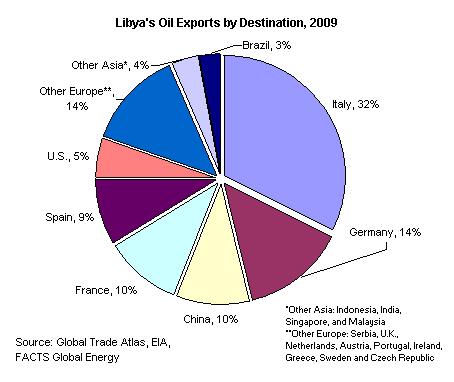
32% of Libya’s 2009 Oil Exports Went to Italy

From the US Energy Information Administration:

2009 Libyan Oil Exports:  “With domestic consumption of 280,000 bbl/d in 2009, Libya had estimated net exports (including all liquids) of 1.5 million bbl/d. According to 2009 official trade data as reported to the Global Trade Atlas, the vast majority of Libyan oil exports are sold to European countries like Italy (425,000 bbl/d), Germany (178,000 bbl/d), France (133,000 bbl/d), and Spain (115,000). With the lifting of sanctions against Libya in 2004, the United States has increased its imports of Libyan oil. According to EIA estimates, the United States imported an average of 80,000 bbl/d from Libya in 2009, up from 56,000 bbl/d in 2005 but, as a result of the U.S. economic downturn and subsequent decline in oil demand, 2009 levels were below 2007 highs of 117,000 bbl/d.”

Click here for link.

(HT to tweet by @johnwilcockson)

1 Comment

Filed under Data / Stats, European Union, France, Germany, Italy, Libya, Mediterranean, News, Spain

Frontex data showing migrant arrivals in Southern Italy as of 13 Feb

Frontex posted data on its web site summarizing migrant detections in southern Italy as of 13 February.  According to media reports, with the exception of a small number of Egyptians who landed in Sicily on Tuesday (it is unclear whether they sailed directly from Egypt), no North African migrants have landed in Italy since 14 February.

From Frontex:  “Warsaw, February 15—According to official data provided by Italian authorities, between January 1 and February 13, 2011, a total of 5526 migrants were recorded landing in the Pelagic Island, in a total of 116 incidents.  This compares to 7,200 for the whole of 2008, the peak year for arrivals of irregular migrants in these islands to date, when Tunisians were the most commonly represented nationality, accounting for 23% of arrivals. Of the official 2011 figures, by far the biggest influx was noted in Lampedusa, where 5031 migrants were recorded between January 1 and February 13, in 80 arrivals….  The table below gives a summary of detections in 2011 until February 13. ”

  Incidents Migrants

Landed

Male Female Minors Accom-panied minors Unacc-ompanied minors
Lampedusa and Linosa 80 5031 4944 18 69 0 69
Agrigento coast 3 20 20 0 0 0 0
Other places in Sicily 21 211 210 0 1 0 1
Apulia 3 57 43 2 12 6 6
Calabria 8 192 152 14 26 12 14
Sardinia 1 15 15 0 0 0 0
Total 116 5526 5384 34 108 18 90

Leave a comment

Filed under Data / Stats, Egypt, Frontex, Italy, Mediterranean, News, Tunisia

Malta Again Declines to Participate in Frontex Central Mediterranean Joint Operation

The Times of Malta reported on Friday that Malta has for the second consecutive year informed Frontex that it will not host or participate in joint sea patrols in the Central Mediterranean, saying that there is no need for the patrols given the drastic reduction in the number of boat people attributable to Italy’s push-back practice with Libya which has been in effect since 2009.  Only 47 migrants reached Malta in 2010 compared with 2,775 in 2008.  Frontex’s Central Mediterranean joint operation, referred to as Operation Nautilus (renamed Operation Chronos last year), has in past years operated during the summer sailing months when sea conditions are most favourable for small boats.

Last year Malta initially said that it would not host the joint operation due to the then recently approved guidelines governing Frontex enforcement operations at sea which required that intercepted migrants be taken to the country hosting the mission under certain circumstances.  A Maltese government spokesperson later said that the decision not to host the operation was not due to the new guidelines, but was due to Malta’s view that there was no longer a need for the operation because of the success of the Italy-Libya migration agreement. “The reason why we decided not to take part in [the 2010] mission is that we feel there is no need for this year’s EU patrol.  We have noticed that, following the introduction of joint patrols by Libya and Italy last year, the number of illegal immigrants reaching Malta has dropped significantly. We feel that, as long as this operation remains in place, there is no real need for another anti-migration mission on behalf of the EU.”

Click here for article.

See my previous posts:

Italy and Malta question need for Frontex sea patrols (9 July 2010)

Malta says Frontex Chronos Mission not needed due to success of Italy-Libya push-back agreement (29 April 2010)

2 Comments

Filed under Data / Stats, European Union, Frontex, Italy, Libya, Malta, Mediterranean, News

Frontex 3rd Quarter Report

On 16 January the Frontex Risk Analysis Unit released its Report for the Third Quarter of 2010 (July-Sept.).  The report contains data, charts, and graphs detailing detections of migrants, asylum seekers, false document use, detections of facilitators, and other information.  The deployment of Frontex’s RABIT force to the Greek-Turkey border did not begin until 2 November 2010, so the effects of the RABIT deployment do not appear in the Third Quarter.

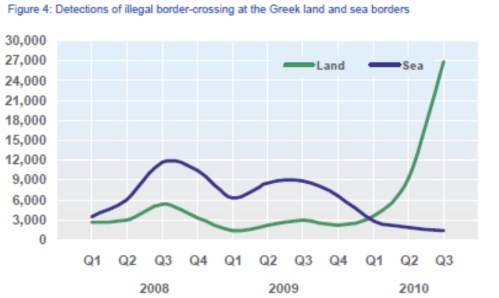
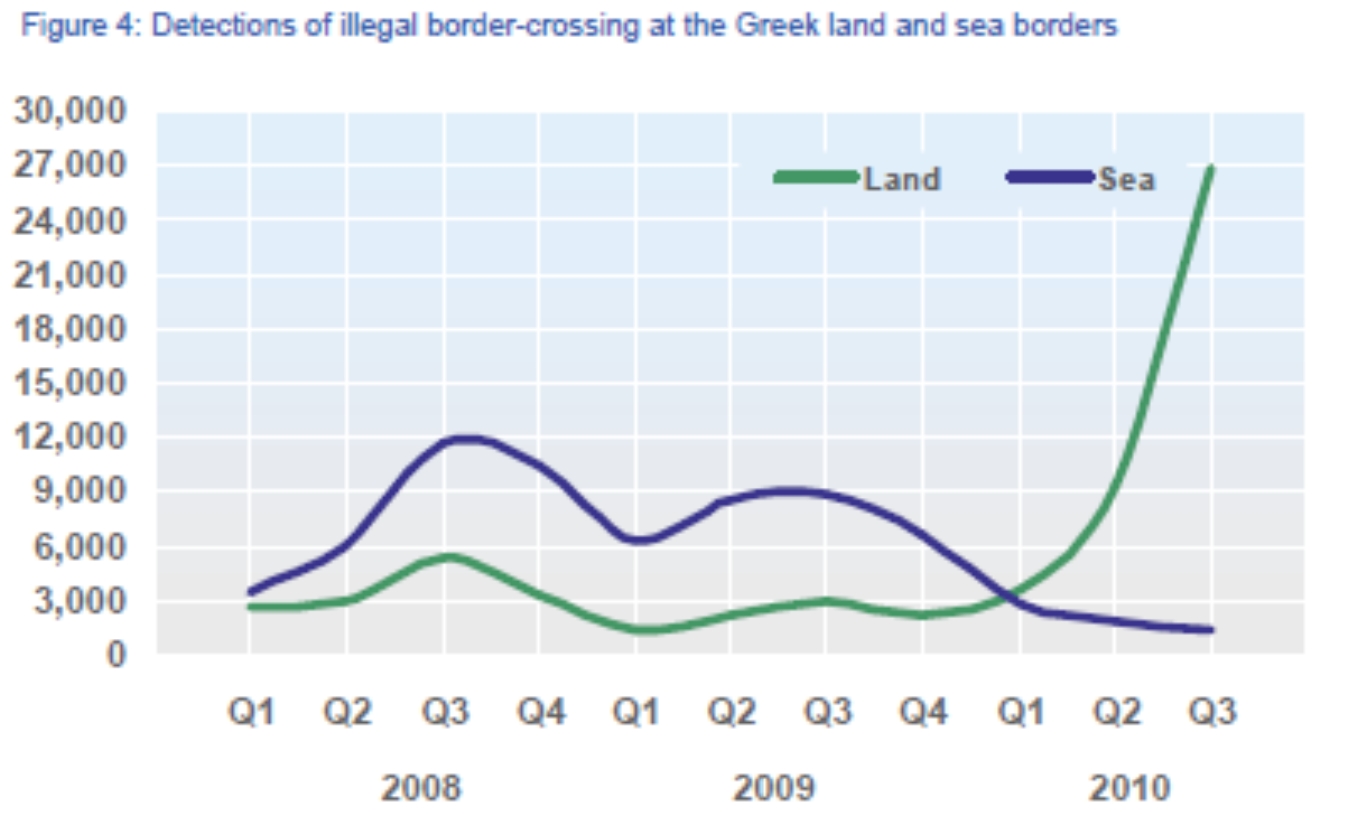
The Report notes that the “unprecedented peak in illegal border-crossings at the Greek land border with Turkey is the result of a shift from the sea to the land border” coupled with a “large increase in the absolute number of migrants” using Turkey as an EU entry point.  The Report states that there has been an eight-fold increase in the number Maghreb nationals detected at the Greek land border which “is thought to be the result of a displacement effect from the West Africa and Western Mediterranean routes.”

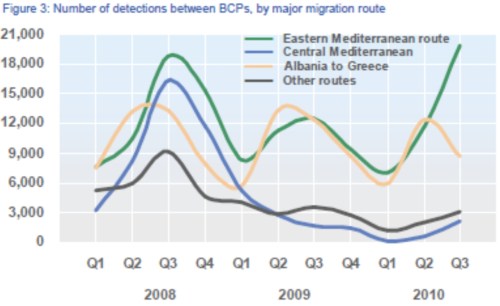
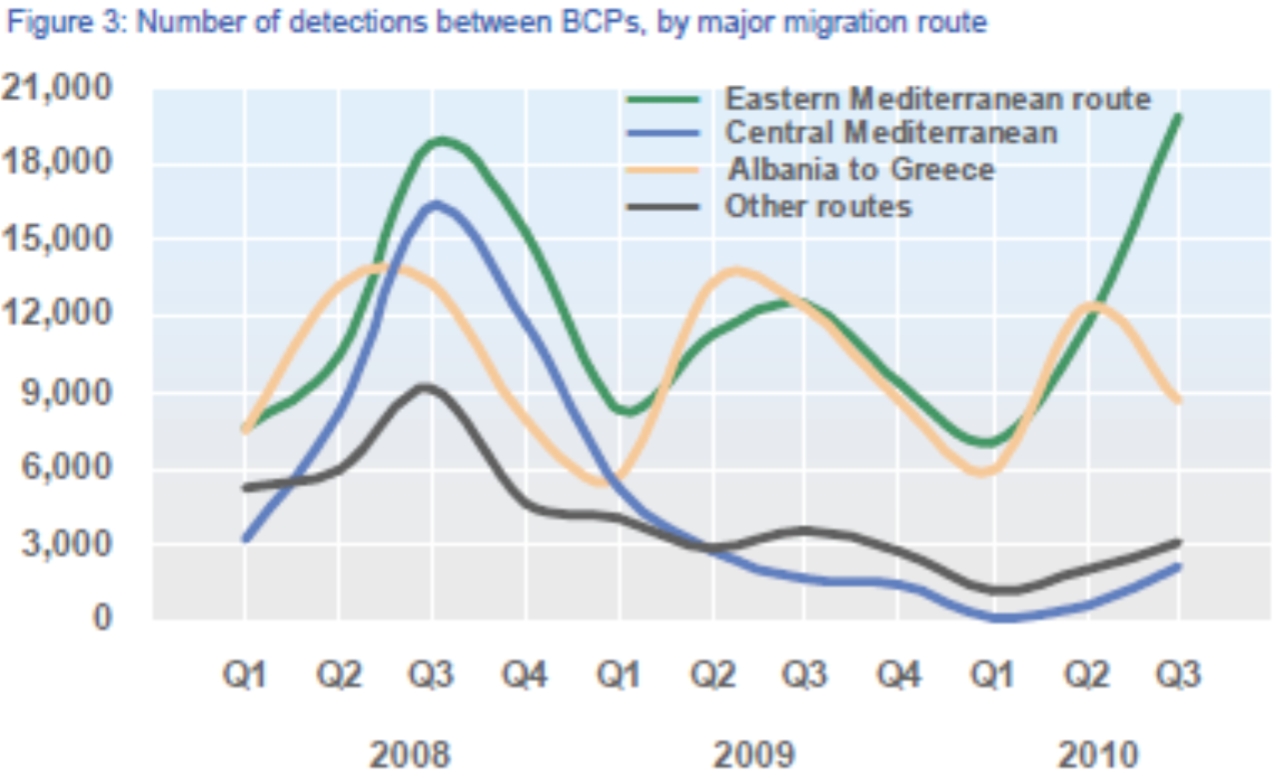
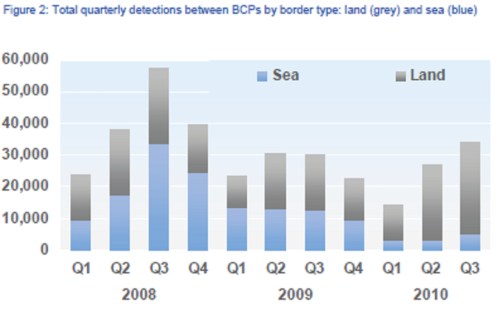
The Report also notes an increase in the number of detections on the Central and Western Mediterranean sea routes compared to Q2 which may be attributable to seasonal variations or “may be indicative of reorganized modi operandi in these areas in response to Frontex Joint Operations, more effective border controls and bilateral agreements implemented in 2008.”  See Figure 3 below.

Excerpts from the Report:

“Detections of illegal border-crossing”

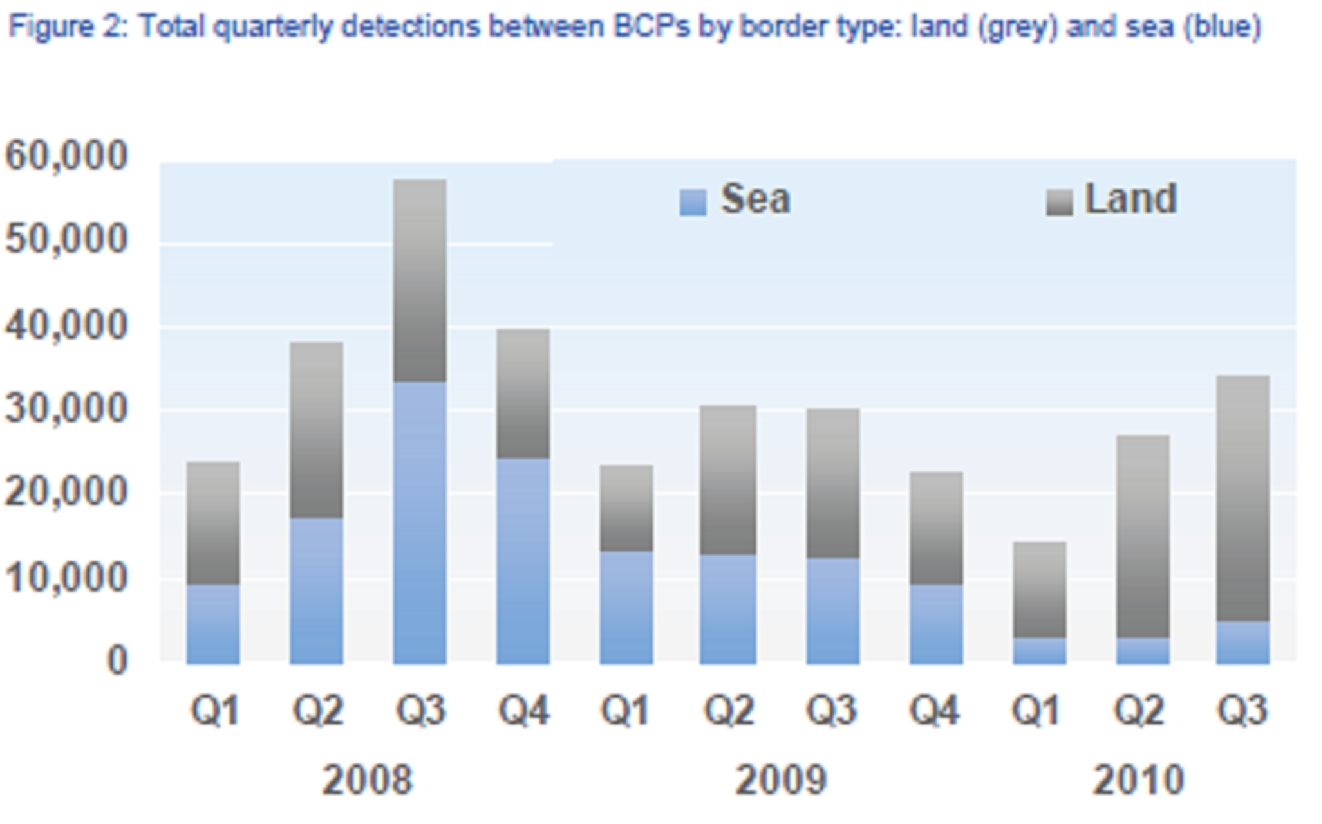
“…  Fig. 2 [see below] shows quarterly detections at the land and sea borders of the EU since the beginning of 2008. The 30% increase in the number of detections between the previous and present quarters is comprised of a 60% increase at the sea borders (although from a lower base) and a 23% increase at the land borders. This means that the shift from sea to land borders has not continued to same extent as in the previous quarters.  Nevertheless in Q3 2010, there were some 29 000 detections of illegal border-crossing at the external land border of the EU, which constitutes 85% of all the detections at the EU level, and the highest number of detections at the land border since data collection began in early 2008….”

“Eastern Mediterranean route”

The Report observes that there has been a shift in illegal crossings from the Greece-Turkey maritime border to the Greece-Turkey land border and notes an increase in the number of nationals from Maghreb countries apprehended at the Greece-Turkey land border.  “This route [being taken by Maghreb nationals] is very indirect, but is thought to be the result of a displacement effect from the West Africa and Western Mediterranean routes….”

See Figure 4 below which shows that detections of illegal border crossers at the land border of Greece have exceeded detections at the sea border since Q1 of 2010.

“Central Mediterranean route”

“There were 2 157 detections of illegal border-crossing during Q3 2010. This is more than a three-fold increase compared to the previous quarter and a third higher than the same period last year. However despite this apparently large increase, detections still remain massively reduced compared to the peak of around 16 000 during the same period in 2008 (Fig. 3)….”

“The JO Hermes 2010 which was operational between June and October 2010, focused on illegal migratory flows departing from Algeria to the southern borders of the EU, specifically to Sardinia. In 2010, there were fewer detections than in previous years….”

“Departures from Libya also remained low. In June 2010, a new law was implemented to serve more severe punishments for facilitating illegal immigration. Ambassadors of the countries of origin were called into the Ministry of Foreign Affairs in Tripoli to be informed about the consequences of the new law, which suggests that this may be a serious implementation.”

“Western Mediterranean route”

“In general, irregular immigration to southern Spain has decreased massively since the beginning of 2006. However, in Q3 2010 there were 2 200 detections of illegal border crossing in the Western Mediterranean, more than twice that of the previous quarter and around a third higher than the same period in 2009. There is growth in the number of detections of a wide range of African nationalities, nine of which more than doubled in number between Q2 and Q3 2010. The most detected nationalities were Algerian, Moroccan, Cameroonian and Guinean.”

“Western Africa route”

“The cooperation and bilateral agreements between Spain and the rest of the Western African countries (Mauritania, Senegal and Mali) are developing steadily, and are one of the main reasons for the decrease in arrivals, as is the presence of patrolling assets near the African coast.”

“According to data collected during JO Hera, the numbers of arrivals in the Canary Islands and detections in West Africa are very low compared to the same time last year. The main nationality and place of departure is from Morocco, to where migrants are returned within a few days.”

Click here for the 3rd Quarter 2010 Report.

Click here for the 2nd Quarter 2010 Report.

Click here for the 1st Quarter 2010 Report.

Click here for my previous post regarding the 2nd Quarter Report.


Leave a comment

Filed under Aegean Sea, Algeria, Data / Stats, Eastern Atlantic, European Union, Frontex, General, Greece, Italy, Libya, Malta, Mauritania, Mediterranean, Morocco, News, Reports, Senegal, Spain, Tunisia, Turkey

INEX Report and Interview with Frontex Director Laitinen

A final report prepared as part of the INEX Work Package 3 “Value Dilemmas of Security Professionals” has just been released.  The Report is entitled “Ethical Security in Europe? Empirical Findings on Value Shifts and Dilemmas across European Internal-External Security Policies.”  The report’s authors are Dr. Matteo Tondini and Dr. Isabelle Ioannides.  The report contains extensive empirical findings and policy recommendations that are based primarily on two case studies: “the recent interception of migrants in the Central Mediterranean Sea undertaken by the Italian authorities” and “the implementation of anti-terrorism/radicalisation measures in the Netherlands and the UK.”

The report contains a significant amount of information which will be of interest to anyone concerned with migrant interdiction practices in the Mediterranean (and elsewhere).  I will try to post a few summaries of some portions of the report in the coming days, but in the meantime I wanted to call attention to an interview that was conducted in May of this year by Dr. Tondini with Frontex Executive Director Ilkka Laitinen as part of the research project.  A transcript of the interview is included in the report. [INEX Laitinen Interview 12May2010]

In the interview Mr Laitinen said that contrary to the information contained in the Human Rights Watch Report of 21 September 2009, Frontex had no involvement in the 18/19 June 2009 incident where Italian and Libyan authorities jointly intercepted and returned a group of migrants to Libya.  He noted that the recent agreements between Libya and Italy had closed the central Mediterranean migration route and that it is therefore now “the right moment for the Agency to intervene, with the aim of consolidating the results achieved so far … The only way of doing this is to cooperate with neighbouring countries such as Libya.”  And while Mr Laitinen stated that the “respect of fundamental rights is a crucial part of the European border control service” he also stated that “the right of boat people to claim asylum or other forms of protection outside [Member States’] territorial waters is not yet acknowledged Europe-wide.”  In response to this latter point, Dr. Tondini pointed out that it is the position of the Italian government that if an asylum claim is made on board an Italian vessel, the asylum seeker is supposed to be transported to Italy for the purpose of making a formal claim.

(Thank you to Matteo Tondini for sharing the Report.)

Click here for the final Report.

Click on this link- INEX Laitinen Interview 12May2010 -for the transcript of the Interview.

1 Comment

Filed under Analysis, Data / Stats, European Union, Frontex, Italy, Libya, Mediterranean, Reports

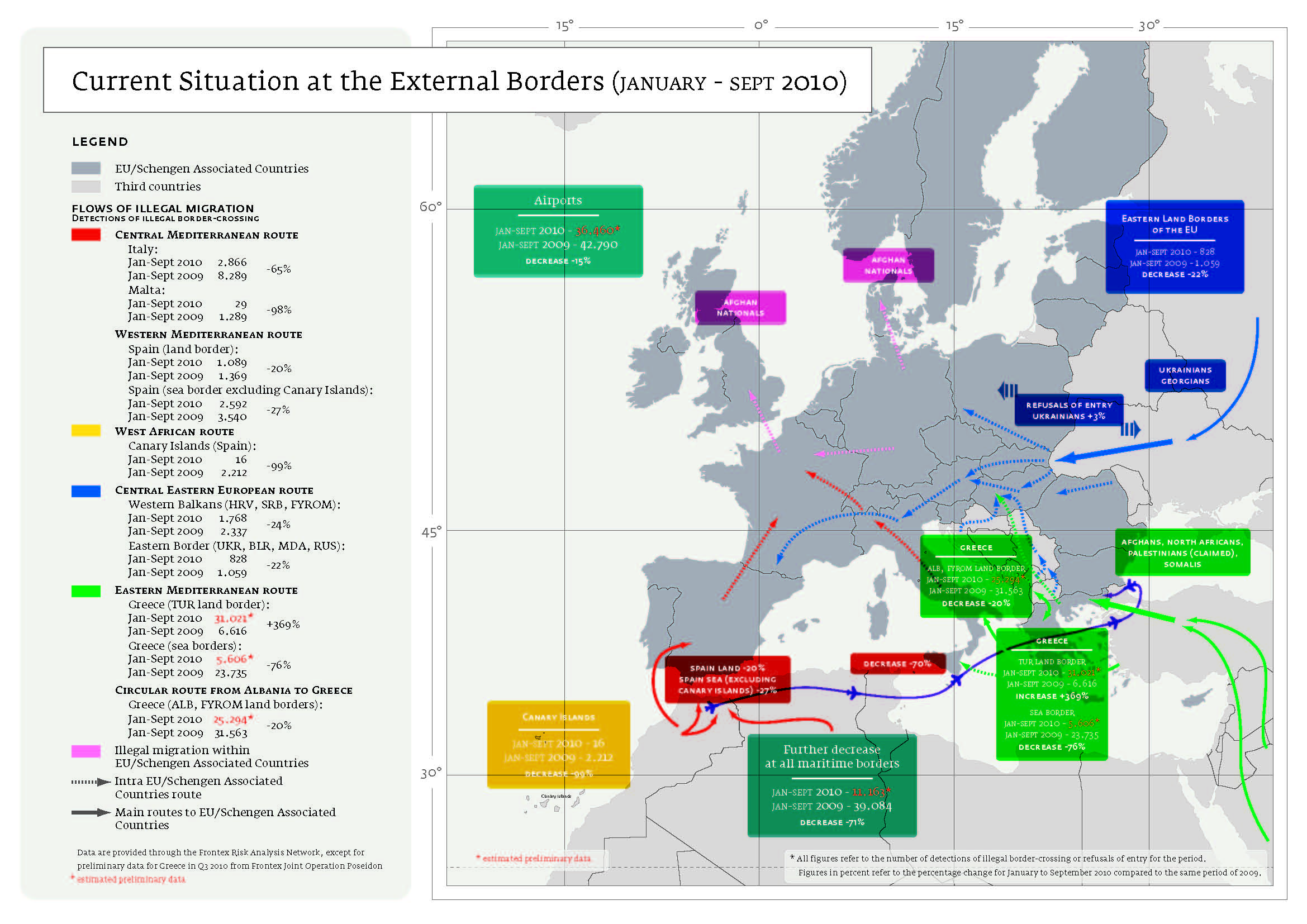
Frontex Map: Current Situation at the External Borders (JANUARY – SEPT 2010)

Frontex has released an updated Third Quarter map, January-September 2010, showing data regarding the situation at the external borders.   Note the information on the map pre-dates the deployment of the Frontex RABIT forces to the Greek border in October/November.  The data shows a 369% increase in detected irregular crossings along the Greek-Turkey land border over the first three quarters of 2010 compared to 2009.

The significant reduction in migrants detected at maritime borders continues:

  • Jan-Sept 2010:   11.163 (estimated preliminary data)
  • Jan-Sept 2009:   39.084
  • 71% reduction

Data by route:

Central Mediterranean route

  • Italy:
    • Jan-Sept 2010:     2.866
    • Jan-Sept 2009:    8.289
    • 65% reduction
  • Malta:
    • Jan-Sept 2010:    29
    • Jan-Sept 2009:    1.289
    • 98% reduction

Western Mediterranean route

Spain (land border):

  • Jan-Sept 2010:   1.089
  • Jan-Sept 2009:   1.369
  • 20% reduction

Spain (sea border excluding Canary Islands):

  • Jan-Sept 2010:   2.592
  • Jan-Sept 2009:   3.540
  • 27% reduction

West African route – Canary Islands (Spain):

  • Jan-Sept 2010:   16
  • Jan-Sept 2009:   2.212
  • 99% reduction

Eastern Mediterranean route

Greece (TUR land border):

  • Jan-Sept 2010:   31.021 (estimated preliminary data)
  • Jan-Sept 2009:   6.616
  • 369% increase

Greece (sea borders):

  • Jan-Sept 2010:   5.606 (estimated preliminary data)
  • Jan-Sept 2009:   23.735
  • 76% decrease

Click here to view Jan-Sept 2010 Map.

Click here for link to Jan-June 2010 Map.

Click here for link to 2009 Map.

1 Comment

Filed under Aegean Sea, Data / Stats, Eastern Atlantic, European Union, Frontex, Greece, Italy, Libya, Malta, Mediterranean, News, Spain, Turkey

Israel Begins Construction of Border Fence to Block African Migrants

Israel today begins the construction of a 250 km border fence along portions of its border with Egypt.  The barrier is primarily designed to prevent the entry into Israel of African migrants and asylum seekers.  Prime Minister Benjamin Netanyahu is quoted as saying that “Peace does not include the flood of illegal infiltrators, who come from Africa through Sinai … This is a blow which our neighbours in Egypt are also suffering from.”

The Israeli Interior Ministry reported that on average on a weekly basis 1,100 irregular migrants enter Israel along its southern border with Egypt.  The Ministry reported that over 10,000 such migrants have entered Israel in this manner so far in 2010 compared with 4,431 for all of 2009.

The construction project will take at least one year to complete and will include sensors and other devices designed to detect persons along the border.

One effect of such a fence will be the diversion of migrants and asylum seekers who will either attempt to cross at unfenced portions of the border or pursue new destinations, with or without the assistance of human traffickers.

Click here, here, and here for articles.

Click here for the Association for Civil Rights in Israel “Refugee and Asylum-Seeker” Fact Sheet.

Leave a comment

Filed under Data / Stats, Egypt, Israel, News