Category Archives: Statements

NGOs Urge EU to Respect Refugee Rights

ECRE, CEAR, and Amnesty International have released a joint statement urging EU governments to respect refugee rights as efforts are made to strengthen Frontex.

“Bjarte Vandvik, ECRE Secretary General said: ‘States have a legitimate right to control their borders, but this is not an excuse to ignore the fact that persons fleeing war or persecution are entitled to protection under international, European and national laws. As Frontex is being strengthened, its operations need to be monitored to ensure that human rights are respected’.”

“Regardless of where border controls take place and of who implements them, methods to prevent unauthorized entry must leave room for the identification of persons in need of international protection so they are not returned to any country where they will face persecution. Member States’ obligations under international and European refugee and human rights law do not stop at the physical boundaries of the EU. This responsibility is not only moral and political but also legal. EU Member States cannot abdicate their principles, values and commitments by doing outside their borders what would not be permissible in their territories.”

Click here for full statement.

Leave a comment

Filed under Aegean Sea, Eastern Atlantic, European Union, Frontex, Mediterranean, Statements

Frattini, Ministre des Affaires étrangères: l’Italie est le pays le plus engagé à sauver la vie de ceux qui sont en danger en Méditerranée

Discours de Franco FRATTINI Ministre des Affaires étrangères de l’Italie le 26 janvier à l’occasion de la 1ère partie de la session ordinaire de 2010 de l’Assemblée parlementaire du Conseil de l’Europe (Strasbourg, 25-29 janvier 2010).

(Extrait du compte-rendu des débats)

M.. FRATTINI, ministre des Affaires étrangères de l’Italie (Interprétation):

“[***] [L]’immigration peut et doit être gérée pour bénéficier de toutes ses potentialités, minimiser le risque des chocs sociaux, et pour encourager au mieux une insertion harmonieuse des nouveaux arrivants dans nos pays.

Pour l’Italie, cela signifie qu’il convient d’adopter une double approche. Il convient d’un côté de lutter avec détermination, contre l’immigration clandestine, de l’autre, de gérer les flux migratoires, tout en définissant une stratégie à long terme pour préparer les parcours d’intégration des migrants en situation régulière.

Nous savons que les flux migratoires qui viennent de l’Afrique par la Méditerranée vers l’Europe représentent l’un des problèmes les plus complexes les plus urgents et les plus dramatiques de notre époque.

Ce défi exige une approche moderne qui tienne compte de l’aspect multidimensionnel de l‘immigration il suppose que tous les acteurs impliqués prennent leurs responsabilités : pays d’origine, pays de transit et pays de destination. En d’autres termes, il convient de mettre en place un véritable partenariat entre l’Europe et, principalement, les pays africains.

La question de l’immigration doit être abordée avec un mélange de fermeté et de sens de l’accueil, dans le plein respect de la légalité et des droits de l’homme, un respect profond pour les droits fondamentaux des migrants. Je dois dire que les opinions publiques européennes ne sont pas toujours pleinement informées du fait que l’Italie est une plate-forme facile à atteindre pour les immigrés clandestins et que lorsque nous accueillons des immigrés, c’est au nom de tous les pays de l’Union européenne. Nous sommes la porte de l’Europe.

C’est la raison pour laquelle l’Italie, malgré quelques vaines tentatives de communication, peut proclamer qu’elle est le pays qui s’est le plus engagé à sauver la vie de ceux qui sont en danger en Méditerranée, – et elle continuera de le faire.

Entre 2008 et 2009, nous avons secouru en mer plus de 40 000 migrants. Mais nous devons faire preuve de la plus grande sévérité à l’encontre des trafiquants d’êtres humains, car ces personnes étaient pour la grande majorité victimes d’un trafic bien organisé, nouvel esclavage du XXIe siècle.

Nous devons donc travailler sur la prévention, en encourageant le développement des pays d’origine. C’est ce que nous avons fait en situant l’Afrique parmi les priorités de la politique étrangère de l‘Italie.

La politique qui vise à gérer ce phénomène si complexe ne peut pas relever uniquement des pays qui sont le plus directement exposés en raison de leur situation géographique. C’est la raison pour laquelle l’Italie insiste pour que l’Europe s’engage davantage sur la question de l’immigration en Méditerranée. L’Union européenne doit faire plus et aborder ce défi dans un esprit de véritable solidarité entre les Etats membres. Une décision récente de l’union européenne, l’approbation du programme « Justice, liberté et sécurité », dénommé le programme de Stockholm, est un pas dans la bonne direction.

Les propositions de l’Italie ont été acceptées. Elles visaient à renforcer l’Agence Frontex, à mettre en place un Office européen de l’asile, à instaurer un régime commun d’asile dans le cadre européen et à développer la protection internationale en dehors du territoire européen. Enfin, l’initiative italienne visait à instaurer une coopération accrue avec les pays de la rive sud de la Méditerranée.  [***]”

Click here for full French text.

Click here for partial English translation of text.

Leave a comment

Filed under Council of Europe, Italy, Mediterranean, Statements

Hammarberg: Criminalising migration is the wrong answer to a complex social phenomenon

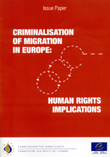
“‘Criminalising the irregular entry and presence of migrants in Europe corrodes established international law principles and causes many human tragedies without achieving its purpose of genuine control’ said Thomas Hammarberg, the Council of Europe Commissioner for Human Rights, presenting today in Brussels an Issue Paper on this topic.

‘I have observed with increasing concern this trend as part of a policy of migration management’ he said. ‘States have a legitimate interest to control their borders, but criminalisation is a disproportionate measure which causes further stigmatisation and marginalisation of migrants. Immigration offences should remain administrative in nature.’

This Issue Paper builds upon these concerns and examines systematically the human rights implications of the criminalisation of migration in Europe. It analyses the external border crossing, migrants’ residence and protection of their social rights including employment, as well as asylum and detention.

It concludes with a number of recommendations to Council of Europe member states, as a starting point to ensure the correct intersection of human rights standards and the treatment of foreign nationals.

Issue Papers are commissioned and published by the Commissioner for Human Rights for the purpose of contributing to debate or further reflection on a current and important human rights matter. The full text is available on the Commissioner’s web-site.”

Click here for Issue Paper.

Leave a comment

Filed under Council of Europe, Reports, Statements

France: Le droit d’asile à nouveau bafoué

“Les organisations soussignées dénoncent l’arrestation et les mesures d’expulsion (reconduite à la frontière) prises à l’encontre de la centaine d’exilés débarqués le 22 janvier à Bonifacio (Corse). Dès leur prise en charge dans un gymnase de la ville réquisitionné, ils ont été détenus, sans pouvoir recevoir devisite, hormis les personnes introduites par la police pour une assistance humanitaire, jusqu’à leur transfert – certains d’entre eux menottes aux mains – par autocar le lendemain, 23 janvier, vers des avions qui les ont conduits dans des centres de rétention administrative (CRA) – éparpillés sur le continent, où ils étaient toujours privés de liberté. Les demandeurs d’asile ont droit au séjour provisoire le temps qu’il soit répondu à leur demande. La France est signataire de la Convention de Genève sur les réfugiés, qui la lie, et interdit les mesures de renvoi dans leur pays d’origine qui ont pourtant été immédiatement prononcées. …”

Signataires : L’ADDE, Amnesty International France, L’ANAFÉ, European Legal Network for Asylum (ELENA), Le GISTI, La LDH, Le SAF, Le SM

Click here for full statement.

Leave a comment

Filed under France, Mediterranean, Statements

La Réponse d’Eric Besson au Débarquement en Corse

Conclusions de la réunion interministérielle du 25 janvier 2010:

“[Le débarqument en Corse] souligne une fois de plus l’urgence de mettre fin au trafic d’êtres humains en Méditerranée. Comme des centaines d’autres chaque année, les étrangers qui ont débarqué en Corse auraient pu perdre la vie dans leur dangereux périple.

La lutte contre les filières d’immigration clandestine nécessite de nouvelles mesures aux plans national, européen et international. J’ai donc pris les décisions suivantes :

1. Renforcer le contrôle de nos frontières nationales.

· La lutte contre l’immigration irrégulière constituera une priorité de la nouvelle fonction « gardes-côtes » créée par le comité interministériel de la mer du 8 décembre 2009.

– Dans les prochains jours, je soumettrai au Premier Ministre des propositions pour que la lutte contre les filières d’immigration clandestine soit placée au centre de l’action de l’Etat en Mer, sous l’autorité du Secrétaire général de la Mer et des préfets maritimes.

– Afin d’assurer la continuité des opérations en mer et à terre, je proposerai au Ministre de l’Intérieur que la direction centrale de la police aux frontières et la direction générale de la gendarmerie nationale participent au centre opérationnel de la fonction « gardescôtes ».

2. Renforcer le contrôle des frontières européennes.

· Dès le 22 janvier, j’ai demandé à la présidence espagnole de l’Union Européenne d’organiser un sommet de crise sur la lutte contre l’immigration irrégulière en Méditerranée. Tous les ministres des pays méditerranéens de l’Union Européenne m’ont immédiatement apporté leur soutien. Je souhaite que ce sommet prenne des décisions concrètes et immédiates pour :

– Généraliser les patrouilles conjointes entre pays riverains de l’Union Européenne en Méditerranée, sur le modèle de ce que nous mettons en oeuvre à terre dans le cadre du traité de Prüm.

– Déployer des renforts opérationnels européens sous l’égide de Frontex.

– Mettre en oeuvre de nouvelles capacités d’analyse des flux d’immigration irrégulière en Méditerranée.

· Afin d’avancer vers la création d’une police aux frontières européenne, j’ai présenté à l’ensemble des ministres européens, le 21 septembre 2009, un plan d’action pour le renforcement de l’agence européenne Frontex :

– Adoption de nouvelles règles d’engagement maritime tournées vers l’interception et la reconduite.

– Création d’un bureau de coordination des opérations de Frontex en Méditerranée.

– Renforcement de la coopération avec les Etats de transit, notamment pour l’organisation de patrouilles conjointes.

– Organisation de vols groupés pour des opérations de reconduite conjointes au niveau européen.

– Mise en place d’un programme européen de formation des gardes frontières.

En vue d’accélérer la mise en oeuvre de ce plan d’action dans le prolongement des décisions

prises par les Chefs d’Etat et de Gouvernement européens le 30 octobre dernier, je rencontrerai prochainement, avec Pierre Lellouche, la nouvelle commissaire européenne en charge des affaires intérieures, Mme Cécilia Malmström.

3. Développer le renseignement pour démanteler les filières internationales de l’immigration clandestine.

En accord avec les Ministres de l’Intérieur et de la Défense :

· J’inviterai chaque mois le directeur général de la sécurité extérieure et le directeur central de la police aux frontières, ainsi que le coordonnateur national du renseignement, à participer à un groupe « renseignement contre les filières d’immigration irrégulière » que je présiderai.

· Au cours des prochains mois, l’Office Central pour la Répression de l’Immigration irrégulière et de l’Emploi d’Etrangers Sans Titre (OCRIEST) généralisera ses coopérations avec les principaux pays d’origine des filières, en vue de s’attaquer à ces réseaux criminels à la source.

4. Enfin, je présenterai devant le Conseil des ministres, avant la fin du premier semestre 2010, un projet de loi sur l’immigration, qui comportera de puissantes mesures de lutte contre les filières clandestines.

Ce projet de loi prévoira en particulier des règles particulières permettant de mieux faire face à des situations d’urgence comme celle que nous avons vécue le 22 janvier à Bonifacio, mais aussi des mesures de dissuasion, comme l’interdiction de retour sur l’ensemble du territoire européen pendant une durée de 5 ans pour toutes les personnes ayant fait l’objet d’une mesure de reconduite.”

Click here for full document.

Click here for Le Point article.

Leave a comment

Filed under European Union, France, Frontex, Mediterranean, Statements

Besson appelle l’UE à accélérer le renforcement de l’agence européenne Frontex et la surveillance des frontières européennes

“Les corps de neuf migrants morts noyés en tentant de gagner la Grèce à partir de la Turquie ont été découverts depuis cinq jours au large du port grec d’Alexandroupolis….

“Alors que les frontières extérieures de l’Union Européenne sont soumises en Grèce à une pression sans précédent des filières d’immigration irrégulière, plus de la moitié des entrées illégales dans l’espace Schengen ayant été enregistrées en 2009 à la frontière turco-grecque, Eric BESSON appelle l’Union Européenne à renforcer la surveillance des frontières européennes notamment en Méditerranée.

“Eric BESSON interviendra dans les prochains jours auprès du Commissaire européen chargé de l’immigration pour demander que les décisions prises par les Chefs d’Etat et de Gouvernement européens pour le renforcement de l’agence européenne Frontex soient mises en oeuvre sans délai.

“Ces décisions, adoptées sur proposition de la France par le Conseil européen du 30 octobre 2009, portent en particulier sur :

  • L’adoption de règles d’engagement claires pour les opérations de contrôle maritimes.
  • Une coopération opérationnelle accrue entre Frontex et les pays d’origine et de transit, notamment la Libye et la Turquie.
  • La possibilité d’affréter régulièrement des vols conjoints financés par Frontex pour des opérations groupées d’éloignement au niveau européen.

“Eric BESSON demandera également que la coopération de la Turquie dans la lutte contre les filières d’immigration irrégulière soit placée au centre des relations entre l’Union Européenne et ce pays.

“Eric BESSON proposera enfin à la présidence espagnole de l’Union Européenne que la prochaine réunion des Ministres européens en charge de l’immigration, le 21 janvier à Tolède, permette de définir une feuille de route précise pour l’application des décisions du Conseil européen et les relations avec la Turquie dans le domaine de la circulation des personnes.”

Click here for full Statement.

Leave a comment

Filed under Aegean Sea, European Union, France, Frontex, Greece, Mediterranean, Statements, Turkey

NGO Asylum Good Practice Recommendations to Spain, Belgium, and Hungary

CEAR (Spanish Refugee Council), the Flemish Refugee Action (Vluchtelingenwerk Vlaanderen), CIRE (Coordination et Initiatives pour Réfugiés et Etrangers),and the Hungarian Helsinki Committee (Magyar Helsinki Bizottság) have made a series of good practice recommendations to Spain, Belgium and Hungary.  These three countries are “the new Trio of States that will hold the Presidency of the European Union from January 2010 until June 2011, a crucial moment for the development of the EU policy and legislation in the field of asylum … The Trio will therefore play a key role in [the] implementation [of the Stockholm Programme] … The aim of [the recommendations is ] to complement ECRE’s positions and identify, from a more national perspective, those issues where the often diverse experiences of Spain, Belgium and Hungary can be employed to effectively address some of the main shortcomings of asy­lum systems in Europe.”

“As a general recommendation we urge the Trio of States to join their efforts in ensuring that the second phase of the Common European Asylum System will translate the best practices and highest protec­tion standards of the Member States’ national laws into EU legislation. The harmonisation on minimum standards, too often resulted in the lowest common denominators, should not be repeated.”

“[I]t must also be noted that in recent years a worrisome tendency has developed towards the exter­nalisation of responsibility for asylum claims outside the EU to neighbouring third countries. In this respect we recommend the Trio of States to support cooperation with third countries aimed at reinforcing their protection system. At the same time we urge the Trio of States to take a strong and clear position to make sure such cooperation does not become a way for the EU to escape its responsibility to protect under international and EU law.”

Click here for full document.

Leave a comment

Filed under Belgium, European Union, Hungary, Spain, Statements

EMHRN Recommendations to the Incoming Spanish EU Presidency

The Euro-Mediterranean Human Rights Network (EMHRN) has conveyed a series of recommendations to the new Spanish EU Presidency regarding the Union for the Mediterranean and the European Neighbourhood Policy.

Relevant excerpts include:

“Migration and Asylum

[***]

In relation to asylum, the EMHRN wishes to underline the following elements:

Refugees and asylum seekers face great difficulties when trying to reach safe havens in the EU.  Due to push back operations and severe, indiscriminate border control policies, including EU supported operations in third countries, asylum seekers often find themselves trapped in North Africa and in the Middle East (MENA), that do not offer them any sort of protection despite the presence of the UNHCR.

Several countries of the region have not yet ratified the 1951 Geneva Convention on the status of refugees and none of the countries from the region has a proper asylum system. Refugees and asylum seekers face extreme vulnerability and are often prevented from accessing their most basic rights. …

In relation to border control, the EU and its member states are keen on promoting cooperation with third countries with the purpose of better controlling migratory flows. It remains that the EU has, until now, failed to properly integrate a human rights dimension to such cooperation policies.

Most countries of the region criminalize irregular migration. Migrants are being arbitrarily arrested and put in detention, with no possibility of appeal. They may face ill treatment and unlawful deportation.

The conclusion of readmission agreements is promoted by the EU and its members. Negotiations have been ongoing for several years between the EU and Morocco to conclude such an agreement. A mandate has also been given by the Member states to negotiate an agreement with Algeria.

The EMHRN believes that returning migrants to countries other than their own, or to countries where they have no anchor and no legal residency, may put them in danger.

Push back and interception operations, including at sea, are other policy instruments promoted by the EU and its member states. Several of these operations have resulted in endangering the security of migrants and asylum seekers and may have resulted in a violation of the ‘non refoulement’ principle.

The EMHRN acknowledges the right of a state to control its borders. However, the EMHRN calls on the Spanish Presidency to actively promote policies ensuring that

  • • cooperation with third countries from the region does not endanger migrants and refugees.
  • •cooperation policy in the field of border management considers the impact of such measures on the access of refugees to international protection mechanisms, including in Europe.
  • • the EU member states strictly respect the principle of ‘non refoulement’ as well as their obligation under article 3 of the European Convention on Human Rights (ECHR).
  • no person is returned to a country other than its own or where he/she has no legal residency.”

Click here for full recommendations.

Leave a comment

Filed under European Union, Mediterranean, Spain, Statements

UNHCR Migration and Border Recommendations to the Incoming Spanish EU Presidency

UNHCR’s recommendations to the Spanish EU presidency include the following”

“Migration and border management

Spain has affirmed that reinforcing Frontex and ensuring that EU migration policy is accompanied by close cooperation with migrants’ countries of origin and transit will be priorities of its Presidency. A review of the Frontex mandate will take place in 2010.

UNHCR encourages the Spanish Presidency to pursue its migration agenda with due regard for international refugee and human rights norms. This includes:

a) Inclusion of refugee protection safeguards in migration control measures generally;

b) Development of clear guidance with respect to the disembarkation of persons intercepted at sea;

c) Attention to the potential protection needs of victims of trafficking;

d) With respect to the return of people found not to need international protection, measures to ensure that such return is safe, dignified and sustainable.

– calling for safeguards in border management activities, including under Frontex’s auspices, with the revision of that body’s mandate foreseen in early 2010;  a call for more focus on protection needs of victims of trafficking as part of anti-trafficking measures.”

Click here for full recommendations.

Leave a comment

Filed under European Union, Spain, Statements, UNHCR

COE Commissioner for HR Releases Letters to Italy and Malta (Statements)

Council of Europe Commissioner for Human Rights, Thomas Hammarberg, released copies of two letters he sent last August to the Minister of Interior of Italy, Roberto Maroni, and to the Minister for Justice and Home Affairs, of Malta, Carmelo Mifsud Bonnici in regard to the incident in August when a boat carrying over 70 migrants was left adrift for over two weeks.  Most of the migrants died.

A statement on the Commissioner’s web page states as follows:

“I publish these letters in order to reopen the discussion on the need to fully align migration practices with human rights standards. This serious incident should be effectively investigated” said the Commissioner. “Four of the five survivors have been granted refugee status in Italy and one is waiting for the decision on her application. This is good news. However, there is still an urgent need to take all necessary measures to prevent the recurrence of such tragedies. Regrettably, the authorities have not replied so far.”

In his letters, the Commissioner also underlined that the responsibility to rescue persons at sea appeared to have been neglected. He therefore recommended that both countries concerned engage in a constructive cooperation to develop sea patrolling which is duly respectful of human rights and humanitarian principles.

“The protection of the human rights of migrants needs urgent attention” said the Commissioner. “Every European country should act in a spirit of solidarity towards other countries, discharge its responsibilities under international law and effectively protect migrants, whose fundamental rights are at serious risk.”

Relevant excerpts from the letters:

Letter to Italian Minister Maroni, Ministry of the Interior – 25 August 2009

“[O]ne element is already evident: these people have not benefited from international humanitarian protection. In particular, the responsibility to rescue persons at sea appears to have been neglected. The Italian Coast Guard and other agencies – as well as fishermen – have shown until recently a laudable record of rescuing at sea hundreds of irregular migrants attempting to reach Italy. What happened this time? Have the provisions set out in the new security package played a deterrent role? Is the cooperation with the Coast Guards of other countries not functioning properly, thereby preventing boats in distress from being spotted and rescued?”

“Indeed, many migrants are human beings in dire circumstances who deserve our attention and respect. A substantial number of them are fleeing persecution or violence; this necessitates the provision of international protection. All European countries, not only Italy, must grant protection to migrants and cooperate more effectively to handle migration flows in a coherent manner, with full regard to humanitarian principles.

I hope that the Italian government will take all necessary measures to avoid such tragedies in the future. In this context, a constructive cooperation with the authorities in Malta, to develop sea patrolling which is duly respectful of human rights and humanitarian principles, would be highly beneficial.”

“The survivors of such tragedies should of course not be criminalised. Instead, they should be provided with all the necessary assistance. Their right to apply for asylum should be fully respected, and their request examined with the utmost attention. The situation of their country of origin and of departure should also be taken into account.

I deeply believe that it is both wrong and counterproductive to politicise migration issues. It is much more in keeping with our common values – and, ultimately, more effective – to address them based on a comprehensive and cooperative approach, guided by human rights and humanitarian principles.”

Click here for the Italian letter.

Letter to Maltese Minister Bonnici, Justice and Home Affairs Ministry – 26 August 2009

“[T]he people on the ill-fated boat have not benefited from international

humanitarian protection. In particular, the responsibility to rescue persons at sea appears to have been neglected. What happened? Is the cooperation with the Coast Guards of other countries not functioning properly, thereby preventing boats in distress from being spotted and rescued?”

“Migratory flows present major challenges to many European countries. A common European approach is therefore needed to meet those challenges. I have raised the issue with the Swedish Presidency of the European Union. There is a need for responsibility-sharing, where every country is ready to contribute in a spirit of solidarity, not only with regard to the reception capacities of other countries, but also vis-à-vis migrants themselves. Many migrants are human beings in dire circumstances who deserve our attention and respect. A substantial number of them are fleeing persecution or violence and deserve international protection.”

“I hope that the Maltese government will take all necessary measures for such tragedies to be avoided in the future. A constructive cooperation with the authorities in Italy, to develop sea patrolling which is duly respectful of human rights and humanitarian principles, would be highly beneficial. I hope it will be possible to address these crucial issues with a cooperative approach, guided by human rights norms.”

Click here for the Maltese letter.

Leave a comment

Filed under Council of Europe, Italy, Libya, Malta, Mediterranean, Statements

EU Fundamental Rights Agency Transmits Opinion on Stockholm Programme (Statements)

The European Union Agency for Fundamental Rights (“FRA”) presented its opinion regarding the Stockholm Programme as proposed by the European Commission at the beginning of June 2009.

Relevant portions include the following:

“Secure that access to EU territory is dealt with under the rule of law:

Absolute respect for fundamental rights and international protection must accompany any measure of border surveillance and control. Fundamental rights safeguards contained in the Schengen Borders Code, such as respect for the principles of non-refoulement, non-discrimination and the duty to fully respect human dignity must be upheld in practice.”

“Measures to control access to the territory of Member States increasingly take place before third country nationals reach the territory of the European Union; … It should be recalled that according to international law and, more specifically, Article 1 ECHR, State responsibility deriving from human rights obligations may be engaged outside the national territory of the State concerned.”

“Therefore, the EU and its Member States have to dedicate attention as to what effects the extra-territorialisation of its immigration policies has on potential immigrants and their rights as human beings. This is in particular the case for potential mechanisms to process asylum applications outside the European Union. Such mechanisms should be guided by the rule of law principles. They should be set up in a manner that does not limit access to fair and efficient procedures in Member States for those who will continue to arrive in Europe spontaneously.”

“Particularly acute is the situation at sea, where the lives of thousands of people remain at risk. Border control and surveillance measures have to be designed with the necessary safeguards to ensure full respect of fundamental rights as well as search and rescue obligations deriving from international maritime law.”

“The principle of non-refoulement remains applicable on the high seas, thus barring the direct or indirect return of individuals to countries where they are at risk of persecution, torture, inhuman or degrading treatment or punishment.  Operational tools, such as the guidelines for FRONTEX operations at sea proposed by the Commission early this year, should be adopted quickly with a view to providing practical guidance on how to act in full respect of fundamental rights. [Ftnt See on this already European Commission, “Study on the International Law Instruments in Relation to Illegal Immigration by Sea”, SEC(2007) 691, 15 May 2007. Compare also UNHCR/IMO, “Rescue at Sea – A Guide to Principles and Practice As Applied to Migrants and Refugees “, 2006, where it is stated clearly at page 8 that if people rescued at sea make known a claim for asylum, “key principles as defined in international refugee law need to be upheld”.]  Such guidance should pay due attention to the special needs of vulnerable people, including, among others, victims of trafficking, unaccompanied and separated children and persons seeking asylum.”

Click here for the full FRA document.

Leave a comment

Filed under European Union, Frontex, Statements

UNHCR Voices Shock at Reports of Boat Tragedy (Statements)

“’We are shocked by the accounts we heard [from the survivors],’ said Mr. Andrej Mahecic, UNHCR spokesperson. ‘It gives UNHCR cause for concern that these people report being passed by many vessels without any assistance being offered. This is contrary to the long-standing maritime tradition of rescue at sea which has been under threat and is increasingly being eroded.’”

“He added that the agency would be very concerned if the hardening of government policies towards boat people has the effect of discouraging ship masters from continuing to honour their international maritime obligations.”

Click here for statement.

Leave a comment

Filed under Italy, Malta, Mediterranean, Statements, UNHCR

Caritas Europa: Recommendations Regarding EU “Stockholm Programme” (Statements)

Caritas Europa and five Christian partner organisations have presented a series of recommendations on the “Stockholm Programme” to the Swedish Presidency of the EU, the European Commission and the European Council.   Recommendations include:

“Border management measures must not lead to the deaths of hundreds of men, women and children. They must effectively guarantee that human rights, including the “nonrefoulement” obligation, are respected under all circumstances. In this regard training of border guards in the rights and obligations pertaining to international protection can be of great importance. Above all, border management structures must become more transparent and accountable. Instead of simply strengthening capacities and funding, a procedure must be put in place that proficiently ensures that those who are committing abuses will be held accountable. To this effect, the mandate and the activities of EU agencies such as FRONTEX should be clarified with respect to international obligations of the Union and its Member States towards persons in need of international protection.”

“Furthermore we encourage the European Parliament to tighten and enhance its control over activities of the FRONTEX Agency and the envisaged European Asylum Support Office. The active involvement of UNHCR and NGOs (including Church-related organisations) is vital for the success of these bodies.”

“Moreover in this context the recent initiatives of some Mediterranean Member States should be taken up and a coherent responsibility sharing policy should be devised, in the sense that other Member States assume responsibility for dealing with a certain number of asylum applications. Additionally the Union must develop a procedure of immediate suspension of the Dublin II Regulation when a Member State cannot comply with its duties under international and European law to ensure a fair procedure, decent reception conditions and effective protection. Nevertheless Member States must comply with their obligations under EU asylum legislation.”

” The negotiation of readmission and other agreements with third countries concerning the treatment (especially the return) of third country nationals must be transparent and subjected to close scrutiny by the European Parliament and the general public. Agreements are only acceptable if they ensure that the human rights of all persons concerned are completely and effectively respected.”

Click here for the full Recommendations.

Leave a comment

Filed under Statements

ECRE Memo to Swedish EU Presidency re Asylum Policies (Statements)

On the eve of Sweden’s assumption of the EU presidency, ECRE has sent a memorandum to the Swedish Government relating to EU asylum policies and the Stockholm Programme, scheduled to be finalized in late 2009 towards the end of the six month EU presidency.

Excerpts from the ECRE memo:

“… ECRE urges Sweden to take a rights-respecting approach during its Presidency and to seek to uphold Europe’s longstanding human rights tradition, and to play a leading role in promoting fair and humane European policies towards asylum seekers and refugees.

“In recent years the EU has increasingly focused on measures aimed at preventing and combating irregular entry. Many of these border control measures lack the necessary mechanisms to identify individuals in need of protection and allow their access to the territory and subsequently to an asylum procedure. This is leading to the violation of the principle of non-refoulement at Europe’s borders and is having a major impact in preventing refugees from seeking asylum in Europe.

“States have also developed a range of externalised migration controls beyond their borders, which allow people to be returned before they can ever reach European territory.

“ECRE stresses that Member States’ obligations under international and European refugee and human rights law do not stop at the physical boundaries of the EU. Member States cannot abdicate their principles, values and legal commitments by doing outside their borders what would not be permissible in their territories.

“The obligation of non-refoulement does not arise only when a refugee is within or at the borders of a state, but also when a refugee is under its effective or de facto control, including in international waters or those of another state. ECRE is therefore seriously concerned by the situation in the Mediterranean, especially reported pushbacks of possible refugees to third countries such as Libya.

“ECRE is also deeply worried about any proposals envisaging the setting up of external processing which would allow EU States to evade their obligations to protect refugees by shifting the responsibility to third countries with extremely dubious human rights records. While building protection capacity in third countries is a welcome objective, such cooperation must be additional to, and not a substitute for facilitating access to protection within the EU.

“EU states also need to place greater emphasis on developing protection-sensitive border controls, including through FRONTEX, the EU external border management agency. Oversight of FRONTEX activities should be strengthened through increased supervision of its activities, including consultation with and reporting back to the European Parliament concerning the agency’s work programme and activities. FRONTEX should also engage in a structured cooperation with asylum experts such as the United Nations High Commissioner for Refugees (UNHCR) and non-governmental organizations  (NGOs) with relevant expertise, in order to facilitate operations that take account of protection issues.”

Click here for the ECRE Memorandum.

Leave a comment

Filed under European Union, Frontex, Statements, Sweden

UNHCR recommendations to the Swedish EU Presidency re EU Asylum Policy (Statements)

blog - unhcr-logo-print

UNHCR press briefing 23 June,  Main points include:

“During the second half of this year, the EU will adopt a new multiannual programme in the area of Justice and Home Affairs which will determine the course of EU law and policy on asylum from 2010 through 2014.

“UNHCR calls on Sweden to use its Presidency to reassert the importance of a rights-based approach to border management and migration control.

“Recent events, including Italy’s push-backs of boat people and elections in which anti-immigrant parties scored big gains in a number of EU countries, give rise to concern about Europe’s commitment to ensuring access to protection.

“UNHCR supports strengthened solidarity among EU Member States, to assist those facing particular pressures resulting from the arrival of irregular migrants and asylum seekers, and suggests a menu of options in this respect which could include the relocation from one Member State to another of persons recognized as refugees.

“But UNHCR points out that this should not be at the expense of solidarity with non-EU countries hosting large refugee populations.”

Click here for Press Briefing.

Leave a comment

Filed under European Union, Statements, UNHCR