Category Archives: Greece

Greece requests 2d extension of Frontex RABIT deployment due to events in Egypt

Kathimerini reported on 1 February that Greece requested an additional extension of the Frontex RABIT deployment in Greece due to the situation in Egypt and a fear that there may be a surge in migration towards Greece.  The current RABIT deployment is scheduled to end on 3 March.  The deployment was originally scheduled to end in November 2010 and was extended until March 2011.  The Kathimerini article said that Frontex’s initial informal response to the requested extension was positive.

Click here (EL) and here (EN) for articles.

1 Comment

Filed under Aegean Sea, Egypt, European Union, Frontex, Greece, Mediterranean, News, Turkey

PACE President Çavusoglu: ECtHR Decision “explodes myth that Europe is able to protect the rights of refugees”

PACE President Mevlüt Çavusoglu issued a statement regarding today’s Grand Chamber decision in the CASE OF M.S.S. v. BELGIUM AND GREECE (Application no. 30696/09) (also FR):

“‘The European Court of Human Rights today delivered a milestone judgment damning how Europe is protecting its refugees, asylum seekers and irregular migrants,’ today said Council of Europe Parliamentary Assembly (PACE) President Mevlüt Çavusoglu.

‘While the M.S.S. v. Belgium and Greece judgment is only against two member states, the implications of the judgment will be rippling through the capitals of Europe,’ he added. ‘The myth that European Union member states are safe places to return asylum seekers has been exploded by the European Court of Human Rights.’

The President stated that the Court had found massive deficiencies in detention conditions in Greece and in the procedures and remedies designed to safeguard the rights of asylum seekers, refugees and irregular migrants in Europe. He commented that Greece was not alone in failing on detention safeguards and that the Assembly had recently addressed recommendations to all member states on steps to improve detention facilities in Europe.

‘What is also clear from this judgment is that the so-called EU ‘Dublin system’ for determining the state responsible for deciding an asylum decision has to be changed as a matter of urgency. It is based on the false premise that EU member states are all safe and able to cope. They are not, and the ‘Dublin system’ creates enormous burdens on front-line states, such as Greece,’ the President declared.

He called on the EU to work with the Council of Europe, UNHCR and others, to solve the problem of returns under the “Dublin system” and reiterated a concern repeatedly highlighted by the Assembly that Europe needs to make its asylum systems fairer (see PACE Resolution 1695 (2009)) and needs clear rules on detention of irregular migrants and asylum seekers (see PACE Resolution 1707 (2010)).

‘Europe has European Prison Rules applying to criminals, but we still do not have similar rules for irregular migrants and asylum seekers who have committed no crime,’ he concluded.”

2 Comments

Filed under Belgium, Council of Europe, European Court of Human Rights, European Union, Greece, News, Statements

Decision from Grand Chamber of ECtHR: Returning Asylum Seekers to Greece Violates European Conv. on Human Rights

The Grand Chamber of the European Court of Human Rights issued a decision today in the CASE OF M.S.S. v. BELGIUM AND GREECE (Application no. 30696/09) (also FR) and concluded that Belgium should not have returned an Afghan asylum seeker to Greece under the Dublin II regulation which mandates that asylum claims are to be considered in the state where the asylum seeker first entered Europe.

This is the first decision from the ECtHR addressing the application of the Dublin II regulation.  According to European Voice, the “Court [currently] has around 960 cases pending that relate to the Dublin regulation, against the Netherlands, Finland, Belgium, the United Kingdom and France, most of them concerning expulsions to Greece.”

I have not had a chance to read the decision closely yet, but here is some basic information about today’s decision (more to follow in a subsequent post):

Excerpts from the Court’s Press Release (click here for FR):

“In today’s Grand Chamber judgment in the case M.S.S. v. Belgium and Greece (application no. 30696/09), which is final, the European Court of Human Rights held, by a majority, that there had been:

A violation of Article 3 (prohibition of inhuman or degrading treatment or punishment) of the European Convention on Human Rights by Greece both because of the applicant’s detention conditions and because of his living conditions in Greece;

A violation of Article 13 (right to an effective remedy) taken together with Article 3 by Greece because of the deficiencies in the asylum procedure followed in the applicant’s case;

A violation of Article 3 by Belgium both because of having exposed the applicant to risks linked to the deficiencies in the asylum procedure in Greece and because of having exposed him to detention and living conditions in Greece that were in breach of Article 3;

A violation of Article 13 taken together with Article 3 by Belgium because of the lack of an effective remedy against the applicant’s expulsion order.”

ECRE released a statement describing the decision as a “major blow to the Dublin system.”  Excerpts from the ECRE statement:

“Bjarte Vandvik, ECRE Secretary General, stated: ‘This judgment is a major blow to the Dublin system. The assumption that all EU Member States respect fundamental rights and that it is therefore safe to automatically transfer asylum seekers between EU countries no longer stands. Europe must seriously rethink the Dublin system and replace it with a regime that ensures the rights of asylum seekers are respected’.

This judgment will affect many asylum seekers in Europe. In 2010 alone, EU countries requested Greece to examine the applications of almost 7,000 asylum seekers who had entered the EU through Greece. Their situation will now need to be re-examined in light of this ruling.

Bjarte Vandvik [also] stated: ‘European countries must comply with the Court’s ruling, stop sending asylum seekers back to Greece, and examine asylum applications themselves until a fair asylum system is in place in Greece’.

The Dublin system fails refugees and Member States and needs to be changed.  This ruling reflects the serious shortcomings in the asylum procedure in Greece and in Belgium and it also highlights the flaws in the Dublin system itself. ECRE has long stressed that Dublin shifts responsibility for asylum seekers to states at Europe’s frontiers. Also, it allows refugees to be sent back to European countries where their fundamental rights are not respected.

As a first step in the right direction, ECRE supports the Commission proposal to review the Dublin Regulation, as it introduces significant humanitarian reforms and important procedural safeguards. For example, the proposal makes it easier for asylum seekers to join family members living in Europe, protects the rights of children who have arrived alone and ensures the continuity of care for vulnerable persons.

However, these are only temporary measures that do not solve the sometimes devastating impact of the Dublin system on asylum seeker’s human rights. Ultimately the Dublin Regulation should be abolished and replaced by a more humane and equitable system that considers the connections between individual asylum seekers and particular Member States.”

Click here for full ECRE Statement on the decision.

Click here (ECHR Blog) and here (Free Movement Blog) for some initial additional thoughts about the decision.

Click here, here, and here for articles.

3 Comments

Filed under Belgium, Commissioner for Human Rights, European Court of Human Rights, European Union, Frontex, Greece, Judicial, News

Greece May Use Dutch “Ships” to Detain Migrants

Following its announcement that it was considering building a wall along portions of its land border with Turkey, Greek officials announced earlier this month that they are considering the acquisition of two floating migrant detention centres from the Netherlands.  The two vessels would be leased and would have the capacity to hold approximately 1000 persons.  Greece reportedly was considering using passenger ships to detain migrants, but decided that floating detention centres used by Dutch authorities in Rotterdam are a better option.  The floating detention centres would be used in conjunction with prefabricated detention facilities that are being constructed on land to detain the large numbers of migrants being detained by Greek and Frontex authorities along the Greek-Turkish land border.

Click here and here for articles. (EL)  (Read with Google translate)

1 Comment

Filed under Aegean Sea, European Union, Frontex, Greece, Netherlands, News, Turkey

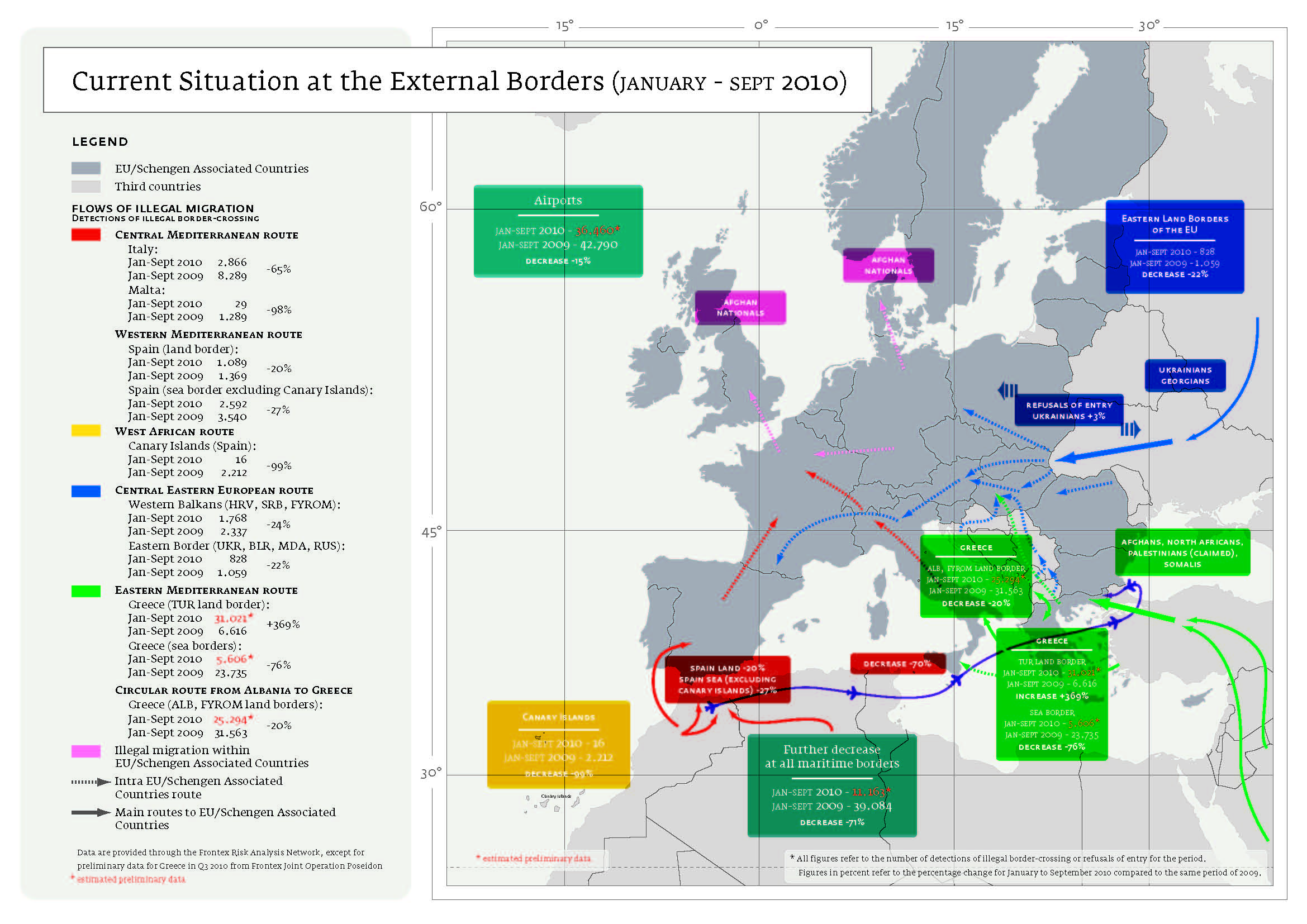
Frontex Map: Current Situation at the External Borders (JANUARY – SEPT 2010)

Frontex has released an updated Third Quarter map, January-September 2010, showing data regarding the situation at the external borders.   Note the information on the map pre-dates the deployment of the Frontex RABIT forces to the Greek border in October/November.  The data shows a 369% increase in detected irregular crossings along the Greek-Turkey land border over the first three quarters of 2010 compared to 2009.

The significant reduction in migrants detected at maritime borders continues:

  • Jan-Sept 2010:   11.163 (estimated preliminary data)
  • Jan-Sept 2009:   39.084
  • 71% reduction

Data by route:

Central Mediterranean route

  • Italy:
    • Jan-Sept 2010:     2.866
    • Jan-Sept 2009:    8.289
    • 65% reduction
  • Malta:
    • Jan-Sept 2010:    29
    • Jan-Sept 2009:    1.289
    • 98% reduction

Western Mediterranean route

Spain (land border):

  • Jan-Sept 2010:   1.089
  • Jan-Sept 2009:   1.369
  • 20% reduction

Spain (sea border excluding Canary Islands):

  • Jan-Sept 2010:   2.592
  • Jan-Sept 2009:   3.540
  • 27% reduction

West African route – Canary Islands (Spain):

  • Jan-Sept 2010:   16
  • Jan-Sept 2009:   2.212
  • 99% reduction

Eastern Mediterranean route

Greece (TUR land border):

  • Jan-Sept 2010:   31.021 (estimated preliminary data)
  • Jan-Sept 2009:   6.616
  • 369% increase

Greece (sea borders):

  • Jan-Sept 2010:   5.606 (estimated preliminary data)
  • Jan-Sept 2009:   23.735
  • 76% decrease

Click here to view Jan-Sept 2010 Map.

Click here for link to Jan-June 2010 Map.

Click here for link to 2009 Map.

1 Comment

Filed under Aegean Sea, Data / Stats, Eastern Atlantic, European Union, Frontex, Greece, Italy, Libya, Malta, Mediterranean, News, Spain, Turkey

Erika Feller’s Comments Regarding Boat People and Irregular Secondary Movements

During her annual address to the UNHCR’s Executive Committee on 6 October, Assistant High Commissioner for Protection Erika Feller reviewed significant protection issues over the past year, noting also that 2010 marks the 60th anniversary of the founding of the UNHCR in December 1950 and the 59th anniversary of the Refugee Convention.

Among the topics she addressed were the challenges posed by the arrival of irregular secondary movements of migrants, including boat people.  She is critical of interdiction practices being carried out throughout the world and makes the strong point that “[t]he evidence suggests that tough sea policies have not solved, just changed and indeed complicated the dynamics, of irregular movements.”  While Ms. Feller does not identify countries by name, she is apparently referencing increased maritime interdiction in the Aegean Sea and the resulting surge in irregular crossings along Greece’s land borders.  The point could also be made in regard to the Italian push-back practice.

Excerpts from her address:

“Arrivals of undocumented migrants continue to test the capacity of States, with the problem of so-called “irregular secondary movement” exacerbated in recent years by boat arrivals. The Pacific, the Mediterranean, the Caribbean or the Gulf of Aden are all regular theatres, with ‘boatpeople’ being interdicted, intercepted, turned around, ignored by passing ships, shot at, or denied landing. Even when rescued, disembarkation somewhere has no guarantees attached, as an incident currently playing out off the Somalia/Djibouti coasts starkly reminds us.

All this is seriously at odds not only with protection principles but also with the reality that when they manage to gain access to territory and asylum processes, a large percentage of asylum-seekers who come by boat are actually found to be refugees. …

Boat arrivals can provoke fears and high emotions which may be difficult for Governments to manage. However, in our experience, an approach built predominantly around closing borders and trying to prevent movement is not the answer, as it does not work. In fact it can make situations even more difficult to deal with. Developments in relation to one country that has pursued a tough policy towards boats are actually quite revealing. While arrivals by sea are dramatically down, arrivals by land have basically doubled. In addition, while sea arrivals had been able to be concentrated through being channeled to one main reception point, land arrivals now come through multiple crossing points and have been able to disperse more effectively and rapidly through the community, below any radar screen. The evidence suggests that tough sea policies have not solved, just changed and indeed complicated the dynamics, of irregular movements….

The phenomenon of refugees on the move for non-protection reasons is also growing. Numbers and categories vary with the regions but the concern is global. On the African continent, where camps are more the norm than the exception, it is preoccupying that camp environments are starting to be compromised by a form of transit migration to and through them, with refugees, and others, seeking to use their facilities for R&R en route to a more distant destination. Just as concerning has been the misuse of reception centers as way-stations, or even lucrative recruitment opportunities for smugglers and traffickers. These facts are not a rationale for abandoning camps or centers. They are, though, a solid reason to rethink how better to manage them within a burden sharing framework….”

Click here for full address.

2 Comments

Filed under Aegean Sea, European Union, Greece, Italy, Libya, Mediterranean, News, Statements, UNHCR

Increased Human Smuggling to Cyprus

According to an article in the Turkish newspaper Today’s Zaman, Turkish Interior Ministry data indicates that human smuggling in Turkey has decreased since 2007, but that one consequence of increased enforcement within Turkey has been a diversion of human smuggling to the Turkish controlled northern portion of Cyprus.

“According to the ministry, the total number of illegal immigrants, asylum seekers and immigrants caught at land and sea borders with Syria, Iran, Iraq, Georgia, Greece and Bulgaria declined to 28,355 in 2009.”  This number is in contrast to the 50,800 migrants reportedly arrested in 2008 and 7,465 arrested over the first six months of 2010.

The Ministry also reported a decline in known deaths: “In line with the drop in the number of immigrants trying to get to the West through Turkey, there has been a decline in the number of illegal immigrant deaths. In 2007, 82 immigrants died in accidents on the Aegean Sea and 102 went missing. The number of deaths dropped to 76 in 2008 and to 43 in 2008. The number of deaths in the first half of 2010 was nine.”

According to the article, there has been a diversion of smuggling operations towards Turkish controlled Cyprus and as a result the “KKTC [the self-declared Turkish Republic of Northern Cyprus] [is] facing the biggest migration move ever in its history.”  “In 2008, the number [of irregular migrants] doubled and increased to 568. It continued to increase in 2009. According to estimates, 750 migrants entered the island in 2009. … Illegal immigrants are brought by ships to Cyprus during the night and left in places that are far from settlement areas in Dipkarpaz and the İskele region. In addition to the KKTC, a similar number of immigrants are brought to Greek Cyprus.  It is believed that illegal immigrants pay between $2,000-$3,000 on average to human smugglers to enter the KKTC. In the latest smuggling cases in Turkey, they pay $5,000-$10,000.”

Click here for article.

Click here Turkish Ministry of Foreign Affairs web site on Illegal Migration.

1 Comment

Filed under Aegean Sea, Cyprus, Data / Stats, Greece, Mediterranean, News, Turkey

Frontex 2nd Quarter Report

The Frontex Risk Analysis Unit has released its Report for the Second Quarter of 2010 (April-June).  It is a 30+ page report containing data, charts, and graphs detailing entry routes, detections of migrants, detections of facilitators, and other information.

Excerpts from the Report’s Executive Summary:

Illegal migration pressure in the EU underwent a foreseeable seasonal increase during the second quarter of 2010, but is still clearly in a period of decline.…

The widespread decline in illegal migration pressure is probably due to two key factors. The first is decreased employment opportunities in the EU …  [and the] second is stricter migration and asylum policies in Member States, supported by much more effective collaboration with key third countries. For example, stricter migration and asylum policies in Norway and the UK have reduced the number of applications in these Member States…. Similarly, bilateral agreements between Italy and Libya, and between Spain and both Senegal and Mauritania, continue to control, for the time being at least, most illegal migration via the Central Mediterranean and West African routes, respectively.

Notwithstanding the general decline in detections, there were two emerging trends in the second quarter (Q2) of 2010: a continued and intensified shift from the Greek sea border to the Greek land border with Turkey….  In the beginning of 2009 illegal crossings of the EU external border between Greece and Turkey were divided roughly equally between the land and sea borders.  However, there has been a gradual and recently intensified shift to the land border. Reasons for this shift from sea to land borders are linked to the effectiveness of the Frontex activities in the Aegean Sea, combining surveillance activities with identification of illegal migrants, and opening the possibility of return to origin countries for detected migrants. ….

Main trends:

  • There is a general decline in illegal migration to the EU compared to a year ago;
  • For the time being, Turkey is the main transit country for illegal migration to the EU….;
  • In the Eastern Mediterranean route, there has been a gradual and recently intensified shift from the Greek-Turkish sea border to the land border, where 90% of detections were made….   At the Greek-Turkish land border around 60% of detections were made at the Border Control Unit (BCU) Orestiada which is under the biggest pressure. Air connections to Turkey are increasingly used by migrants from North Africa, who then illegally cross the EU external border with Turkey. As well as effective Frontex-coordinated joint operations at the sea border, potential explanations for this shift include cheaper facilitation costs, a lower risk crossing, lower detection rates…;
  • There were increased detections on the Central Mediterranean route, probably due to the recent re-organisation of criminal groups in response to effective bilateral agreements in the area. In June 2010 Libya expelled the United Nations High Commissioner for Refugees (UNHCR), with whom 9,000 refugees and 4,000 asylum-seekers were registered and who, in the absence of protection, may now attempt entry to the EU.

Click here for the 2nd Quarter Report.

Click here for the 1st Quarter Report.

2 Comments

Filed under Aegean Sea, Analysis, Data / Stats, Eastern Atlantic, European Union, Frontex, Greece, Italy, Libya, Malta, Mauritania, Mediterranean, News, Reports, Senegal, Spain, Turkey

EUROSTAT Q1 2010 Asylum Statistics for EU27 Countries

EUROSTAT released updated data on 15 July for the First Quarter of 2010.  The report is entitled: Asylum applicants and first instance decisions on asylum applications in Q1 2010 (Doc. 32/2010).

Notable statistics include reductions of over 50% in the number of asylum applicants in three countries, Malta, Italy, and Greece, relative to the First Quarter of 2009.  Malta had the largest reduction of approximately 95%.

The reductions in Malta and Italy are almost certainly due to Italy’s push-back practice.  Though the first migrant arrivals in Malta in 2010 occurred this past weekend, 17 July, when 55 migrants on a sinking vessel were intercepted by Maltese and Libyan patrol boats.  The Times of Malta reported that the migrants were “shared out” between the Maltese and Libyan patrol boats.  28 migrants were brought to Malta and 27 were apparently taken to Libya.

Click here for the full EUROSTAT document.

Click here for Times of Malta article.

3 Comments

Filed under Aegean Sea, Data / Stats, Eastern Atlantic, European Union, Greece, Italy, Libya, Malta, Mediterranean, News

Frontex 2010 1st Quarter Report: Irregular Migration at Sea Borders Less Than 10% of Peak Levels

Frontex has released information from its 2010 First Quarter report by the Frontex Risk Analysis Network (FRAN).  A copy of the report itself has apparently not been released.  According to the summary provided, there have been significant reductions in irregular migration:

  • “[D]etections of irregular immigrants at [all EU] sea borders … were less than one-tenth of the peak level (for the third quarter of 2008) when roughly 33,600 detections were reported.”
  • “[D]etections at the Spanish and Italian sea borders became negligible…”
  • “[D]etections at the dominant Eastern Aegean Sea border between Greece and Turkey also fell by more than 60% to just under 2,300.”
  • “Detections at the Greek-Turkish land border were for the first time greater than those at the countries’ sea border.”
  • There were “only 150 detections of illegal border-crossing [in the Central Mediterranean], compared to 5,200 detections in the first quarter of 2009…”
  • There were “only 500 irregular immigrants detected [in the Western Mediterranean] (almost 72% down on the fourth quarter of 2009 …).”
  • There were “only five detections over the first three months of 2010 [on the West African/Canary Island route], in contrast to 31,700 detections in 2006…”

Click here for full statement.

Leave a comment

Filed under Aegean Sea, Algeria, Analysis, Data / Stats, Eastern Atlantic, European Union, Frontex, Greece, Italy, Libya, Malta, Mauritania, Mediterranean, Morocco, News, Reports, Senegal, Spain, Turkey

Frontex 2010 Annual Risk Analysis

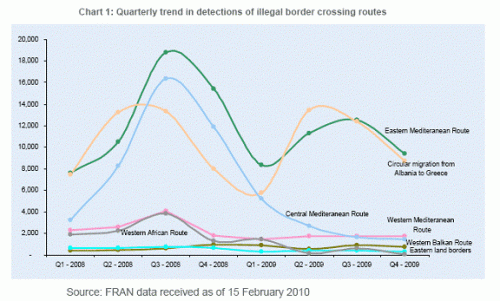
Frontex’s Annual Risk Analysis (ARA) for 2010 was prepared in March 2010 and was posted to the Frontex web site on 7 July.  The public document only contains certain portions of the full ARA as recommendations and other “operationally sensitive details” have been redacted. While some of the ARA’s contents have previously been released by Frontex, this 35 page document contains a lot of data regarding irregular migration by land, sea, and air, and is worth a read.

Excerpts from the ARA relating to maritime migration include:

“Detections of illegal border crossing – In 2009, the [EU] Member States and Schengen Associated Countries reported a total of 106,200 detections of illegal border crossings at the sea and land borders of the EU. This represented a 33% decrease compared to 2008. The decrease is comprised of both a strong decrease reported from the sea borders (-23%), and land borders (-43%).”

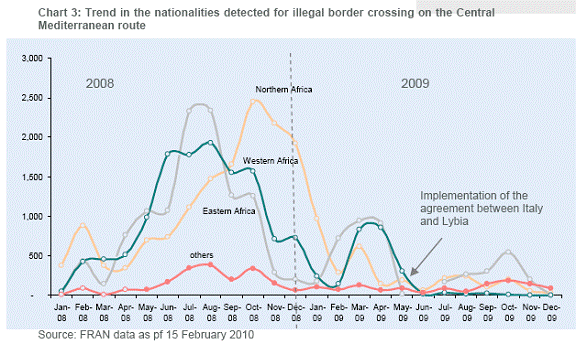
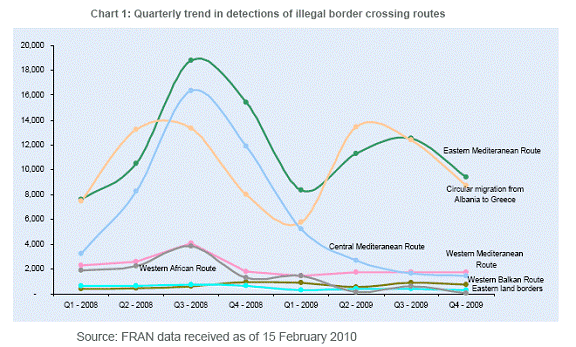
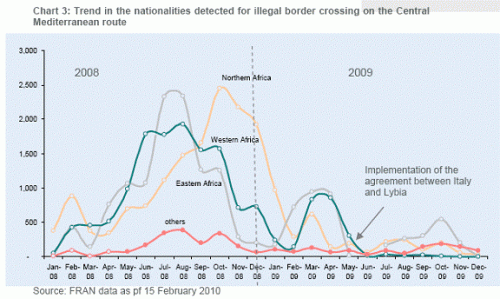
“The bilateral collaboration agreements with third countries of departure on the Central Mediterranean route (Italy with Libya) and the Western African route (which Spain signed with Senegal and Mauritania) had an impact on reducing departures of illegal migrants from Africa.”

“The agreements were made at a time when the economic crisis decreased the labour demand in the EU, thus simultaneously reducing the pull factor. The synchronisation of these events probably explains why no displacement has so far been noticed from the Central Mediterranean and Western African routes to other illegal migration routes in the statistics for detections.”

“However, intelligence suggests that the risk of displacement remains high, either with the emergence of new routes or the exploitation of existing ones by nationalities which used to be detected along the Central Mediterranean or the Western African routes.”

“As a corollary to the sharp decreases registered in Italy and Spain, the number of detections of illegal border crossing in Greece rose from 50% of the total EU detections to 75% of the total. In 2009, the Greek land border sections with Albania and FYROM represented the largest share of the EU total, with 36,600 detections (34% of the EU total), followed by 22,000 detections in the Aegean Sea with (21% of the EU total).”

“Eastern Mediterranean route – The Eastern Mediterranean route is the route taken by illegal migrants transiting through Turkey and entering the EU through eastern Greece, southern Bulgaria or Cyprus. Turkey, due to its geographical position near the EU, is the main nexus point on this route. From Istanbul, illegal migrants may reach the Greek islands in the Aegean Sea, or cross the land borders to Greece or to Bulgaria.”

“In 2009, illegal border crossing on the Eastern Mediterranean route totalled 41,500, or 39% of all EU detections. Most of the detections were reported from the Aegean Sea, followed by detections along the land border between Turkey and Greece. The number of detections reported by Bulgaria and Cyprus were considerably lower.”

“Central Mediterranean route – The Central Mediterranean route refers to illegal migration from northern Africa to Italy and to Malta. For the past two years, Libya has been a nexus point where migrants from the Horn of Africa and Western African routes and a small proportion of Asian nationals met before embarking.”

“Since the signing of a bilateral agreement with Libya, joint patrols by Libya and Italy have had a clear and measurable deterrent effect, with 3,200 detections in the seven months after the joint patrols (June to December), compared to 7,200 detections in the five months before the joint patrols (January to May), and almost 40,000 detections in the whole of 2008.”

“Western African route – The Western African route is primarily through Western African countries to Spain via the Canary Islands. The main embarkation points are in Senegal and Mauritania and the main countries of origin are Mali, Mauritania, Guinea Conakry and Senegal. Other African nationals have also been reported, and occasionally migrants from Asia. This route is now less favoured since the Spanish collaboration agreements with Senegal and Mauritania. The Frontex coordinated Joint Operation Hera plays a major role in maintaining effective surveillance in the area.”

“The Western Mediterranean route includes the sea route from Northern Africa to the Iberian Peninsula, and the land route through Ceuta and Melilla. It is mostly used by Northern African nationals (Algerian and Moroccan) travelling to Spain, France and Italy.”

“Maritime detections between Northern Africa and Spain are rising, with increasing detections of Algerian and to a lesser extent Sub Saharan nationals. Moroccan nationals are also regularly detected on this route. The lack of employment opportunities for the growing population of young people in Morocco continues to increase the incentives of migrating to the EU. The Spanish authorities recently reported an increasing number of attempts by Moroccan minors to get on the ferry link between Tanger and Spain. These cases do not seem connected with criminal networks; rather individual attempts are driven by poor employment prospects in Morocco.”

Click here for the ARA.

Click here for link to Frontex Map showing situation at External Borders.
[ARA page 18]

[ARA page 13]

1 Comment

Filed under Aegean Sea, Data / Stats, Eastern Atlantic, European Union, Frontex, Greece, Italy, Libya, Malta, Mauritania, Mediterranean, Morocco, Reports, Senegal, Spain, Turkey

UNODC Publication: Smuggling of Migrants into, through and from North Africa

UNODC has issued a new publication entitled “Smuggling of Migrants into, through and from North Africa: A thematic review and annotated bibliography of recent publications.”  Most of the reviewed literature and data are from 2008 and earlier dates and therefore the publication does not include references to more recent events, e.g. the Italy-Libya migration agreement.  But it is a comprehensive and useful publication.  The 16 page Annotated Bibliography is a very good resource.

According to the UNODC web site, the publication “focuses primarily on the patterns and dynamics of migrant smuggling, as it concerns the North African region. Recognizing, however, that irregular migration and smuggling flows are transnational in nature, the review goes beyond North Africa, to also cover sub- Saharan African and European countries affected along the various smuggling routes.  The aim of the review is twofold: to describe major findings on smuggling of migrants; into, through and from North Africa, and to highlight the need for further research on specific issues that have not yet been studied.”

Table of Contents:

  • I. Introduction
  • II. Quantifying irregular migration and smuggling of migrants
  • III. Migrant smuggling routes
  • IV. Profiles and characteristics of smuggled migrants
  • V. Smuggler-migrant relationships
  • VI. Organizational structures of migrant-smuggling networks
  • VII. Modus operandi of migrant smuggling
  • VIII. Smuggling fees
  • IX. The human and social costs of smuggling
  • X. Summary of findings
  • XI. Annotated bibliography

Click here for the publication.

Leave a comment

Filed under Aegean Sea, Algeria, Analysis, Data / Stats, Eastern Atlantic, Egypt, France, Greece, Italy, Libya, Malta, Mauritania, Mediterranean, Morocco, Reports, Senegal, Spain, Tunisia, Turkey, UNODC

EU-Turkey Readmission Agreement Negotiations Continuing

The Turkish paper, Today’s Zaman, reported that Turkey and the EU have reached agreement on 19 articles of a draft readmission agreement, but have been unable to reach agreement on 5 articles.

The news article states that Turkey wants “the readmission agreement [to include] strong funding from the EU, mirroring similar funding that is available to member states under the “resettlement policies” within the European Refugee Fund (ERF), which was established to support and improve the efforts of member states to grant refugee or asylum status to beneficiaries.”

“The [Turkish] government also fears that, without a strong and clear readmission agreement in place, vetting thousands of immigrants and asylum seekers in reception centers while awaiting deportation will open a Pandora’s box for Turkey in the European Court of Human Rights (ECtHR). Turkey ranks second after Russia in terms of the number of cases ending up in the ECtHR and is trying to reduce them by introducing constitutional changes on fundamental rights, due to be submitted to a referendum on Sept. 12.”

“In April, for example, the ECtHR decided in three out of four cases involving refugees recognized by the UN High Commissioner for Refugees (UNHCR) that Turkey would violate Article 3 of the European Convention on Human Rights (ECHR) if the expulsion orders were enforced. The court also criticized the unlawfulness and the conditions of their detention in a police station and in some of the detention centers where they had been held awaiting deportation.”

Click here for article.

Leave a comment

Filed under Aegean Sea, European Court of Human Rights, European Union, Greece, News, Turkey

Details from Frontex General Report 2009 (Post 2 of 2)

Last week I posted a summary of the first part of Frontex’s 2009 General Report.  This second post summarizes the portion of the Report pertaining to Frontex’s sea operations.

The General Report 2009 provides selective information regarding the six major Joint Operations conducted at the sea borders.  With only one exception, no information or data is provided regarding the specific numbers of intercepted migrants or vessels.

Instead of numbers, the Report provides various descriptive terms which could mean almost anything.  For example, Operation Hera led to a “drastic decrease of migrants,” during Operation Nautilus there was a “remarkable decrease” in migrants, and during Operation Hermes, the numbers of migrants arriving and dying at sea “decreased dramatically.” The one exception is for Operation Indalo where the Report states that 750 irregular migrants and 10 facilitators were detected.

When desired, the Report provides details and numbers.  For example, Operation Poseidon utilized 4 open sea vessels, 6 coastal patrol vessels, 13 coastal patrol boats, six airplanes, 4 helicopters, and 152 experts who delivered 2680 man days of operational activities, but no data regarding the total number of irregular migrants intercepted at sea is provided.

Here is a summary of the information provided in the Report for each of the six major Joint Operations:

Poseidon 2009, Eastern Mediterranean (365 Days)

Poseidon was conducted along land borders as well as at sea.  Interpreters were deployed on board ships to facilitate the identification process of intercepted migrants.  Less than 10% of the interviewed migrants claimed their original nationality.  There was an overall reduction in migrant flow of 16% (land and sea) compared to 2008.  “The main operational objectives of the joint operation were achieved but there is a clear need for closer cooperation between local authorities.”

Hera 2009, Atlantic Ocean waters between North Western African countries and Canary Islands (365 Days)

Due to the permanent implementation of Joint Operation Hera and better cooperation from “involved African countries”, there was a notable reduction in migrants reaching the Canary Islands, 2280 in 2009 compared with 9200 in 2008.  Aerial and maritime surveillance conducted close to the territory of Senegal and Mauritania and local cooperation from police led to the decrease in migrants.  “Despite these clear successes, participation of more member States would greatly increase effectiveness and outcomes.”  [NF- While the Report does provide migrant arrival data for the Canary Islands, it is silent on the number of migrants intercepted at sea or within Senegal or Mauritania.]

Nautilus 2009, Central Mediterranean (172 Days)

There was a remarkable decrease in migrant arrivals in Malta.  A “significant obstacle to the effectiveness of the Joint Operation lay in the contrasting interpretations of the International Law of the Sea by Member States….”  The effectiveness of the operation compared with 2008 was not improved.

Hermes 2009, Central Mediterranean (184 Days)

“Due to the bilateral agreement between Italy and Libya, the number of people arriving from Libya, as well as the number of migrants died at sea, decreased dramatically….”  “In addition, the first examples of co-operation with Algeria should also be considered as promising.”  As with Nautilus, “differing interpretations of the International Law of the Sea led to a limited contribution by the Member States to the joint operation by maritime surface means.”  The effectiveness of the operation compared with 2008 can be considered as increased.

Minerva 2009, Western Mediterranean (39 Days)

The launch of the operation was delayed in 2009.  Its effectiveness compared with 2008 has remained the same.

Indalo 2009, Western Mediterranean (50 Days)

The lack of cooperation from Algeria is an obstacle for operational activities.  10 Facilitators and 750 irregular migrants were identified.

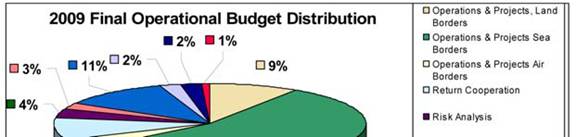
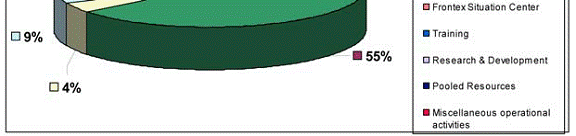
And as I noted in my earlier post, Frontex continued to devote the biggest single portion of its expenditures to maritime enforcement.  Almost 40% of Frontex’s total budget, over € 34 million, was spent on sea operations in 2009, constituting 55% of the operational budget.

This chart from the Report (p 23) shows the breakdown of expenditures within the 2009 Operational Budget (which was 71% of the total 2009 Frontex budget).

Click here for previous post.

Click here for the Frontex General Report 2009.

2 Comments

Filed under Aegean Sea, Algeria, Data / Stats, Eastern Atlantic, Frontex, Greece, Italy, Libya, Malta, Mauritania, Mediterranean, Reports, Senegal, Spain

Greek – Turkish Migration Agreement

Greece and Turkey signed a series of agreements on 14 May, including a new agreement on immigration.  Turkish Prime Minister Recep Tayyip Erdogan traveled to Athens to sign the agreements.

The immigration agreement will facilitate Greece’s ability to return irregular migrants who enter Greece from Turkey.  Pursuant to the agreement Turkey will designate a port in or near Izmir within three months as the location to which irregular migrants may be returned by Greece.  Turkey also agreed to accept up to 1,000 readmission requests per year.

Click here (EL) for Press Release from Greek Ministry of Citizen Protection.

Click here (EN) for article.

1 Comment

Filed under Aegean Sea, Greece, News, Turkey