Category Archives: Italy

Tunisia Intercepts / Rescues Migrant Boat Fleeing Libya

Tunisian Coast Guard and Army units (les unités de la garde maritime et de l’armée nationale) intercepted and rescued 222 people on board a migrant boat that left Libya and was attempting to sail to Italy.  The incident occurred on Saturday, 14 May.  The migrant boat was intercepted near Djerba and had reportedly made a distress call because it was taking on water.  The people on board the boat were reportedly all sub-Saharan Africans and they have been taken to the Tunisian camp at Choucha (Shusha).

Click here (EN), here FR), here (FR), and here (IT) for articles.

Leave a comment

Filed under Italy, Libya, Mediterranean, News, Tunisia

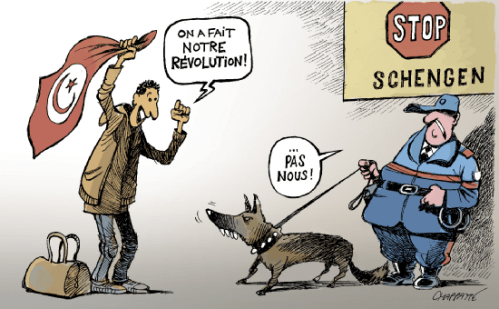
Retour des Contrôles Dans L’espace Schengen (by Chappatte)

© Chappatte - http://www.globecartoon.com - Used by Migrants At Sea with permission.

Leave a comment

Filed under Cartoon, European Union, France, Italy, Mediterranean, Tunisia

Follow-Up Report and Analysis Regarding Failure to Rescue Disabled Migrant Boat Resulting in 61 Deaths

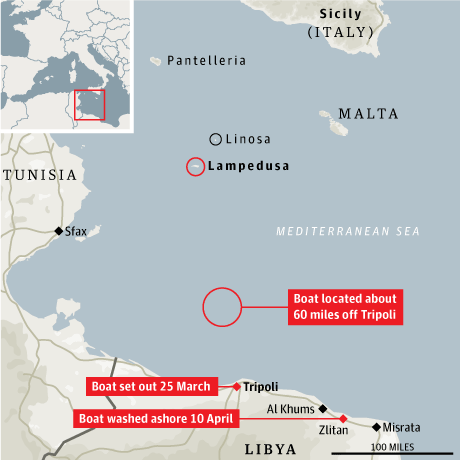
UNHCR today released more information from three Ethiopian survivors of the migrant boat that left Tripoli on 25 March with 72 passengers and which, after becoming disabled and running out of food and water, washed ashore in Libya over two weeks later with only nine survivors.

Additionally, the Bruxelles2 blog in a recent post, “Un navire de réfugiés non secouru ? Retour sur un drame non élucidé,” has provided detailed analysis regarding the possible identities of the helicopter and warships that failed to render assistance to the migrant boat after it had become disabled.  (See more on this below.)

From UNHCR’s statement:

“[One surviving] refugee said that military vessels twice passed their boat without stopping, and that a military helicopter dropped food and water onto the boat at some point during the journey. The first boat refused their request to board. The second only took photos, he said. The man was not able to identify where the vessels came from.

UNHCR staff met with the three in Shousha camp in Tunisia. One spoke Arabic, while the others spoke Oromo. UNHCR interviewed the Arabic speaker. He said that they paid smugglers US$800 to make the journey. The passengers were expected to operate the boat on their own.

According to the refugee, when water ran out people drank sea water and their own urine. They ate toothpaste. One by one people started to die. He said that they waited for a day or two before dropping the bodies into the sea. There were 20 women and two small children on board. A woman with a two-year-old boy died three days before he died. The refugee described the anguish of the boy after his mother’s death.

After arrival on a beach near Zliten, between Tripoli and the Tunisian border, a woman died on the beach from exhaustion. The remaining 10 men walked to the town of Zliten where they were arrested by the Libyan police. They were taken to a hospital and then to a prison where they were given some water, milk and dates. After two days another survivor died.

After begging jail staff to take the remaining survivors back to hospital, they were taken to a hospital in al-Khums city. Doctors and nurses were said to have given the group water and told them to leave. They were returned to the prison and then taken to Twesha jail near Tripoli. Finally Ethiopian friends in Tripoli paid the prison US$900 to release the men. UNHCR is now providing them with assistance in Tunisia.”

Bruxelles2 notes that the survivors’ reports that the helicopter that dropped supplies had an “Army” marking on it would tend to suggest that the helicopter did not belong to France (“Marine”), Italy (“Marina”), the U.S. Navy (“Navy”), or the Royal Navy (“UK Navy”).  Bruxelles2 believes it is plausible that an “army” helicopter belonging to the US or UK could have been operating in the area, but US Army helicopters tend to be marked “United States.”  According to Bruxelles2 some British army helicopters do carry the “Army” marking.  (One other possibility I would note is that the survivors could simply be mistaken about the marking – they recall clearly that a military helicopter hovered over them and dropped supplies, but incorrectly remember, misread, or assumed that the marking on the side of the helicopter said “Army”.)

Bruxelles2 also suggests that there are other warships that might appear to be an aircraft carrier, especially when viewed from a small migrant boat.  Bruxelles2 points in particular to “the USS Kearsarge (LHD3), [an] amphibious ship [that] regularly hosts (and welcomed during the operations – which the U.S. Navy confirms) AV-8B Harrier vertical takeoff [aircraft].”

Bruxelles2 also notes that the time period when the migrant boat was disabled and drifting was a period when there was a shifting of commands for the multiple European and US naval and air forces operating off Libya.  NATO took command of the maritime embargo on 23 March; the no fly zone and the air attacks were initially under the control of an ad hoc coalition (France, UK, USA, Canada, Belgium, Denmark); full command did not shift to NATO until 31 March and even then it took several days for the transfers of command to occur; and some military vessels continued (and continue to this day) to operate under independent national command.

In short, NATO may be fully correct when it says that a vessel under its command during the time period in question did not encounter the disabled migrant boat.  Further investigation into responsibility is needed.

Click here for UNHCR statement.

Click here for Bruxelles2 post. (FR)

Leave a comment

Filed under Analysis, France, Italy, Libya, Mediterranean, News, UK, United States

Maltese JHA Minister Doubts Migrants Are Being Pushed to Flee Libya

An article in the Malta Independent says that Maltese Justice and Home Affairs Minister Carm Mifsud Bonnici believes it is unlikely that the asylum seekers who have reached Malta in recent weeks have been forced by anyone to flee Libya.  His view is at odds with the statements being made by some of the migrants who have recently arrived in both Lampedusa and Malta.

Mifsud Bonnici “said that he doesn’t think the thousands who have fled from the north African country so far have done so because they were pushed by some people. ‘I don’t think there are any people who are benefiting from this exodus of immigrants to Europe. From the information we have, there is no evidence to suggest that people are being pushed into boats and sent towards Europe. Most immigrants have sought pastures new simply because they fear for their lives. As I have said time and time before, this latest wave of immigration is different to what we have experienced before. Quite a lot of the immigrants who have come to Europe by boat over the past few weeks came with their families, are university graduates, and have a lot of work experience behind them,’ Dr Mifsud Bonnici said.”  The latest boat arrival in Malta carried mostly Libyan nationals.  Over 1100 persons have landed in Malta over the past six weeks.

Click here for article.

1 Comment

Filed under European Union, Italy, Libya, Malta, Mediterranean, News

58 Bodies Discovered in April on Tunisian Beaches

The Tunisian Interior Ministry released a communiqué reporting that authorities during the month of April recovered a total of 58 bodies that had been washed ashore.   The bodies were mostly those of men and were found along beaches in Skhira, Chaffar, and Kerkennah, in the department of Sfax, and in Gabès, Djerba, and Mahdia.  The dead are believed to be persons who attempted to reach Italy by boat.

Click here and here for articles (FR)

1 Comment

Filed under Italy, Mediterranean, News, Tunisia

Libya: Because of NATO Aggression, We Cannot Be Guards of Europe

From an AP story about the sinking of the migrant boat that left Tripoli last week, killing hundreds of persons:

“… International agencies say some recent migrants report being forced onto dangerously packed ships at gunpoint by Libyan soldiers. A spokesman for Moammar Gadhafi suggested that increased illegal immigration was the price European nations would pay for their military and political support of the rebels trying to topple Libya’s strongman. ‘Because of the NATO aggression against our country and because our coastal border guard is being hit daily … we are unable to deal with this situation and that is why Europe is being flooded with illegal immigration,’ government spokesman Moussa Ibrahim said. ‘We cannot be the guards of Europe at this moment.’…

The U.N. said migrants’ boats started leaving Libya for Europe again on March 25, the day NATO took over military operations. About 14,800 since have made the gruelling journey across the Mediterranean in rickety ships run by smugglers who rarely provide enough food and water. At least 800 people had been lost at sea in three boat sinkings before the latest ship went down with 600 aboard off Tripoli on Friday, the U.N. said.  Five boats carrying 2,400 people have arrived in recent days on the Italian island of Lampedusa, the closest European point to Libya. Every one of those boats needed to be rescued by the Italian coast guard and police, the U.N. said.

‘We know that the people running the boats are smugglers. But obviously you cannot have over 2,000 people leaving in a few short days without the government knowing and allowing it,’ U.N. refugee agency spokeswoman Sybella Wilkes said. ‘That port of Tripoli is under government control.’…”

Click here for full text of article.

1 Comment

Filed under European Union, Italy, Libya, Mediterranean, News, UNHCR

IOM Reports Migrants Were Forced by Libyan Soldiers to Board Boats

The International Organization for Migration has interviewed migrants who reached Lampedusa who witnessed the migrant boat carrying 500-600 people that sank just off the Libyan coast this past Thursday or Friday.  IOM reports that persons who were preparing to leave Libya on a second migrant boat witnessed the accident involving the first boat.  “Migrants … told IOM that after seeing what had happened to the first boat, many of them who had been waiting on land [preparing to board the second boat] changed their mind about making the sea journey to Italy. However, they claim that Libyan soldiers and officials forced them onto a waiting boat by firing their guns indirectly.  Although this is the first time that IOM has been told of migrants being forced by Libyan officials to get on a boat, many have told IOM that they did not have to pay for their passage to Lampedusa while others say they have paid a nominal fee. However, they say that they been stripped by officials and soldiers of their savings and possessions, including mobile phones….”

Click here for IOM press briefing.

Click here for article.

2 Comments

Filed under Italy, Libya, Mediterranean, News

500 Migrants Rescued Off Lampedusa; Hundreds Likely Dead Off Libya

A boat from Libya carrying over 500 people from sub-Sahara Africa and Asia ran around off Lampedusa on Sunday. Italian rescuers saved everyone on board.  The survivors had to be brought ashore by rescuers in the water because rescue boats were unable to approach due to the shoals on which the migrant boat ran around.

In a separate incident, early Friday morning, 6 May, a migrant boat believed to be carrying over 600 people capsized or broke apart off the Libyan coast.  It is feared that most of the passengers have died.

Click here, here, and here for articles about the Lampedusa rescue. (EN)

Click here (EN) and here (IT) for article about the sinking off Libya.

Leave a comment

Filed under Italy, Libya, Mediterranean, News, UNHCR

Report: Military Ships Failed to Rescue or Render Aid and 61 Died at Sea

The Guardian on Sunday reported many more details about an incident that began on 25 March when a migrant boat left Libya carrying 72 asylum seekers and which ended 16 days later on 10 April when the disabled vessel washed ashore in Libya with only 11 survivors.  The survivors have described several incidents where military ships and planes ignored their pleas for rescue.  It is clear from the survivors’ descriptions that their disabled vessel was sighted because at one point a military helicopter dropped bottles of water and emergency food rations on the migrant boat.

The UNHCR and Father Mussie Zerai, an Eritrean priest in Rome who runs the refugee rights organisation Habeshia, have called for further investigations into why the boat’s passengers were not rescued.

From the Guardian article: “The Guardian’s investigation into the case of the boat of 72 migrants which set sail from Tripoli on 25 March established that it carried 47 Ethiopians, seven Nigerians, seven Eritreans, six Ghanaians and five Sudanese migrants. Twenty were women and two were small children, one of whom was just one year old. The boat’s Ghanaian captain was aiming for the Italian island of Lampedusa, 180 miles north-west of the Libyan capital, but after 18 hours at sea the small vessel began running into trouble and losing fuel.  Using witness testimony from survivors and other individuals who were in contact with the passengers during its doomed voyage, the Guardian has pieced together what happened next. The account paints a harrowing picture of a group of desperate migrants condemned to death by a combination of bad luck, bureaucracy and the apparent indifference of European military forces who had the opportunity to attempt a rescue….

The Guardian has made extensive inquiries to ascertain the identity of the Nato aircraft carrier, and has concluded that it is likely to have been the French ship Charles de Gaulle, which was operating in the Mediterranean on those dates.  French naval authorities initially denied the carrier was in the region at that time. After being shown news reports which indicated this was untrue, a spokesperson declined to comment.

A spokesman for Nato, which is co-ordinating military action in Libya, said it had not logged any distress signals from the boat and had no records of the incident. ‘Nato units are fully aware of their responsibilities with regard to the international maritime law regarding safety of life at sea,’ said an official. ‘Nato ships will answer all distress calls at sea and always provide help when necessary. Saving lives is a priority for any Nato ships.’”

Click here for full Guardian article.

Click here (IT) for earlier article.

The route of the boat - from guardian.co.uk

2 Comments

Filed under France, Italy, Libya, Malta, Mediterranean, News, UNHCR

Tunisia Stops Migrant Boat From Leaving Tunisia for First Time

Italian Interior Minister Roberto Maroni said on Saturday, 7 May, that Tunisia had for the first time blocked a migrant boat from departing Tunisia pursuant to the terms of the 5 April 2011 agreement with Italy.  Maroni also said that four patrol boats would be transferred to Tunisia by Italy in the coming week for purposes of increasing Tunisia’s capacity to block migrant departures.

Click here (EN) and here (IT) for articles.

Leave a comment

Filed under Italy, Mediterranean, News, Tunisia

Commission Communication on Migration of 4 May

The European Commission today issued a Communication on Migration (COM(2011) 248 final) in response to the ongoing arrivals of migrants and asylum seekers in Italy and Malta and in response to the calls by Italy and France for changes in the implementation or interpretation of the Schengen Agreement.

France has welcomed the Commission’s Communication: “We note with interest that the Commission is considering establishing a mechanism for the temporary reintroduction of controls on some sections of internal borders in cases of difficulties or failures of a Member State. We also welcome the emphasis on strengthening the operational capacity of Frontex, the prospect of ultimately creating a European border guard that France has repeatedly called for. Finally, we welcome with satisfaction the intention of the Commission to propose a suspension clause of the liberalization of visa abuse.” (“Nous relevons ainsi avec intérêt que la Commission envisage l’établissement d’un mécanisme permettant la réintroduction temporaire des contrôles à certaines sections des frontières intérieures en cas de difficultés ou de défaillances d’un État membre. Nous nous félicitons aussi de l’accent mis sur le renforcement des capacités opérationnelles de FRONTEX, avec la perspective de créer à terme un système européen de garde-frontières que la France a régulièrement appelé de ses vœux. Nous accueillons enfin avec satisfaction l’intention de la Commission de proposer une clause de suspension de la libéralisation des visas en cas d’abus.”)

Excerpts from the Commission’s Communication on Migration:

“[***]

The purpose of this Communication is to set recent and future policy proposals in a framework that takes account of all relevant aspects and allows the EU and its Member States to manage asylum, migration and mobility of third-country nationals in a secure environment.

[***]

The continuously evolving situation in our Southern Neighbourhood requires rapid responses. Building upon the European Council Conclusions of 11 and 25 March, the European Parliament’s Resolution of 5 April1, and, the joint Communication of the Commission and the High Representative of 8 March, the Commission will present on 24 May a package of proposals to ensure a coherent EU approach in the area of migration, mobility and security with the Southern Mediterranean countries.

However, the need to address this challenging and evolving situation should not lead to a short-term approach limited to border control without taking account of long-term issues.

[***]

The EU should also ensure that it has in place safe and efficient asylum procedures for people in need of protection. Sixty years after the signature of the Geneva Convention on the Status of Refugees, it is time for the EU to reaffirm its commitment to offer protection to any persecuted third country national or stateless person arriving on its territory. A Common European Asylum System, offering a high level of protection and reducing the disparities among Member States’ asylum systems, must be completed by 2012, as agreed by the European Council.

[***]

At the same time, as recent events have starkly illustrated, the EU continues to face serious challenges in the development of its migration policy. The vulnerability of some sections of the EU’s external borders is a clear example, notably in the Southern Mediterranean and at the land border between Greece and Turkey. In particular, measures must be taken to prevent large numbers of irregular migrants, often exploited by unscrupulous criminal networks, from arriving in the EU. The EU should accordingly pursue a migration policy based on ensuring that inward migration is effectively managed and ensure that the need for enhanced mobility does not undermine the security of the Union’s external borders. While this Communication naturally focuses on regions of most immediate concern, the EU’s migration policy follows a geographically comprehensive approach.

[***]

However, while the current crisis confirms the need for increased solidarity at the European level and better sharing of responsibility, it must be recognised that the EU is not fully equipped to help those Member States most exposed to massive migratory movements.

[***]

Building on the experience gained so far with the current pilot project on relocation from Malta, the Commission will support an extension of this project in view of the current influx of migrants seeking international protection there, to be implemented in close cooperation with the United Nations High Commissioner for Refugees and the International Organisation for Migration.

However, the currently available instruments fall short of fulfilling all the needs and providing a comprehensive response. They can only be resorted to in an ad hoc manner, and are entirely dependent on the will of Member States to voluntarily offer assistance – in whatever form – at a given point in time. This in turn exposes the EU to criticism and risks undermining the trust of the citizens in the EU.

The Commission will closely monitor the continuously evolving situation and may decide, if the relevant conditions are met, to trigger the Temporary Protection Directive3 to provide immediate and temporary protection to displaced persons from third countries that are unable to return to their country of origin.

The Commission will make further proposals during 2011 on delivering solidarity in a holistic manner and how concretely such assistance can be delivered. A number of different approaches are currently being studied, with a view to developing alternatives that will allow urgent needs to be responded to in a more rapid and structured fashion. This initiative will build on the appropriate legal basis of the Lisbon Treaty, such as Articles 80 and 78 paragraph 3, and will draw lessons from the situation in Greece, particularly at the land border between Greece and Turkey, and the crisis in the Southern Mediterranean; it will include possible ad hoc measures to be resorted to in case of particular temporary pressure on one or several Member States, as well as more structural means of ensuring solidarity, both financial and in the form of practical cooperation and technical assistance (e.g. via FRONTEX, EASO, joint operations).

[***]

FRONTEX’s role is key in channelling resources to places where the border is under pressure, as shown by the deployment – for the first time ever – of rapid border intervention teams to the Greek-Turkish land border in 2010 and the deployment of the joint naval operation HERMES to support Italy in 2011. FRONTEX’s legal framework needs be updated to allow it to be more effective in terms of its operational capacity to act at the external border. The Commission proposed the necessary changes in February last year5 and it is now urgent, especially in the light of recent events, that the Council and the Parliament approve this proposal before the end of this semester, as called for by the European Council.

[***]

[A] clear system for Schengen governance is needed. Currently the Union still relies on an intergovernmental system of peer reviews to ensure the application of the common rules. The current revision of the Schengen evaluation mechanism should be based on a Community approach with participation of experts from Member States, FRONTEX and lead by the Commission. The proposed mechanism would ensure more transparency and improve the follow-up of shortcomings identified during the experts’ evaluations. The Commission will also issue guidelines to ensure a coherent implementation and interpretation of the Schengen rules.

A mechanism must also be put in place to allow the Union to handle situations where either a Member State is not fulfilling its obligations to control its section of the external border, or where a particular portion of the external border comes under unexpected and heavy pressure due to external events. A coordinated Community-based response by the Union in critical situations would undoubtedly increase trust among Member States. It would also reduce recourse to unilateral initiatives by Member States to temporarily reintroduce internal border controls or to intensify police checks in internal border regions which inevitably slow down the crossing of internal borders for everyone. Such a mechanism may therefore need to be introduced, allowing for a decision at the European level defining which Member States would exceptionally reintroduce internal border control and for how long. The mechanism should be used as a last resort in truly critical situations, until other (emergency) measures have been taken to stabilise the situation at the relevant external border section either at European level, in a spirit of solidarity, and/or at national level, to better comply with the common rules. The Commission is exploring the feasibility of introducing such a mechanism, and may present a proposal to this effect shortly.

[***]

One of the main purposes of the Common European Asylum System is to reduce the wide divergence in the outcome of asylum applications lodged in different countries of the EU, and to ensure a common set of procedural and substantive rights which can be relied on across the Union, while ensuring full compliance with the 1951 Geneva Convention on refugees and other relevant international obligations.

In 2010, there were some 257 800 asylum seekers registered in the EU, or 515 applicants per million inhabitants. Ten Member States accounted for more than 90% of applicants registered in the EU17.

It is time to complete the Common European Asylum System by reaching agreement on a balanced package by the 2012 deadline agreed by the European Council in December 2009. To that end, the Commission will shortly put forward modified proposals on the Reception Conditions and the Asylum Procedures Directives. A balanced agreement on the revision of the Dublin Regulation must be reached, including on a last resort emergency mechanism in case of exceptional pressures, and on the revised Eurodac system.

[***]”

Click here for the Communication – COM(2011) 248 final.

Click here for Commission Press Statement and here for Commission FAQs.

Click here for French Government’s Point de Presse.

3 Comments

Filed under Communiqués, European Union, France, Frontex, Italy, Libya, Malta, Mediterranean, News, Tunisia

MEPs Express Concern Over Possible Changes to Schengen Rules

According to an EP press release, during Monday’s LIBE meeting, MEPs expressed concern over the “Commission’s announcement that it is considering a temporary reintroduction of checks at the EU’s internal borders.”

From the EP press release:

“‘Schengen governance is suffering too much from inter-governmentalism’, said the Commission representative [at the LIBE meeting], adding that the Commission would table a communication on the issue on 4 May. The Commission paper will seek to ‘replace the unilateral re-introduction of border controls by a Community mechanism’. This would enable the Commission temporarily to impose checks at national borders, in exceptional circumstances and as a last resort.  [Click on this link [DRAFT 15-04-2011] for a draft version of the Commission Communication on Migration.]

‘The decision would be taken collectively, and not unilaterally as is now the case’, said the Commission representative, pointing out that, at present, Member States’ decisions to restore internal border checks cannot be challenged before the European Court of Justice.

‘Schengen should not be weakened’, said Civil Liberties Committee rapporteur Carlos Coelho (EPP, PT), asking for ‘some precaution’ on this issue….

According to the Commission representative, the 4 May communication, to be unveiled ahead of the extraordinary meeting of the Justice and Home Affairs Council on 12 May and of the European Council in June, will provide a long-term perspective for migration policies.

The communication will focus on the management of the Schengen area and propose ways to improve the administration of the visa system. It will also address the common asylum system, which needs to overcome the current impasse in the Council, and the ‘security and mobility partnership’….

‘This is not a Schengen problem, this is a social problem’ to do with migration, said Birgit Sippel (S&D, DE), adding that ‘I am bothered about the timing’ of these requests by Sarkozy and Berlusconi.

The ‘Council is not willing to deal with migration’, added Judith Sargentini (Greens/EFA, NL). Concerning the reintroduction of border controls, she called for a clear definition of ‘temporary’. Franziska Keller (Greens/EFA, DE), asked ‘Which are the specific cases and who decides what is an emergency or not?’…”

Click here for EP press release.

Click on this link [DRAFT 15-04-2011] for draft version of the Commission Communication on Migration.

Leave a comment

Filed under European Union, France, Italy, Mediterranean, News, Tunisia

Draft Commission Communication on Migration

[UPDATE 4 May 2011 – the FINAL Communication on Migration was released today.  Click here for Communication and click here for my updated post.]

The European Commission will consider and likely adopt a Communication on migration on Wednesday, 4 May.  Below are excerpts from a draft document which appears to have been under consideration as of 15 April.  The draft Communication  [DRAFT 15-04-2011] includes proposals for burden sharing under certain circumstances and “a mechanism [for the introduction of] a coordinated and temporary reintroduction of [internal EU border] controls. 

Excerpts from the draft:

“Table of Contents

1……….. Introduction

2……….. Crossing the borders

2.1…….. Coping with the crisis: the short-term measures

2.2…….. Border controls

2.3…….. Schengen governance

2.4…….. Preventing irregular immigration

3……….. Moving and living in an area without internal borders

3.1…….. Organised mobility

3.2…….. A consistent policy on mobility including visas

3.3…….. A properly managed legal migration

3.4…….. Building an inclusive society by integrating immigrants

4……….. Providing international protection to persons in need

5……….. Migration in External relations beyond the crisis

5.1…….. The Global approach to migration

5.2…….. Beyond the crisis: the EU and the Southern Mediterranean in partnership

1.  Introduction

[***]

Some Member States, such as Italy, Malta, Greece and Cyprus are more directly exposed to massive arrivals of irregular migrants and, to a limited extent, of persons in need of international protection. This is not a national problem alone, but needs also to be addressed at the EU level and requires true solidarity amongst Member States.

The EU must ensure quick assistance to all persons in need – as it has done notably at the Tunisian-Libyan border – and provide shelter to those in need of international protection. Whilst the EU must maintain and consolidate its tradition of granting asylum and protection it should also foresee the appropriate tools in order to prevent large number of economic migrants crossing the borders irregularly. To reach these objectives, managing effectively the EU borders is a condition of credibility inside and outside the Union.

The continuously evolving situation in our Southern Neighbourhood requires rapid responses. Building upon the European Council Conclusions of 11 and 25 March, and the joint Communication of the Commission and the High Representative of 8 March, the Commission will present on 24 May a package of proposals to address the EU approach in the area of migration, mobility and security with the Southern Mediterranean countries.

However, the absolute need to address this challenging and evolving situation should not lead to a short-term approach limited to border control without taking account of long-term issues. Dialogue and cooperation with countries of origin and of transit of these migrants is essential. Such collaboration needs to be built on security and good governance for the establishment of mutually beneficial policies in the field of legal migration. It also implies enhanced economic cooperation in order to develop the conditions for growth and employment in the countries of origin, to address the causes of irregular migration and to promote a pact for development and well managed legal migration in its various forms.

[***]

2.1   Coping with the crisis: the short-term measures

[***]

Those Member States that are most exposed to the growing flows of refugees and irregular migrants have been helped with the financial consequences of the displacement. To this end, around 25 MEUR which were identified under the External Borders Fund and European Refugee Fund.

While the current crisis confirms the need for increased solidarity at the European level and better sharing of responsibility, it must be recognised that the EU is not fully equipped to help those Member States most exposed to massive migratory movements.

The financial resources available under the General programme “Solidarity and Management of Migration Flows” are inadequate to respond to all requests for assistance. First, these funds can not be mobilised easily; they are designed to intervene in a stable situation and not to tackle emergencies and crisis. Secondly, the magnitude of the problems largely exceeds the existing facilities.

In the context of the next Multi-Annual Financial Framework, the European Parliament, the Council and the Commission, will have to draw lessons from the current crisis. For the EU to react quickly and effectively in the case of unforeseen events or emergencies, Home Affairs funding should be adapted so that it can be mobilised much more rapidly and flexibly, including in third countries.

In principle, other forms of solidarity exist to respond to the dramatic events taking place in the region. Building on the experience gained so far with the current pilot project on relocation from Malta, the Commission will support an extension of this project in view of the current influx of migrants seeking international protection there, to be implemented in close cooperation with the United Nations High Commissioner for Refugees and the International Organisation for Migration. However, the currently available instruments fall short of fulfilling all the needs and providing a comprehensive response. They can only be resorted to in an ad hoc manner, and are entirely dependent on the will of Member States to voluntarily offer assistance – in whatever form – at a given point in time. This in turn exposes the EU to criticism and risks undermining the trust of the citizens in the EU.

The Commission will closely monitor the continuously evolving situation and may decide, if the relevant conditions are met, to trigger the Temporary Protection Directive to provide immediate and temporary protection to displaced persons from third countries that are unable to return to their country of origin.

The Commission will make further proposals during 2011 on delivering solidarity in a holistic manner and how concretely such assistance can be delivered. A number of different approaches are currently being studied, with a view to developing alternatives that will allow urgent needs to be responded to in a more rapid and structured fashion. This initiative will build on the appropriate legal basis of the Lisbon Treaty, such as Articles 80 and 78 paragraph 3, and will draw lessons from the situation in Greece, particularly at the land border between Greece and Turkey, and the crisis in the Southern Mediterranean; it will include possible ad hoc measures to be resorted to in case of particular temporary pressure on one or several Member States, as well as more structural means of ensuring solidarity, both financial and in the form practical cooperation and technical assistance (e.g. via FRONTEX, EASO, joint operations).

Finally, as an important gesture of solidarity towards the North African countries (especially Tunisia) which are currently hosting large number of persons in need of international protection who cannot be returned to their countries of origin, and in order to maintain ‘protection space’ in these countries, it is important for EU Member States to accept to resettle some of these persons.

2.3  Schengen governance

[***]

A mechanism must also be put in place to allow the Union to handle situations where either a Member State is not fulfilling its obligations to control its section of the external border, or where a particular portion of the external border comes under unexpected and heavy pressure due to external events. A coordinated response by the Union in these critical situations will increase trust among Member States. It will also reduce the need for unilateral initiatives by Member States to temporarily reintroduce internal border controls or to intensify police checks in internal border regions. However, even when such initiatives are taken within the limits set by the acquis, they inevitably slow down the crossing of internal borders for everyone. To be used as a last resort in truly critical situations, a mechanism may therefore need to be introduced allowing for a coordinated and temporary reintroduction of controls at one or several sections of the internal border. Such a mechanism would apply for a limited and pre-determined period of time, until other (emergency) measures have been taken to stabilise the situation at the relevant external border section either at European level, in a spirit of solidarity, and/or at national level, to better comply with the common rules. The Commission is exploring the feasibility of introducing such a mechanism, and may present a proposal to this effect shortly.

[***]”

Click on this link  “DRAFT 15-04-2011” for draft Communication.

Click here, here, and here for articles.

[UPDATE – 4 May 2011 – Click here for FINAL Communication and click here for my updated post.]
Leave a comment

Filed under Cyprus, European Union, Frontex, General, Greece, Italy, Libya, Malta, Mediterranean, News, Tunisia

2500+ New Migrant Landings in Lampedusa; Italy and Malta in New Diplomatic Dispute Over Search and Rescue Responsibilities

Migrant boats carrying over 2500 persons arrived in Lampedusa over the weekend.  The boats are all believed to have departed from Libya.  Improving sea conditions are thought to be responsible for the new surge in migrant boats.  Italy has said it will lodge a formal diplomatic complaint with Malta over what it says was Malta’s failure to rescue a migrant boat in distress.  The migrant boat in question was apparently closer to Lampedusa than to Malta, but was within the Maltese SAR zone when a distress call was made.  Maltese authorities said they were unable to send their patrol boats to the boat that was in distress due to bad sea conditions.  Italian coast guard boats eventually provided assistance while NATO and Armed Forces of Malta aircraft provided air surveillance.

Click here (IT), here (EN), here (EN) and here (EN) for articles.

2 Comments

Filed under Frontex, Italy, Libya, Malta, Mediterranean, News

Northern League Issues Ultimatum to Berlusconi Over Migration Issue

Northern League leader Umberto Bossi has issued an ultimatum to Silvio Berlusconi demanding a parliamentary vote to set a date certain by which Italy would halt its involvement with NATO operations against Libya.  The Northern League’s basic argument is that ongoing NATO attacks against Libya will lead to larger numbers of migrants and asylum seekers fleeing to Italy.  Interior Minister Roberto Maroni (Northern League) repeated yesterday his belief that up to 50,000 people may soon flee Libya towards Italy.

Click here (FR),  here (IT), and here (IT) for articles.

Leave a comment

Filed under Italy, Libya, Mediterranean, News