Category Archives: Italy

Eritreans Diverted from Libya Held by Human Smugglers at Egypt-Israel Border

Several organizations, including Gruppo EveryOne, are making an appeal on behalf of a group of 80 Eritreans who are reportedly being held by traffickers at the Egypt-Israel border. The Eritreans apparently departed Tripoli en route to Israel.  This incident provides anecdotal evidence that African asylum seekers are attempting to enter Israel because the Central Mediterranean sea route to Europe has for all practical purposes been closed by the Italian-Libyan push-back practice in effect since May 2009.

Click here (EN) or here (IT) for the Gruppo EveryOne appeal.

1 Comment

Filed under Egypt, Eritrea, Israel, Italy, Libya, Mediterranean, News

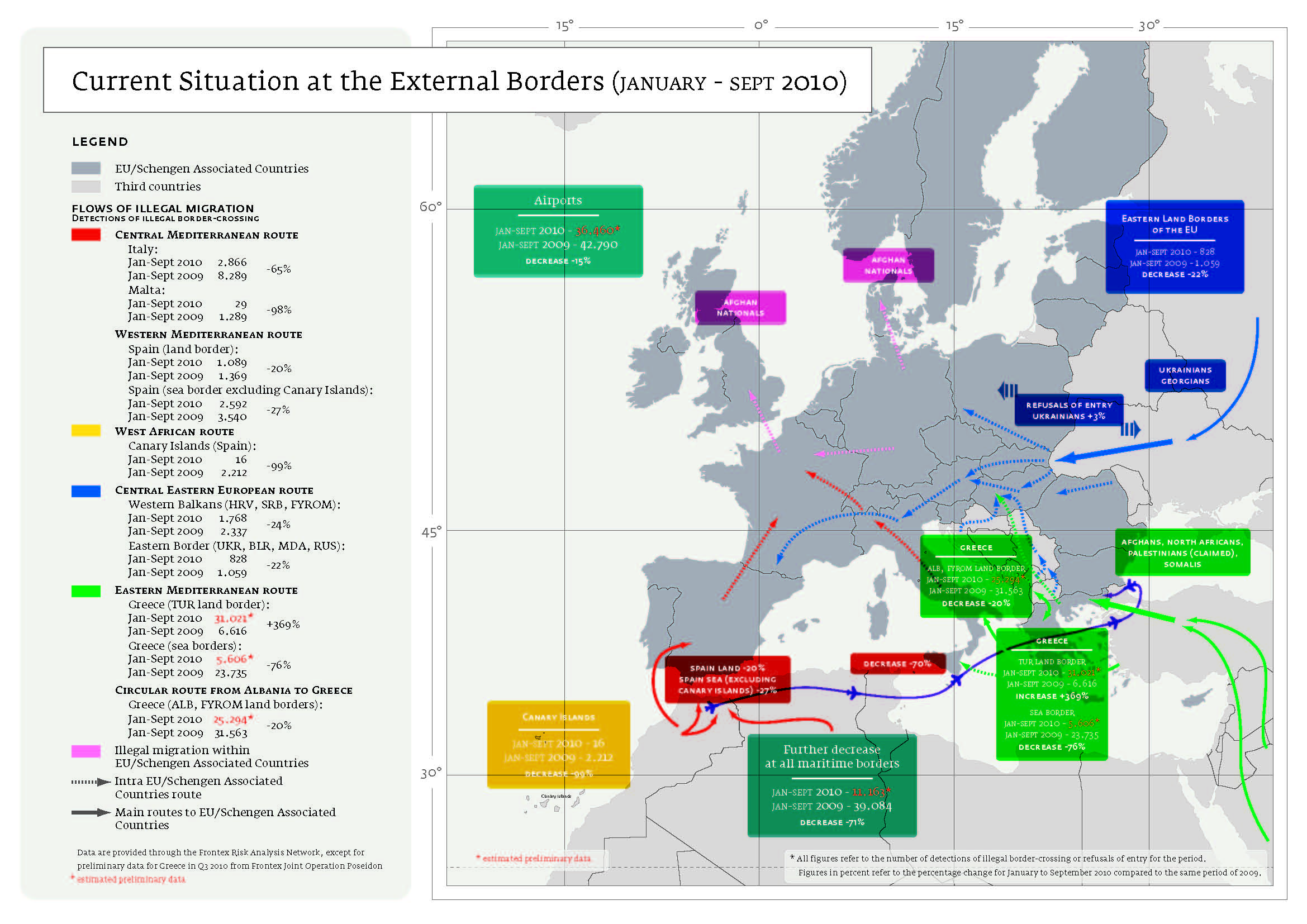
Frontex Map: Current Situation at the External Borders (JANUARY – SEPT 2010)

Frontex has released an updated Third Quarter map, January-September 2010, showing data regarding the situation at the external borders.   Note the information on the map pre-dates the deployment of the Frontex RABIT forces to the Greek border in October/November.  The data shows a 369% increase in detected irregular crossings along the Greek-Turkey land border over the first three quarters of 2010 compared to 2009.

The significant reduction in migrants detected at maritime borders continues:

  • Jan-Sept 2010:   11.163 (estimated preliminary data)
  • Jan-Sept 2009:   39.084
  • 71% reduction

Data by route:

Central Mediterranean route

  • Italy:
    • Jan-Sept 2010:     2.866
    • Jan-Sept 2009:    8.289
    • 65% reduction
  • Malta:
    • Jan-Sept 2010:    29
    • Jan-Sept 2009:    1.289
    • 98% reduction

Western Mediterranean route

Spain (land border):

  • Jan-Sept 2010:   1.089
  • Jan-Sept 2009:   1.369
  • 20% reduction

Spain (sea border excluding Canary Islands):

  • Jan-Sept 2010:   2.592
  • Jan-Sept 2009:   3.540
  • 27% reduction

West African route – Canary Islands (Spain):

  • Jan-Sept 2010:   16
  • Jan-Sept 2009:   2.212
  • 99% reduction

Eastern Mediterranean route

Greece (TUR land border):

  • Jan-Sept 2010:   31.021 (estimated preliminary data)
  • Jan-Sept 2009:   6.616
  • 369% increase

Greece (sea borders):

  • Jan-Sept 2010:   5.606 (estimated preliminary data)
  • Jan-Sept 2009:   23.735
  • 76% decrease

Click here to view Jan-Sept 2010 Map.

Click here for link to Jan-June 2010 Map.

Click here for link to 2009 Map.

1 Comment

Filed under Aegean Sea, Data / Stats, Eastern Atlantic, European Union, Frontex, Greece, Italy, Libya, Malta, Mediterranean, News, Spain, Turkey

Migreurop Report: European borders- Controls, detention and deportations

Migreurop has released its second report on Europe’s borders: “European borders- Controls, detention and deportations.”  Migreurop describes the report as a “[denunciation of] the « externalization » process of the European union migratory policy [which] shows how third countries are obliged, through the threat of the reconsideration of cooperation agreements and development aid, not only to readmit the migrants chased from Europe, but also to keep them on their own territory from travelling towards its doors.   From Calais area in France to the edge of Turkey and the Adriatic sea, from the surroundings of Gibraltar to the Sahel Saharan desert and the new member states of eastern Europe, a subcontracting of migratory control is carried out in series, sometimes very far away from the Union but also within its territory, especially when it deals with sending asylum seekers from country to country considered as unwanted. A large population of exiles, from both sides of the European borders, is subjected to arbitrary incarceration, wandering, and the constant humiliation of a hostile environment….”

Here is the Table of Contents:

Introduction

  • What have migrants become 3

Ceuta, a gilded prison

  • A murderous border 7
  • A legal limbo 8
  • The situation of migrants in detention 8
  • The situation of migrants in the CETI (open centre) 9
  • Deportations and expulsions 12
  • Surviving without resources 14

Sahel-Saharan countries, Europe’s new sentries

  • I – European interference in inter-African migrations – the case of Mauritania 18
    • The “crisis of the cayucos” 18
    • 1. Cooperation instigated by Europe 18
    • 2. Mauritania tramples on its own principles and conforms 21
    • 3. Subcontracting repression and endangering foreigners 22
  • II – Bargaining between Libya and Europe: migrants as an exchange currency –the case of Niger 33
    • 1. A reciprocal exploitation 34
    • 2. An increasingly repressive control of borders 37
    • 3. Arrests and detention in Libyan territory 39
    • 4. A deadly expulsion policy 42
  • Conclusion: the real face of Kadhafi’s pan-Africanism 44

Poland, Romania: how to be good state members in the enlarged EU

  • I – At the new frontiers: the screening of migration 47
    • 1. Reducing the transit and deserving Schengen 48
    • 2. The border police, Frontex and cooperation with other European states 48
  • II – Reception and detention centres 52
    • 1. The detention of foreigners 52
    • 2. Reception centres: isolating asylum seekers 60
    • 3. “Dublinized” asylum seekers 61
  • III – Returns 63
  • IV – Intolerance towards migrants and refugees 66
  • V – Embryonic mobilizations 70

The Ionian and Adriatic seas: forced returns between Italy and Greece

  • A new migration route at Europe’s gates 73
  • I – Controlling and blocking 75
    • 1. Controls in Greece 75
    • 2. Controls at sea 77
    • 3. Controls in Italian ports 78
  • II – Turning back and readmission 82
    • 1. Arbitrary practices and violation of rights 82
    • 2. The port of Venice: collective returns 83
    • 3. The port of Ancona 86
    • 4. Forced return to Greece 86
  • III – Detention 88
    • 1. At the borders and at sea: areas beyond legality 88
    • 2. Detention in Italy 89
    • 3. Detention in Greece 90
  • IV – Some cruel situations 93
    • 1. In Greece 93
    • 2. In Italy 96
  • V – Mobilizations 97
    • 1. In Venice 97
    • 2. In Ancona 97
    • 3. In Greece 98

Ping-pong at the Greco-Turkish border

  • Selective expulsions and random readmissions 106
  • Reactions to a degrading and sometimes murderous situation 107
  • Assistance, support, resistance 108

Dismantling the Calais jungle: a deceptive operation

  • I – The declared objectives of the 22 September 2009 operation 112
  • II – The real objectives of dismantling the jungle 113
  • III – The Modus Operandi: brutality and trickery 115
  • IV – What next? 116

Migreurop network 121

Annexes 122

  • Knocking down walls and defending the right to migrate 122
  • UNHCR-Libya : the bid is rising, migrants pay the price 124
  • All for the closure of camps for migrants, in Europe and beyond 125
  • Italia and Libya: hand in hand 127
  • Roma people victims of the French government xenophobia 128

Click here for the report (EN), or  here (FR), or here (ES).

Click here for article (ES) in Periodismo Humano about the report.

1 Comment

Filed under Aegean Sea, Eastern Atlantic, English Channel / La Manche, European Union, France, Frontex, Italy, Libya, Mauritania, Mediterranean, Morocco, Niger, Reports, Spain, Turkey, UNHCR

New Paper: M Tondini, “Fishers of Men? The Interception of Migrants in the Mediterranean Sea and Their Forced Return to Libya”

A new legal paper by Dr Matteo Tondini entitled “Fishers of Men? The Interception of Migrants in the Mediterranean Sea and Their Forced Return to Libya” is available.  This paper should be read by anyone with any interest in Italy’s current push-back practice with Libya.  Dr Tondini is currently a post-doctoral researcher at the Vrije Universiteit AmsterdamFaculty of Social SciencesDepartment of Governance Studies.  The paper has been produced as part of the INEX Project, financed by the EC under the FP7 (http://www.inexproject.eu).

The paper refers to some unpublished material and interviews. Here is the abstract:

“This paper presents an extensive account and assesses the legality of the recent naval constabulary operations – undertaken by Italian and Libyan military vessels – in the central Mediterranean Sea, aimed at intercepting boat people in international waters and returning them to the Northern African coasts. If considered as a border control operation, the interception of migrants and their debarkation in a third country often lacks a valid legal basis. The latter is easier to be found under maritime law, by ‘labelling’ interceptions as rescue missions. Nevertheless, such operations must be conducted according to state obligations under human rights law and refugee law (especially the non-refoulement rule), which only allow Italian vessels to disembark boat people to a ‘safe third country’. The paper concludes that since Libya cannot be considered a ‘safe third country’ in this sense, the interception of migrants on the high seas and their forced return to Tripoli may entail violations of maritime, human rights, migration and refugee law at both an international, European and domestic level.”

Click here or here to access the paper.

(Thank you to Dr Tondini for bringing this paper to my attention.)

Leave a comment

Filed under Analysis, European Union, Frontex, Italy, Libya, Mediterranean

ECRE Critical of EU Migration Agreement with Libya

ECRE has posted a statement on its web site that is very critical of the recent EU-Libya Migration agreement.  Also posted is an interview with MEP Sylvie Guillaume (S&D, France) who is a member of the LIBE Committee where she discusses the human rights implications of the EU agreement.

Excerpts from ECRE’s Statement:  “It is difficult to understand why the EU is finalising a deal with the political dictatorship in Libya on issues that impact the fundamental rights of thousands of people. In June this year, Tripoli ordered the UN Refugee Agency, UNHCR, to close its offices in the country, a perfect illustration of Libya’s particular understanding of refugee protection and the unreliable nature of the regime under Colonel Gaddafi. Can we honestly think that refugees are safe in Libya? …

Through this ‘migration cooperation agenda’, the EU is trusting Libya to stop irregular migration towards Europe and to decide on the fate of those asylum seekers who will find it now even harder to reach safety in Europe. This follows last year’s highly questionable agreement between Rome and Tripoli to allow Italy to push back migrants to Libya without assessing their need for international protection. Since then, hardly any refugee has managed to reach Italy by sea. The EU Governments and the European Commission have so far turned a blind eye….

In particular, EU representatives have committed to assist Tripoli in reinforcing its capacity to prevent migrants from entering Libya through its Southern borders and in developing its patrolling capacities in its territorial waters and at high sea. The agreement also covers EU’s assistance to Libya in screening migrants in order to identify those in need of international protection. By setting up EU-sponsored asylum processing centres in Libya, EU States would evade their obligations to protect refugees and shift the responsibility to a country with an appalling human rights record….”

Click here for full statement.

Click here (EN) and here (FR) for interview with MEP Sylvie Guillaume.

1 Comment

Filed under European Union, Italy, Libya, Mediterranean, Statements, UNHCR

Erika Feller’s Comments Regarding Boat People and Irregular Secondary Movements

During her annual address to the UNHCR’s Executive Committee on 6 October, Assistant High Commissioner for Protection Erika Feller reviewed significant protection issues over the past year, noting also that 2010 marks the 60th anniversary of the founding of the UNHCR in December 1950 and the 59th anniversary of the Refugee Convention.

Among the topics she addressed were the challenges posed by the arrival of irregular secondary movements of migrants, including boat people.  She is critical of interdiction practices being carried out throughout the world and makes the strong point that “[t]he evidence suggests that tough sea policies have not solved, just changed and indeed complicated the dynamics, of irregular movements.”  While Ms. Feller does not identify countries by name, she is apparently referencing increased maritime interdiction in the Aegean Sea and the resulting surge in irregular crossings along Greece’s land borders.  The point could also be made in regard to the Italian push-back practice.

Excerpts from her address:

“Arrivals of undocumented migrants continue to test the capacity of States, with the problem of so-called “irregular secondary movement” exacerbated in recent years by boat arrivals. The Pacific, the Mediterranean, the Caribbean or the Gulf of Aden are all regular theatres, with ‘boatpeople’ being interdicted, intercepted, turned around, ignored by passing ships, shot at, or denied landing. Even when rescued, disembarkation somewhere has no guarantees attached, as an incident currently playing out off the Somalia/Djibouti coasts starkly reminds us.

All this is seriously at odds not only with protection principles but also with the reality that when they manage to gain access to territory and asylum processes, a large percentage of asylum-seekers who come by boat are actually found to be refugees. …

Boat arrivals can provoke fears and high emotions which may be difficult for Governments to manage. However, in our experience, an approach built predominantly around closing borders and trying to prevent movement is not the answer, as it does not work. In fact it can make situations even more difficult to deal with. Developments in relation to one country that has pursued a tough policy towards boats are actually quite revealing. While arrivals by sea are dramatically down, arrivals by land have basically doubled. In addition, while sea arrivals had been able to be concentrated through being channeled to one main reception point, land arrivals now come through multiple crossing points and have been able to disperse more effectively and rapidly through the community, below any radar screen. The evidence suggests that tough sea policies have not solved, just changed and indeed complicated the dynamics, of irregular movements….

The phenomenon of refugees on the move for non-protection reasons is also growing. Numbers and categories vary with the regions but the concern is global. On the African continent, where camps are more the norm than the exception, it is preoccupying that camp environments are starting to be compromised by a form of transit migration to and through them, with refugees, and others, seeking to use their facilities for R&R en route to a more distant destination. Just as concerning has been the misuse of reception centers as way-stations, or even lucrative recruitment opportunities for smugglers and traffickers. These facts are not a rationale for abandoning camps or centers. They are, though, a solid reason to rethink how better to manage them within a burden sharing framework….”

Click here for full address.
2 Comments

Filed under Aegean Sea, European Union, Greece, Italy, Libya, Mediterranean, News, Statements, UNHCR

Cecilia Malmström: Back From Libya

Commissioner Malmström writes her own blog, Cecilia Malmström Mitt Europa (My Europe).  Here is her most recent posting regarding her trip to Libya (translated from Swedish with Google Translate).  There are several points worth noting – and worrying about.  She notes that Libya is not a signatory to the 1951 Refugee Convention or 1967 Protocol.  (Though Libya is a signatory to the OAU Refugee Convention.)  She suggests that the new migration agreement between the EU and Libya will involve the UNHCR, but no insight is offered regarding whether or how the UNHCR might return to Libya.  She concedes that the European Commission does not know all of the details of the bi-lateral agreement between Italy and Libya which has resulted in the current push-back practice in the central Mediterranean.  And she seems to say that she was greatly troubled by what she saw when she visited one of the southern migrant detention centres in Libya during her official trip.

Translated excerpts:

“Just returned from Libya … I have been there to try to initiate a dialogue between the EU and Libya on issues relating to asylum, migration and international protection. … I believe it is necessary to have a dialogue with Libya.

Libya has not signed the Geneva Convention and the concept of asylum is not in Libyan law. … Since Italy and Libya signed an agreement, which we unfortunately do not know everything about, it has basically been that case that no boats are crossing the Mediterranean.

Against this background, I see it as progress that the first time we have agreed a text with Libya, a version of a plan for cooperation, which deals with issues of asylum and international protection…  Our aim is to identify people in need of international protection, while helping Libya to raise standards in the detention centres in order to provide decent conditions to people. We also address the issues of border control, labor migration and human smuggling in this plan for cooperation. From the EU side, we are prepared to put up 50 million euros over three years to support reforms. These will obviously not be given as a blank check to Libya but will be provided using the guidelines of the European Commission. For example, we support specific projects by various organizations, including the UNHCR.

Besides holding talks with Libyan ministers, I also visited Libya’s southern border in the middle of the desert, observed International Organisation for Migration activities in Libya, and visited one of the detention centres where many migrants have ended up. I had the opportunity to talk to some of the people there.  Several of these stories that I heard have kept both me and my staff awake at night. …”

Click here for the full posting.

3 Comments

Filed under European Union, Italy, Libya, Mediterranean, News, UNHCR

Frontex 2nd Quarter Report

The Frontex Risk Analysis Unit has released its Report for the Second Quarter of 2010 (April-June).  It is a 30+ page report containing data, charts, and graphs detailing entry routes, detections of migrants, detections of facilitators, and other information.

Excerpts from the Report’s Executive Summary:

Illegal migration pressure in the EU underwent a foreseeable seasonal increase during the second quarter of 2010, but is still clearly in a period of decline.…

The widespread decline in illegal migration pressure is probably due to two key factors. The first is decreased employment opportunities in the EU …  [and the] second is stricter migration and asylum policies in Member States, supported by much more effective collaboration with key third countries. For example, stricter migration and asylum policies in Norway and the UK have reduced the number of applications in these Member States…. Similarly, bilateral agreements between Italy and Libya, and between Spain and both Senegal and Mauritania, continue to control, for the time being at least, most illegal migration via the Central Mediterranean and West African routes, respectively.

Notwithstanding the general decline in detections, there were two emerging trends in the second quarter (Q2) of 2010: a continued and intensified shift from the Greek sea border to the Greek land border with Turkey….  In the beginning of 2009 illegal crossings of the EU external border between Greece and Turkey were divided roughly equally between the land and sea borders.  However, there has been a gradual and recently intensified shift to the land border. Reasons for this shift from sea to land borders are linked to the effectiveness of the Frontex activities in the Aegean Sea, combining surveillance activities with identification of illegal migrants, and opening the possibility of return to origin countries for detected migrants. ….

Main trends:

  • There is a general decline in illegal migration to the EU compared to a year ago;
  • For the time being, Turkey is the main transit country for illegal migration to the EU….;
  • In the Eastern Mediterranean route, there has been a gradual and recently intensified shift from the Greek-Turkish sea border to the land border, where 90% of detections were made….   At the Greek-Turkish land border around 60% of detections were made at the Border Control Unit (BCU) Orestiada which is under the biggest pressure. Air connections to Turkey are increasingly used by migrants from North Africa, who then illegally cross the EU external border with Turkey. As well as effective Frontex-coordinated joint operations at the sea border, potential explanations for this shift include cheaper facilitation costs, a lower risk crossing, lower detection rates…;
  • There were increased detections on the Central Mediterranean route, probably due to the recent re-organisation of criminal groups in response to effective bilateral agreements in the area. In June 2010 Libya expelled the United Nations High Commissioner for Refugees (UNHCR), with whom 9,000 refugees and 4,000 asylum-seekers were registered and who, in the absence of protection, may now attempt entry to the EU.

Click here for the 2nd Quarter Report.

Click here for the 1st Quarter Report.

2 Comments

Filed under Aegean Sea, Analysis, Data / Stats, Eastern Atlantic, European Union, Frontex, Greece, Italy, Libya, Malta, Mauritania, Mediterranean, News, Reports, Senegal, Spain, Turkey

Libyan Court Delays Ruling in Mass Trafficking Trial

According to the Libyan newspaper Oya (or Oea), the State Security Court has delayed its ruling in the mass human trafficking trial involving approximately 520 defendants until 17 October.

Click here for article. (AR)

Click here for previous post.

Leave a comment

Filed under Italy, Judicial, Libya, Mediterranean, News

HRW Calls on Libya to Halt Firing on Migrant Boats

Human Rights Watch on 16 September called on the Libyan government to “immediately end what appears to be a policy that allows shooting at boats carrying migrants from Libya to Italy.”  HRW also called for Italy to stop participating in joint patrols with Libya.

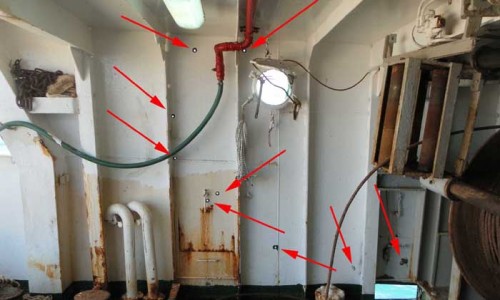
The request was made as a result of the incident on 12 September when a Libyan patrol boat fired on an Italian fishing vessel.  After the incident, Italian Interior Minister Roberto Maroni suggested that the Libyans “perhaps…confused the fishing boat for a boat with illegal migrants.” [”Posso immaginare che i libici abbiano confuso il peschereccio con una imbarcazione con immigrati irregolari, ma posso immaginare soltanto.”]

Bill Frelick, Refugee Program director at Human Rights Watch, said “the Libyans and Italians appear to agree that it was a mistake to shoot at Italian fishermen, but imply that it’s OK to shoot at migrants. The bullet-riddled boat shows a reckless use of potentially lethal force that would have been just as bad if it had actually targeted nonthreatening migrants.  This incident shows once again the dangers when an EU member outsources its border controls to third countries.  Italy should immediately end its agreement with Libya aimed at intercepting migrants trying to leave Libya.”

Click here for full HRW statement.

Click here and here (IT) for articles.

The arrows indicate the holes left by shots fired from a machine gun against a Libyan patrol boat fishing boat fleet of Mazara del Vallo, Aries (Ansa)

Click here for photo source.

Leave a comment

Filed under Italy, Libya, Mediterranean, News

Libyan State Security Court Expected to Rule Soon in Human Trafficking Trial Involving 500+ Defendants

The Libyan newspaper Oya (or Oea) reported this past week that the State Security Court is expected to issue a ruling on 26 September in a mass human trafficking trial involving approximately 520 defendants.  The trials have been ongoing since at least May 2010.  The defendants reportedly include members of the armed forces, public security, and Navy. They have been charged with offences relating to human trafficking and facilitating illegal immigration from Libya to Italy.

Click here for article. (AR) (Recently I have not been able to get Google Translate to work with Arabic.  I am therefore “reading” Arabic via these two sites: http://www.appliedlanguage.com/web_translation.shtml?s=dd and http://translation.babylon.com/ .)

Click here and here for previous posts on the trial.

2 Comments

Filed under Italy, Judicial, Libya, Mediterranean, News

Patrol Boat Given to Libya by Italy Fires On Italian Fishing Vessel

One of the six Italian patrol boats given to Libya by the Italian government to assist in efforts to stop migrants from leaving Libya fired on an Italian fishing boat in the Gulf of Sirte on Monday.  An Italian official was on board the Libyan vessel as an observer during the incident.  Libya apologised for the incident which is being investigated.

Click here and here for articles.

1 Comment

Filed under Italy, Libya, Mediterranean, News

EUROSTAT Q1 2010 Asylum Statistics for EU27 Countries

EUROSTAT released updated data on 15 July for the First Quarter of 2010.  The report is entitled: Asylum applicants and first instance decisions on asylum applications in Q1 2010 (Doc. 32/2010).

Notable statistics include reductions of over 50% in the number of asylum applicants in three countries, Malta, Italy, and Greece, relative to the First Quarter of 2009.  Malta had the largest reduction of approximately 95%.

The reductions in Malta and Italy are almost certainly due to Italy’s push-back practice.  Though the first migrant arrivals in Malta in 2010 occurred this past weekend, 17 July, when 55 migrants on a sinking vessel were intercepted by Maltese and Libyan patrol boats.  The Times of Malta reported that the migrants were “shared out” between the Maltese and Libyan patrol boats.  28 migrants were brought to Malta and 27 were apparently taken to Libya.

Click here for the full EUROSTAT document.

Click here for Times of Malta article.

3 Comments

Filed under Aegean Sea, Data / Stats, Eastern Atlantic, European Union, Greece, Italy, Libya, Malta, Mediterranean, News

Malmström Meets With Libyan Foreign Minister

Commissioner Cecilia Malmström met with Libyan Foreign Minister Moussa Koussa on 13 July.  I cannot find any reference to the meeting on Commissioner Malmström’s official web site, but she mentions the meeting on her personal blog (written in Swedish).   She writes simply that she met with the FM and that “Libya is a complex but important neighbour and we have a lot to talk about – not least, migration and asylum and human rights.  The meeting was a first opportunity to talk.” (translation using Google translate.)

According to an article in Il Manifesto (and reposted on the Diritti Globali web site where I first read / Google-translated it), the ongoing EU-Libya partnership accord talks and the immigration aspects of the accord were discussed in the meeting between the Libyan FM and Malmström.

Also apparently discussed at the meeting was Libya’s decision to release up to 3000 detained migrants from several detention centres, including the Eritreans who were likely detained by Libya after being interdicted at sea and subjected to Italy’s push-back practice.

From the Il Manifesto article:

Quanto alle responsabilità italiane nella vicenda, legate in particolare al fatto che 103 dei 205 detenuti di Braq sono stati respinti in mare dalle navi italiane, la Commissione Ue continua a mantenere un profilo alquanto basso. Ieri Stefano Manservisi, Direttore generale della DG interni della Commissione Ue, intervenendo al dibattito in Parlamento sugli eritrei, ha affermato che «non abbiamo informazioni su dove sono state intercettate queste persone, non si può dire che Malta doveva fare o l’Italia doveva fare, si sa che ora sono in Libia e dobbiamo verificare in che condizioni si trovano». .[…]

Per ora il silenzio, che dura da un anno sui respingimenti, e poche parole anche sul Trattato di partenariato, amicizia e cooperazione tra Italia-Libia, che ha di fatto dato il via libera a questa nuova politica. «Riguardo agli accordi bilaterali, a titolo personale – ha affermato ancora il numero 2 della Malmström – considero migliore un accordo europeo a uno bilaterale, ma ci vuole chiarezza, questo accordo ha pure dimostrato la propria efficacia, è un dato di fatto che il flusso di immigrati si è bloccato».  E ancora: «Ci è stato notificato un accordo in linea con la normativa Ue, anche se c’è una componente segreta che non conosciamo». Pur con questa dosi di oscurità, per la Commissione il futuro dell’intesa tra Bruxelles e Tripoli dovrebbe ricalcare una buona parte dell’ accordo tra Berlusconi e Gheddafi: «Dobbiamo fare modo che ciò che è coperto da accordi bilaterali possa diventare base accordo più amplio», ha concluso Manservisi.

Per procedere nei contatti, lo stesso Direttore generale si recherà in Libia prima dell’autunno, quindi toccherà alla commissaria Malmström in ottobre, il tutto in vista della stesura di un accordo generale che parli di immigrazione, ma anche controllo delle frontiere, visti e relazioni economiche. Altro appuntamento chiave il vertice Ue-Unione africana del 29 e 30 novembre a Sirte.

Click here (SV) for the Commissioner’s personal blog post.

Click here (IT) for full Il Manifesto article.

Leave a comment

Filed under European Union, Italy, Libya, Mediterranean, News

Frontex 2010 1st Quarter Report: Irregular Migration at Sea Borders Less Than 10% of Peak Levels

Frontex has released information from its 2010 First Quarter report by the Frontex Risk Analysis Network (FRAN).  A copy of the report itself has apparently not been released.  According to the summary provided, there have been significant reductions in irregular migration:

  • “[D]etections of irregular immigrants at [all EU] sea borders … were less than one-tenth of the peak level (for the third quarter of 2008) when roughly 33,600 detections were reported.”
  • “[D]etections at the Spanish and Italian sea borders became negligible…”
  • “[D]etections at the dominant Eastern Aegean Sea border between Greece and Turkey also fell by more than 60% to just under 2,300.”
  • “Detections at the Greek-Turkish land border were for the first time greater than those at the countries’ sea border.”
  • There were “only 150 detections of illegal border-crossing [in the Central Mediterranean], compared to 5,200 detections in the first quarter of 2009…”
  • There were “only 500 irregular immigrants detected [in the Western Mediterranean] (almost 72% down on the fourth quarter of 2009 …).”
  • There were “only five detections over the first three months of 2010 [on the West African/Canary Island route], in contrast to 31,700 detections in 2006…”

Click here for full statement.

Leave a comment

Filed under Aegean Sea, Algeria, Analysis, Data / Stats, Eastern Atlantic, European Union, Frontex, Greece, Italy, Libya, Malta, Mauritania, Mediterranean, Morocco, News, Reports, Senegal, Spain, Turkey