Category Archives: Libya

28th Franco-Italian Summit – Agreement on Joint Maritime Patrols

The 28th Franco-Italian Summit was held 9 April in Paris and resulted in the signing of approximately 25 agreements between France and Italy.  Among the agreements is a joint declaration on immigration which highlights the leading role played by France and Italy in controlling illegal immigration in the Mediterranean region.  The agreement provides for, among other things, joint French-Italian maritime patrols to monitor the countries’ territorial waters.  The agreement also stresses the need to strengthen the role of Frontex and calls for cooperation with both Libya and Turkey on immigration matters, including readmission of migrants.

Click here (EN), here (IT), here (IT), and here (FR) for articles.

Leave a comment

Filed under France, Frontex, Italy, Libya, Mediterranean, News, Turkey

NRC Article: Seaborne interception of immigrants tested in ECtHR

From NRC Handelsblad (Netherlands):  “None of them have ever set foot on European soil. Most are incarcerated in Libyan detention centres. Some may have already been sent back to their countries of origin. Yet they are filing suit against the Italian state in the European Court of Human Rights (ECHR). The plaintiffs are 24 immigrants from Somalia and Eritrea who tried to sail from Libya to Italy on May 6, 2009. They were intercepted by the Italian coast guard 35 kilometres off the island of Lampedusa and immediately sent back to Libya. Back in the north African country, the would-be immigrants were put in touch with two Italian immigration lawyers, who then brought their case to the ECHR in Strasbourg.

The case is unique, said Thomas Spijkerboer, a professor of migration law at Amsterdam’s Vrije Universiteit. ‘For the first time, Europe’s highest court for human rights will look into the most controversial policy combating illegal seaborne migration any European state has implemented so far,’ he said. …

The Italian lawyer Anton Giulio Lana has been granted power of attorney to act on the behalf of 24 returned would-be immigrants. Lana was put in touch with his clients by an international NGO that operates in Libya. Speaking on the phone from Rome, Lana explained: ‘I would rather not say what NGO is helping us. It needs to be able to operate in Libya for the time being.’  According to Lana, Italy has violated Article 3 of the European Convention on Human Rights that prohibits ‘torture or inhuman or degrading treatment or punishment’. Deported immigrants run the risk of being exposed to such treatment in Libya. The convention also forbids collective expulsion of foreigners, and according to refugee law, it is illegal to deport asylum seekers to a country where they could face persecution.”

Click here for full article.

Leave a comment

Filed under European Court of Human Rights, Italy, Libya, Mediterranean, News

UNHCR Files ECtHR Third Party Intervention in Hirsi v. Italy

The UNHCR submitted a third party intervention to the European Court of Human Rights in the case of Hirsi and others v Italy, Requête no 27765/09, which was filed on 26 May 2009 by 11 Somalis and 13 Eritreans who were among the first group of about 200 migrants interdicted by Italian authorities and summarily returned to Libya pursuant to Italy’s push-back practice.  The case was communicated by the Second Section of the Court on 17 November 2009.

The UNHCR’s intervention “addresses the practice and justification of ‘push-back’ operations by the Italian government, the conditions for reception and seeking asylum in Libya and the extraterritorial scope of the principle of non-refoulement and pursuant legal obligations concerning the rescue and interception of people at sea.”

Excerpts from the intervention:

“[***]  2.2.1  On 6 May 2009, the Italian government, in cooperation with the government of Libya, initiated the so-called “push-back policy” by intercepting people, including those who may be in need of international protection, on the high seas and returning them to Libya. This policy was a departure from the previous practice where Italian naval forces had regularly disembarked such persons in Lampedusa or Sicily. Based on UNHCR’s estimates, in 2008 some 75% of sea arrivals in Italy applied for asylum, and 50% of those who applied received some form of protection after their claims were assessed in the Italian asylum procedure.

2.2.2  According to the Italian authorities, from 6 May to 6 November 2009, a total of nine operations were carried out, returning a total of 834 persons to Libya. The precise modalities of the operations have not been made public and were not otherwise fully disclosed to UNHCR. …

4.1  The extraterritorial scope of the principle of non-refoulement under Article 33 (1) of the 1951 Convention…

4.1.2  The territorial scope of Article 33 (1) is not explicitly defined in the 1951 Convention. The meaning, purpose and intent of the provision demonstrate, in UNHCR’s view, its extraterritorial application, e.g., to situations where a state acts outside its territory or territorial waters. Furthermore, the extraterritorial applicability of human rights obligations contained in various instruments supports this position ….

4.2  The extraterritorial scope of the principle of non-refoulement in human rights law

4.2.1  The complementary and mutually reinforcing nature of international human rights law and international refugee law speak strongly in favour of delineating the same territorial scope for all expressions of the non-refoulement principle, whether developed under refugee or human rights law….

4.3  The principle of non-refoulement in the context of interception and search and rescue operations on the high seas

4.3.1  As stated earlier, the principle of non-refoulement applies whenever a state exercises jurisdiction. Jurisdiction can be based on de jure entitlements and/or de facto control. De jure jurisdiction on the high seas derives from the flag state jurisdiction.  De facto jurisdiction on the high seas is established when a state exercises effective control over persons. Whether there is effective control will depend on the circumstances of the particular case.

4.3.2  Where people are intercepted on the high seas, rescued and put on board a vessel of the intercepting state, the intercepting state is exercising de jure as well as de facto jurisdiction. While de jure jurisdiction applies when the people on board a ship are sailing under the flag of the intercepting state, it is also exercised – relevant to the case of “push-backs” – where the intercepting state has taken the persons on board its vessel, bringing them under its full (effective) control. In UNHCR’s view, as becomes clear from section 2.2 above, the Italian authorities were in full and effective control of the persons throughout the “push-back” operations until the formal hand-over to the Libyan authorities. Article 4 of the Italian Code of Navigation specifies that Italian ships on the high seas are considered as Italian territory.

4.3.3  When jurisdiction on the high seas has been established, the obligations deriving from it in relation to the principle of non-refoulement should be examined. The UNHCR’s Executive Committee has emphasized the fundamental importance of fully respecting this principle for people at sea, underlining that: ‘interception measures should not result in asylum-seekers and refugees being denied access to international protection, or result in those in need of international protection being returned, directly or indirectly, to the frontiers of territories where their life or freedom would be threatened on account of a Convention ground, or where the person has other grounds for protection based on international law.’

4.3.4  In UNHCR’s view, the situation in which a state exercises jurisdiction on the high seas over people on board its vessels requires respect for the principle of non-refoulement. It follows that states are obliged, inter alia, not to hand over those concerned to the control of a state where they would be at risk of persecution (direct refoulement), or from which they would be returned to another country where such a risk exists (indirect refoulement). The state exercising jurisdiction needs to ensure that asylum-seekers are able to access fair and effective asylum procedures in order to determine their needs for international protection….

4.3.6  For interception or rescue operations carried out by EU Member States, UNHCR has clarified that, “… disembarkation of people rescued in the Search and Rescue (SAR) area of an EU Member State should take place either on the territory of the intercepting/rescuing State or on the territory of the State responsible for the SAR. This will ensure that any asylum-seekers among those intercepted or rescued are able to have access to fair and effective asylum procedures. The disembarkation of such persons in Libya does not provide such an assurance”.

5.  Conclusion

5.1  UNHCR considers that the interception of persons on the high seas between Italy and Libya, their transfer from Italian to Libyan custody, and their return to Libya, may be at variance with the principle of non-refoulement and in contradiction to Article 3 of the ECHR. By returning persons to Libya without an adequate assessment of their protection needs, the Italian authorities appear not to have sufficiently taken into account the potential risk of refoulement, including indirect refoulement, and other possible violations of fundamental rights upon return of the affected persons to Libya. The lack of an asylum system in Libya means that there are not sufficient safeguards to ensure that persons in need of international protection will be recognized as such and accorded legal status and associated entitlements that could ensure their rights, including to protection against refoulement, are not violated. The risk of chain refoulement denying international protection, especially to Eritrea, cannot be excluded.”

Click here for the full text of the UNHCR intervention.

Click here for an earlier post on the case.

1 Comment

Filed under European Court of Human Rights, Italy, Judicial, Libya, Mediterranean, News, UNHCR

Article: “A Contested Asylum System: The European Union between Refugee Protection and Border Control in the Mediterranean Sea”

An article in the most recent edition (Vol. 12, Number 1, 2010) of the European Journal of Migration and Law by Silja Klepp:

Abstract:

“During the past few years the border waters between Europe and Africa have become an EU-policy crucible. In the midst of the tightening of EU border controls and refugee protection claims, supranational, national and local actors find themselves in a phase of legal insecurity and negotiation. This article is based on ethnographical research carried out in Libya, Italy and Malta. It sheds light on the different actors’ practices at sea and in the surrounding border region. It also explores how new parameters for refugee protection are emerging in the border regions of the European Union. The article argues that the policy practices of the co-operation between Italy and Libya as well as the informal operational methods carried out in the Mediterranean Sea function as a trailblazer of the overall EU refugee policy. In the long term, some of these practices will affect and change the legal basis and the formal regulations of the European refugee regime. The principle of non-refoulement could first be undermined and then abolished in this process. Using an approach that combines the empirical study of border regions with a legal anthropological perspective, the article analyses the Union’s processes of change and decision-making on local, national and supranational levels and their interconnections.”

Click here for link to full article – restricted access only.

1 Comment

Filed under Analysis, European Union, Italy, Libya, Malta, Mediterranean

CARIM Mediterranean Migration 2008-2009 Report

Noted recently in the Newsletter of the Real Instituto Elcano:

CARIM MEDITERRANEAN MIGRATION 2008-2009 REPORT, Robert Schuman Centre for Advanced Studies, San Domenico di Fiesole (FI): European University Institute, October 2009, Edited by Philippe Fargues

MIGRATIONS MÉDITERRANÉENNES, RAPPORT 2008-2009, Octobre 2009, Sous la direction de Philippe Fargues

An excerpt:

“The period covered in this latest report, the years 2007 and 2008, is characterised by the accentuation of the migratory trends described in previous reports1: emigration from South and East Mediterranean countries (SEM) is continuing at a steady rate, while immigration to these countries is increasing, particularly in various irregular forms. [***]

Transit Migrants

Transit migrants in the SEM countries are people who cannot reach the destination of their choice (Europe) for lack of the required visa. They are waiting to find a way to reach this destination and over time their transit becomes stay. All the SEM countries, from Mauritania in the west to Turkey in the East, have, over the course of the last two decades, been transformed into transit countries for those travelling to Europe.

How many transit migrants are there in the SEM countries? The statistics in this area are even more inadequate than those for de facto refugees or irregular migrant workers. Aggregating figures provided by the police and various NGOs allows for a maximum estimation of 200,000 transit migrants in the region (Table 7).

Table 7: Transit migrants present in SEM countries around 2005

Country                        Estimated number

Algeria                           > 10,000

Turkey                           > 50,000

Libya                              > 10,000

Mauritania                   ± 30,000

Morocco                      > 10,000

Egypt, Israel, Jordan,

Lebanon, Palestine,

Syria, Tunisia              Not available

Total SEM                     < 200,000

Sources: CARIM, Irregular Migration Series http://www.carim.org/index.php?areaid=8&contentid=235&callTopic=7

According to data collected by an Italian NGO on deaths and disappearances at sea (Table 8), it would seem that the number of clandestine sea crossings from SEM countries to Europe is not increasing (in fact it may even have decreased in 2008) but the routes are changing. The most ancient route across the Straits of Gibraltar is being used less and less and has been successively replaced by that from Mauritania, or even Senegal, to the Canary Islands (on which traffic peaked in 2006), from Turkey to the Greek Islands of the Dodecanese (on which traffic peaked in 2007) and lastly from Libya to Italy on which traffic peaked in 2008).

How many transit migrants are there who attempt (sometimes successfully) the crossing to Europe? And for how many does transit in the SEM countries become a more long period of stay? The rare surveys carried out in the Maghreb or in Turkey do not allow us to assess this. With the extension of their stay in countries initially seen as a place of transit, transit migrants soon become mixed up with the more significant mass of migrant workers in irregular situation. On the other hand, it is not always possible to distinguish them from refugees. The two groups exist side by side in what the HCR calls flows of “mixed migration” where transit migrants and refugees, sometimes from the same countries of provenance, resort to the same smugglers and find themselves in the same circumstances.

Table 8: Dead and missing persons on sea routes of irregular migration from SEM to Europe 2000 – 2008

Year\ Route      Sicily +             Gibraltar +

Sardinia           Ceuta & Melilla

2000                   0                           127

2001                     8                           157

2002                     236                     106

2003                     413                     108

2004                     206                    64

2005                     437                    146

2006                     302                    215

2007                     621                    142

2008                     702                    216

Total                     2,925                1,281

Year\ Route      Canary              Aegean Sea

Islands

2000                   16                         32

2001                     40                        102

2002                     39                        94

2003                     130                      81

2004                     232                      103

2005                     185                      98

2006                     1,035                  73

2007                     745                      257

2008                      136                      181

Total                       2,558                 1,021

Year                Total All Routes

2000                 175

2001                   307

2002                   475

2003                   732

2004                   605

2005                   866

2006                   1,625

2007                   1,765

2008                   1,235

Total                  7,785

Source : http://fortresseurope.blogspot.com/

[***]”

Click here for link to full Report in both English and francais.

Leave a comment

Filed under Algeria, Data / Stats, Egypt, France, Greece, Italy, Libya, Malta, Mauritania, Mediterranean, Morocco, Portugal, Reports, Spain, Tunisia, Turkey

Informal Meeting of European Union Defence Ministers

An Informal Meeting of EU Defence Ministers was held in Mallorca last week to discuss the EU Common Security and Defence Policy (CSDP) established by the Treaty of Lisbon.

A decision was taken at the meeting to expand the objectives of Operation Atalanta to include the surveillance and control of Somali ports where pirate ships are based.  This decision will be implemented later in the month of March as weather conditions in the region improve.  The decision represents a potentially significant expansion of the EU’s anti-piracy operations.

Also attending the Informal Meeting were the ministers of defence from Algeria, Libya, Morocco, Mauritania and Tunisia.  A side meeting was conducted with regard to improving co-operation in matters of security in the Euro-Mediterranean zone.  The side talks pertained to the so-called “5+5 Western Mediterranean Defence Initiative” or more simply the “5 + 5 Initiative”.

Spanish Minister of Defence, Carme Chacón, who chaired the Informal Meeting said in regard to the meetings with the defence ministers from the five Maghreb countries:

“Spain is very clear on the fact that the Mediterranean is a sea of opportunities, but if we let our guard down then it can become a sea of problems – and we share this vision with all the associations we are involved in. At the moment it is a sea of peace and tranquillity, but both North and South must work together to tackle the dangers and new threats of the 21st Century, such as international terrorism, drug smuggling and organised crime. We must put our surveillance and maritime safety capacities into action in order to combat these threats, which could become an area of concern or a problem if we do not deal with them properly. And Spain will not forget this. In terms of the initiative of bringing together the countries of Europe and the Maghreb, we would like it to be not just the Spanish Presidency that sees to hold these meetings, but for the EU to be able to sit down regularly with these countries to discuss issues relating to the Mediterranean Sea, which must carry on being a source of opportunities rather than one of concern.”

Click here, here, here, and here for Press Releases from the Informal Meeting.

Cliquez ici pour un article (blog post) en francais.

Leave a comment

Filed under Algeria, European Union, Gulf of Aden, Indian Ocean, Libya, Mauritania, Mediterranean, Morocco, News, Somalia, Spain, Tunisia

Italy Warns that Libya May Suspend Bi-Lateral Migration Agreement

Italian Interior Minister Roberto Maroni said that the Swiss – Libya visa dispute which has resulted in a Libyan decision to stop issuing visas to nationals of the Schengen zone may result in Libya halting its cooperation with Italy under the terms of the two countries’ bi-lateral migration agreement.

“Speaking on the sidelines of a meeting of European Union interior ministers, …  Maroni said the row put the Schengen zone at risk and could further strain relations with Libya. Cooperation by Tripoli in controlling immigration to the EU was one issue, he said. ‘The fear is in part that … Libya could weaken its border controls concerning illegal immigration.’”

Click here and here for articles.

Leave a comment

Filed under European Union, Italy, Libya, Mediterranean, News

JHA Council Conclusions on 29 measures for Reinforcing External Borders and Combating Illegal Immigration

Here are excerpts from the Justice and Home Affairs Council conclusions adopted on 25 February 2010:

“Council conclusions on 29 measures for reinforcing the protection of the external borders and combating illegal immigration

2998th JUSTICE and HOME AFFAIRS Council meeting – Brussels, 25 and 26 February 2010

The Council adopted the following conclusions:

The Council:

a) Taking into account the momentum created for the further development of the area of freedom, security and justice represented by the entry into force of the Lisbon Treaty and by the political priorities included in the Stockholm Programme, the European Pact on Immigration and Asylum, the Global Approach to Migration and the European Council Conclusions of June and October 2009; [***]

d) Stressing the need to share and assess analysis of the continuing illegal arrivals of migrants at the southern maritime borders, as well as the eastern land borders, as shown in particular by recent events in the Mediterranean area, and of the smuggling of migrants and trafficking in human beings, which often have tragic consequences; and to take a series of measures immediately, in the short term and medium term, in order to address the challenges;

e) Underlining that all measures and actions taken as a consequence of these conclusions shall fully respect human rights, the protection of persons in need of international protection and the principle of non-refoulement; [***]

Concerning the activities of FRONTEX, the Council has agreed:

1. To seek agreement as a matter of urgency on the Commission proposal for a Regulation of the European Parliament and of the Council amending the FRONTEX Regulation, in order to reinforce the capabilities of the FRONTEX Agency. [***]

4. To improve operational cooperation with third countries of origin and transit, in order to improve joint patrolling on land and at sea, upon consent of the Member State concerned, return, and collection and exchange of relevant information within the applicable legal framework, and other effective preventive measures in the field of border management and illegal immigration.

5. To underline the importance of the role of the European Asylum Support Office (EASO) in developing methods to better identify those who are in need of international protection in mixed flows and in cooperating with FRONTEX where ever possible, and to welcome the development of the regional protection programs and the enhancement of the dialogue and cooperation on international protection with third countries. [***]

9. To invite FRONTEX to implement its decision to carry out a pilot project for the creation of an operational office in the eastern Mediterranean, in Piraeus, as soon as possible in 2010. The Council takes note that Frontex has agreed that, on the basis of an independent external evaluation, it may decide whether to pursue the pilot project and/or establish other Frontex operational offices as appropriate, and invites FRONTEX to report to Council on the matter.

Concerning the development of the European Surveillance System – EUROSUR, the Council has agreed:

10. To call on the Member States to implement the phases and steps laid down for the development of EUROSUR as soon as possible, in order to reinforce cooperation and Member States’ border surveillance capabilities. The Council invites the European Commission to report on EUROSUR progress on mid-2010.

11. To urge relevant Member States to establish or further develop a single national border surveillance system and a single national Coordination Centre. A network of national Coordination Centres, compatible with the FRONTEX Information System, and available on a 24/7 basis in real time, should be fully operational on a pilot basis as of 2011, involving as many Member States of the southern and eastern external borders as possible. The Commission is invited to present legislative proposals if necessary to consolidate the network of Member States by 2013.

12. To create a Common pre-frontier intelligence picture in order to provide the Coordination Centres with pre-frontier information provided by Member States, Frontex and third countries. To this end, the Council invites Frontex, in close cooperation with the Commission and the Member States to take the necessary measures to implement the study carried out by the Commission in 2009.

13. To encourage cooperation by neighbouring third countries in border surveillance. It is essential that within the territorial scope of EUROSUR and in the current financial framework, financial and logistic support from the European Union and its Member States be made available to the third countries whose cooperation could significantly contribute to controlling illegal immigration flows, in order to improve their capacity to manage their own borders.

14. To invite the Commission to report before the end of 2010 on how the conclusions of the Global Monitoring for Environment and Security (GMES) border surveillance group on common application of surveillance tools, such as satellites, could be implemented in the EU land and sea borders. [***]

Concerning solidarity and the integrated management of external borders by the Member States, the Council has agreed:

17. To request Frontex and the Member States concerned to further develop the European Patrols Network (EPN) in order to generalize bilateral joint maritime patrols, in particular between neighbouring Member States at the southern and eastern maritime borders, taking into account the experience gained on joint police patrols in the context of the Prüm Decision, and to ensure the full integration of the EPN in the EUROSUR network. [***]

Concerning the cooperation with third countries, the Council has agreed:

22. To ensure that the migration policy objectives are at the centre of the political dialogue with relevant third countries of origin and transit, with a view to the strategic, evidence based and systematic implementation of the Global Approach to Migration in all its dimensions, i.e. legal migration, illegal immigration and migration and development. This also requires, as a matter of principle, that all parties concerned assume their responsibilities in terms of return and readmission of migrants entering or staying illegally, including those migrants who have entered or tried to enter the European Union illegally from their territory. [***]

24. To enhance in particular the implementation of the Global Approach in the dialogue on migration with the main countries of origin and transit, such as, in accordance with the Stockholm Programme, those of the Mediterranean area, the East and South-Eastern Europe and Africa. This process may cover, on a case by case basis, all aspects of migration, including also cooperation on and support of border management, return and readmission, and, where appropriate, mobility issues. In doing so, the EU will promote human rights and the full respect for relevant international obligations. Dialogue and cooperation should be further developed also with other countries and regions such as those in Asia and Latin America on the basis of the identification of common interests and challenges.

25. To implement actively the European Council Conclusions of June and October 2009, including in particular by taking forward the dialogue on migration with Libya, with a view to setting up in the short term an effective cooperation. The Commission is invited to explore, as a matter of urgency, a cooperation agenda between the European Union and Libya with a view to including initiatives on maritime cooperation, border management (including possibilities for the development of an integrated surveillance system), international protection, effective return and readmission of irregular migrants and issues of mobility of persons.

26. To welcome the constructive resumption of the formal negotiations on a EU/Turkey readmission agreement, which makes provision for the return of third country nationals, and to call for its conclusion as a matter of urgency, and to stress that adequate implementation of already existing bilateral readmission agreements remains a priority. Building on the dialogue now under way with Turkey, the Council invites the Commission, the Member States and Turkey to further develop cooperation on migration, international protection and mobility issues. The Commission is also invited, in the context of the existing Instrument for Pre-accession Assistance (IPA) financial framework, to explore possibilities to provide adequate financial means to improve Turkish capacity to tackle illegal migration, including support to the implementation of the Turkish integrated border management system.

27. To underline the importance of swift finalisation of the negotiation of Article 13 of the Cotonou Agreement, the revision of which should seek to reinforce the three dimensions of the Global Approach, and in particular the effectiveness of readmission obligations.

28. To invite the Commission to identify the necessary means to support enhanced capacity building and infrastructures in relevant third countries, so that they can control efficiently their external borders and tackle illegal immigration, taking also into account the assessments made by FRONTEX.

29. To invite the Commission to report on the implementation of these Conclusions by the end of 2010.”

Click here for full Document.
Leave a comment

Filed under Aegean Sea, Eastern Atlantic, European Union, Frontex, Libya, Mediterranean, News, Turkey

Malmström: Expand Frontex Powers and Respect Rights

On the eve of the 25-26 February meeting of the Council of Justice and Home Affairs, EC Home Affairs Commissioner Cecilia Malmström in her first press conference as Commissioner presented the Commission’s proposal to expand Frontex’s powers in several areas including giving it the authority to co-lead enforcement operations with member states.  The proposal would also introduce “an explicit requirement for all border guards taking part in operations to have been trained in fundamental rights, with the aim to safeguard that all immigrants are met with full respect of fundamental rights and in particular the principle of non-refoulement.”

Speaking of Italy’s forcible migrant return policy, Malmström said “I don’t exclude at all that errors were committed in the past, that’s why I’m so keen to really reinforce that all the people involved in Frontex operations have the adequate education and know exactly what to do. Because of course, these people [the migrants] are not criminals, they are in the search for a better life and they have the right to be treated in a dignified way.”

Click here and here for articles.

Click here for JHA Council 25-26 February Meeting Agenda.

Click here for JHA Council Meeting Background Note.

Leave a comment

Filed under Aegean Sea, Eastern Atlantic, European Union, Frontex, Italy, Libya, Mediterranean, News

Frontex Presentation at European Defence Agency Annual Conference

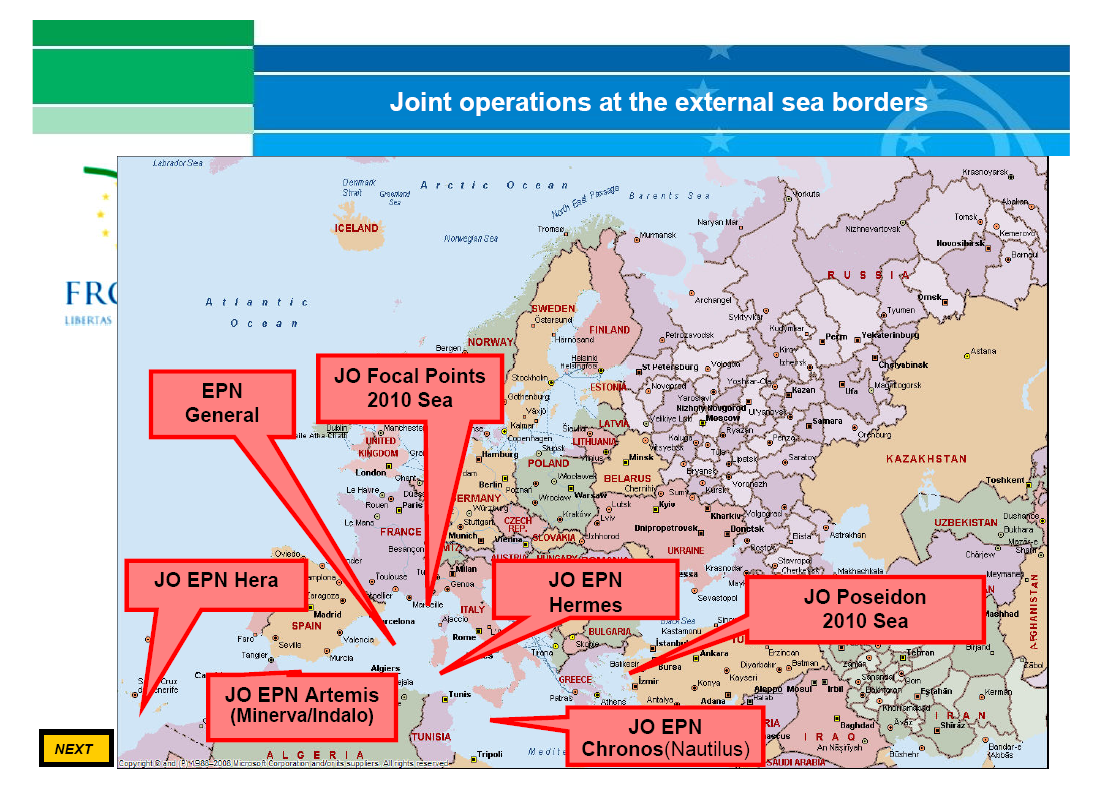
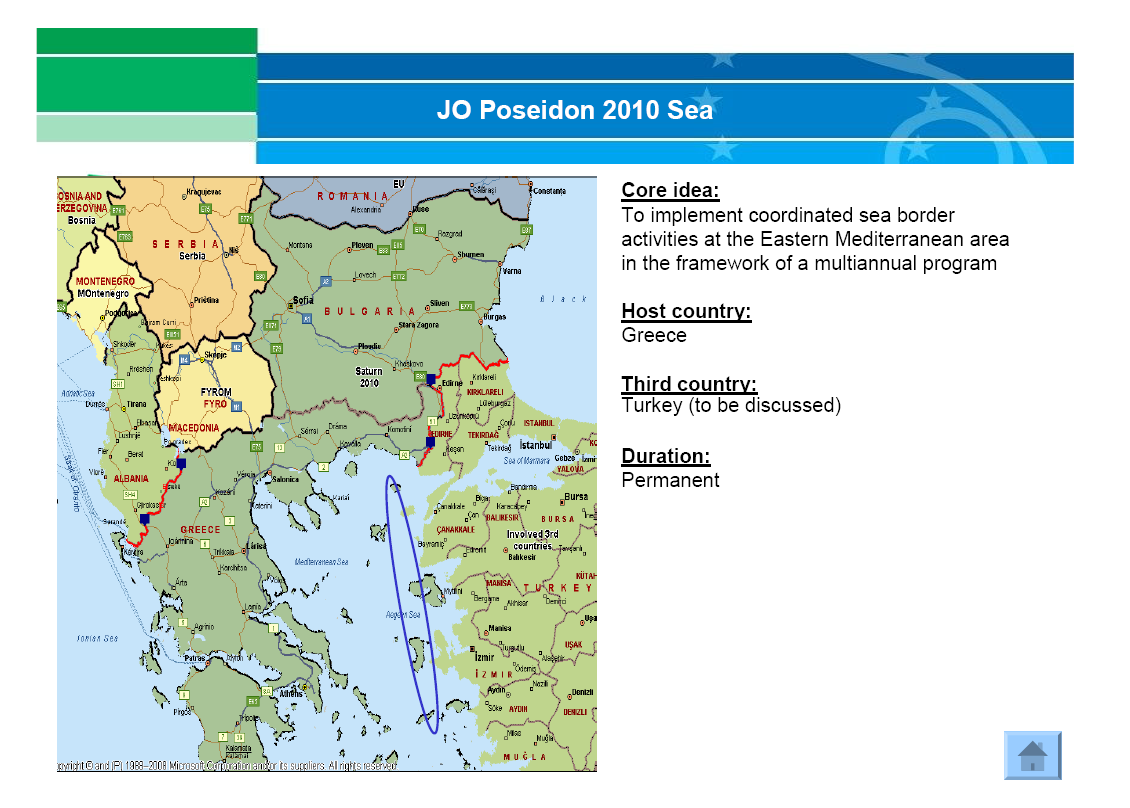
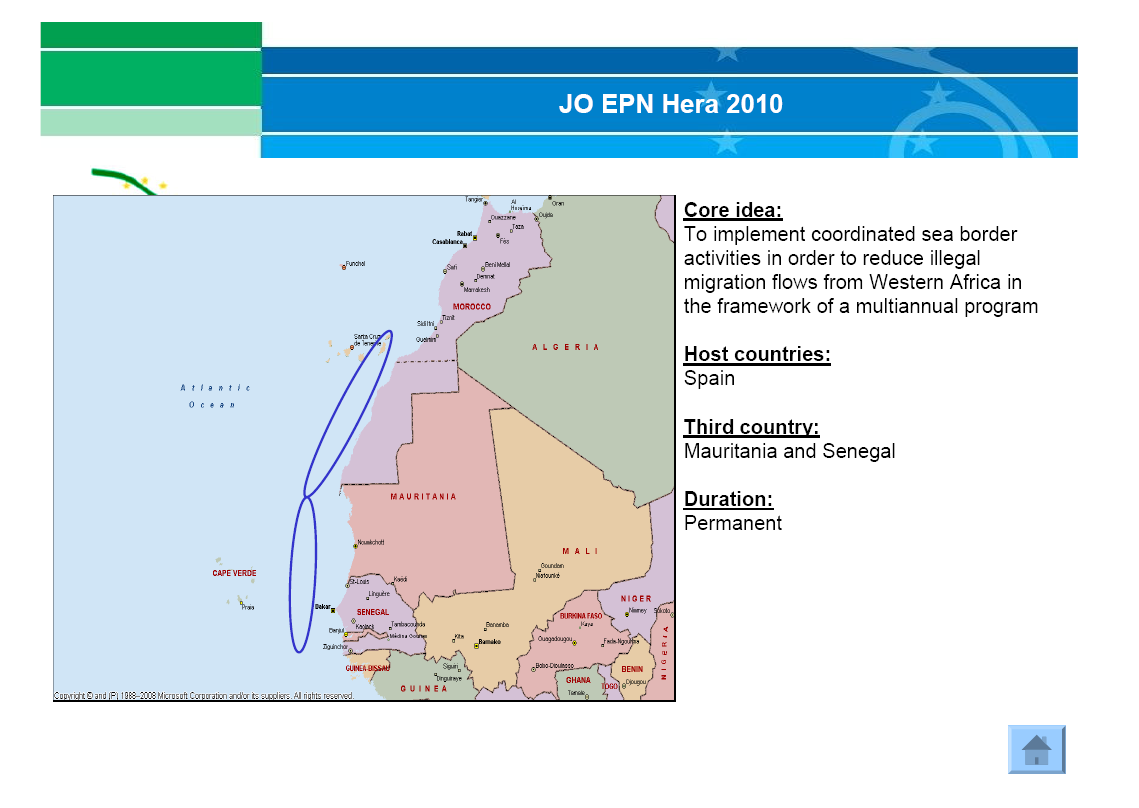
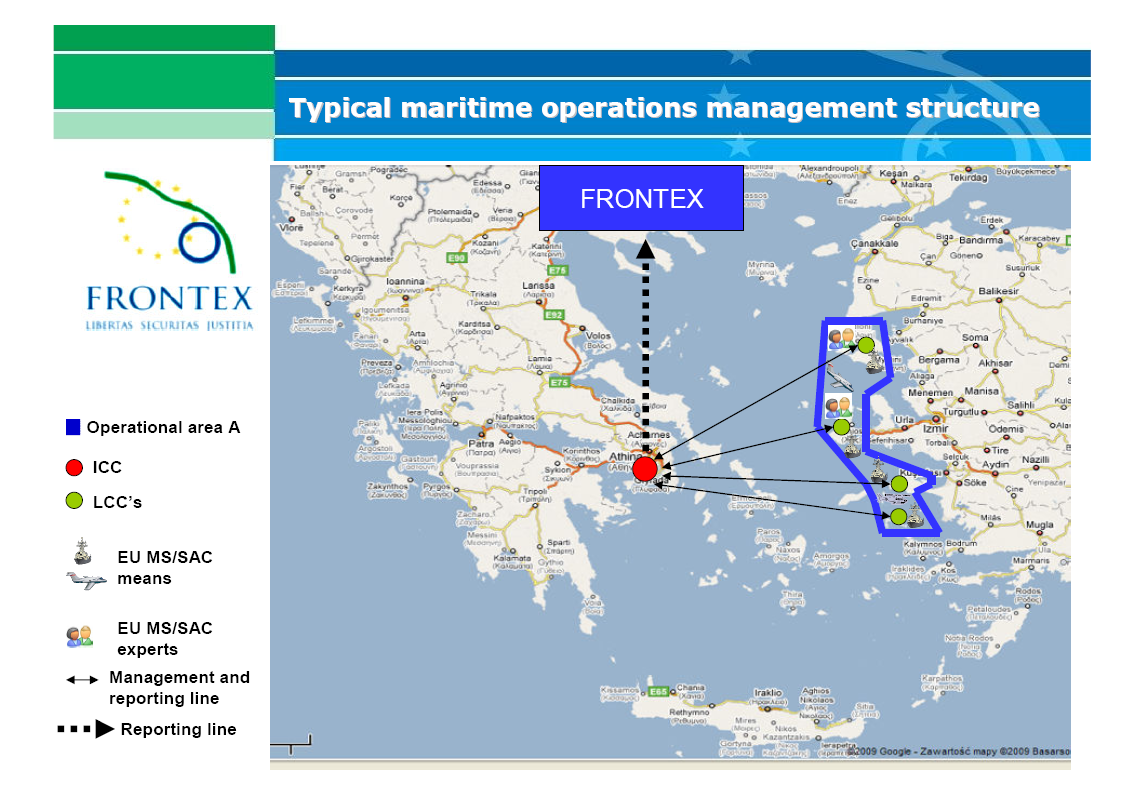
Rustamas Liubajevas, Head, Frontex Joint Operations Unit, presented a lecture entitled “Frontex within integrated Border management concept – Structural approach in planning capability” at the recent Annual Conference of the European Defence Agency.

Copies of some of his slides are reproduced here.

Click here for full slide presentation.

Leave a comment

Filed under Aegean Sea, Algeria, Colloques / Conferences, Eastern Atlantic, European Union, Frontex, Greece, Italy, Libya, Malta, Mauritania, Mediterranean, Morocco, News, Senegal, Spain, Turkey

Libya Opposes Blocking Peoples’ Freedom of Movement

Speaking at the 10 February ceremony in Gaeta, Italy marking the transfer of three patrol boats from Italy to Libya, The Libyan Ambassador to Italy reportedly said that  “Libya is against human trafficking and it is at the same time against the exploitation that stems from imposing any blockade on peoples’ freedom of movement around the world as it is a natural phenomenon throughout history.”

Click here for article and click here for link to earlier post with Italian Interior Minister Maroni’s comments made at the same ceremony.

Leave a comment

Filed under Italy, Libya, Mediterranean, News

New Patrol Boats for Libya and Malta

Italy has delivered to Libya three patrol boats pursuant to the terms of Italy’s bi-lateral agreement with Libya to control irregular immigration.  The three boats that were turned over to Libya in a ceremony attended by Italian Interior Minister Roberto Maroni supplement three patrol boats which were delivered by Italy earlier.

Maroni spoke at the ceremony and said “Italy and Libya alone cannot carry the burden of a migration problem that touches the whole of Europe.  … [The European Commission] has not done much to date [on the migration issue].  In recent days I travelled to Ghana and Niger to sign bilateral accords and it is the first time these countries sign such agreements [on immigration] with a European state. This shows Italy is taking a leading role.”

And unrelated to the new Libyan boats, four new Armed Forces of Malta patrol boats were scheduled to arrive on Wednesday in Malta from Australia.  The new patrol boats cost €9.3m and were funded in part by the EU.

Click here and here for articles.

Leave a comment

Filed under Italy, Libya, Malta, Mediterranean, News

Italy’s “Africa Campaign”: Stop Migrants in Countries of Origin

Italian Interior Minister Roberto Maroni has completed a visit to Ghana and is now in Niger.  A trip to Senegal will occur soon.  In Ghana he signed an agreement to increase cooperation on combating illegal immigration, human trafficking, and other forms of organized crime.

Maroni is quoted as saying ”We have excellent bilateral agreements with the African countries of the Mediterranean region, from Morocco to Egypt. However, these are often transit countries for illegal immigrants who in reality originate in sub-Saharan African states. This is why now, while awaiting action from Europe, we want to extend security measures to that area not only regarding immigration, but also regarding the issues of drug trafficking and terrorism.”

ANSAmed reported that Maroni said Italy’s agreement with Libya has reduced the numbers of illegal migrants arriving in Italy and that “[n]ow the focus is to completely eliminate their arrival by blocking the departure of these ‘journeys of hope’.”

Click here and here for articles.

Leave a comment

Filed under Ghana, Italy, Libya, Mediterranean, News, Niger, Senegal

“Un échec total’’ – Trois tentatives de traverser la Méditerrané

“Oumar Baldé, [un sénégalais] de 36 ans, fait partie des candidats à à l’émigration revenus dans son Fouladou natal après avoir, comme il le dit, ‘’essuyé un échec total’’ dans sa tentative de rejoindre l’Espagne.  Parti du Sénégal par voie terrestre en 2000, en passant par le Mali, le Burkina Faso, le Niger, traversant le Sahara pour se retrouver en Libye…. “Ce fut un échec total’’, souligne Baldé, précisant avoir travaillé pendant 18 mois en Lybie avant de se retrouver en Algérie, puis au Maroc où il est resté pendant six ans, avec trois tentatives de traverser la Méditerranée, sans succès.”

“’On payait 8000 dirhams (500 000 francs CFA) [ €750 ] par traversée, poursuit-il, à des Arabes pour nous faire traverser la rive, ils nous amenaient jusqu’en pleine mer et on se perdait, il ne nous rester qu’à retourner et d’être pris par les gardes côtes marocaines qui nous jeter à la frontière algérienne’.  De guère lasse et ne disposant plus de moyens … Oumar Baldé s’est résigné à rentrer [en Sénégal]…”

“D’après le président du Conseil de la jeunesse de Dioulacolon, Abdoulaye Baldé, l’exemple de Oumar Baldé, n’est qu’une goutte d’eau dans l’océan. … ‘Il arrive qu’une famille dépêche deux à trois enfants pour tenter l’aventure. Et deux ou trois mois après, elles sont informées qu’ils sont tous morts en mer, entre la Mauritanie et l’Espagne’, se désole Abdoulaye Baldé.”

Click here for full article.

Leave a comment

Filed under Algeria, Libya, Mediterranean, Morocco, News, Senegal, Spain

IAI Analysis: Control of Illegal Immigration and Italian-EU Relations

An analysis by Bruno Nascimbene, with the Istituto Affari Internazionali (IAI), CONTROL OF ILLEGAL IMMIGRATION AND ITALIAN-EU RELATIONS:

“Controlling maritime borders and flows of illegal immigrants in the Mediterranean is an issue where sharp tensions have been evident for some months now at the national, EU and international levels. Tensions evidenced by the reactions and outcry provoked by operations involving Italian naval units which have intercepted boats carrying migrants and sent them back to their ports of departure, most notably in Libya. The migrants concerned were deemed to be illegal regardless of their possible asylum-seeker status. Such interventions have raised, and continue to raise, concerns over the fate of the persons involved, especially as regards the protection of their fundamental human rights.”

Click here for full article.

Leave a comment

Filed under Analysis, European Union, Italy, Libya, Mediterranean