Category Archives: Libya

ECtHR Grand Chamber: Italy’s Maritime Push-Back Practice Amounts to Collective Expulsion and Exposes Migrants to Risks of Torture and Ill-Treatment

The Grand Chamber of the European Court of Human Rights issued a unanimous judgment earlier today in the case of Hirsi Jamaa and Others v. Italy (application no. 27765/09) holding that “There had been two violations of [ECHR] Article 3 (prohibition of inhuman or degrading treatment) … because the applicants had been exposed to the risk of ill-treatment in Libya and of repatriation to Somalia or Eritrea; There had been a violation of Article 4 of Protocol No. 4 (prohibition of collective expulsions); There had been a violation of Article 13 (right to an effective remedy) taken in conjunction with Article 3 and with Article 4 of Protocol No.4.”

More to follow once I have had a chance to closely read the 80+ page judgment.

Click here (EN) and here (FR) for the Grand Chamber’s judgment.

Click here (EN) and here (FR) for Press Statements from the Court Registry.

Click here, here, and here for UNHCR press statements.

Click here for Amnesty International statement.

Excerpt from the Registry Press Release:

“Decision of the Court

The question of jurisdiction under Article 1

Only in exceptional cases did the Court accept that acts of the member States performed, or producing effects, outside their territories could constitute an exercise of jurisdiction by them. Whenever the State, through its agents operating outside its territory, exercised control and authority over an individual, and thus its jurisdiction, the State was under an obligation to secure the rights under the Convention to that individual.

Italy did not dispute that the ships onto which the applicants had been embarked had been fully within Italian jurisdiction. The Court reiterated the principle of international law, enshrined in the Italian Navigation Code, that a vessel sailing on the high seas was subject to the exclusive jurisdiction of the State of the flag it was flying. The Court could not accept the Government’s description of the operation as a “rescue operation on the high seas” or that Italy had exercised allegedly minimal control over the applicants. The events had taken place entirely on board ships of the Italian armed forces, the crews of which had been composed exclusively of Italian military personnel. In the period between boarding the ships and being handed over to the Libyan authorities, the applicants had been under the continuous and exclusive de jure and de facto control of the Italian authorities. Accordingly, the events giving rise to the alleged violations had fallen within Italy’s jurisdiction within the meaning of Article 1.

Article 3 – Risk of suffering ill-treatment in Libya

The Court was aware of the pressure on States resulting from the increasing influx of migrants, which was a particularly complex phenomenon when occurring by sea, but observed that this could not absolve a State of its obligation not to remove any person who would run the risk of being subjected to treatment prohibited under Article 3 in the receiving country. Noting that the situation in Libya had deteriorated after April 2010, the Court decided to confine its examination of the case to the situation prevailing in Libya at the material time. It noted that the disturbing conclusions of numerous organisations (2)  regarding the treatment of clandestine immigrants were corroborated by the report of the Committee for the Prevention of Torture (CPT) of 2010 (3).

Irregular migrants and asylum seekers, between whom no distinction was made, had been systematically arrested and detained in conditions described as inhuman by observers (4), who reported cases of torture among others. Clandestine migrants had been at risk of being returned to their countries of origin at any time and, if they managed to regain their freedom, had been subjected to particularly precarious living conditions and exposed to racist acts. The Italian Government had maintained that Libya was a safe destination for migrants and that Libya complied with its international commitments as regards asylum and the protection of refugees. The Court observed that the existence of domestic laws and the ratification of international treaties guaranteeing respect for fundamental rights were not in themselves sufficient to ensure adequate protection against the risk of ill-treatment where reliable sources had reported practices contrary to the principles of the Convention. Furthermore, Italy could not evade its responsibility under the Convention by referring to its subsequent obligations arising out of bilateral agreements with Libya. The Court noted, further, that the Office of the UNHCR in Tripoli had never been recognised by the Libyan Government. That situation had been well-known and easy to verify at the relevant time. The Court therefore considered that when the applicants had been removed, the Italian authorities had known or should have known that they would be exposed to treatment in breach of the Convention. Furthermore, the fact the applicants had not expressly applied for asylum had not exempted Italy from its responsibility. The Court reiterated the obligations on States arising out of international refugee law, including the “non-refoulement principle” also enshrined in the Charter of Fundamental Rights of the European Union. The Court attached particular weight in this regard to a letter of 15 May 2009 from Mr Jacques Barrot, Vice-President of the European Commission, in which he reiterated the importance of that principle (5).

The Court, considering that the fact that a large number of irregular immigrants in Libya had found themselves in the same situation as the applicants did not make the risk concerned any less individual, concluded that by transferring the applicants to Libya the Italian authorities had, in full knowledge of the facts, exposed them to treatment proscribed by the Convention. The Court thus concluded that there had been a violation of Article 3.

Risk of suffering ill-treatment in the applicants’ country of origin

The indirect removal of an alien left the State’s responsibility intact, and that State was required to ensure that the intermediary country offered sufficient guarantees against arbitrary refoulement particularly where that State was not a party to the Convention. The Court would determine whether there had been such guarantees in this case. All the information in the Court’s possession showed prima facie that there was widespread insecurity in Somalia – see the Court’s conclusions in the case of Sufi and Elmi v. the United Kingdom (6) – and in Eritrea – individuals faced being tortured and detained in inhuman conditions merely for having left the country irregularly. The applicants could therefore arguably claim that their repatriation would breach Article 3 of the Convention. The Court observed that Libya had not ratified the Geneva Convention and noted the absence of any form of asylum and protection procedure for refugees in the country. The Court could not therefore subscribe to the Government’s argument that the UNHCR’s activities in Tripoli represented a guarantee against arbitrary repatriation. Moreover, Human Rights Watch and the UNHCR had denounced several forced returns of asylum seekers and refugees to highrisk countries. Thus, the fact that some of the applicants had obtained refugee status in Libya, far from being reassuring, might actually have increased their vulnerability.

The Court concluded that when the applicants were transferred to Libya, the Italian authorities had known or should have known that there were insufficient guarantees protecting them from the risk of being arbitrarily returned to their countries of origin. That transfer accordingly violated Article 3.

Article 4 of Protocol No.4 – Admissibility of the complaint

The Court was required, for the first time, to examine whether Article 4 of Protocol No. 4 applied to a case involving the removal of aliens to a third State carried out outside national territory. It had to ascertain whether the transfer of the applicants to Libya constituted a collective expulsion within the meaning of Article 4 of Protocol No. 4. The Court observed that neither the text nor the travaux préparatoires of the Convention precluded the extraterritorial application of that provision. Furthermore, were Article 4 of Protocol No. 4 to apply only to collective expulsions from the national territory of the member States, a significant component of contemporary migratory patterns would not fall within the ambit of that provision and migrants having taken to the sea, often risking their lives, and not having managed to reach the borders of a State, would not be entitled to an examination of their personal circumstances before being expelled, unlike those travelling by land. The notion of expulsion, like the concept of “jurisdiction”, was clearly principally territorial. Where, however, the Court found that a State had, exceptionally, exercised its jurisdiction outside its national territory, it could accept that the exercise of extraterritorial jurisdiction by that State had taken the form of collective expulsion. The Court also reiterated that the special nature of the maritime environment did not make it an area outside the law. It concluded that the complaint was admissible.

Merits of the complaint

The Court observed that, to date, the Čonka v. Belgium (7) case was the only one in which it had found a violation of Article 4 of Protocol No. 4. It reiterated that the fact that a number of aliens were subject to similar decisions did not in itself lead to the conclusion that there was a collective expulsion if the case of each person concerned had been duly examined. In the present case the transfer of the applicants to Libya had been carried out without any examination of each individual situation. No identification procedure had been carried out by the Italian authorities, which had merely embarked the applicants and then disembarked them in Libya. The Court concluded that the removal of the applicants had been of a collective nature, in breach of Article 4 of Protocol No. 4.

Article 13 taken in conjunction with Article 3 and with Article 4 of Protocol No.4

The Italian Government acknowledged it had not been possible to assess the applicants’ personal circumstances on board the military ships. The applicants alleged that they had been given no information by the Italian military personnel, who had led them to believe that they were being taken to Italy and had not informed them as to the procedure to be followed to avoid being returned to Libya. That version of events, though disputed by the Government, was corroborated by a large number of witness statements gathered by the UNHCR, the CPT and Human Rights Watch. The applicants had thus been unable to lodge their complaints under Article 3 of the Convention and Article 4 of Protocol No. 4 with a competent authority and to obtain a thorough and rigorous assessment of their requests before the removal measure was enforced.

Even if a remedy under the criminal law against the military personnel on board the ship were accessible in practice, this did not satisfy the criterion of suspensive effect. The Court reiterated the requirement flowing from Article 13 that execution of a measure be stayed where the measure was contrary to the Convention and had potentially irreversible effects. Having regard to the irreversible consequences if the risk of torture or ill-treatment materialised, the suspensive effect of an appeal should apply where an alien was returned to a State where there were serious grounds for believing that he or she faced a risk of that nature. The Court concluded that there had been a violation of Article 13 taken in conjunction with Article 3 and Article 4 of Protocol No. 4.

Article 41

Under Article 41 (just satisfaction), the Court held that Italy was to pay each applicant 15,000 euros (EUR) in respect of non-pecuniary damage and EUR 1,575.74 to the applicants jointly in respect of costs and expenses.

2 International bodies and non-governmental organisations; see paragraphs 37 – 41 of the judgment.

3 Report of 28 April 2010 of the Committee for the Prevention of Torture and Inhuman or Degrading Treatment or Punishment (CPT) of the Council of Europe after a visit to Italy.

4 The UNHCR, Human Rights Watch and Amnesty International.

5 Paragraph 34 of the judgment.

6 Judgment of 28.06.2011.

7 Judgment of 05.02.2002.”

Click here (EN) and here (FR) for the Grand Chamber’s judgment.

Click here (EN) and here (FR) for Press Statements from the Court Registry.

Click here, here, and here for UNHCR press statements.

Click here for Amnesty International statement

3 Comments

Filed under Council of Europe, European Court of Human Rights, Italy, Judicial, Libya, Mediterranean, News

ECtHR Grand Chamber to Deliver Judgement in Hirsi v Italy on 23 February

The decision in Hirsi and others v Italy, Requête no 27765/09, is scheduled to be released by the Grand Camber of the European Court of Human Rights next Thursday, 23 February.  The case was filed on 26 May 2009 by 11 Somalis and 13 Eritreans who were among the first group of about 200 migrants interdicted by Italian authorities and summarily returned to Libya under the terms of the Libya-Italy agreement which took effect on 4 February 2009.  The Applicants were intercepted on 6 May 2009 approximately 35 miles south of Lampedusa.   On 17 November 2009 the Second Section of the Court communicated the case and then subsequently relinquished jurisdiction in favour of the Grand Chamber.  The argument before the Grand Chamber occurred on 22 June 2011.

Today’s statement from the CoE web site:

“Human rights judges will soon deliver their judgement in a case which involved Italy intercepting Somalian and Eritrean migrants at sea and returning them to Libya.  The European Court of Human Rights’ Grand Chamber final judgment in the case of Hirsi Jamaa and Others v. Italy (application no. 27765/09), is expected at a public hearing scheduled for Thursday 23 February.

Principal facts

The applicants are 11 Somalian and 13 Eritrean nationals. They were part of a group of about 200 people who left Libya in 2009 on board three boats bound for Italy. On 6 May 2009, when the boats were 35 miles south of Lampedusa (Agrigento), within the maritime search and rescue region under the responsibility of Malta, they were intercepted by Italian Customs and Coastguard vessels. The passengers were transferred to the Italian military vessels and taken to Tripoli.

The applicants say that during the journey the Italian authorities did not tell them where they were being taken, or check their identity. Once in Tripoli they were handed over to the Libyan authorities.

At a press conference on 7 May 2009 the Italian Minister of the Interior explained that the interception of the vessels on the high seas and the return of the migrants to Libya was in accordance with the bilateral agreements with Libya that entered into force on 4 February 2009, marking a turning point in the fight against illegal immigration.

Complaint

The applicants consider that their case falls within the jurisdiction of Italy. Relying on Article 3 of the European Convention on Human Rights (prohibition of inhuman or degrading treatment), they argue that the decision of the Italian authorities to send them back to Libya exposed them to the risk of ill-treatment there, as well as to the serious threat of being sent back to their countries of origin (Somalia and Eritrea), where they might also face ill-treatment.

They also complain that they were subjected to collective expulsion prohibited by Article 4 of Protocol No. 4 (prohibition of collective expulsion of aliens) of the Convention. Lastly, relying on Article 13 (right to an effective remedy), they complain that they had no effective remedy against the alleged violations of Article 3 and Article 4 of Protocol No. 4.

The application was lodged with the European Court of Human Rights on 26 May 2009.

On 15 February 2011 the Chamber to which the case had been allocated relinquished jurisdiction in favour of the Grand Chamber. A hearing took place in public in the Human Rights Building, Strasbourg on 22 June 2011.

The following have been authorised to intervene as a third party (under Article 36 § 2 of the Convention):

– the Office of the United Nations High Commissioner for Refugees,

– the Office of the United Nations High Commissioner for Human Rights,

– the non-governmental organisations Aire Center, Amnesty International, and International Federation for Human Rights (FIDH),

– the non-governmental organisation Human Rights Watch, and

– the Columbia Law School Human Rights Clinic.”

Click here for CoE Statement.

Click here for Press Statement from ECtHR.

Click here for previous post on the argument before the Grand Chamber.

Leave a comment

Filed under Council of Europe, European Court of Human Rights, Italy, Judicial, Libya, Mediterranean, News

Mare Deserto: RSI documentary about the failure to rescue and subsequent deaths of 60 migrants in the Mediterranean in March 2011

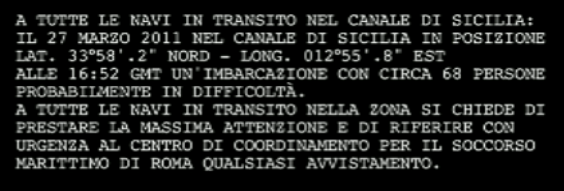
RSI LA1, the Swiss Italian-language television network, last month broadcasted a one hour documentary,  Mare deserto , produced by Emiliano Bos and Paul Nicol.  The documentary is in Italian.  It investigates the events that occurred between 25 March and 10 April 2011 when a disabled migrant boat attempting to travel from Libya to Italy drifted for days during which time approximately 60 persons died.  Survivors from the migrant boat reported that at various times military ships and helicopters ignored their requests for assistance.  The producers located and interviewed 9 of the known survivors in Italy, Tunisia and Norway.

Click here or here for a link to the documentary.  (IT)

Click here and here for some of my previous posts on the incident and the ongoing PACE investigation into the incident.

2 Comments

Filed under Council of Europe, Italy, Libya, Mediterranean, News, Reports, UNHCR

UNHCR: “Mediterranean takes record as most deadly stretch of water for refugees and migrants in 2011”

Full Text of UNHCR Briefing Note, 31 January:

“This is a summary of what was said by UNHCR spokesperson Sybella Wilkes – to whom quoted text may be attributed – at the press briefing, on 31 January 2012, at the Palais des Nations in Geneva.

According to UNHCR estimates, more than 1,500 people drowned or went missing while attempting to cross the Mediterranean to reach Europe in 2011. This makes 2011 the deadliest year for this region since UNHCR started to record these statistics in 2006. The previous high was in 2007 when 630 people were reported dead or missing.

Last year is also a record in terms of the massive number of arrivals in Europe via the Mediterranean, with more than 58,000 people arriving. The previous high was in 2008 when 54,000 people reached Greece, Italy and Malta. During 2009 and 2010, border control measures sharply reduced arrivals in Europe. The frequency of boat arrivals increased in early 2011 as the regimes in Tunisia and Libya collapsed.

Our teams in Greece, Italy, Libya and Malta, warn that the actual number of deaths at sea may be even higher. Our estimates are based on interviews with people who reached Europe on boats, telephone calls and e-mails from relatives, as well as reports from Libya and Tunisia from survivors whose boats either sank or were in distress in the early stages of the journey.

Survivors told UNHCR staff harrowing stories of being forced onboard by armed guards, particularly during April and May in Libya. The actual journey took place on unseaworthy vessels with refugee and migrant passengers often forced into having to skipper boats themselves. In addition, some survivors told UNHCR that fellow passengers beat and tortured them. Judicial investigations are ongoing in Italy following these reports.

The majority of last year’s arrivals by sea landed in Italy (56,000, of whom 28,000 were Tunisian) while Malta and Greece received 1,574 and 1,030 respectively. The vast majority arrived in the first half of the year. Most were migrants, not asylum-seekers. Only three boats landed from mid-August to the end of the year. In addition, according to Greek government figures, some 55,000 irregular migrants crossed the Greek-Turkish land border at Evros.

We are disturbed that since the beginning of 2012, despite high seas and poor weather conditions, three boats have attempted this perilous journey from Libya, with one going missing at sea. This boat, carrying at least 55 people raised the alarm on 14 January, warning of engine failure. Libyan coast guards informed UNHCR that 15 dead bodies, all identified as Somali, were found washed up on the beaches last week, including 12 women, two men and a baby girl. On Sunday, three more bodies were recovered. It was confirmed later that all those that perished were Somali residents of the makeshift site in Tripoli known as the Railway Project.

The other two boats that made it to Malta and Italy in January required rescuing. The first rescue of 72 Somali nationals by the Italian coast guard took place on 13 January. Those rescued included a pregnant woman and 29 children.

The second boat was rescued by the Maltese Armed Forces on 15 January with the support of the US Navy and a commercial vessel. In total 68 people were rescued from a dinghy found drifting some 56 nautical miles from Malta. A baby girl was born on one of the rescue vessels. Another woman reported a miscarriage during the voyage.

UNHCR welcomes the ongoing efforts of the Italian, Maltese and Libyan authorities to rescue boats in distress in the Mediterranean. We renew our call to all shipmasters in the Mediterranean, one of the busiest stretches of water in the world, to remain vigilant and to carry out their duty of rescuing vessels in distress.

For further information on this topic, please contact:

In Rome: Laura Boldrini on mobile +39 33 55 403 194

In Valetta: Fabrizio Ellul on mobile +356 99 69 0081

In Geneva: Sybella Wilkes on mobile +41 79 557 91 38”

Click here for link to statement.

Leave a comment

Filed under Data / Stats, European Union, Greece, Italy, Libya, Malta, Mediterranean, News, Statements, Tunisia, UNHCR

Libya Asks EU to Assist with Renovation of Migrant Detention Centres

At a press conference held last week, Libyan Interior Minister Fawzi Abdelali asked the European Union for assistance in dealing with new immigration flows and specifically requested assistance to renovate 19 existing migrant detention centres.  (Global Detention Project identified 27 dedicated immigration detention centres in Libya as of late 2009.)

Libyan officials have said recently that irregular migration flows are resuming.  AFP reported that Libyan interior ministry spokesman General Abdelmonem al-Tunsi said on 19 January “that illegal immigration had resumed since the end of the anti-Kadhafi revolt” and “thousands of people from … Syria were also entering through the Massad terminal on the border with Egypt, apart from Africans infiltrating through the southern borders.”

Italian Prime Minister Mario Monti traveled to Tripoli on 21 January to meet with the Libyan NTC.  Prior to his trip Amnesty International sent Monti a letter urging him to address numerous matters with the Libyans, including the eradication of torture, reforming the criminal justice system, and ratifying the Refugee Convention.

Amnesty also called upon Italy not to resume push-back operations at sea and to refrain from cooperating with Libya on other migration control practices until appropriate reforms are instituted within Libya.  There are fears that Italy is moving towards resuming coordination with Libya on immigration control matters.  Italian Interior Minister Anne Marie Cancellieri is reportedly scheduled to travel to Tripoli next month to discuss bilateral cooperation on immigration.

Translated excerpts from Amnesty’s press statement regarding the AI letter to PM Monti:

“With regard to cooperation on migration between Italy and Libya, Amnesty International calls on the Italian Government:

  • To desist from conducting any operation of ‘refoulement’ (deportation) at sea to Libya and cooperating with Libya to intercept migrants and reject them;
  • To set aside the Memorandum of Understanding on ‘migration control’, signed with the National Transitional Council (CNT) on June 17, 2011, until a thorough review is conducted of the impact on human rights agreements signed by the two countries in this area, and until the necessary changes have been introduced in order to ensure that the ‘immigration control’ is never carried out at the expense of human rights;
  • To ensure that all forms of cooperation with the Libyan authorities are absolutely transparent and subject to the commitment and ability of both parties to fully respect the human rights of asylum seekers, refugees and migrants, and are consistent with the international law of human rights and international refugee law….”

Click here for AI Letter. (IT)

Click here (EN), here (IT), here (EN), here (IT), and here (IT) for articles.

Leave a comment

Filed under European Union, Italy, Libya, Mediterranean, News

Report of Migrant Boat Sinking Off Libyan Coast – 15 Dead, 40 Missing

According to AFP , the Somali envoy in Tripoli has reported that a migrant boat carrying approximately 50 migrants sank off the coast of Misrata on Wednesday last week.   The boat was reportedly carrying about 55 migrants from Somalia.  15 bodies have been recovered.

Click here (EN) and here (IT) for articles.

Leave a comment

Filed under Libya, Mediterranean, News

Pillay: Extreme Concern Regarding Ill-Treatment of Detainees in Libya, Including Large Number of Sub-Saharan Africans

UN High Commissioner for Human Rights Navi Pillay addressed the UN Security Council on 25 January regarding the situation in Libya.  Pillay expressed extreme concern regarding the conditions of detention in Libya faced by thousands of detainees, including a large number of Sub-Saharan African nationals, and called for all detention centres to be brought under the control of the Ministry of Justice and the General Prosecutor’s Office.

Amnesty International and MSF have both just released additional reports documenting ongoing torture of detainees in Libya.

Excerpts from Pillay’s statement:

“The Interim Government still does not exercise effective control over the revolutionary brigades and this has human rights repercussions in a number of areas. …

A related area that I am extremely concerned about is the conditions of detention and treatment of detainees held by various revolutionary brigades. The ICRC visited over 8,500 detainees in approximately 60 places of detention between March and December 2011. The majority of detainees are accused of being Gaddafi loyalists and include a large number of sub-Saharan African nationals. The lack of oversight by the central authorities creates an environment conducive to torture and ill-treatment. My staff have received alarming reports that this is happening in places of detention that they have visited.

It is therefore urgent that all detention centres are brought under the control of the Ministry of Justice and the General Prosecutor’s Office. Moreover, a structure and process for judicial screening of detainees should be put in place immediately so that those detainees held without any legal basis can be released while others receive a fair trial. … However, detainees continue to be held in unacceptable circumstances outside any legal framework or the protection of the state….”

Click here for Pillay’s Statement.

Click here for AI Statement.

Click here for MSF Statement.

Leave a comment

Filed under Libya, News, OHCHR, Reports, Statements

Rescued Somali Asylum Seekers in Malta Describe Dangerous Conditions in Libya

The first group of rescued migrants for 2012 arrived in Malta on 15 January after being rescued by an Armed Forces of Malta patrol boat and an Italian cargo ship.  The 68 rescued migrants are Somali asylum seekers and had left Libya four days earlier.  Another boat carrying 72 migrants was rescued by the Italian coastguard on the 13th.  This boat is also believed to have departed from Libya.  UNHCR officials have interviewed the asylum seekers in Malta: “The new arrivals confirmed to UNHCR that the situation in Libya is still not stable and that it is particularly precarious for Sub-Saharan nationals. One Somali woman told UNHCR that they were afraid to go outside the house. Some even described the situation in parts of Libya as being similar to the lawlessness of Somalia. They explained that smugglers provided them with the only possible way out at this point.”  The Times of Malta reported that two of the asylum seekers said “they paid armed Libyan militiamen $400 each to facilitate their crossing of the Mediterranean.”

Click here, here, and here for articles.

Click here (IT) for article.

Leave a comment

Filed under Italy, Libya, Malta, Mediterranean, News, UNHCR

Statewatch Analysis: The Arab Spring and the death toll in the Mediterranean: the true face of Fortress Europe

Statewatch released an Analysis by Marie Martin entitled “The Arab Spring and the death toll in the Mediterranean: the true face of Fortress Europe.”

Excerpt: “Throughout the uprisings in North Africa, the EU has maintained a discourse of double standards: supporting calls for freedom and democracy but greeting resulting population displacement with hostility. This has contributed to a record number of people dying at Europe’s borders during the first seven months of 2011. It is all about numbers when it comes to migration; about how large a flow came in, how many people asked for protection and how many applicants were “failed” or “rejected.” Numbers quantify the “threat” (e.g. the “invasion” of irregular migrants) and serve as a bargaining tool with third countries (allowing the acceptance of the externalisation of border controls in exchange for facilitating the mobility of a specific number of nationals). Numbers demonstrate whether the target of “x” thousands of annual deportations of irregular migrants is met. Numbers released by public authorities are meant to justify the need for migration policies and to show how efficiently they are implemented. Yet hidden numbers question the legitimacy of these policies – the death toll of people dying at Europe’s borders is such an example. For several years, Gabriele del Grande has monitored the situation at the EU’s external borders and kept a record of the number of deaths occurring in the context of irregular bordercrossings [2] on the Fortress Europe website. According to the website’s latest update, the EU’s borders have never been so “murderous” [3]: there were 1,931 deaths during the first seven months of 2011. [4] In 2008, a petition was brought before the European Parliament by the ProAsyl organisation, denouncing the  deathtrap at the EU’s borders” [5]: it was a particularly “murderous” year, with 1,500 deaths. It is terrifying to realise that this toll was exceeded in the first seven months of 2011. …”

Click here for Analysis.

1 Comment

Filed under Algeria, Analysis, Egypt, European Union, France, Frontex, Italy, Libya, Malta, Mediterranean, Morocco, Spain, Tunisia, UK

Malmström: Europe Failed Refugees in 2011

Commissioner Cecilia Malmström wrote an opinion article in The Times of Malta of 19 January:  “Refugees: How Europe failed- European promises of solidarity with people in need were tested in 2011. It is worrying to note that Europe, collectively, did not pass the test. Now, all member states of the European Union must take responsibility and make sure that 2012 will be a better year for asylum matters. … In the first half of 2011, over 75 per cent of all asylum applications were made in only six EU member states. That leaves a long row of European countries that can and must do more. And as over 700,000 people were forced to flee the violence in Libya, many ended up in refugee camps in neighbouring countries. Of the 8,000 people identified by the UN as being in particular need of help, all EU member states only managed to promise to receive 400. Norway, a non EU-country, accepted nearly as many by itself.  Meanwhile, more than 50,000 migrants crossed the Mediterranean in rickety vessels to the EU. Far too many died trying. Others arrived at the Italian island of Lampedusa and Malta and, at a pledging conference last spring, European countries had the chance to show their solidarity. The result? A mere 300 refugees being relocated from Malta to other member states. …”

Click here for full article.


1 Comment

Filed under European Union, Italy, Libya, Malta, Mediterranean, News, Statements, Tunisia

Amnesty International Report: Year of Rebellion – The State of Human Rights in the Middle East and North Africa

Amnesty International this morning released a report entitled “Year of Rebellion – The State of Human Rights in the Middle East and North Africa” focusing on the events of 2011 in Tunisia, Egypt, Libya, Yemen, Syria, Bahrain, and Iraq.  Additional chapters in the Report address the “International response”, the “Failure to put human rights first”, “Protection of displaced people”, and “Arms transfers”, among other topics.

Excerpts:

“This report describes the events of this historic, tumultuous year, one which saw so much suffering and sadness but also spread so much hope within the region and beyond, to countries where other people face repression and everyday abuse of their human rights. Amnesty International too was challenged, as never before, to respond to the events by documenting the violations that were committed and, most of all, by mobilizing its members and supporters to extraordinary lengths in support and solidarity with the people in the streets of Cairo, Benghazi, Sana’a, Manama, Dera’a and elsewhere who were truly “in the frontline” in demanding reform, accountability and real guarantees for human rights. This report is dedicated to them, their suffering and their momentous achievements.”

“Protection of Displaced People- … Many of those who fled Libya sought safety in neighbouring countries, mainly in Egypt and Tunisia. However, around 5,000 sub-Saharan refugees and asylum-seekers remain stranded in desert camps in Tunisia and makeshift tents in Saloum, a remote border point in Egypt. When Amnesty International visited the camps in June and July, poor conditions and insecurity prevailed, making life extremely challenging for those living there. Unlike the thousands of migrants who were repatriated during the initial stages of the conflict, these people cannot return to their home countries because they would then be at risk of persecution. Nor can they remain in Egypt and Tunisia, which have been unwilling to offer long-term solutions to refugees. Returning to Libya is also not an option, despite the fall of the al-Gaddafi regime, as Libya cannot currently offer a safe haven for refugees. The only solution is for other countries where they would be safe to resettle them. How many are resettled and how quickly this happens depends on the speed and extent with which the international community fulfils its responsibility to them. So far, the international community’s response has been miserably poor, with European countries offering fewer than 800 resettlement places between them in response to a refugee crisis unfolding on Europe’s doorstep. Many of those who fled Libya attempted the dangerous sea-crossing to Europe, often in overcrowded and barely sea-worthy boats. Among them were people who initially fled from Libya to Tunisia, but then crossed back into Libya frustrated at the lack of durable solutions for refugees in the camps. At least 1,500 men, women and children are estimated to have drowned while attempting this journey. The true total was probably far higher. Governments and institutions failed to put in place effective mechanisms to prevent such deaths at sea, including by increasing search and rescue operations, and by ensuring that rescue operations comply fully with human rights and refugee law….”

Click here for Report.

Click here for AI Press Release.

2 Comments

Filed under Algeria, Egypt, Libya, Mediterranean, Morocco, Reports, Tunisia, Yemen

Statewatch Analysis: The EU’s self-interested response to unrest in north Africa: the meaning of treaties and readmission agreements between Italy and north African states

Statewatch released an Analysis by Yasha Maccanico entitled “The EU’s self-interested response to unrest in north Africa: the meaning of treaties and readmission agreements between Italy and north African states.”  The Analysis provides a description of Italy’s responses to the migrant arrivals in 2011 caused by the unrest in North Africa.

Excerpts:  “The ‘crisis’ reveals questionable practices and routine abuses – The measures adopted in response to the increasing number of migrants arriving from north African countries serve to highlight a number of practices that have become commonplace in Italy in recent years.

The first of these is a widening of the concept of ‘emergency.’ Calling an emergency gives the government a wider remit to derogate from specified laws so as to resolve situations that cannot be dealt with through ordinary measures….

Although the situation in north Africa was worrying, the emergency was called when slightly over 5,000 migrants had arrived. An analysis by Massimiliano Vrenna and Francesca Biondi Dal Monte for ASGI notes that the government has repeatedly called and extended states of emergency since 2002 to deal with immigration, which is treated as though it were a “natural calamity” even when there is a wholly predictable influx of people from third countries. The urgent need specified in decrees declaring a state of emergency is to conduct ‘activities to counter the exceptional – later referred to as massive – influx of immigrants on Italian territory’ (as happened on 11 December 2002, 7 November 2003, 23 December 2004, 28 October 2005, 16 March 2007, 31 December 2007, 14 February 2008 for Sicily, Calabria and Apulia and was extended to the whole nation on 25 July 2008 and 19 November 2009), stemming from a prime ministerial decree of 20 March 2002. Thus, Vrenna and Biondi Dal Monte’s observation that the emergency is ‘structural’ appears well-founded. It has serious repercussions for the treatment of migrants (see below) and the awarding of contracts outside of normal procedures, with the involvement of the civil protection department whose competencies have been expanding considerably.

The second practice involves the expulsion, refoulement or deportation of migrants outside the limits and procedures established by legislation for this purpose. The failure to identify people, to issue formal decisions on an individual basis to refuse them entry or expel them, or to give them the opportunity to apply for asylum or other forms of protection, was a key concern when boats were intercepted at sea and either the vessels or their passengers were taken back to Libya between May and September 2009, when 1,329 people were returned. These rights were also denied to people arriving from Egypt and Tunisia in application of readmission agreements in the framework of the fight against illegal migration. Their presumed nationality was deemed sufficient to enact expulsions to these countries, because ongoing cooperation and good relations with Italy appeared sufficient to indicate that they were not in need of protection, regardless of the situation in their home countries. ….

The third practice is the ill-treatment of migrants held in detention centres. Without dealing with this issue in depth, it is worth noting that what could be viewed as arbitrary detention is occurring on a large scale, in the absence of formal measures decreeing detention and without the possibility of appealing against decisions. In fact, after landing, migrants are summarily identified as either ‘illegal’ migrants or asylum seekers, largely on the basis of their nationality….”

Click here for Analysis.

1 Comment

Filed under Analysis, Egypt, European Union, Frontex, Italy, Libya, Mediterranean, Tunisia

PACE Rapporteur Completes Malta Trip

Ms Tineke Strik, the PACE Migration Committee rapporteur heading up the investigation into the deaths of boat people in the Mediterranean, completed a two day fact-finding visit to Malta.  From the Times of Malta reporting:  Ms Strik said that the “visit to Malta was important for my inquiry into who is responsible for lives lost in the Mediterranean Sea, and enabled me to piece together another part of the puzzle in the case of the ‘left-to-die boat’. … Nonetheless, the puzzle remains incomplete. Gaps remain and important questions still need to be answered. As time is precious in this kind of inquiry, I very much count on national authorities, NATO and the EU to provide me swiftly with the information I have requested.  … [T]he on-going dispute between Italy and Malta on their respective responsibility with regard to the disembarkation of boat people rescued at sea remains a cause of serious concern.”

Click here and here for articles.


Leave a comment

Filed under Council of Europe, European Union, Frontex, Italy, Libya, Malta, Mediterranean, News

PACE Rapporteur in Malta

Ms Tineke Strik, the PACE Migration Committee’s rapporteur who is heading up the investigation into the deaths of boat people in the Mediterranean, is in Malta today and tomorrow in connection with the ongoing inquiry.  PACE Press Statement:  Ms. Strik “will make a fact-finding visit to Malta from 15 to 16 December 2011.  During her visit, the rapporteur will meet refugees who arrived from Libya after January 2011 to gather testimony on their experiences, and will meet officials from the Maltese armed forces who are involved in organising rescues. She will also meet representatives of NGOs and European and UN officials dealing with refugee matters on the island, and the Maltese delegation to PACE. … Her report is expected in the spring of 2012.”

Click here for press statement.
 

Leave a comment

Filed under Council of Europe, Libya, Malta, Mediterranean, News

ECRE Interview with Tineke Strik Regarding PACE Investigation into Migrants Deaths in Mediterranean

ECRE last week published an interview with Ms Tineke Strike regarding the PACE Migration Committee’s ongoing investigation into the almost 2000 migrant deaths that have occurred in the central Mediterranean this year.  The Committee is focusing in particular on the incident that occurred in late March 2011 when unknown ship(s) and aircraft observed and then failed to rescue a disabled migrant boat.  Approximately 60 persons subsequently died.

Excerpts from the ECRE interview:

“[***]  What are the main findings of your report on the death at the Mediterranean so far?

We have spoken with survivors and with the priest who received the request for assistance from the boat in distress, Italian border guards, and the Italian refugee agency, as well as the Italian Refugee Council (CIR), a Member of ECRE. We also talked to different people in Brussels, including NATO, the ambassador of the Council of Europe, Amnesty and several MEPs. Today, during the PACE hearing on November 30 in Paris, we had a discussion with a number of experts in international law, Frontex, UNHCR and ICRC. All in all a lot of information has been gathered.

We have already sent requests for information to find out via satellite maps and logs if there were boats near the distressed boat Once we know under which flags these boats were sailing, we will be able to track which governments might have been responsible and ask them whether they knew that the boat asking for help was in danger or not and how they acted upon that information.

We are actually still waiting for information for this information. It is unfortunate that it takes time to get this information but we are trying to get hold of it through different channels. We have approached High Representative Ashton and asked for her consent to provide us with information from the European Satellite Centre. We have already used this kind of information at the Council of Europe, for example to detect the illegal detention centres that the CIA was using. We therefore hope that Ashton once again will cooperate.

We also asked NATO to provide us with information and have asked all the countries who took part in the NATO action in Libya and who had ships in that region during that period to give us data on where their boats were and when. NATO has promised to request the Member States to provide us with this information, also if these boats were not under the command of NATO. If this does not succeed, we still have our own national parliamentarians that could push their governments in their own country if it is necessary to gather the information.

If countries were involved they might not want to admit that, which makes my position difficult. I am not a judge and I don’t have enforcement powers so I’m partly dependent on the cooperation of various parties.  But I think all parties can benefit from transparency on what has happened, in order to avoid such tragedies in the future.

[***]

How do you think the EU has responded to the turmoil and war in North Africa and, in particular, the following displacement of people in the region and the arrival of some of them to Europe?

In my report following the protests in North Africa, we see that by far the largest part of the people who have fled Libya went to Tunisia and Egypt. There was a lot of fuss in the EU about the 25,000 who eventually fled to Italy. Tunisia took half million, Egypt took a half a million which shows how big the contrast with the EU was, especially considering that Member States were reluctant to resettle refugees from camps in Tunisia. This while Tunisia and Egypt were in a very vulnerable position in the post-revolutionary period. If we really want to help and strengthen stability in the region, we must show these states that they are not alone. These countries generously opened their borders, they understood the situation of the people there and to a great extent we stood aside and just watched.

Then we failed to help out Italy and Malta, especially when countries like France and Denmark wanted to close their borders. This shows exactly how much we are still not politically ready for a common asylum system. We provide beautiful public statements but when it comes down to it, Member States do not want to lose their sovereignty or be troubled by developments elsewhere. I do not think you can have both: either you have a joint system and you show solidarity, or you close all the borders and reinvent the wheel.

Common policies go hand in hand with solidarity and in fact we should look beyond the European borders.  What you see now is that border controls at the external borders of the EU continue to shift to North Africa and sometimes even further. One cannot claim that our responsibilities only begin when people have reached our territory. I was therefore very disappointed when the European Commission replied to a question by MEP Hélène Flautre on this incident saying that the boat was in Libyan waters and therefore they had no power to get involved. If certain acts like push backs at high sea or bilateral agreements with unsafe third countries such as Libya, lead to death or inhumane treatment, EU member states or other countries of the Council of Europe are accountable for a violation of the European Convention on Human Rights. In that sense I have high expectations of the decision of the ECHR in the case of Hirsi and others v. Italy.

[***]

What do you think the impact of your work and the investigation will be?

I hope the report will raise the awareness of the international obligations and also the awareness of the importance of avoiding such tragedies. It is important that violating the obligation to rescue does not remain unmentioned or lead to impunity. If we succeed in proving which actors were wrong. Member States will be more careful and there will be more pressure to cooperate and share the responsibilities, and to establish practical and binding solutions. Being a parliamentary assembly of national parliamentarians, I also hope that the discussion will also take place in Member States. I find it really outrageous that such a tragedy can occur so close to our borders and that we have been so silent about it.

[***]”

Click here for full interview.

Click here for my last post on this topic.


Leave a comment

Filed under Council of Europe, European Union, Frontex, General, Italy, Libya, Malta, Mediterranean, News, Tunisia, UNHCR