Category Archives: Malta

Frontex 2010 1st Quarter Report: Irregular Migration at Sea Borders Less Than 10% of Peak Levels

Frontex has released information from its 2010 First Quarter report by the Frontex Risk Analysis Network (FRAN).  A copy of the report itself has apparently not been released.  According to the summary provided, there have been significant reductions in irregular migration:

  • “[D]etections of irregular immigrants at [all EU] sea borders … were less than one-tenth of the peak level (for the third quarter of 2008) when roughly 33,600 detections were reported.”
  • “[D]etections at the Spanish and Italian sea borders became negligible…”
  • “[D]etections at the dominant Eastern Aegean Sea border between Greece and Turkey also fell by more than 60% to just under 2,300.”
  • “Detections at the Greek-Turkish land border were for the first time greater than those at the countries’ sea border.”
  • There were “only 150 detections of illegal border-crossing [in the Central Mediterranean], compared to 5,200 detections in the first quarter of 2009…”
  • There were “only 500 irregular immigrants detected [in the Western Mediterranean] (almost 72% down on the fourth quarter of 2009 …).”
  • There were “only five detections over the first three months of 2010 [on the West African/Canary Island route], in contrast to 31,700 detections in 2006…”

Click here for full statement.

Leave a comment

Filed under Aegean Sea, Algeria, Analysis, Data / Stats, Eastern Atlantic, European Union, Frontex, Greece, Italy, Libya, Malta, Mauritania, Mediterranean, Morocco, News, Reports, Senegal, Spain, Turkey

Frontex 2010 Annual Risk Analysis

Frontex’s Annual Risk Analysis (ARA) for 2010 was prepared in March 2010 and was posted to the Frontex web site on 7 July.  The public document only contains certain portions of the full ARA as recommendations and other “operationally sensitive details” have been redacted. While some of the ARA’s contents have previously been released by Frontex, this 35 page document contains a lot of data regarding irregular migration by land, sea, and air, and is worth a read.

Excerpts from the ARA relating to maritime migration include:

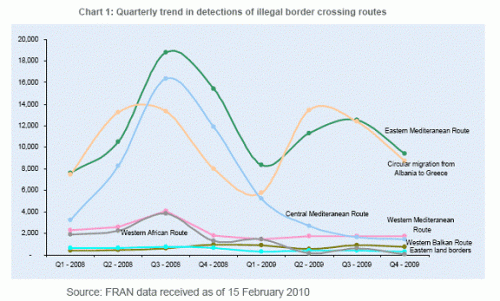
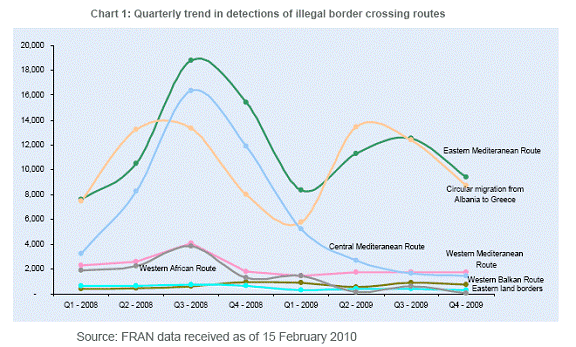
“Detections of illegal border crossing – In 2009, the [EU] Member States and Schengen Associated Countries reported a total of 106,200 detections of illegal border crossings at the sea and land borders of the EU. This represented a 33% decrease compared to 2008. The decrease is comprised of both a strong decrease reported from the sea borders (-23%), and land borders (-43%).”

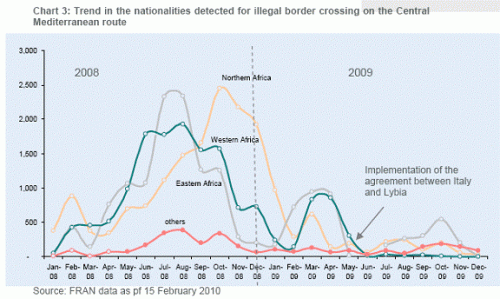
“The bilateral collaboration agreements with third countries of departure on the Central Mediterranean route (Italy with Libya) and the Western African route (which Spain signed with Senegal and Mauritania) had an impact on reducing departures of illegal migrants from Africa.”

“The agreements were made at a time when the economic crisis decreased the labour demand in the EU, thus simultaneously reducing the pull factor. The synchronisation of these events probably explains why no displacement has so far been noticed from the Central Mediterranean and Western African routes to other illegal migration routes in the statistics for detections.”

“However, intelligence suggests that the risk of displacement remains high, either with the emergence of new routes or the exploitation of existing ones by nationalities which used to be detected along the Central Mediterranean or the Western African routes.”

“As a corollary to the sharp decreases registered in Italy and Spain, the number of detections of illegal border crossing in Greece rose from 50% of the total EU detections to 75% of the total. In 2009, the Greek land border sections with Albania and FYROM represented the largest share of the EU total, with 36,600 detections (34% of the EU total), followed by 22,000 detections in the Aegean Sea with (21% of the EU total).”

“Eastern Mediterranean route – The Eastern Mediterranean route is the route taken by illegal migrants transiting through Turkey and entering the EU through eastern Greece, southern Bulgaria or Cyprus. Turkey, due to its geographical position near the EU, is the main nexus point on this route. From Istanbul, illegal migrants may reach the Greek islands in the Aegean Sea, or cross the land borders to Greece or to Bulgaria.”

“In 2009, illegal border crossing on the Eastern Mediterranean route totalled 41,500, or 39% of all EU detections. Most of the detections were reported from the Aegean Sea, followed by detections along the land border between Turkey and Greece. The number of detections reported by Bulgaria and Cyprus were considerably lower.”

“Central Mediterranean route – The Central Mediterranean route refers to illegal migration from northern Africa to Italy and to Malta. For the past two years, Libya has been a nexus point where migrants from the Horn of Africa and Western African routes and a small proportion of Asian nationals met before embarking.”

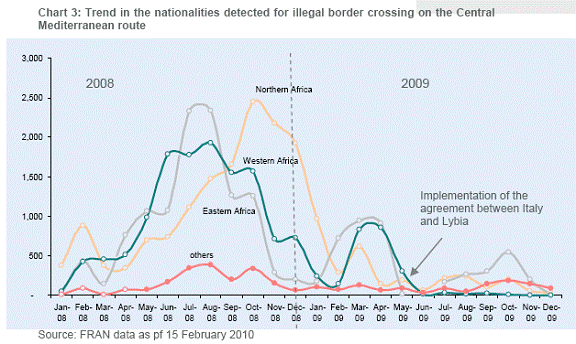
“Since the signing of a bilateral agreement with Libya, joint patrols by Libya and Italy have had a clear and measurable deterrent effect, with 3,200 detections in the seven months after the joint patrols (June to December), compared to 7,200 detections in the five months before the joint patrols (January to May), and almost 40,000 detections in the whole of 2008.”

“Western African route – The Western African route is primarily through Western African countries to Spain via the Canary Islands. The main embarkation points are in Senegal and Mauritania and the main countries of origin are Mali, Mauritania, Guinea Conakry and Senegal. Other African nationals have also been reported, and occasionally migrants from Asia. This route is now less favoured since the Spanish collaboration agreements with Senegal and Mauritania. The Frontex coordinated Joint Operation Hera plays a major role in maintaining effective surveillance in the area.”

“The Western Mediterranean route includes the sea route from Northern Africa to the Iberian Peninsula, and the land route through Ceuta and Melilla. It is mostly used by Northern African nationals (Algerian and Moroccan) travelling to Spain, France and Italy.”

“Maritime detections between Northern Africa and Spain are rising, with increasing detections of Algerian and to a lesser extent Sub Saharan nationals. Moroccan nationals are also regularly detected on this route. The lack of employment opportunities for the growing population of young people in Morocco continues to increase the incentives of migrating to the EU. The Spanish authorities recently reported an increasing number of attempts by Moroccan minors to get on the ferry link between Tanger and Spain. These cases do not seem connected with criminal networks; rather individual attempts are driven by poor employment prospects in Morocco.”

Click here for the ARA.

Click here for link to Frontex Map showing situation at External Borders.
[ARA page 18]

[ARA page 13]

1 Comment

Filed under Aegean Sea, Data / Stats, Eastern Atlantic, European Union, Frontex, Greece, Italy, Libya, Malta, Mauritania, Mediterranean, Morocco, Reports, Senegal, Spain, Turkey

UNODC Publication: Smuggling of Migrants into, through and from North Africa

UNODC has issued a new publication entitled “Smuggling of Migrants into, through and from North Africa: A thematic review and annotated bibliography of recent publications.”  Most of the reviewed literature and data are from 2008 and earlier dates and therefore the publication does not include references to more recent events, e.g. the Italy-Libya migration agreement.  But it is a comprehensive and useful publication.  The 16 page Annotated Bibliography is a very good resource.

According to the UNODC web site, the publication “focuses primarily on the patterns and dynamics of migrant smuggling, as it concerns the North African region. Recognizing, however, that irregular migration and smuggling flows are transnational in nature, the review goes beyond North Africa, to also cover sub- Saharan African and European countries affected along the various smuggling routes.  The aim of the review is twofold: to describe major findings on smuggling of migrants; into, through and from North Africa, and to highlight the need for further research on specific issues that have not yet been studied.”

Table of Contents:

  • I. Introduction
  • II. Quantifying irregular migration and smuggling of migrants
  • III. Migrant smuggling routes
  • IV. Profiles and characteristics of smuggled migrants
  • V. Smuggler-migrant relationships
  • VI. Organizational structures of migrant-smuggling networks
  • VII. Modus operandi of migrant smuggling
  • VIII. Smuggling fees
  • IX. The human and social costs of smuggling
  • X. Summary of findings
  • XI. Annotated bibliography

Click here for the publication.

Leave a comment

Filed under Aegean Sea, Algeria, Analysis, Data / Stats, Eastern Atlantic, Egypt, France, Greece, Italy, Libya, Malta, Mauritania, Mediterranean, Morocco, Reports, Senegal, Spain, Tunisia, Turkey, UNODC

Italy and Malta Question Need for Frontex Sea Patrols

Italy and Malta held a one day summit yesterday that focused on “Strategic Mediterranean” themes.  The two countries are calling for a reassessment of Frontex’s role in the Mediterranean, suggesting that Frontex may be best suited for repatriation operations and not for sea patrols.  Maltese Foreign Minister Tonio Borg said that even Italy questioned the need for ongoing Frontex missions fearing that such missions might upset the Italy-Libya migration agreement which has almost eliminated irregular migration from Libya.  A statement issued by the Italian Foreign Ministry described the Italy-Libya migration agreement as a model that is “exemplary for extension to other African countries.”

Malta also reaffirmed that it would not reconsider its decision not to host Frontex missions unless the Frontex rule addressing where intercepted migrants are to be taken is changed.

Click here and here for articles.

Click here for Italian Foreign Ministry statement.

1 Comment

Filed under Frontex, Italy, Libya, Malta, Mediterranean, News

EP Refers Frontex Sea Borders Rule to ECJ

On 23 June the JURI committee (Committee on Legal Affairs) voted in camera to refer the question of the validity of the Frontex rule regarding the surveillance of the sea external borders to the European Court of Justice (Council Decision 2010/252/EU (“Frontex / Sea borders”)).  The referral requests the Court “to preserve the effects of the measure until a new legislative act has been adopted.”

Maltese MEP Simon Busuttil, the EPP Coordinator in the Civil Liberties Committee, was quoted as saying: “we have given notice to the Commission that not all is fine with these Frontex guidelines and it is time for a rethink. We want to ensure that Parliament’s role is defended and that we can have our say. We want these rules to be fair. In their current version they are not.”

Both the LIBE and JURI committees believe that the European Commission exceeded its power when it presented the new Frontex rule under the comitology procedure as opposed to using the ordinary legislative procedure which would have given the Parliament the ability to amend the rule.  Malta has strongly objected to provisions within the rule.  Malta has said that its decision not to host Frontex’s Central Mediterranean enforcement operation this year, Operation Chronos, was due to the disembarkation provisions contained in the new Frontex rule.  Malta believes that the rule would require intercepted migrants to be taken to Malta.

Click here for article.

Click here for statement on MEP Simon Busuttil’s web site.

Click here for EPP Group press release.

Click here and here for earlier posts.

4 Comments

Filed under European Union, Frontex, Judicial, Malta, Mediterranean, News

UNHCR Criticises Delay by Italy and Malta in Launching Search and Rescue of Migrant Boat

“UNHCR is concerned about delays in a search-and-rescue operation on Sunday and Monday [6-7 June]  involving a boat carrying more than 20 people, mostly Eritreans, near Malta. Distress calls were received on Sunday evening, including by UNHCR, and passed to Maltese and Italian maritime authorities. It is unclear which country had search-and-rescue responsibility when the distress calls were first sent. According to information made available to UNHCR, the boat was only rescued late on Monday, and by Libyan vessels.”

The persons on board the boat have reportedly been taken to Libya.

Click here for UNHCR statement.

Click here and here for articles.

Leave a comment

Filed under Italy, Libya, Malta, Mediterranean, News, UNHCR

Malta: Italian Sea Patrols are Secretive But Effective

A Malta Today article quotes an unidentified source within the Armed Forces of Malta as saying that Italy’s anti-migrant operations are effective but are veiled in a suspicious secrecy:

“‘Nothing is happening [in regard to migrants], because the Italians are effective with joint patrolling, donations of sea vessels, and hands-on training,’ an informed officer said.  Developments on the Libyan sea-front, where the Italian army is engaged in joint repatriations of migrant traffic, seem to be veiled in a suspicious secrecy. The same officer said ‘we don’t know what the Italians are doing’, and as the first months of 2010 saw no significant migrant arrivals, observers feel the situation may not alter radically.  There seems to be consensus that the deal forged between the Italian and Libyan leaders has stemmed the migrant tide in the Mediterranean.”

Click here for article.

Leave a comment

Filed under Italy, Libya, Malta, Mediterranean, News

Details from Frontex General Report 2009 (Post 2 of 2)

Last week I posted a summary of the first part of Frontex’s 2009 General Report.  This second post summarizes the portion of the Report pertaining to Frontex’s sea operations.

The General Report 2009 provides selective information regarding the six major Joint Operations conducted at the sea borders.  With only one exception, no information or data is provided regarding the specific numbers of intercepted migrants or vessels.

Instead of numbers, the Report provides various descriptive terms which could mean almost anything.  For example, Operation Hera led to a “drastic decrease of migrants,” during Operation Nautilus there was a “remarkable decrease” in migrants, and during Operation Hermes, the numbers of migrants arriving and dying at sea “decreased dramatically.” The one exception is for Operation Indalo where the Report states that 750 irregular migrants and 10 facilitators were detected.

When desired, the Report provides details and numbers.  For example, Operation Poseidon utilized 4 open sea vessels, 6 coastal patrol vessels, 13 coastal patrol boats, six airplanes, 4 helicopters, and 152 experts who delivered 2680 man days of operational activities, but no data regarding the total number of irregular migrants intercepted at sea is provided.

Here is a summary of the information provided in the Report for each of the six major Joint Operations:

Poseidon 2009, Eastern Mediterranean (365 Days)

Poseidon was conducted along land borders as well as at sea.  Interpreters were deployed on board ships to facilitate the identification process of intercepted migrants.  Less than 10% of the interviewed migrants claimed their original nationality.  There was an overall reduction in migrant flow of 16% (land and sea) compared to 2008.  “The main operational objectives of the joint operation were achieved but there is a clear need for closer cooperation between local authorities.”

Hera 2009, Atlantic Ocean waters between North Western African countries and Canary Islands (365 Days)

Due to the permanent implementation of Joint Operation Hera and better cooperation from “involved African countries”, there was a notable reduction in migrants reaching the Canary Islands, 2280 in 2009 compared with 9200 in 2008.  Aerial and maritime surveillance conducted close to the territory of Senegal and Mauritania and local cooperation from police led to the decrease in migrants.  “Despite these clear successes, participation of more member States would greatly increase effectiveness and outcomes.”  [NF- While the Report does provide migrant arrival data for the Canary Islands, it is silent on the number of migrants intercepted at sea or within Senegal or Mauritania.]

Nautilus 2009, Central Mediterranean (172 Days)

There was a remarkable decrease in migrant arrivals in Malta.  A “significant obstacle to the effectiveness of the Joint Operation lay in the contrasting interpretations of the International Law of the Sea by Member States….”  The effectiveness of the operation compared with 2008 was not improved.

Hermes 2009, Central Mediterranean (184 Days)

“Due to the bilateral agreement between Italy and Libya, the number of people arriving from Libya, as well as the number of migrants died at sea, decreased dramatically….”  “In addition, the first examples of co-operation with Algeria should also be considered as promising.”  As with Nautilus, “differing interpretations of the International Law of the Sea led to a limited contribution by the Member States to the joint operation by maritime surface means.”  The effectiveness of the operation compared with 2008 can be considered as increased.

Minerva 2009, Western Mediterranean (39 Days)

The launch of the operation was delayed in 2009.  Its effectiveness compared with 2008 has remained the same.

Indalo 2009, Western Mediterranean (50 Days)

The lack of cooperation from Algeria is an obstacle for operational activities.  10 Facilitators and 750 irregular migrants were identified.

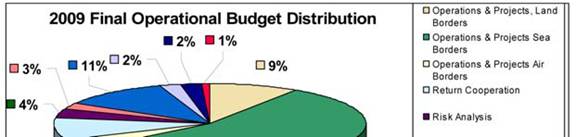
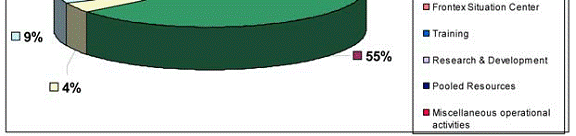
And as I noted in my earlier post, Frontex continued to devote the biggest single portion of its expenditures to maritime enforcement.  Almost 40% of Frontex’s total budget, over € 34 million, was spent on sea operations in 2009, constituting 55% of the operational budget.

This chart from the Report (p 23) shows the breakdown of expenditures within the 2009 Operational Budget (which was 71% of the total 2009 Frontex budget).

Click here for previous post.

Click here for the Frontex General Report 2009.

2 Comments

Filed under Aegean Sea, Algeria, Data / Stats, Eastern Atlantic, Frontex, Greece, Italy, Libya, Malta, Mauritania, Mediterranean, Reports, Senegal, Spain

Italy Will Try to Convince Malta to Resume Frontex Patrols

A bi-lateral meeting between Italy and Malta is scheduled for Thursday, 13 May.  Italy’s Interior Minister Roberto Maroni reportedly has said that he will try to convince Malta to recommit to the Frontex sea patrols.  Maroni expressed concern that the lack of participation by Malta in the patrols will have negative consequences because it will create a break in what was a united front in the Mediterranean.

Click here (EN) and here (IT) for articles.

1 Comment

Filed under Frontex, Italy, Malta, Mediterranean, News

Details from Frontex General Report 2009 (Post 1 of 2)

There is nothing really unexpected in the Frontex General Report for 2009.  If anything, it disappoints with its limited information.

The number of illegal border crossings at EU borders was smaller by a third in 2009 compared to 2008 and Frontex’s budget increased by 25% to € 88.3 million.

Frontex continued to devote the biggest single portion of its expenditures to maritime enforcement.  Almost 40% of Frontex’s total budget, over € 34 million, was spent on sea operations in 2009.  This constitutes 55% of the operational budget.  The Report notes that this cost is due to the high operating costs of ships and surveillance aircraft.

Expenditures for Frontex facilitated return operations sharply increased by 500% in 2009 to almost € 5.5 million.

Limited Information in the Report – The Report explains that Frontex made a decision in 2008 to decrease the level of detail provided in the General Report.  Frontex’s justification is that the Report “is mainly directed towards the general public” and the reduced level of detail “is more suited to this audience.”  This practice was unfortunately continued in the 2009 Report.

General Statistics – Overall there were 106,200 “detections of illegal border-crossings” at EU external land and sea borders in 2009.  This represents a 33% decrease in overall detected crossings relative to 2008, with a 23% reduction of detections at sea and a 43% reduction at land borders.

The reductions are attributed by Frontex to the economic crisis and to bilateral “collaboration agreements with third countries of departure” such as Libya, Senegal, and Mauritania.

Applications for international protection within the EU were 2% fewer in number than in 2008 and were approximately 50% of the 2001-2002 peak when 420,000 applications for international protection were filed.

Cooperation with Non-EU / Non-Schengen Countries – The Report states that cooperation with third countries, including neighbouring countries and countries of origin, is the critical element in “integrated border management.”   It describes Operation HERA as Frontex’s most successful joint operation due to close cooperation with West African countries, particularly Senegal and Mauritania.  On other fronts, “considerable progress” was made with Turkey consisting of Turkey’s appointment of a “first point of contact for Frontex related coordination issues” and preparation of a draft text of a possible Working Arrangement agreement.  “Ad hoc operational co-operation” was pursued when a targeted country was not willing or able to enter into a formal Working Arrangement with Frontex.  An “overriding priority” for Frontex in 2010 is the development of “structured operational co-operation with neighbouring Mediterranean countries.”  The Report acknowledges the existence of the bilateral migration agreement between Italy and Libya, but says nothing about its provisions other than to say that there were “contrasting interpretations of the International Law of the Sea” between Member States.  There is no criticism in the Report whatsoever of the Italian push-back practice.  It is obviously difficult for Frontex to criticise Italy, but was it not possible to note that most people and organizations who have considered the push-back practice have concluded that the practice violates international law?

New Partner Organisations – Frontex formalised a co-operation plan with Europol in October, a Working Arrangement with Interpol in May, a co-operation plan with IOM in February, and made a tripartite agreement with the European Maritime Safety Agency (EMSA) and the Community Fisheries Control Agency (CFCA) relating to maritime surveillance.

More to follow: I will post a second summary with additional information from the General Report pertaining to the specific sea operations for which information is provided within the next day or two.

Click here for the Report.

2 Comments

Filed under Aegean Sea, Data / Stats, Eastern Atlantic, European Union, Frontex, Greece, Italy, Libya, Malta, Mauritania, Mediterranean, Reports, Senegal, Spain, Turkey

Publication of Council Decision re Rules for Sea Border Operations Coordinated by Frontex

The Council decision on the surveillance of  sea external borders has been published in the EU Official Journal: “COUNCIL DECISION of 26 April 2010 supplementing the Schengen Borders Code as regards the surveillance of the sea external borders in the context of operational cooperation coordinated by the European Agency for the Management of Operational Cooperation at the External Borders of the Member States of the European Union.”

Malta has strenuously objected to certain provisions within the new rule and has said that its decision not to host Frontex’s Central Mediterranean enforcement operation, Operation Chronos, was due to the disembarkation provisions contained in the new Frontex rule.  It should be noted that Malta has more recently said that its decision not to participate in Operation Chronos was due to the lack of need for the operation given the “success” of Italy’s push-back practice.

Malta’s objection to the guidelines is largely focused on the following provision in the rule for sea border operations:

“2. Disembarkation

2.1. The operational plan should spell out the modalities for the disembarkation of the persons intercepted or rescued, in accordance with international law and any applicable bilateral agreements. The operational plan shall not have the effect of imposing obligations on Member States not participating in the operation.  Without prejudice to the responsibility of the Rescue Coordination Centre, and unless otherwise specified in the operational plan, priority should be given to disembarkation in the third country from where the ship carrying the persons departed or through the territorial waters or search and rescue region of which that ship transited and if this is not possible, priority should be given to disembarkation in the host Member State unless it is necessary to act otherwise to ensure the safety of these persons.”

Commissioner Cecilia Malmström pointed out during her recent official visit to Malta that the rule could be interpreted by the member states participating in an operation so as to provide for disembarkation of migrants at a location other than the host state.

(HT to Steve Peers (Univ. of Essex) via Bernard Ryan on Migration and Law Network list serve.)

Click here for the Council Decision.

4 Comments

Filed under European Union, Frontex, Malta, Mediterranean, News

Maltese MEP Appointed EP Rapporteur on Review of the Frontex Regulation

The Malta Independent reports that Maltese MEP Simon Busuttil has been appointed the European Parliament’s rapporteur on the review of the law establishing the Frontex agency.  “As a rapporteur, Dr Busuttil will draw up the position of the European Parliament, including amendments to the proposal of the European Commission to change the agency’s legal framework. The changes must be agreed by the European Parliament and the Council of Ministers.”

MEP Busuttil is quoted as saying: “If we want an internal EU area without borders then we should share the responsibility of protecting our external borders. Co-ordination of our air, land and sea borders must improve.”  “In Malta we know that Frontex has not performed up to our expectations and I am keen to use the Maltese experience in order to improve the agency where it did not work well.” “Nevertheless, I am mindful of the fact that this agency is not there just for the Mediterranean but for all of Europe and for all of Europe’s borders, including its air and land borders. I will therefore be taking a holistic approach.”

Click here for article.

1 Comment

Filed under European Union, Frontex, Malta, News

LIBE Considering Legal Challenge to Council and Commission Over New Frontex Guidelines

Times of Malta reported on Monday that Maltese MEP and LIBE Committee member, Simon Busuttil, who is the EPP coordinator on LIBE, has received a positive legal response to his question regarding whether sufficient grounds exist to bring a legal challenge against the Council and the Commission in regard to the recently approved Frontex sea operation Guidelines.  This report follows by a few days Commissioner  Malmström’s first visit to Malta and the reaffirmation by Malta that it will not host Frontex’s Operation Chronos.

The Times of Malta states that “The EP’s legal unit advised there were enough grounds to take the EU Council and European Commission to court on the basis that the rules exceed the two institutions’ powers under the EU Treaties.”  MEP Busuttil was quoted as saying “I have already gone on record saying that I will not let this one go and this legal advice opens the way to court proceedings to invalidate these rules. I am reasonably confident that the European Parliament has a good case and the European Commission would do well to take this possibility into account and start thinking about Plan B.”

Click here for article.

1 Comment

Filed under European Union, Frontex, Malta, Mediterranean, News

Malmström: Frontex Sea Operation Guidelines May Be Re-Negotiated by Participating Member States

Commissioner Cecilia Malmström was in Malta on 30 April for meetings with Maltese officials.  Malta recently reaffirmed its decision not to host Frontex’s Operation Chronos.  Malmström trip was planned before Malta’s announcement.  There is no indication that Malta changed its position during Malmström’s visit.

Malmström was interviewed during her visit by the Times of Malta and said that the new guidelines governing Frontex enforcement operations at sea could be negotiated by member states on a mission by mission basis.  The new guidelines require that intercepted migrants be taken to the country hosting the Frontex mission, but  Malmström said there is the possibility before a mission starts that the participating member states agree on different rules of engagement, which might include the sharing of responsibility where not all intercepted migrants would be brought to country hosting the mission.

Presumably participating member states would not be permitted to negotiate substantive mission by mission changes to the guidelines so as to undercut the very reasons for which the guidelines were recently adopted.

Click here for Times of Malta article.

Click here for video of Times of Malta Interview.

Click here, here, and here for other articles regarding the visit.

1 Comment

Filed under European Union, Frontex, Malta, Mediterranean, News

Malmström: Right to Seek Asylum At Sea Should Be Respected

Commissioner Cecilia Malmström held meetings in Italy yesterday and has meetings in Malta today.  In her meeting with Italian Foreign Minister Franco Frattini she suggested that any possible future migration agreement between the EU and Tripoli ”would not follow the model of the [current migration] agreement between Italy and Libya.”  ANSA reported she said that while it is ”important to try and begin dialogue” with Tripoli, ”if there is an agreement, it is clear that the fundamental condition for Libya must be adherence to the Geneva Convention or the equivalent among African states ”on the rights of political refugees.”

In regard to current practices, Malmström said that the right to seek asylum should be respected even when one is already at sea. (”Bisogna comunque – ha concluso la Malmstrom – rispettare il diritto di chiedere asilo quando si e’ gia’ in mare”.)

Click here (IT), here (EN), and here (IT) for articles.

Leave a comment

Filed under European Union, Italy, Libya, Malta, Mediterranean, News