Category Archives: States

Update Regarding Migrant Boat Sinking Off Tunisian Coast

Tunisian authorities continue to recover the bodies of victims from the migrant boat that capsized off the coast of the Kerkennah islands  last week.  TAP reported that 26 additional bodies were recovered on Sunday, 5 June.  Poor weather conditions on Sunday made recovery operations difficult.  According to TAP, 577 persons were rescued from the boat and 200 to 270 persons are believed to have drowned.  There are conflicting media reports regarding the numbers of confirmed deaths.  Some reports indicate that at least 150 bodies have been recovered in addition to the 26 bodies reportedly recovered on 5 June.

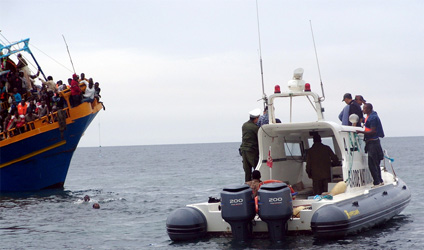
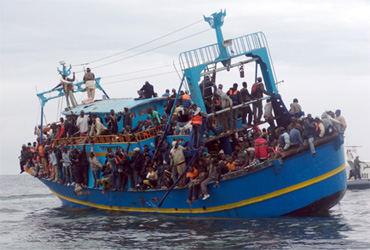
The boat, named The Wave, ran around last week, probably on Wednesday, 1 June.  The boat did not capsize until after rescue boats had arrived on the scene.   Tunisian coast guard and local fishing boats were involved in the rescue efforts.  The rescue boats did not have the capacity to rescue all of the migrants from the stranded migrant boat and some people jumped into the water and others moved to one side of the migrant boat causing it to capsize.  Media pictures show the vessel in an upright position with some rescue boats already on scene.  A France24 video report contains cell phone video shot immediately after the boat capsized.  (See pictures below.)

UNHCR and IOM staff have conducted interviews with some of the survivors.  According to UNHCR, the boat left Tripoli on 28 May with up to 850 people on board.  The passengers were primarily from West Africa, Pakistan, and Bangladesh. The crew was recruited on an ad hoc basis and had little or no maritime experience. The France24 video report states that survivors said Libyan military assisted them in leaving Libya.  The boat became lost after leaving Tripoli and on Wednesday, 1 June, it ran around near the Kerkennah islands.  UNHCR spokesman Adrian Edwards said that the boat “capsized as desperate passengers rushed to one side, seeking rescue by the Tunisian coast guard and fishing boats that had approached the vessel. Many fell into the water.”  IOM staff reported that at least one survivor said that during the boat’s voyage some people were thrown overboard alive.  The boat reportedly had run out of food and water.

Click here for a France24 video news report (EN) with cell phone video shot immediately after the migrant boat capsized.

Click here and here for UNHCR reports on the incident.

Click here for IOM Press Briefing Note.

Click here, here, here, and here for Tunisian articles. (FR)

Click here, here, and here for articles.  (EN)

Photo Agence Tunis Afrique Presse 04 juin 2011

La Garde maritime à Sfax au secours du chalutier libyen bloqué au large de Kerkennah (Photo AFP)

France24 03 June 2011 - Screen shot

France24 03 June 2011 - Screen Shot


1 Comment

Filed under Data / Stats, European Union, Italy, Libya, Mediterranean, News, Tunisia, UNHCR

Migrant Boat(s) Sink Off Tunisian Coast / 250+ Feared Dead, 550+ Rescued

Tunisian authorities report that one or more migrant boats that had departed from Libya capsized and sank near the Tunisian coast on Tuesday near the Tunisian island of Kerkennah.  There are currently conflicting media reports on the number of boats involved.  The boat(s) are is thought to have been carrying approximately 800 people in total.  Over 500 people have reportedly been saved.  Approximately 270 are missing and assumed dead.

Click here, here, and here for articles.

Leave a comment

Filed under Italy, Libya, Mediterranean, News, Tunisia

UNODC Report: The Role of Organized Crime in the Smuggling of Migrants from West Africa to the EU

UNODC released a report on 30 May: The Role of Organized Crime in the Smuggling of Migrants from West Africa to the European Union.  From the UNODC web page: “… The new report by the United Nations Office on Drugs and Crime (UNODC) investigates the involvement of organized criminal groups in the smuggling of migrants from West Africa towards the European Union (EU).  The involvement of organized crime in the smuggling of migrants is a sensitive and controversial issue in West African countries, as the report discusses at various points. The publication contributes to better understand the underlying mechanisms and actors involved in this criminal process as a basis for policy reforms in countries affected.

Information in the report was compiled by a team of researchers from West Africa and Europe using both documentary studies and field research conducted in Mali, the Niger, Nigeria and Spain. …  UNODC, as guardian of the Protocol against the Smuggling of Migrants by Land, Sea and Air, supplementing the United Nations Convention against Transnational Organized Crime, possesses specific expertise and experience that could be put at the service of all countries affected to support them in matters linked to prevention, legislation, operations or prosecution.”

From the Report’s Summary:  “The United Nations Office on Drugs and Crime (UNODC), through the European Union-funded ‘Law enforcement capacity-building to prevent and combat smuggling of migrants in the ECOWAS region and Mauritania (Impact)’, undertook to investigate the role played by organized criminal groups in the smuggling of migrants from West Africa to Europe.

The present report is aimed primarily at decision makers, law enforcement and judicial officials, but also at a wider audience interested in irregular migration. It contributes to a better understanding of the underlying mechanisms and actors involved in this criminal process as a basis for policy reforms in the West African countries concerned.  This report was prepared through desk and field research, conducted in Mali, Morocco, the Niger, Nigeria, Senegal and Spain. Interviews were conducted with over 200 people in Africa and Europe belonging to three main groups: migrants, national authorities and non-governmental organizations, and smugglers.

Four main findings can be mentioned:

• Transnational organized criminal groups are generally involved in the smuggling of migrants from West Africa to Europe. However, there are important differences among them in terms of specialization and professionalism. With regard to trafficking in persons and the smuggling of non-African irregular migrants, criminal groups are clearly well organized and structured, and keep close contacts with operatives in several countries. On the other hand, other would-be migrants in West Africa have to deal with loose networks that are not permanently structured. Various groups of actors usually collaborate for one particular operation, and there are no exclusive relationships between those criminal groups.

• Specialization and the building of transnational criminal networks usually come as a result of increased efficiency in border interdiction. Within West Africa, freedom of movement gives little incentive, if any, to engage in the smuggling of migrants. However, the situation changes when there are natural obstacles, such as the sea, or man-made obstacles, such as surveillance

• In most cases, smugglers are migrants themselves. Realizing that their knowledge acquired through (often painful) experience may be used by other migrants in exchange for remuneration, some migrants decide to enter the business of smuggling of migrants. They may then become specialized professional smugglers, or they use their knowledge to finance the completion of their journey to Europe.

• Irregular migrants generally do not see themselves as victims, and smugglers do not see themselves as criminals. A complex relationship exists between irregular migrants and smugglers. The latter have an interest in maintaining the flow and feeding youngsters with dreams of success. These dreams are also kept alive in some West African countries by families and circles where important social value is attached to those who decide to leave, as well as by those who have made it to Europe, be it legally or illegally, even though their situation in Europe is often worse than it was at home….”

Click here for Report.

Click here for article on UNDOC web page.

Leave a comment

Filed under Analysis, Eastern Atlantic, European Union, Mauritania, Mediterranean, Morocco, Niger, Reports, Senegal, Spain, United Nations, UNODC

Some Refugees Who Fled Libya Return in Effort to Board Boats to Europe

Last week, UNHCR reported that hundreds of people who recently fled Libya to Tunisia and Egypt are returning to Libya in an effort to board boats for Europe.  “Among them are refugees, including members of the Somali, Ethiopian and Eritrean communities in the camps at Choucha near Tunisia’s border with Libya.”  UNHCR is warning of the dangers of trying to reach Europe by sea and of returning to Libya.  “UNHCR has met with refugees in Tripoli who are planning to make the perilous sea journey. ‘They are all aware of the high death toll, but they told us that they feel they have nothing to lose. One Eritrean man told us he would rather die trying to reach safety than continue to live in danger,’ [UNHCR’s chief spokesperson, Melissa] Fleming said.”  “Fleming [also] said that UNHCR had learnt with sadness ‘that people on track for resettlement, following interviews last year in Libya, lost their lives while trying to reach Europe recently. People in the middle of the resettlement process and vulnerable cases are prioritized in our interview schedule.’”

Click here for UNHCR statement.

Leave a comment

Filed under Egypt, European Union, Italy, Libya, Mediterranean, News, Tunisia, UNHCR

Frontex Deployment, Repatriation Practices, and Diplomacy Are Responsible For Halting Migrant Arrivals in Canary Islands

From Europa Press: Juan Martinez, Chief Inspector of the Spanish National Police’s  Illegal Immigration Network and False Document Unit (UCRIF – Unidad Contra las Redes de Inmigración Ilegal y Falsedades Documentales), attributes the significant decline in the arrival of migrant boats in the Canary Islands to the deployment of Frontex, diplomatic management in the countries of origin, and repatriation policies.  The article notes the first migrant boat arrival in the Canaries in 1994, the peak years of 2006-2008, and the ensuing practices which have halted further migrant arrivals.

Click here (ES) for article.

Leave a comment

Filed under Eastern Atlantic, Frontex, News, Senegal, Spain

PACE Delegation Completes Visit to Lampedusa

A delegation from the PACE Committee on Migration, Refugees and Population has just completed a two day visit to Lampedusa.  The members of the delegation were Christopher Chope (United Kingdom, EDG), Chair of the Migration Committee, Giacomo Santini (Italy, EPP/CD), First Vice-Chair of the Migration Committee, Tineke Strik (Netherlands, SOC), Chair of the Sub-Committee on Refugees, Tina Acketoft (Sweden, ALDE), and Annette Groth (Germany, UEL).  The delegation reported that while the situation in Lampedusa in regard to newly arriving migrants is under control when compared with the situation earlier in the year, the “reception facilities on Lampedusa were inadequate for longer stays – especially for vulnerable groups such as unaccompanied children – and that transfers to better-equipped centres elsewhere in Italy should be carried out within days: ‘In particular, the situation of the Tunisians that have been on the island in detention-like conditions for almost three weeks should be dealt with as soon as possible.’”

The delegation also said that “[t]he arrivals to Lampedusa are not the sole responsibility of a tiny island. There have been enough calls for responsibility-sharing and for solidarity. It is time that Europe acted on them. … Too many have already died at sea trying to reach Europe.  …  Europe must try to protect asylum seekers and refugees in a way that they are not forced to risk their lives first.”

Click here for PACE statement.

Click here for earlier announcement of the visit.

1 Comment

Filed under Council of Europe, Italy, Libya, Mediterranean, News, Reports, Tunisia

Interview with Frontex Deputy ED Gil Arias

EurActiv.es conducted an interview in Spanish with Frontex Deputy Executive Director Gil Arias where he speaks about several topics, including Frontex’s response to the current situation in North Africa, the possible implications for Spain should unrest spread to Algeria or Morocco, Frontex’s budget shortfall and need for supplemental funding, and the problems experienced by Frontex when it attempts to negotiate cooperation or training agreements with third countries.

Click here for interview. (ES)

Leave a comment

Filed under Egypt, European Union, Frontex, Greece, Italy, Libya, Malta, Mediterranean, News, Spain, Tunisia

62 Bodies Recovered on Tunisian Beaches in First Week of May

While irregular departures from Tunisia have been significantly reduced in number since Tunisian authorities resumed efforts to prevent or discourage such departures, bodies from earlier departures and accidents continue to wash ashore.  The Financial Times reports that “62 bodies [were] found [during the first week of May] near Sfax, Kerkennah and Chaffar, up the coastline from Zarzis, apparently from boats lost weeks earlier.”  58 bodies were discovered during the month of April.  FT also reported that “[u]nder the previous regime, would-be illegal migrants risked a fortnight in jail for ‘infringement of frontiers’; now there are no penalties imposed on those who attempted the illegal crossing.”

Click here for FT article (free access, but registration may be required).

Click here for previous post.

Leave a comment

Filed under European Union, Italy, Mediterranean, News, Tunisia

600+ Migrants Reach Andalusian Coast in 2011

A total of 612 migrants in 24 different boats have reached the Andalusian coast of Spain (Almeria, Granada, Cadiz and Huelva) from Morocco and Algeria so far in 2011.

Click here for article (ES).

Leave a comment

Filed under Algeria, Data / Stats, Eastern Atlantic, Mediterranean, Morocco, News, Spain

Commission to Adopt New Communication on Migration

The European Voice reported last week that the European Commission will likely adopt a new Communication on migration when the Commission meets on 24 May.  “A communication expected to be adopted by European commissioners … proposes that the countries of the region should receive increased assistance for managing migration in return for commitments to accept repatriated migrants and to tighten border controls. … [The new expected] communication follows a broader communication on migration adopted by the Commission on 4 May. A national diplomat said that the measures outlined in the two communications go ‘in the right direction’ but that the member states were now waiting for actual legislative proposals….”

Click here for EV article.

Click here for Communication on Migration of 4 May.

Click here for previous post regarding Communication of 4 May.

Leave a comment

Filed under European Union, Frontex, Italy, Libya, Malta, Mediterranean, News, Tunisia

Análisis del Real Instituto Elcano: La crisis en el Norte de África y su impacto en la inmigración irregular a la Unión Europea (by Frontex Dep. ED Gil Arias)

Real Instituto Elcano has published an analysis regarding the situation in North Africa and its impact on irregular immigration to the EU.  The analysis was written by Frontex’s Deputy Executive Director Gil Arias.

Of particular interest is the analysis regarding what Frontex believes might occur in regard to migrant flows from Libya under two different scenarios: Gadafi remaining in power or ultimately being removed from power (see Google translation of excerpt below):

“… En el caso de que el régimen de Gadafi recupere el control, la UE y sus Estados Miembros no podrán reanudar la cooperación con un régimen totalmente desacreditado. Se producirá el cese en la aplicación de acuerdos de cooperación policial que en el pasado (desde mayo de 2009) sirvieron para detener los flujos de inmigración irregular desde Libia hacia Italia y Malta. La posibilidad de que ciudadanos de otros países africanos bloqueados en Libia sean obligados o “ayudados” a emigrar a la UE no debe descartarse. De hecho, Gadafi ha amenazado con “abrir la puerta” de la inmigración ilegal hacia Europa.

La OIM estima la cifra de extranjeros presentes en Libia entre 0,5 y 1,5 millones. No obstante, no todos serian candidatos a la inmigración ilegal. Se trata fundamentalmente de trabajadores empleados por empresas extranjeras asentadas en el país, por lo que su intención primaria no sería la emigración a la UE y por otra parte una buena parte de ellos ya han abandonado Libia.

En el peor de los casos, la consecuencia de ese “abrir la puerta” sería la reactivación de los flujos por vía marítima hacia Lampedusa y Malta (eventualmente también Creta, que se encuentra a 200 km de distancia de la costa libia) en un escenario similar al de 2008 (40.000 inmigrantes llegaron a Italia y Malta, con origen en las costas libias) agravado por el efecto adicional de la inestabilidad en el país. Su destino principal serían los países con presencia importante de ciudadanos norteafricanos (Italia, Francia, España, Bélgica y el Reino Unido). El destino de los nacionales de países subsaharianos se encontraría más repartido por toda la UE.

Si Gadafi es derrocado resultará clave la capacidad y rapidez de la oposición para reorganizarse. La oposición se encuentra, por el momento, bastante desorganizada y es probable que se produzcan luchas internas por el poder, especialmente por el control de los campos petrolíferos. Ello podría conducir a un estado persistente de disturbios y a una ausencia de control por un largo periodo de tiempo.

La eventual reactivación de las rutas migratorias hacia la UE dependerá de la capacidad del nuevo régimen para imponer la ley y el orden en el país así como el control efectivo sobre los 2.000 km de costas y 4.000 km de fronteras terrestres libias. En el peor de los escenarios podría darse una situación similar a la de Somalia.

En este escenario, la economía libia puede deteriorarse y elevarse los niveles de desempleo. Actualmente se desconoce la tasa de desempleo en Libia, pero se presume baja. Previsiblemente, la mayoría de los trabajadores desempleados intentará regresar a sus países, pero parte de ellos (sobre todo los nacionales de países inseguros) buscaran otras oportunidades, entre ellas la emigración clandestina a la UE.

La ausencia de ley y orden, especialmente la ausencia de control sobre las fronteras marítimas, llevará rápidamente a las mafias al tráfico de inmigrantes hacia la UE. Los candidatos serían primariamente trabajadores desempleados no deseosos de volver a sus países (mayormente de África Occidental y Oriental, pero eventualmente también libios, egipcios, argelinos y tunecinos). Esta situación impediría, por otra parte, el retorno de quienes fuesen detectados cruzando ilegalmente las fronteras exteriores de la UE.

En tales circunstancias se puede prever un flujo constante de inmigración ilegal durante meses, mayoritariamente por vía marítima, pero también por vía aérea a través de Turquía. La duración en el tiempo de este escenario dependerá de la rapidez con la que la UE o los Estados Miembros y las nuevas autoridades sean capaces de restablecer la cooperación. En este sentido, serán determinantes los acuerdos de readmisión efectivos.

Por último, ha de tenerse también en cuenta el riesgo marginal de que los vencedores realicen acciones de persecución sobre los partidarios de Gadafi, lo que provocaría la huida de éstos del país en busca de refugio….”

Google translation of the above excerpts (NB – this is only a rough translation):

“…In the case of Qaddafi’s regime  regaining control, the EU and its Member States shall not resume cooperation with a discredited regime. Termination will occur in the implementation of agreements on police cooperation in the past (May 2009) served to stop the flow of illegal immigration from Libya to Italy and Malta. The possibility for citizens from other African countries locked in Libya are forced or “helped” to migrate to the EU can not be ruled out. In fact, Gaddafi has threatened to “open the door” of illegal immigration into Europe.

The IOM estimates the number of foreigners in Libya between 0.5 and 1.5 million. However, not all candidates would be illegal immigration. These are mainly employed by foreign companies settled in the country, so that their primary intention would not be the migration to the EU and, moreover, a good portion of them have already left Libya.

In the worst case, the consequence of this “open door” would be the reactivation of the flows by sea to Lampedusa and Malta (and possibly Crete, which is 200 km away from the Libyan coast) in a scenario similar to that of 2008 (40.000 immigrants arrived in Italy and Malta, departing from the Libyan coast) aggravated by the additional effect of instability in the country. Its main destination countries would be a significant presence of North African citizens (Italy, France, Spain, Belgium and the UK). The fate of the national sub-Saharan countries would be more distributed throughout the EU.

If Gadhafi is overthrown will be key capacity and speed of the opposition to regroup. The opposition is, at present, quite disorganized and is likely to produce internal power struggles, especially for control of the oilfields. This could lead to a persistent state of unrest and a lack of control over a long period of time.

The eventual recovery of migratory routes towards the EU depends on the ability of the new regime to impose law and order in the country as well as effective control over the 2,000 km of coastline and 4,000 km of land borders Libya. In the worst case scenario could be a situation similar to Somalia.

In this scenario, the Libyan economy may deteriorate and unemployment levels rise. Currently unknown unemployment rate in Libya, but presumably low. Predictably, most unemployed workers try to return to their countries, but some of them (especially insecure country nationals) to seek other opportunities, including illegal migration to the EU.

The absence of law and order, especially the lack of control over maritime borders, whisk the trafficking mafias immigrants into the EU. Candidates would be primarily unemployed workers eager to return to their countries (mostly from West and East Africa, but also possibly Libyans, Egyptians, Algerians and Tunisians). This would prevent, on the other hand, the return of those who were detected illegally crossing the external borders of the EU.

In such circumstances, can provide a steady flow of illegal immigration for months, mostly by sea, but also by air through Turkey. The long life of this scenario depends on the speed with which the EU or the Member States and the new authorities are able to restore cooperation. In this regard, will determine the effective readmission agreements.

Finally, it must also take into account the marginal risk that the winners perform acts of persecution on Gaddafi’s supporters, causing them to flee the country in search of refuge….”

Click here for the Analysis. (ES)
Leave a comment

Filed under Algeria, Analysis, Egypt, European Union, France, Frontex, Greece, Italy, Libya, Malta, Mediterranean, Morocco, Spain, Tunisia, Turkey

Libyan Navy Destroyed by NATO

British RAF warplanes destroyed or severely damaged all (or most) of Libya’s navy which consisted of about 8 ships.  The attacks occurred last Thursday.  There are conflicting media reports about whether any of the destroyed vessels included Libyan coast guard patrol boats.

Click here and here for articles.

Leave a comment

Filed under Libya, Mediterranean, News

NY Times Commentary: The Killing Seas

Here is an op-ed article from Thursday’s New York Times by Hans Lucht, an anthropologist at the University of Copenhagen and author of the forthcoming “Darkness Before Daybreak: African Migrants Living on the Fringes in Southern Italy Today.” (Scheduled for release Dec. 2011.)

“…. In the long run, Europe should learn from the situation in Libya that paying dictators to make ‘problems’ disappear is not only morally bankrupt but also short-sighted. European leaders must seek commitments from any post-Qaddafi government to handle the challenges of international migration in an orderly and humane fashion. Instead of banishing asylum-seekers to detention camps in the desert, Europe should offer support to Tunisia and Egypt, which are struggling to assist refugees from Libya, and to southern European countries….”

Click here for article.

Leave a comment

Filed under Analysis, European Union, Ghana, Italy, Libya, Mediterranean

Malta Confirms that it Will Not Host Frontex Mission

The Sunday Times of Malta reports that Malta has again declined to host a Frontex mission because Malta objects to the rules of engagement for such missions which require under certain circumstances that intercepted migrants be brought to the territory of the Member State hosting the mission.  “‘If Frontex changes its mind and manages to convince the other member states about the rules of engagement for the mission it wants to hold in Malta, we will reconsider our position. However, at this stage, we have ruled out the possibility of hosting a Frontex mission’ said [Home Affairs Minister Carmelo Mifsud Bonnici.]”  “Frontex sources said other member states had been sounded out on Malta’s demand to have different rules for its mission based on the ‘closest safe port’ concept. However, the Warsaw-based agency failed to convince them.”

Click here for article.

Click here, here, and here for previous posts on the Malta–Frontex negotiations.

Leave a comment

Filed under European Union, Frontex, Malta, Mediterranean, News

Maltese JHA Minister: Migrant Boats Have Rights of Passage and Rescue Not Always Needed

Maltese Justice and Home Affairs Minister Carm Mifsud Bonnici is quoted by AP as saying that migrant boats leaving Libya “have the right of passage and nobody can stop them, not even our forces or a NATO ship.  As long as [the boats] are not in distress, then [there] is no issue.”

While Mifsud Bonnici’s observation about the right of passage in international waters is technically correct, given that all or virtually all of the migrant boats that have left Libya in recent weeks have been severely overloaded, all migrant boats leaving North Africa under the current situation should be considered to be in distress and in need of rescue.  Migrant boats departing from Libya with few exceptions must pass through the Maltese Search and Rescue Area and Malta should not avoid its rescue at sea obligations under international law by claiming that it is respecting a vessel’s right of passage.  The UNHCR has called upon “states, commercial shipping companies and others present in the Mediterranean to consider that all boats leaving Libya for Europe are likely to require assistance.”

Click here or here for AP article.

Click here for UNHCR statement.

Leave a comment

Filed under Libya, Malta, Mediterranean, News, UNHCR