Category Archives: Spain

Canary Island Trial of 3 Accused in Deaths of 25 Drowned Migrant Children

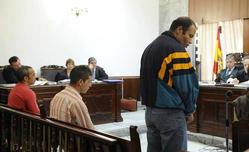
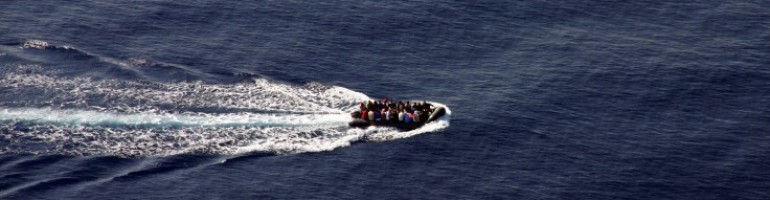
The trial of 3 Moroccan men (YF, MSB and BJ) accused of murder of 25 young African migrants began on 18 May in Gran Canaria before the Sixth Section of Audiencia Provincial de Las Palmas.  The migrants who died were all between the ages of 8 and 16.  The young migrants drowned when their boat sank 20 meters from the shore in Lanzarote, Canary Islands on 15 February 2009.  The boat had departed from Guelmin, Morocco on 13 February.  The migrants reportedly paid between 500 and 1000 euros to be transported to the Canary Islands.  The prosecution has asserted that the boat was designed for use as a small fishing boat close to shore and was not designed for travel on the open sea.  Six persons on the boat survived, several of them were rescued by a local surfer.

Click here, here, here, and here for articles (all ES).

Click here for video – Antena 3 Canarias televisión de difusión de noticias 17 May with video of rescue operation.

Leave a comment

Filed under Eastern Atlantic, Morocco, News, Spain

Details from Frontex General Report 2009 (Post 2 of 2)

Last week I posted a summary of the first part of Frontex’s 2009 General Report.  This second post summarizes the portion of the Report pertaining to Frontex’s sea operations.

The General Report 2009 provides selective information regarding the six major Joint Operations conducted at the sea borders.  With only one exception, no information or data is provided regarding the specific numbers of intercepted migrants or vessels.

Instead of numbers, the Report provides various descriptive terms which could mean almost anything.  For example, Operation Hera led to a “drastic decrease of migrants,” during Operation Nautilus there was a “remarkable decrease” in migrants, and during Operation Hermes, the numbers of migrants arriving and dying at sea “decreased dramatically.” The one exception is for Operation Indalo where the Report states that 750 irregular migrants and 10 facilitators were detected.

When desired, the Report provides details and numbers.  For example, Operation Poseidon utilized 4 open sea vessels, 6 coastal patrol vessels, 13 coastal patrol boats, six airplanes, 4 helicopters, and 152 experts who delivered 2680 man days of operational activities, but no data regarding the total number of irregular migrants intercepted at sea is provided.

Here is a summary of the information provided in the Report for each of the six major Joint Operations:

Poseidon 2009, Eastern Mediterranean (365 Days)

Poseidon was conducted along land borders as well as at sea.  Interpreters were deployed on board ships to facilitate the identification process of intercepted migrants.  Less than 10% of the interviewed migrants claimed their original nationality.  There was an overall reduction in migrant flow of 16% (land and sea) compared to 2008.  “The main operational objectives of the joint operation were achieved but there is a clear need for closer cooperation between local authorities.”

Hera 2009, Atlantic Ocean waters between North Western African countries and Canary Islands (365 Days)

Due to the permanent implementation of Joint Operation Hera and better cooperation from “involved African countries”, there was a notable reduction in migrants reaching the Canary Islands, 2280 in 2009 compared with 9200 in 2008.  Aerial and maritime surveillance conducted close to the territory of Senegal and Mauritania and local cooperation from police led to the decrease in migrants.  “Despite these clear successes, participation of more member States would greatly increase effectiveness and outcomes.”  [NF- While the Report does provide migrant arrival data for the Canary Islands, it is silent on the number of migrants intercepted at sea or within Senegal or Mauritania.]

Nautilus 2009, Central Mediterranean (172 Days)

There was a remarkable decrease in migrant arrivals in Malta.  A “significant obstacle to the effectiveness of the Joint Operation lay in the contrasting interpretations of the International Law of the Sea by Member States….”  The effectiveness of the operation compared with 2008 was not improved.

Hermes 2009, Central Mediterranean (184 Days)

“Due to the bilateral agreement between Italy and Libya, the number of people arriving from Libya, as well as the number of migrants died at sea, decreased dramatically….”  “In addition, the first examples of co-operation with Algeria should also be considered as promising.”  As with Nautilus, “differing interpretations of the International Law of the Sea led to a limited contribution by the Member States to the joint operation by maritime surface means.”  The effectiveness of the operation compared with 2008 can be considered as increased.

Minerva 2009, Western Mediterranean (39 Days)

The launch of the operation was delayed in 2009.  Its effectiveness compared with 2008 has remained the same.

Indalo 2009, Western Mediterranean (50 Days)

The lack of cooperation from Algeria is an obstacle for operational activities.  10 Facilitators and 750 irregular migrants were identified.

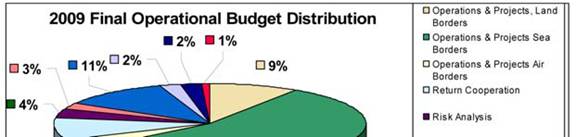
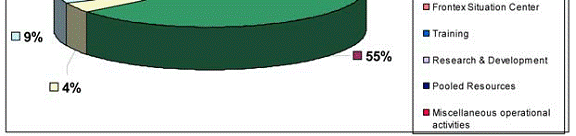
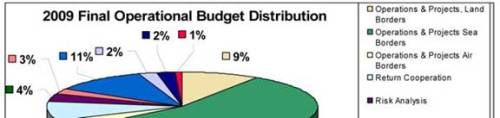
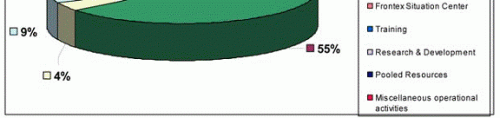
And as I noted in my earlier post, Frontex continued to devote the biggest single portion of its expenditures to maritime enforcement.  Almost 40% of Frontex’s total budget, over € 34 million, was spent on sea operations in 2009, constituting 55% of the operational budget.

This chart from the Report (p 23) shows the breakdown of expenditures within the 2009 Operational Budget (which was 71% of the total 2009 Frontex budget).
Click here for previous post.

Click here for the Frontex General Report 2009.
2 Comments

Filed under Aegean Sea, Algeria, Data / Stats, Eastern Atlantic, Frontex, Greece, Italy, Libya, Malta, Mauritania, Mediterranean, Reports, Senegal, Spain

Details from Frontex General Report 2009 (Post 1 of 2)

There is nothing really unexpected in the Frontex General Report for 2009.  If anything, it disappoints with its limited information.

The number of illegal border crossings at EU borders was smaller by a third in 2009 compared to 2008 and Frontex’s budget increased by 25% to € 88.3 million.

Frontex continued to devote the biggest single portion of its expenditures to maritime enforcement.  Almost 40% of Frontex’s total budget, over € 34 million, was spent on sea operations in 2009.  This constitutes 55% of the operational budget.  The Report notes that this cost is due to the high operating costs of ships and surveillance aircraft.

Expenditures for Frontex facilitated return operations sharply increased by 500% in 2009 to almost € 5.5 million.

Limited Information in the Report – The Report explains that Frontex made a decision in 2008 to decrease the level of detail provided in the General Report.  Frontex’s justification is that the Report “is mainly directed towards the general public” and the reduced level of detail “is more suited to this audience.”  This practice was unfortunately continued in the 2009 Report.

General Statistics – Overall there were 106,200 “detections of illegal border-crossings” at EU external land and sea borders in 2009.  This represents a 33% decrease in overall detected crossings relative to 2008, with a 23% reduction of detections at sea and a 43% reduction at land borders.

The reductions are attributed by Frontex to the economic crisis and to bilateral “collaboration agreements with third countries of departure” such as Libya, Senegal, and Mauritania.

Applications for international protection within the EU were 2% fewer in number than in 2008 and were approximately 50% of the 2001-2002 peak when 420,000 applications for international protection were filed.

Cooperation with Non-EU / Non-Schengen Countries – The Report states that cooperation with third countries, including neighbouring countries and countries of origin, is the critical element in “integrated border management.”   It describes Operation HERA as Frontex’s most successful joint operation due to close cooperation with West African countries, particularly Senegal and Mauritania.  On other fronts, “considerable progress” was made with Turkey consisting of Turkey’s appointment of a “first point of contact for Frontex related coordination issues” and preparation of a draft text of a possible Working Arrangement agreement.  “Ad hoc operational co-operation” was pursued when a targeted country was not willing or able to enter into a formal Working Arrangement with Frontex.  An “overriding priority” for Frontex in 2010 is the development of “structured operational co-operation with neighbouring Mediterranean countries.”  The Report acknowledges the existence of the bilateral migration agreement between Italy and Libya, but says nothing about its provisions other than to say that there were “contrasting interpretations of the International Law of the Sea” between Member States.  There is no criticism in the Report whatsoever of the Italian push-back practice.  It is obviously difficult for Frontex to criticise Italy, but was it not possible to note that most people and organizations who have considered the push-back practice have concluded that the practice violates international law?

New Partner Organisations – Frontex formalised a co-operation plan with Europol in October, a Working Arrangement with Interpol in May, a co-operation plan with IOM in February, and made a tripartite agreement with the European Maritime Safety Agency (EMSA) and the Community Fisheries Control Agency (CFCA) relating to maritime surveillance.

More to follow: I will post a second summary with additional information from the General Report pertaining to the specific sea operations for which information is provided within the next day or two.

Click here for the Report.

2 Comments

Filed under Aegean Sea, Data / Stats, Eastern Atlantic, European Union, Frontex, Greece, Italy, Libya, Malta, Mauritania, Mediterranean, Reports, Senegal, Spain, Turkey

Spanish Parliamentary Delegation Visits Senegal to Discuss Immigration

A Spanish parliamentary delegation from the Foreign Affairs Committee has completed an official visit to Senegal where they visited the Spanish-Frontex mission based in Dakar and met with Senegalese government officials.  The Spanish delegation included Josep Antoni Duran i Lleida, Chair of the Standing Committee on Foreign Affairs of the Congress of Deputies, and Jorge Moragas, coordinator of the Presidency and International Relations for the Partido Popular.

Duran i Lleida noted that no boat has succeeded in reaching the Canary Islands in recent months and that this is due to the Spanish presence in Senegal in the form of the National Police and Civil Guard.  The Spanish presence in Senegal along with support from Frontex carries out ongoing surveillance and patrols known as Operation Hera.

Duran i Lleida is quoted as saying that “Thanks to the work of the Spanish National Police and Civil Guard and collaboration with security forces, Senegal has managed to curb illegal immigration.”  He writes on his blog (in Catalan) that “for many years, Senegal is a country that has exported more illegal immigration. … Spanish authorities decided to negotiate with Senegal the conditions for ending illegal immigration. … Here in Dakar there is a unit of the Guardia Civil and [Spanish] police force with naval and air means that control, in collaboration with the Senegalese, the possible departures of illegal immigrants.”

Click here (ES), here (ES), and here (ES) for articles.

1 Comment

Filed under Eastern Atlantic, Frontex, News, Senegal, Spain

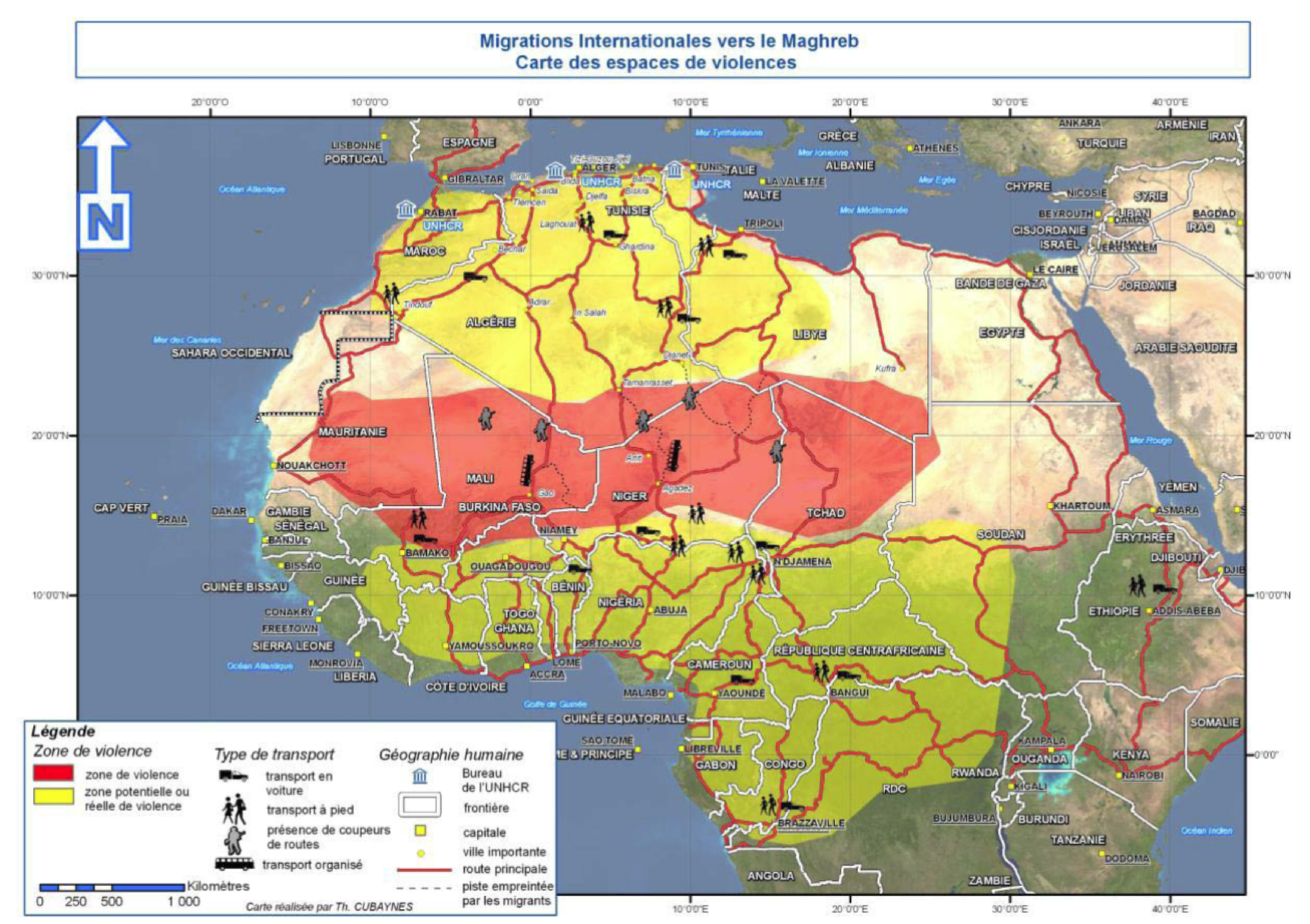
UNHCR Research Paper: Les violences faites aux femmes pendant leur voyage clandestin: Algérie, France, Espagne, Maroc

Un nouveau rapport du HCR (UNHCR Research Paper) par Smaïn Laacher a été publié: “Les violences faites aux femmes  pendant leur voyage clandestin: Algérie, France, Espagne, Maroc.”

Extraits:

“L‟objet de notre mission a porté sur les violences faites aux femmes migrantes pendant leur voyage clandestin. Les femmes qui constituent la population de notre étude sont des femmes qui ont quitté illégalement leur pays et ont voyagé jusqu‟au Maroc, en Algérie, en Espagne, et en France. *** Les violences subies par les femmes pendant leur voyage clandestine … , dont la plus destructrice est la violence sexuelle, visent principalement des êtres sans défense, c‟est-à-dire des femmes qui n‟ont pu ou qui ne peuvent pas être défendues, précisément parce qu‟elles n‟existent pour personne, si ce n‟est que pour elles-mêmes et pour leurs agresseurs. ***”

Cliquez ici pour télécharger le rapport.

Cliquez ici pour télécharger le rapport.

1 Comment

Filed under Algeria, France, Morocco, Reports, Spain, UNHCR

Thomas More Institute: Towards a Sustainable Security in the Maghreb – An Opportunity for the Region

The Thomas More Institute has released a report, “Towards a Sustainable Security in the Maghreb –  An Opportunity for the Region, a Commitment for the European Union.”  The report was released on 7 April at the “Maghreb and the European Union: Enhancing the partnership for a sustainable security” conference in Brussels.

From the Executive Summary:  “The relationship between Europe and the Maghreb is a complex, multidimensional and somewhat passionate one. The two areas share a common history and are bound by common interests. United against a number of joint challenges (economic development, regional stability, fight against terrorism, migration, sustainable development), it is time for the two shores of the Mediterranean to reconsider the basis for their cooperation. [***] The EU is well aware of what is at stake and must now look for ways of making a more active commitment in the region, particularly on sensitive issues such as human rights and migration. [***] The question of migration, which extends as far as the Sahelian area, is another area of cooperation which needs to be looked into in more depth, since the EU’s policy of limiting migratory flows can no longer be restricted to the northern border of the Maghreb. Reinforcing the role of the European agency FRONTEX throughout the area, for example by opening regional offices and assigning resources, is one possible solution. Intensifying efforts to coordinate development assistance policies between the EU and Maghreb countries to help Sub-Saharan African countries that represent sources of immigration is another solution that should not be ignored.”

A further excerpt: “A need for increased cooperation between the European Union and the Maghreb – Europe’s policy on migration is based on the principle that the great era of mass migrations is over, replaced by a new international division of labour, whereby a foreign workforce is substituted for the national workforce, and by policies that involve returning and rehabilitating non-Europeans in their countries of origin and internal mobility for Europeans within an area with no interior borders. European countries – and the Community, followed by the EU – concentrated their efforts on border control, in a securitarian view dictated by the migratory risk and concerns about the challenges of integration. Schengen relegated the countries of the Maghreb, and others, to the status of “outsider countries”, with which human circulation is restricted. This logic was maintained by the militarisation of borders which started in 1988 when barriers were built around the Spanish enclaves of Ceuta and Melilla, then as of 2002 by the installation of the Integrated System of External Vigilance (SIVE) around Gibraltar and later along the Spanish coasts – including the Canary isles – comprising twenty-five detection points, a dozen mobile radar and ten or so patrol units. The attacks perpetrated on September 11th reinforced the security component and, following the creation of FRONTEX (European Agency for the Management of Operational Cooperation at the External Borders) in 2005, other areas were militarised, with preventive sea and air patrols in the Mediterranean and even in the Atlantic, near the Canary isles. The EU also provides its members with technical assistance. [***] The Maghreb has made a real effort to contribute and cooperate with the EU in the fight against immigration.  In February 2004, Morocco and Spain started joint patrols and in 2008, cooperation was reinforced by improving controls in the ports of Tangier and Algeciras.  According to the Spanish authorities, the result was an overall drop of 60% in illegal immigration originating in Morocco between 2007 and 2008.  The decrease in illegal Moroccans was reportedly around 38%. However, reinforced controls caused a shift in migratory routes. According to the Italian Ministry of the Interior, the number of illegal immigrants arriving in Italy by sea rose by 75% between 2007 and 2008. 14 000 people arrived in Italy illegally in 2007, whereas the figure was in excess of 40 000 in 2008. Following the signature of the Benghazi treaty between Italy and Libya on 30th August 2008, Italy obtained greater assistance from Tripoli in the form of bilateral cooperation on illegal immigration and the application of the December 2007 agreement on joint patrols off the Libyan coasts, plus the installation of radars by Finmeccanica at Libya’s southern borders.”

Click here for full Report.

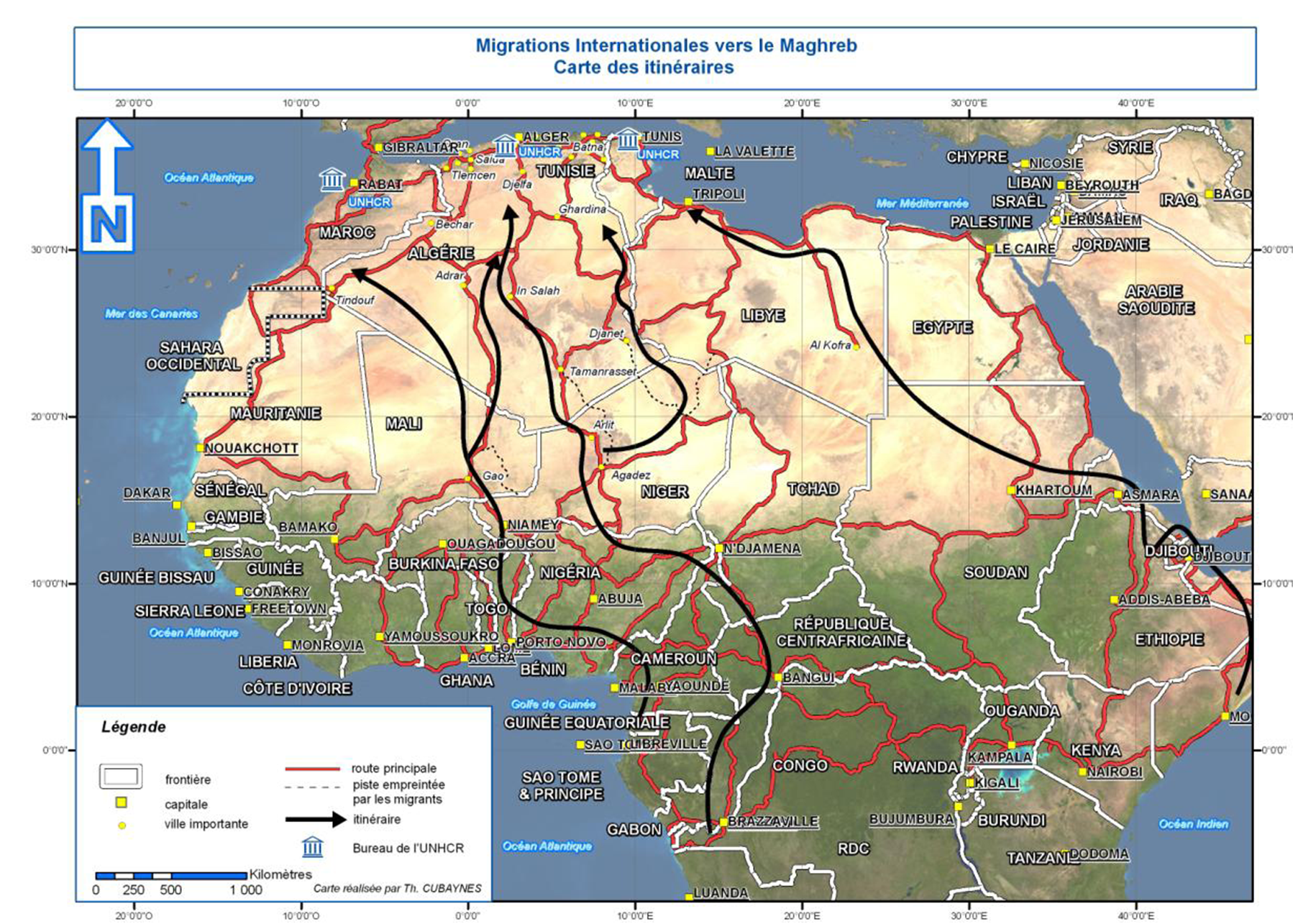
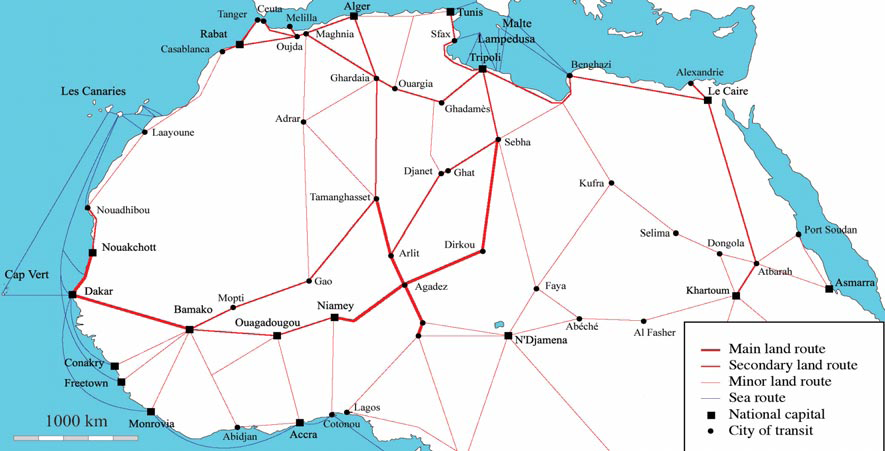
Main routes of present-day Trans-Saharan migrations

1 Comment

Filed under Algeria, Analysis, Data / Stats, Eastern Atlantic, European Union, Frontex, Italy, Libya, Malta, Mauritania, Mediterranean, Morocco, Spain

Spain Adds New SIVE Radar Stations

The Spanish Ministry of Interior is investing €3.8 million to expand the SIVE network in Valencia.  The two new SIVE radar stations are in addition to the four SIVE radar stations that operate on the Alicante coast in Cabo Roig, Santa Pola, Sierra Frost, and Denia.  According to ABC, the Ministry of Interior acknowledges that SIVE has numerous problems and that since its entry into operation last September in Alicante, SIVE has detected only four of the fifteen illegal boats discovered on the coast.

ABC also reports that despite the problems with SIVE on the Alicante coast, Frontex’s coming summer enforcement operation, Operation Indalo, will not extend to Alicante.  Operation Indalo, using patrol boats and helicopters from Spain, Portugal, France, Italy, Malta and Luxembourg, will be deployed along the Spanish coast from Granada to Murcia.

Click here (ES) for article.

1 Comment

Filed under France, Frontex, Libya, Luxembourg, Malta, Mediterranean, News, Portugal, Spain

Maroni: Italy’s Push-Back Agreement with Libya Has Resolved Italy’s Migrant Problem

Roberto Maroni, Italy’s Interior Minister, speaking to the Italian Parliament’s Schengen Committee, said that as a result of Italy’s 2009 push-back agreement with Italy, migratory flows have been mostly diverted to the west to Spain and to the east to Greece.  According to Maroni, to the extent that migrants are reaching Italy by sea, they are doing so by routes from Tunisia and other countries, but not from Libya.  Maroni said that “this resolves Italy’s problem, but not Europe’s problem.” [“Questo risolve i problemi dell’Itala, ma non dell’Europa.”]

According to Maroni there has been a 96% decrease in the arrival of irregular migrants in Italy over the first three months of 2010 compared with the same period last year: from 1 January to 4 April there have reportedly been 170 arrivals compared with 4,573 arrivals over the same period in 2009.

Maroni praised the push-back agreement by saying “We’ve had 28,000 fewer arrivals [since its May 2009 implementation] and we’ve saved countless lives. It’s an unprecedented and concrete achievement which is the result of Berlusconi’s diplomacy and the agreement he struck with Libya.”.

Click here (IT) and here (EN) for articles.

Leave a comment

Filed under Data / Stats, Greece, Italy, Libya, Mediterranean, News, Spain, Tunisia

8th Conference of the Foreign Ministers of the Western Mediterranean (“5+5”)

Foreign Ministers from the so-called “5+5” countries, France, Spain, Italy, Malta, Portugal, Morocco, Algeria, Libya, Mauritania, and Tunisia, are meeting this week in Tunis to discuss a variety of issues including migration, which will be discussed at the plenary session on 16 April.

Click here (FR) and here (FR) for articles.

Leave a comment

Filed under Algeria, France, Italy, Libya, Malta, Mauritania, Mediterranean, Morocco, News, Portugal, Spain, Tunisia

COE Committee of Ministers: “Europe’s boat people: mixed migration flows by sea into southern Europe”

The Council of Europe’s Committee of Ministers on 31 March adopted its Reply to COE Parliamentary Assembly Recommendation 1850 (2008) on“Europe’s boat people: mixed migration flows by sea into southern Europe.”

Comments from the COE European Committee for the Prevention of Torture and Inhuman or Degrading Treatment or Punishment are attached to the Rely as an Appendix.

The Reply contains an acknowledgement that the Committee of Ministers was not able to reach agreement on the recommendation that guidelines be prepared for minimum standards to be applied to the detention of irregular migrants:

“5. The Committee of Ministers has taken note of the proposal that guidelines be prepared for minimum standards to be applied to the detention of irregular migrants and asylum seekers. However, the Committee of Ministers has not, at the present time, reached a common position with regard to examining possibilities for Council of Europe action in this area. The Committee of Ministers underlines the importance of the relevant instruments of the Council of Europe, such as the European Convention on Human Rights and the recommendations adopted by the Committee of Ministers in this field (see paragraph 9 below), as well as those emerging from the work of the CPT and the Commissioner for Human Rights. It notes the ongoing work in the European Union in this field, including the revision under way of the 2003 directive laying down minimum standards for the reception of asylum seekers.”

Parliamentary Assembly Recommendation 1850 was issued in 2008 prior to the implementation in 2009 of Italy’s push-back practice and the Committee of Ministers’ Reply does not make explicit reference to Italy’s push-back policy.  The Recommendation and Reply are focused on the treatment of irregular migrants as they arrive on the shores of member states.

But there are several statements in the Reply which should apply implicitly to the irregular migrants whether encountered upon arrival on shore or intercepted or rescued in international waters.

For example:

“6. Particularly significant instruments in this field, also to be borne in mind in the framework of any possible activity in this area, include Committee of Ministers’ Recommendation No. R (98) 13 of 18 September 1998 on the right of rejected asylum seekers to an effective remedy against decisions on expulsion in the context of Article 3 of the European Convention on Human Rights, Recommendation No. R (98) 15 on the training of officials who first come into contact with asylum seekers, in particular at border points and Recommendation Rec(2003)5 on measures of detention of asylum seekers. The Committee of Ministers would also signal the “Twenty guidelines on forced return” adopted on 20 May 2005 and the Guidelines on human rights protection in the context of accelerated asylum procedures adopted on 1 July 2009.”

“7. The Committee of Ministers would also refer to other texts relevant in this area, such as its reply to Parliamentary Assembly Recommendation 1755 (2006) on “Human rights of irregular migrants” in which it draws attention to the minimum safeguards provided for in the European Convention on Human Rights that can be applied to irregular migrants. It also recalls its Recommendation No. R (2000) 3 to member states on the right to satisfaction of basic material needs of persons in situations of extreme hardship, which provides a minimum threshold of rights which should be recognised regardless of their status.”

“10. The Committee of Ministers would also draw attention to the extensive work of the Commissioner for Human Rights in this field and to his recommendations to member states and his appeals for solidarity within Europe with those countries that are on the frontline and facing a very difficult situation. It also refers to the regular exchanges of views that it holds with the Commissioner during the year. These exchanges are both of a general nature but also concern specific country reports in which he addresses, inter alia, the protection of human rights of immigrants and asylum seekers, including, where relevant, those arriving by sea. [***]”

Click here for the full Committee of Ministers Reply.

1 Comment

Filed under Aegean Sea, Commissioner for Human Rights, Committee of Ministers, Council of Europe, Eastern Atlantic, European Committee for the Prevention of Torture and Inhuman or Degrading Treatment or Punishment, Greece, Italy, Mediterranean, Spain, Statements

Analysis of the Real Instituto Elcano- Frontex: Successful Blame Shifting of the Member States?

Analysis of the Real Instituto Elcano: “Frontex: Successful Blame Shifting of the Member States?” by Jorrit J. Rijpma, PhD European University Institute, Florence, and Lecturer in EU law, Europa Instituut, Leiden University.

Excerpts:

“Frontex in Short – Frontex can be seen as the outcome of a ‘re-balancing’ of powers between the Member States, the Council and the Commission following the communitarisation of the policy on external borders after the Treaty of Amsterdam, constituting an important shift from the intergovernmental coordination of operational activity under the Council to a more Community-based approach. [***]

Joint Operations at Sea – [***] Currently, the most controversial practice is that of the diversion by national border guards of ships back to their point of departure. This practice entails not only a real risk to the life and safety of the passengers on board these often unseaworthy ships, but as regards possible asylum seekers on board, it also risks violating the right to claim asylum and the prohibition of refoulement. The Greek coast guard has the questionable reputation of regularly diverting boats back to the Turkish shores. Italy has openly admitted to the interception and return of irregular migrants and asylum seekers from Libya under its 2008 Treaty on Friendship, Partnership and Cooperation with the latter country. Both within and outside the Hera operations, Spain has been returning people to Senegal and Mauritania, but here at least the interceptions are formally cast in terms of rescue operations and transfer to the nearest place of safety.

Frontex: the Lesser Evil?- There are many reasons why Frontex can be subject to criticism. It could be argued that it is an instrument of an essentially flawed EU migration and asylum policy. [***] Finally, it could be said that the Agency reinforces a securitised perception of what is essentially a humanitarian problem through its one-sided mandate, the background of most of its staff in national law-enforcement agencies and its military-style operations. [***] However, it is important to realise that for the moment the Agency’s scope for independent action remains very limited, both in practical and in legal terms. Serious human-rights violations are more likely to occur in operations from national border guards removed from the public eye, than in relatively well-scrutinised joint operations. Frontex, being a Community body, is subject to numerous reporting and evaluation duties, as well rules on transparency. [***]

Conclusion: Efforts should focus on ensuring full respect of international rules regarding international protection and search and rescue and an authoritative interpretation of these rules in a broad sense. These are essentially political decisions. It is the Member States and the Community institutions, not Frontex, that are to be reproached for the failure to do so. [***]”

Click here for full Analysis.

Leave a comment

Filed under Aegean Sea, Analysis, Eastern Atlantic, European Union, Frontex, Greece, Italy, Libya, Malta, Mauritania, Mediterranean, Senegal, Spain, Turkey

Frontex Operation Indalo 2010

Operation Indalo, which focuses on the interception of migrants travelling from North Africa, primarily Algeria, to Spain, will take place from June to September this year and will focus primarily on migrant arrivals on the coasts of the Spanish provinces of Murcia and Almeria.

Last year’s Operation Indalo took place in September and October, used assets from Spain, Italy, France, Belgium, Germany and Portugal, and resulted in the detention of approximately 500 migrants.

Click here for article (ES).

Leave a comment

Filed under Algeria, Frontex, Mediterranean, News, Spain

Público: La llegada de inmigrantes en cayucos a España ha caído hasta mínimos históricos

«La llegada de inmigrantes en cayucos o pateras a España ha caído en los últimos meses hasta mínimos históricos. Entre enero y febrero de este año hubo sólo 126 detenciones, por 1.432 en el mismo periodo de 2009, lo que supone un 91,2% menos. Es el arranque de año con menor migración marítima desde que el Ministerio del Interior empezó a contabilizar losdesembarcos, en 1999. »

[“The arrival of immigrants in cayucos or pateras in Spain has fallen in recent months to historic lows. Between January and February of this year there were only 126 arrests compared with 1,432 during the same period in 2009, representing a 91.2% reduction.  These are the smallest numbers of beginning of year arrivals since the Interior Ministry began tracking arrivals in 1999.”]

Click here for article.

Leave a comment

Filed under Data / Stats, Eastern Atlantic, Mediterranean, News, Spain

First Meeting of EU Committee on Operational Cooperation on Internal Security – COSI

The Standing Committee on Operational Cooperation on Internal Security was established by the EU Council pursuant to Council decisions of 27 November 2009 (16515/09) and 5 February 2010 (5949/10) based on the guidelines established by the Treaty of Lisbon. Its stated objective is “to strengthen the co-ordination of the operational actions between EU Member States in relation to internal security.”

COSI met for the first time on 11 March in Brussels.  The Spanish EU Presidency’s web site states: “The Spanish Director General of the Police and Civil Guard, Francisco Javier Velázquez, chaired the first meeting of … COSI …which began the process of designing a joint strategy to deal with global threats. The meeting was attended by directors of police and heads of security forces in Europe, who examined joint measures for tackling terrorism, human trafficking, drug trafficking and cyber crime. …”

“In relation to drug trafficking, [COSI is] studying proposals from Member States, such as a French operational project to deal with trafficking from Africa, or the possibility of creating EU platforms in affected African countries.”

“Other tasks entrusted to COSI include co-ordinating the action of European agencies with responsibilities in areas of justice and home affairs, such as EUROPOL, EUROJUST, FRONTEX and CEPOL. It must also ensure that none of their activities overlap and that there is a real focus on their requirements.”

Click here for article posted on Spanish EU Presidency’s site.

Click here for article.

Leave a comment

Filed under European Union, Frontex, News, Spain

EU Conference on Space and Security

One of the decisions taken at last month’s meeting of the Council of Justice and Home Affairs (JHA) was a decision concerning EUROSUR (the European Surveillance System)  and GMES (Global Monitoring for Environment and Security) where the Council agreed “[…] To invite the Commission to report before the end of 2010 on how the conclusions of the Global Monitoring for Environment and Security (GMES) border surveillance group on common application of surveillance tools, such as satellites, could be implemented in the EU land and sea borders”.

On 10 and 11 March the Spanish EU Presidency is sponsoring a Conference on Space and Security in Madrid.  “The Conference seeks to facilitate a structured dialogue amongst all actors involved in Security-related Space matters embedded in two main programmes: GMES and SSA…. The aim is to build upon the status of discussions on these two programmes in Space Council Resolutions, in GMES Communications from the European Commission and in GMES-related Conferences of previous EU Presidencies (Graz, Munich, Lisbon, Portoroz, Lille, Prague and Stockholm).”

As noted in a Draft Input Paper posted on the Conference web site, one of the topics under discussion is a focus on the security aspects of space monitoring:  “[S]ince its inception, the security element of GMES focused on environmental applications and, to a much lesser extent, civilian security applications. Reflecting on current political dynamics, GMES stakeholders are now taking initiatives to strengthen the ‘S’ in GMES by creating synergies between civilian and military actors.”

“The 2008 EU Council Conclusions on GMES call on the Commission to foster the implementation of GMES security related services to support the related European Union policies. (Council Conclusions on Global Monitoring for Environment and Security (GMES): “Towards a GMES programme”, 16722/08 of 2 December 2008.)  Border surveillance, maritime surveillance and support to EU External Action have been identified as priority areas for action.”

Click here for the draft EC/ESA Joint Secretariat Input Paper on Space and Security, Feb. 2010.

Click here for ESA GMES page.

Leave a comment

Filed under Colloques / Conferences, European Union, Frontex, News, Spain