Malmström Meets With Libyan Foreign Minister

Commissioner Cecilia Malmström met with Libyan Foreign Minister Moussa Koussa on 13 July.  I cannot find any reference to the meeting on Commissioner Malmström’s official web site, but she mentions the meeting on her personal blog (written in Swedish).   She writes simply that she met with the FM and that “Libya is a complex but important neighbour and we have a lot to talk about – not least, migration and asylum and human rights.  The meeting was a first opportunity to talk.” (translation using Google translate.)

According to an article in Il Manifesto (and reposted on the Diritti Globali web site where I first read / Google-translated it), the ongoing EU-Libya partnership accord talks and the immigration aspects of the accord were discussed in the meeting between the Libyan FM and Malmström.

Also apparently discussed at the meeting was Libya’s decision to release up to 3000 detained migrants from several detention centres, including the Eritreans who were likely detained by Libya after being interdicted at sea and subjected to Italy’s push-back practice.

From the Il Manifesto article:

Quanto alle responsabilità italiane nella vicenda, legate in particolare al fatto che 103 dei 205 detenuti di Braq sono stati respinti in mare dalle navi italiane, la Commissione Ue continua a mantenere un profilo alquanto basso. Ieri Stefano Manservisi, Direttore generale della DG interni della Commissione Ue, intervenendo al dibattito in Parlamento sugli eritrei, ha affermato che «non abbiamo informazioni su dove sono state intercettate queste persone, non si può dire che Malta doveva fare o l’Italia doveva fare, si sa che ora sono in Libia e dobbiamo verificare in che condizioni si trovano». .[…]

Per ora il silenzio, che dura da un anno sui respingimenti, e poche parole anche sul Trattato di partenariato, amicizia e cooperazione tra Italia-Libia, che ha di fatto dato il via libera a questa nuova politica. «Riguardo agli accordi bilaterali, a titolo personale – ha affermato ancora il numero 2 della Malmström – considero migliore un accordo europeo a uno bilaterale, ma ci vuole chiarezza, questo accordo ha pure dimostrato la propria efficacia, è un dato di fatto che il flusso di immigrati si è bloccato».  E ancora: «Ci è stato notificato un accordo in linea con la normativa Ue, anche se c’è una componente segreta che non conosciamo». Pur con questa dosi di oscurità, per la Commissione il futuro dell’intesa tra Bruxelles e Tripoli dovrebbe ricalcare una buona parte dell’ accordo tra Berlusconi e Gheddafi: «Dobbiamo fare modo che ciò che è coperto da accordi bilaterali possa diventare base accordo più amplio», ha concluso Manservisi.

Per procedere nei contatti, lo stesso Direttore generale si recherà in Libia prima dell’autunno, quindi toccherà alla commissaria Malmström in ottobre, il tutto in vista della stesura di un accordo generale che parli di immigrazione, ma anche controllo delle frontiere, visti e relazioni economiche. Altro appuntamento chiave il vertice Ue-Unione africana del 29 e 30 novembre a Sirte.

Click here (SV) for the Commissioner’s personal blog post.

Click here (IT) for full Il Manifesto article.

Leave a comment

Filed under European Union, Italy, Libya, Mediterranean, News

Frontex 2010 1st Quarter Report: Irregular Migration at Sea Borders Less Than 10% of Peak Levels

Frontex has released information from its 2010 First Quarter report by the Frontex Risk Analysis Network (FRAN).  A copy of the report itself has apparently not been released.  According to the summary provided, there have been significant reductions in irregular migration:

  • “[D]etections of irregular immigrants at [all EU] sea borders … were less than one-tenth of the peak level (for the third quarter of 2008) when roughly 33,600 detections were reported.”
  • “[D]etections at the Spanish and Italian sea borders became negligible…”
  • “[D]etections at the dominant Eastern Aegean Sea border between Greece and Turkey also fell by more than 60% to just under 2,300.”
  • “Detections at the Greek-Turkish land border were for the first time greater than those at the countries’ sea border.”
  • There were “only 150 detections of illegal border-crossing [in the Central Mediterranean], compared to 5,200 detections in the first quarter of 2009…”
  • There were “only 500 irregular immigrants detected [in the Western Mediterranean] (almost 72% down on the fourth quarter of 2009 …).”
  • There were “only five detections over the first three months of 2010 [on the West African/Canary Island route], in contrast to 31,700 detections in 2006…”

Click here for full statement.

Leave a comment

Filed under Aegean Sea, Algeria, Analysis, Data / Stats, Eastern Atlantic, European Union, Frontex, Greece, Italy, Libya, Malta, Mauritania, Mediterranean, Morocco, News, Reports, Senegal, Spain, Turkey

Frontex 2010 Annual Risk Analysis

Frontex’s Annual Risk Analysis (ARA) for 2010 was prepared in March 2010 and was posted to the Frontex web site on 7 July.  The public document only contains certain portions of the full ARA as recommendations and other “operationally sensitive details” have been redacted. While some of the ARA’s contents have previously been released by Frontex, this 35 page document contains a lot of data regarding irregular migration by land, sea, and air, and is worth a read.

Excerpts from the ARA relating to maritime migration include:

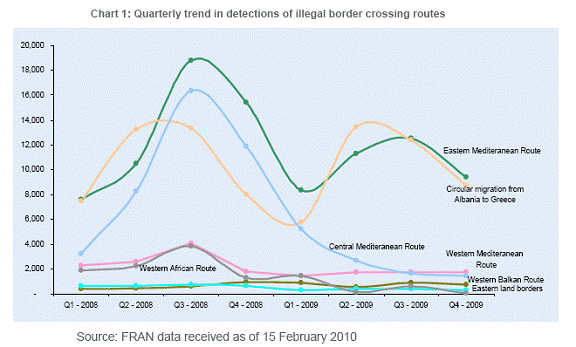
“Detections of illegal border crossing – In 2009, the [EU] Member States and Schengen Associated Countries reported a total of 106,200 detections of illegal border crossings at the sea and land borders of the EU. This represented a 33% decrease compared to 2008. The decrease is comprised of both a strong decrease reported from the sea borders (-23%), and land borders (-43%).”

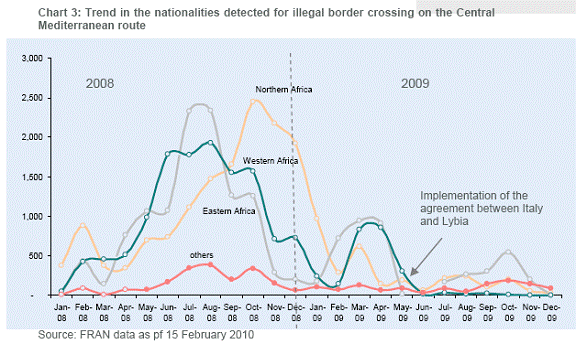
“The bilateral collaboration agreements with third countries of departure on the Central Mediterranean route (Italy with Libya) and the Western African route (which Spain signed with Senegal and Mauritania) had an impact on reducing departures of illegal migrants from Africa.”

“The agreements were made at a time when the economic crisis decreased the labour demand in the EU, thus simultaneously reducing the pull factor. The synchronisation of these events probably explains why no displacement has so far been noticed from the Central Mediterranean and Western African routes to other illegal migration routes in the statistics for detections.”

“However, intelligence suggests that the risk of displacement remains high, either with the emergence of new routes or the exploitation of existing ones by nationalities which used to be detected along the Central Mediterranean or the Western African routes.”

“As a corollary to the sharp decreases registered in Italy and Spain, the number of detections of illegal border crossing in Greece rose from 50% of the total EU detections to 75% of the total. In 2009, the Greek land border sections with Albania and FYROM represented the largest share of the EU total, with 36,600 detections (34% of the EU total), followed by 22,000 detections in the Aegean Sea with (21% of the EU total).”

“Eastern Mediterranean route – The Eastern Mediterranean route is the route taken by illegal migrants transiting through Turkey and entering the EU through eastern Greece, southern Bulgaria or Cyprus. Turkey, due to its geographical position near the EU, is the main nexus point on this route. From Istanbul, illegal migrants may reach the Greek islands in the Aegean Sea, or cross the land borders to Greece or to Bulgaria.”

“In 2009, illegal border crossing on the Eastern Mediterranean route totalled 41,500, or 39% of all EU detections. Most of the detections were reported from the Aegean Sea, followed by detections along the land border between Turkey and Greece. The number of detections reported by Bulgaria and Cyprus were considerably lower.”

“Central Mediterranean route – The Central Mediterranean route refers to illegal migration from northern Africa to Italy and to Malta. For the past two years, Libya has been a nexus point where migrants from the Horn of Africa and Western African routes and a small proportion of Asian nationals met before embarking.”

“Since the signing of a bilateral agreement with Libya, joint patrols by Libya and Italy have had a clear and measurable deterrent effect, with 3,200 detections in the seven months after the joint patrols (June to December), compared to 7,200 detections in the five months before the joint patrols (January to May), and almost 40,000 detections in the whole of 2008.”

“Western African route – The Western African route is primarily through Western African countries to Spain via the Canary Islands. The main embarkation points are in Senegal and Mauritania and the main countries of origin are Mali, Mauritania, Guinea Conakry and Senegal. Other African nationals have also been reported, and occasionally migrants from Asia. This route is now less favoured since the Spanish collaboration agreements with Senegal and Mauritania. The Frontex coordinated Joint Operation Hera plays a major role in maintaining effective surveillance in the area.”

“The Western Mediterranean route includes the sea route from Northern Africa to the Iberian Peninsula, and the land route through Ceuta and Melilla. It is mostly used by Northern African nationals (Algerian and Moroccan) travelling to Spain, France and Italy.”

“Maritime detections between Northern Africa and Spain are rising, with increasing detections of Algerian and to a lesser extent Sub Saharan nationals. Moroccan nationals are also regularly detected on this route. The lack of employment opportunities for the growing population of young people in Morocco continues to increase the incentives of migrating to the EU. The Spanish authorities recently reported an increasing number of attempts by Moroccan minors to get on the ferry link between Tanger and Spain. These cases do not seem connected with criminal networks; rather individual attempts are driven by poor employment prospects in Morocco.”

Click here for the ARA.

Click here for link to Frontex Map showing situation at External Borders.

[ARA page 18]

[ARA page 13]

1 Comment

Filed under Aegean Sea, Data / Stats, Eastern Atlantic, European Union, Frontex, Greece, Italy, Libya, Malta, Mauritania, Mediterranean, Morocco, Reports, Senegal, Spain, Turkey

UNODC Publication: Smuggling of Migrants into, through and from North Africa

UNODC has issued a new publication entitled “Smuggling of Migrants into, through and from North Africa: A thematic review and annotated bibliography of recent publications.”  Most of the reviewed literature and data are from 2008 and earlier dates and therefore the publication does not include references to more recent events, e.g. the Italy-Libya migration agreement.  But it is a comprehensive and useful publication.  The 16 page Annotated Bibliography is a very good resource.

According to the UNODC web site, the publication “focuses primarily on the patterns and dynamics of migrant smuggling, as it concerns the North African region. Recognizing, however, that irregular migration and smuggling flows are transnational in nature, the review goes beyond North Africa, to also cover sub- Saharan African and European countries affected along the various smuggling routes.  The aim of the review is twofold: to describe major findings on smuggling of migrants; into, through and from North Africa, and to highlight the need for further research on specific issues that have not yet been studied.”

Table of Contents:

  • I. Introduction
  • II. Quantifying irregular migration and smuggling of migrants
  • III. Migrant smuggling routes
  • IV. Profiles and characteristics of smuggled migrants
  • V. Smuggler-migrant relationships
  • VI. Organizational structures of migrant-smuggling networks
  • VII. Modus operandi of migrant smuggling
  • VIII. Smuggling fees
  • IX. The human and social costs of smuggling
  • X. Summary of findings
  • XI. Annotated bibliography

Click here for the publication.

Leave a comment

Filed under Aegean Sea, Algeria, Analysis, Data / Stats, Eastern Atlantic, Egypt, France, Greece, Italy, Libya, Malta, Mauritania, Mediterranean, Morocco, Reports, Senegal, Spain, Tunisia, Turkey, UNODC

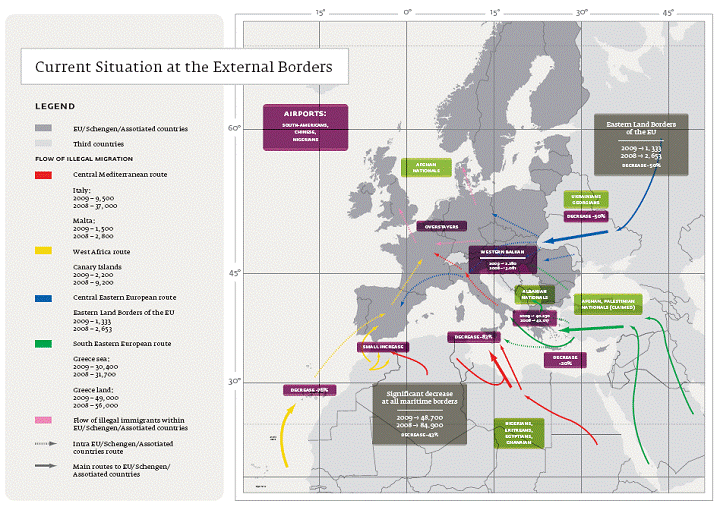
Frontex Map: 2009 Situation at External Borders

Frontex posted this map to its web site earlier this week.  The map “describes the … situation [as of the end of 2009] at the external borders of the EU, including the main entry routes of irregular migration into the European Union: West African route, via Canary islands, Central Mediterranean, including Italy and Malta, South Eastern European route (including Greek land and sea borders) as well as the Eastern land borders.”

Click here for link to the map.

1 Comment

Filed under Data / Stats, European Union, Frontex, News

Italy and Malta Question Need for Frontex Sea Patrols

Italy and Malta held a one day summit yesterday that focused on “Strategic Mediterranean” themes.  The two countries are calling for a reassessment of Frontex’s role in the Mediterranean, suggesting that Frontex may be best suited for repatriation operations and not for sea patrols.  Maltese Foreign Minister Tonio Borg said that even Italy questioned the need for ongoing Frontex missions fearing that such missions might upset the Italy-Libya migration agreement which has almost eliminated irregular migration from Libya.  A statement issued by the Italian Foreign Ministry described the Italy-Libya migration agreement as a model that is “exemplary for extension to other African countries.”

Malta also reaffirmed that it would not reconsider its decision not to host Frontex missions unless the Frontex rule addressing where intercepted migrants are to be taken is changed.

Click here and here for articles.

Click here for Italian Foreign Ministry statement.

1 Comment

Filed under Frontex, Italy, Libya, Malta, Mediterranean, News

Libya Confirms It Is Detaining “Pushed Back” Eritreans

Reuters reported that the Libyan Foreign Ministry confirmed there are approximately 400 Eritreans being held in detention centres in Libya and that 245 of these Eritreans were turned over to Libyan authorities after being intercepted at sea by Italian authorities.   Italian officials have previously questioned whether any of the Eritreans in question had been subjected to the Italian push-back practice.

Click here for article.

Leave a comment

Filed under Italy, Libya, Mediterranean, News

Libya May Allow Eritreans to Remain – Italy Claims Credit for Decision

Libya has reportedly agreed to allow approximately 400 Eritreans to remain in Libya, though they will not be given refugee protection as Libya is not a signatory to the Refugee Convention.

ANSAmed reported that Italian officials have claimed credit for Libya’s decision, though the Italians have questioned whether any of the Eritreans have been mistreated and whether any of the Eritreans were subjected to Italy’s push-back practice.  Italian Foreign Ministry Undersecretary Stefania Craxi stated that ”the Italian government never backed away from raising awareness with[] Libyan authorities on the topic of human rights.”  Craxi said ”it is thanks to the Italian government [that] the UNHCR activities in Tripoli have started again, albeit in an informal and conditioned way.”  Foreign Minister Franco Frattini said ”it is unbelievable that Brussels did not even make a press release.  [Italy] worked in silence, without proclamations, sadly with the total and absolute absence of Europe. We asked for a compromise, a mediation and the result came.”

While it is good if the Italian Government did indeed work to arrive at a temporary and imperfect solution for this particular group of Eritreans and it is good that the Italian ministers speak of respecting human rights in Libya, the Italians should be equally if not more concerned with the human rights implications of their push-back practice in the Mediterranean.

Click here for article.

Leave a comment

Filed under European Union, Italy, Libya, Mediterranean, News, UNHCR

ECRE and CIR: Ill-treatment of Refugees in Libya: the EU, a Silent Accomplice

ECRE and CIR released a statement on 7 July criticising Italy and the EU in regard to the plight of over 200 Eritrean refugees, some of whom may have been subject to Italy’s push-back practice and who are now detained under dangerous conditions in Libya.

The two organisations “call upon all authorities involved to ensure that refugees are not repatriated to Eritrea where they are at risk of torture and ill- treatment. … ‘We strongly repeat our plea to the Italian Government to resettle the refugees to Italy’, says Christopher Hein, Director of the Italian Council for Refugees (CIR). ‘Some of those who are being mistreated now by the Libyan authorities have been pushed back there by Italy one year ago. Refugees are suffering the consequences of Italy’s violation of its legal obligations and EU Member States’ consenting silence’, added Bjarte Vandvik, ECRE’s Secretary General.”

Click here for the full statement.

Leave a comment

Filed under European Union, Italy, Libya, Mediterranean, Statements

Hammarberg Makes Urgent Request of Italy for Information on Eritreans in Libya

COE Human Rights Commissioner Thomas Hammarberg has made an urgent request to the Italian Government for information on alleged human rights violations of Eritrean migrants in Libya, including Eritreans who may have been among persons intercepted at sea by Italy and forcibly returned to Libya without being afforded an opportunity to seek international protection.

In a letter to the Italian Foreign Minister, Commissioner Hammarberg wrote “[g]iven the recent decision of the Libyan authorities to discontinue UNHCR’s activities in the country, it is increasingly difficult to confirm the exact accuracy of these reports. However, given their consistency and the seriousness of the allegations, I hope that I can count on your cooperation to urgently clarify the situation with the Libyan authorities and be kept informed about the results of your investigations.”

The Foreign Minister and Interior Minister have written a joint letter to the Il Foglio newspaper where they say that the Italian Government “was mediating with Tripoli to identify the Eritreans and try to find them employment in Libya so that they would not be forcibly repatriated.”  According to Reuters, the ministers also said “it was necessary to respect Libyan sovereignty and [they] called for an international approach, involving the United Nations and other organizations” and that the “fate of these Eritrean citizens cannot be resolved only through our bilateral relationship (with Libya).”

Click here for the Commissioner’s letter to the Italian Foreign Minister.

Click here for the Commissioner’s letter to the Italian Interior Minister.

Click here for article.

Click here (IT) for Italian Ministers’ Reply to Il Foglio.

Leave a comment

Filed under Commissioner for Human Rights, Italy, Libya, Mediterranean, News, UNHCR

EP Refers Frontex Sea Borders Rule to ECJ

On 23 June the JURI committee (Committee on Legal Affairs) voted in camera to refer the question of the validity of the Frontex rule regarding the surveillance of the sea external borders to the European Court of Justice (Council Decision 2010/252/EU (“Frontex / Sea borders”)).  The referral requests the Court “to preserve the effects of the measure until a new legislative act has been adopted.”

Maltese MEP Simon Busuttil, the EPP Coordinator in the Civil Liberties Committee, was quoted as saying: “we have given notice to the Commission that not all is fine with these Frontex guidelines and it is time for a rethink. We want to ensure that Parliament’s role is defended and that we can have our say. We want these rules to be fair. In their current version they are not.”

Both the LIBE and JURI committees believe that the European Commission exceeded its power when it presented the new Frontex rule under the comitology procedure as opposed to using the ordinary legislative procedure which would have given the Parliament the ability to amend the rule.  Malta has strongly objected to provisions within the rule.  Malta has said that its decision not to host Frontex’s Central Mediterranean enforcement operation this year, Operation Chronos, was due to the disembarkation provisions contained in the new Frontex rule.  Malta believes that the rule would require intercepted migrants to be taken to Malta.

Click here for article.

Click here for statement on MEP Simon Busuttil’s web site.

Click here for EPP Group press release.

Click here and here for earlier posts.

4 Comments

Filed under European Union, Frontex, Judicial, Malta, Mediterranean, News

Libya to Permit UNHCR to Resume Limited Activities

The UNHCR announced on Friday that it has received permission to resume some activities in Libya.  The UNHCR said that “its operations will be restricted to only its current caseload” in Libya.

Libyan officials have offered several reasons for why the Libyan government ordered UNHCR to cease operations several weeks ago, including complaints that UNHCR entered into cooperation agreements with local NGOs within Libya without authorisation, rented office space without permission, displayed the UNHCR logo improperly, and, most recently, that one or more persons associated with UNHCR accepted bribes and/or sexual favours from persons in exchange for refugee status.

“UNHCR spokesperson Adrian Edwards stressed that the Libyan allegations remain unsubstantiated. He told journalists in Geneva that talks on the agency’s future in the country will resume shortly and that the expulsion order has not yet been formally lifted. ‘UNHCR does take very seriously any accusation against any UNHCR staff member from whatever source,’ he said. ‘We have a zero tolerance policy for misconduct. We have asked the Libyan Government to substantiate these particular claims. If and when we receive these indications, we will be in a position to investigate through our normal procedures.’”

Click here for UN statement.

Click here, here, here (EN) and here (AR) for articles.

Leave a comment

Filed under Libya, Mediterranean, News, UNHCR

Updated CARIM Overview of Migration Developments in Libya

CARIM just issued a short paper, Libya: The Migration Scene – Which implications for migrants and refugees?: “In the light of UNHCR’s announcement of the 8th of June 2010 that it was requested to close its offices in Libya, CARIM provides an overview of migration developments in Libya from sociopolitical, legal and demographic-economic perspectives.”

Click here for the document.

Leave a comment

Filed under Analysis, European Union, Libya, Mediterranean, UNHCR

Amnesty Int’l Report on Libya Criticises Libya and EU on Refugee Treatment

Amnesty International has released a comprehensive report on Libya entitled “Libya of Tomorrow – What Hope for Human Rights?”  The report covers a range of matters including the criminal justice system and the use of the death penalty.   Section 5 of the report (beginning at p 91) addresses the rights of refugees, asylum-seekers and migrants.  The report was finalised before the recent decision of the Libyan government to close the UNHCR office in Tripoli.

In regard to refugee issues, Amnesty is very critical of both Libya and the EU and calls upon EU member states to “ensure that any bilateral agreements with Libya in the area of migration and asylum, including the EU-Libya Framework Agreement currently being negotiated, are based on full respect for the rights of asylum-seekers, refugees and migrants.”

Excerpts from Section 5, “Rights of refugees, asylum-seekers and migrants”:

Members of the EU have been actively seeking the collaboration of Libya in controlling the flow of migrants to European shores – turning a blind eye to Libya’s dire human rights record, the absence of a functioning asylum system in Libya, and persistent reports of the abuse and ill-treatment of refugees, asylum-seekers and migrants.  The Treaty of Friendship, Partnership and Co-operation signed in August 2008 between Italy and Libya includes provisions for bilateral efforts to combat “illegal migration”, facilitated by the joint patrolling of the sea agreed upon in December 2007 in the “Protocol” and the “Additional Technical-Operational” Protocol”.

As part of the agreements, Italy promised to compensate Libya for its occupation of the country between 1911 and 1943. The Treaty of Friendship, Partnership and Co-operation involves a US$5bn package for construction projects, [and other items].  In return, Libya agreed, among other things, to tighten control of its territorial waters and accept disembarkation on its soil of individuals intercepted at sea by Italian vessels. Italy was also reported to have undertaken to provide resources, including technology, to control migrant flows through the southern borders of Libya. In fact, Italy has provided Libya with six motor patrol boats since the Treaty entered into force.

In the framework of these agreements, from May 2009 onwards Italy started returning refugees, asylum-seekers and migrants intercepted in international waters to Libya. On 6 May 2009, distress calls were sent from three vessels with an estimated 230 third-country nationals on board. Italian coastguard vessels intervened but transported the individuals to Tripoli, without stopping in an Italian port and without checking whether any individuals on board were in need of international protection or basic humanitarian assistance. Further interceptions and returns occurred in the subsequent months: according to official information from the Italian Ambassador to Libya, between 6 May and 3 September 2009, over 1,000 individuals were returned to Libya. They included nationals from Eritrea, Somalia and other sub-Saharan African countries. The Italian Minister of the Interior Roberto Maroni was reported to have called this action “an historic achievement after one year of bilateral negotiations with Libya”….

Despite these pleas by UNHCR and consistent reports of abuses suffered by refugees, asylum-seekers and migrants in Libya, the Italian authorities continue to intercept vessels at sea and send them back to other countries most notably Libya.  In January 2010, Italian Minister of the Interior Roberto Maroni stated that the number of migrants arriving to Italian shores was reduced by 74 per cent in 2009 compared to 2008, attributing the reduction to Italy’s bilateral agreements with Libya.

Italy is not alone in seeking Libya’s cooperation to control the flow of migrants to European shores. Negotiations between Libya and the EU over a Framework Agreement started in November 2008 covering the control of migration, among other issues, including potential readmission agreements for third-country nationals who have transited through Libya on their way to Europe….

UNHCR [prior to its recent expulsion from Libya] and its partners have also been involved in screening individuals pushed back to Libya from Italy. UNHCR declared that by October 2009, it had been able to screen 890 people and had registered 206 of them as refugees and secured their release from detention.  UNCHR also registered 80 individuals pushed back from Italy in November 2009, granting 40 of them refugee status. The remainder were awaiting their interviews for refugee status determination at the time of writing. UNHCR confirmed that a total of 685 individuals determined to be refugees or asylum-seekers were released from detention from 2008 to February 2010, including 450 Eritreans and 150 Somalis…..

Click here for the Report.

Click here for AI Press Release regarding the Report.

Leave a comment

Filed under European Union, Italy, Libya, Mediterranean, Reports, UNHCR

EU and ACP Fail to Reach Agreement on Migration in Revised Cotonou Agreement

Representatives of the EU and ACP (Africa, Caribbean, and Pacific group of states) signed the second revision to the Cotonou Agreement in Ouagadougou on 22 June.  The Agreement provides the basic framework for relations between the EU and ACP states.  The parties failed to reach agreement on revisions to Article 13, the migration provision.

The EU has been pressuring the ACP states to agree to changes in the Cotonou Agreement which would make it easier for EU member states to return illegal or irregular migrants from the EU to their home countries.  ACP states resisted incorporating such a provision in the Agreement, instead wanting to deal with readmission issues on a bi-lateral basis.

As a result of this ongoing disagreement, Article 13 of the Agreement will remain unchanged for the time being.  The EU and ACP instead agreed on a Joint Declaration (Declaration III) which was signed yesterday in conjunction with the revised Cotonou Agreement.  It reads as follows:

“JOINT DECLARATION ON MIGRATION AND DEVELOPMENT (ARTICLE 13)

The Parties agree to strengthen and deepen their dialogue and cooperation in the area of migration, building on the following three pillars of a comprehensive and balanced approach to migration:

1. Migration and Development, including issues relating to diasporas, brain drain and remittances;

2. Legal migration including admission, mobility and movement of skills and services; and

3. Illegal migration, including smuggling and trafficking of human beings and border management, as well as readmission.

Without prejudice to the current Article 13, the Parties undertake to work out the details of this enhanced cooperation in the area of migration.  They further agree to work towards the timely completion of this dialogue and to report about the progress made to the next ACP-EC Council.”

Click here for the full 2010 amendments to the Cotonou Agreement.

Click here for EU Council Press Release.

Click here for the Secretariat of the ACP States’ web page pertaining to the Cotonou Agreement.

Click here for the EU web page pertaining to the Cotonou Agreement.

Click here, here, and here for previous posts on the Migration provision of the Cotonou Agreement.

Leave a comment

Filed under Communiqués, European Union, News