Tag Archives: European Union

More on Libya’s Decision to Expel UNHCR

Libya’s decision to expel the UNHCR from Libya was made public during the seventh round of Framework Agreement talks between the EU and Libya.  The talks concluded yesterday in Tripoli.  “[Libya’s Deputy Foreign Minister Mohammed Tahar] Sayala said the main stumbling blocks to progress were illegal immigration and the International Criminal Court (ICC), which Libya does not recognise.  [Sayala] said Libya wanted financing and equipment [from the EU] for the surveillance of its borders, both on land and sea.”

Amnesty International criticized the decision to expel the UNHCR and called on Libya to reverse the decision:

“[***] The move to expel the UNHCR came against the backdrop of the 7th round of negotiations, which started on 6 June in Tripoli, between Libya and the EU over a Framework Agreement, which addresses bilateral cooperation in the control of irregular migration, among other issues, including potential readmission agreements for third-country nationals, who have transited through Libya on their way to Europe. EU member states, most notably Italy, have been seeking Libya’s assistance in decreasing the flow of arrivals of asylum-seekers and migrants to European shores. The expulsion of the UNHCR further casts doubt on Libya’s commitment to respect its obligations under the Organization of African Unity Convention Governing the Specific Aspects of Refugee Problems in Africa. It also shows how essential it is to include effective human rights safeguards and adequate standards of protection in any bilateral agreements with Libya in the field of the control of migration. [***]”

The European Commission also expressed “concern” with Libya’s decision “but sees it as one more reason to engage in ‘dialogue’ with General Gaddafi’s country on immigration and asylum.”

And as noted by Michèle Morel on International Law Observer, even though Libya is not a signatory to the UN Refugee Convention, Libya is bound by customary international law which prohibits refoulement to countries where there is a risk of torture, “[t]herefore, while Libya itself has no asylum system for the examination of asylum seekers’ situations, refusing to allow UNHCR to carry out its activities in Libya would amount to a violation of international human rights law.”

Click here, here, here (EN), and here (AR) for articles.

Click here for Amnesty International’s statement.

Click here for link to ILO post.

3 Comments

Filed under European Union, Libya, Mediterranean, News, UNHCR

EU-Libya Resume Partnership Talks

The seventh round of negotiations on the EU-Libya partnership accord began on 8 June in Tripoli.  According to the AFP, EU negotiators hope to have a final agreement with Libya signed by the end of 2010.  The current EU delegation is led by Hugo Mingarelli, deputy head of the European Commission for foreign affairs.  The negotiations have been slow for a variety of reasons, one of them being disagreement over immigration topics and the reported pressure on Libya by the EU to sign the UN Refugee Convention.  (See my previous post on Libya’s sudden decision to close the UNHCR office in Tripoli.)

Click here and here (AR) for articles.

Click here for EC External Relations web page on Libya.

Leave a comment

Filed under European Union, Libya, Mediterranean, News

Libya Orders UNHCR Office Closed – Possible Link to EU-Libya Talks on Partnership Accord

The Libyan government has ordered the UNHCR office in Libya to halt all activities and to close it office.  UNHCR has been working in Libya since 1991 even though Libya is not a signatory to the UN Refugee Convention.

The UNHCR said it was not given a reason for the Libyan decision.  Reuters reported that Libya’s Foreign Ministry considers the UNHCR presence within Libya to be illegal since Libya is not a signatory to the Refugee Convention.  Reuters also says that JANA, the Libyan news agency, accused a UNHCR official of carrying out an unspecified illegal activity.

The Libyan newspaper Oya and other reports say that the EU is pressuring Libya in the ongoing EU-Libya Partnership Talks to sign the Refugee Convention and that illegal immigration is one of the main areas of disagreement in the current negotiations.

The UNHCR said in a press release “[i]n the absence of a national asylum system, UNHCR has carried out registration and refugee status determination, visiting detention facilities and providing medical and humanitarian assistance to detainees.”  Among the asylum seekers detained in Libya over the past year are persons who were forcibly returned to Libya by Italian authorities pursuant to the Italy-Libya migration agreement.

Click here for UNHCR press release.

Click here for Oya article (AR).

Click here, here, and here for articles (EN).

2 Comments

Filed under European Union, Libya, Mediterranean, News, UNHCR

Article: Overview of North African Bilateral Cooperation on the Removal of Unauthorized Migrants

The May 2010 publication by the Middle East Institute (Washington DC), Viewpoints- Migration and the Maghreb, contains several articles including “An Overview of North African Countries’ Bilateral Cooperation on the Removal of Unauthorized Migrants: Drivers and Implications” by Jean-Pierre Cassarino.

Excerpts from the article (at page 34):

“Since 1965, when Bourguiba’s Tunisia signed with Austria its first bilateral agreement on the repatriation of its own nationals, North African countries’ patterns of cooperation on readmission or removal have changed dramatically….

“[R]eadmission agreements are … one of the many ways to consolidate a broader bilateral cooperative framework, including other strategic, and perhaps more crucial, policy areas such as security, energy, development aid, and police cooperation….

“Faced with the uncertainty surrounding the concrete implementation of the cooperative agreements, some EU Member States, particularly those affected by migration flows originating in North Africa (e.g., France, Spain, Italy), set out to devise flexible arrangements while opting for different ways of dealing with readmission. These include exchanges of letters, memoranda of understanding, or other types of arrangements (e.g., police cooperation agreements and pacts)….

“Readmission is embedded in power relations that can shape the intensity of the quid pro quo. Following their proactive involvement in the reinforced police control of the EU external borders, North African countries have become gradually aware that they could play the efficiency card in the field of migration and border management, while gaining further international credibility….”

Click here for link to publication (see p. 34 for this article.)

Click here for the MIREM Project Inventory of Agreements Linked to Readmission.

Leave a comment

Filed under Analysis, European Union

EU-Turkey Readmission Agreement Negotiations Continuing

The Turkish paper, Today’s Zaman, reported that Turkey and the EU have reached agreement on 19 articles of a draft readmission agreement, but have been unable to reach agreement on 5 articles.

The news article states that Turkey wants “the readmission agreement [to include] strong funding from the EU, mirroring similar funding that is available to member states under the “resettlement policies” within the European Refugee Fund (ERF), which was established to support and improve the efforts of member states to grant refugee or asylum status to beneficiaries.”

“The [Turkish] government also fears that, without a strong and clear readmission agreement in place, vetting thousands of immigrants and asylum seekers in reception centers while awaiting deportation will open a Pandora’s box for Turkey in the European Court of Human Rights (ECtHR). Turkey ranks second after Russia in terms of the number of cases ending up in the ECtHR and is trying to reduce them by introducing constitutional changes on fundamental rights, due to be submitted to a referendum on Sept. 12.”

“In April, for example, the ECtHR decided in three out of four cases involving refugees recognized by the UN High Commissioner for Refugees (UNHCR) that Turkey would violate Article 3 of the European Convention on Human Rights (ECHR) if the expulsion orders were enforced. The court also criticized the unlawfulness and the conditions of their detention in a police station and in some of the detention centers where they had been held awaiting deportation.”

Click here for article.

Leave a comment

Filed under Aegean Sea, European Court of Human Rights, European Union, Greece, News, Turkey

Colloque: les trajectoires migratoires vers l’UE au XXIe siècle (Marseille, 18-19 juin)

La PLAGE co-organise avec la Bibliothèque Marseillaise à Vocation Régionale, l’Alcazar, et le programme MIMED (MMSH-Migration en Méditerranée), deux journées de rencontres et de débats sur le thème des migrations vers l’Union Européenne.

La première journée sera consacrée d’une part à la présentation et à la clôture de l’exposition cartographique et géographique de Philippe Rekacewicz « Frontières, migrants et réfugiés » … et d’autre part à une rencontre sous le titre : « Du Sahara à la Mer Egée : Horizon Europe ».

Nous aborderons lors de la deuxième journée la question des camps de rétention – « L’enfermement, une étape dans les trajectoires migratoires ? » – puis celle du travail associatif et des relations entre la société civil et l’administration, notamment dans le contexte marseillais.

RDV vendredi 18 et samedi 19 juin à l’Alcazar, 58 cours belsunce, 13001 Marseille.”

Cliquez ici ou ici pour télécharger le programme.

Leave a comment

Filed under Aegean Sea, Colloques / Conferences, European Union

Frontex’s 5th Anniversary

Yesterday, 25 May, marked Frontex’s fifth anniversary.  Frontex marked the occasion by holding a conference, European Day for Border Guards, “publicising the work of 400,000 border guards in Europe [and] providing a forum for discussion and the exchange of best practices.”

Here is an interesting and thoughtful post on the Frontex anniversary by Professor J. Peter Burgess:

“… FRONTEX is quickly and quietly evolving into a kind of moral testing ground for Europe. It is here that the airy principles of European construction meet the pavement, where decisions are made about the role of rights and responsibilities in the management of Europe’s most dilemma-ridden challenge: the management of its external borders.  Border control is the operational theater where Europe meets its others: other worlds, other human beings, other values. It is here where the aspirations of those who long to embrace Europe, to be European, live under the protection of Europe’s social and economic well-being are confronted with European ideals of tolerance and universal rights. It’s also the place where Europe meets its ‘other’ other: trafficking, smuggling and other forms of cross-border criminality. The coherence with which Europe manages its others in both these forms is one measure of the success of the European project.….”

Click here for the full post.

Leave a comment

Filed under Analysis, European Union, Frontex, News

CSDP and Maritime Surveillance

The May edition of the ISIS European Security Review contains an article reviewing the Spanish EU Presidency and the Common Security and Defence Policy (CSDP, formerly ESDP).  The article notes that a main priority of the Spanish Presidency has been an “Integrated Maritime Surveillance.” “[T]he Spanish Government has clearly followed the Swedish Presidency in many areas, especially in the creation of an Integrated Maritime Surveillance, probably the most notable accomplishment of this EU Presidency on defence policy. *** The attention paid by Spain to naval protection is not something new: Spanish interest in increasing patrolling across Europe’s coastlines has been proven during the last decade, especially through its support to FRONTEX assistance in the Mediterranean Sea and the Canary Islands. Beyond that, the project of a common management of external borders has resulted in a need for protection of European interests away from the official maritime borders, moving also to trade routes where the EU economic interest is at stake.”

Click here for the ISIS May 2010 Newsletter.

Leave a comment

Filed under Eastern Atlantic, European Union, Frontex, Mediterranean, News, Spain

EU-Libya Association Agreement Negotiations

A Reuters article from 11 May reports that the EU and Libya may sign a cooperation pact known as an Association Agreement before the end of the year and that the pact would address matters such as trade and the control illegal immigration.   An EU mission will likely be opened in Libya before the end of the year according to Reuters.

Commissioner Cecilia Malmström during an interview with the Times of Malta several weeks ago referred to her efforts to begin immigration discussions with Libya:

“Libya is not exactly the easiest government to cooperate with and you know that much better being neighbours. It’s a complicated but important country and we will try to move forward. I’ve already written a letter to the Libyan Foreign Minister suggesting that we should sit together and identify areas where we can cooperate more in the field of migration.”

And Frontex’s 2009 General Report states that one of Frontex’s “overriding priorit[ies]” for 2010 is the development of “structured operational co-operation with neighbouring Mediterranean countries.”  Presumably Frontex desires such an agreement with Libya.

Click here and here for articles.

2 Comments

Filed under European Union, Frontex, Libya, Mediterranean, News

Details from Frontex General Report 2009 (Post 1 of 2)

There is nothing really unexpected in the Frontex General Report for 2009.  If anything, it disappoints with its limited information.

The number of illegal border crossings at EU borders was smaller by a third in 2009 compared to 2008 and Frontex’s budget increased by 25% to € 88.3 million.

Frontex continued to devote the biggest single portion of its expenditures to maritime enforcement.  Almost 40% of Frontex’s total budget, over € 34 million, was spent on sea operations in 2009.  This constitutes 55% of the operational budget.  The Report notes that this cost is due to the high operating costs of ships and surveillance aircraft.

Expenditures for Frontex facilitated return operations sharply increased by 500% in 2009 to almost € 5.5 million.

Limited Information in the Report – The Report explains that Frontex made a decision in 2008 to decrease the level of detail provided in the General Report.  Frontex’s justification is that the Report “is mainly directed towards the general public” and the reduced level of detail “is more suited to this audience.”  This practice was unfortunately continued in the 2009 Report.

General Statistics – Overall there were 106,200 “detections of illegal border-crossings” at EU external land and sea borders in 2009.  This represents a 33% decrease in overall detected crossings relative to 2008, with a 23% reduction of detections at sea and a 43% reduction at land borders.

The reductions are attributed by Frontex to the economic crisis and to bilateral “collaboration agreements with third countries of departure” such as Libya, Senegal, and Mauritania.

Applications for international protection within the EU were 2% fewer in number than in 2008 and were approximately 50% of the 2001-2002 peak when 420,000 applications for international protection were filed.

Cooperation with Non-EU / Non-Schengen Countries – The Report states that cooperation with third countries, including neighbouring countries and countries of origin, is the critical element in “integrated border management.”   It describes Operation HERA as Frontex’s most successful joint operation due to close cooperation with West African countries, particularly Senegal and Mauritania.  On other fronts, “considerable progress” was made with Turkey consisting of Turkey’s appointment of a “first point of contact for Frontex related coordination issues” and preparation of a draft text of a possible Working Arrangement agreement.  “Ad hoc operational co-operation” was pursued when a targeted country was not willing or able to enter into a formal Working Arrangement with Frontex.  An “overriding priority” for Frontex in 2010 is the development of “structured operational co-operation with neighbouring Mediterranean countries.”  The Report acknowledges the existence of the bilateral migration agreement between Italy and Libya, but says nothing about its provisions other than to say that there were “contrasting interpretations of the International Law of the Sea” between Member States.  There is no criticism in the Report whatsoever of the Italian push-back practice.  It is obviously difficult for Frontex to criticise Italy, but was it not possible to note that most people and organizations who have considered the push-back practice have concluded that the practice violates international law?

New Partner Organisations – Frontex formalised a co-operation plan with Europol in October, a Working Arrangement with Interpol in May, a co-operation plan with IOM in February, and made a tripartite agreement with the European Maritime Safety Agency (EMSA) and the Community Fisheries Control Agency (CFCA) relating to maritime surveillance.

More to follow: I will post a second summary with additional information from the General Report pertaining to the specific sea operations for which information is provided within the next day or two.

Click here for the Report.

2 Comments

Filed under Aegean Sea, Data / Stats, Eastern Atlantic, European Union, Frontex, Greece, Italy, Libya, Malta, Mauritania, Mediterranean, Reports, Senegal, Spain, Turkey

Eurostat 2009 Asylum Statistics Released

Eurostat released asylum statistics for 2009 showing that the largest total numbers of applicants were in France, Germany, and UK and the largest per capita numbers of applicants (relative to member state population) were in Malta, Cypress, and Sweden.

From the Press Release:

“In 2009, there were nearly 261 000 asylum applicants registered in the EU27, or 520 applicants per million inhabitants. The main countries of citizenship of these applicants were Afghanistan (20 400 or 8% of the total number of applicants), Russia (20 100 or 8%), Somalia (19 100 or 7%), Iraq (18 700 or 7%) and Kosovo under UN Security Council Resolution 1244 (14 200 or 5%).”

“In 2009, the highest number of applicants were registered in France (47 600 applicants) followed by Germany (31 800), the United Kingdom3 (30 300), Sweden (24 200), Belgium (21 600), Italy (17 500), the Netherlands (16 100), Greece (15 900) and Austria (15 800).  When compared with the population of each Member State, the highest rates of applicants registered were recorded in Malta (5 800 applicants per million inhabitants), Cyprus4 (3 300), Sweden (2 600), Belgium (2 000) and Austria (1 900).”

“In some Member States, a large proportion of the applicants came from a single country. The Member States with the highest concentrations were Malta (60% of the applicants came from Somalia), Lithuania (54% from Russia), Poland (54% from Russia), Hungary (38% from Kosovo under UN Security Council Resolution 1244) and the Netherlands (37% from Somalia).”

Click here for Eurostat News Release.

Click here for Times of Malta article.

1 Comment

Filed under Data / Stats, European Union, News

Gadhafi Suggests EU-Funded Program to Combat Illegal Immigration

As noted on Euromed-Migrasyl, in an interview with Der Spiegel, Libyan leader Moammar Gadhafi, has suggested that the EU pay Libya €5 billion “to combat illegal immigration”:

“SPIEGEL: In recent years, thousands of people have drowned as they tried to flee from Africa across the Mediterranean to Europe. What can you do to help end this tragedy?

Gadhafi: The European Union should annually pay Libya €5 billion ($6.6 billion) via a special fund to combat illegal immigration. We have a precisely calculated plan to solve this problem.

SPIEGEL: What kind of plan is this?

Gadhafi: We will organize housing and employment projects in the refugees’ African countries of origin so they remain there. We will do the same for those who are already in Libya, give them a place to live and create jobs for them. Furthermore, we are bolstering our border security on land and water with modern radar equipment and vehicles.”

During the interview Gadhafi also called for dissolution of Switzerland and said that his “closest friend in Europe is Italian Prime Minister Silvio Berlusconi.”

Click here for Der Spiegel article.

Click here for second article.

1 Comment

Filed under European Union, Italy, Libya, News, Switzerland

14th Ministerial Meeting of Africa-EU Dialogue

The 14th Ministerial Meeting of the Africa-EU Dialogue was held in Luxembourg on 26 April.  The meeting topics included preparation for the second Action Plan (2011-13) and the upcoming 3rd AU-Africa Summit which will be held in November 2010.  For more information on the Africa-EU Partnership and Dialogue see the EC Development web site and the Europafrica web site.  One of the eight thematic partnerships of the Dialogue is Migration, Mobility and Employment.

Click here for the Ministerial Meeting Communiqué.

Click here for the EC Development web article.

Click here for the 2007 Action Plan on Migration.

Click here for information on the Partnership on Migration, Mobility and Employment from Europafrica.net

1 Comment

Filed under African Union, Communiqués, European Union, News

Thomas More Institute: Towards a Sustainable Security in the Maghreb – An Opportunity for the Region

The Thomas More Institute has released a report, “Towards a Sustainable Security in the Maghreb –  An Opportunity for the Region, a Commitment for the European Union.”  The report was released on 7 April at the “Maghreb and the European Union: Enhancing the partnership for a sustainable security” conference in Brussels.

From the Executive Summary:  “The relationship between Europe and the Maghreb is a complex, multidimensional and somewhat passionate one. The two areas share a common history and are bound by common interests. United against a number of joint challenges (economic development, regional stability, fight against terrorism, migration, sustainable development), it is time for the two shores of the Mediterranean to reconsider the basis for their cooperation. [***] The EU is well aware of what is at stake and must now look for ways of making a more active commitment in the region, particularly on sensitive issues such as human rights and migration. [***] The question of migration, which extends as far as the Sahelian area, is another area of cooperation which needs to be looked into in more depth, since the EU’s policy of limiting migratory flows can no longer be restricted to the northern border of the Maghreb. Reinforcing the role of the European agency FRONTEX throughout the area, for example by opening regional offices and assigning resources, is one possible solution. Intensifying efforts to coordinate development assistance policies between the EU and Maghreb countries to help Sub-Saharan African countries that represent sources of immigration is another solution that should not be ignored.”

A further excerpt: “A need for increased cooperation between the European Union and the Maghreb – Europe’s policy on migration is based on the principle that the great era of mass migrations is over, replaced by a new international division of labour, whereby a foreign workforce is substituted for the national workforce, and by policies that involve returning and rehabilitating non-Europeans in their countries of origin and internal mobility for Europeans within an area with no interior borders. European countries – and the Community, followed by the EU – concentrated their efforts on border control, in a securitarian view dictated by the migratory risk and concerns about the challenges of integration. Schengen relegated the countries of the Maghreb, and others, to the status of “outsider countries”, with which human circulation is restricted. This logic was maintained by the militarisation of borders which started in 1988 when barriers were built around the Spanish enclaves of Ceuta and Melilla, then as of 2002 by the installation of the Integrated System of External Vigilance (SIVE) around Gibraltar and later along the Spanish coasts – including the Canary isles – comprising twenty-five detection points, a dozen mobile radar and ten or so patrol units. The attacks perpetrated on September 11th reinforced the security component and, following the creation of FRONTEX (European Agency for the Management of Operational Cooperation at the External Borders) in 2005, other areas were militarised, with preventive sea and air patrols in the Mediterranean and even in the Atlantic, near the Canary isles. The EU also provides its members with technical assistance. [***] The Maghreb has made a real effort to contribute and cooperate with the EU in the fight against immigration.  In February 2004, Morocco and Spain started joint patrols and in 2008, cooperation was reinforced by improving controls in the ports of Tangier and Algeciras.  According to the Spanish authorities, the result was an overall drop of 60% in illegal immigration originating in Morocco between 2007 and 2008.  The decrease in illegal Moroccans was reportedly around 38%. However, reinforced controls caused a shift in migratory routes. According to the Italian Ministry of the Interior, the number of illegal immigrants arriving in Italy by sea rose by 75% between 2007 and 2008. 14 000 people arrived in Italy illegally in 2007, whereas the figure was in excess of 40 000 in 2008. Following the signature of the Benghazi treaty between Italy and Libya on 30th August 2008, Italy obtained greater assistance from Tripoli in the form of bilateral cooperation on illegal immigration and the application of the December 2007 agreement on joint patrols off the Libyan coasts, plus the installation of radars by Finmeccanica at Libya’s southern borders.”

Click here for full Report.

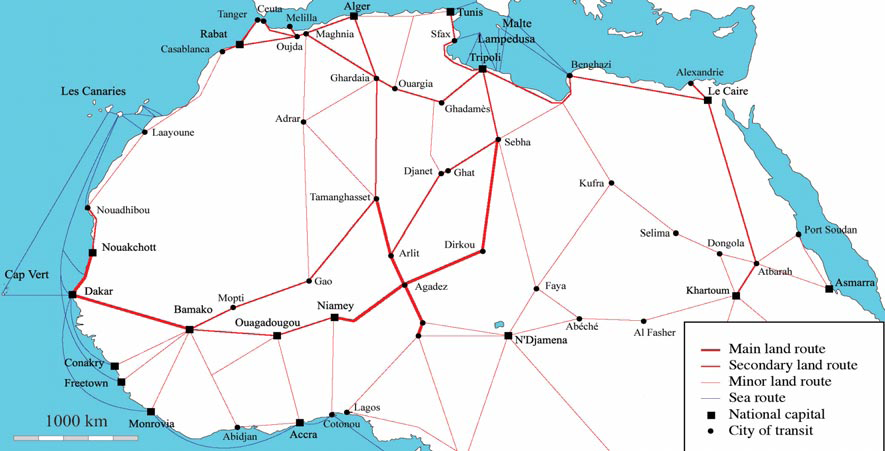
Main routes of present-day Trans-Saharan migrations

1 Comment

Filed under Algeria, Analysis, Data / Stats, Eastern Atlantic, European Union, Frontex, Italy, Libya, Malta, Mauritania, Mediterranean, Morocco, Spain

Commissioner Cecilia Malmström’s blog – Mitt Europa

This is not new, but I just noticed Cecilia Malmström’s blog, Mitt Europa.   It is in Swedish but easily accessible using Google Translate.   Given the difficulty in accessing information concerning the European Commission and Frontex, perhaps some interesting information will turn up from time to time.

Click here for blog.

1 Comment

Filed under European Union, News