Tag Archives: European Union

Statewatch Analysis – “New EU rules on maritime surveillance: will they stop the deaths and push-backs in the Mediterranean?”

Statewatch last month released a new Analysis of the EU Regulation for Frontex-coordinated surveillance of external sea borders which is scheduled for a plenary vote in the European Parliament in April.  The Analysis, written by Prof. Steve Peers, Univ. of Essex Law School, reviews the enhanced protections to be afforded to intercepted or rescued migrants relative to the earlier Council Decision which was annulled by the CJEU.  The Analysis also highlights concerns with various provisions within the Regulation, including:

  • One significant concern with the Regulation is due to the fact that “the Regulation does not contemplate the scenario of migrants being intercepted in the territorial waters of third States.”  (Frenzen’s Note: This raises a serious concern in regard to the push-back and interception practices which have been carried out for many years within the territorial waters of Mauritania and Senegal within Frontex’s Operation Hera.  Additionally, prior to the Libyan revolution, Libya authorised Italy to conduct joint maritime patrols within Libyan territorial waters.  It is safe to assume that Frontex and some EU Member States will continue to seek the ability to intercept migrant boats within the territorial waters of third States.);
  • While the Regulation requires that migrants intercepted in the territorial sea or contiguous zone of an EU Member State be disembarked in that Member State, “this [requirement] is subject to a crucial exception: it is possible under the Regulation that a vessel that has made it this close to a Member State could still be ordered to alter course towards another destination.”;
  • While the bulk of the EU’s asylum legislation does not apply [to interceptions which occur outside of the territorial sea of a Member State,] the EU’s qualification Directive does – since there is nothing in the text of that Directive to limit its territorial scope. But the wording of the Regulation is confusing in this regard, since it does not refer to the detailed text of that Directive but rather to general standards on non-refoulement, which are different from that Directive in some respects….”;
  • Member States are required to “use all means” to identify intercepted migrants, assess their particular circumstances, and inform them of the intended place of disembarkation, in order to give the migrants the opportunity to assert a non-refoulement claim.  The Regulation states that the Frontex operational plan, “where necessary,” must provide for interpreters and legal advisors on shore. “[T]he Council Presidency points out the ‘wiggle room’ granted by the words ‘where necessary’ and ‘use all means.’”

Click here or here for Statewatch Analysis.

2 Comments

Filed under Aegean Sea, Analysis, Eastern Atlantic, European Union, Frontex, Italy, Libya, Malta, Mauritania, Mediterranean, Senegal, Spain

Frontex FRAN Report for Q1 2013

In July of this year, Frontex released its first quarter (January – March) 2013 report. As in past quarters, the 70-page report provided in-depth information about irregular migration patterns at the EU external borders. The report is based on data provided by 30 Member State border-control authorities, and presents results of statistical analysis of quarterly variations in eight irregular migration indicators and one asylum  indicator (here is a link to our summary of the 2012 fourth quarter report).

In Q1 2013 all indicators of irregular migration were reduced in comparison with the final quarter of 2012. In most instances these declines were consistent with past documentation of seasonal variation; typically the first few months of each year are associated with reduced pressure at the border compared to other times of the year. Here are some highlights from the report focusing on the sea borders:

  • The Greek operation Aspida (see the 2012 Q4 summary for details) has resulted in a dramatic reduction of irregular migration across the Greek-Turkish border. As a result, one of the three alternative routes increasingly utilized is: migrants leaving the west coast of Turkey to illegally cross the Eastern Aegean Sea towards the Greek Islands. This border section ranked second at the EU level in terms of detections. Syrians and Afghans were both detected at similar frequencies of around 500 each over the three-month period.
  • The JO Poseidon Sea 2012 was also active during the reporting period in order to tackle the flow of irregular migrants penetrating the external EU sea borders in the Eastern Mediterranean mainly from Turkey and, to a lesser extent, from Egypt.
  • Syrians, were increasingly detected at the Greek sea border with Turkey (Eastern Aegean Sea) and the Bulgarian land border with Turkey.

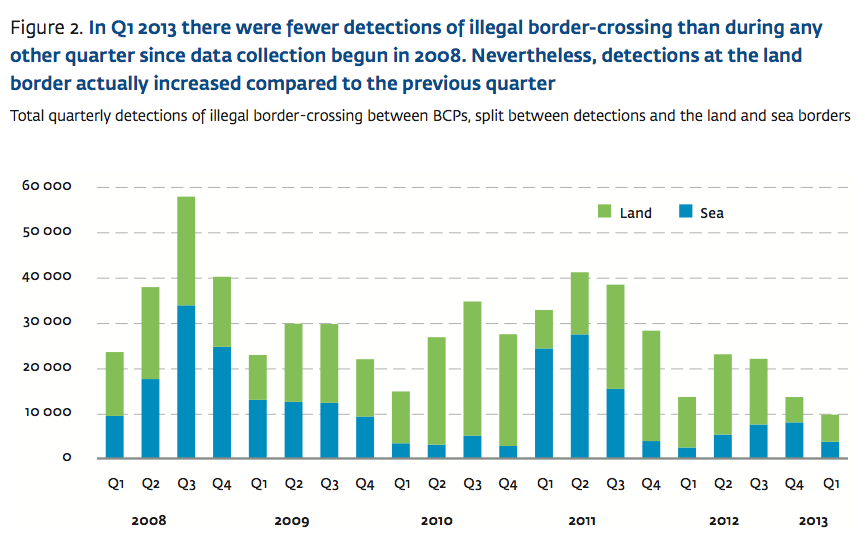
  • There were fewer detections of illegal border-crossing than ever before, with just 9 717 detections. The drop was limited mostly to sea borders.The JO Poseidon Land 2012 was active during Q1 2013.
    Screen Shot 2013-10-12 at 12.31.12 PM
    Here are excerpts from the Report focusing on the sea borders:
    [***]
    4.2 Routes
    • In the Eastern Mediterranean, detections tend to be characterised by Asian and some North African migrants illegally crossing the border from Turkey into Greece. In the second half of 2012 detections were much reduced following increased operational activity at the Greek land border with Turkey, where most detections were previously reported (see Section 4.1.1.).
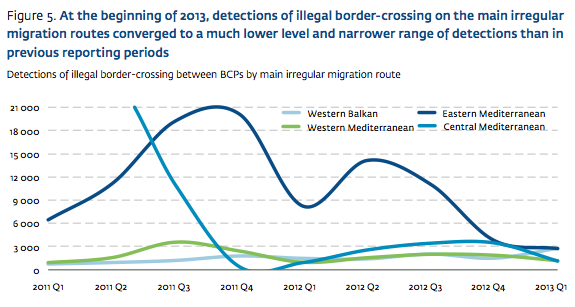
    • On the main Central Mediterranean route, which includes the Italian Pelagic Islands (Linosa, Lampione and Lampedusa) and Malta, most detections tend to be of migrants arriving on boats from North Africa. During the previous quarter there were fewer detections of North African nationalities such as Tunisians and Egyptians but there was a surge of migrants from sub-Saharan countries such as Eritrea, the Gambia and Mali, all of which were detected in much higher numbers during the last there months of 2012 compared with Q3 2012. In the current reporting period, the number of detected Somalis decreased, resulting in the top three nationalities – Somalis, Gambians and Egyptians– being detected at similarly low levels of around 200–250 each over the three-month period (Fig. 5).Screen Shot 2013-10-12 at 1.57.51 PM

    [***]

    4.2.1 Eastern Mediterranean Route
    • In Q1 2013 there were 2 734 detections of il- legal border-crossing on the Eastern Mediterranean route, which was a decrease of 66% compared to the same period in 2012 but nevertheless still constituting nearly 30% of all detections at the EU level. In effect, this route remained the major entry point to the Schengen area.

      With nearly 1 000 detections in Q1 2013, Syrians were by far the most detected nationality on this route. More than half of these detections were in the Eastern Aegean Sea region, with significant numbers also at the Bulgarian land border with Turkey.

      [***]

      1. East Aegean Sea

        This border section ranked second at the EU level in Q1 2013. The most frequently detected migrants were Syrians and Afghans, followed Sri Lankans, whose number has recently increased.

        The JO Poseidon Sea 2012 was operational throughout the reporting period, focusing on tackling the flow of irregular migrants penetrating the external EU sea borders in the Eastern Mediterranean mainly from Turkey and, to a lesser extent, from Egypt.

        Syrians have been the most commonly detected migrants during the operation so far in 2013. Most were men travelling alone but here were some family units, and all were heading for Sweden or Germany to claim asylum. Once they entered Turkey, those intending to enter the EU travelled to Istanbul in order to make contact with facilitation networks. They stayed in Istanbul for between 1–12 weeks before being taken by van to the west coast of Turkey to depart towards the Greek eastern Aegean Islands.

        Afghans were also detected in this region. Most were previously resident in Iran and had decided to travel to the EU due to deteriorating employment conditions. The Afghan community in Iran can easily find criminal networks that can facilitate them to Turkey and then to Greece. Once in Turkey, the Afghan migrants were transported by public transport to Istanbul and from there mainly by private transportation directly to departure area on the western coast of Turkey, where they boarded rubber boats destined for the Greek eastern Aegean Islands.

    [***]
    4.2.2 Central Mediterranean Route
    • Since early 2011 migrants from Tunisia have been among the most commonly detected migrants arriving in the Central Mediterranean region but during the first three months of 2013 only 75 Tunisians were detected. In fact nearly all of the top 10 nationalities in Q1 2013 were detected in much lower numbers than during the final quarter of 2012.

      Migrants from Somalia ranked top in the region but were detected at their lowest level for over a year.

      [***]

      A total of 233 migrants from the Gambia were detected in the Central Mediterranean during Q1 2013 which is the highest ever level for this nationality resulting in them ranking second in this region, followed by 216 Egyptians.

      The JO Hermes 2012 was operational just for the first month of the reporting period. The operation was established to support the Italian authorities in tackling maritime illegal migration on the coasts of Sicily, Pantelleria and the Pelagic Islands (Lampedusa, Linosa, Lampione).

      In January 2013, there was only one incident reported under JO Hermes whereby a total of 35 irregular migrants were detected, 32 of which were Syrian and three were Egyptian. [***] The disembarkation point was near Syracuse but this time the interception took place inland, implying that the facilitators (and probably some migrants) evaded detection.

      The absence of boats from Tunisia and Libya may be due to the bad weather conditions throughout the Mediterranean area.

      Although FRAN data suggest that detections of migrants from Syria were low in this region during the first three months of 2013 (85), there were some reports of boats arriving directly from Syria.

    [***]
    4.2.3 Western Mediterranean Route
    • In Q1 2013 there were only around 1 000 detections of illegal border-crossing in the Western Mediterranean region, which consists of several areas of the southern Spanish coast as well as the land borders of Ceuta and Melilla, where three-quarters of all detections were reported. At the end of 2012 we reported vastly increased detections of migrants from Chad, Cameroon, Mali and Guinea arriving in the region of Cadiz but this did not continue into the first few months of 2013.

      Analysing the nationalities detected on this route is problematic as half were reported by the Spanish authorities as being of unknown nationality. However, open sources suggest that there have been increased reports of African migrants storming the border fence in Melilla.

    [***]
    4.2.4 Western African Route
    • In the first quarter of 2013, there were just a few individual detections of illegal border-crossing in this region, which is the same level as during the same period in 2012. During the previous quarter there were 30 or so detections of both Gambians and Moroccans but neither of these nationalities were apparent in the data exchanged for the first three months of 2013. Hence irregular migration pressure on the Western African route in much reduced.

      ————

      Click here for a copy of the report.

1 Comment

Filed under Aegean Sea, Analysis, Data / Stats, European Union, Frontex, General, Mediterranean, Reports

Chappatte on the latest disaster at Lampedusa

© Chappatte - www.globecartoon.com - Used by Migrants At Sea with permission.

© Chappatte – http://www.globecartoon.com – Used by Migrants At Sea with permission.

© Chappatte - www.globecartoon.com - Used by Migrants At Sea with permission.

© Chappatte – http://www.globecartoon.com – Used by Migrants At Sea with permission.

1 Comment

Filed under Cartoon, European Union, Frontex, Italy, Libya, Mediterranean

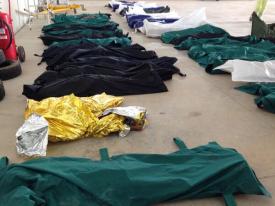
Lampedusa – 300 or more dead in latest accident, what can be done to stop migrant deaths at sea?

Italian authorities have so far recovered about 120 bodies from yesterday’s accident a very very short distance from the shores of Lampedusa. Authorities believe there may be more than 150 bodies of children, women, and men still to be recovered.

What can be done to prevent such deaths? It is certainly possible that nothing could have prevented yesterday’s disaster.  This was not a case of a disabled boat left to drift at sea while ships and aircraft failed to assist.  This was not a case involving a failure to act promptly to rescue persons in distress.  This was not a case of a diplomatic dispute between countries over which country had the responsibility to rescue and where rescued persons were to be disembarked after rescue.  It may turn out to be the case that someone observed the overloaded migrant boat as it sailed from Libya towards Lampedusa.  If the migrant boat was observed by a commercial or military ship, a rescue operation probably should have been implemented immediately.  But while the Mediterranean Sea is crowded with ships, it is certainly possible that this boat sailed unobserved from Libya to Lampedusa.

Could anything have been done to prevent these deaths?

Could anything have been done to prevent the deaths of 13 migrants who drowned on the beach at Sicily last week? Or the 31 people who drowned off the Libyan coast in July? Or the 20 who died near Lesvos Island in Greece last December, the 89 who died in the Strait of Gibraltar over 10 days in October-November 2012, or the 58 who died off the coast of Izmir, Turkey in September 2012?  (For a more complete list of reported deaths at sea consult Fortress Europe’s La Strage web page (the Massacre).)

As long as people move, whether forced to flee danger or to improve their lives or for other reasons, there will be dangers on land and sea.  The dangers will always be greater when people are compelled to move outside of legal channels. Creating more opportunities for legal migration and creating an external procedure for seeking refugee protection within the EU would help many people and would reduce the numbers of people traveling by dangerous means.  But there will still be people unable to secure a visa or protection who would be compelled to travel by sea. 

There are many measures that can be taken by the EU to reduce the numbers of people dying in the Mediterranean and off the coast of western Africa.  As a reminder, here is an excerpt from the recommendations issued last year by the Parliamentary Assembly of the Council of Europe in the report issued in the aftermath of the deaths of 63 people on board the “left to die” boat that drifted in the Mediterranean for two weeks. The recommendations made sense then as they do now:

  •  fill the vacuum of responsibility for an SAR zone left by a State which cannot or does not exercise its responsibility for search and rescue, such as was the case for Libya. This may require amending the International Maritime Search and Rescue Convention (SAR Convention)….;
  • ensure that there are clear and simple guidelines, which are then followed, on what amounts to a distress signal, so as to avoid any confusion over the obligation to launch a search and rescue operation for a boat in distress;
  • avoid differing interpretations of what constitutes a vessel in distress, in particular as concerns overloaded, unseaworthy boats, even if under propulsion, and render appropriate assistance to such vessels. Whenever safety requires that a vessel be assisted, this should lead to rescue actions;
  • tackle the reasons why commercial vessels fail to go to the rescue of boats in distress. This will require dealing with:
    • the economic consequences for the rescuing vessel and its owners, and the issue of compensation;
    • the disagreement between Malta and Italy as to whether disembarkation should be to the nearest safe port or to a port within the country of the SAR zone. The International Maritime Organization should be urged to find a solution to the matter and step up its efforts towards a harmonised interpretation and application of international maritime law;
    • the fear of criminalisation (trafficking or aiding and abetting irregular migration) by those who go to the rescue of boats carrying irregular migrants, asylum seekers and refugees;
    • legislation to criminalise private shipmasters who fail to comply with their duty under the law of the sea, as is already the case in certain Council of Europe member States;
  • ensure that, in accordance with the Hirsi v. Italy judgment of the European Court of Human Rights, after the rescue operation, people are not pushed back to a country where they risk being treated in violation of Article 3 of the European Convention on Human Rights;
  • tackle the issue of responsibility sharing, particularly in the context of rescue services, disembarkation, administration of asylum requests, setting up reception facilities and relocation and resettlement, with a view to developing a binding European Union protocol for the Mediterranean region. The heavy burden placed on frontline States leads to a problem of saturation and a reluctance to take responsibility;
  • respect the families’ right to know the fate of those who lose their lives at sea by improving identity data collection and sharing. This could include the setting up of a DNA file of the remains of those retrieved from the Mediterranean Sea. In this context, the ongoing work of the International Committee of the Red Cross (ICRC) and other organisations should be acknowledged and supported.

For more on this, see Jack Shenker’s article in today’s Guardian, “Mediterranean migrant deaths: a litany of largely avoidable loss.”

2 Comments

Filed under Council of Europe, European Union, Frontex, Italy, Libya, Mediterranean

PACE Calls for Urgent Measures to Assist Greece and Turkey With Mounting Migratory Tensions in Eastern Mediterranean

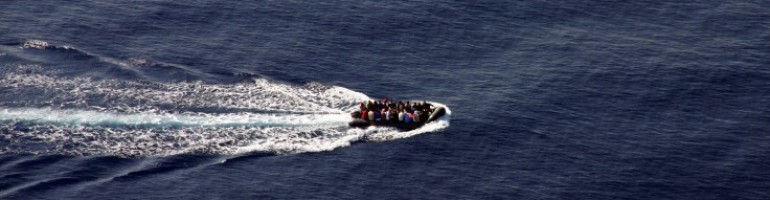
PACE, the Council of Europe’s Parliamentary Assembly, adopted a Resolution on 24 January 2013 calling for “firm and urgent measures [to] tackle the mounting pressure and tension over asylum and irregular migration into Greece, Turkey and other Mediterranean countries.”  The Resolution noted that Greece, with EU assistance, has enhanced border controls, particularly along its land border with Turkey and while “these policies have helped reduce considerably the flow of arrivals across the Evros border with Turkey, they have transferred the problem to the Greek islands and have not helped significantly in dealing with the situation of irregular migrants, asylum seekers and refugees already in Greece.”

The Resolution makes recommendations to the EU, Greece, and Turkey and calls on CoE members states to “substantially increase their assistance to Greece, Turkey and other front-line countries” in various ways, including:

  • provide bi-lateral assistance, including by exploring new approaches to resettlement and intraEurope relocation of refugees  and asylum seekers;
  • share responsibility for Syrian refugees and asylum seekers via intra European Union relocation and refrain from sending these persons back to Syria or third countries;
  • maintain a moratorium on returns to Greece of asylum seekers under the Dublin Regulation.

The Resolution was supported by a Report prepared by Ms Tineke Strik, Rapporteur, PACE Committee on Migration, Refugees and Displaced Persons.

Click here for full text of Resolution 1918(2013), Migration and asylum: mounting tensions in the Eastern Mediterranean.

Click here for PACE press statement.

Click here for Report by Rapporteur, Ms Tineke Strik, Doc. 13106, 23 Jan 2013.
Here are extensive excerpts from the Rapporteur’s Report (which should be read in its entirety):

Summary –  Greece has become the main entry point for irregular migratory flows into the European Union, while Turkey has become the main country of transit. [***]

Europe must drastically rethink its approach to responsibility sharing to deal with what is a European problem and not one reserved to a single or only a few countries. Member States are called on to substantially increase their support for Greece, Turkey and other front-line countries to ensure that they have a realistic possibility of dealing with the challenges that they face. In this the Council of Europe also has a role to play, for example through exploring resettlement and readmission possibilities, assisting States in dealing with their asylum backlogs and putting forward innovative projects to alleviate growing racism and xenophobia towards migrants, refugees and asylum seekers.

[***]

C. Explanatory memorandum by Ms Strik, rapporteur

1. Introduction

[***]

2. Greece is facing a major challenge to cope with both the large influx of mixed migratory flows, including irregular migrants, refugees and asylum seekers, and the current economic crisis. That said it is not the only country struggling to cope in the region. It is impossible to look at the situation of Greece without also examining that of Turkey, which is the main country of transit to Greece and is also having to shoulder responsibility for over 150 000 Syrian refugees.

3. In the light of the foregoing, it is necessary to examine the extent of the migration and asylum challenges at Europe’s south-eastern border, taking into account Turkey and Greece’s policy reactions. Two further elements have to be added to this, namely the social tensions arising within Greek society due to an overload of financial and migratory pressure and also the issue of shared responsibility in Europe for dealing with European as opposed to simply national problems.

2. The storm at Europe’s south-eastern border

2.1. Greece under pressure: irregular migration challenge and economic crisis

4. In recent years, hundreds of thousands of irregular migrants, asylum seekers and refugees crossed the Greek land, river and sea borders with many travelling through Turkey. In 2010, the large majority of mixed migratory flows entered the European Union through the Greek-Turkish border. This situation brings major challenges in terms of human rights and migration management.

5. According to statistics provided by the United Nations High Commissioner for Refugees (UNHCR), in 2010, more than 132 000 third-country nationals were arrested in Greece, including 53 000 in the Greek-Turkish border regions. During the first ten months of 2012, over 70 000 arrests occurred, including about 32 000 at the borders of Turkey.  People came from 110 different countries – the majority from Asia, including Afghanis, Pakistanis and Bangladeshis, as well as from Iraq, Somalia, and the Middle-East, especially Palestinians and an increasing number of Syrians.

6. Most migrants and asylum seekers do not want to stay in Greece and plan to continue their journey further into Europe. Many of them are however stuck in Greece, due to border checks and arrests when trying to exit Greece, the current Dublin Regulation, and the fact that many irregular migrants cannot be returned to their country of origin.

7. The context of the serious economic and sovereign debt crisis aggravates the situation and reduces the ability for the Greek Government to adequately respond to the large influx. [***]

2.2. Syria: a bad situation could get worse

8. In its Resolution 1902 (2012) on “The European response to the humanitarian crisis in Syria”, the Parliamentary Assembly condemned “the continuing, systematic and gross human rights violations, amounting to crimes against humanity, committed in Syria”. It described the humanitarian situation as becoming “more and more critical” for the estimated 1.2 million internally displaced Syrians and the 638 000 Syrians registered or awaiting registration as refugees in neighbouring countries.

[***]

11. By October 2012, 23 500 Syrian nationals had applied for asylum in EU member States, including almost 3 000 applications in September 2012 alone, and over 15 000 in Germany and Sweden.  Compared to neighbouring countries, asylum seeker numbers in the European Union currently remains manageable. However the number of Syrians trying to enter Greek territory in an irregular manner reached a critical level in July 2012, when up to 800 Syrians were crossing the Greek-Turkish land border every week. In the second half of 2012, more than 32% of sea arrivals to the Greek Islands were Syrian nationals.

2.3. Regional implications of mixed migratory arrivals

12. In recent years, Spain, Italy and Malta were at the forefront of large-scale sea arrivals. According to the UNHCR, in 2012, 1 567 individuals arrived in Malta by sea. 75% of these persons were from Somalia. The UNHCR estimates however that less than 30% of the more than 16 000 individuals who have arrived in Malta since 2002 remain in Malta.

13. Spain and Italy have signed and effectively enforced readmission agreements with North and West African countries cutting down on the mixed migration flows. These agreements have provided the basis for returning irregular migrants and preventing their crossing through increased maritime patrols and border surveillance, including in the context of joint Frontex operations.

14. As a consequence of shifting routes, migratory pressure at the Greek-Turkish border increased significantly and Greece became the main gate of entry into the European Union from 2008 onwards, with an interval in 2011 when the Arab Spring brought a new migratory flow to Italy and Malta. To give an idea of how much the routes have changed, Frontex indicated that in 2012, 56% of detections of irregular entry into the European Union occurred on the Greek-Turkish border.

15. Turkey, by contrast, has become the main transit country for migrants seeking to enter the European Union. Its 11 000-km-long border and its extensive visa-free regime make it an easy country to enter. An estimated half a million documented and undocumented migrants currently live in the country. This has brought a whole new range of challenges for Turkey and meant that it has had to develop a new approach to migration management and protection for those seeking asylum and international protection.  It has also faced problems in terms of detention of irregular migrants and asylum seekers. As with Greece, the conditions of detention have been highly criticised and steps are being taken to build new centres with the assistance of funding from the European Union.

16. Until recently, the traditionally complex Greek-Turkish political relations did not allow the pursuit and consolidation of an effective readmission policy with Turkey. Although Greece, for example, signed a readmission protocol with Turkey which goes back to 2001, the implementation of this was only agreed on in 2010. It is important that this bilateral agreement between Greece and Turkey functions effectively and this will be a challenge for both countries.

3. Shielding Greece through border management and detention: does it work?

3.1. Enhanced border controls at the Greek-Turkish land border (Evros region)

17. The unprecedented numbers of irregular migrants and asylum seekers attempting to cross the Greek-Turkish border in recent years put the existing capacities and resources of Greece under severe strain. To remedy this situation, the Greek authorities have adopted the “Greek Action Plan on Asylum and Migration Management”, which is the basis for reforming the asylum and migration management framework in Greece.

18. In this context, considerable efforts were undertaken to reinforce Greece’s external borders and particularly the Greek-Turkish border in the Evros region. This was done notably through building up operational centres, using electronic surveillance and night vision devices, and by deploying patrol boats to strengthen river patrols. The surveillance technology used is part of the efforts under the European Border Surveillance System (Eurosur).

19. The so-called operation “Aspida” (“shield”), initiated in August 2012, aims to enhance border controls, surveillance and patrolling activities at the Greek-Turkish land border. Approximately 1 800 additional police officers from across Greece were deployed as border guards to the Evros region.

20. Increased border controls in the context of this operation have not been without criticism. There have been worrying reports about migrants, including refugees and asylum seekers from Syria and other countries, being pushed back to Turkey over the Evros river.  Two incidents reportedly took place in June and October 2012, when inflatable boats were intercepted in the middle of the Evros river by Greek patrol boats and pushed back to Turkey before their boat was sunk, leaving people to swim to the Turkish shore.

21. In addition, the Greek authorities completed a barbed wire fence at the 12.5-km-land border in December 2012. The barrier which was criticised by EU officials when announced  and built without EU funding, cost an estimated 3 million euros.

22. As a consequence of these actions, the numbers of irregular land border crossings dropped from over 2 000 a week in the first week of August to below 30 a week in the second half of September. According to the regional governor of Eastern Macedonia and Thrace, they are now close to zero.  While the Greek authorities claim that these actions have resulted in a more than 80% decrease of irregular entries,  one can observe that migrants’ routes have shifted from the Greek-Turkish land border mainly to the sea border between both countries. This shift has been recognised by the Greek authorities.

23. Increased numbers of migrants are now arriving on the Greek Aegean islands of Lesvos, Samos, Symi and Farmkonissi. Between August and December 2012, 3 280 persons were arrested after crossing the Greek-Turkish sea border,  compared to 65 persons in the first seven months of 2012.

24. There has also been an increase in the number of deaths at sea. In early September 2012, 60 people perished when their boat sank off the coast in Izmir.  On 15 December 2012, at least 18 migrants drowned off the coast of Lesvos while attempting to reach the island by boat.

25. The spill over effect of new routes opening are now being felt by neighbouring countries, such as Bulgaria and some of the Western Balkans.

3.2. Systematic detention of irregular migrants and asylum seekers

26. Together with increased border controls, administrative detention remains the predominant policy response by the Greek authorities to the entry and stay of irregular migrants.  [***]

[***]

29. Particularly worrying are the conditions in the various detention centres and police stations where irregular migrants and asylum seekers are held, and which have frequently been criticised. The European Court of Human Rights has found Greece to be in violation of the right to freedom from inhuman or degrading treatment in several cases in recent years.  In addition, the European Committee for the Prevention of Torture and Inhuman or Degrading Treatment and Punishment (CPT) has regularly criticised the poor detention conditions of irregular migrants and asylum seekers and the structural deficiencies in Greece’s detention policy as well as the government’s persistent lack of action to improve the situation.  See also: CPT, Report on its visit from 19 to 27 January 2011, published on 10 January 2012, at: www.cpt.coe.int/documents/grc/2012-01-inf-eng.pdf, together with the reply by the Greek authorities, at: www.cpt.coe.int/documents/grc/2012-02-inf-eng.pdf. The conditions of detention in one centre in Greece were found to be so bad that a local court in Igoumenista acquitted, earlier this year, migrants who were charged with escaping from detention stating that the conditions in the centre were not in compliance with the migrants’ human rights.

[***]

3.3. Impediments in accessing asylum and international protection

35. Despite the current efforts by the Greek authorities to reform the asylum and migration management framework, the country still does not have a fair and effective asylum system in place. The Greek Action Plan on Migration and Asylum, which was revised in December 2012, sets out the strategy of the Greek Government. It foresees the speedy creation of a functioning new Asylum Service, a new First Reception Service and a new Appeals Authority, staffed by civil servants under the Ministry of Public Order and Citizens Protection, disengaging the asylum procedure from the police authorities. However problems in finding sufficient financial resources and qualified staff still give rise for concerns on the implementation of the plans.

[***]

4. Social tensions within Greek society

4.1. The social situation of migrants and asylum seekers

41. Greece’s efforts to deal with the influx of irregular migrants and asylum seekers suffers from there being no comprehensive migration policy. [***]

4.2. Discrimination, xenophobia and racist attacks against migrants

46. The mounting social tensions and the inadequate response by the State to address the difficult social situation of migrants, asylum seekers and refugees have led to an increase in criminality and exploitation of this group. In addition, migration has become a key confrontational political issue. This in turn has contributed to an increasingly wide-spread anti-immigrant sentiment among the Greek population.

47. Over the last two years there has been a dramatic increase in xenophobic violence and racially motivated attacks against migrants in Greece, including physical attacks, such as beatings and stabbings, attacks on immigrants’ residences, places of worship, migrants’ shops or community centres.  The Network for Recording Incidents of Racist Violence documented 87 racist incidents against migrants and refugees between January and September 2012.  Half of them were connected with extremist groups.

48. Members and supporters of Golden Dawn have often been linked with recent violent attacks and raids against migrants and asylum seekers. By using blatantly anti-migrant and racist discourse, often inciting violence, Golden Dawn gained 7% of the popular vote during the June 2012 parliamentary elections and support seems to be growing, according to recent polls. In October 2012, the Greek Parliament lifted the immunity from prosecution of the two Golden Dawn MPs who participated in the violent attacks against migrants in September.

49. The Council of Europe Commissioner for Human Rights has called on Greece to examine whether the “most overt extremist and Nazi party in Europe” is legal. It seems that Golden Dawn aims at political and societal destabilisation and gains by the failing policy regarding refugees and irregular migrants. In December 2012, the European Commission against Racism and Intolerance (ECRI) expressed its “deep concern” about the rise of Golden Dawn and asked the Greek authorities to “take firm and effective action to ensure that the activities of Golden Dawn do not violate the free and democratic political order or the rights of any individuals”.

5. The European responsibility for a European problem

5.1. European front-line States under particular pressure

50. This is not the first time that the Parliamentary Assembly expresses its concern on the particular pressure that European front-line States are confronted with. Resolution 1521 (2006) on the mass arrival of irregular migrants on Europe’s Southern shores, Resolution 1637 (2008) on Europe’s “boat people”: mixed migration flows by sea into southern Europe and Resolution 1805 (2011) on the large-scale arrival of irregular migrants, asylum seekers and refugees on Europe’s southern shores.

51. Despite the fact that most European Union countries have stopped returning asylum seekers to Greece under the Dublin Regulation following the judgment of the European Court of Human Rights in the case M.S.S. v. Belgium and Greece,  there are still some reports of returns from some countries based on this regulation.

52. The final agreement between the Council and the European Parliament on the revision of the Dublin Regulation still allocates responsibilities for asylum seekers to a single EU member State and does not present a more fundamental reform of the rules. European Union member States also rejected the idea of a mechanism to suspend transfers to those EU countries which were unable to manage the influx of asylum seekers into their territory, preferring to adopt an “early warning mechanism”.

5.2. Greece: A test case for European solidarity

53. This migratory pressure Greece is confronted with comes at a moment when the country is suffering as no other European country does from the current economic and social crisis. In response to these difficulties, the European Union has provided financial and technical assistance.

54. During the period of 2011-2013, Greece received 98,6 million euros under the Return Fund, 132,8 million euros under the External Border Fund and 19,95 million euros under the European Refugee Fund. The focus of funding was thus on border control and detention measures, to the detriment of the protection measures.

55. Frontex Joint Operation “Poseidon Land” was launched in 2010 at the borders between Turkey and Greece and between Turkey and Bulgaria. EU member States currently have 41 police officers and equipment deployed to the Evros border region in Greece.  They also support the Greek and Bulgarian authorities with the screening and debriefing of irregular migrants, and tackling irregular migratory inflows and smuggling networks towards Greece. In addition, Frontex has recently strengthened its patrols in the coastal waters in the Eastern Aegean between Greece and Turkey in the context of Joint Operation “Poseidon Sea”. European Union member States have deployed additional maritime surveillance assets at the sea border between Greece and Turkey. The joint operation was extended to also cover the West coast of Greece and today is Frontex’s main operational activity in the Mediterranean region.

56. Furthermore, the European Asylum Support Office (EASO) provides technical support to Greece and other EU member States whose asylum and reception systems are under particular pressure. Following the request by the Greek Government in February 2011, EASO started giving assistance and training in building up a new asylum system, improving reception conditions of asylum seekers in Greece and clearing the backlog of outstanding asylum claims. To do this they have deployed over 40 Asylum Support Teams of experts to the country.

57. While EU member States are ready to provide financial and technical assistance to help Greece in managing and controlling its borders, with a focus on both forced and voluntary returns as a policy solution, they are not keen on sharing the reception and processing of mixed migratory flows arriving at the European Union’s external border. According to the Greens/European Free Alliance of the European Parliament, “[m]igration will not be stopped by reinforcing border control, border management measures and forced returns; the current approach only reinforces human rights violations”.

58. As rapporteur I would largely agree with this statement, although I would add that while such policies may be able to solve a problem in one country, it then simply “passes the buck” to another. Should it be possible to seal Greece’s border, this would undoubtedly then put even greater pressure on Turkey and Bulgaria and then up the eastern borders of the European Union. This is an issue which will be the subject of a separate report by the Committee on Migration, Refugees and Displaced Persons.

59. The European Union response to the economic and financial crisis in Greece has been a massive bail out. Similar solidarity is however necessary with regards to the current social and humanitarian crisis in the field of migration and asylum. Europe is however doing too little, too late. A shared asylum policy that takes into account that the migratory pressures are not the sole responsible of one or a few European States, but a European problem, is even more essential in a time when the region is facing major instability. This instability will only increase further if the up and coming Golden Dawn party succeeds in exploiting the immigrant issue. Europe cannot afford to look away.

60. Increased migratory flows to European front-line States requires a fundamental rethink on solidarity and responsibility sharing. This includes swift solutions that go beyond mere financial and technical assistance and show greater solidarity in receiving refugees and asylum seekers and developing resettlement, especially currently for Syrian refugees from the neighbouring countries of Syria, and intra-EU relocation programmes, in particular where children and families are concerned. Assembly Resolution 1820 (2011) on asylum seekers and refugees: sharing responsibility in Europe provides meaningful recommendations in this respect.

6. Conclusions

61. The pressure of mixed migratory flows currently unfolding at the European Union’s external borders in the eastern Mediterranean requires rethinking of the entire solidarity system with the European Union and the Council of Europe. Greece, Turkey or other neighbouring countries should not be left with the primary responsibility of dealing with the mounting mixed migratory pressure from the South and East. A shared asylum and migration policy is even more essential at a time when the region is facing major economic and social instability.

62. Stricter border control, prolonging migrants’ and asylum seekers’ detention or constructing new detention facilities in Greece all contribute to further human rights violations taking place. They are not the way out of the problem and they do not persuade people fleeing from poverty or violence in their countries of origin to remain at home.

63. The recent efforts by the Greek authorities to introduce a more effective and humane system addressing the large number of irregular migrants and asylum seekers entering Greece is a welcome step in the right direction. Greece however faces a Herculean task in building up an efficient, fair and functioning system providing international protection to those in need.

64. Europe urgently needs to join forces to deal with the Syrian refugee problem, offering resettlement and relocation to relieve the burden falling on neighbouring States of Syria as well as its southern European States, and ensuring that Syrian refugees are not sent back.

65. The challenges are great but not insurmountable for Europe. Left to individual States they are.

[***]”

Click here for full text of Resolution 1918(2013), Migration and asylum: mounting tensions in the Eastern Mediterranean.

Click here for PACE press statement.

Click here for Report by Rapporteur, Ms Tineke Strik, Doc. 13106, 23 Jan 2013.

2 Comments

Filed under Aegean Sea, Analysis, Council of Europe, Frontex, Greece, News, Reports, Syria, Turkey, UNHCR

At Least 20 Persons Dead After Migrant Boat Capsizes in Aegean Sea

A migrant boat attempting to sail from Turkey to Greece reportedly capsized near the Greek island of Lesvos on Thursday or Friday.  The boat was carrying about 28 persons.  At least 20 bodies have been recovered.  Only one survivor has been located.  Media reports describe the migrants as Iraqis or “of Asian origin.”  The boat’s captain was reportedly Turkish.

Click here (EN), here (EN) and here (GR) for articles.

3 Comments

Filed under Aegean Sea, European Union, Frontex, Greece, News, Turkey

UN Special Rapporteur on HR of Migrants expresses concern over plight of irregular migrants in Greece; calls for EU assistance; Frontex patrolling Greece-Italy sea border

The UN Special Rapporteur on the human rights of migrants, Prof. François Crépeau, has completed  a nine-day official visit to Greece, the fourth and last country visit in connection with a “a one-year comprehensive study to examine the rights of migrants in the Euro-Mediterranean region, focusing in particular on the management of the external borders of the European Union.”  The Special Rapporteur will present a thematic report on the human rights of migrants at the borders of the European Union to the UN Human Rights Council in May/ June 2013.  In addition to the visit to Greece, he previously conducted official visits to EU offices in Brussels, Tunisia, Turkey, and Italy.

One point of particular interest in the Special Rapporteur’s end-of-mission statement is that Frontex sea patrols in Greece are not along being used to patrol the external sea border of the EU (Greece-Turkey), but are also being used to patrol the sea border between Greece and Italy to prevent irregular migrants from leaving Greece.  (Is this within Frontex’s mandate?)  According to the end-of mission statement, Frontex Joint Operation Poseidon Sea “which used to cover the sea border between Greece and Turkey, was extended in 2012 to also cover the west coast of Greece, where migrants trying to reach Italy by boats operated by smugglers are intercepted and returned to Greece.”

The Special Rapporteur also notes “[t]he enhanced border controls at the Greek-Turkish land border under operation ‘Aspida’ (‘Shield’) initiated in August 2012, which included the deployment of approximately 1800 border police officers, coupled with the construction of a fence and the Frontex operation ‘Poseidon Land’ have resulted in a renewed influx of irregular migrants via the islands of the eastern Aegean Sea, with boats arriving on the different islands almost daily.”

Here are additional excerpts from the end-of-mission statement:

“[W]hile most EU countries have stopped returning asylum seekers to Greece under the Dublin II Regulation due to a decision of the European Court of Human Rights (M.S.S. vs Belgium and Greece), I was informed that there are still some returns to Greece based on this Regulation.”

“As the large number of irregular migrants stuck in Greece is mainly a result of EU policies and practices, there is a strong need for solidarity and responsibility-sharing within the EU in order to ensure full respect of the human rights of all these migrants.”

“While the role of the EU in managing the migration flows in Greece is crucial, the Greek government also needs to significantly step up its efforts in order to ensure that the rights of all migrants within its territory are fully respected.”

“I am deeply concerned about the widespread xenophobic violence and attacks against migrants in Greece, and I strongly condemn the inadequate response by the law enforcement agencies to curb this violence, and to punish those responsible.”

“I also deeply regret the Greek government’s new policy of systematically detaining everyone they detect irregularly entering the Greek territory, including unaccompanied children and families. I also regret the ‘sweep operations’ in the context of operation ‘Xenios Zeus’, which have led to widespread detention of migrants in different parts of the country, many of whom have lived and worked in Greece for years.”

Among the several preliminary recommendations to Greece and the EU was the recommendation that the EU “[e]nsure that the full protection of the human rights of all migrants, regardless of their status, is the primary consideration for its support to the Greek efforts in managing the migration flow entering the EU territory, including in relation to the activities undertaken by Frontex at the Greek borders.”

Click here for complete End-of-Mission Statement.

Click here for my previous post on the Special Rapporteur’s visits to other countries.

2 Comments

Filed under Aegean Sea, European Union, Frontex, Greece, Italy, OHCHR, Reports, Statements, Turkey

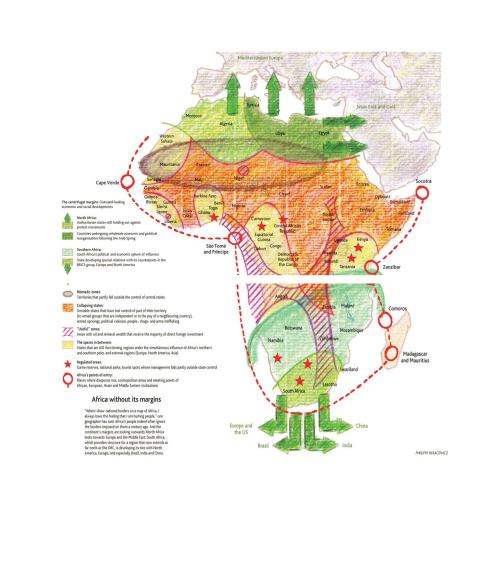
Map: “Africa without its margins” (Le Monde Diplo/Philippe Rekacewicz)

“Africa without its margins,” Le Monde Diplomatique, by Philippe Rekacewicz, Nov. 2012.

“Africa without its margins,” Le Monde Diplomatique, by Philippe Rekacewicz, Nov. 2012.

Leave a comment

Filed under Analysis, Maps

Frontex FRAN Report for Q2 2012

On 10 October Frontex released its FRAN (Frontex Risk Assessment Network) Quarterly Report for the Second Quarter of 2012 (April-June). As is always the case, the 70 page report contains a significant amount of information, graphs, and statistical tables regarding detections of illegal border crossings (land, air, and sea), irregular migration routes, detections of facilitators, detections of illegal stays, refusals of entry, asylum claims, returns, information regarding other illegal border activities, and more.  Here are some highlights (focusing on the sea borders):

Malta-  There was a significant increase in the number of Somalis reaching Malta. “Taking into account the professional planning of the trips, it is assumed that the modus operandi has changed and that Malta is now targeted on purpose, thereby replacing Italy as the preferred destination country for this nationality. The reason for this change has not yet been confirmed; however, in the past Malta resettled some Somali migrants in the United States and in some EU Member States, which might be acting as a pull factor.”

Spain-  “In this region there was a new modus operandi involving facilitators dropping off migrants in the Chafarinas Islands, a Spanish archipelago 2 nautical miles away from the Moroccan coastline.”

“As reported in the previous FRAN Quarterly, in February 2012 Moroccan and Spanish Ministers of Interior signed a police agreement to create two joint police stations in the Spanish (Algeciras) and Moroccan (Tangiers) territories to cooperate by exchanging operational information and best practices between different police services.”

Italy-  “Throughout the quarter, Italy and Tunisia cooperated efficiently to repatriate Tunisian nationals and so most migrants typically arrived undocumented to delay readmission.”

Central Mediterranean-    “[D]etections in the Central Mediterranean showed a seasonal increase but were much reduced (-86%) compared with the dramatic peak during the same period in 2011. Indeed, in the second quarter of 2012 detections in this region resembled the pre-Arab Spring levels reported during the summer of 2010. … The Central Mediterranean was recently affected by increased detections of Somalis, and a steady trend of Tunisians and Egyptians.”

“In Q2 2012, there were no Joint Operations running in the Central Mediterranean Sea, therefore Frontex and the FRAN community are unable to utilize intelligence obtained through the direct debriefing of migrants. However, valuable information has been obtained from interviews carried out by the Maltese authorities. Such preliminary interviews revealed that some of the Somali migrants arriving in Malta had been promised that they would be brought to Italy. They departed from an unknown location in Libya and travelled for up to three days in boats before either being intercepted by Maltese authorities or reaching the shore. The average fare was said to be around USD 1 000 per person.”

“Subsequent to the reporting period, JO Hermes 2012 was launched on 2 July and is currently planned to run until 31 October 2012 as a continuation of the deployment of JO Hermes Extension 2011, which ended just before the reporting period, on 31 March 2012. JO Hermes 2012 has been established to support the Italian authorities in tackling maritime irregular migration along the coasts of Sicily, Pantelleria and the Pelagic islands (Lampedusa, Linosa, Lampione).”

Western Mediterranean –   “Detections in the Western Mediterranean were almost equally comparable to Q2 2011…”

“JO EPN Indalo 2012 started on 16 May and is currently scheduled to run until 31 October 2012. So far the number of irregular migrants apprehended in the operational areas is almost double that of the same period in 2011. Analysis of the information provided by the Spanish authorities also indicates a new increasing trend in the number of Algerian and Moroccan migrants per boat since the beginning of 2012.”

Western Africa –  “[D]etections increased to a large degree, yet from lower bases, on the … Western African route (+29%).” “In the second quarter of 2012, there were just 31 detections of illegal border-crossing in this region, almost exclusively of Moroccan nationals.”

“As reported in previous FRAN Quarterlies, the Western African route from the north of Mauritania to the Western Sahara territory is being reopened by illegal migration facilitation networks. It has been inactive for years but recently an estimated 2 000 sub-Saharans (particularly from Senegal) settled in the Western Saharan coastal cities of El Aaioún and Dakhla and in the last few months ~20 000 Senegalese nationals have entered Mauritania along these routes to the north.”

“During the reporting period there was no Frontex operation relevant for the Western African Route.”

Eastern Mediterranean-  “Subsequent to the reporting period (July 2012), JO EPN Aeneas 2012 was launched and is currently scheduled to run until the end of October 2012. There are two operational areas, Apulia and Calabria, covering the seashore along the Ionian Sea and part of the Adriatic Sea.”

Here are extensive excerpts from the Report with a focus on the sea borders:

“Executive summary

Taken as a whole, in Q2 2012, detections of illegal border-crossing were reduced by nearly half compared to the same quarter in 2011 due to the simultaneous effects of the winding down of the Arab Spring and fewer Albanian circular migrants entering Greece. However, detections at the undisputed long-term hotspot for irregular migration – the Greek land border with Turkey – were some 25% higher than during the same period in 2011 due to increased detections of migrants from Bangladesh and particularly Syria. [***]

In the Central Mediterranean, where detections peaked in 2011 during the Arab Spring, migrants from Somalia were increasingly detected in Malta. Specifically, in May 2012 the arrival of Somali migrants in Malta increased significantly while Italy registered a decrease in the number of Somali migrants apprehended in Sicily and the Pelagic Islands. The detected Somalis were mainly young males many of whom had been imprisoned by police or military forces during their travels through Libya. Taking into account the professional planning of the trips, it is assumed that the modus operandi has changed and that Malta is now targeted on purpose, thereby replacing Italy as the preferred destination country for this nationality. The reason for this change has not yet been confirmed; however, in the past Malta resettled some Somali migrants in the United States and in some EU Member States, which might be acting as a pull factor. Also, there is some evidence that facilitation networks located in Malta have tried to forward migrants to Sicily. [***]

The Western Mediterranean route was apparently dominated by local migrants from Morocco and Algeria but with large numbers of unknown nationalities it is assumed that local migrants were also accompanied by long-distance migrants probably from sub-Saharan Africa. In this region there was a new modus operandi involving facilitators dropping off migrants in the Chafarinas Islands, a Spanish archipelago 2 nautical miles away from the Moroccan coastline. [***]

4.1 Detections of illegal border-crossing

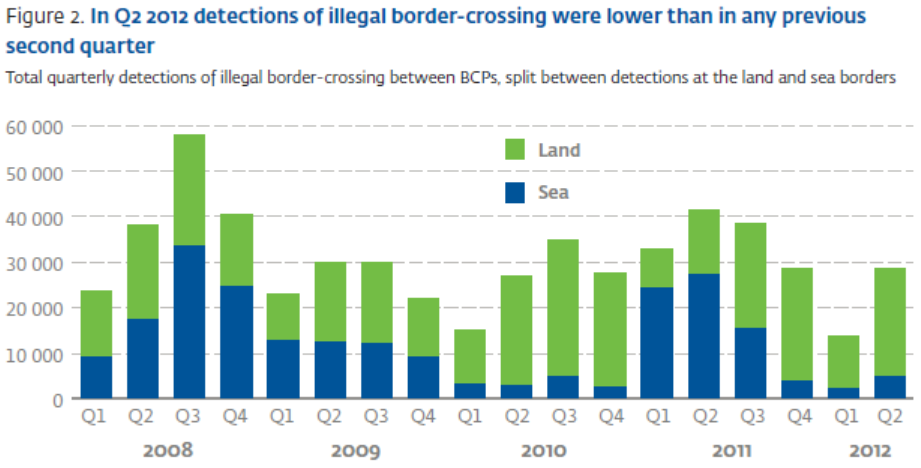
Overall, in Q2 2012 there were 23 092 detections of illegal border-crossing at the EU level, which is a considerable if somewhat expected seasonal increase compared to the previous quarter, and a 44% decrease compared to the same period in 2011 amidst the influx of migrants during the Arab Spring. Taken as a whole, detections of illegal border-crossing in Q2 2012 were lower than in any other second quarter since FRAN reporting began. Most probably, the low number of detections was due to the overlapping effects of the end of the Arab Spring in its initial countries (Egypt, Libya, Tunisia) and far fewer detections of circular Albanian migrants in Greece. The vast majority of detections were at the EU external land border (77%). [***]

[***] Ranked third among border sections [after the Greece-Turkey land border and the Greece-Albania border section] in Q2 2012 was the blue border of Sicily, where Tunisians, Egyptians and Somalis were increasingly detected. [***]

Figure 2 shows the evolution of the FRAN Indicator 1A – detections of illegal border-crossing, and the proportion of detections between the land and sea borders of the EU per quarter since the beginning of 2008. The second quarter of each year is usually associated with improving weather conditions more favourable for approaching and illegally crossing the external border of the EU. Moreover, conditions that are more favourable for illegal border-crossing are also more favourable for detection. The combination of these two effects tends to produce the highest number of detections during the second quarter of each year. [***]

 2012-10-10_Frontex_FRAN_Q2_2012-FIG_2

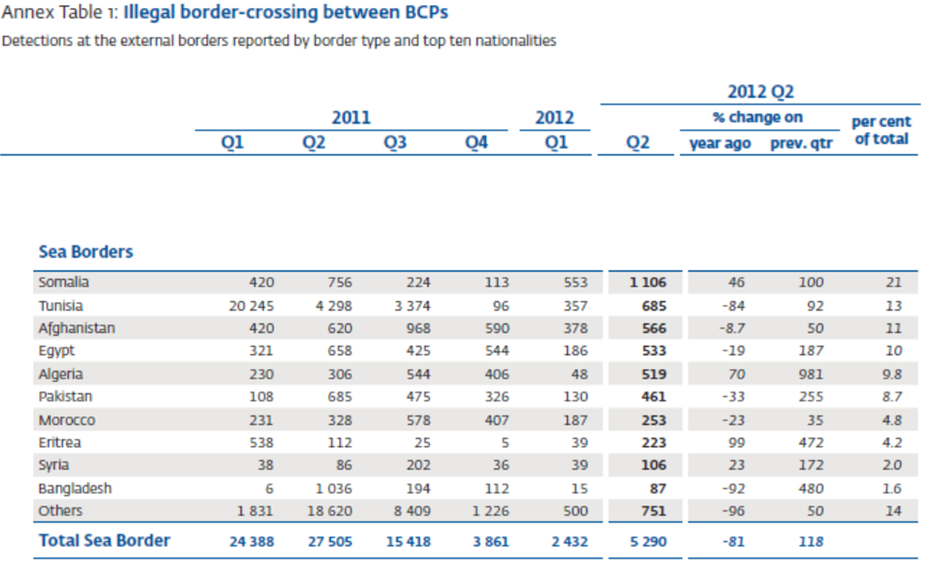
Without question, during the second quarter of 2012 the migrants that were detected with the most increasing frequency were those from Bangladesh (+35%), Somalia (+62%), Algeria (+88%) and Syria (+639%) (Fig. 5). In fact, more migrants from Syria were detected than ever before (2 024). Detections of most of these nationalities were concentrated at the Greek land border with Turkey, with the exception of Somalis, who were mostly detected in Malta. Indeed, Somalis were particularly notable in that their detections were distributed across a very wide range of locations; as well as Malta and the Greek land border with Turkey, they were also detected in Sicily, Lampedusa and the Slovakian land border with the Ukraine. [***]

[M]igrants from Algeria were not only increasingly detected at the Greek land bor[d]er with Turkey, but also in the Spanish maritime region of Almeria and at the Romanian land border with Serbia.The latter case is assumed to represent secondary movements through the Western Balkans region.

4.2 Routes

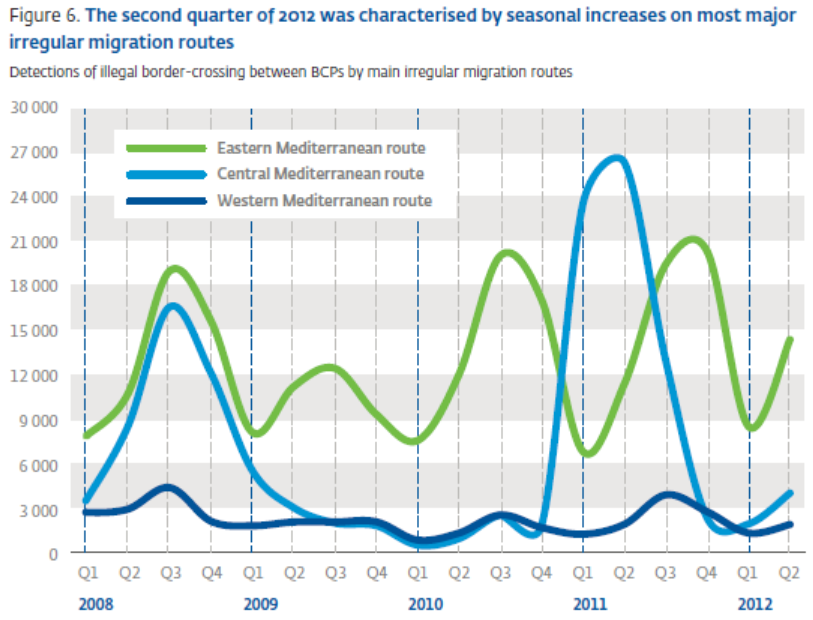
In 2011, detections of illegal border-crossing on the Central Mediterranean route peaked briefly during the period of turbulent sociopolitical developments in North Africa, known as the Arab Spring. In contrast, on the Eastern Mediterranean route, detections have followed a remarkably seasonal pattern over the last two years. Throughout 2011 detections in the Western Mediterranean (land and sea borders with Spain) steadily increased.

As illustrated in Figure 6, the Eastern and Central Mediterranean routes reported the most detections of illegal border-crossing in the second quarter of 2012, and were characterized with seasonal increases consistent with previous years, aside the Central Mediterranean region during the Arab Spring.

2012-10-10_Frontex_FRAN_Q2_2012-FIG_6

In Q2 2012, there were 14 125 detections of illegal border-crossing on the Eastern Mediterranean route, an increase of 27% compared to the same period in 2011 (Fig. 6) rendering this region the undisputed hotspot for illegal entries to the EU during the current reporting period. Elsewhere, detections in the Central Mediterranean showed a seasonal increase but were much reduced (-86%) compared with the dramatic peak during the same period in 2011. Indeed, in the second quarter of 2012 detections in this region resembled the pre-Arab Spring levels reported during the summer of 2010. Detections in the

Western Mediterranean were almost equally comparable to Q2 2011, whereas detections increased to a large degree, yet from lower bases, on the Eastern Borders route (+103%), Western Balkans route (+50%) and Western African route (+29%).

These routes not only differed in their magnitudes over time but also in the composition of detected nationalities. Consistent with previous periods, detections on the Eastern Mediterranean route were dominated by migrants from Afghanistan, and more recently Bangladesh, Algeria and Syria. The Central Mediterranean was recently affected by increased detections of Somalis, and a steady trend of Tunisians and Egyptians. [***]

[T]he Western Mediterranean route was apparently dominated by local migrants from Morocco and Algeria but with large numbers of unknown nationalities it is assumed that local migrants are also accompanied by other long-distance migrants probably from sub-Saharan Africa. The exception was the much less used Western African route, which was exclusively affected by local migrants from Morocco.

4.2.1. Eastern Mediterranean route

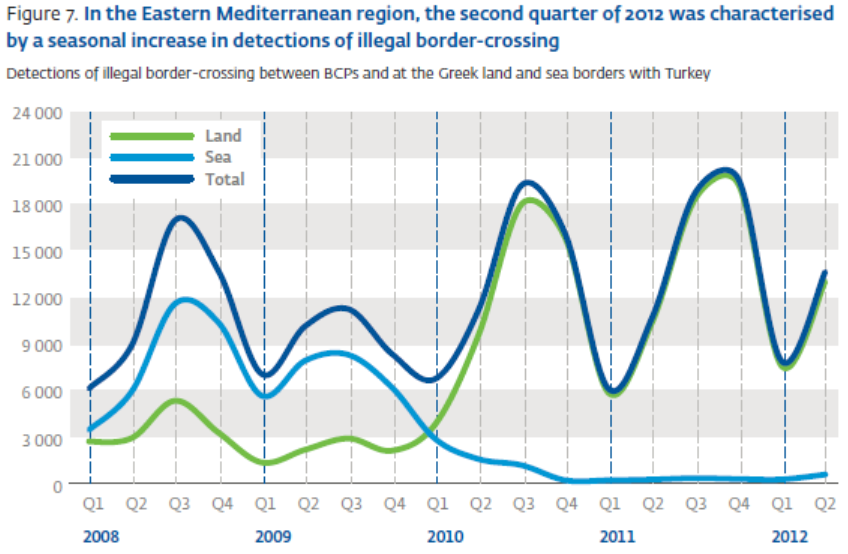
Since data collection began in early 2008, the Eastern Mediterranean has maintained its status as a major hotspot of irregular migration. Detections have followed a remarkably seasonal pattern invariably peaking in the third quarter of each year and concentrated at the border between Greece and Turkey, with a shift from the sea border to the land border visible in late 2009 (Fig. 7). Unusually, at the end of 2011 detections of illegal border- crossing on the Eastern Mediterranean rote remained almost constant between the third and final quarters of the year, resulting in the first recorded example of a sustained peak of detections at that time of year. This was due to an unexpected increase in detections at the Greek land border with Turkey, particularly in October. [***]

2012-10-10_Frontex_FRAN_Q2_2012-FIG_7

Italian Ionian Coast: For some time there has been a steady flow of Afghans and, to a lesser extent, Pakistanis arriving in the Southern Italian blue borders of Calabria and Apulia with some increases during Q2 2012.

Subsequent to the reporting period (July 2012), JO EPN Aeneas 2012 was launched and is currently scheduled to run until the end of October 2012. There are two operational areas, Apulia and Calabria, covering the seashore along the Ionian Sea and part of the Adriatic Sea.

According to Croatian open sources* in July, some 65 Asian and African migrants presumed to be heading to Italy were found drifting some 47 nautical miles south of Dubrovnik due to a broken engine (Fig. 12). They had been drifting for two days. The migrants, who had departed from Greece, did not want to be rescued by the Croatian authorities as they wanted to go to Italy. After several hours of negotiations, the authority for search and rescue towed the sailing boat to the nearest Croatian port.

There was also a recent increase in the numbers of Bangladeshis, Iraqis, Moroccans and Syrians arriving in Apulia from Greece but these detections were in much lower numbers than other nationalities. [***]

4.2.2. Central Mediterranean route

Irregular migration in the Central Mediterranean massively fluctuated in size and composition during 2011, largely due to the political and civil unrest across North Africa, particularly in Tunisia and Libya. Since Q4 2011, the situation has significantly improved following better cooperation between Italian and Tunisian authorities concerning the return of Tunisian nationals.

According to FRAN data, in Q2 2012 there were just 3 685 reported detections of illegal border-crossing on the Central Mediterranean route, a massive decrease compared to the peak in last year in Q2 2011 but an increase compared to late 2011 and early 2012. The increase was almost entirely due to more detections of migrants from Somalia (1 094) combined with a steady stream of migrants still arriving from Tunisia. Several nationalities previously detected in high numbers particularly in 2011 were not detected in significant numbers, including Bangladeshis (72) and Nigerians (19).

Migrants from Somalia – During May 2012, the arrival of Somali migrants in Malta increased significantly while

Italy registered a decrease in the number of Somali migrants apprehended in Sicily and the Pelagic Islands. In most cases, groups of males, females and minors (or families) were found on board rubber dinghies with outboard motors. A few of the boats were detected in Italian territorial waters in some distress after the migrants had called the Italian authorities for help using satellite telephones. The boats that recently headed for Malta were either intercepted by Maltese patrol boats or made it to the island without being intercepted.

Detected Somalis were mainly young males (aged 18–24) with secondary education and low or no income. The main reason for the migration was socio-economic, but in some cases it was military conflict. In Q2 2012, there were no Joint Operations running in the Central Mediterranean Sea, therefore Frontex and the FRAN community are unable to utilize intelligence obtained through the direct debriefing of migrants. However, valuable information has been obtained from interviews carried out by the Maltese authorities. Such preliminary interviews revealed that some of the Somali migrants arriving in Malta had been promised that they would be brought to Italy. They departed from an unknown location in Libya and travelled for up to three days in boats before either being intercepted by Maltese authorities or reaching the shore. The average fare was said to be around USD 1 000 per person.

Migrants from Tunisia – Most Tunisian migrants detected arriving in the Central Mediterranean Region were young (18–35 years) unmarried males with a primary level of education and low previous incomes (EUR 80–180 per month). All interviewed migrants declared to have relatives or friends already in the EU, especially in Italy, and they arrived on boats containing on average 20 migrants (Fig. 13).

Throughout the quarter, Italy and Tunisia cooperated efficiently to repatriate Tunisian nationals and so most migrants typically arrived undocumented to delay readmission. Subsequent to the reporting period, JO Hermes 2012 was launched on 2 July and is currently planned to run until 31 October 2012 as a continuation of the deployment of JO Hermes Extension 2011, which ended just before the reporting period, on 31 March 2012. JO Hermes 2012 has been established to support the Italian authorities in tackling maritime irregular migration along the coasts of Sicily, Pantelleria and the Pelagic islands (Lampedusa, Linosa, Lampione).

4.2.3. Western Mediterranean route

Irregular migration in the Western Mediterranean region increased throughout 2011 from just 890 detections in Q1 2011 to 3 568 detections in Q3. In Q2 2012, there were 1 549 detections which almost exactly corresponds to the number of detections the year before in Q2 2011 (1 569). As was the case a year ago, most detections were of Algerians followed by migrants of unknown nationalities (presumed to be sub-Saharan Africans) and Moroccans.

Recently, the size of the sub-Saharan population coming from Algeria has increased in different settlements adjacent to the Melilla border fence. Criminal networks operate more easily in this north eastern region of Morocco and the Spanish authorities treat a large-scale illegal crossing of the fence to the Spanish side as a real possibility. Attempts to cross have been made in the past involving groups of dozens or even hundreds.

JO EPN Indalo 2012 started on 16 May and is currently scheduled to run until 31 October 2012. So far the number of irregular migrants apprehended in the operational areas is almost double that of the same period in 2011. Analysis of the information provided by the Spanish authorities also indicates a new increasing trend in the number of Algerian and Moroccan migrants per boat since the beginning of 2012. The improvement of the weather and sea conditions during the reporting period impacted on the number of boats detected, with a gradual increase of the number of arrivals during the peak period, which according to data from the last two years is from May to October.

Migrants from Algeria – According to information gathered during interviews, most Algerians were single male adults aged 19–36 on average, but there were also a few females and minors in good health. Most migrants belonged to the lower middle class and, despite having a high level of education compared to sub-Saharan nationals, they suffered from a generalised lack of opportunities, welfare and access to public health services. Nearly all the Algerian migrants spoke Arabic with a few French and English speakers, but all were undocumented to avoid repatriation after arriving in Spain. The majority had relatives or friends in EU Member States, mainly in France and Spain, who could help them to find a job and settle within the ethnic communities already established in these countries.

4.2.4. Western African route

In the second quarter of 2012, there were just 31 detections of illegal border-crossing in this region, almost exclusively of Moroccan nationals.

As reported in the previous FRAN Quarterly*, in February 2012 Moroccan and Spanish Ministers of Interior signed a police agreement to create two joint police stations in the Spanish (Algeciras) and Moroccan (Tangiers) territories to cooperate by exchanging operational information and best practices between different police services. The goal of this cooperation is to strengthen the efforts and improve the results against organized crime operating on both sides of the Strait of Gibraltar involved in the smuggling of drugs, international terrorism, irregular migration and trafficking in human beings.

Following these developments, both International Police Cooperation Centres became operational during May 2012 (Fig. 14). The International Joint Police Stations are going to be integrated with National Police / Guardia Civil (Spain) and General Direction for National Security (Police) / Royal Gendarmerie (Morocco) staff for a rapid and effective exchange of information.

As reported in previous FRAN Quarterlies, the Western African route from the north of Mauritania to the Western Sahara territory is being reopened by illegal migration facilitation networks. It has been inactive for years but recently an estimated 2 000 sub-Saharans (particularly from Senegal) settled in the Western Saharan coastal cities of El Aaioún and Dakhla and in the last few months ~20 000 Senegalese nationals have entered Mauritania along these routes to the north.

During the reporting period there was no Frontex operation relevant for the Western African Route. [***]”

2012-10-10_Frontex_FRAN_Q2_2012-Annex Table 1_Sea Borders only

Click here or here for Report.

4 Comments

Filed under Aegean Sea, Analysis, Data / Stats, Eastern Atlantic, European Union, Frontex, Greece, Italy, Libya, Malta, Mauritania, Mediterranean, Morocco, Reports, Spain, Tunisia

UN Special Rapporteur on HR of Migrants expresses concern over Italy-Libya cooperation on migration

The UN Special Rapporteur on the human rights of migrants, Prof. François Crépeau, for the past six months has been conducting “a one-year comprehensive study to examine the rights of migrants in the Euro-Mediterranean region, focusing in particular on the management of the external borders of the European Union.”  The Special Rapporteur will present a thematic report on the human rights of migrants at the borders of the European Union to the UN Human Rights Council in June 2013.  To date he has concluded official visits to EU offices in Brussels, Tunisia, Turkey, and Italy; a nine-day visit to Greece began on 25 November.  The Special Rapporteur has issued preliminary conclusions at the end of each completed mission.  One common concern is that various actions of the EU and neighbouring countries are resulting in human rights considerations being overshadowed by migration control and security objectives.

At the conclusion of the most recent mission to Italy (30 September – 8 October 2012), the Special Rapporteur expressed concern over Italy’s (and the EU’s) ongoing cooperation with Libya:

“Another matter of paramount importance are the bilateral cooperation agreements negotiated between Italy and its neighbours on the question of migration. Although the EU has negotiated a number of EU wide readmission agreements, the absence of a clear regional framework for such agreements, including a lack of minimum human rights standards, has led to the creation of a number of bilateral readmission agreements between Italy and its neighbours which often do not appear to have human rights at their core.  Of particular concern is the Italy-Libya bilateral cooperation on migration. The 2008 agreement formalised cooperation to strengthen Libya`s capacity to intercept irregular migrants on Libyan territory or territorial waters, even though Libya’s record at effectively protecting the human rights of migrants was poor and reports of human rights abuses of migrants in Libya were frequent. In line with the decision of the European Court of Human Rights pronounced in the Hirsi case that such ‘push-backs’ by Italian authorities towards Libya were not acceptable, the agreement is currently suspended and the Hirsi-defined push-backs appear to have ceased. However, Italy-Libya migration cooperation was recently reinforced through a 2012 processo verbale. This new political framework however, contains very little concrete information on strengthening Libya’s normative framework and institutional capacities regarding the human rights of migrants.”

The Special Rapporteur also expressed concern that the current technical assistance in Search and Rescue capability being provided by Italy to Libya is in effect disguised migration control assistance:

 “Moreover, I have learnt of increased bilateral cooperation between Italian and Libyan authorities regarding search and rescue operations, including the provision of logistical and technical support to Libyan coast guards. Whilst increased search and rescue capacity in the Mediterranean is undoubtedly of paramount importance, I have observed that there appears to be a strong focus on strengthening the capacities of the Libyan authorities to intercept migrants hoping to reach Europe, on both their territory and in their territorial waters, and return them to Libya. In this context, I warn EU member states against a progressive ‘externalisation’ of border control. In particular, considering the on-going difficulties of the Libyan authorities and the reports of human rights abuses against migrants on Libyan territory, this migration cooperation with Libya should not lead to any migrant being returned to Libyan shores against their will, either by Italian coast guards or Guardia di Finanza, or by Libyan coast guards with the technical or logistical support of their Italian counterparts.”

While acknowledging the important support provided to Italy by Frontex, the Special Rapporteur expressed concern over certain Frontex activities in Italy:

“[  ] I am aware that the key focus of FRONTEX remains information and intelligence gathering. In Italy FRONTEX thus works predominantly with the Guarda di Finanza and the Border Police to combat irregular migration, migrant smuggling and other migration related crimes. I remain concerned that these security objectives still appear to overshadow human rights considerations. For example, I have learned that FRONTEX officers conduct interviews with migrants in Italian detention facilities in order to gather information on their journeys. However these interviews are conducted without any external supervision. It is thus essential that effective human rights standards be integrated into all departments and agencies related to border management.”

The Special Rapporteur made the following “Preliminary Recommendations to the Italian government”:

  • “Ensure that migration cooperation with Libya does not lead to any migrant being returned to Libyan shores against their will, either by Italian authorities, or by Libyan authorities with the technical or logistical support of their Italian counterparts.
  • Prohibit the practice of informal automatic “push-backs” to Greece.
  • Guarantee the full access by international organisations, including UNHCR and IOM, civil society organisations and lawyers to all areas where migrants are held or detained to identify protection concerns
  • Develop a nation-wide regulatory framework, with respect for human rights at its core, for the organisation and management of all migrant detention centres.
  • Develop a simpler and fairer appeal system for expulsion and detention orders that integrates human rights considerations at each procedural step.
  • Develop a speedier identification system, including commencing the identification of foreign inmates whilst in prison, in order to make sure that detention of migrants for identification purposes is limited to the shortest time possible, with a maximum of 6 months.”

Similar concerns were expressed by the Special Rapporteur after his missions to Tunisia and Turkey:

Tunisia, 8 June 2012: “… Nevertheless, I learned that a large majority of regional migration initiatives coming from the EU continue to be focused on issues of border control, and do not consider important issues such as the facilitation of regular migration channels. Thus I encourage the European authorities to develop, in the context of the Migration and Mobility Partnership currently being negotiated, and in conjunction with bilateral agreements of the Member States of the Union, a more nuanced policy of migration cooperation with Tunisia, which moves beyond security issues to develop new initiatives in consultation and in real partnership with Tunisian authorities, which place at their core the respect, protection and promotion of the human rights of migrants….”

Turkey, 29 June 2012:  “… While the EU and Turkey have developed a close cooperation on migration issues, which has led to some notable positive developments, the assistance offered to Turkey regarding migration management appears to focus largely on securitising the borders and decreasing irregular migration to the European common territory through focusing on projects related to the detention and removal of migrants in Turkey and the increased monitoring of the Turkish border. Often neglected from the equation, is an equivalent emphasis on the human rights of those most vulnerable and most affected by the migration process: the migrants themselves….”

The Special Rapporteur will likely issue preliminary observations at the conclusion of the current mission to Greece on or after 3 December.

Click here (Italy), here (Tunisia), and here (Turkey) for the Special Rapporteur’s statements.

Click here for the web site for the UN Special Rapporteur on the human rights of migrants.

3 Comments

Filed under Aegean Sea, European Union, Frontex, Greece, Human Rights Council, Italy, Libya, Mediterranean, News, Statements, Tunisia, Turkey, United Nations

EU Court of Justice Annuls Frontex Sea Borders Rule – EU Parliamentary Approval Required (28.11.2012 update)

[UPDATE 28 November 2012: The European Commission intends to present a legislative proposal in early 2013 to replace the annulled Frontex sea border operations rule (Council Decision 2010/252/EU).  See EC’s “Second biannual report on the functioning of the Schengen area” covering the period 1 May 2012-31 October 2012.  (COM(2012) 686 final, 23.11.2012)]

The EU Court of Justice, Grand Chamber, issued a judgment on 5 September 2012 annulling Council Decision 2010/252/EU of 26 April 2010 supplementing the Schengen Borders Code as regards the surveillance of the sea external borders in the context of operational cooperation coordinated by [Frontex] (OJ 2010 L 111, p. 20), i.e. the Frontex Sea Borders Rule.  ECJ Advocate General Paolo Mengozzi issued an Opinion on 17 April 2012 recommending that the Court annul the Rule.

The Court concluded that the provisions of the contested rule were not minor, non-essential provisions, but instead “constitute[d] a major [new] development in the [Schengen Borders Code] system” and which therefore required the consideration and approval of the European Parliament.

The Court stated that the Schengen Borders Code (“SBC”) as it currently stands “does not contain any rules concerning the measures which border guards are authorised to apply against persons or ships when they are apprehended….”  The contested rule “lays down the measures which border guards may take against ships [authorising] ships to be stopped, boarded, searched and seized…”  The contested rule “lays down rules on the disembarkation of the persons intercepted or rescued …stating that priority should be given to disembarkation in the third country from where the ship carrying the persons departed.”

The Court said the adoption of such rules conferring “enforcement powers on border guards …entails political choices falling within the responsibilities of the European Union legislature, in that it requires the conflicting interests at issue to be weighed up on the basis of a number of assessments. Depending on the political choices on the basis of which those rules are adopted, the powers of the border guards may vary significantly, and the exercise of those powers require authorisation, be an obligation or be prohibited, for example, in relation to applying enforcement measures, using force or conducting the persons apprehended to a specific location. In addition, where those powers concern the taking of measures against ships, their exercise is liable, depending on the scope of the powers, to interfere with the sovereign rights of third countries according to the flag flown by the ships concerned. Thus, the adoption of such rules constitutes a major development in the SBC system.”

The Court also noted that “the powers conferred in the contested [rule] mean that the fundamental rights of the persons concerned may be interfered with to such an extent that the involvement of the European Union legislature is required.”

For these reasons the Court decided that the “contested [rule] must be annulled in its entirety because it contains essential elements of the surveillance of the sea external borders of the Member States which go beyond the scope of the additional measures within the meaning of Article 12(5) of the SBC, and only the European Union legislature was entitled to adopt such a decision.”

The Court ordered “the effects of the contested [rule] [to]  be maintained until the entry into force, within a reasonable time, of new rules intended to replace the contested decision annulled by the present judgment.”

Click here or here for Judgment.

Extensive Excerpts from Judgment:

THE COURT (Grand Chamber), composed of V. Skouris, President, A. Tizzano, J.N. Cunha Rodrigues, K. Lenaerts, J.-C. Bonichot and A. Prechal, Presidents of Chambers, R. Silva de Lapuerta, K. Schiemann, E. Juhász, G. Arestis, T. von Danwitz (Rapporteur), M. Berger and E. Jarašiūnas, Judges,

Advocate General: P. Mengozzi,

having regard to the written procedure and further to the hearing on 25 January 2012, after hearing the Opinion of the Advocate General at the sitting on 17 April 2012, gives the following Judgment

1. By its action, the European Parliament seeks the annulment of Council Decision 2010/252/EU of 26 April 2010 supplementing the Schengen Borders Code as regards the surveillance of the sea external borders in the context of operational cooperation coordinated by [FRONTEX] (OJ 2010 L 111, p. 20, ‘the contested decision’).

2. [***] The Parliament submits that the provisions of the contested decision ought to have been adopted by the ordinary legislative procedure and not by the comitology procedure based on Article 12(5) of the SBC [Schengen Borders Code].

I – Legal context

A – Decision 1999/468/EC

3.-7. [***]

B – The SBC

8.-16.[***]

C – Regulation (EC) No 2007/2004

17.-21.[***]

D – The contested decision

22.-29.[***]

II – Forms of order sought by the parties and the procedure before the Court

30. The Parliament claims that the Court should:

– annul the contested decision;

– order that the effects of the contested decision be maintained until it is replaced, …

31. The Council contends that the Court should:

– dismiss the Parliament’s action as inadmissible;

– in the alternative, dismiss the action as unfounded, …

32.[***] the Commission was granted leave to intervene in support of the form of order sought by the Council and, in its statement in intervention, it requests the Court to dismiss the Parliament’s action …..

III – The action

A – The admissibility of the action

33.-40.[***]

41. It follows from the above that the action for annulment must be declared to be admissible.

B – Substance

1. Arguments of the parties

42. [***]

(a) As regards the principles governing the implementing powers

43. The Parliament submits that the regulatory procedure with scrutiny can have as its subject-matter the modification or removal of non-essential elements of a basic instrument or the addition of new non-essential elements, but not the modification of the essential elements of such an instrument. [***]

44.-45.[***]

46. The Commission contends that [it has] the power to put flesh on the bones of the essential elements which the co‑legislators have chosen not to detail in extenso . It is authorised to supplement those elements and to regulate new activities within the scope of the essential subject-matter and of the essential rules.

(b) As regards the contested decision

47. Although the Parliament does not challenge the objectives of the contested decision, it takes the view that its content ought to have been adopted by means of a legislative act and not by an implementing measure. That decision goes beyond the scope of the implementing powers referred to in Article 12(5) of the SBC because it introduces new essential elements into that code and alters essential elements of the SBC as well as the content of the Frontex Regulation.

(i) Introduction of new essential elements into the SBC

48. As regards the introduction of new essential elements into the SBC, the Parliament submits that Parts I and II to the Annex of the contested decision lay down measures which cannot be considered to be within the scope of border surveillance as defined by the SBC or to be a non‑essential element of that code.

49. Thus, …, paragraph 2.4 of Part I to the Annex of the contested decision does not merely lay down detailed practical rules of border surveillance but grants border guards far‑reaching powers. The SBC is silent as to the measures which might be taken against persons or ships. However, the contested decision lays down far-reaching enforcement measures, yet does not ensure the right of persons intercepted on the high seas to claim asylum and associated rights, whereas, in accordance with Article 13 of the SBC, returning the persons concerned to the country from where they came can only arise in the context of a formal refusal of entry.

50. In addition, the rules relating to activities such as search and rescue and disembarkation in Part II to the Annex of the contested decision do not, in the Parliament’s view, fall within the concept of surveillance. Even though the title of Part II contains the word ‘guidelines’, Part II is binding and is intended to produce legal effects as against Member States which participate in an operation coordinated by the Agency, due to its wording, the fact that it is contained in a legally binding instrument, and the fact that it forms part of an operational plan provided for by the Frontex Regulation. The contested decision thus contains essential elements of the SBC and could not therefore be regulated in an implementing measure.

51. In addition, the Parliament submits that the contested decision exceeds the territorial scope of the SBC . In accordance with Article 2(11) of the SBC, surveillance is limited to the surveillance of borders between border crossing points and the surveillance of border crossing points outside the fixed opening hours, whereas, in accordance with paragraph 2.5 of Part I to its Annex, the contested decision applies not only to territorial waters, but also to contiguous zones and to the high seas.

52. [***]

53. [***] The Council contends that the argument alleging an extension of the territorial scope of the SBC is unfounded, since that code does not define the concept of a sea border, which must be understood as applying also to border surveillance carried out in the contiguous zones as well as on the high seas.

54. [***] Admittedly, helping ships in distress is not a surveillance measure in the narrow sense. However, if such a situation were to occur during a surveillance operation coordinated by the Agency, it would be indispensable to coordinate in advance how the search and rescue was conducted by various participating Member States. In those circumstances, the Council takes the view that the contested decision does not introduce new elements into the SBC.

55. The Commission contends that border surveillance is an essential element of the SBC, but that the essential rules governing that matter are found in Article 12 of the SBC which lays down provisions regarding the content as well as the object and purpose of the surveillance without serving to regulate that surveillance extensively and exhaustively. The co-legislators conferred on the Commission the power to supplement those essential elements. The power to regulate new activities allows the Commission to regulate the content of border surveillance and to define what that activity entails.

56. The Commission contends that the contested decision does not introduce new essential elements into the SBC. Surveillance must, in the light of its purpose, not only encompass the detection of attempts to gain illegal entry into the European Union but also extend to positive steps such as intercepting ships which are suspected of trying to gain entry to the Union without submitting to border checks. Article 12(4) of the SBC specifically mentions one of the purposes of surveillance as being to apprehend individuals. In order to assess whether ‘search and rescue’ falls within the concept of surveillance, it is important to take into consideration the factual circumstances in which attempted illegal entries arise. In many instances, the surveillance operation will prompt the search and rescue situation, and it is not possible to draw a sharp distinction between those operations. The issue of whether or not the guidelines are binding does not arise, given that the measures which they lay down fall within the concept of surveillance.

(ii) Modification of essential elements of the SBC

57. As regards the modification of the essential elements of the SBC, the Parliament contends, in particular, that the contested decision alters Article 13 of the Code. Since that article applies to any form of interception, persons who have entered illegally into the territorial waters and contiguous zones cannot be forced back or asked to leave without a decision pursuant to Article 13 of the SBC. However, paragraph 2.4 of Part I to the Annex of the contested decision confers on border guards the power to order the ship to modify its course outside of the territorial waters, without a decision within the meaning of Article 13 being taken or without the persons concerned having the possibility to challenge the refusal of entry.

58. In that connection, the Council and the Commission contend that Article 13 of the SBC does not apply to border surveillance activities so that the contested decision does not amend that article.

(iii) Amendment of the Frontex Regulation

59. As regards the amendment of the Frontex Regulation, the Parliament contends that Article 12(5) of the SBC does not grant the Commission the power to lay down rules which amend the powers and obligations set out by the Frontex Regulation for the operations co-ordinated by the Agency. The contested decision is not the appropriate legal instrument for creating obligations in relation to those operations or for modifying the provisions of the Frontex Regulation.

60. However, the contested decision is intended to apply only within the context of operations coordinated by the Agency and is obligatory not only for the Member States but also for the Agency, in light of the fact that its Annex forms part of the operational plan for each operation, whilst Article 8e of the Frontex Regulation determines the main elements of that plan. The mandatory inclusion in the operational plan of the rules and guidelines set out in the Annex of the contested decision significantly amends the list of necessary elements for the implementation of that plan, such as the roles of border guards, the participating units and the Rescue Coordination Centre, respectively.

61. In that connection, the Council contends that the contested decision does not amend the tasks of the Agency, even though the Annex of that decision forms part of the operational plan. [***]

62. According to the Commission, the contested decision does not affect the operation of the Frontex Regulation. The requirement in Article 1 of the contested decision that both Parts to the Annex are to be part of the operational plan imposes a requirement not upon the Agency, but rather the Member States as the persons to whom that decision is addressed and responsible for ensuring that the Annex forms part of that plan. In those circumstances, the contested decision does not amend the Frontex Regulation.

2. Findings of the Court

63.-68. [***]

69. As to whether the Council was empowered to adopt the contested decision as a measure implementing Article 12 of the SBC on border surveillance, on the basis of Article 12(5) of that code, it is first of all necessary to assess the meaning of that article.

70.-72.[***]

73. Although the SBC, which is the basic legislation in the matter, states in Article 12(4) thereof, that the aim of such [border] surveillance is to apprehend individuals crossing the border illegally, it does not contain any rules concerning the measures which border guards are authorised to apply against persons or ships when they are apprehended and subsequently – such as the application of enforcement measures, the use of force or conducting the persons apprehended to a specific location – or even measures against persons implicated in human trafficking.

74. That said, paragraph 2.4 of Part I to the Annex of the contested decision lays down the measures which border guards may take against ships detected and persons on board. In that connection, paragraph 2.4 (b), (d), (f) and (g) allows, inter alia, ships to be stopped, boarded, searched and seized, the persons on board to be searched and stopped, the ship or persons on board to be conducted to another Member State, and thus enforcement measures to be taken against persons and ships which could be subject to the sovereignty of the State whose flag they are flying.

75. In addition, paragraph 1.1 of Part II to the Annex of the contested decision lays down, inter alia, the obligation of the units participating in sea external border operations coordinated by the Agency to provide assistance to any vessel or person in distress at sea. Paragraph 2 of Part II lays down rules on the disembarkation of the persons intercepted or rescued, the second subparagraph of paragraph 2.1 stating that priority should be given to disembarkation in the third country from where the ship carrying the persons departed.

76. First, the adoption of rules on the conferral of enforcement powers on border guards, referred to in paragraphs 74 and 75 above, entails political choices falling within the responsibilities of the European Union legislature, in that it requires the conflicting interests at issue to be weighed up on the basis of a number of assessments. Depending on the political choices on the basis of which those rules are adopted, the powers of the border guards may vary significantly, and the exercise of those powers require authorisation, be an obligation or be prohibited, for example, in relation to applying enforcement measures, using force or conducting the persons apprehended to a specific location. In addition, where those powers concern the taking of measures against ships, their exercise is liable, depending on the scope of the powers, to interfere with the sovereign rights of third countries according to the flag flown by the ships concerned. Thus, the adoption of such rules constitutes a major development in the SBC system.

77. Second, it is important to point out that provisions on conferring powers of public authority on border guards – such as the powers conferred in the contested decision, which include stopping persons apprehended, seizing vessels and conducting persons apprehended to a specific location – mean that the fundamental rights of the persons concerned may be interfered with to such an extent that the involvement of the European Union legislature is required.

78. Thus, the adoption of provisions such as those laid down in paragraph 2.4 of Part I, and paragraphs 1.1 and 2.1 of Part II, of the Annex to the contested decision, requires political choices to be made as referred to in paragraphs 76 and 77 above. Accordingly, the adoption of such provisions goes beyond the scope of the additional measures within the meaning of Article 12(5) of the SBC and, in the context of the European Union’s institutional system, is a matter for the legislature.

79. In those circumstances, it must be found that, as the Advocate General observed in points 61 and 66 of his Opinion, Parts I and II to the Annex of the contested decision contain essential elements of external maritime border surveillance.

80. The mere fact that the title of Part II to the Annex of the contested decision contains the word ‘guidelines’ and that the second sentence of Article 1 of that decision states that the rules and guidelines in Part II are ‘non-binding’ cannot affect their classification as essential rules.

81.-83. [***]

84. In those circumstances, the contested decision must be annulled in its entirety because it contains essential elements of the surveillance of the sea external borders of the Member States which go beyond the scope of the additional measures within the meaning of Article 12(5) of the SBC, and only the European Union legislature was entitled to adopt such a decision.

85. Consequently, the Parliament’s arguments to the effect that the contested decision amends the essential elements of the SBC and also the Frontex Regulation do not require to be examined.

IV – The application for the effects of the contested decision to be maintained

86. The Parliament requests the Court, should it annul the contested decision, to maintain its effects, pursuant to the second paragraph of Article 264 TFEU, until that decision is replaced.

87. The Parliament submits that it is necessary to maintain the effects of the contested decision, in the light of the importance of the objectives of the proposed measures in the context of the European Union’s policy on border control operations.

88. [***]

89. The annulment of the contested decision without maintaining its effects on a provisional basis could compromise the smooth functioning of the current and future operations coordinated by the Agency and, consequently, the surveillance of the sea external borders of the Member States.

90. In those circumstances, there are important grounds of legal certainty which justify the Court exercising the power conferred on it by the second paragraph of Article 264 TFEU. In the present case, the effects of the contested decision must be maintained until the entry into force, within a reasonable time, of new rules intended to replace the contested decision annulled by the present judgment.

V – Costs

91. [***]

On those grounds, the Court (Grand Chamber) hereby:

1. Annuls Council Decision 2010/252/EU of 26 April 2010 supplementing the Schengen Borders Code as regards the surveillance of the sea external borders in the context of operational cooperation coordinated by the European Agency for the Management of Operational Cooperation at the External Borders of the Member States of the European Union;

2. Maintains the effects of decision 2010/252 until the entry into force of new rules within a reasonable time;

3. Orders the Council of the European Union to pay the costs;

4. Orders the European Commission to bear its own costs.

2 Comments

Filed under European Union, Frontex, Judicial, News

Frontex to Increase Sea and Air Patrols in Aegean at Greece’s Request

Greek news reports say that Greek officials have made requests to Commissioner Malmström and Frontex for assistance to respond to “increasing migratory pressures on the islands of the Eastern Aegean.”  The Greek islands of Lesvos, Samos, Patmos, Leros and Symi in particular have reportedly seen an increase in the number of persons entering from nearby Turkish territory.  According to the media reports the assistance will include the deployment of “four aerial vehicle[s], four patrol boats, three mobile surveillance units and eight expert officers, whose costs will be covered by EU funds the agency and the European Commission.”

Click here and here for articles. (EL)

1 Comment

Filed under Aegean Sea, European Union, Frontex, Greece, Mediterranean, News, Turkey

European Ombudsman Opens Public Consultation on Frontex and EU Charter of Fundamental Rights; NGOs and Public Invited to Submit Comments

Text of 19 July 2012 press release from the European Ombudsman:  “The European Ombudsman, P. Nikiforos Diamandouros, has invited individuals, NGOs, and other organisations active in the area of fundamental rights protection to submit comments in his ongoing inquiry concerning the EU Borders Agency, Frontex. Frontex coordinates the operational cooperation between Member States in the field of border security. In March 2012, the Ombudsman asked Frontex a number of questions about the implementation of its fundamental rights obligations. Frontex replied in May 2012. Comments on Frontex’s response can be submitted to the Ombudsman until 30 September 2012.

Fundamental rights organisations and NGOs invited to submit comments

In 2009, the Charter of Fundamental Rights became legally binding on Frontex, which is based in Warsaw. Since then, a number of civil society organisations have questioned whether Frontex is doing enough to comply with the Charter, for example, in its deployment of EU border guards to Greece where migrant detainees were kept in detention centres under conditions which have been criticised by the European Court of Human Rights.

In October 2011, the European Parliament and the Council adopted a Regulation setting out additional specific fundamental rights obligations for Frontex. In March 2012, the Ombudsman asked Frontex a number of questions about how it is fulfilling these obligations, including the obligation to draw up a fundamental rights strategy, as well as codes of conduct applicable to its operations.

Frontex submitted its opinion in May 2012. It explained that, since 2010, it has developed a fundamental rights strategy, as well as a binding code of conduct for those participating in its activities. Frontex also listed other measures it is currently taking to ensure full respect for fundamental rights.

The Ombudsman considers that, before proceeding further, it would be useful to seek information and views from NGOs and other organisations active in the area of fundamental rights protection. He therefore invites interested parties to make observations on Frontex’s opinion. The Ombudsman has also invited the EU Fundamental Rights Agency to give its views.

All documents related to the inquiry, including Frontex’s opinion, are available at: http://www.ombudsman.europa.eu/en/cases/correspondence.faces/en/11757/html.bookmark

From the Ombudsman’s website:

What the Ombudsman is looking for

The present inquiry concerns the implementation by Frontex of its fundamental rights obligations. The Ombudsman would, therefore, be highly interested in receiving feedback from interested parties, such as NGOs and other organisations specialised in the areas covered by his inquiry, on Frontex’s answers to the questions he put to it.

The present inquiry is not intended to examine and solve individual cases involving Frontex’s fundamental rights obligations. Such cases can of course be submitted to the Ombudsman through individual complaints. A complaint form that can be used for this purpose is available on this website.

How to contribute

Comments should be sent to the Ombudsman by 30 September 2012.

Click here for press release.

Click here for all documents related to the inquiry.

Click here for Frontex’s 17 May 2012 response.

1 Comment

Filed under European Ombudsman, European Union, Frontex, News, Reports

HRW Report on Malta’s Migrant Detention Policy: “Boat Ride to Detention”

Human Rights Watch has issued a report, “Boat Ride to Detention – Adult and Child Migrants in Malta”, documenting the treatment of migrants and asylum seekers arriving by boat in Malta and concluding that the mandatory detention policy violates international law.

Excerpts:

Summary – Malta routinely detains an average of 1,500 people per year, including children, who arrive in the country by boat without permission, or ‘irregularly.’ These are migrants and asylum seekers, typically from Somalia, Eritrea, and other sub-Saharan African countries, who travel to Europe fleeing persecution or in search of a better life. Many have fled violence and conflict, and almost all have made an arduous journey, taking months to cross the Sahara and travel north through Libya. The last stage of that journey is a perilous, multiday trip across the Mediterranean, typically in overcrowded vessels that are not seaworthy, and without enough food, water, or fuel, before they reach Maltese shores or are intercepted at sea by the Armed Forces of Malta.

Boat migrants arriving in Malta are taken straight to detention if they lack an entry visa (as they virtually all do). This report addresses their arbitrary, indiscriminate, and unfair detention. The report focuses on those who arrive in Malta by boat, as migrants who arrive in Malta by air for the most part are not detained, even if they enter under false pretenses or subsequently claim asylum. Asylum seekers who arrive by boat are detained for up to 12 months, and migrants who do not apply for asylum, or whose asylum claims are rejected, can be detained for up to 18 months. Under international law migrants who do not have permission to enter or stay in a country may be subject to detention, in certain circumstances, and also may be subject to safeguards. However in Malta, the detention policy operates in an automated, indiscriminate, and blanket manner in violation of international law.

In the course of this virtually automated detention policy, Malta routinely detains unaccompanied migrant children whose age is in question. ‘Unaccompanied children’ are migrants under the age of 18 (typically between 14 and 17) who travel without parents or caregivers. Migrants who claim to be unaccompanied children go through an age determination procedure, which relies on interviews and occasional medical testing to establish age. In 2007 and 2008, for example, around 400 children each year arrived in Malta claiming to be unaccompanied.1 While they register for and undergo the age determination procedure, Malta keeps these children in detention. [***]

While Malta justifies its prolonged detention of migrants as a legitimate response to irregular entry, the practice amounts to arbitrary detention prohibited by international law. Prolonged administrative custody, without the possibility of meaningful review, violates the prohibition on arbitrary detention in article 9 of the International Covenant on Civil and Political Rights, and the European Court of Human Rights has found Malta’s detention policy to violate the European Convention’s provisions on the right to liberty. Children enjoy particular protection under the law: in principle, migrant children should not be detained, and where they are detained it must be as a last resort for the shortest appropriate period of time. [***]

Flawed Maltese and European Migration Policies

Malta’s detention policy is part of flawed approaches to migration, both by Malta itself and by the European Union (EU). The central Mediterranean migration route—typically from Libya to Malta or Italy—is a major entrance point to the EU. Since 2002, approximately 15,000 migrants have reached Malta by this route, some intentionally, many by mistake as they stumble across the small island country while hoping to reach Italy. While the number of migrants arriving in Malta is low in absolute terms, Malta now has the highest number of asylum seekers relative to the national population of any country in the industrialized world. Malta, a country of only 400,000 people, received 20.1 asylum seekers per 1,000 inhabitants in the years 2007-2011, whereas France, the EU member state receiving the largest number of asylum seekers in absolute terms in 2011, received about 3 per 1,000.

Although migrants have been traveling this migration route—in higher or lower numbers— for some ten years, neither Malta nor the EU has developed a sound policy that either respects migrants’ human rights or that addresses the high burden placed on Malta. EU asylum rules mean that member states at EU borders sometimes are forced to assume responsibility for a vastly disproportionate share of migrants and asylum seekers. The Dublin II regulation, promulgated in 2003, mandates that an individual’s asylum application must be processed in the country where the individual first entered the EU. This places an unfair burden on Malta, which must process these asylum applications in-country and which is obliged to accept the return of any asylum seekers whose first port of entry in the EU was Malta.

The EU has taken some steps towards mitigating this burden, for instance by relocating recognized refugees from Malta to other EU states and providing limited financial support. But these steps have been insufficient to assist Malta in meeting migrants’ needs. The case of Malta, like that of Greece, shows the need to revise the Dublin II regulation to permit greater burden sharing in processing and hosting asylum seekers, rather than insisting on the country of first arrival as the primary factor in assessing member state responsibility.

Malta’s arbitrary detention policy, in addition to violating international standards, does not work to deter migrants from landing on its shores. Migrants may not intend to travel to Malta, and indeed the boats in which they travel lack navigational equipment that would enable them to choose their destination. Some migrants Human Rights Watch spoke with said they did not even know that Malta existed as a country before they landed there.

Though Malta’s burden is disproportionately large, detention is neither a legal nor a sound response to boat migration in the central Mediterranean. Both Malta and the EU should enact new policies to respond to their legal obligations to uphold migrants’ rights.

  • Malta should allow detention of migrants only in exceptional circumstances, with individualized determinations, and access to procedures to challenge detention.
  • Malta should treat those who claim to be children as such pending the outcome of age determination proceedings, and release all those with pending claims from detention.
  • The EU should reform the Dublin system by having the Dublin regulation take into account equitable burden-sharing among member countries.

[***]

IV. Conclusion

[***] Malta must revise its migrant detention policies for adult and child migrants alike, and end the continued mental stress imposed on migrants kept in prolonged detention. Maltese laws should allow detention of migrants only in exceptional circumstances, with individualized determinations, and access to procedures to challenge detention.”

Click here or here for Report.

Click here for HRW press release.

3 Comments

Filed under European Union, Malta, Mediterranean, Reports

Boats4People Releases Mapping Platform to Monitor the Maritime Borders of the EU for Violations of Migrants’ Rights

Boats4People announced last week the release of a mapping platform to monitor “in almost real-time reported cases of migrants in distress at sea”. The project is called WatchTheMed and “is a collaboration between the Forensic Oceanography research project at Goldsmiths College and Boats4People, a campaign led by an international coalition of NGOs aiming at bringing an end to the death of migrants at sea and foster solidarity between both sides of the Mediterranean.”

Press Release: 03.07.2012 WatchTheMed

Boats4People Mapping Platform to Monitor the Maritime Borders of the EU for Violations of Migrants’ Rights

While Boats4People’s Oloferne boat is at sea, many other participants are contributing from the land in Italy, Tunisia, across Africa and Europe and even as far as the USA. Amongst them, researchers of the Forensic Oceanography research project at Goldsmiths, University of London, who, in the frame of the B4P campaign, have launched a new online mapping platform to monitor in almost real time the death of migrants and violations of their rights at the Maritime Borders of the EU.

Acting as a “civilian watchtower” over the Mediterranean, WatchTheMed aims to collect all possible sources of information concerning incidents at sea: distress signals send out by Coast Guards, news articles, reports by different partners, testimonies from migrants, satellite imagery. It inscribes these incidents within the complex political ecology of the Mediterranean: overlapping Search and Rescue zones, maritime patrols, radar coverage.

By assembling these multiple sources of information so as to document with the highest possible degree of precision incidents at sea and by spatialising this data, the aim is to develop a new tool to increase accountability in the Mediterranean.

During the three weeks of the B4P journey, the WatchTheMed platform will be regularly updated. Help us monitor the maritime borders of the EU by reporting an incident, maritime patrols or means of surveillance on the website www.watchthemed.crowdmap.com or send us an email at: obs@boats4people.org.

For more information on the Forensic Oceanography project visit:
http://www.forensic-architecture.org/investigations/forensic-oceanography/

WatchTheMed
Una piattaforma per mappare le violazioni dei diritti dei migranti ai confini marittimi dell’ EU.

WatchTheMed è una collaborazione fra Boats4People e il progetto di ricerca Forensic Oceanography del Goldsmiths College.

WatchTheMed vuole essere uno strumento per mettere fine all’impunità per la morte dei migranti in mare e la violazione dei loro diritti ai confini marittimi dell’UE. Per fare questo, monitora e mappa in tempo (quasi) reale casi di migranti in difficoltà in mare, di violazioni dei loro diritti e di decessi. Questi episodi vengono inscritti nell’ambito della complessa ecologia politica del Mediterraneo, con un attenzione particolare al Canale di Sicilia.

Questa mappa è un progetto pilota partito nel luglio 2012. Aiutaci a monitorare i confini marittimi dell’ Unione Europea, visita il sito www.watchthemed.crowdmap.com.

WatchTheMed
Une plateforme pour cartographier les violations des droits des migrants aux frontières maritimes de l’UE

WatchTheMed est une collaboration entre Boats4People et le projet de recherche Forensic Oceanography de l’Université de Goldsmiths, Londres.

WatchTheMed vise à être un outil pour mettre un terme à l’impunité qui entoure les morts des migrants et les violations de leurs droits aux frontières maritimes de l‘ UE. A cette fin, le projet observe et cartographie en temps presque réel les cas rapportés de détresse, de violations du droit et de morts en mer, et inscrit ceux-ci dans la structure complexe de la Méditerranée, en mettant l’accent sur le Canal de Sicile.
Cette carte est un projet pilote lancé en juillet 2012. Aidez nous à observer les frontières maritimes de l’UE, rapportez un incident en visitant le site www.watchthemed.crowdmap.com.

1 Comment

Filed under European Union, Frontex, Italy, Libya, Malta, Mediterranean, News, Reports, Tunisia