Tag Archives: European Union

EU Foreign Affairs Council: Condemnation of Libya, but No Call for Sanctions or Travel Bans

The conclusions of the just completed EU Council meeting on Foreign Affairs were released yesterday.  Not surprisingly, Libya was a major topic of discussion and there was condemnation of the Libyan government’s actions.  But there is a strong difference of opinion among member states regarding what else should be done.  Finnish Foreign Minister Alexander Stubb called for the imposition of sanctions against Gaddafi, his family, and Libyan government officials saying “it was hypocritical that Europe last month slapped sanctions on the Belarussian leader, Alexander Lukashenko, and his associates. ‘How can we on one side look at what’s going on in Libya, with almost 300 people shot dead, and not talk about sanctions or travel bans, and at the same time put travel bans and sanctions in Belarus?’.”  Italy strongly opposed imposing sanction against Libya:  Italian Foreign Minister Franco Frattini called for a “European Marshall Plan” instead of sanctions.  His plan would “include political, economic, and social support” for Libya.

Among the agreed upon conclusions was the following:  “The Council stresses the importance of strengthened cooperation with Mediterranean countries to address illegal immigration, in accordance with the principles of international law. JHA Ministers meeting later this week in the Council will pursue detailed work on this issue.”

Click here for the Foreign Affairs Council Meeting Conclusions.

Click here, here, here, and here for articles. (EN)

Leave a comment

Filed under Communiqués, European Union, Italy, Libya, Mediterranean, News, Tunisia

Libyan Interior Minister Met Commissioner Malmström on 15 Feb.

According to the EU Observer, Libya’s Interior Minister met last week with Commissioner Cecilia Malmström: “It emerged on Monday  [21 Feb.] that the Libyan interior minister, Abdel Fatah Younes, visited EU home affairs commissioner [Cecilia Malmström] last Tuesday (15 February) to discuss ‘how to put into practice’ an agreement reached in October on immigration co-operation.  The commission last year offered the country some €50 million euros to assist in efforts to prevent irregular migrants from reaching the Mediterranean’s northern shores. At the meeting, it is thought that a figure of 2 million refugees was brandished by Mr Younes.”

It is unclear from the article whether Libya used this meeting with Malmström to communicate a threat to halt cooperation on irregular immigration similar to the one that was communicated to the Hungarian Ambassador to Libya on 17 February or whether this was an otherwise routine meeting in furtherance of the EU-Libya framework agreement.

Click here for article.

1 Comment

Filed under European Union, Libya, Mediterranean, News

Frattini and Berlusconi Slow to Criticise Gaddafi

As reported by the EU Observer, while the EU and most member states are now condemning Libya’s actions, “[o]n the other side of the EU divide, Italy is horrified at the possible loss of a close ally. Foreign minister and ex-EU-commissioner Franco Frattini is trying to convince other European states that Mr Gaddafi has promised constitutional reforms and that the bloc should allow him to make good. ‘Italy as you know is the closest neighbour of both Tunisia and Libya so we are extremely concerned about the repercussions on the migratory situation in the southern Mediterranean,’ Mr Frattini told reporters on Sunday. The previous day, Prime Minister Silvio Berlusconi said he did not want to ‘disturb’ his long-time friend with appeals for restraint.”

Click here for article.

Leave a comment

Filed under European Union, Italy, Libya, Mediterranean, News

Correction-Libyan Govt Summoned Hungarian Ambassador, Not EU Rep

According to a more recent Reuters Africa report, the Libyan threat to halt cooperation on immigration was communicated this past Thursday to the Hungarian Ambassador in Tripoli.  This information was then released by the Hungarian EU Presidency.

Click here for article.

1 Comment

Filed under European Union, Hungary, Libya, Mediterranean, News

Libya Issues Immigration Threat to EU

The EU Hungarian Presidency announced earlier today that the Libyan government summoned the EU representative in Tripoli [UPDATE – it was reportedly the Hungarian Ambassador to Libya who was summoned this past Thursday] and informed the representative that Libya will halt cooperation on illegal migration if the European Union continues to “encourage” protests in Libya.  It is unclear whether there has been any response yet by the EU to the Libyan threat.

Click here and here for articles.  (IT)   [Click here (EN) for updated article.]

Leave a comment

Filed under European Union, Italy, Libya, Malta, Mediterranean, News

Video of Yesterday’s EP Plenary Session Addressing Common EU Asylum System and the Italian Migration Emergency

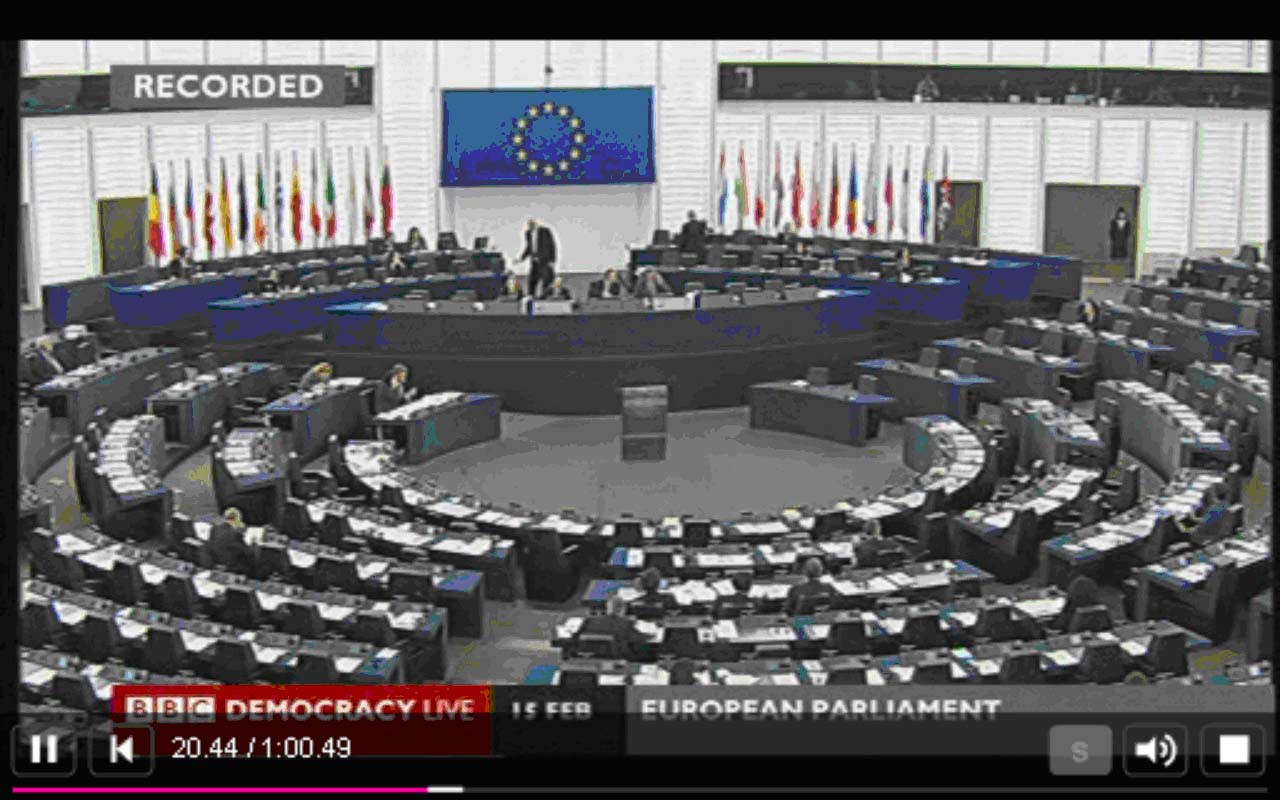
Of possible interest to a few, here are two links to the portions of yesterday’s plenary session of the European Parliament where the Common EU Asylum System and the migration emergency in Italy were discussed by a few MEPs and Commissioner Malmström.  As you can see from my screen shot below of the debate regarding the migration emergency, very few MEPs were in attendance.

Click here (Common EU Asylum System) and here (migration emergency) for link to the BBC’s Democracy Live site with the video.

Leave a comment

Filed under European Union, Frontex, Greece, Italy, Mediterranean, News, Tunisia, Turkey

Over 4000 Migrants Reach Italy – Humanitarian Emergency Declared

Over 4000 migrants have now arrived in Italy from Tunisia.  The Italian government has declared a humanitarian emergency.  Tunisian security forces have reportedly secured the Tunisian port of Zarzis from which many of the migrant boats have departed, but it is not clear whether this and other efforts that are being taken by the new Tunisian government will have an immediate effect on the flow of migrants.

Click here, (EN) here (EN) , and here (EN) , and here (IT)  for articles.

Leave a comment

Filed under European Union, Italy, Mediterranean, News, Tunisia

Malmström Receives Conflicting Information From Italian Government Regarding Need for EU Assistance

Commissioner Cecilia Malmström yesterday described different statements that have been made to her and her staff by Italian Interior Minister Roberto Maroni.  Writing on her blog, Malmström said that she and her staff have had intensive contacts with the Italian Government over the weekend and that the Interior Minister and others said EU assistance was not needed, but that assistance may be needed later in the coming week.  In light of these statements, Malmström expressed her surprise at seeing the Interior Minister’s comments in the media on Sunday where he said he is annoyed with the lack of support from the EU.  (“Così il ministro dell’Interno Roberto Maroni lancia il suo j’accuse:  “Siamo soli, l’Europa non sta facendo nulla”, dice intervistato dal TG5.”)  Malmström speculated that in light of Sunday’s large anti-Berlusconi demonstrations, perhaps the Italian government is simply happy to blame Brussels for something.  Malmström said that tomorrow she will be receiving reports from Frontex and EASO about the situation.

Click here (SV) for Malmström’s blog post.

Click here (IT) for article.

Leave a comment

Filed under European Union, Frontex, Italy, Mediterranean, News, Tunisia

Italy Requests Urgent Deployment of Frontex Patrols to Coast of Tunisia

Italy on Friday requested an urgent meeting of the EU Justice and Home Affairs Council to address the immigration situation that is developing with Tunisia and the arrivals in Italy of over 2000 Tunisians over the past two days.  Interior Minister Maroni said that the bilateral cooperation agreement between Italy and Tunisia that has in the past controlled departures from Tunisia is not being implemented due to the crisis within Tunisia. (“Il problema è che l’accordo bilaterale che abbiamo con la Tunisia che ha permesso finora di gestire in modo efficace l’immigrazione clandestina, non viene attuato da Tunisi per la situazione di crisi. C’è una incapacità di fronteggiare la situazione da parte dell’autorità tunisina”.)

Click here (IT), here (IT), and here (EN) for articles.

1 Comment

Filed under European Union, Frontex, Italy, Mediterranean, News, Tunisia

Euro-Africa Conference on Illegal Immigration, Human Trafficking, Drug Trafficking, and Terrorism (Napoli, 7-9 February)

The Italian Interior Ministry and the Direzione Centrale dell’Immigrazione e della Polizia delle Frontiere are conducting a three day conference, beginning today, in Napoli, 7-9 February.  In attendance will be top police officials from 45 African countries, 25 EU countries as well as officials from agencies including Interpol, Europol, Frontex and, as observers, representatives of the US FBI and Dept. of Homeland Security.  Among those scheduled to attend are Rodolfo Ronconi, Direttore Centrale dell’Immigrazione e della Polizia delle Frontiere, Interior Minister Roberto Maroni, INTERPOL Secretary General Ronald Noble, EUROPOL Director Rob Wainwright, and Frontex Director Ilkka Laitinen.

According to a draft agenda for the conference, discussion topics will include:

  • Immigration Group – The African continent as a source and place of transit for migratory flows towards Europe across the Mediterranean Sea.  Internal migration within African. Threat assessment, ongoing bilateral initiatives, multilateral initiatives, and methods of law enforcement;
  • Group on human trafficking and organized crime – Criminal networks involved in smuggling: prevention and law enforcement investigative techniques, with particular reference to flows from Greece and Central Africa to Europe;
  • Drug Trafficking Group – African continent: new narcotrafficking directed towards Europe;
  • Group on Terrorism – Cyberspace as a new platform for radicalization: comparing experiences.

Original Italian:

  • Gruppo Immigrazione – Il  Continente africano quale origine e transito dei flussi migratory diretti in Europa attraverso il Mar Mediterraneo.  I fenomeni migratori interni al Continente africano.  Valutazione della minaccia, iniziative bilaterali, multilaterali e metodologie di contrasto;
  • Gruppo Tratta degli esseri umani e criminalità organizzata sul tema “Le reti criminali coinvolte nel traffico di migranti: tecniche di investigazione preventiva e repressiva, con particolare riferimento ai flussi provenienti dalla Grecia e dal Centro Africa verso l’Europa”;
  • Gruppo Traffico di Stupefacenti sul tema “Il Continente africano: nuovo crocevia del narcotraffico diretto verso l’Europa?”;
  • Gruppo Terrorismo sul tema “Il Cyberspazio quale nuova piattaforma per la radicalizzazione: esperienze a confronto”;

Click here (IT) for short article.

Click here (IT) for draft agenda.

I would love to know more about the substance of the conference – if anyone has any information or documents to share, please do so. ( nfrenzen@law.usc.edu ).

2 Comments

Filed under Aegean Sea, Colloques / Conferences, European Union, Frontex, Greece, Italy, Mediterranean, News

WikiLeaks 2009 US Cable: UN Official says Libya, Italy shirking HR responsibilities

Several US State Department cables discussing Libya, Italy, Malta, and the EU have been released over the past several days by WikiLeaks.  I will post several of the memos over the next day or so.

Among the cables released by WikiLeaks on 31 January 2011, is a Cable written in August 2009 by Gene Cretz, US Ambassador to Libya.  The cable is headed: “UN OFFICIAL SAYS LIBYA, ITALY SHIRKING HUMAN RIGHTS RESPONSIBILITIES.” Excerpts from the cable:

“In a July 28 [2009] meeting with Pol/Econ chief and Poloff, UNHCR Chief of Mission Mohammed al-Wash complained that Italy was breaking its commitments to support UN and EU charters on human rights by returning asylum seekers to Libya with other economic migrants, and strongly denounced the Italian Coast Guard’s tactics while forcing migrants to return. He cited the example of the return of 80 migrants — including several refugees registered with UNHCR in Tripoli, Addis Ababa, and Cairo — interdicted by Italy on or around July 1 who later related their story to UNHCR staff. When the vessel carrying the migrants was stopped, three Eritrean representatives reportedly asked to speak with the Italian ship’s commander to inform him of their refugee status. Several on the boat produced their UNHCR attestations for the commander. Replying that he was under strict orders from his government to return migrants to Libya, the Italian commander reportedly ordered that all migrants – including those registered with UNHCR — be removed from their vessel for transport to Libya. Some of the migrants refused, leading to physical altercations between the migrants and the Italian crew that ended with the Italians beating some Africans with plastic and metal batons, leaving at least six injured. Migrants on the boat reportedly filmed the incident with their mobile phones, leading the Italian crew to confiscate phones, documents, and personal belongings that have not yet been returned….”

“Al-Wash alleged that the Italian government was intentionally stonewalling the UN. According to al-Wash, Italian Ambassador Francesco Trupiano refuses to meet with UNHCR and told al-Wash that he was a “troublemaker.” Al-Wash believed that that Trupiano was single-mindedly focused on returning migrants to Libya and claimed to be unaware that Rome had agreed in principle to accept 63 refugees for resettlement from Libya. UNHCR has also submitted to the GOI a list of 93 refugees that have been returned since Italy and Libya began joint patrols in May. According to al-Wash, Rome agreed to accept “20 or 30″ of the 93 refugees, provided EU states committed to a burden-sharing agreement, though states did not seem eager to undertake one. Al-Wash was hopeful the EC would intercede to bring Italy in line, citing the EC’s inclusion of Libya signing an MOU with UNHCR as part of its requirements for a Framework Agreement (ref A) and a recent letter from the Commission to the Italian Interior Ministry, reminding it of its obligations under the EU’s Human Rights Charter….”

“Al-Wash alleged that the Italian government was intentionally stonewalling the UN. According to al-Wash, Italian Ambassador Francesco Trupiano refuses to meet with UNHCR and told al-Wash that he was a “troublemaker.” Al-Wash believed that that Trupiano was single-mindedly focused on returning migrants to Libya and claimed to be unaware that Rome had agreed in principle to accept 63 refugees for resettlement from Libya. UNHCR has also submitted to the GOI a list of 93 refugees that have been returned since Italy and Libya began joint patrols in May. According to al-Wash, Rome agreed to accept “20 or 30″ of the 93 refugees, provided EU states committed to a burden-sharing agreement, though states did not seem eager to undertake one. Al-Wash was hopeful the EC would intercede to bring Italy in line, citing the EC’s inclusion of Libya signing an MOU with UNHCR as part of its requirements for a Framework Agreement (ref A) and a recent letter from the Commission to the Italian Interior Ministry, reminding it of its obligations under the EU’s Human Rights Charter.”

Click here or here for the full memo.

Leave a comment

Filed under European Union, Italy, Libya, Mediterranean, News, UNHCR

EP Adopts Recommendation to Council on EU-Libya Framework Agreement

On 20 January 2011 the European Parliament adopted a slightly watered down recommendation to the Council regarding the negotiations on the EU-Libya Framework Agreement.  The adopted text is similar in most, but not all respects to the Draft Proposal prepared 23 November 2010 by the Committee on Foreign Affairs and Rapporteur MEP Ana Gomes.  One substantive difference between the draft proposal and the final adopted text is a weakening of the language addressing the negotiation of the readmission agreement with Libya.  The final adopted text is also critical of the secrecy of the Council/Commission negotiations with Libya.

The Draft Proposal prepared by MEP Ana Gomes in Nov. 2010 called for an end to negotiations on the readmission agreement with Libya given the poor human rights conditions in Libya.  (Click here (pdf) or here for ECRE interview with MEP Gomes.)  The final text eliminated the call for an end to negotiations on readmission and replaced the language with a call for the respect of the rights of persons subjected to a future readmission agreement.

The Draft Proposal’s language stated:

“(d)  [the Council is urged] to cease pursuing a readmission agreement with Libya, as sending individuals back to a country with a record of continuous human rights violations and the use of the death penalty would be in breach of EU legal obligations;”

The final adopted text now states:

“(d)  [the Council and the Commission are reminded] of their obligations to ensure full compliance of the EU’s external policy with the Charter of Fundamental Rights, particularly its Article 19, which prohibits collective expulsion and grants the principle of ‘non-refoulement’;

[***]

(f)  [the Council and the Commission are urged] to ensure that a readmission agreement with Libya could only be envisaged for irregular immigrants, excluding therefore those who declare themselves asylum-seekers, refugees or persons in need of protection, and reiterates that the principle of ‘non-refoulement’ applies to any persons who are at risk of the death penalty, inhumane treatment or torture;”

The final adopted text is critical of the secrecy surrounding the Commission’s negotiations with Libya:

“(a) [The Parliament] [n]otes the recent Council decision to finally allow a limited number of Members of Parliament to read the mandate given to the Commission to negotiate a Framework Agreement between the EU and Libya; regrets however the delay in this decision and calls for the EP to be granted access to the mandates of all international agreements under negotiation, in accordance with Article 218(10) TFEU, which states that Parliament shall be immediately and fully informed at all stages of the procedure;”

The final text urges the Council and Commission to take steps to encourage Libya to ratify and implement various international agreements and to allow the UNHCR to work within the country.  For example, the Council and Commission are urged-

  • “to strongly recommend that Libya ratify and implement the Geneva Convention on Refugees of 1951 and its 1967 Protocol, including full cooperation with UNHCR so as to guarantee adequate protection and rights for migrants, and adopt asylum legislation that recognises refugees‘ status and rights accordingly, notably the prohibition of collective expulsion and the principle of ’non-refoulement‘;”
  • “to request that the Libyan authorities sign a Memorandum of Understanding granting UNHCR a legal presence in the country, with a mandate to exercise its full range of access and protection activities;”
  • “to encourage Libya to fully respect its pledges given when acceding to the UNHRC and thus urges Libya to issue standing invitations to those appointed under UN special procedures such as the UN Special Rapporteur on extrajudicial, summary or arbitrary executions, the Special Rapporteur on torture, the Special Rapporteur on freedom of expression and the Special Rapporteur on contemporary forms of racism, racial discrimination, xenophobia and related intolerance as well as the Working Group on enforced and involuntary disappearances and the Working Group on arbitrary detentions, as requested in the recent Universal Periodic Review on Libya; calls in the same spirit for unfettered access to the country for independent scrutiny of the overall human rights situation;”

Click here for final adopted text.

Click here for draft proposal.

Click here for link to EP’s Procedure File – Negotiations on EU-Libya Framework Agreement.

Click here (pdf) or here for ECRE interview with MEP Ana Gomes.

Leave a comment

Filed under Analysis, European Union, Libya, News, UNHCR

Greece May Use Dutch “Ships” to Detain Migrants

Following its announcement that it was considering building a wall along portions of its land border with Turkey, Greek officials announced earlier this month that they are considering the acquisition of two floating migrant detention centres from the Netherlands.  The two vessels would be leased and would have the capacity to hold approximately 1000 persons.  Greece reportedly was considering using passenger ships to detain migrants, but decided that floating detention centres used by Dutch authorities in Rotterdam are a better option.  The floating detention centres would be used in conjunction with prefabricated detention facilities that are being constructed on land to detain the large numbers of migrants being detained by Greek and Frontex authorities along the Greek-Turkish land border.

Click here and here for articles. (EL)  (Read with Google translate)

1 Comment

Filed under Aegean Sea, European Union, Frontex, Greece, Netherlands, News, Turkey

New Blog to Follow EASO

Earlier this month, Dr. Neil Falzon launched a new blog, the EASO Monitor, which will be focused on the European Asylum Support Office (EASO).   Falzon is based in Malta and lectures International Human Rights Law at the Faculty of Laws and EU Migration and Asylum Law at the European Documentation and Research Centre at the University of Malta. 

(I have been off line for more than a month and am just getting back to work now that a new semester has begun here in all too warm Los Angeles.  A belated Happy 2011 to all.  -nwf)

2 Comments

Filed under European Union, Malta, News

New Book: European Immigration and Asylum Law

European Immigration and Asylum Law- A Commentary, Edited by Kay Hailbronner.

As described by the publisher:

The EU has usurped essential parts of the national laws of immigration and asylum. Hence, European Directives and Regulations have become more important for the immigration departments and administrative tribunals. From German Courts alone, more than five referrals on the interpretation of Directives, especially in the area of the so-called Qualification-Directive (criteria for the recognition as a refugee,) have been made to the European Court of Justice. The immigration departments, too, are obliged to interpret national law, according to European Directives and Regulations. Accordingly, in most of the European member states numerous courts are required to decide on the basis of the European law in the field of immigration and asylum.

For example, the following pieces of European legislation have been dealt with in detail:

  • Directive on the qualification and status of refugees
  • Directive on asylum procedure
  • Directive on the admission of students
  • Directive on the admission of researchers
  • Family reunion Directive
  • Blue Card Directive
  • Directive on the return of third-country nationals
  • Dublin Regulation, including Dublin Implementation Regulation and Eurodac

Contributors:

  • Professor Hailbronner is Director of the Center for International and European Immigration and Asylum Law at the University of Konstanz.
  • Professor Astrid Epiney, University of Fribourg
  • Ryszard Cholewinski, International Organisation for Migration in Geneva
  • Dr Martin Schieffer, European Commission
  • Professor Achilles Skordas, University of Bristol
  • Professor Thomas Spijkerboer, VU University, Amsterdam.

Click here for link to publisher’s page.

Click here for Table of Contents.

1 Comment

Filed under Books, European Union