Frontex’s 2009 General Report is available on the Frontex web site. I have not had a chance to review it yet.
Click here for the report.
Frontex’s 2009 General Report is available on the Frontex web site. I have not had a chance to review it yet.
Click here for the report.
The Malta Independent reports that Maltese MEP Simon Busuttil has been appointed the European Parliament’s rapporteur on the review of the law establishing the Frontex agency. “As a rapporteur, Dr Busuttil will draw up the position of the European Parliament, including amendments to the proposal of the European Commission to change the agency’s legal framework. The changes must be agreed by the European Parliament and the Council of Ministers.”
MEP Busuttil is quoted as saying: “If we want an internal EU area without borders then we should share the responsibility of protecting our external borders. Co-ordination of our air, land and sea borders must improve.” “In Malta we know that Frontex has not performed up to our expectations and I am keen to use the Maltese experience in order to improve the agency where it did not work well.” “Nevertheless, I am mindful of the fact that this agency is not there just for the Mediterranean but for all of Europe and for all of Europe’s borders, including its air and land borders. I will therefore be taking a holistic approach.”
Click here for article.
Filed under European Union, Frontex, Malta, News
Times of Malta reported on Monday that Maltese MEP and LIBE Committee member, Simon Busuttil, who is the EPP coordinator on LIBE, has received a positive legal response to his question regarding whether sufficient grounds exist to bring a legal challenge against the Council and the Commission in regard to the recently approved Frontex sea operation Guidelines. This report follows by a few days Commissioner Malmström’s first visit to Malta and the reaffirmation by Malta that it will not host Frontex’s Operation Chronos.
The Times of Malta states that “The EP’s legal unit advised there were enough grounds to take the EU Council and European Commission to court on the basis that the rules exceed the two institutions’ powers under the EU Treaties.” MEP Busuttil was quoted as saying “I have already gone on record saying that I will not let this one go and this legal advice opens the way to court proceedings to invalidate these rules. I am reasonably confident that the European Parliament has a good case and the European Commission would do well to take this possibility into account and start thinking about Plan B.”
Click here for article.
Filed under European Union, Frontex, Malta, Mediterranean, News
Commissioner Cecilia Malmström was in Malta on 30 April for meetings with Maltese officials. Malta recently reaffirmed its decision not to host Frontex’s Operation Chronos. Malmström trip was planned before Malta’s announcement. There is no indication that Malta changed its position during Malmström’s visit.
Malmström was interviewed during her visit by the Times of Malta and said that the new guidelines governing Frontex enforcement operations at sea could be negotiated by member states on a mission by mission basis. The new guidelines require that intercepted migrants be taken to the country hosting the Frontex mission, but Malmström said there is the possibility before a mission starts that the participating member states agree on different rules of engagement, which might include the sharing of responsibility where not all intercepted migrants would be brought to country hosting the mission.
Presumably participating member states would not be permitted to negotiate substantive mission by mission changes to the guidelines so as to undercut the very reasons for which the guidelines were recently adopted.
Click here for Times of Malta article.
Click here for video of Times of Malta Interview.
Click here, here, and here for other articles regarding the visit.
Filed under European Union, Frontex, Malta, Mediterranean, News
Malta previously said that it would not host Operation Chronos, Frontex’s annual central Mediterranean enforcement operation, formerly known as Nautilus, due to the recently approved guidelines governing Frontex enforcement operations at sea which require that intercepted migrants be taken to the country hosting the mission under certain circumstances.
But the Times of Malta is reporting that a Maltese government spokesperson said that the decision not to host Frontex is not because of the new guidelines, but is due to Malta’s view that there is no longer a need for Operation Chronos because of the success of the Italy-Libya migration agreement. “The reason why we decided not to take part in this year’s mission is that we feel there is no need for this year’s EU patrol. We have noticed that, following the introduction of joint patrols by Libya and Italy last year, the number of illegal immigrants reaching Malta has dropped significantly. We feel that, as long as this operation remains in place, there is no real need for another anti-migration mission on behalf of the EU.”
The Times article reports that 84 boats carrying 2,775 migrants arrived in 2008 and that this number was reduced in 2009 to 17 boats carrying 1,475, with the majority of arrivals occurring in the first half of 2009 before the Italian push-back policy was implemented.
Commissioner Cecilia Malmström travels to Rome and Malta this week for meetings with officials on asylum and migration issues.
Click here for article.
Click here, here, and here for earlier related posts.
Filed under Data / Stats, European Union, Frontex, Italy, Libya, Malta, Mediterranean, News
The Thomas More Institute has released a report, “Towards a Sustainable Security in the Maghreb – An Opportunity for the Region, a Commitment for the European Union.” The report was released on 7 April at the “Maghreb and the European Union: Enhancing the partnership for a sustainable security” conference in Brussels.
From the Executive Summary: “The relationship between Europe and the Maghreb is a complex, multidimensional and somewhat passionate one. The two areas share a common history and are bound by common interests. United against a number of joint challenges (economic development, regional stability, fight against terrorism, migration, sustainable development), it is time for the two shores of the Mediterranean to reconsider the basis for their cooperation. [***] The EU is well aware of what is at stake and must now look for ways of making a more active commitment in the region, particularly on sensitive issues such as human rights and migration. [***] The question of migration, which extends as far as the Sahelian area, is another area of cooperation which needs to be looked into in more depth, since the EU’s policy of limiting migratory flows can no longer be restricted to the northern border of the Maghreb. Reinforcing the role of the European agency FRONTEX throughout the area, for example by opening regional offices and assigning resources, is one possible solution. Intensifying efforts to coordinate development assistance policies between the EU and Maghreb countries to help Sub-Saharan African countries that represent sources of immigration is another solution that should not be ignored.”
A further excerpt: “A need for increased cooperation between the European Union and the Maghreb – Europe’s policy on migration is based on the principle that the great era of mass migrations is over, replaced by a new international division of labour, whereby a foreign workforce is substituted for the national workforce, and by policies that involve returning and rehabilitating non-Europeans in their countries of origin and internal mobility for Europeans within an area with no interior borders. European countries – and the Community, followed by the EU – concentrated their efforts on border control, in a securitarian view dictated by the migratory risk and concerns about the challenges of integration. Schengen relegated the countries of the Maghreb, and others, to the status of “outsider countries”, with which human circulation is restricted. This logic was maintained by the militarisation of borders which started in 1988 when barriers were built around the Spanish enclaves of Ceuta and Melilla, then as of 2002 by the installation of the Integrated System of External Vigilance (SIVE) around Gibraltar and later along the Spanish coasts – including the Canary isles – comprising twenty-five detection points, a dozen mobile radar and ten or so patrol units. The attacks perpetrated on September 11th reinforced the security component and, following the creation of FRONTEX (European Agency for the Management of Operational Cooperation at the External Borders) in 2005, other areas were militarised, with preventive sea and air patrols in the Mediterranean and even in the Atlantic, near the Canary isles. The EU also provides its members with technical assistance. [***] The Maghreb has made a real effort to contribute and cooperate with the EU in the fight against immigration. In February 2004, Morocco and Spain started joint patrols and in 2008, cooperation was reinforced by improving controls in the ports of Tangier and Algeciras. According to the Spanish authorities, the result was an overall drop of 60% in illegal immigration originating in Morocco between 2007 and 2008. The decrease in illegal Moroccans was reportedly around 38%. However, reinforced controls caused a shift in migratory routes. According to the Italian Ministry of the Interior, the number of illegal immigrants arriving in Italy by sea rose by 75% between 2007 and 2008. 14 000 people arrived in Italy illegally in 2007, whereas the figure was in excess of 40 000 in 2008. Following the signature of the Benghazi treaty between Italy and Libya on 30th August 2008, Italy obtained greater assistance from Tripoli in the form of bilateral cooperation on illegal immigration and the application of the December 2007 agreement on joint patrols off the Libyan coasts, plus the installation of radars by Finmeccanica at Libya’s southern borders.”
Click here for full Report.
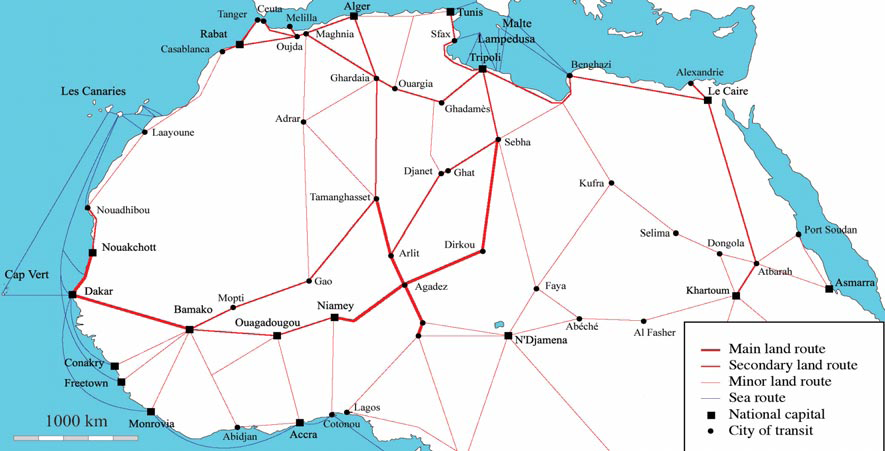
Main routes of present-day Trans-Saharan migrations
Filed under Algeria, Analysis, Data / Stats, Eastern Atlantic, European Union, Frontex, Italy, Libya, Malta, Mauritania, Mediterranean, Morocco, Spain
The Spanish Ministry of Interior is investing €3.8 million to expand the SIVE network in Valencia. The two new SIVE radar stations are in addition to the four SIVE radar stations that operate on the Alicante coast in Cabo Roig, Santa Pola, Sierra Frost, and Denia. According to ABC, the Ministry of Interior acknowledges that SIVE has numerous problems and that since its entry into operation last September in Alicante, SIVE has detected only four of the fifteen illegal boats discovered on the coast.
ABC also reports that despite the problems with SIVE on the Alicante coast, Frontex’s coming summer enforcement operation, Operation Indalo, will not extend to Alicante. Operation Indalo, using patrol boats and helicopters from Spain, Portugal, France, Italy, Malta and Luxembourg, will be deployed along the Spanish coast from Granada to Murcia.
Click here (ES) for article.
Filed under France, Frontex, Libya, Luxembourg, Malta, Mediterranean, News, Portugal, Spain
Migreurop: Rencontre internationale d’ISTANBUL – “Au programme de cette rencontre seront traités les enjeux et les conséquences des accords de réadmission, la situation dans les camps de rétention pour étrangers dans l’UE et à ses frontières extérieures, ainsi que le rôle de l’agence Frontex. Large espace sera donnée aux discussions sur les actions et revendications des associations, leurs réalisations et possibilités d’intervention.”
Pour en savoir plus, cliquez ici.
Filed under Colloques / Conferences, Frontex, Turkey
As noted on NeoConOpticon, Frontex’s Research and Development Unit has issued a tender calling for proposals to conduct research and provide studies to Frontex on two subjects: 1) Ethics of Border Security and 2) Forward Study on European Border Checks. Proposals are due 21 May.
The Ethics of Border Security tender calls for various issues to be addressed, including:
Click here for link to Frontex tender request.
Click here for the NeoConOpticon post.
Times of Malta reports that Frontex will delay the start of its central Mediterranean enforcement mission, Operation Chronos (known in previous years as Operation Nautilus), pending talks between the European Commission and the Maltese Government regarding the new Frontex guidelines governing enforcement operations at sea. EU Home Affairs Commissioner Cecilia Malmström is scheduled to go to Malta for meetings with the Maltese Government on 30 April. The Times of Malta article states that “Ms Malmström had already announced she would continue speaking to Malta over the Frontex guidelines because she considered the island an important player in the fight against illegal immigration, a Commission official in Brussels said. ‘Ms Malmström has decided to personally visit Malta later this month to engage the government in more talks to try to find a solution acceptable to both parties,’ the official said.”
Click here for article.
Click here, here, and here for related posts.
Filed under Frontex, Malta, Mediterranean, News
Analysis of the Real Instituto Elcano: “Frontex: Successful Blame Shifting of the Member States?” by Jorrit J. Rijpma, PhD European University Institute, Florence, and Lecturer in EU law, Europa Instituut, Leiden University.
Excerpts:
“Frontex in Short – Frontex can be seen as the outcome of a ‘re-balancing’ of powers between the Member States, the Council and the Commission following the communitarisation of the policy on external borders after the Treaty of Amsterdam, constituting an important shift from the intergovernmental coordination of operational activity under the Council to a more Community-based approach. [***]
Joint Operations at Sea – [***] Currently, the most controversial practice is that of the diversion by national border guards of ships back to their point of departure. This practice entails not only a real risk to the life and safety of the passengers on board these often unseaworthy ships, but as regards possible asylum seekers on board, it also risks violating the right to claim asylum and the prohibition of refoulement. The Greek coast guard has the questionable reputation of regularly diverting boats back to the Turkish shores. Italy has openly admitted to the interception and return of irregular migrants and asylum seekers from Libya under its 2008 Treaty on Friendship, Partnership and Cooperation with the latter country. Both within and outside the Hera operations, Spain has been returning people to Senegal and Mauritania, but here at least the interceptions are formally cast in terms of rescue operations and transfer to the nearest place of safety.
Frontex: the Lesser Evil?- There are many reasons why Frontex can be subject to criticism. It could be argued that it is an instrument of an essentially flawed EU migration and asylum policy. [***] Finally, it could be said that the Agency reinforces a securitised perception of what is essentially a humanitarian problem through its one-sided mandate, the background of most of its staff in national law-enforcement agencies and its military-style operations. [***] However, it is important to realise that for the moment the Agency’s scope for independent action remains very limited, both in practical and in legal terms. Serious human-rights violations are more likely to occur in operations from national border guards removed from the public eye, than in relatively well-scrutinised joint operations. Frontex, being a Community body, is subject to numerous reporting and evaluation duties, as well rules on transparency. [***]
Conclusion: Efforts should focus on ensuring full respect of international rules regarding international protection and search and rescue and an authoritative interpretation of these rules in a broad sense. These are essentially political decisions. It is the Member States and the Community institutions, not Frontex, that are to be reproached for the failure to do so. [***]”
Click here for full Analysis.
Filed under Aegean Sea, Analysis, Eastern Atlantic, European Union, Frontex, Greece, Italy, Libya, Malta, Mauritania, Mediterranean, Senegal, Spain, Turkey
Operation Indalo, which focuses on the interception of migrants travelling from North Africa, primarily Algeria, to Spain, will take place from June to September this year and will focus primarily on migrant arrivals on the coasts of the Spanish provinces of Murcia and Almeria.
Last year’s Operation Indalo took place in September and October, used assets from Spain, Italy, France, Belgium, Germany and Portugal, and resulted in the detention of approximately 500 migrants.
Click here for article (ES).
Filed under Algeria, Frontex, Mediterranean, News, Spain
“Migrant Smuggling by Sea-Combating a Current Threat to Maritime Security through the Creation of a Cooperative Framework” by Patricia Mallia, lecturer and Head of the Department of International Law at the University of Malta.
Publisher’s summary of the book: “A number of rules of the international law governing the oceans were created at a time far removed from the challenges of the present day. The principle of the freedom of the high seas and its corollary of flag State exclusivity are archetypical examples of this. Today these rules may appear to be obstacles in the effort to combat a number of contemporary maritime threats such as migrant smuggling by sea. This study examines this multi-faceted threat to maritime security against the backdrop of the current international legal framework and State practice in order to establish whether this threat can be effectively addressed within the existing framework of the law of the sea.”
In an interview with the Malta Independent the author suggests that the new Frontex guidelines governing operations at sea are inconsistent with international law: “On the recently approved Frontex guidelines, apart from the fact that the wrong legal basis was used to get them through, the position taken in the guidelines goes beyond what is stipulated in international conventions, namely the International Maritime Organisation’s Safety of Life at Sea Convention (SOLAS) and Search and Rescue (SAR) Convention.”
Click here for link to publisher.
Click here for article.
Filed under Books, Frontex, Malta, Mediterranean
The 28th Franco-Italian Summit was held 9 April in Paris and resulted in the signing of approximately 25 agreements between France and Italy. Among the agreements is a joint declaration on immigration which highlights the leading role played by France and Italy in controlling illegal immigration in the Mediterranean region. The agreement provides for, among other things, joint French-Italian maritime patrols to monitor the countries’ territorial waters. The agreement also stresses the need to strengthen the role of Frontex and calls for cooperation with both Libya and Turkey on immigration matters, including readmission of migrants.
Click here (EN), here (IT), here (IT), and here (FR) for articles.
The Second Conference for Heads of Coast Guards from the EU Member States and Schengen Associated Countries is being held in Málaga, Spain. According to Santiago Macarrón, el general de Fiscal y Fronteras de la Guardia Civil, the conference represents an ongoing effort to standardize actions within the EU. Among the topics being discussed at the Conference is the question of where migrants who are intercepted at sea are to be taken. Frontex’s Deputy Director Gil Arias stated that where migrants are to be landed is not clear under international law and has caused problems in the past, especially in the Mediterranean.
Click here for article (Spanish).
Filed under European Union, Frontex, Mediterranean, News


 MIGRANTS AT SEA