Tag Archives: Frontex

Malmström: Expand Frontex Powers and Respect Rights

On the eve of the 25-26 February meeting of the Council of Justice and Home Affairs, EC Home Affairs Commissioner Cecilia Malmström in her first press conference as Commissioner presented the Commission’s proposal to expand Frontex’s powers in several areas including giving it the authority to co-lead enforcement operations with member states.  The proposal would also introduce “an explicit requirement for all border guards taking part in operations to have been trained in fundamental rights, with the aim to safeguard that all immigrants are met with full respect of fundamental rights and in particular the principle of non-refoulement.”

Speaking of Italy’s forcible migrant return policy, Malmström said “I don’t exclude at all that errors were committed in the past, that’s why I’m so keen to really reinforce that all the people involved in Frontex operations have the adequate education and know exactly what to do. Because of course, these people [the migrants] are not criminals, they are in the search for a better life and they have the right to be treated in a dignified way.”

Click here and here for articles.

Click here for JHA Council 25-26 February Meeting Agenda.

Click here for JHA Council Meeting Background Note.

Leave a comment

Filed under Aegean Sea, Eastern Atlantic, European Union, Frontex, Italy, Libya, Mediterranean, News

Frontex Programme of Work 2010

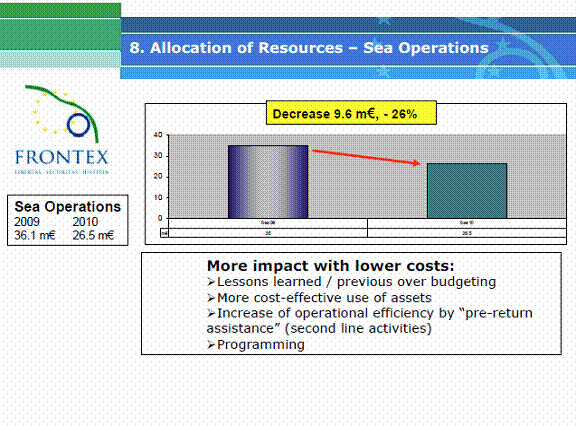
Frontex issued its 2010 Work Programme some time in late 2009.  I have not taken the time to closely read the full 90 page document, but it is worth noting that Frontex sea operations continue to constitute the largest share of the Frontex operational budget, over 26.5 M €.  Due to delayed payments from member states, Frontex is planning on cutting its sea operation budget by 9.7 M € in 2010.

Here are some excerpts from the Programme for Work relevant to sea operations:

“Executive Summary – Frontex’ Programme of Work 2010, as the output of a cyclical planning process, is the operative plan of the Agency to be used as reference for the governance process of assessing and evaluating operational activities carried out during 2010. Frontex’ Programme of Work also seeks to ensure the highest possible level of transparency towards the citizen of the European Union. [***]

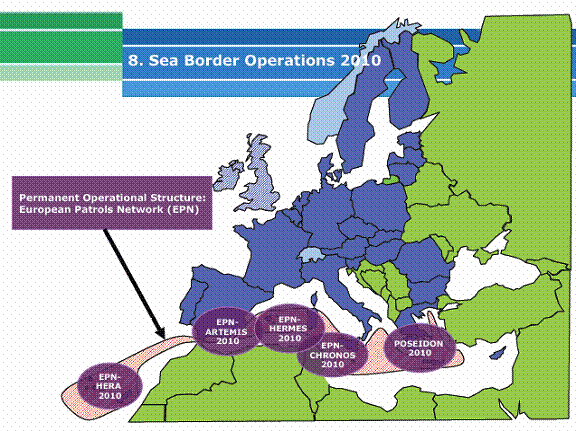
Sea Borders has the biggest share of the budget for operational activities: 26.5 M €. This is a decrease of 9.7 M €. Based on experiences from 2007 and 2008 the budget allocated to Sea Borders has been reduced as payments have been lagging seriously behind and it seems logical that the level of ambition has to be (at least temporarily) adjusted downward. However, the presently foreseen budget does give sufficient room for 7 to 9 projects within the EPN European Patrols Network and 6-7 joint operations in different geographical areas to decrease the illegal immigration flows and to detect facilitators (26.3 M €). Other activities carried out by Sea Borders will be:

– Improved working conditions and improved operational value of interrogation experts (0.1 M €);

– Improved level of awareness in ICCs and regional centers during JOs. (0.1 M €). [***]”

“1.6. Outlook for the situation at the external borders in 2010

General trends –  [***] In May 2009 Libya agreed to direct repatriation of illegal migrants, increasing in the process the deterrent effect of Frontex coordinated Joint Operations in the area. Likewise, Joint Operation Poseidon 2009 has introduced pilot measures to gauge the magnitude of the phenomenon of nationality swapping. When extended and systematized, this measure will facilitate return, determination of illegal migration routes correctly and spotting any displacement in a more timely manner. [***]”

“External maritime borders of the Member States – With significantly lower number of migrants departing from Libya and a decreasing trend of arrivals in the Canary Islands, the relative importance of Algeria, Morocco, Tunisia and possibly Egypt as departure points is likely to grow throughout 2009 and 2010. Efforts by authorities there against illegal migration will be crucial for limiting the flow towards Italy and Spain.  Gambia is expected to take over from Senegal the role of a major embarkation point on the West African coast. That said, in absolute numbers the Aegean Sea (at the border between Turkey and Greece) is expected to remain the main entry point at external sea borders in 2010 should cooperation with Turkey continue to be limited. With the strengthening of the southern EU maritime borders, migrants who initially considered sea crossing might opt for alternative way of entry. One of them might be the use of air borders, either with forged documents or after obtaining visa on false pretence.  At the moment, such a shift has not yet been detected and the risk is considered rather low for 2010, but the situation at the air border should nevertheless continue to be monitored with vigilance. [***]”

“1.7.1. Priority locations by border type

(1) At the external sea borders, operational cooperation should continue to focus on the southern maritime areas where large number of illegal migrants have been detected and where migrants’ life is most at risk, namely the maritime areas leading to: the Canary Islands, the Spanish south-eastern Mediterranean coast, the Island of Lampedusa, Malta—taking into account possible displacement to Sicily and/or Crete—, Sardinia and the Greek Islands close to the Turkish coasts (Lesvos, Chios, Samos, Patmos, Leros and Kos).

Even though decreases detections of illegal border crossing have been reported during the first semester 2009 on the West African and Central Mediterranean routes, operational cooperation should continue to include these areas, on the one hand because the decrease might only be temporary, and on the other because Frontex coordinated Joint Operations in these areas as one factor have contributed to the decrease. [***]”

“1.7.2.2. Recommendations for operational cooperation at the sea borders

(18) All efforts, from diplomatic to technical ones, should continue to be explored to break the deadlock situation of illegal migrants, as advised by facilitators, purposely turning sea surveillance patrols into rescue operations, thereby using surveillance measures as part of their modus operandi. As of mid-2009, such situation was still prevailing in the Aegean Sea.

(19) Joint Operations at the sea borders should aim at developing a permanent linguistic expertise pool, combined with debriefing techniques. Alternatively, language expertise could be outsourced to vetted private sector.

(20) At the sea borders where migrants arrive in big groups, special attention should be given to the rapid identification of victims of THB, especially women and children, with a view to gaining information leading to the identification and prosecution of the traffickers. In this process victim protection should be paramount. [***]”

Click here for a link to the full document.  Note that the document is 90 pages in length but for some reason the 90 page document available at this link is in triplicate, i.e. it is 270 pages in length.  But it is the same 90 page document thrice.

Click here for a link to Slides used by Frontex to summarize some aspects of the Programme.

Leave a comment

Filed under Aegean Sea, Eastern Atlantic, Frontex, Mediterranean, News, Reports

Frontex Presentation at European Defence Agency Annual Conference

Rustamas Liubajevas, Head, Frontex Joint Operations Unit, presented a lecture entitled “Frontex within integrated Border management concept – Structural approach in planning capability” at the recent Annual Conference of the European Defence Agency.

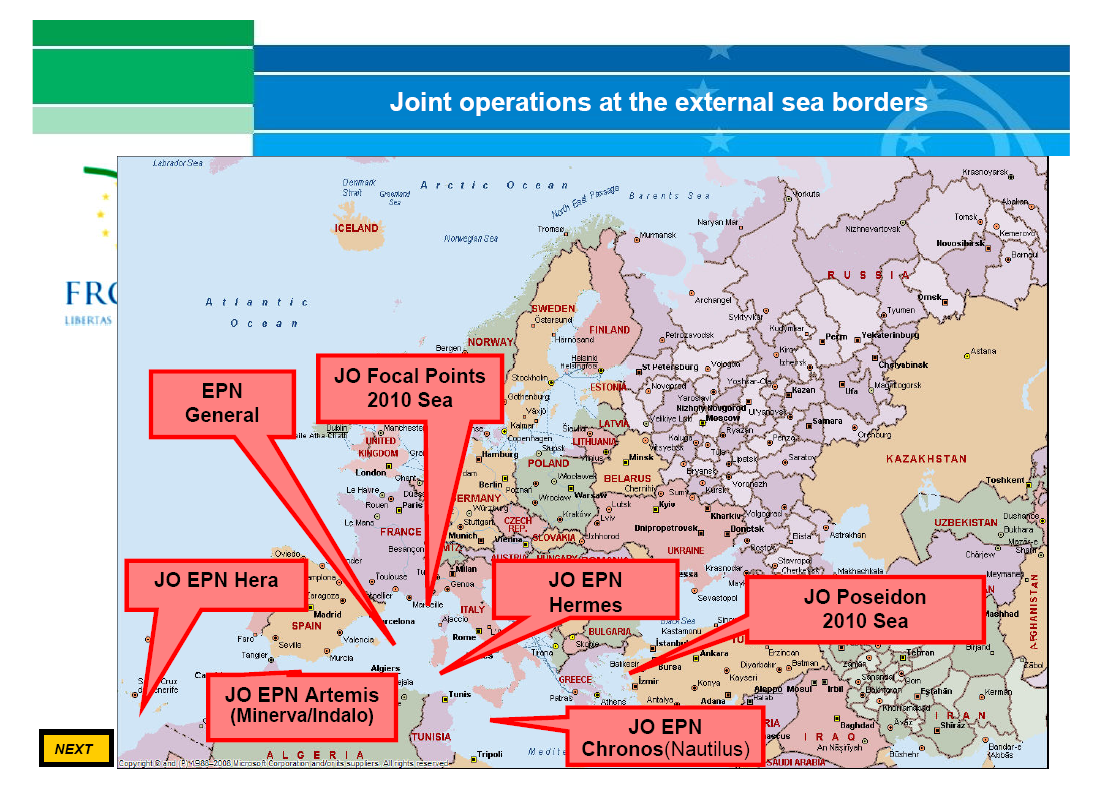
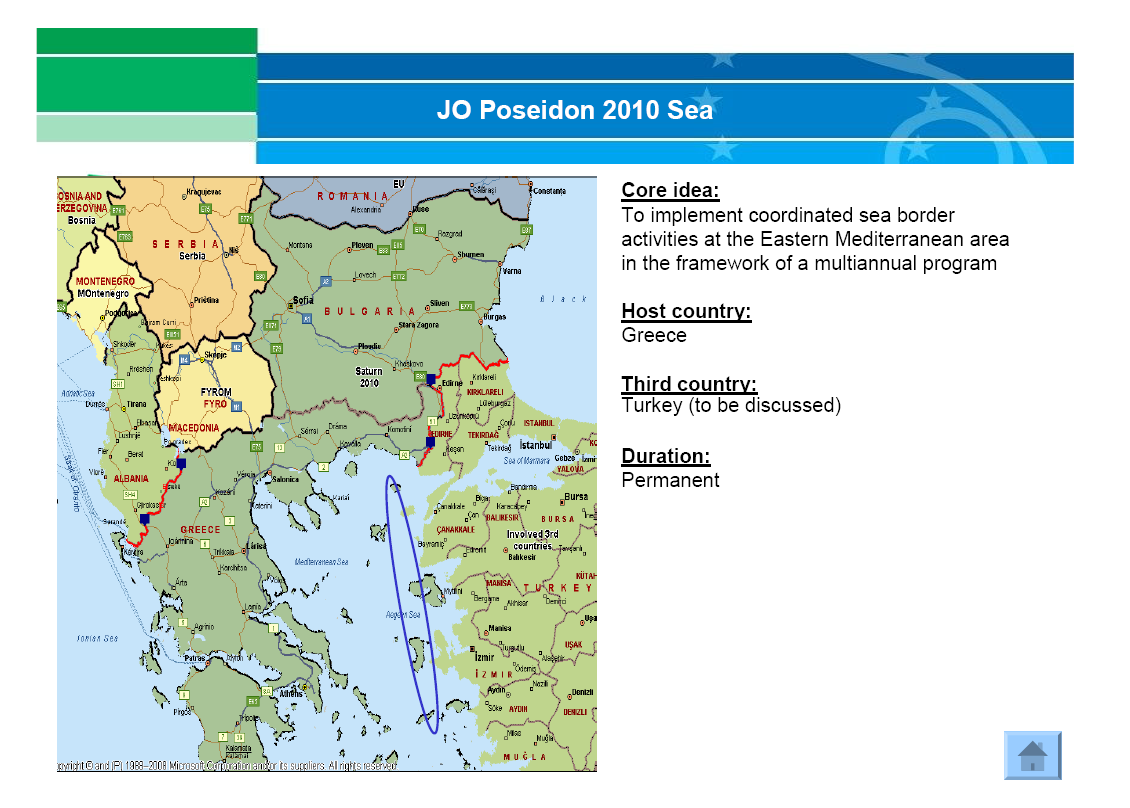
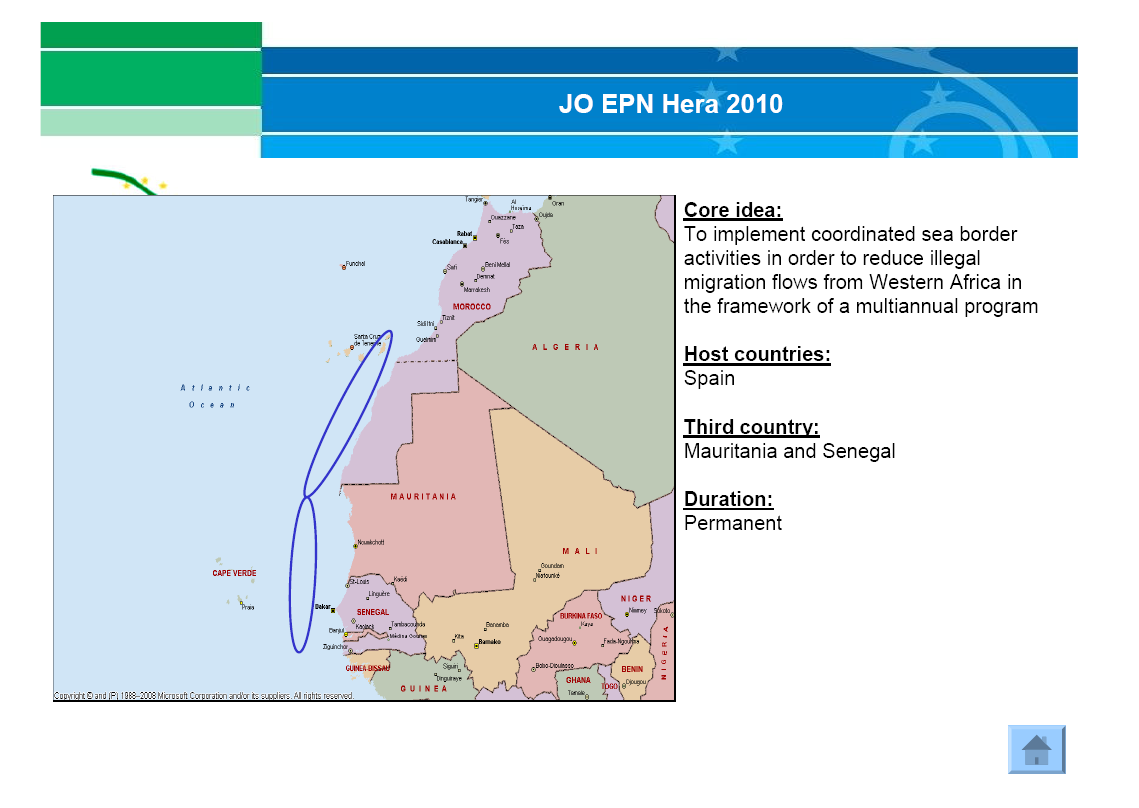
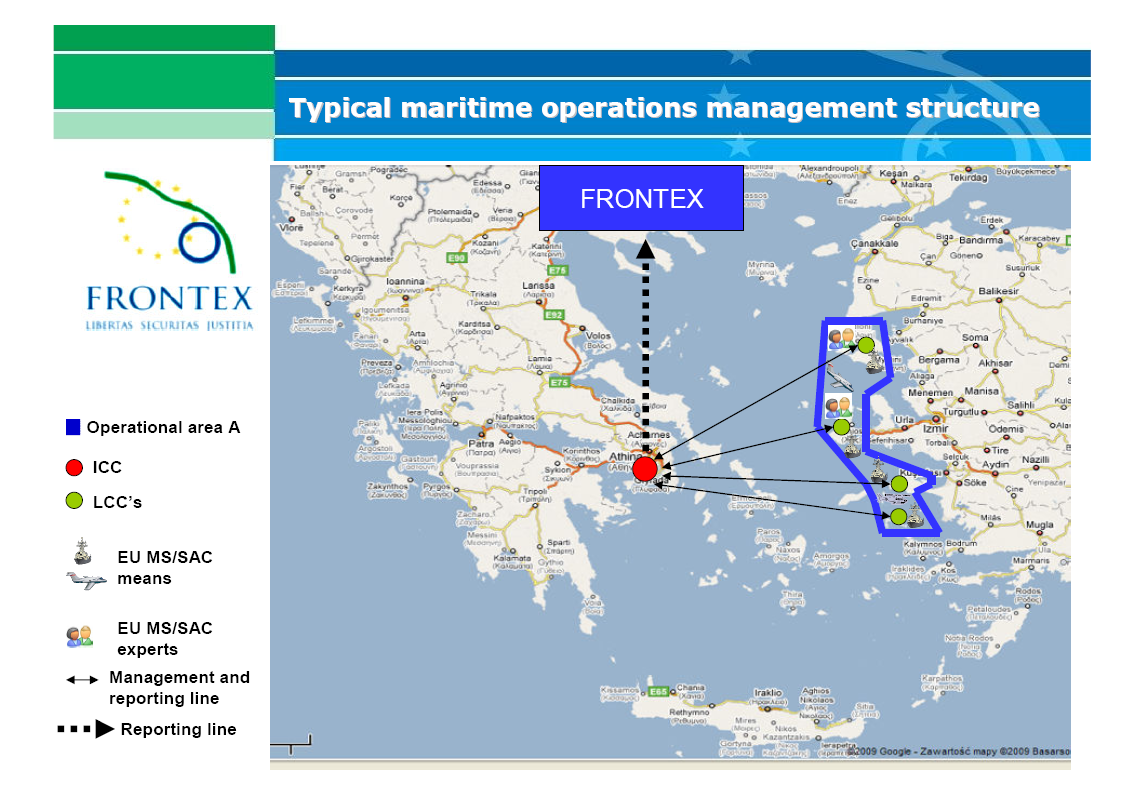
Copies of some of his slides are reproduced here.

Click here for full slide presentation.

Leave a comment

Filed under Aegean Sea, Algeria, Colloques / Conferences, Eastern Atlantic, European Union, Frontex, Greece, Italy, Libya, Malta, Mauritania, Mediterranean, Morocco, News, Senegal, Spain, Turkey

Malta: New Frontex Guidelines for Operations at Sea Could Be Ignored

The new Armed Forces of Malta Commander, Brigadier Martin Xuereb, suggested in an interview with the Times of Malta that Frontex enforcement operations are governed by operational plans that “may or may not draw from the [newly approved Frontex] guidelines”.  “‘The guidelines also state that the modalities of the operation will be agreed upon in the operational plan decided by countries that participate in the mission,’ he says, insisting the operational plan superseded the [new] guidelines.”  Xuereb also said that it was too early to say whether Malta would decline to participate in future Frontext operations.

Click here for full article.

Leave a comment

Filed under European Union, Frontex, Malta, Mediterranean, News

Besson et Frattini: renforcement des frontières “urgent”

“La France et l’Italie veulent un renforcement ‘urgent’ des frontières extérieures de l’UE afin de lutter contre les filières d’immigration clandestine…. Paris et Rome veulent un ‘développement des capacités opérationnelles de … Frontex en vue de mettre en place la police européenne aux frontières prévue par le Pacte européen sur l’immigration et l’asile’ et une ‘généralisation des accords de coopération opérationnelle et de réadmission avec les principaux Etats tiers d’origine et de transit’.”

“Les ministres de l’UE en charge de l’immigration doivent tenir le 25 février à Bruxelles une réunion extraordinaire convoquée par Eric Besson après la découverte de 123 Kurdes sur une plage corse en janvier.”

Cliquez ici pour l’article.

Leave a comment

Filed under European Union, France, Frontex, Italy, Mediterranean, News

Más patrullas para prevenir llegada de barcas neumáticas a la costa andaluza

“El Ministerio del Interior ha intensificado las patrullas de la Guardia Civil y las tareas de inteligencia para prevenir la llegada de embarcaciones neumáticas que cruzan el Estrecho de Gibraltar hasta las costas andaluzas, según consta en una respuesta aportada por el Gobierno al senador Eugenio Jesús Gonzalvez (PP), a la que tuvo acceso Europa Press….”

“Por otra parte, recuerda que en los meses de septiembre y octubre se puso en marcha el dispositivo Indalo, coordinado por la Agencia Europea de Fronteras (Frontex), consistente en el despliegue de medios marítimos y aéreos, complementado con personal de varios países en distintos puntos de la costa, entre las provincias de Murcia y Granada.”

“Asimismo, Interior indica que el Sistema Integral de Vigilancia Exterior (SIVE) se mantiene a la “máxima operatividad” en toda la costa del Mediterráneo, donde también continúa la realización de patrullas mixtas marítimas….”

Click here and here for articles.

Leave a comment

Filed under Eastern Atlantic, Frontex, Mediterranean, News, Spain

Malmström: Non-Refoulement Must be Respected in the Mediterranean

Speaking at the first meeting of the new European Commission (Barroso 2), Cecila Malmström made remarks about Frontex:

“We have evaluated Frontex, how it works, we will strengthen it, we will increase the coordination capacities and make it a better tool in order to work with the Member States on handling irregular immigration but also on making sure that the rule of law and the principle of ‘non-refoulement’ is respected on the Mediterranean.”

“Nous avons évalué le dispositif Frontex, son fonctionnement, et nous allons le renforcer, a-t-elle déclaré. Nous allons augmenter les capacités de coordination et en faire un meilleur outil pour faire en sorte, avec les Etats, de contrôler l’immigration mais aussi pour s’assurer que la primauté du droit et que le principe de non-refoulement soient respectés autour de la Méditerranée.”

Click here for article in English.

Cliquez ici pour l’article en francais.

Leave a comment

Filed under European Union, Frontex, Italy, Mediterranean, News

Frontex: UAV Workshop and Demonstration Event for Maritime Surveillance

Frontex has issued a press release:

“In the context of the development of a common European border surveillance system (EUROSUR), Member States are expected to improve and harmonise their surveillance activities in order to ensure effective detection of illegal immigration and cross-border crime. In the maritime domain, there is a wide spectrum of possible technical means that can be employed to provide effective surveillance … [h]owever, it is clear that Unmanned Aerial Vehicles (UAVs) could also play an important role in further enhancing border surveillance in the future, though they face a number of technical and other challenges.

Following last year’s successful mini-UAV demonstration event in Finland focusing on surveillance of land borders, Frontex R&D Unit intends to organise a UAV workshop and real-flight demonstration event at the beginning of June 2010 in Spain covering the maritime domain. …”

Click here for full press release.

Click here for Frontex press release regarding its 24 May Conference on “Surveillance Technology for Border Control.”

Click here for IPS article: “Military Technology to Track Down Migrants?”

Leave a comment

Filed under Frontex, Mediterranean, News

New Statewatch Report: NeoConOpticon- The EU Security-Industrial Complex

Statewatch and the Transnational Institute have published a comprehensive new report.

The report, “NeoConOpticon, The EU Security-Industrial Complex”, is a “follow-up [to Arming Big Brother, 2006] [and] contains new research showing how the European Security Research Programme [ESRP] continues to be shaped by prominent transnational defence and security corporations and other vested interests. Though technically a Research and Development (R&D) programme, the ESRP is heavily focused on the application of security technologies (rather than objective research per se), and is increasingly aligned with EU policy in the fields of justice and home affairs (JHA, the ‘third pillar’), security and external defence (CFSP, the ‘second pillar’).”

The Report includes a discussion of maritime immigration enforcement.  Excerpt:

“Having fortified many of the traditional entry points to Europe, the focus of the ‘war on migration’ has shifted to the islands of the Mediterranean and the coastlines of Africa and the Middle East. For FRONTEX, the newly created EU border management agency, this ‘southern maritime frontier’ is the ‘first line of defence’ of ‘Europe’s borders’. Since 2003 FRONTEX has coordinated a host of joint police and naval missions to combat ‘illegal’ immigration by sea and is now in the process of setting up a permanent European Patrols Network for the Mediterranean and a corps of Rapid Border Intervention Teams (RABITs) for deployment to ‘illegal immigration hotspots’.

This militarised approach to immigration control is part of a broader EU maritime security and defence strategy. In 2005, following the lead of the USA’s ‘SeaPower21’ strategy, the Chiefs of European Navies (CHENS) launched a 20-year ‘Vision for the Future Role of European Maritime Forces’ to meet the demands of the European Security Strategy (2003) and enhanced NATO Maritime Joint Operations. The rationale behind the CHENS strategy is that the sea: ‘has already been used for terror attacks by boats armed with rockets and small arms’ and ‘for logistic support to terrorism’. The sea is also a potential conduit for CBRN material and “criminal activity including narcotics, human trafficking and piracy’, all of which is ‘increasing in sophistication and volume.’ …”

Click here for Executive Summary.

Click here for full report.

Leave a comment

Filed under Eastern Atlantic, European Union, Frontex, Mediterranean, Reports

Presentation Materials from EU Conference on “Maritime Policies for a Prosperous and Secure Europe”

The Spanish EU Presidency conducted a conference on “MARITIME POLICIES FOR A PROSPEROUS AND SECURE EUROPE – Towards a Comprehensive 21st-Century Civil-Military Approach” in January 2010 during which multiple presentations were given by representatives from Frontex, military representatives, and others.

The PowerPoint presentations used by some of the presenters are posted on the internet (See http://www.eutrio.eu/export/sites/presidencia/comun/descargas/ [xxx] )

Links to two of the presentations are provided here.

“European Border Surveillance”, Erik Berglund, Director of Capacity Building, Frontex.

Click here.

“Integration of Maritime Surveillance Systems as a Keystone for Maritime Security”, Bg. Gen. José María Orea Malo, Head Operations Division Spanish Air Force Staff.

Click here.

Leave a comment

Filed under European Union, Frontex, Spain

First “Frontex Operational Office” to be Based in Greece

The Frontex Management Board has taken the decision to establish Frontex’s first Operational Office (“FOO”) in Piraeus, Greece.  According to the Frontex press release, the purpose of the office is to provide regionally-based support for Frontex coordinated activities such as joint operations and enhanced situational awareness.  If this pilot project is successful, it is expected that future FOOs would be established elsewhere such as the Western Mediterranean, the Western Balkans and Black Sea, and Eastern land borders.

According to the Frontex press release, Frontex Executive Director Laitinen said the establishment of this FOO “supports the possible enhancement of [the] Frontex mandate highlighted in the Stockholm Programme … I can even say this decision anticipates potential enlargement of the EU and Schengen zone. It gives Frontex a possibility to offer more support for the operational involvement of third countries, something that is essential for effective border management.”

Click here for Frontex statement.

Click here for the Final Report on the “Study on the feasibility of establishing specialised branches of Frontex.”  The specific functions of the new FOO are based in part on this feasibility study which was prepared in 2009.

Leave a comment

Filed under Aegean Sea, Frontex, Greece, Mediterranean, News, Turkey

Background Note Pertaining to Proposed Guidelines for Frontex Operations at Sea

Given the strong objections by Malta and Italy to the proposed Guidelines for Frontex Operations at Sea, the “Note for the File” pertaining to the “Draft Council Decision supplementing the Schengen Borders Code as regards sea border surveillance in the context of operational cooperation coordinated by FRONTEX (COM(2009)658) as amended by the Council on 25 January 2010” is worth reading.

The “Note” explains the origins of the Guidelines and the additional procedures which will need to be completed before the Guidelines take effect:

“Note for the File:

The questions of who is responsible for saving people at sea and where they should be disembarked have been subject to intense debates in the context of surveillance operations concerning the EU’s sea borders coordinated by Frontex. The operations take place in a highly complex legal and political environment and touch upon international law issues and on the EU’s relations with third countries.

After long preparatory work, including a study on the relevant international law instruments completed in 2007, the Commission drafted a set of guidelines intended to

  • ensure that international rules are uniformly applied by all Member States taking part in surveillance operations coordinated by Frontex (Convention on the Law of the Sea (UNCLOS), conventions on safety at sea and search and rescue, international law on refugees and fundamental rights) and
  • create a basis in EU law enabling one Member State to carry out surveillance of another Member States’ maritime borders.

The Commission presented the draft guidelines in the form of an implementing measure, based on Article 12 (5) of the Schengen Borders Code.  This provision, together with Article 33 of the Borders Code, authorises the Commission to adopt additional measures governing border surveillance in accordance with the regulatory procedure with scrutiny as laid down in Council Decision 1999/468/EC (“comitology decision”).

After the entry into force of the Treaty of Lisbon this procedure continues to apply until the basic legal act, the Schengen Borders Code, has been aligned to the framework of the Treaty of Lisbon. Therefore, the regulatory procedure with scrutiny applies to the present draft measure.

The draft was first submitted to the Borders Code Committee. Member States’ experts failed to agree on the draft; therefore, the Committee did not issue a formal opinion. One of the controversial issues was whether the Commission’s draft went beyond its implementing powers.

On 7 December 2009, the Commission submitted a revised draft to the Council and to the Parliament, in the form of a draft Council Decision (COM(2009)658).

In accordance with the regulatory procedure with scrutiny the Council, acting by qualified majority, had the following options:

  • · oppose the proposed measure, in which case it will not be adopted; the Commission may submit an amended proposal or present a legislative proposal (option 1)
  • · envisage adopting the proposed measure, in which case it shall without delay submit it to the European Parliament (option 2)
  • · not act within the two months, in which case the Commission shall without delay submit the measures to the Parliament.

The Council had to act within a deadline of two months, i.e. before 7 February 2010.  On 25 January 2010 the Council, with Italy and Malta abstaining, decided to envisage adopting draft Council Decision and submit the draft Council Decision to the European Parliament. Furthermore, the Council agreed on an additional declaration to be adopted by the Council if Parliament does not oppose the measure, asking Frontex to report on the practical implementation of this decision.

European Parliament’s role in the procedure and deadline

In accordance with the regulatory procedure with scrutiny, Parliament has four months in total, starting from the date of referral on 7 December 2009, to scrutinise the draft measure. In practice, Parliament now has two more months to take position before 7 April 2010.

Parliament’s options in the regulatory procedure with scrutiny are limited to the following. Parliament may, acting by a majority of its component Members,

  • · oppose the adoption of the measure; in this case, Parliament must justify its opposition, stating that the proposed measure exceeds the implementing powers granted to the Commission in the basic instrument, or is not compatible with the aim or the content of the basic instrument or does not respect the principles of subsidiarity or proportionality; if Parliament opposes, the draft measure shall not be adopted; the Commission may submit an amended proposal or present a legislative proposal
  • · not oppose the adoption of the draft measure; in this case, the draft measure may be adopted by the Council or the Commission.

LIBE, as the committee responsible, will prepare Parliament’s position, in accordance with Rule 88 of the Rules of Procedure. The Member responsible in LIBE is Michael Cashman, rapporteur for the basic act, the Schengen Borders Code. Once the Council’s position, adopted on 25 February 2010, has been officially referred to the Parliament, the chairman will set a deadline for Members who wish to propose that the committee objects to the draft measure. If the committee decides to object, it shall table a motion for a resolution to the plenary for adoption before 7 April 2010.

Action undertaken by LIBE so far:

On 11 January 2010, LIBE, as the committee responsible, heard presentations of the Commission (Mr Henrik Nielsen, Head of Unit, DG JLS) and the Spanish Presidency (Mr Burgos Nieto, JHA Counsellor) and held a first exchange of views on the file.

During the debate, several Members highlighted the political importance of the decision on the guidelines (Mr Busuttil, Mrs Flautre, Mr Moraes, Mrs Hennis-Plasschaert) and the fact that this was a long-standing discussion in the Council. The Executive Director of Frontex (Mr Laitinen) underlined the swift adoption of guidelines would enhance the efficiency of Frontex’ operations.

Next steps:

The Council will refer its position, which was adopted on 25 January 2010, to the Parliament within a few days. Then it will be Parliament’s turn to take a position before the expiry of the deadline on 7 April 2010.

In order to prepare LIBE’s position, the rapporteur recommends that an opinion be requested from the Parliament’s legal service, which should answer the following questions:

1)

a) Having regard to the delineation between “rules” and “guidelines” for Member States in the draft measure as amended by the Council, could the content be considered a “non-essential element” of the final legal framework shaping the role of the Member States and Frontex?

b) Has the Commission exceeded its implementing powers under Article 12 (5) of the Schengen Borders Code by proposing the present draft measure?

2) In case the content or a part of the content of the draft measure touches upon essential elements of the basic act, could the objectives of the measure be achieved by a legislative act, notably by amending the basic act, i.e. the Schengen Borders Code?

OPERATIONAL INFORMATION:

Documents:

  • · Proposal for a Council Decision supplementing the Schengen Borders Code as regards the surveillance of the sea external borders in the context of the operational cooperation coordinated by Frontex, COM(2009)658 of 27.11.2009, as amended by the Council on 25 January 2010
  • · Commission staff working document, Study on the international law instruments in relation to illegal immigration by sea, SEC (2007)691 of 15.5.2007, available in EN and FR.

Contacts:

European Parliament:

Member responsible: Michael CASHMAN

Asisstant to Mr Cashman: Renaud-Raphaël Savignat, tel. – 47759

S&D political Advisor: Mrs Annie Lemarchal, tel. – 43057

Desk officer responsible in the LIBE Secretariat: Lotte Madlen Tittor, tel. -40785

European Commission:

Desk officer responsible in DG JLS: Ana Isabel Sanchez Ruiz, tel. 02-2998239, email: Ana-Isabel.Sanchez-Ruiz@ec.europa.eu

Head of the responsible Unit in DG JLS: Henrik Nielsen, tel. 02-2991641, email: Henrik.Nielsen@ec.europa.eu

Council General Secretariat:

Desk officer: Mr Bent Mejborn, tel. 02-2816722, email: bent.mejborn@consilium.europa.eu

Spanish Presidency:

Mr Eugenio Burgos Nieto, JHA Counsellor, email: eugenio.burgos@reper.maec.es”

Click here for link to Document.
1 Comment

Filed under Analysis, European Union, Frontex, Italy, Malta, Mediterranean

Guidelines for Frontex Operations at Sea

NB –I believe this document is the final version of the proposed guidelines approved by the Council on 25 January 2010, with Italy and Malta abstaining, and which has now been forwarded to the Parliament for scrutiny.  I will remove or amend this post if I discover this is not the final version approved by the Council.

What follows are relevant excerpts from Document COM(2009)658 (Brussels, 27.11.2009), the final Proposal for a COUNCIL DECISION supplementing the Schengen Borders Code as regards the surveillance of the sea external borders in the context of the operational cooperation coordinated by the European Agency for the Management of Operational Cooperation at the External Borders – Frontex.

As noted, Malta and Italy oppose these guidelines and have threatened to withdraw from future Frontex missions if these guidelines take effect.

Guidelines for Frontex operations at sea

1. GENERAL PRINCIPLES

1.1 Measures taken for the purpose of the surveillance operation should be conducted in a way that does not put at risk the safety of the persons intercepted or rescued as well as of the participating units.

1.2. The special needs of children, victims of trafficking, persons in need of urgent medical assistance, persons in need of international protection and other persons in a particularly vulnerable situation should be considered throughout all the operation.

1.3. These guidelines should be applied by Member States in accordance with fundamental rights. Member States should ensure that border guards participating in the surveillance operation are trained with regard to relevant provisions of human rights and refugee law, and are familiar with the international regime on search and rescue.

2. INTERCEPTION

2.1 Upon detection, the ship or other sea craft (“ship”) should be approached in order to observe its identity and nationality and, pending further measures, should be surveyed at a prudent distance. [***]

2.4. Measures taken in the course of the surveillance operation against ships or other sea craft with regard to which there are reasonable grounds for suspecting that they carry persons intending to circumvent the checks at border crossing points may include: [***]

(f) conducting the ship or persons on board to a third country or otherwise handing over the ship or persons on board to the authorities of a third country;

(g) conducting the ship or persons on board to the host Member State or to another Member State participating in the operation.

3. SEARCH AND RESCUE SITUATIONS ARISING IN THE COURSE OF THE OPERATION

3.1. Participating units shall provide assistance to any vessel or person in distress at sea. They shall do so regardless of the nationality or status of such a person or the circumstances in which that person is found.

3.2. When facing in the course of the operation a situation in which uncertainty or apprehension exists as to the safety of a ship or of any person on board, the participating unit should forward as soon as possible all available information to the Rescue Coordination Centre responsible for the search and rescue region where the situation is taking place.

In cases where the Rescue Coordination Centre of the third country responsible for the search and rescue region does not respond to the notification transmitted by the participating unit, the latter should contact the Rescue Coordination Centre of the host Member State that is geographically the closest to the emergency.

While awaiting instructions from the Rescue Coordination Centre, participating units should take all the appropriate measures to ensure the safety of the persons concerned. [***].

4. DISEMBARKATION

4.1. The operational plan should spell out the modalities for the disembarkation of the persons intercepted or rescued, in accordance with international law and any applicable bilateral agreements.

Subject to section 4.2, priority should be given to disembarkation in the third country from where the persons departed or through the territorial waters or search and rescue region of which the persons transited or, if this is not possible, to disembarkation in the geographically closest place where the safety of the persons can be ensured.

4.2. No person should be disembarked in or otherwise handed over to the authorities of a country with regard to which there are substantial grounds for believing that he or she would be subjected to persecution or to torture or to other forms of inhuman or degrading treatment or punishment, or from which there is a risk of expulsion or return towards such a country. The persons intercepted or rescued must be informed in an appropriate way so that they can express any reasons for believing that they would be subject to such treatment in the proposed place of disembarkation.

4.3. The coordination centre should be informed of the presence of persons within the meaning of paragraph 4.2, and should convey that information to the competent authorities of the host Member State.

Click here for full Document.

Click here for a “Note to the File” pertaining to the Draft Council Decision supplementing the Schengen Borders Code as regards sea border surveillance in the context of operational cooperation coordinated by FRONTEX (COM(2009)658) as amended by the Council on 25 January 2010.

1 Comment

Filed under European Union, Frontex, General, Italy, Malta, Mediterranean

Proposed Changes to Interdiction Patrol Rules Jeopardise Malta and Italian Cooperation with Frontex

The Malta Times reports that “a Frontex official said [yesterday] the new [maritime interdiction] guidelines were specifically aimed at avoiding disputes such as the ones that broke out between Malta and Italy. In the past, immigrants were stuck on the high seas as the two countries were locked in a diplomatic wrangle on who was responsible for the people rescued. ‘Everyone recalls these incidents and the Commission’s intervention. Brussels ended up as a referee in these disputes and we don’t think that’s our role. This is specifically why we needed to have a specific code of conduct to guide future Frontex missions. This will put participating member states’ minds at rest,’ the official said.”

The proposed changes would require migrants to be taken to the country hosting the Frontex mission if it was not possible to return the migrants to their country of departure and could go into effect as early as April when Frontex interdiction patrols are scheduled to resume in the central Mediterranean under the new mission name of Operation Chronos.

“Both Malta and Italy objected strongly [to the proposed changes] on the basis of the fact that the guidelines go beyond international legal obligations, which say that migrants should be taken to the nearest safe port [which in Malta’s case] often meant the Italian island of Lampedusa.”

Click here for article.

1 Comment

Filed under European Union, Frontex, Italy, Malta, Mediterranean, News

Frontex: Operation “Nautilus” to become Operation “Chronos”

During a recent briefing to the Civil Liberties Committee of the European Parliament, Frontex Executive Director Ilkka Laitinen revealed that the Frontex name for its four year old interdiction operation in the central Mediterranean will change from “Nautilus” to “Chronos” as of April 2010.

“According to figures given by Frontex [at the briefing], only 3,300 illegal immigrants reached Malta and Lampedusa last year, less than half the number registered in the previous year.  In the case of Malta, there were 2,775 arrivals in 2008 and 1,475 in 2009.”

Click here for article.

1 Comment

Filed under Data / Stats, Frontex, Malta, Mediterranean, News