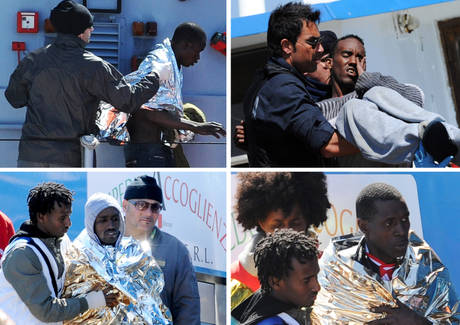
Italy returned a group of 30 Tunisian migrants to Tunisia on Thursday evening. They were returned to Tunisia under the terms of the new Italy-Tunisia migration agreement. The migrants were flown from Lampedusa to Italy.
Tag Archives: Italy
Rescued Migrants Arriving at Lampedusa (Pictures)
53 survivors have been rescued from today’s accident. The total number of dead and missing is not known. Dozens of bodies, including those of children, have been observed in the sea by a Guardia di Finanza helicopter.
Click here for article. (IT)
Filed under Italy, Libya, Mediterranean, News
200 or More Now Feared Dead in Migrant Boat Sinking Off Lampedusa – Boat Was Likely Coming from Libya, Not Tunisia
It now appears that the boat that capsized earlier this morning off of Lampedusa was carrying Sub-Saharan Africans and that it had sailed from Libya not from Tunisia. The boat departed from Zuwarah in western Libya according to the Times of Malta. Woman and children were on board and are likely among the victims. The accident occurred around 4:00 AM local time in very rough seas. A call for help was made by satellite phone to Malta SAR. ANSA reported a short time ago that 48 people have been rescued and approximately 20 bodies have been recovered. IOM said that based on interviews with survivors there may have been as many as 300 people on board the boat.
Click here (EN), here (IT), and here (IT) for articles.
Filed under Italy, Libya, Malta, Mediterranean, News
Migrant Boat Capsizes Near Lampedusa – 150 Missing
There are reports that a boat carrying approximately 200 migrants believed to be Tunisians capsized during a rescue operation this morning. The incident occurred 39 miles southwest of Lampedusa. As of early this morning approximately 45 people have been rescued and 150 are missing. Italian Coast Guard boats are searching for survivors.
Filed under Italy, Mediterranean, News, Tunisia
Italy-Tunisia Reach Migration Agreement: 6 Month Residency Permits for Tunisians Already in Italy; Accelerated Return Procedures for Newly Arriving Tunisians
Italy and Tunisia reached a new migration agreement on Tuesday. It was signed in Tunis by Interior Minister Roberto Maroni and Tunisian Minister Habib Essid. Italy reportedly pressed Tunisia to quickly accept the repatriation of the 20,000 Tunisians who have arrived in Italy. Tunisia refused to agree to the mass return of its nationals.
The compromise that was apparently reached will allow the 20,000 Tunisians who have already arrived in Italy to remain for at least six months with temporary residency permits and Tunisia in turn has apparently agreed to accelerated and simplified return procedures for newly arriving Tunisians that will not require fingerprinting or documentation. Italy reportedly believes that the accelerated repatriation procedures, once implemented, will act as a deterrent to those Tunisians who may attempt to leave Tunisia after the agreement enters into force.
The accelerated return procedures are troubling in multiple respects. While the overwhelming majority of persons who have reached Italy over the past two months are Tunisian nationals, over the past week or two for the first time there have been hundreds of non-Tunisians arriving in Italy and Malta. Many are from Eritrea, Ethiopia, and Somalia and clearly have strong claims to international protection. An accelerated return procedure will mean that persons with claims to asylum or who are in need of other forms of protection may not be properly identified.
Where will the accelerated return procedures be carried out? Will migrants be rescued, brought to land, processed under the accelerated procedures, and then repatriated? Or will Italy attempt to revive its push-back practice and attempt to turn boats around at sea?
The text of the agreement has apparently not been yet made public (at least I cannot find it), but various media reports suggest that its provisions include the following:
- Six month temporary residency permits for Tunisian nationals who have already arrived in Italy (what happens when the six month period expires is not clear);
- Temporary residency permits will allow free travel within the Schengen zone (but if the holder of the permit is outside of Italy when the permit expires, the person could apparently be returned to Italy);
- Accelerated direct repatriation for newly arriving Tunisian nationals (the date on which the decree is signed will apparently determine whether a Tunisian receives the temporary permit or is subject to direct repatriation, the decree may be enacted as soon as today, Wednesday, 6 April);
- Increased cooperation between Italy and Tunisia police / security forces;
- Italy to provide 12 new and refurbished patrol boats and hundreds of off-road vehicles to Tunisia.
The announcement of this bi-lateral agreement comes one day after Frontex released its recently approved Fundamental Rights Strategy. Click here for yesterday’s post about this strategy. Note the following provisions within the strategy:
“14. [***] One particular objective in [Joint Operations] is ensuring that the right to international protection must not be hampered by the law enforcement action and that persons seeking protection are referred to the competent national authorities to assess their case.
15. [***] Corrective measures should be taken in case of breach or serious risk of breach of fundamental rights. As last resort, Frontex might terminate a JO if the conditions guaranteeing the respect for fundamental rights are no longer met. [***]”
It remains to be seen what Italy will do in regard to accelerated direct repatriations to Tunisia, but there is definitely the concern that the right to international protection may be hampered by Italy’s actions. Frontex’s Joint Operation Hermes Extension is currently hosted by Italy. Frontex may be obligated to act pursuant to its Fundamental Rights Strategy depending on what new practices are implemented by Italy.
Click here (IT), here (IT), here (IT), here (FR), here (FR), and here (EN) for articles.

Filed under European Union, Frontex, Italy, Mediterranean, News, Tunisia
Libyan Migrant Boats Carrying Over 400 People Missing; Reports of Deaths
There have been reports in recent days from the UNHCR and others about at least two boats that are believed to have left Libya over the past 10-14 days carrying persons from Eritrea, Ethiopia, Somalia, and possible other countries. Family members and friends of people who are believed to be on the boats have been calling for assistance in searching for the boats. Reuters reported that “[o]ne of the boats was reported to have left Libya on March 22 with 335 people on board. Italian media said 68 people on the other boat had almost certainly died during the journey, although there was no official confirmation. The top Vatican official in Tripoli, Bishop Giovanni Innocenzo Martinelli, said 10 bodies of African migrants were at the capital’s morgue on [4 April]. … He said there were reports of ‘many more bodies’ of migrants washed up on the shores of Garaboulli, some 40 km from Tripoli.” Father Mussie Zerai, who is based in Rome, “said he had last spoken to migrants on board the smaller boat, an inflatable, by satellite phone on 26 March before the line went dead. ‘I have meanwhile had no contact with the larger boat, but family members of those on board have called us from Canada, Sweden and Switzerland to tell us they left.’”
Click here and here for articles. (EN)
There have been confirmed deaths among migrants who have left Tunisia in recent weeks. At least 27 bodies had been recovered as of last week in Kerkennah. The dead were probably on board boats that sank on the 13th and 27th of March off the Tunisian coast.
Click here for article.
UPDATE: If you have information about a family member or friend who may be on a boat or if you are seeking information, please consider contacting the Agenzia Habeshia per la Cooperazione allo Sviluppo in Italy at this email address: agenzia_habeshia@yahoo.it .
Filed under European Union, Frontex, Italy, Libya, Mediterranean, News, Tunisia, UNHCR
Tunisia Denies Reaching Migration Agreement with Italy; Berlusconi Travels Today to Tunis for Talks
Responding to statements made by Italian Ministers Maroni and Frattini that Tunisia was not complying with recent migration agreements reached during their 25 March visit to Tunis, a Tunisian Foreign Ministry source said on Saturday that no such agreement was finalised or signed.
A statement summarising the 25 March meeting between Italy and Tunisia, previously posted on the Tunisian Ministry of Foreign Affairs web site, said in relevant part that “bilateral and regional cooperation has also been discussed during this meeting, particularly regarding the management of migration flows and within the framework of a comprehensive and integrated approach. As such, both sides agreed to conclude in the near future an agreement on joint management of migration and development in solidarity like agreements signed with other partner countries.” (“La coopération bilatérale et régionale a été, également, évoquée au cours de cette réunion, notamment, en ce qui concerne la gestion des flux migratoires et ce dans le cadre d’une approche globale et intégrée. A ce titre, les deux parties ont convenu de conclure dans un proche avenir un accord relatif à la gestion concertée de la migration et au développement solidaire à l’instar des accords signés avec d’autres pays partenaires.”
Click here (EN), here (FR), and here (IT) for articles.
Click here (FR) for Tunisian FM statement re 25 March meeting.
Filed under Italy, Mediterranean, News, Tunisia
Tunisian Migrant Crisis vs. Italian Migrant Crisis – Comparing the Numbers
Since the collapse of Tunisian president Ben Ali’s rule on 14 January 2011, tens of thousands of people have been on the move as a result of the events in Tunisia and the ensuing events elsewhere in the Middle East and North Africa. Many of those taking advantage of this transitional period are Tunisians who are leaving their country to seek better opportunity in Europe. Most however, are people who have fled from Libya to neighbouring countries due to fighting and threats to their safety.
So far Italy has received about 20,000 migrants and a smaller number of asylum seekers. The 20,000 migrants are almost all Tunisian nationals. At the same time, Tunisia has received over 150,000 asylum seekers and others who have fled from Libya.
Based on the raw numbers alone – 20,000 vs. 150,000 – Tunisia has received 7.5 times as many people as Italy over the past 2 ½ months. When you compare these numbers in light of the respective population of the two countries, the burden imposed on Tunisia is even more striking. Italy has a current population of approximately 61.0 million people. Tunisia’s current population is approximately 10.6 million. Assuming my calculations are correct, Italy has received approximately 3.3 persons per 10,000 of its population and Tunisia has received approximately 141.5 persons per 10,000 of its population. Tunisia has therefore received almost 43 times as many people per capita relative to Italy. There is no comparison between the humanitarian crises faced by the two countries. Tunisia is facing by far the greater burden.
Agence Tunis Afrique Press on Saturday attributed the statement below to an authorised source within the Tunisian Ministry of Foreign Affairs. The statement notes the burden faced by Tunisia and asks Italy to show understanding and solidarity within the context of the ongoing migration talks between Tunisia and Italy. Italian Prime Minister Silvio Berlusconi travels to Tunis today (Monday) for continuing migration talks with Tunisia.
Statement attributed to Tunisian Ministry of Foreign Affairs: “While reaffirming the strong historical ties that bind [Tunisia] to the friendly country [of Italy], especially since the signing of the agreement of friendship and good neighborliness in 2003, Tunisia calls on the government and the people of Italy to show proof of their solidarity with the Tunisian people in this important transitional stage that this country is now experiencing, after the glorious revolution, and especially in light of the challenges posed by the current situation on the Tunisian-Libyan border, with the arrival of more than 150,000 displaced persons who have been welcomed by the Tunisian people in a unique showing of solidarity, despite the difficult conditions faced by Tunisia, as witnessed by several countries and international and humanitarian organizations.”
(“Tout en réaffirmant la solidité des liens historiques qui l’unissent à ce pays ami, notamment, depuis la signature de la convention d’amitié et de bon voisinage en 2003, la Tunisie elle appelle le gouvernement et le peuple italiens à faire preuve de solidarité avec le peuple tunisien en cette étape transitoire importante que vit le pays, après sa glorieuse révolution et, tout particulièrement, dans le contexte des défis que pose la situation actuelle sur les frontières tuniso-libyennes, avec l’arrivée de plus de 150.000 déplacés, qui ont été accueillis par le peuple tunisien dans un élan de solidarité sans pareil, en dépit des conditions difficiles auxquelles la Tunisie est confrontée, comme en témoignent plusieurs pays et organisations internationales et humanitaires.”)
Click here (FR) for TAP article.
Filed under Analysis, Data / Stats, Italy, Libya, Mediterranean, Tunisia
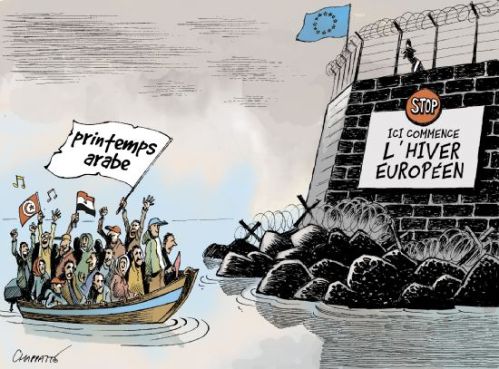
The Arab Spring meets the European Winter (by Chappatte)

© Chappatte - http://www.globecartoon.com - Used by Migrants At Sea with permission.
Filed under Analysis, European Union, Frontex, Mediterranean
Is Libyan Government Facilitating Migrant Boat Departures from Libya?
Gaddafi and other Libyan officials in recent weeks have made statements to the effect that Libya will no longer prevent irregular migrants from leaving Libya and have made threats that Libya will encourage irregular migration. (6 March, Gaddafi: “I want to make myself understood: if one threatens [Libya], if one seeks to destabilize [Libya], there will be chaos, Bin Laden, armed factions. That is what will happen. You will have immigration, thousands of people will invade Europe from Libya. And there will no longer be anyone to stop them….”)
Now that migrants boats are again leaving Libya and arriving in Italy and Malta, it is unclear what role, if any, the Libyan government may be playing. In an article in yesterday’s Times of Malta there is a short statement by an Eritrean man who had just arrived in Malta from Libya on a migrant boat. His statement suggests that the Libyan government may be facilitating the departures: “[a] man said he had been in Libya for five years and this was not the first time he had tried to escape. ‘The boats were organised by the same people,’ he said, referring to a Libyan racket which was widely believed to enjoy the support of the North African regime. The migrants said they paid between $500 and $1,000 for their journey – meaning that those who organised the boats were pocketing an average of $200,000.”
Click here for article.
Filed under Italy, Libya, Malta, Mediterranean, News
Mussie Zerai – Eritrean Catholic priest assisting refugees in Libya and at sea
Here is a short AFP article about Father Mussie Zerai who is in frequent contact by satellite phone with African refugees in Libya and with those who are in the process of leaving Libya: “A few steps away from St Peter’s Basilica, an Eritrean Catholic priest is on the phone with boats in the middle of the Mediterranean filled with African refugees fleeing Libya. Mussie Zerai receives calls from satellite phones on the boats and co-ordinates the arrival of hundreds of Eritreans, Ethiopians and Somalis with Italy’s coast guard and the NATO warships imposing a naval embargo on Libya….”
Click here for article.
Father Zerai’s organisation’s blog: habeshia.blogspot.com/
UPDATE: If you have information about a family member or friend who may be on a boat or if you are seeking information, please consider contacting the Agenzia Habeshia per la Cooperazione allo Sviluppo in Italy at this email address: agenzia_habeshia@yahoo.it .
UPDATE: Click here for 19 April 2011 BBC article.
Filed under Eritrea, Italy, Libya, Mediterranean, News
France Restores Border Controls at Italy-France Border to Block Entry by Tunisians
Growing numbers of Tunisians are arriving in the Italian border town of Ventimiglia (Vintimille), on the border with France, and are attempting to enter France. 3500 Tunisians have reportedly arrived in recent weeks. Most of the newly arriving Tunisians appear to have passed through Lampedusa in recent weeks and were then relocated elsewhere in Italy to relieve the overcrowding on the island. Many of the Tunisians arriving in Lampedusa have been very clear about their desire to continue on to France due to family or linguistic ties.
France has reinstituted some border controls in the area in an effort to block the entry of the Tunisians. Additional controls are being instituted within French territory in Menton and Nice. La Stampa reports that “[p]eople smugglers, who had largely disappeared when border checkpoints [in the Schengen area] were closed down, are now increasingly common. [Smugglers] seek out the migrants at the station [in Ventimiglia] and offer to take them to France…” Le Point suggests that “by discretely allowing illegal immigrants to arrive in Ventimiglia, Italy is hoping that Europe will wake up and share the burden. Italian Foreign Minister Franco Frattini on Wednesday criticised France for returning Tunisians to Italy after crossing the border, accusing France of a lack of solidarity.
Filed under European Union, France, Italy, Mediterranean, News, Tunisia
Frattini Criticises EU for Failure to Assist Italy; Frattini and MEPs Call for Implementation of Temporary Protection Directive and Mandatory Burden Sharing
Italian Foreign Minister Franco Frattini has again criticised what he describes as the EU’s and European Commission’s failure to assist Italy with the migrant situation in Lampedusa. Minister Frattini singled out Commissioner Malmström for his criticism. A statement on the Italian Foreign Ministry web site says that “Italy continues to solicit Europe’s help in confronting the immigration emergency, not only in terms of economic aid but also in terms of a plan for the distribution of the refugees among Member States. ‘Europe has been totally inert in this period’, Minister Frattini asserted and, commenting on EU Home Affairs Commissioner Cecilia Malmström[‘s] observation that Italy had already received European funding for managing the influx, specified: ‘This is the typical expression of a European bureaucracy that thinks money alone solves everything’, but it is not enough, ‘there need to be policy interventions’. …[I]n addition to funds it is necessary to ‘invoke a European law clearly establishing the adoption of an extraordinary plan with any sudden influx of refugees toward one or more Member States, which includes the distribution of the refugees among Members within the temporary timeframe necessary to repatriate those who are not refugees, as in the case of the Tunisians, who are simply economic immigrants’.”
MEPs Simon Busuttil (Malta) and Salvatore Iacolino (IT) issued a press release calling on the Commission “to activate the Solidarity Mechanism envisaged in EU law in cases of mass influx of displaced persons. … ‘EU law already provides for a solidarity mechanism that can be triggered in the event of a mass influx of displaced persons (Council Directive 2001-55-EC)’ [and ‘we call upon the Commission to activate it’] Busuttil and Iacolino said.”
Click here for Italian Foreign Ministry statement.
Click here for MEPs Busuttil and Iacolino press release.
Click here for link to Temporary Protection Directive.
Filed under European Union, Italy, Libya, Malta, Mediterranean, News, Statements, Tunisia
Berlusconi Visits Lampedusa and Promises All Migrants Will be Moved Within 60 Hours
Prime Minister Silvio Berlusconi visited Lampedusa this afternoon and said that all 6000 migrants now on the island would be moved to new locations within Italy, in Sicily and elsewhere, within 48-60 hours. He indicated that a navy ship and multiple civilian ferries would be used to transport the migrants. He promised a massive clean-up operation and beautification programme for the island, announced there would be a tax holiday for island residents, said Lampedusa would be nominated for the Nobel Peace Prize, and said that he had just purchased a personal home on Lampedusa.
Berlusconi said new unspecified measures were being taken to prevent new migrant arrivals. He seemed to say that some vessels that could be used for the transport of migrants from Tunisia have been purchased by Italy (or by him?). (“Abbiamo attuato anche misure imprenditoriali. Ve ne diro’ una variopinta: abbiamo comprato pescherecci affinche’ non possano essere utilizzati per le traversate.” “We have also implemented business measures. I will tell you [something] colorful: we bought vessels so they can not be used for the crossings.”)
There has been a lull in migrant arrivals to the island; no new boats from Tunisia or Libya arrived overnight.
Click here (IT), here (IT), here (IT), and here (EN) for articles.
Filed under Italy, Libya, Mediterranean, News, Tunisia
NATO Policy Regarding Migrant Boats Leaving Libya
I posed several questions to NATO Maritime Command Naples asking what NATO’s policy is in regard to encounters between NATO ships and migrant boats leaving Libya. NATO Maritime Command Naples is responsible for enforcing the maritime embargo of Libya known as Operation Unified Protector. I also asked for more information about the encounter on 25-26 March between the Canadian navy ship, HMCS Charlottetown, and what was probably the first recent migrant boat from Libya. This particular migrant boat was subsequently taken to Linosa by the Italian Coast Guard.
Today’s response from NATO’s public affairs office is fairly straightforward and states that NATO ships will respond to vessels or persons in distress. The response suggests that NATO ships will otherwise not interfere with the passage of migrant boats unless a boat is suspected of carrying arms or mercenaries. Presumably NATO would also seek to stop and board migrant vessels suspected of carrying any persons of particular interest to NATO, e.g. Libyan officials.
Here are my questions and the responses from the Public Affairs Office at NATO Maritime Command Naples:
Q: Does Operation Unified Protector have plans or procedures in place regarding what to do in the situation where a NATO vessel encounters a boat or inflatable that is carrying irregular migrants or asylum seekers out of Libya and attempting to reach another country, e.g. Italy or Malta?
NATO: Operation Unified Protector is part of the broad international effort to protect civilians and civilian-populated areas under threat of attack. The maritime portion of the operation foresees NATO warships and aircraft patrolling the approaches to Libyan territorial waters to reduce the flow of arms, related material and mercenaries to Libya as called for in UN Security Council Resolution 1973. Issues of migration or asylum seekers are not within the mandate of this specific NATO operation.
Q: If there are plans or procedures for encounters with migrant boats, what do they provide for?
NATO: A master of a ship at sea which is in a position to be able to provide assistance on receiving information from any source that persons are in distress at sea, is bound to proceed with all speed to their assistance, if possible informing them or the search and rescue service that the ship is doing so. This obligation to provide assistance applies regardless of the nationality or status of such persons or the circumstances in which they are found.
Q: Additionally, can you provide details regarding what HMCS Charlottetown did on/about 26 March when it encountered a migrant boat carrying approximately 350 African migrants from Libya? Did HMCS Charlottetown request assistance in connection with this encounter from the Italian Coast Guard or Navy or from Frontex? What assistance, if any, was provided to the migrant boat?
NATO: On 25 and 26 of March 2011, NATO ships patrolling in International Waters attended a boat to ensure there was not a case of Safety of Life at Sea (SOLAS). Assistance was offered in the form of technical expertise and supplies. NATO ships monitored the situation constantly throughout the stated period. For action taken by Italy with regard to this event we recommend you contact the appropriate authorities.
Q: Does NATO anticipate that there may at some point be large numbers of non-Libyans or Libyans attempting to leave Libya by sea?
NATO: We do not feel that we can speculate on this matter.
Click here for link to NATO Maritime Command Naples and here for link to Operation Unified Protector.
Filed under Italy, Libya, Malta, Mediterranean, News