Tag Archives: Italy

Hirsi and Others v. Italy – Relinquishment of jurisdiction to the ECtHR Grand Chamber

There is a notice on the European Court of Human Rights web page dated 1 March 2011 stating the following:

“The Chamber dealing with the case of Hirsi and Others v. Italy has relinquished jurisdiction in favour of the Grand Chamber. The applicants, 11 Somali nationals and 13 Eritrean nationals, were part of a group of illegal migrants who left Libya by boat heading for the Italian coast. The application concerns the interception of their boats on the high seas and their immediate return to Libya on board Italian naval vessels.”

Previous history of the case:

On 17 November the Second Section of the European Court of Human Rights communicated the case of Hirsi and others v Italy, Requête no 27765/09.  The case was filed on 26 May 2009 by 11 Somalis and 13 Eritreans who were among the first group of about 200 migrants interdicted by Italian authorities and summarily returned to Libya under the terms of the Libya-Italy agreement which took effect on 4 February 2009.  The Applicants were intercepted on 6 May 2009 approximately 35 miles south of Lampedusa.

Click here for previous post on the case.

More details on this development later.

1 Comment

Filed under European Court of Human Rights, European Union, Italy, Judicial, Libya, Mediterranean

Update from Today’s LIBE Committee’s Discussions re Central Mediterranean

The Hungarian Presidency and LIBE have released summaries regarding today’s LIBE Committee meeting.  Here are some points from the two summaries:

  • Commissioner Malmström emphasized that, so far, migrants had not started coming to Europe from Libya, but the EU had to prepare for this possibility;
  • Frontex Director Laitinen made it clear that the region should not be seen as a whole, but as separate countries with separate problems;
  • Laitinen underlined that from Tunisia only economic migration could be seen so far, but for the moment, as Tunisian authorities have regained control of the migration flow, this had stopped, as well. Since 26 February, no migrants had arrived to Lampedusa.
  • Laitinen also stressed that Italy was not the only entry point for migrants from North-Africa. Greece should not be forgotten in this context.  Low-cost flights from North-Africa to Istanbul were operating, bringing many migrants who then were trying to enter the Schengen area through the Greek-Turkish border;
  • Laitinen said that the possibility of extending Hermes to address Malta’s needs was being examined. More money and staff might be needed if the current emergency persists;
  • MEPs urged Member States to accelerate work on the “asylum package” and stressed the need for solidarity as regards relocating migrants;
  • Malmström said that most of the current migration from Tunisia to Lampedusa appears to be for economic reasons;
  • Malmström said that “Frontex and Member States may not push away people in need of international protection”;
  • MEP Simon Busuttil (EPP, MT) said the three main priorities in Libya are halting violence, sending humanitarian aid and planning for a possible immigration emergency. “What if a mass influx turns into Europe, is there a plan in the drawer to be pull out if this happens?” “Member States show no appetite for relocation.”

Click here and here for the two articles.

Leave a comment

Filed under European Union, Frontex, Greece, Hungary, Italy, Libya, Malta, Mediterranean, News, Tunisia, Turkey

Laitinen in Malta for Discussions

Frontex Director Ilkka Laitinen is in Malta today for discussions with Maltese officials about the situation in Libya and the possibility of a new migrant flow from Libya.  It seems that the discussions concern the expansion of Joint Operation Hermes Extension or the creation of a new joint operation based in Malta.  Before leaving Brussels earlier today, Laitinen said that “although the situation is fluid and until now no flows of asylum seekers to Europe has resulted, Frontex was preparing for such an eventuality.”

Click here (EN), here (IT) and here (IT) for articles.

Leave a comment

Filed under European Union, Frontex, Italy, Libya, Malta, Mediterranean, News, Tunisia

Live Coverage, 1 March, 09:00, LIBE Meeting re Situation in the Central Mediterranean

LIBE will reconvene today, 1 March, 09:00-10:30, to discuss “the situation in the central Mediterranean…. They will consider the democratisation process in the region and its impact on migration flows and EU immigration and asylum policy. In attendance: Hungarian Presidency representative, H.E. Peter Györkös, Cecilia Malmström, Commissioner for Home Affairs and Ilkka Laitinen, Executive Director of Frontex, the EU border security agency.”

Click here for live coverage.

Leave a comment

Filed under European Union, Frontex, Italy, Libya, Malta, Mediterranean, News, Tunisia

Austria Would Accept Up To 6000 Refugees from Libya if Needed

Austrian Interior Minister Maria Fekter said that while she doubts there will be a massive flow of refugees from Libya, if necessary, Austria would be in a position to accept up to 6,000 asylum seekers.

Click here (EN) and here (DE) for articles.

Leave a comment

Filed under Austria, European Union, Italy, Libya, Malta, Mediterranean, News

EU migration control made by Gaddafi?

An article from OpenDemocracy by Prof. Gregor Noll (Lund University) and Mariagiulia Giuffré (doctoral candidate at the School of International Studies, University of Trento):

“[T]here is a far-reaching consensus that a government [such as the Gaddafi Government] that uses indiscriminate lethal force to retain power is, as the diplomatic phrasebook has it, “unacceptable”. Yet, over the past six years, it has been perfectly acceptable for EU governments to outsource its border protection to an authoritarian leader with a dismal human rights record…. We, the citizens of the EU, should also be reminded that for over three years now, we have relied on Gaddafi and his state apparatus to keep asylum seekers and other migrants away from our doors….”

Click here for article.

2 Comments

Filed under Analysis, European Union, Italy, Libya, Mediterranean

Italian Defence Minister: Italy-Libya Friendship Agreement is “Defunct, Inoperative, Suspended”

Italian Defence Minister Ignazio La Russa stated that “the Italy-Libya treaty is effectively defunct, inoperative, suspended.”  In addition to the migration control provisions, the treaty also contains provisions which forbade Italy from participating in military actions again Libya.

La Russa also said that the Italian Finance Police officers who under the terms of the treaty were assigned to Libyan patrol vessels engaged in anti-migrant patrols have been withdrawn and are present at the Italian embassy in Tripoli.

Click here (EN), here (EN) (WSJ registration required), here (IT), and here (IT) for articles.

Leave a comment

Filed under Italy, Libya, Mediterranean, News

More Assets Dedicated to Frontex Joint Operation “Hermes Extension”; More EU and NATO Naval Forces Present in Central Mediterranean

The assets dedicated to Joint Operation Hermes Extension continue to increase, although at present there are only two coastal patrol boats (Italian) participating in the Frontex  mission.  Ten surveillance aircraft will soon be deployed.  See the table with the list of resources below.

While the naval assets dedicated to JO Hermes Extension are minimal, there is a growing number of EU and NATO naval ships in the Central Mediterranean.  Nicolas Gros-Verheyde (writing on the Bruxelles2 blog (FR)) has counted 14 naval ships from EU states that are present in the waters near Libya; the ships consist of destroyers, frigates, electronic surveillance ships, and supply and support ships.   Additionally, Turkey has two naval ships in the area.

Some of the naval ships have already been used to evacuate European and other non-Libyan nationals from Libya.  What additional activity the EU ships may engage in remains to be seen.  They may become involved in military activities (presumably with UN authority (?)) and/or they may play a yet undetermined role should there be a sudden flow of migrants and asylum seekers from Libya.  If there is a sudden and significant migratory flow, the naval ships should function in a search and rescue manner, but there is always the possibility that if faced with large numbers of migrants, the navy vessels may be used to interdict, blockade, or otherwise to try to prevent migrants from leaving Libya.

Click here for link to Frontex update regarding deployed assets.

Click here and here for Bruxelles2 postings. (FR)

Table: Resources available to JO Hermes Extension 2011 as of February 25, 2011.

Italy (HMS) 2 Coastal Patrol Vessel, 1 aircraft, 5 experts, 2 cultural mediators
Austria 1 expert
Belgium 2 experts
Denmark 3-5 experts
France 10 experts, 1 aircraft
Germany 2 experts, 2 aircrafts
Hungary 2 experts
the Netherlands 1 aircraft, 2 experts
Portugal 7 experts, 1 aircraft
Romania 6 experts
Sweden 1 expert
Switzerland 2 experts
Spain 4 experts, 1 aircraft (at a later stage)

Leave a comment

Filed under Algeria, Data / Stats, European Union, Frontex, General, Italy, Libya, Malta, Mediterranean, News, Tunisia

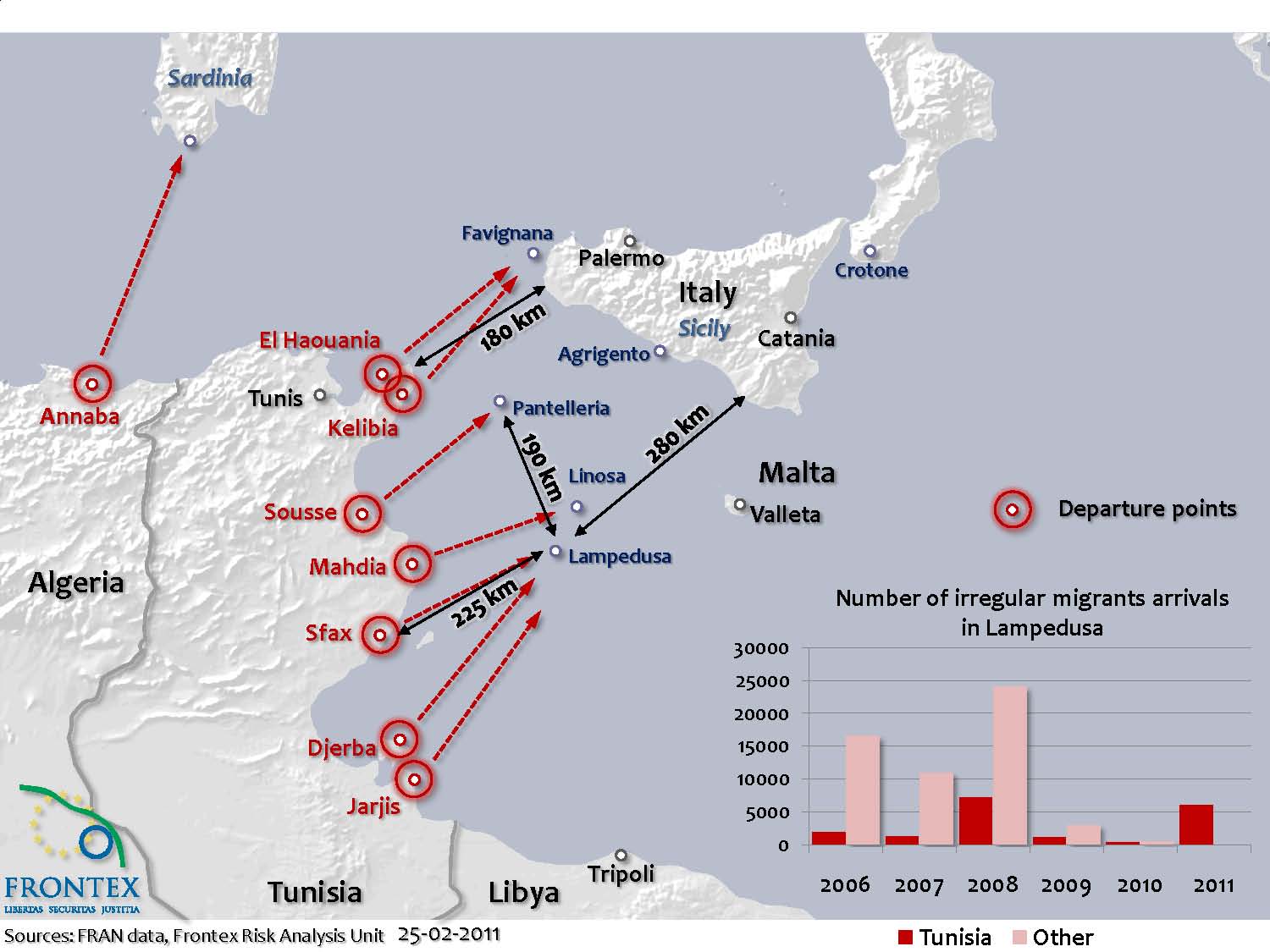
Frontex Lampedusa Situational Map

Frontex posted a situational map showing current and past information regarding migrant flows from Tunisia to Italy.  The map is dated 25 Feb. 2011.

1 Comment

Filed under Algeria, Data / Stats, European Union, Frontex, Italy, Malta, Mediterranean, News, Tunisia

Network Euro Mediterraneo per i Diritti dell’Uomo: Missione di raccolta informazioni in Tunisia e Italia e Raccomandazioni

From CIR:  “…[I]l Network Euro Mediterraneo per i Diritti dell’Uomo ha organizzato una missione di raccolta informazioni, che si è svolta dal 18 al 24 febbraio prima in Tunisia e poi in Italia. La missione era composta da rappresentanti di organizzazioni membro del Network e di partner e da esperti del Nord e del Sud del Mediterraneo. La missione ha potuto raccogliere testimonianze e informazioni dirette, tanto in Tunisia che in Italia.

La missione ha permesso di smentire sia la tesi della presenza massiva tra i migarnti arrivati in Italia di delinquenti di diritto comune evasi dalle carceri, sia quella di un complotto migratorio che sarebbe stato ordito dalla Libia e dai nostalgici di Ben Ali.

Nel corso della missione, le preoccupazione legate agli avvenimenti drammatici che sconvolgono la Libia hanno, in qualche maniera, soppiantato gli interrogativi che circondano i migranti tunisini.

Al termine di questa missione, il Network formula le seguenti raccomandazioni:

Alle autorità italiane:

  • Rispettare la dignità di tutti i migranti, quali che siano le loro motivazioni.
  • Sospendere l’applicazione dell’accordo bilaterale di riammissione con la Tunisia sotto il concluso con il regime di Ben Ali. Sospendere tutte le misure di espulsione forzata individuale o collettiva verso la Tunisia.
  • Richiedere all’Unione Europea l’attivazione del meccanismo di protezione temporanea.
  • Nell’attesa della protezione temporanea, accordare ai migranti una forma di protezione umanitaria che si traduca in un titolo di soggiorno legale in Italia. Misura che deve essere indicata dalle autorità centrali e che non deve essere in alcun modo delegata alla discrezionalità delle singole Questure e Commissioni Territoriali per il riconoscimento della protezione internazionale
  • Migliorare e razionalizzare le condizioni d’accoglienza, il ricorso allo stato d’urgenza umanitaria non può tradursi in un abbassamento degli standard di accoglienza.
  • Astenersi dal mettere in opera il progetto di raggruppamento del Villaggio Mineo, in Sicilia, di tutti i richiedenti asilo in corso di procedura in Italia, misura         che può provocare una situazione di ghetto ed esclusione sociale
  • Assicurare ai migranti che hanno fatto domanda d’asilo un esame individuale della domanda di protezione nel pieno rispetto delle direttive “procedure” e “qualifiche”
  • Astenersi da dichiarazioni allarmistiche e incendiarie che assimilano migranti, delinquenti e terroristi

Alle autorità tunisine

  • Garantire la libertà di tutte le persone di lasciare qualsiasi paese compreso il proprio ( Articolo 12, 2 del Patto internazionale relativo ai diritti civili e politici). Di conseguenza, astenersi di tutte le procedure penali per le persone fermate nel tentativo di lasciare la Tunisia via mare o per quanti sono rimpatriati forzatamente verso il Paese
  • Rispettare pienamente le obbligazioni marittime internazionali relative alla ricerca e al salvataggio in mare.
  • Aprire una inchiesta approfondita e imparziale sulle condizioni nelle quali una barca è affondata l’11 febbraio, in un incidente che è costato la vita ad almeno 5 persone, e perseguirne i responsabili
  • Sospendere l’applicazione dell’accordo bilaterale sul controllo dell’Immigrazione concluso con l’Italia. Esigerne la rinegoziazione e, nel futuro, escludere la possibilità di rimpatri massivi e la sua applicazione a cittadini di paesi terzi.

Alle autorità europee

  • Accompagnare gli Stati dell’Africa del Nord nel processo di transizione in corso, poiché la democrazia è la sola a poter garantire una reale stabilità nella regione, e quindi offrire ai giovani la possibilità di costruire il loro futuro in un paese nel quale possono progettare un avvenire.
  • Aiutare l’Egitto e la Tunisia che, contrariamente all’Europa, sono già stati chiamati ad accogliere rifugiati libici e stranieri, in provenienza dalla Libia. La solidarietà a cui si appellano gli Stati del Sud dell’Unione Europea deve esprimersi innanzitutto nei confronti di questi Stati in transizione
  • Astenersi da tutte le operazioni che avrebbero come conseguenza la dissuasione o l’impedimento dell’arrivo in Europa di persone che avrebbero bisogno di protezione
  • Prepararsi all’attivazione della direttiva sulla “protezione temporanea” nel caso si producano arrivi massivi dal Nord Africa.”

Click here (IT) for full CIR post.

See also CIR “Emergenza Nord Africa”.

Leave a comment

Filed under European Union, General, Italy, Libya, Mediterranean, Reports, Statements, Tunisia

Special web page – CIR “Emergenza Nord Africa”

Consiglio Italiano per i Rifugiati (CIR) created a special web page – Emergenza Nord Africa – which is tracking migration and other related aspects of the North African crisis.

Click here (IT).

Leave a comment

Filed under European Union, Italy, Libya, News, Tunisia

Most EU States View Italy’s Concerns Over Refugee Threat As Grossly Exaggerated

The JHA Council yesterday rejected Italy’s call for a stronger EU response to what it describes as an impending migrant flow from North Africa consisting of hundreds of thousands of migrants and asylum seekers.  Several EU governments described the Italian request as one that was based on exaggerated fears.  Hungary’s interior minister, Sandor Pinter, told reporters that “we shouldn’t paint the devil on the wall until he appears.”  German Interior Minister Thomas de Maiziere said “we shouldn’t be painting horror figures and encouraging refugees to come to Europe.”  Another accused Italy of “crying wolf.”

IOM spokeswoman Jemini Pandya said that while Italy should not shoulder a refugee burden on its own, no Libyans have arrived in Italy to date and she rejected the Italian estimates:  “I don’t think in any shape or form you are going to see one-and-a-half million migrants suddenly flood into Europe.  That is really not going to happen at all.  That would really be fear mongering to the extreme.”

Italy has done itself and neighbouring countries a disservice by repeatedly speaking of an “exodus of biblical proportions” and by suggesting that many hundreds of thousands of migrants are poised to take to the sea to try to reach Italy and Malta from Libya.  These estimates are in all likelihood grossly exaggerated.

But even if you agree that Italy’s feared numbers are exaggerations, the fact that no irregular migrant or asylum seeker has apparently yet left Libya by sea is not at all surprising.  Libya is in chaos and few people are likely to try to depart the country by sea until the level of violence begins to diminish.  Libya has (or had) a functioning network of human traffickers and they will be ready to begin exploiting the chaos and to take advantage of desperate people seeking to flee at some point in the future.  If Gaddafi manages to remain in power, once he is no longer concerned with his personal survival, his thoughts will at some point turn to revenge.  Libya will presumably cease cooperating with Italy on the bi-lateral pushback practice, and Gaddafi will tolerate or encourage irregular migration towards Europe.  So Italy is correct in that there is a real threat of significant numbers of migrants and asylum seekers leaving from Libya some time in the near future.  The numbers could easily and quickly surpass the 6,000 who have left Tunisia for Lampedusa.  Could the numbers surpass 30,000?  30,000 asylum seekers entered Sweden last year (population 9 million – Italy’s population is 50+ million) and Sweden has not received any extraordinary EU assistance as a result.  Could the numbers exceed the hundreds of thousands that fled the Balkan wars in the 1990s?  Possible, but probably not very likely.

Click here, here, here, here, and here for articles.  (EN)

2 Comments

Filed under Cyprus, European Union, France, Germany, Greece, Hungary, Italy, Libya, Malta, Mediterranean, News, Spain, Sweden, Tunisia

JHA Council: Commission is Studying Different Funding Possibilities to Assist with Impact of Migratory Flows from North Africa

A Justice and Home Affairs press release summarizing today’s JHA Council meeting includes the following brief summary regarding the topic of migratory flows from North Africa:

“Over lunch, ministers discussed the situation in Northern Africa, and particularly the situation in Libya and the influx of migrants, above all from Tunisia to Italy. Since the beginning of the year, some 6000 immigrants have arrived mainly to the Italian island of Lampedusa. Following a formal request for help from the Italian Ministry of Interior, received on February 15, Frontex and Italy have started a Joint Operation in the central Mediterranean area on Sunday 20 February. Joint Operation Hermes 2011, originally planned to commence in June, was thus brought forward. Assets and experts for this operation were made available from a large number of EU member states. More information.  In addition to that, the Commission is studying different funding possibilities through various EU instruments, such as the European Refugee Fund, the European Return Fund and the European Border Fund.”

It is unclear whether the JHA Council will address this topic further tomorrow when the Council meeting resumes.

Click here for full JHA press release.

Leave a comment

Filed under Aegean Sea, European Union, Frontex, Libya, Mediterranean, News, Statements, Tunisia

Italy, France, Spain, Malta, Cyprus Call for Redistribution of Asylum Seekers

The Ministers of the Interior of Italy, France, Spain, Malta and Cyprus met in Rome on Wednesday in advance of today’s JHA Council meeting and agreed to ask the EU for assistance in regard to the expected flow of migrants from North Africa.  The Ministers will call for the creation of a special EU fund to provide financial support to the frontline states directly affected by significant numbers of migrants and for the redistribution or relocation of asylum seekers among all EU member states so that the states of first arrival do not experience an unfair burden.  Michele Cercone, spokesperson for Commissioner Cecilia Malmström, noted that current European standards do not provide a mechanism for the redistribution between member states of migrants seeking asylum, other than on a voluntary basis.

Click here (IT) for article.

1 Comment

Filed under Cyprus, European Union, France, Italy, Libya, Malta, Mediterranean, News, Spain, Tunisia

Barroso Criticises Italy’s Use of Migration Issue to Not Support Democracy in North Africa

From the EU Observer:  “Italian leader Silvio Berlusconi is friends with Gaddafi…  Italy also has major oil, gas and arms interests in Libya and it fears a ‘biblical exodus’ of hundreds of thousands of irregular migrants and refugees if Gaddafi snaps.  The head of the European Commission, Jose Manuel Barroso, on Wednesday made an implicit criticism of Italian policy. ‘This question of migration, or of illegal migration, or even of refugees, is sometimes used as a way of not supporting democracy and I do not agree with that,’ [Barroso] said after meeting a top UN human rights official in the EU capital.”

Click here (EN) and here (IT) for articles.

1 Comment

Filed under European Union, Italy, Libya, Mediterranean, News