Tag Archives: Italy

If the EU Attacks Migrant Boats in Zuwara, Libya, How Will It Select from Among the 100s of Boats?

Italy and other EU States are clearly in possession of information regarding the specific locations in Libya from where migrant boats depart. The Guardian’ s Patrick Kingsley has been reporting from Libya in recent days, interviewing smugglers and observing a migrant boat depart on at least one recent occasion from the port of Zuwara located west of Tripoli.

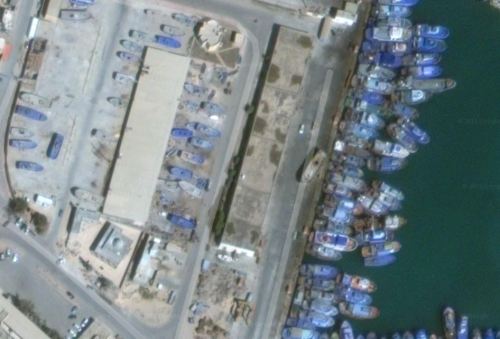
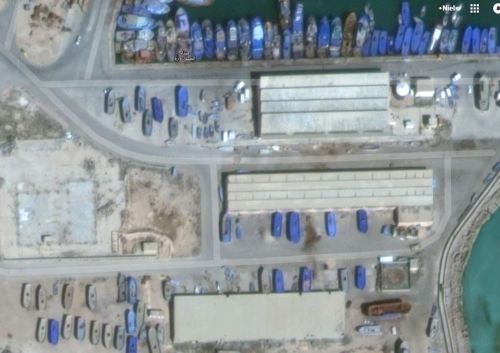
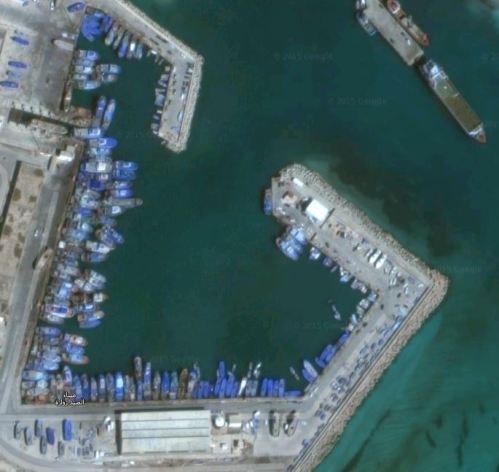
If the EU does press forward with its stated intention of destroying boats that may be used by smugglers, how will the EU select the boat or boats to be destroyed? Google Earth imagery dating from early this year shows approximately 125 large fishing boats moored in the harbour and another 100 boats on land immediately adjacent to the harbour. Dozens of smaller boats are also in the water and on land. (See screen shots below.) Additionally, the harbour is surrounded by at least five large warehouses, each approximately 100 metres in length. The Google Earth imagery suggests that additional boats may be located within some of the warehouses.

There is no effective and safe (or legal) means by which a particular smuggling boat can be identified and destroyed without destroying multiple other boats. As the Guardian’s Kingsley wrote, “smugglers do not maintain a separate, independent harbour of clearly marked vessels, ready to be targeted by EU air strikes. They buy them off fishermen at a few days’ notice. To destroy their potential pool of boats, the EU would need to raze whole fishing ports.”

UN Secretary General Ban Ki Moon on Sunday criticised the EU plan to use military force, telling La Stampa (as reported by Reuters), “[t]here is no military solution to the human tragedy playing out in the Mediterranean. It is crucial that we take a holistic approach that looks at the root causes, at security and the human rights of migrants and refugees, and have legal and regulated immigration networks.”

See previous posts on this topic: The EU’s Proposed Plan to Destroy Migrant Boats in Libya Must be Rejected by the European Council and UK and France to Seek UN Security Council Authorisation for Military Action Against Smuggler Boats.

Zuwara Harbour 2015 Via Google Earth

Zuwara Harbour.

Zuwara Harbour West Side Warehouses via Google Earth

Storage area and warehouses on west side of Zuwara Harbour.

Zuwara Harbour South Warehouses South 2015 via Google Earth

Storage area and warehouses on south side of Zuwara Harbour.

1 Comment

Filed under European Union, Libya, Mediterranean, News

Official Statement: Special meeting of the European Council, 23 April 2015

Full text:

“1. The situation in the Mediterranean is a tragedy. The European Union will mobilise all efforts at its disposal to prevent further loss of life at sea and to tackle the root causes of the human emergency that we face, in cooperation with the countries of origin and transit. Our immediate priority is to prevent more people from dying at sea.

2. We have therefore decided to strengthen our presence at sea, to fight the traffickers, to prevent illegal migration flows and to reinforce internal solidarity and responsibility. Given that instability in Libya creates an ideal environment for the criminal activities of traffickers, we will actively support all UN-led efforts towards re-establishing government authority in Libya. We will also step up efforts to address conflict and instability as key push factors of migration, including in Syria.

3. We today commit to:

Strengthening our presence at sea

a) rapidly reinforce EU Operations Triton and Poseidon by at least tripling the financial resources for this purpose in 2015 and 2016 and reinforcing the number of assets, thus allowing to increase the search and rescue possibilities within the mandate of FRONTEX. We welcome the commitments already made by Member States which will allow to reach this objective in the coming weeks;

Fighting traffickers in accordance with international law

b) disrupt trafficking networks, bring the perpetrators to justice and seize their assets, through swift action by Member State authorities in co-operation with EUROPOL, FRONTEX, the European Asylum Support Office (EASO) and EUROJUST, as well as through increased intelligence and police-cooperation with third countries;

c) undertake systematic efforts to identify, capture and destroy vessels before they are used by traffickers;

d) at the same time, the High Representative is invited to immediately begin preparations for a possible CSDP operation to this effect;

e) use EUROPOL to detect and request removal of internet content used by traffickers to attract migrants and refugees, in accordance with national constitutions;

Preventing illegal migration flows

f) increase support to Tunisia, Egypt, Sudan, Mali and Niger among others, to monitor and control the land borders and routes, building on current CSDP operations in the region, as well as on regional cooperation frameworks (Rabat and Khartoum processes); step up dialogue with the African Union at all levels on all these issues;

g) reinforce our political cooperation with African partners at all levels in order to tackle the cause of illegal migration and combat the smuggling and trafficking of human beings. The EU will raise these issues with the African Union and the key countries concerned, with whom it will propose the holding of a summit in Malta in the coming months;

h) step up cooperation with Turkey in view of the situation in Syria and Iraq;

i) deploy European migration liaison officers in key countries to gather information on migratory flows, co-ordinate with national liaison officers, and co-operate directly with the local authorities;

j) work with regional partners in building capacity for maritime border management and search and rescue operations;

k) launch Regional Development and Protection programmes for North Africa and the Horn of Africa;

l) invite the Commission and the High Representative to mobilise all tools, including through development cooperation and the implementation of EU and national readmission agreements with third countries, to promote readmission of unauthorised economic migrants to countries of origin and transit, working closely with the International Organisation for Migration;

m) while respecting the right to seek asylum, set up a new return programme for the rapid return of illegal migrants from frontline Member States, coordinated by FRONTEX;

Reinforcing internal solidarity and responsibility

n) rapid and full transposition and effective implementation of the Common European Asylum System by all participating Member States, thereby ensuring common European standards under existing legislation;

o) increase emergency aid to frontline Member States and consider options for organising emergency relocation between all Member States on a voluntary basis;

p) deploy EASO teams in frontline Member States for joint processing of asylum applications, including registration and finger-printing;

q) set up a first voluntary pilot project on resettlement across the EU, offering places to persons qualifying for protection.

4. The EU institutions and the Member States will work immediately on the full implementation of these orientations. The Presidency and the Commission will present next week a roadmap setting out work up to June.

5. The European Council looks forward to the Commission Communication on a European Agenda for Migration, in order to develop a more systemic and geographically comprehensive approach to migration. The European Council will remain seized of the situation and will closely monitor the implementation of these orientations. The Council and the Commission will report to the European Council in June.”
1 Comment

Filed under European Union, Frontex, Mediterranean, Statements

Libya Group With Control Over Tripoli and Libya’s Western Coast Says It Will “Confront” Unilateral EU Attacks on People Smuggler Sites

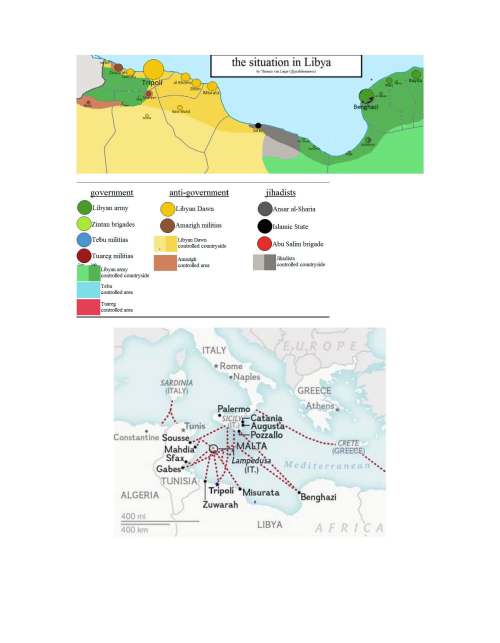
Libya Dawn, “[t]he group controlling Libya’s coastal capital Tripoli [and the Mediterranean coastal areas to the east and west of Tripoli] says it will ‘confront’ any unilateral European Union moves to attack sites used by people smugglers, urging the [EU] to consult it over plans to deal with the migration crisis.” (Click here for Guardian article-reporting based on Times of Malta interview with the group’s foreign minister.)

The political and security situation in Libya is complicated. And while migrant boats tend to depart from areas around Tripoli because the area is closer to Lampedusa and Malta, boats leave from eastern areas of Libya as well. If the EU does end up taking military action in Libya, it will necessarily engage with different militias and political groups.

Libya Situation Map mid-April 2015 – Map by @arabthomness.

2015-April Libya Situation Map

Leave a comment

Filed under European Union, Italy, Libya, Malta, Maps, Mediterranean, News

Post Meeting Remarks from Council President Tusk: EU to destroy smugglers’ boats in line with int’l law; triple resources for Frontex Operation Triton; seek better co-operation with countries of origin and transit; coordinate resettlement of more refugees

Remarks by President Donald Tusk following the special European Council meeting on migratory pressures in the Mediterranean – 23/04/2015, 22:00

Full Text:

“Good evening. Today, we discussed the dramatic situation in the Mediterranean at the highest political level. Saving the lives of innocent people is the number one priority. But saving lives is not just about rescuing people at sea. It is also about stopping the smugglers and addressing irregular migration.

Let me be clear. Europe did not cause this tragedy. But that does not mean we can be indifferent. We are facing a difficult summer and we need to be ready to act.

Therefore, leaders have agreed four priority areas for action.
First, leaders have asked the High Representative to propose actions in order to capture and destroy the smugglers’ vessels before they can be used. Naturally, this will be in line with international law and respect for human rights. We will step up co-operation against smuggling networks by working through Europol, and by deploying immigration officers to third countries.

Second, we have agreed to triple the resources available to Triton, our border mission in the Central Mediterranean, and to enhance its operational capability. The mission will continue to carry out its mandate and respond to distress calls where necessary. I am happy to announce that leaders have already pledged significantly greater support, including many more vessels, aircraft and experts, and money.

Third, we need to limit irregular migration flows and to discourage people from putting their lives at risk. This means better co-operation with the countries of origin and transit, especially the countries around Libya.

Finally, we will do more on refugee protection. The European Union will help front-line Member States under pressure and co-ordinate the resettlement of more people to Europe on a voluntary basis, and with an option for emergency relocation. For those who do not qualify as refugees, we will operate an effective returns policy.
Leaders had no illusions that we would solve this international human emergency today. Therefore, we have tasked the Commission, the Council and the High Representative to step up their work based on what we have now agreed. This issue remains our priority and the European Council will come back to it in June.

As a final remark, let me repeat that the European Union is completely opposed to the death penalty. It cannot be the answer to drug trafficking. I am referring here to Mr Atlaoui, the French citizen who has been condemned by the Indonesian authorities. Thank you.”

3 Comments

Filed under European Union, Frontex, Mediterranean, Statements

Text of Draft European Council Statement (via Statewatch)

From Statewatch, here is the text of the Draft European Council Statement that will be considered today:

DRAFT EUROPEAN COUNCIL STATEMENT

1. The situation in the Mediterranean is a tragedy. The European Union will mobilise all efforts at its disposal to prevent further loss of life at sea and to tackle the root causes of the human emergency that we face, in cooperation with the countries of origin and transit. Our immediate priority is to prevent more people from dying at sea.

2. We have therefore decided to strengthen our presence at sea, to fight the traffickers, to prevent illegal migration flows and to reinforce internal solidarity. Given that instability in Libya creates an ideal environment for the criminal activities of traffickers, we will actively support all UN-led efforts towards re-establishing government authority in Libya. We will also step up efforts to address conflict and instability as key push factors of migration, including in Syria.

3. We today commit to:

Strengthening our presence at sea

a)rapidly reinforce EU Operations Triton and Poseidon by at least doubling the financial resources for this purpose in 2015 and 2016 and reinforcing the number of assets, thus allowing to increase the search and rescue possibilities within the mandate of FRONTEX; [p.m.: welcome pledges]

Fighting traffickers

b) disrupt trafficking networks, bring the perpetrators to justice and seize their assets, through swift action by Member State authorities in co-operation with EUROPOL, FRONTEX, the European Asylum Support Office (EASO) and EUROJUST, as well as through increased intelligence and police-cooperation with third countries;

c) undertake systematic efforts to identify, capture and destroy vessels before they are used by traffickers. The High Representative is invited to immediately begin preparations for a possible CSDP operation to this effect, in accordance with international law;

d) use EUROPOL to detect and request removal of internet content used by traffickers to attract migrants and refugees, in accordance with national constitutions;

Preventing illegal migration flows

e) increase support to Tunisia, Egypt, Sudan, Mali and Niger among others, to monitor and control the land borders and routes in order to prevent potential migrants from gaining access to Mediterranean shores, building on current CSDP operations in the region, as well as on regional cooperation frameworks (Rabat and Khartoum processes); step up dialogue with the African Union at all levels on all these issues;

f) deploy European migration liaison officers in key countries to gather information on migratory flows, co-ordinate with national liaison officers, and co-operate directly with the local authorities;

g) work with regional partners in building capacity for maritime border management and search and rescue operations;

h) launch Regional Development and Protection programmes for North Africa and the Horn of Africa;

i) invite the Commission and the High Representative to mobilise all tools, including through development cooperation, to promote readmission of unauthorised economic migrants to countries of origin, working closely with the International Organisation for Migration;

j) set up a new return programme for the rapid return of irregular migrants from frontline Member States, coordinated by FRONTEX;

Reinforcing internal solidarity

k) set up a first voluntary pilot project on resettlement, offering at least 5,000 places to persons qualifying for protection;

l) increase emergency aid to frontline Member States and consider options for organising emergency relocation between Member States;

m) deploy EASO teams in frontline Member States for joint processing of asylum applications, including registration and finger-printing.

4.The EU institutions and the Member States will work immediately on the full implementation of these orientations. The European Council looks forward to the Commission Communication on a European Agenda for Migration, in order to develop a more systemic and geographically comprehensive EU approach to migration. The European Council will remain seized of the situation and will closely monitor the implementation of these orientations. The Council and the Commission will report to the European Council in June.

3 Comments

Filed under European Union, Frontex, Mediterranean, News

Recent UN Security Council Statements on Libya and Migrants

The special meeting of the European Council will occur later today. Based on various press reports, it seems that the EU will decide to pursue several courses of actions in response to the situation in the Mediterranean, including taking steps – presumably by military force – to identify, capture and destroy migrant boats in Libya before the boats are used by smugglers. HR Federica Mogherini will reportedly be instructed to seek authorisation for the military strikes from the UN. (Click here (IT) and here (EN) for articles)  (Here is the Draft European Council Statement via Statewatch.)

The most recent UN Security Council resolution on Libya (Resolution 2213) was adopted on 27 March 2015; the Resolution extended the mandate of the United Nations Support Mission in Libya (UNSMIL) until 15 September 2015. The Resolution also took note of, among other matters, the dire situation faced by migrants in Libya and called on the Libyan government to promote and protect “the human rights of all persons in Libya, particularly those of African migrants and other foreign nationals.”

On 21 April, after the most recent migrant boat accident, the Security Council released a Press Statement regarding the boat accident and “expressed their concern at the implications for regional stability posed by transnational organized crime and illicit activities such as the smuggling of migrants…”

The press statement is not a formal statement from the Security Council, but may provide some limited insight into how members of the Security Council view the relationship between the flow of migrant boats and a possible threat to international peace and security and how the Security Council might respond to the EU request.

Full Text of the 21 April 2015 Press Statement:

“Security Council Press Statement on Recent Maritime Tragedy in Mediterranean Sea

The following Security Council press statement was issued today by Council President Dina Kawar (Jordan):

The members of the Security Council deplored the recent maritime tragedy in the Mediterranean Sea that resulted in hundreds of casualties, and extended their deepest condolences to all those affected and to their families.

The members of the Security Council expressed their grave concern at the recent proliferation of, and endangerment of lives by, the smuggling of migrants in the Mediterranean Sea, off the coast of Libya.

The members of the Security Council expressed their concern at the implications for regional stability posed by transnational organized crime and illicit activities such as the smuggling of migrants, condemned and deplored the said acts and underlined the need to bring the perpetrators of these acts to justice.

The members of the Security Council called for the full implementation by State Parties of the Protocol against the Smuggling of Migrants by Land, Sea and Air, supplementing the United Nations Convention against Transnational Organized Crime.

The members of the Security Council expressed their strong support to countries in the region affected by the smuggling of migrants and emphasized the need to step up coordination of international efforts in order to strengthen a global response to this common challenge, and in order to protect these vulnerable migrants from being victimized by human traffickers.

The members of the Security Council urged all Member States, including countries of origin and transit, to cooperate with each other and with relevant international and regional organizations, including the IOM [International Organization for Migration], in addressing illicit migration flows, and dismantling smuggling networks in the region.

In that regard, the members of the Security Council urged all States to comply with their applicable obligations under international law, including international human rights law, international humanitarian law, and refugee law.

For information media. Not an official record.”

Leave a comment

Filed under Mediterranean

The EU’s Proposed Plan to Destroy Migrant Boats in Libya Must be Rejected by the European Council

A plan for EU Member States to capture or destroy the boats used by people smugglers in the Mediterranean is one of ten possible courses of action that will be considered during the Extraordinary European Council Meeting on the Situation in the Mediterranean that will be held on 23 April.

The boat destruction proposal should be rejected for multiple reasons. There is no basis in law for the proposal and it would endanger lives of innocent people including migrants and fishermen, among others. It would certainly have little effect on its intended target, the people smugglers.

EU migration commissioner Avramopoulos described the plan, which has been recommended by the Foreign Affairs Council which met on 20 April, as a civil-military operation which would “capture and destroy vessels used by smugglers.” Avramopoulos reportedly compared the proposed EU boat destruction plan to Operation ATALANTA, the EU’s maritime operation against piracy off Somalia, saying that Atalanta “should inspire us for new operations against smugglers in the Mediterranean.”

As is always the case, the specific details of the proposed plan matter. There are situations where the destruction of a migrant boat under certain circumstances may be perfectly legal and otherwise appropriate. For example after a rescue operation when migrants have been safely removed from an unflagged and unseaworthy vessel, it may be appropriate for that vessel to be destroyed at sea rather than taking it in tow or leaving it adrift and thereby creating a navigational hazard. In such circumstances, there is no reason for an EU coast guard vessel, after migrants have been transferred from a migrant boat, to stand by and allow smugglers to take possession of the now empty migrant boat.

But if the EU boat destruction plan were to authorise the use of armed force to capture or destroy a smuggling boat at sea, particularly in the face of armed resistance from people smugglers, or if it were to authorise the destruction of boats at anchor in Libyan harbours, it is difficult to imagine how such a plan could be carried without endangering the lives of migrants and fisherman and thereby violating international humanitarian and human rights law.

Frontex and Italian patrol boats have already experienced armed threats at sea during rescue operations. One situation occurred on 13 April when armed people smugglers fired into the air to recover an empty migrant boat after an Italian tugboat and the Icelandic Coast Guard vessel Týr deployed by Frontex had rescued a group of migrants.  The Frontex vessel did not engage the people smugglers with force and allowed the smugglers to return to Libya with the empty migrant boat. If Frontex vessels or coast guard vessels were now to be called upon to use some level of appropriate force to prevent such incidents, rescue operations would be delayed, further complicated, and the rescued migrants would be placed in danger.

In regard to the possible destruction of boats at anchor in a Libyan harbour, the EU cannot engage in the proposed civil-military operation without having a legal basis to do so. One possible source of authority would be the invocation of Chapter VII of the UN Charter by the UN Security Council, but this would require the finding that the flow of migrant boats constitutes a threat to international peace and security. While the security situation in Libya or Syria might well constitute such a threat, the large scale movement of migrants by people smugglers does not.

Chapter VII has of course been invoked to authorise the EU Operation ATALANTA after the Security Council authorised of the use of force off Somalia in international waters and in Somalian territorial waters (as well as within Somalian territory). But the legal basis for Operation ATALANTA has no relevance to the proposed EU boat destruction plan. The suppression of piracy in international waters is authorised and governed by specialized international law and customary international practice relating to the suppression of piracy. There is no equivalent basis in international law for the suppression of people smuggling.

Chapter VII was likewise invoked in 2011 to authorise the use of force by NATO in Libya. The Security Council again made the necessary determination that the situation in Libya at the time was a threat to international peace. Among the factors referenced by the Security Council in Resolution 1973 was the plight of refugees and foreign workers who were subject to violence and who were forced to flee Libya. The resolution praised Tunisia and Egypt for protecting the fleeing refugees and called on the international community to support the efforts. It would be repugnant if today the ongoing violence in Libya was somehow used as a legal basis for a use of force which would serve to trap and endanger migrants, rather than making them safer.

In addition to the serious legal questions relating to the use of force to capture and destroy smugglers’ boats, there are serious practical concerns. Take the example of the unprecedented boat disaster and the 900 deaths that occurred earlier this week. One of the likely reasons for the massive death toll was the large number of persons who were locked below the main deck of the boat. What precautions would prevent the destruction of a suspected smuggling vessel at anchor with hundreds of people below deck and out of sight? Would the EU boat destruction plan require that any capture or destruction of a suspected smuggling boat be carried out by deploying EU military personnel on the ground in Libya with the resulting ability to more closely inspect a vessel before its destruction? Or would the plan permit destruction of a suspected smuggling boat by armed drones or military aircraft? If the destruction could occur through the use of aircraft, people will be killed, and it is more likely that those who will be killed will be migrants or innocent fisherman and not the people smugglers.

The easiest targets for destruction will be the larger fishing vessels that are being used by the people smugglers. But not so long ago the smuggling boats of choice were the Zodiacs and other large or medium–sized inflatable boats powered by outboard engines. This type of boat can be easily stored in vehicles or storage buildings and quickly moved into the water when needed. It would be an easy tactical shift on the part of the people smugglers to resume the use of inflatables if the larger fishing vessels were no longer obtainable.

The European Council needs to take new and significant steps to respond to this crisis. A focus on people smugglers should certainly be something that is addressed, but while the people smugglers are taking advantage of the crisis, they are not the cause. The EU response needs to instead focus on expanded search and rescue (i.e. Mare Nostrum plus – not Operation Triton plus) and creating alternative safe paths for people to seek protection in the EU or in other appropriate countries. The boat destruction plan should be rejected.

6 Comments

Filed under Analysis, European Union, Frontex, Italy, Libya, Mediterranean, Refugees, United Nations

Very Few Migrants Reaching Italy Apply for Asylum

While roughly 170,000 migrants over the past 14 months have reached Italy or been rescued and brought to Italy, according to UNHCR and Eurostat figures, very few of them are applying for asylum in Italy. Eurostat data through November 2014 indicate approximately 25,200 asylum applications from all nationalities were filed in Italy during the first six months of 2014; the number increased to approximately 27,000 during the period July-November 2014.

Eurostat data further show that only 455 asylum applications were submitted by Syrians in Italy during the January-November 2014 period, whereas over the same period over 28,000 Syrian asylum applications were submitted in Germany.

According to Italian press reports, “[n]ew figures from the UN’s refugee agency showed 25,077 people applied for asylum in Italy during the first six months of 2014. The highest number in Europe was recorded in Germany, which received 77,109 applications, followed by France (54,131) and Sweden (38,792).”

Click here for Eurostat “Asylum and new asylum applicants – monthly data”.

Click here for Eurostat “Asylum and new asylum applicants by citizenship, age and sex Monthly data (rounded)”. (Conduct search by modifying “+Citizen” option at upper right.)

Or click here for main Eurostat website and search for “asylum.”

Click here for news article.

7 Comments

Filed under Data / Stats, Germany, Italy, Migrants, Refugees, Syria

IOM Report on Recent Use of Cargo Ships to Transport Syrians to Italy

Excerpts from a short IOM report released on 6 January 2015 on the recent use of cargo ships, specifically the Blue Sky M and the Ezadeen, to transport Syrians towards Italy:

“IOM analysts do believe the prospect of single-nationality cargoes – on these latest voyages, migrants fleeing Syria – creates opportunities for smuggling rings to employ certain economies of scale that were not apparent in the more ‘mixed’ passenger manifests seen leaving Egypt and Libya in 2014.”

“‘The predictability of thousands now fleeing Syria every month allows smugglers to plan for a reliable stream of customers, which of course allows them to set a price point,’ explained Joel Millman, a spokesperson for IOM in Geneva. ‘So they can predict how much revenue each trip will bring, and then quickly deploy vessels and crews’. Millman added that Lebanon’s recent decision to require visas of Syrian migrants seeking to enter Lebanon may divert new migrant traffic to Turkey’s coasts, which will swell demand for smugglers’ services.”

“In the last four months of 2014 IOM learned of larger ‘mother’ ships waiting in open water to receive passengers ferried out by smugglers. Larger ships leaving Turkey loaded with migrants from Syria began appearing in greater numbers late last year in the Eastern Mediterranean.”

“Maritime experts calculate that such ships normally would be available for between USD 100,000 and USD 150,000, allowing smugglers to earn upwards of USD 3 million for voyages like the two that ended in recent days, with up to 900 migrants crammed on board.”

“‘This new route is a direct consequence of the Syrian crisis,’ added IOM’s [Federico] Soda. ‘Despite the end of the Mare Nostrum’s rescue-at-sea operations, arrivals continue because of the many crises close to Europe.’”

Click here for report.

1 Comment

Filed under Aegean Sea, Frontex, Migrants, Refugees, Reports

Frontex Update on Incident Involving Ezadeen Cargo Vessel

Frontex press statement: The cargo vessel was carrying 360 migrants and had departed from Turkey. “People smugglers began using cargo vessels like Ezadeen last summer, and it has now become a new method of bringing migrants to Europe. These decommissioned freighters, up to 75-metre long, depart from Turkey and head for the Italian cost. Some 15 incidents involving cargo ships have taken place since August 2014.”

1 Comment

Filed under European Union, Frontex, Migrants, Refugees

UNHCR: Urgent European Action Needed in Mediterranean

Statement by Vincent Cochetel, UNHCR Europe Bureau Director, on new boat arrival in Italy:

“The use of larger cargo ships is a new trend, but it is part of an ongoing and worrying situation that can no longer be ignored by European governments. We need urgent European concerted action in the Mediterranean Sea, increasing efforts to rescue people at sea and stepping up efforts to provide legal alternatives to dangerous voyages. Without safer ways for refugees to find safety in Europe, we won’t be able to reduce the multiple risks and dangers posed by these movements at sea.

UNHCR thanks the Italian authorities for their response to these latest incidents, despite the phasing down of the Mare Nostrum operation. We have expressed concerns over the ending of this operation without a similar European search-and-rescue operation to replace it. This will undoubtedly increase the risk for those trying to find safety in Europe.”

For more information on this topic, please contact:

In Geneva, William Spindler on mobile +41 79 217 3011, spindler@unhcr.org
In Geneva, Ariane Rummery on mobile +41 79 200 7617, rummery@unhcr.org

Click here for Statement.

1 Comment

Filed under Frontex, Mediterranean, Statements, UNHCR

Frontex: Update on Operation Triton; Growing Use of Larger Vessels by Smugglers

Frontex last week released updated information on Operation Triton since its launch on 1 November. Frontex also reported on the growing use by smugglers of older freighters and cargo vessels which are being obtained primarily in south-eastern Turkey and which are being used by smugglers to transport larger numbers of migrants – as occurred yesterday with the rescue of 500-700 migrants on board the Moldovan flagged Blue Sky M between Greece and Italy.

Excerpts from the Frontex statement:

“Since the launch on November 1st of Operation Triton, the Frontex-coordinated mission in the central Mediterranean, some 11,400 migrants have been rescued, about 10,000 of them in situations characterised as “distressed,” in 77 separate Search and Rescue incidents at sea. Although significantly smaller than the number recorded during the August peak – when some 28,000 migrants were detected on this route – this level of traffic is still unprecedented for wintertime….”

“In a rapid adaptation of strategy that has become their hallmark, the smugglers have started using much larger boats. These are typically decommissioned freighters, up to 75m long, procured in the ports of south-eastern Turkey, notably Mersin: a departure point still connected by ferry to the Syrian port of Latakia, making it reachable for the tens of thousands of Syrians still fleeing the conflict in their country. The freighters, repaired and manned by crews sometimes hired from as far away as Russia, are piloted via Cyprus and Crete towards Italy, which remains the EU destination of choice for refugees from the Middle East.”

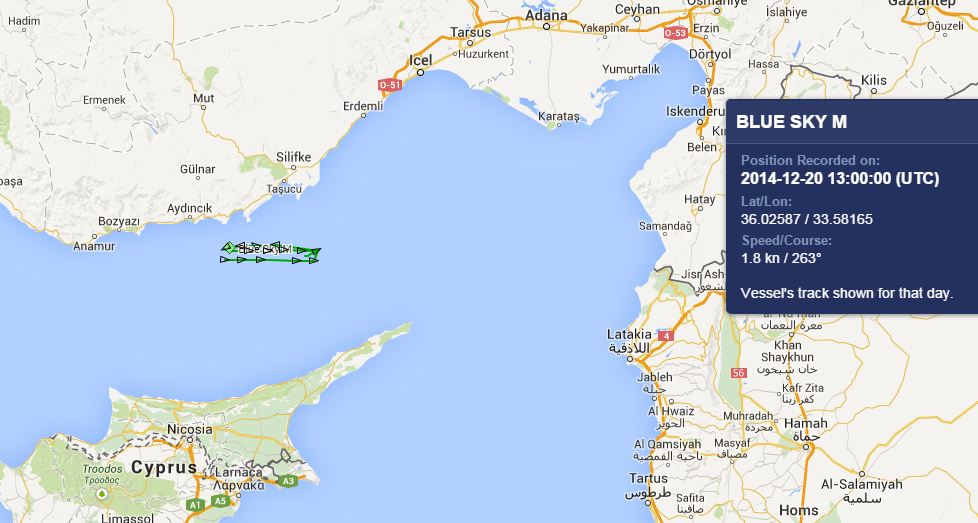
[Editor’s note: yesterday’s incident involving the rescue by Italian authorities of the Moldovan cargo ship Blue Sky M carrying hundreds of migrants would seem to be one such example; AIS tracking information from Marine Traffic shows that the Blue Sky M spent approximately five days (20-25 December) sailing in circles off the south-eastern Turkish coast before it began sailing towards western Greece. See screen capture of ship’s path from Marine Traffic below.]

“A place on a freighter from Turkey costs at least three times the price of a ticket on the usual sea route from Libya. And yet the migrants are willing to pay. Travelling this way not only circumvents the considerable danger of capsizing in a small boat in rough seas: it also avoids having to go to Libya. The departure point of choice for facilitator networks in 2014, this increasingly lawless North African nation appears to have become too dangerous an operating environment even for the criminal gangs….”

“For all its advantages, though, the new route from Turkey is not without dangers. The engines of the old ships are often highly unreliable. In the last six weeks alone, one freighter has been found drifting near Cyprus; another was rescued 30 miles off Crete; still others, off the Italian coast. The danger of shipwreck is greatly increased by the smugglers’ habit of switching off the freighter’s AIS (the Automatic Identification System with which all boats over 300 tonnes, as well as all passenger ships, are equipped). The effect is to make the boat electronically invisible to the Italian search and rescue authorities – a stratagem that buys time for the smuggling crew to escape by fast launch and thus avoid arrest.”

“Frontex has discerned another worrying recent trend: some 30% of all migrants rescued at sea in September and October were picked up by civilian shipping – the vast majority of them, 52 incidents, off the coast of Libya. The smugglers have learned to time the departure of migrant boats so that they cross the paths of merchant ships heading for the EU. When a distress call is transmitted, the merchant ship, being the nearest, is obliged by international maritime law to go to the rescue – and then disembarks them at the next port of call.”

Click here for full statement.

Screen capture from Marine Traffic showing path of Blue Sky M from 20-25 December 2014.

Screen capture from Marine Traffic showing path of Blue Sky M from 20-25 December 2014.

1 Comment

Filed under Frontex, Migrants, News, Refugees

“Mediterranean flows into Europe: Migration and the EU’s foreign policy” – Analysis by European Parliament DG for External Policies

The EP’s Directorate-General for External Policies just released an Analysis, “Mediterranean flows into Europe: Migration and the EU’s foreign policy,” in which it reviews the EU’s external policies and instruments relating to migration in the Mediterranean, including the Mediterranean Task Force established after 3 October 2013 tragedy at Lampedusa in which over 350 people died.

The Analysis describes the serious shortcomings of the security-driven approach that has been taken by the EU. Noting, for example, that “it is unclear whether the militarisation of EU border management (resulting from a tighter relation between the CSDP and Frontex) will actually save lives or create even more danger for migrants” and that “[t]he increasing militarisation of the issue of irregular migration was underscored in December 2013, when the European Council called for the establishment of an EU Maritime Security Strategy by June 2014 as well as for increased synergies between the EU’s Common Security and Defence Policy (CSDP) and freedom/security/justice actors to tackle illegal migration.”

The Analysis discusses possible ways in which the European Parliament might play a more significant role in the shaping of future policies:

“The coming months – which will include the European elections and the June 2014 Council – present an important opportunity for the EP to engage politically with the topic of migration in the Mediterranean. As outlined above, numerous EU external policies and instruments deal with migration in the region; […]

All should incorporate respect for human rights as a central concern and pursue the overall goals of prevention, protection and solidarity. The EP has tools at hand to contribute effectively to those objectives. The EP should use its co-decision powers to ensure the inclusion of human rights provisions in all migration-related legislation, and its power of consent to guarantee that international agreements contain effective human rights guarantees. The EP’s budgetary powers also allow the institution to link assistance to third countries to proper human rights monitoring mechanisms.

Most pressingly, the EP should advocate the implementation of the actions recommended by the Mediterranean Task Force set up by the Commission. The EP should also use the opportunities generated by inter-parliamentary relations (such as the 27th ACP-EU Joint Parliamentary Assembly in March and the EU-Africa summit in April) to engage in a dialogue about migration with third countries. This dialogue should foster cooperation in the management of regular migration and in the fight against irregular migration and trafficking networks, with special emphasis on the need to prevent migrants from embarking on dangerous journeys to the EU.

The dialogue should also seek to frame Mediterranean migration within a wider perspective, possibly in the following ways:

  • Steer away from excessively militarised and security-centred approaches. The EP should ensure that strict human rights standards are respected in the fight against organised crime and smugglers’ networks, and that a clear distinction is drawn between criminal networks and their victims. The EU should prevent the criminalisation of migrants and of humanitarian organisations supporting migrants.
  • Highlight the importance of good governance, and of good migration governance more specifically. By reinforcing the EU’s Regional Development and Protection Programmes, for example, the Union can develop a comprehensive and long-term framework to develop and enhance the capacities of migration management and national asylum systems in Mediterranean countries.
  • Demand full respect for humanitarian law, refugee protection and human rights (including the rights of non-nationals) in crisis situations, and stress that humanitarian access must be guaranteed to provide life-saving supplies.
  • Recognise the importance and challenges that South-South and intra-African migration represent for countries in the southern Mediterranean, rather than focussing solely on the (much smaller) flows towards the EU.
  • Encourage further research on the migration-development nexus and explore the positive impact of human mobility on socioeconomic development.
  • Encourage EU Member States to facilitate and speed up their procedures to grant asylum and EU protected status, whilst better differentiating between refugees and irregular migrants. The EP should respect the competence of the Member States in this regard, but could also encourage Member States – in cooperation with the UNHCR – to increase their quotas for resettling refugees not adequately protected in third countries. The EP should support the Mediterranean Task Force’s proposed feasibility study on the joint processing of protection claims outside the EU, and the Commission’s proposal to move towards a common approach for humanitarian permits and visas.

All these actions would contribute to reshaping the EU’s external action related to migration, notably in the Mediterranean. They would also enhance the EU’s credibility vis-à-vis those third countries that accept significant number of migrants and refugees, and that most directly bear the consequences of their neighbours’ conflicts. (This is the case today for Lebanon and Turkey, as a result of the Syrian civil war). A modified EU approach could also project a more nuanced and positive view of migration – a change that might, in turn, influence the way migration is perceived more broadly within the EU.”

Click here or here for the Analysis.

5 Comments

Filed under Analysis, European Union, Frontex, Greece, Italy, Libya, Malta, Mediterranean, Turkey

Statewatch Analysis – “New EU rules on maritime surveillance: will they stop the deaths and push-backs in the Mediterranean?”

Statewatch last month released a new Analysis of the EU Regulation for Frontex-coordinated surveillance of external sea borders which is scheduled for a plenary vote in the European Parliament in April.  The Analysis, written by Prof. Steve Peers, Univ. of Essex Law School, reviews the enhanced protections to be afforded to intercepted or rescued migrants relative to the earlier Council Decision which was annulled by the CJEU.  The Analysis also highlights concerns with various provisions within the Regulation, including:

  • One significant concern with the Regulation is due to the fact that “the Regulation does not contemplate the scenario of migrants being intercepted in the territorial waters of third States.”  (Frenzen’s Note: This raises a serious concern in regard to the push-back and interception practices which have been carried out for many years within the territorial waters of Mauritania and Senegal within Frontex’s Operation Hera.  Additionally, prior to the Libyan revolution, Libya authorised Italy to conduct joint maritime patrols within Libyan territorial waters.  It is safe to assume that Frontex and some EU Member States will continue to seek the ability to intercept migrant boats within the territorial waters of third States.);
  • While the Regulation requires that migrants intercepted in the territorial sea or contiguous zone of an EU Member State be disembarked in that Member State, “this [requirement] is subject to a crucial exception: it is possible under the Regulation that a vessel that has made it this close to a Member State could still be ordered to alter course towards another destination.”;
  • While the bulk of the EU’s asylum legislation does not apply [to interceptions which occur outside of the territorial sea of a Member State,] the EU’s qualification Directive does – since there is nothing in the text of that Directive to limit its territorial scope. But the wording of the Regulation is confusing in this regard, since it does not refer to the detailed text of that Directive but rather to general standards on non-refoulement, which are different from that Directive in some respects….”;
  • Member States are required to “use all means” to identify intercepted migrants, assess their particular circumstances, and inform them of the intended place of disembarkation, in order to give the migrants the opportunity to assert a non-refoulement claim.  The Regulation states that the Frontex operational plan, “where necessary,” must provide for interpreters and legal advisors on shore. “[T]he Council Presidency points out the ‘wiggle room’ granted by the words ‘where necessary’ and ‘use all means.’”

Click here or here for Statewatch Analysis.

2 Comments

Filed under Aegean Sea, Analysis, Eastern Atlantic, European Union, Frontex, Italy, Libya, Malta, Mauritania, Mediterranean, Senegal, Spain

EU Mediterranean States Oppose Provisions of Proposed Frontex Sea Borders Regulation Relating to Rescue and Disembarkation

[16 Oct. UPDATE: The document from the six states opposing the proposed Regulation is available here.]

One week ago Commissioner Cecilia Malmström called for an “extensive Frontex search and rescue operation that would cover the Mediterranean from Cyprus to Spain.” Yesterday the ANSA news service reported that all six EU Mediterranean states (Cyprus, Greece, Italy, Malta, France and Spain) have voiced opposition to the proposed Frontex Sea Borders Regulation (COM(2013) 197 final) and specifically to Articles 9 and 10 relating to “Search and Rescue Situations” and “Disembarkation.” ANSA reported that the six member states “expressed disapproval of the draft and called it ‘unacceptable for practical and legal reasons’.”  The six countries have reportedly taken the position that there is no need for further regulations pertaining to rescue at sea or post-rescue places of disembarkation since other international laws already “deal ‘amply’ with the matters.”

As you may recall, the earlier version of the Frontex Sea Borders Rule in the form of a Decision was adopted by the European Council in 2010 (Decision 2010/252/EU).  The Decision was subsequently annulled by the Court of Justice of the European Union on the ground that it introduced new essential elements into the Schengen Borders Code by way of the provisions on interception, rescue and disembarkation and that such substantive changes required the consideration and approval of the European Parliament. (European Parliament v Council of the European Union, Case C-355/10, 5 Sept. 2012). The proposed replacement for the annulled Decision is in the form of a Regulation but is fairly similar in content.

While the ANSA report does not identify the specific reasons why the six states are opposing the proposal, one can speculate that the objections to Art. 9, Search and Rescue Situations, may be based on a perception that it would expand the obligation to rescue under certain circumstances.  For example the Article requires that even in the absence of a distress call, a rescue operation might still be required if other factors are present, including:

  • the seaworthiness of the ship and the likelihood that the ship will not reach its final destination;
  • the number of passengers in relation to the type and condition of the ship;
  • the availability of necessary supplies such as fuel, water, food to reach a shore;
  • the presence of passengers in urgent need of medical assistance;
  • the presence of deceased passengers;
  • the presence of pregnant women or children.

The objections by the six states to Art. 10 regarding places of disembarkation are most likely due to the states’ conflicting positions regarding where disembarkation should occur.  While Art. 10 creates a procedure for decisions regarding places of disembarkation to be made by participating member states in advance of joint operations, its provisions identify circumstances under which disembarkation in member state may occur when that state is not participating in the joint operation.  Malta and Italy in particular have long disagreed on where disembarkations are to occur.  This long standing disagreement obviously contradicts the claims made by the six opposing states that existing international laws already deal “amply” with the disembarkation issue.

Click here for ANSA article.

3 Comments

Filed under Aegean Sea, Cyprus, European Union, France, Frontex, Greece, Italy, Malta, Mediterranean, News, Spain