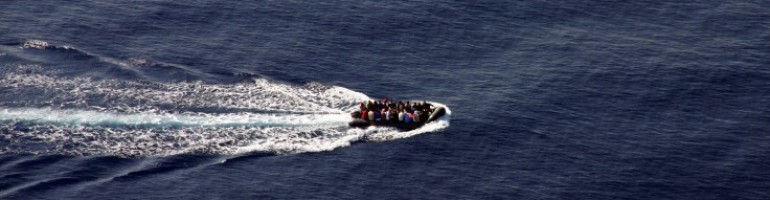
Migrant arrivals in Italy continue with over 1000 migrants reaching Lampedusa in at least 11 different boats on Sunday.
Click here (IT) and here (IT) for articles.
Migrant arrivals in Italy continue with over 1000 migrants reaching Lampedusa in at least 11 different boats on Sunday.
Click here (IT) and here (IT) for articles.
Filed under European Union, Frontex, Italy, Mediterranean, News, Tunisia
After a week or so without any migrants arriving in Lampedusa, ten boats carrying approximately 500 persons arrived in Lampedusa and nearby Italian islands over a 24 hour period 1st-2nd March. Improved weather conditions are the most likely explanation for the new boat arrivals. Highlighting the difficulties of maritime surveillance, one of the migrant boats with 22 migrants landed on the island of Linosa, roughly halfway between Lampedusa and Malta, without being detected.
According to Interior Minister Roberto Maroni, to date 2,000 Tunisians have applied for some form of protection; less than 400 asylum requests have been made. According to Maroni, most of the Tunisians have expressed a desire to go to other European countries, generally France or Germany.
Maroni said that Italy’s agreement with Tunisia limits repatriation of Tunisians to four persons per day and Italy is therefore currently negotiating with Tunisia to increase the number of persons who may be repatriated. If the daily limit is not changed it would take years to return the thousands who have arrived in Italy.
Click here (IT), here (IT), and here (EN) for articles.
The chief criminal prosecutor of Agrigento, Sicily, Renato Di Natale, has opened criminal cases on charges of illegal immigration against the Tunisians who arrived in Lampedusa over the past several weeks. Cases have been opened against hundreds of Tunisians and additional cases will be opened as the migrants are identified. The chief prosecutor described the opening of the criminal cases as routine procedure which would occur in any case involving the arrival of a suspected illegal immigrant. The prosecutor said additional charges of providing false information could be added if it is discovered that a migrant provided a false name. If an individual migrant were to be given status as a political refugee, the criminal case would be dropped.
Bringing criminal charges against traffickers or smugglers would seem reasonable, but it strikes me as a poor use of limited state resources to open criminal investigations against the overwhelming majority of the Tunisians who have arrived in Italy in recent weeks. Even if the cases do not proceed, one would think that Italian authorities could respond to this situation differently.
Click here, here, here, and here for articles. (IT)
Filed under Italy, Judicial, Mediterranean, News, Tunisia
The Hungarian Presidency and LIBE have released summaries regarding today’s LIBE Committee meeting. Here are some points from the two summaries:
Click here and here for the two articles.
Frontex Director Ilkka Laitinen is in Malta today for discussions with Maltese officials about the situation in Libya and the possibility of a new migrant flow from Libya. It seems that the discussions concern the expansion of Joint Operation Hermes Extension or the creation of a new joint operation based in Malta. Before leaving Brussels earlier today, Laitinen said that “although the situation is fluid and until now no flows of asylum seekers to Europe has resulted, Frontex was preparing for such an eventuality.”
Click here (EN), here (IT) and here (IT) for articles.
Filed under European Union, Frontex, Italy, Libya, Malta, Mediterranean, News, Tunisia
LIBE will reconvene today, 1 March, 09:00-10:30, to discuss “the situation in the central Mediterranean…. They will consider the democratisation process in the region and its impact on migration flows and EU immigration and asylum policy. In attendance: Hungarian Presidency representative, H.E. Peter Györkös, Cecilia Malmström, Commissioner for Home Affairs and Ilkka Laitinen, Executive Director of Frontex, the EU border security agency.”
Click here for live coverage.
Filed under European Union, Frontex, Italy, Libya, Malta, Mediterranean, News, Tunisia
The assets dedicated to Joint Operation Hermes Extension continue to increase, although at present there are only two coastal patrol boats (Italian) participating in the Frontex mission. Ten surveillance aircraft will soon be deployed. See the table with the list of resources below.
While the naval assets dedicated to JO Hermes Extension are minimal, there is a growing number of EU and NATO naval ships in the Central Mediterranean. Nicolas Gros-Verheyde (writing on the Bruxelles2 blog (FR)) has counted 14 naval ships from EU states that are present in the waters near Libya; the ships consist of destroyers, frigates, electronic surveillance ships, and supply and support ships. Additionally, Turkey has two naval ships in the area.
Some of the naval ships have already been used to evacuate European and other non-Libyan nationals from Libya. What additional activity the EU ships may engage in remains to be seen. They may become involved in military activities (presumably with UN authority (?)) and/or they may play a yet undetermined role should there be a sudden flow of migrants and asylum seekers from Libya. If there is a sudden and significant migratory flow, the naval ships should function in a search and rescue manner, but there is always the possibility that if faced with large numbers of migrants, the navy vessels may be used to interdict, blockade, or otherwise to try to prevent migrants from leaving Libya.
Click here for link to Frontex update regarding deployed assets.
Click here and here for Bruxelles2 postings. (FR)
Table: Resources available to JO Hermes Extension 2011 as of February 25, 2011.
| Italy (HMS) | 2 Coastal Patrol Vessel, 1 aircraft, 5 experts, 2 cultural mediators |
| Austria | 1 expert |
| Belgium | 2 experts |
| Denmark | 3-5 experts |
| France | 10 experts, 1 aircraft |
| Germany | 2 experts, 2 aircrafts |
| Hungary | 2 experts |
| the Netherlands | 1 aircraft, 2 experts |
| Portugal | 7 experts, 1 aircraft |
| Romania | 6 experts |
| Sweden | 1 expert |
| Switzerland | 2 experts |
| Spain | 4 experts, 1 aircraft (at a later stage) |
Filed under Algeria, Data / Stats, European Union, Frontex, General, Italy, Libya, Malta, Mediterranean, News, Tunisia
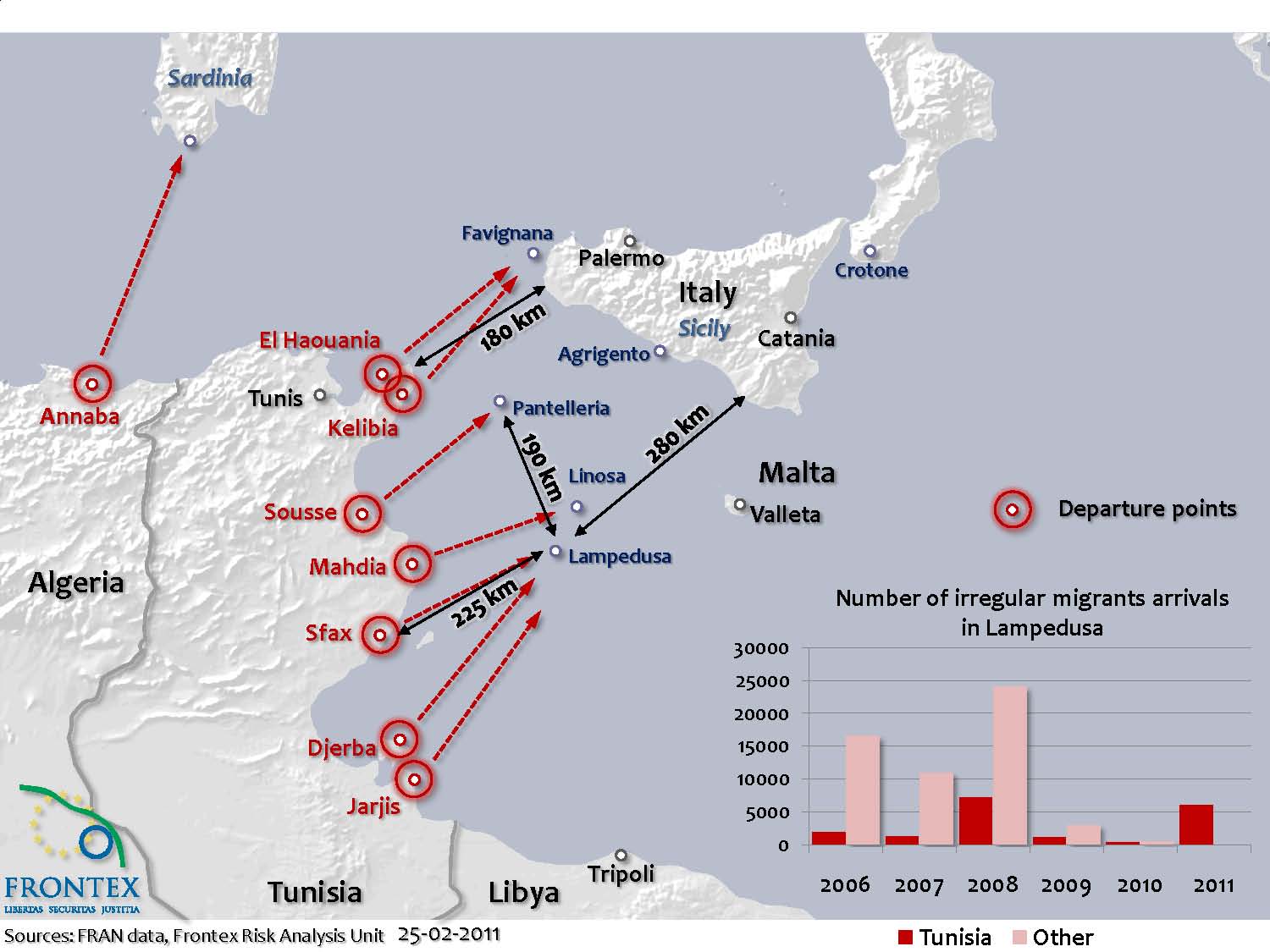
Frontex posted a situational map showing current and past information regarding migrant flows from Tunisia to Italy. The map is dated 25 Feb. 2011.
Filed under Algeria, Data / Stats, European Union, Frontex, Italy, Malta, Mediterranean, News, Tunisia
From CIR: “…[I]l Network Euro Mediterraneo per i Diritti dell’Uomo ha organizzato una missione di raccolta informazioni, che si è svolta dal 18 al 24 febbraio prima in Tunisia e poi in Italia. La missione era composta da rappresentanti di organizzazioni membro del Network e di partner e da esperti del Nord e del Sud del Mediterraneo. La missione ha potuto raccogliere testimonianze e informazioni dirette, tanto in Tunisia che in Italia.
La missione ha permesso di smentire sia la tesi della presenza massiva tra i migarnti arrivati in Italia di delinquenti di diritto comune evasi dalle carceri, sia quella di un complotto migratorio che sarebbe stato ordito dalla Libia e dai nostalgici di Ben Ali.
Nel corso della missione, le preoccupazione legate agli avvenimenti drammatici che sconvolgono la Libia hanno, in qualche maniera, soppiantato gli interrogativi che circondano i migranti tunisini.
Al termine di questa missione, il Network formula le seguenti raccomandazioni:
Alle autorità italiane:
Alle autorità tunisine
Alle autorità europee
Click here (IT) for full CIR post.
See also CIR “Emergenza Nord Africa”.
Filed under European Union, General, Italy, Libya, Mediterranean, Reports, Statements, Tunisia
Consiglio Italiano per i Rifugiati (CIR) created a special web page – Emergenza Nord Africa – which is tracking migration and other related aspects of the North African crisis.
Click here (IT).
Filed under European Union, Italy, Libya, News, Tunisia
ECRE issued a statement earlier today. Here is the full statement:
As the situation in Libya is worsening and the world is watching the atrocities of Gaddafi’s regime, European governments are stepping up efforts to evacuate their citizens outside the country. The repression is brutal and just as British, Turkish, Egyptians and other foreigners, some Libyans and refugees from sub-Saharan countries unable to go back and stranded in Libya will need refuge from violence and human rights abuses.
At this historical moment, on the other side of the Mediterranean, the EU needs to live up to its obligations to protect those fleeing the violence.
With or without Frontex, border control operations carried out at sea cannot result in persons being returned to Libya without assessing in a fair asylum procedure whether they are in need of international protection.
Some European governments have warned of an exodus of biblical proportions. The truth is that what will happen is totally unpredictable. For the moment, those leaving the country seem to be travelling to Egypt or remaining elsewhere in the region. So far, according to the EU Border Agency Frontex, some 5.500 people, mainly Tunisians, arrived to Lampedusa in January and February. This is nowhere near the number that would make an asylum system of a country such as Italy collapse.
Even if the number of people arriving to Europe would increase dramatically, to the extent that an immediate and individual assessment of their protection needs would no longer be possible, the EU has already at its disposal the tools to ensure that people can reach a safe haven. The Temporary Protection Directive, adopted after the Kosovo crisis, allows Member States to grant immediately a protection status to persons who arrive in Europe in the context of so-called mass influx and makes it possible for Member States to better share responsibility through the relocation of refugees protected under this scheme to other EU countries.
In addition, the recently established European Asylum Support Office has the competence to deploy national asylum experts to EU Member States receiving high numbers of asylum seekers. Although the agency is not yet operational, ad hoc solutions can be found if need be.
Finally, the EU’s decision to suspend the negotiations with Libya on a framework agreement, which included cooperation in the field of immigration and asylum, is indeed the only sensible thing to do. Libya’s poor human rights record was well known when last year the European Commission agreed to offer the dictatorship € 50m over the next 3 years to reinforce Tripoli’s capacity to prevent migrants from entering the Southern border and from crossing the Mediterranean towards Europe. According to the European Commission, no money has been disbursed so far. The bloodshed in the country and the regime’s attempts to blackmail the EU by threatening with breaking its cooperation on controlling migration towards Europe, showed clearer than ever who the EU was willing to trust to control migration to Europe. This cannot go on.
Contact
Ana Fontal
Senior Press and Public Information Officer
Tel: +32 2 212 08 12
Mobile: + 32 (0) 486 531 676
Click here for link to statement.
Filed under European Union, Frontex, Italy, Libya, Mediterranean, Statements, Tunisia
The JHA Council yesterday rejected Italy’s call for a stronger EU response to what it describes as an impending migrant flow from North Africa consisting of hundreds of thousands of migrants and asylum seekers. Several EU governments described the Italian request as one that was based on exaggerated fears. Hungary’s interior minister, Sandor Pinter, told reporters that “we shouldn’t paint the devil on the wall until he appears.” German Interior Minister Thomas de Maiziere said “we shouldn’t be painting horror figures and encouraging refugees to come to Europe.” Another accused Italy of “crying wolf.”
IOM spokeswoman Jemini Pandya said that while Italy should not shoulder a refugee burden on its own, no Libyans have arrived in Italy to date and she rejected the Italian estimates: “I don’t think in any shape or form you are going to see one-and-a-half million migrants suddenly flood into Europe. That is really not going to happen at all. That would really be fear mongering to the extreme.”
Italy has done itself and neighbouring countries a disservice by repeatedly speaking of an “exodus of biblical proportions” and by suggesting that many hundreds of thousands of migrants are poised to take to the sea to try to reach Italy and Malta from Libya. These estimates are in all likelihood grossly exaggerated.
But even if you agree that Italy’s feared numbers are exaggerations, the fact that no irregular migrant or asylum seeker has apparently yet left Libya by sea is not at all surprising. Libya is in chaos and few people are likely to try to depart the country by sea until the level of violence begins to diminish. Libya has (or had) a functioning network of human traffickers and they will be ready to begin exploiting the chaos and to take advantage of desperate people seeking to flee at some point in the future. If Gaddafi manages to remain in power, once he is no longer concerned with his personal survival, his thoughts will at some point turn to revenge. Libya will presumably cease cooperating with Italy on the bi-lateral pushback practice, and Gaddafi will tolerate or encourage irregular migration towards Europe. So Italy is correct in that there is a real threat of significant numbers of migrants and asylum seekers leaving from Libya some time in the near future. The numbers could easily and quickly surpass the 6,000 who have left Tunisia for Lampedusa. Could the numbers surpass 30,000? 30,000 asylum seekers entered Sweden last year (population 9 million – Italy’s population is 50+ million) and Sweden has not received any extraordinary EU assistance as a result. Could the numbers exceed the hundreds of thousands that fled the Balkan wars in the 1990s? Possible, but probably not very likely.
Click here, here, here, here, and here for articles. (EN)
A Justice and Home Affairs press release summarizing today’s JHA Council meeting includes the following brief summary regarding the topic of migratory flows from North Africa:
“Over lunch, ministers discussed the situation in Northern Africa, and particularly the situation in Libya and the influx of migrants, above all from Tunisia to Italy. Since the beginning of the year, some 6000 immigrants have arrived mainly to the Italian island of Lampedusa. Following a formal request for help from the Italian Ministry of Interior, received on February 15, Frontex and Italy have started a Joint Operation in the central Mediterranean area on Sunday 20 February. Joint Operation Hermes 2011, originally planned to commence in June, was thus brought forward. Assets and experts for this operation were made available from a large number of EU member states. More information. In addition to that, the Commission is studying different funding possibilities through various EU instruments, such as the European Refugee Fund, the European Return Fund and the European Border Fund.”
It is unclear whether the JHA Council will address this topic further tomorrow when the Council meeting resumes.
Click here for full JHA press release.
Filed under Aegean Sea, European Union, Frontex, Libya, Mediterranean, News, Statements, Tunisia
After a meeting yesterday of the Prime Minister and the ministers of Foreign Affairs, Defence, Economy, Labour, Justice, and Interior, the government formed a standing committee to follow the crisis in Libya (“un comitato permanente sulla crisi libica”). The committee will monitor the flow of migrants to Italy. According to reports in the Italian press, the Italian Government believes that between 200,000-300,000 migrants may seek to reach Italy if conditions in Libya continue to worsen. Three Italian naval ships, the San Marco, San Giorgio and Mimbelli, have been moved close to Libya in order to be ready to assist with the evacuation of Italian citizens should it become necessary. Tunisian migrants continue to arrive in Lampedusa. Over the past day approximately 200 arrived.
Click here, here, and here for articles. (IT)
Filed under European Union, Frontex, Italy, Libya, Mediterranean, News, Tunisia
The Times of Malta reports today that Frontex “has been given instructions to start preparing for a possible unprecedented influx of immigrants and asylum seekers fleeing Libya towards the EU, particularly through Malta and Lampedusa.” “‘The fact that the Libyan regime does not seem to be in control of the huge expanse of the 2,000-km long Libyan coastline might already pose a big danger of a flood of asylum seekers crossing by rogue boats towards Malta, Lampedusa and Sicily,’ the sources said.” According to the article the planned response to a massive flow would involve all 27 member states. EU spokesman for Home Affairs Michele Cercone confirmed that Frontex was engaged in planning for a migrant flow from Libya, but said he would not “speculate on details and suppositions.” The article also states that “six EU Mediterranean member states [Malta, France, Cyprus, Spain, Greece, and Italy] will meet in Rome tomorrow in an urgent minisummit to devise a common stance on the immigration crisis facing the southern Mediterranean region, a day before official talks of EU justice ministers in Brussels.”
Click here article.


 MIGRANTS AT SEA