Tag Archives: Maritime Surveillance

Frontex Press Release: Hermes 2011 Starts Tomorrow in Lampedusa

Frontex news release:  “Hermes 2011 Starts Tomorrow in Lampedusa, 19-02-2011

Joint Operation (JO) Hermes 2011 is due to start tomorrow with the deployment of additional aerial and maritime assets from Italy and Malta.  In the following days the second line activities will be activated with the deployment of debriefing/screening experts. Their task will be to gather information necessary needed for analysis, to make assumptions concerning migrants’ nationalities, and to enable early detection and prevention of possible criminal activities at the EU external borders.  Next important element of this operation will be to provide assistance at the following stage focusing on organising return operations to the countries of origin.  Frontex risk analysis experts will be supporting Italian authorities producing targeted risk analysis identifying vulnerabilities and security risks that might occur at the EU southern external border.

Background – Frontex received a formal request for assistance on February 15th from the Italian Ministry of Interior regarding the extraordinary migratory situation in the Pelagic Islands. The Italian Government requested assistance in strengthening the surveillance of the EU’s external borders in the form of a Joint Operation. Additionally, Italy requested a targeted risk analysis on the possible future scenarios of the increased migratory pressure in the region in the light of recent political developments in North Africa and the possibility of the opening up of a further migratory front in the Central Mediterranean area.

According to the Italian Ministry of Interior, approximately 6,000 irregular migrants, mostly of the Tunisian origin, have arrived on the Italian coast in the last month, of whom 3,000 have arrived since February 11th. Before February 11th, only 14 Tunisian nationals had arrived on the Italian coast in 2011.”

Click here for link.

Leave a comment

Filed under European Union, Frontex, Italy, Libya, Malta, Mediterranean, News, Statements, Tunisia

Frontex Operation Hermes to Begin on Sunday, 20 Feb.–Push-Back Practice Prohibited

Commissioner Cecilia Malmström announced today that the new Frontex mission, Operation Hermes, will begin operations tomorrow, 20 February.  According to AFP, the initial deployment will consist of about 30 personnel, aircraft, and several ships.  A dozen member states have expressed willingness to send assests to the new joint operation.

In an interview published earlier today, before the announcement of Operation Hermes, Commissioner Malmström clearly stated that the Frontex mission will be governed by European legislation and that the interdiction and push-back of migrants encountered at sea is not permitted.  In the earlier interview the Commissioner said that the mission will provide surveillance by air in support of the Italian authorities which will detect any new influx of migrants as soon as it occurs and sound the alarm for naval surveillance which will in turn lead migrant boats to “safe ports.”  (“Di sorveglianza dal cielo in supporto alle autorità italiane. Potranno individuare ogni nuovo flusso di migranti non appena si manifesti. E lanciare l’allarme ai mezzi di sorveglianza navale, facendo condurre i barconi verso porti sicuri.”)  When asked whether push-backs of migrant boats would occur, the Commissioner said that the push-back practice was prohibited by European norms. (“I respingimenti sono espressamente proibiti dalle norme europee.”)

Click here and here for articles.  (IT)

1 Comment

Filed under European Union, Frontex, Italy, Libya, Malta, Mediterranean, News, Tunisia

Frontex’s Role to be One of Coordination

Consistent with its mandate and standard practice, Frontex’s role in the new Central Mediterranean joint operation will be one of coordination.  According to DI-VE, “[i]n the current situation, [Frontex] foresees its main role as coordinating border guards from among the member states, particularly with regard to second-line experts in the screening and debriefing of irregular migrants as well as in coordinating an appropriate operational response to the humanitarian needs in the area. In addition, the agency is investigating the most optimal means by which to adapt a range of technical assets engaged in sea border operations in the Mediterranean to the needs of the Italian authorities.”

Click here for article.

Leave a comment

Filed under European Union, France, Frontex, Italy, Libya, Malta, Mediterranean, Netherlands, News, Spain, Tunisia

Frontex Central Mediterranean Operation Likely to Begin Within Days; Dutch to Send Coast Guard Plane to Lampedusa; France and Spain Likely to Deploy Planes or Ships

The Dutch government has decided to deploy a Coast Guard surveillance plane to Italy to participate in the new Frontex joint operation.  The Dutch decision was announced by Immigration and Asylum Minister Gerd Leers on Friday.  The plane and two Dutch border guards are scheduled to be deployed for at least six weeks beginning 21 February.

The Financial Times reports today that the Frontex joint operation may be operational early next week and that details are being finalised at a meeting that is taking place today in Rome between European Commission and Italian officials.  According to the FT article, one topic under discussion is the situation in Libya and the possibility for a larger wave of migrants should the situation in Libya become more unstable or should Gaddafi’s government collapse.

Click here (EN) (FT registration may be required), here (NL), here (NL), and here (EN) for articles.

Leave a comment

Filed under European Union, France, Frontex, Italy, Libya, Malta, Mediterranean, Netherlands, News, Spain, Tunisia

Frontex Begins Consultations for Emergency Joint Operation –2010 Frontex Sea Border Rule Should Govern Joint Operation

The European Voice reports that Frontex began consultations yesterday with member states to identify what equipment and personnel they will commit to a planned joint operation with Italy to deter migrants seeking to leave North Africa. “Naval vessels, surveillance aircraft and enhanced radar tracking are likely to be deployed….”

Assuming an emergency joint operation is deployed in the coming days, it may to some extent simply be a revival of Frontex’s Joint Operation Nautilus (slated to be renamed Operation Chronos).  Less than two weeks ago, on 4 February Malta for the second year running announced that it would not host or participate in Operation Nautilus this year due to the success of Italy’s push-back agreement with Libya which eliminated the movement of migrants in the Central Mediterranean.

Malta, however, also likely refused to host the Frontex mission due to the 2010 guidelines governing Frontex enforcement operations at sea which require that intercepted migrants be taken to the country hosting the Frontex mission under certain circumstances.  The validity of the Frontex sea border rule is currently under review by the European Court of Justice.  The legal challenge to the rule was brought by the European Parliament.  Maltese MEP Simon Busuttil initiated the challenge within the LIBE Committee.  It will be interesting to see what role Malta will be willing to play in any new emergency joint operation.  Even though the Frontex sea border rule is under review by the ECJ, the referral clearly requested the ECJ “to preserve the effects of the measure until a new legislative act has been adopted.”  The rule therefore remains in effect.

Click here for EV article.

Click here for the Council decision on the surveillance of  sea external borders (the Sea Border Rule).

Click here, here, here, here, and here for previous posts on the sea border rule and the ECJ challenge.

1 Comment

Filed under Egypt, European Union, Frontex, Italy, Libya, Malta, Mediterranean, News, Tunisia

Frontex Signs Cooperation Agreement with Cape Verde

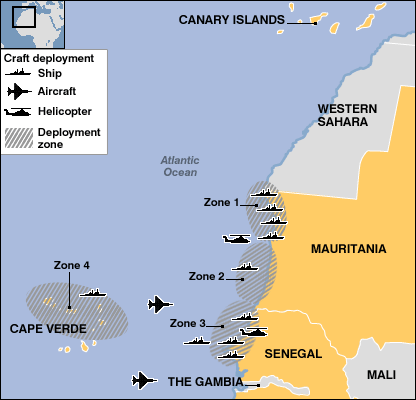
2006 BBC Map of Frontex Deployment

Frontex and Cape Verde signed a “Working Arrangement” on 14 January.  According to the Frontex press release, “the arrangement aims at promoting the development of broad cooperation on operational and technical border security/management matters between the Agency and the competent authorities of Cape Verde, with a view to working toward sustainable partnership. The intended cooperation in areas related to border security and management include exchange of best practices and strategic information, training, capacity-building and collaboration on relevant technologies as well as participation in joint operations. Information sharing regarding people-smuggling and trafficking in human beings is also foreseen as part of the arrangement.”

Frontex has coordinated operations with Cape Verde for many years pursuant to the provisions of bi-lateral agreements between Spain and Cape Verde.  In a September 2010 interview with EurAsylum, Frontex Director Laitinen said:  “In West Africa, Senegal, Mauritania and Cape Verde have all been integrated into Frontex operations for many years with good results, always demonstrating a willingness and capacity to work for the same aims and goals as their European colleagues. Although we do not have formal working arrangements in place yet with these countries, we are able to work together on the basis of their existing bi-lateral provisions with Spain. This cooperation has had measurable results in reducing people smuggling via the Canary Islands and in preventing the loss of human lives at sea.”

Click here for Frontex Press Release.

1 Comment

Filed under Eastern Atlantic, Frontex, News

Commission Issues New “EU Internal Security Strategy”

Earlier today the Commission released a Communication entitled “The EU Internal Security Strategy in Action.” The Communication to the EP and Council contains 41 proposals in five general areas: organised crime, terrorism, cybercrime and cyber security, border management, and crises and disasters.  It contains a strategy which is described as an effort to identify, explain, and coordinate what the EU seeks to achieve in the area of internal security.  The accompanying Commission Press Release quotes Commissioner Malmström as stating that “EU internal security has traditionally been following a silo mentality, focusing on one area at a time. Now we take a common approach on how to respond to the security threats and challenges ahead. Terrorism, organised, cross-border and cyber crime, and crises and disasters are areas where we need to combine our efforts and work together in order to increase the security of our citizens, businesses, and societies across the EU. This strategy outlines the threats ahead and the necessary actions we must take in order to be able to fight them….”

Here are several excerpts (with some footnotes omitted) from Objective Number 4 entitled “Strengthen security through border management”:

“[***] In relation to movement of persons, the EU can treat migration management and the fight against crime as twin objectives of the integrated border management strategy. It is based on three strategic strands.

  • An enhanced use of new technology for border checks (the second generation of the Schengen Information System (SIS II), the Visa Information System (VIS), the entry/exit system and the registered traveller programme);
  • an enhanced use of new technology for border surveillance (the European Border Surveillance System, EUROSUR) with the support of GMES security services, and the gradual creation of a common information sharing environment for the EU maritime domain [25 Commission communication, ‘Towards the integration of maritime surveillance: A Common information environment for the EU maritime domain’, COM (2009) 538 ]; and
  • an enhanced coordination of Member States through Frontex.

[***]

Action 1: Exploit the full potential of EUROSUR

The Commission will present a legislative proposal to set up EUROSUR in 2011 to contribute to internal security and the fight against crime. EUROSUR will establish a mechanism for Member States’ authorities to share operational information related to border surveillance and for cooperation with each other and with Frontex at tactical, operational and strategic level. [27 Commission proposals for the development of the EUROSUR system and for the development of a common information sharing environment (CISE) for the EU maritime domain are set out in COM (2008) 68 and COM(2009) 538 respectively. A six step road map for establishing the CISE was recently adopted – COM(2010) 584.]  EUROSUR will make use of new technologies developed through EU funded research projects and activities, such as satellite imagery to detect and track targets at the maritime border, e.g. tracing fast vessels transporting drugs to the EU. In recent years, two major initiatives on operational cooperation at the maritime borders have been launched – one on human trafficking and human smuggling under the umbrella of Frontex and the second on drugs smuggling in the framework of MAOC-N [28 MAOC-N – Maritime Analysis and Operations Centre – Narcotics] and CeCLADM. [29 CeCLAD-M – Centre de Coordination pour la lutte antidrogue en Méditerranée.]

As part of the development of integrated and operational action at the EU’s maritime border, the EU will launch in 2011 a pilot project at its southern or south-western border, involving those two centres, the Commission, Frontex and Europol. This pilot project will explore synergies on risk analysis and surveillance data in common areas of interest concerning different types of threats, such as drugs and people smuggling. [30 This project will complement the other integrated maritime surveillance projects such as BlueMassMed and Marsuno, which aim to optimise the efficiency of maritime surveillance in the Mediterranean Sea, Atlantic and the northern European sea basins.]

Action 2: Enhancing the contribution of Frontex at the external borders

[***] From 2011 onwards, the Commission, with joint input from Frontex and Europol, will present a report by the end of each year on specific cross-border crimes such as human trafficking, human smuggling and smuggling of illicit goods. This annual report will serve as a basis for assessing the need for Frontex and its joint operations and joint operations between police, customs and other specialised law enforcement authorities to be carried out from 2012 onwards. [***]”

Click here for the complete Commission Document.

Click here for Commission’s Press Release.

Click here for the Feb 2010 Council Draft Internal Security Strategy.

Click here (SW) for comments on Commissioner Malmström’s blog.

Leave a comment

Filed under European Union, Frontex, News

Libya Purchases Coastal Surveillance System

Libyan officials signed a €20 million contract on 14 October to purchase a national coastal surveillance system from Transas Marine, an Irish company.  According to the company’s press release, the system “will ensure continuous surveillance of the territorial waters, safety of navigation, reduction of illegal immigration and protection of the marine environment.”  The system is scheduled to become operational in 16 months.  Malta Today noted that the “deal was inked after the European Commission … offered Libya up to 50 million euros in aid to stop the flow of illegal migrants to Europe and to protect refugees.”

Click here for article.

Click here for Transas Marine press release.

2 Comments

Filed under European Union, Libya, Mediterranean, News

Bulgaria Prepares for Admission to Schengen Zone and Begins Patrols on Black Sea

The Sofia News Agency Novinite reports that Bulgaria has added five new coast guard ships which will soon begin patrolling Bulgaria’s Black Sea border.  The patrols are a requirement for Bulgaria’s impending admission to the Schengen Zone which is set to occur in March 2011.

The ships will reportedly be included in “Bulgaria’s integrated system for the observation of the sea border, which is part of the European External Border Surveillance System (EUROSUR)” and “will be taking part in operations of the Frontex Agency … under the European Patrol Network project.”

Click here for article.

Leave a comment

Filed under Black Sea, Bulgaria, European Union, Frontex, News

EU and Libya Sign “Unclear” Migration Cooperation Agreement

At the end of a two day visit to Tripoli, 4-5 October, Cecilia Malmström, European Commissioner for Home Affairs, and Štefan Füle, European Commissioner for Enlargement and European Neighbourhood, signed a “migration cooperation agenda” with Libya.  The European Commission issued a Press Release with details of the negotiations and signed agreement.

The specific contents of the full agreement and negotiations however are not clear.  “‘What worries us is the vagueness of the deal,’ Annelise Baldaccini from Amnesty International told [euobserver.com]. ‘We do not know what the EU has signed up to. It mentions for instance addressing the burden of recognised refugees and rejected asylum seekers, but it does not say what this involves.’”

Here are some excerpts from the Commission press release:

In the framework of the visit an agreement on a migration cooperation agenda was signed yesterday evening in Tripoli by Commissioner Malmström, Commissioner Füle, M. Moussa Koussa, the Secretary of General People’s Committee for Foreign Liaison and International Cooperation, and M. Yunis Al-Obeidi, the Secretary of General People’s Committee for Public Security. This is a Cooperation agenda between the European Commission and Libya, including concrete steps on border surveillance system, mobility-related issues, smuggling and trafficking in human beings, and dialogue on refugees and international protection.

Commenting the signature of the Cooperation agenda Commissioner Malmström said: ”It is my objective to put the protection of fundamental rights of all people involved in migratory and asylum flows at the centre of our efforts in the EU relationship with Libya. The Cooperation Agenda will enable us also to promote initiatives aimed at better protecting and assisting the rights of migrants and refugees’.

Commissioner Füle said: “I welcome agreeing on this cooperation agenda because this is an important first step to solve the serious challenge irregular migration poses not only to Libya but also to the EU. This step is part of the much broader relationship we are trying to build together. It was clear from our talks in Tripoli that both EU and Libya have at heart to sustain the new momentum in our relationship over recent months.”

The EU and Libya also discussed the establishment of an informal group of senior officials that would oversee the implementation of the list of possible initiatives in the field of migration cooperation. The proposed initiatives will be implemented through a variety of means, ranging from the sharing of experience and best practices, as well as financing of actions, including the acquisition of equipment in accordance with applicable rules.

Both sides agreed on the following initiatives for possible further dialogue and cooperation.

1. Regional and Pan african dialogue and cooperation

  • Increasing joint efforts in the development of African countries of origin of migration. This would build on the serious and substantial efforts of Libya and the European Union as major donors to African countries. In this context, the EU and Libya will continue to address root causes of migration in the countries of origin of migrants travelling through Libya and creating viable alternatives to migration in these countries.
  • The EU and Libya will support awareness campaigns to take place in main countries of origin of migrants transiting through North Africa and Libya specifically to alert migrants to the dangers of irregular migration.
  • Libya and the EU will work together in the implementation of the “Declaration of Tripoli on Migration and Development” of 2006, and the EU-Africa Migration, Mobility and Employment Partnership adopted in Lisbon in 2007.
  • Libya and the EU will increase dialogue and exchange information regarding the issue of smuggling of human beings and related illicit traffics reaching Libya from other countries and the EU from Libya.
  • Libya and the EU will also establish an informal consultative group that will exchange information on development policies benefitting Africa, and possibly also to identify development projects in sub Saharan Africa. This group will be composed by the Libyan administration, by the representatives of the European Commission and of the EU member States which are willing to participate.

[***]

3. Ensuring effective management of migratory flows

  • Supporting the development in Libya of a more efficient system to manage labour migration. This could be done by allowing to maximise the skills of the migrants already present in the country and of the newcomers.
  • Enhancing the capacities of Libyan authorities, Libyan NGOs and international organisations, to properly launch and implement search and rescue operations aimed at saving lives of migrants in the desert or on high seas and to provide them with the necessary humanitarian assistance.
  • Providing decent treatment, reception and assistance – in line with international standards – to irregular migrants intercepted or readmitted or to be returned by Libyan authorities, or stranded in Libya, with focus on migrants belonging to vulnerable categories (like unaccompanied minors, victims of trafficking; pregnant women, and families with small children). This could build on the activities already carried out in Libya by the local authorities, international organisations and NGOs.
  • Offering assisted voluntary return home to irregular migrants intercepted or readmitted or to be returned by Libyan authorities, or stranded in Libya or in the countries of origin, as well as offer support for their social and professional reintegration.
  • Enhancing the capacity to address smuggling and trafficking in human beings, with reference in particular to the two respective protocols of the 2000 UN Convention on the Trans-national organised Crime, and in view of reinforcing the capabilities of law enforcement officials in charge of the implementation of this legislation, by taking also into the account the Ouagadougou Action Plan to combat Trafficking in Human Beings.

4. Border management

  • Carrying out a gap-analysis on the current functioning modalities of the Libyan border and immigration services, aimed at reinforcing the capacity of the latter to prevent the irregular migration flows from entering Libya from its Southern borders.
  • Strengthening cooperation between Libya and the neighbouring and other transit and origin countries, in the border surveillance and in the prevention of attempts of irregular migrants and smugglers to violate Libyan borders, through promoting joint patrolling, intelligence sharing, the development of joint training, the facilitation of working contacts and the establishment of dedicated communication channels aimed at transmitting early warnings and sensible data.
  • Supporting the development of Libyan patrolling, search and rescue capacities in its territorial waters and at high sea. Delimiting the search and rescue region for which it Libya is responsible, pursuant to the SAR Convention it has ratified.
  • Establishment of an integrated surveillance system along the Libyan land borders, with focus on the areas prone to irregular migration flows, in line with the Memorandum of Understanding agreed between Libya and the European Commission on 23 July 2007.
  • Exploring concrete possibilities of cooperation between Libyan police, border, migration authorities and agencies and those of the EU Member States as regards the return and readmission of irregular migrants.

5. International Protection

  • Supporting Libya in its efforts aimed at establishing a protection system able to deal with asylum seekers and refugees in line with international standards and in good cooperation with the competent international organisation , in particular through providing advice on the development of a legislation in line with the 1969 African Union Convention Governing the Specific Aspects of Refugee Problems in Africa as well as providing training, technical assistance and equipment in view of promoting the development of administrative structures and human resources, able to properly act in line with this legislation
  • Assisting Libyan authorities in screening migrants in order to identify those in need of international protection and in addressing the burden represented both by the recognized refugees and the unsuccessful asylum seekers, and which would consist in resettling some of the recognized refugees towards EU Member States, in supporting the voluntary return of some of the unsuccessful asylum seekers back to their origin country, as well as in enhancing the reception capacities offered in Libya to asylum seekers and refugees.

Click here for full European Commission Press Release.

Click here, here, and here for articles.
4 Comments

Filed under European Union, Libya, Mediterranean, News

Frontex 2nd Quarter Report

The Frontex Risk Analysis Unit has released its Report for the Second Quarter of 2010 (April-June).  It is a 30+ page report containing data, charts, and graphs detailing entry routes, detections of migrants, detections of facilitators, and other information.

Excerpts from the Report’s Executive Summary:

Illegal migration pressure in the EU underwent a foreseeable seasonal increase during the second quarter of 2010, but is still clearly in a period of decline.…

The widespread decline in illegal migration pressure is probably due to two key factors. The first is decreased employment opportunities in the EU …  [and the] second is stricter migration and asylum policies in Member States, supported by much more effective collaboration with key third countries. For example, stricter migration and asylum policies in Norway and the UK have reduced the number of applications in these Member States…. Similarly, bilateral agreements between Italy and Libya, and between Spain and both Senegal and Mauritania, continue to control, for the time being at least, most illegal migration via the Central Mediterranean and West African routes, respectively.

Notwithstanding the general decline in detections, there were two emerging trends in the second quarter (Q2) of 2010: a continued and intensified shift from the Greek sea border to the Greek land border with Turkey….  In the beginning of 2009 illegal crossings of the EU external border between Greece and Turkey were divided roughly equally between the land and sea borders.  However, there has been a gradual and recently intensified shift to the land border. Reasons for this shift from sea to land borders are linked to the effectiveness of the Frontex activities in the Aegean Sea, combining surveillance activities with identification of illegal migrants, and opening the possibility of return to origin countries for detected migrants. ….

Main trends:

  • There is a general decline in illegal migration to the EU compared to a year ago;
  • For the time being, Turkey is the main transit country for illegal migration to the EU….;
  • In the Eastern Mediterranean route, there has been a gradual and recently intensified shift from the Greek-Turkish sea border to the land border, where 90% of detections were made….   At the Greek-Turkish land border around 60% of detections were made at the Border Control Unit (BCU) Orestiada which is under the biggest pressure. Air connections to Turkey are increasingly used by migrants from North Africa, who then illegally cross the EU external border with Turkey. As well as effective Frontex-coordinated joint operations at the sea border, potential explanations for this shift include cheaper facilitation costs, a lower risk crossing, lower detection rates…;
  • There were increased detections on the Central Mediterranean route, probably due to the recent re-organisation of criminal groups in response to effective bilateral agreements in the area. In June 2010 Libya expelled the United Nations High Commissioner for Refugees (UNHCR), with whom 9,000 refugees and 4,000 asylum-seekers were registered and who, in the absence of protection, may now attempt entry to the EU.

Click here for the 2nd Quarter Report.

Click here for the 1st Quarter Report.

2 Comments

Filed under Aegean Sea, Analysis, Data / Stats, Eastern Atlantic, European Union, Frontex, Greece, Italy, Libya, Malta, Mauritania, Mediterranean, News, Reports, Senegal, Spain, Turkey

ECJ Invites Council to Submit Statement of Defence re EP Challenge to Frontex Sea Borders Rule

In an Order issued on 28 July, the European Court of Justice invited the European Council to submit a statement of defence in:  Case No. C-355/10, European Parliament v. Council of European Union (Application under Article 263 TFEU for annulment of Council Decision 2010/252/EU).

Here are the relevant portions of the Order (several footnotes omitted):

“1. By application under Article 263 TFEU, notified to the Council on 26 July 2010, the European Parliament asked the Court to annul Council Decision 2010/252/EU of 26 April 2010 supplementing the Schengen Borders Code as regards the surveillance of the sea external borders in the context of operational cooperation coordinated by the European Agency for the Management of Operational Cooperation at the External Borders of the Member States of the European Union.

2. In support of its action for annulment, the European Parliament argues that the Council in adopting the contested decision exceeded the implementing powers set out in Article 12(5) of the Schengen Borders Code to adopt additional measures governing border surveillance.

3. The Council is invited to submit a statement of defence, in accordance with Article 40(1) and Article 81(2) of the Rules of Procedure of the Court of Justice.

[***]”

(Thank you to the editor at Blogging Portal.EU for bringing this new development to my attention – and now back to my vacation break.)

Click here for the full document from the ECJ.

Click here for previous post (with links to earlier posts).

4 Comments

Filed under European Union, Frontex, Judicial, Mediterranean

Spain and Senegal Renew Agreement Permitting Frontex to Operate From Dakar

Spain and Senegal have renewed a bi-lateral agreement permitting Frontex to operate from a base in Dakar for another year.

The Frontex mission in Senegal currently consists of two Spanish Guardia Civil patrol boats, a Spanish National Police helicopter, and a private airplane leased by the Spanish Defence Ministry.  One Frontex patrol boat also operates from Nuadibú, Mauritania.

Spanish Interior Minister Alfredo Pérez Rubalcaba said that France and Italy will soon be deploying additional assets and personnel to the Frontex mission in Senegal consisting of a ship and plane from Italy and a French security force team.  Rubalcaba stated that this new assistance demonstrates that “Spain is not alone” in the fight against the mafias responsible for the illegal boat arrivals to the coast this country. (“España no está sola” en la lucha contra las mafias responsables de las llegadas de embarcaciones irregulares a las costas de este país.)

Senegalese Interior Minister Ousmane Ngom, said that so far this year a total of 101 canoes from the coast of Senegal with 450 people aboard have been identified by the patrols. In 2006, the figures were 901 boats, with 35,490 irregular migrants.

Click here for article.  (ES)

1 Comment

Filed under Data / Stats, Eastern Atlantic, France, Frontex, Italy, Mauritania, News, Senegal, Spain

Italy Gives 2 Patrol Boats to Egypt

On 5 May Italian authorities transferred two naval patrol boats to Egypt for use in anti-immigration patrols and port security.  Italy has previously given patrol boats to Egypt.

Click here and here for articles. (AR)

Leave a comment

Filed under Egypt, Italy, Mediterranean, News

CSDP and Maritime Surveillance

The May edition of the ISIS European Security Review contains an article reviewing the Spanish EU Presidency and the Common Security and Defence Policy (CSDP, formerly ESDP).  The article notes that a main priority of the Spanish Presidency has been an “Integrated Maritime Surveillance.” “[T]he Spanish Government has clearly followed the Swedish Presidency in many areas, especially in the creation of an Integrated Maritime Surveillance, probably the most notable accomplishment of this EU Presidency on defence policy. *** The attention paid by Spain to naval protection is not something new: Spanish interest in increasing patrolling across Europe’s coastlines has been proven during the last decade, especially through its support to FRONTEX assistance in the Mediterranean Sea and the Canary Islands. Beyond that, the project of a common management of external borders has resulted in a need for protection of European interests away from the official maritime borders, moving also to trade routes where the EU economic interest is at stake.”

Click here for the ISIS May 2010 Newsletter.

Leave a comment

Filed under Eastern Atlantic, European Union, Frontex, Mediterranean, News, Spain