Tag Archives: Migrants

Frontex 3rd Quarter Report

On 16 January the Frontex Risk Analysis Unit released its Report for the Third Quarter of 2010 (July-Sept.).  The report contains data, charts, and graphs detailing detections of migrants, asylum seekers, false document use, detections of facilitators, and other information.  The deployment of Frontex’s RABIT force to the Greek-Turkey border did not begin until 2 November 2010, so the effects of the RABIT deployment do not appear in the Third Quarter.

The Report notes that the “unprecedented peak in illegal border-crossings at the Greek land border with Turkey is the result of a shift from the sea to the land border” coupled with a “large increase in the absolute number of migrants” using Turkey as an EU entry point.  The Report states that there has been an eight-fold increase in the number Maghreb nationals detected at the Greek land border which “is thought to be the result of a displacement effect from the West Africa and Western Mediterranean routes.”

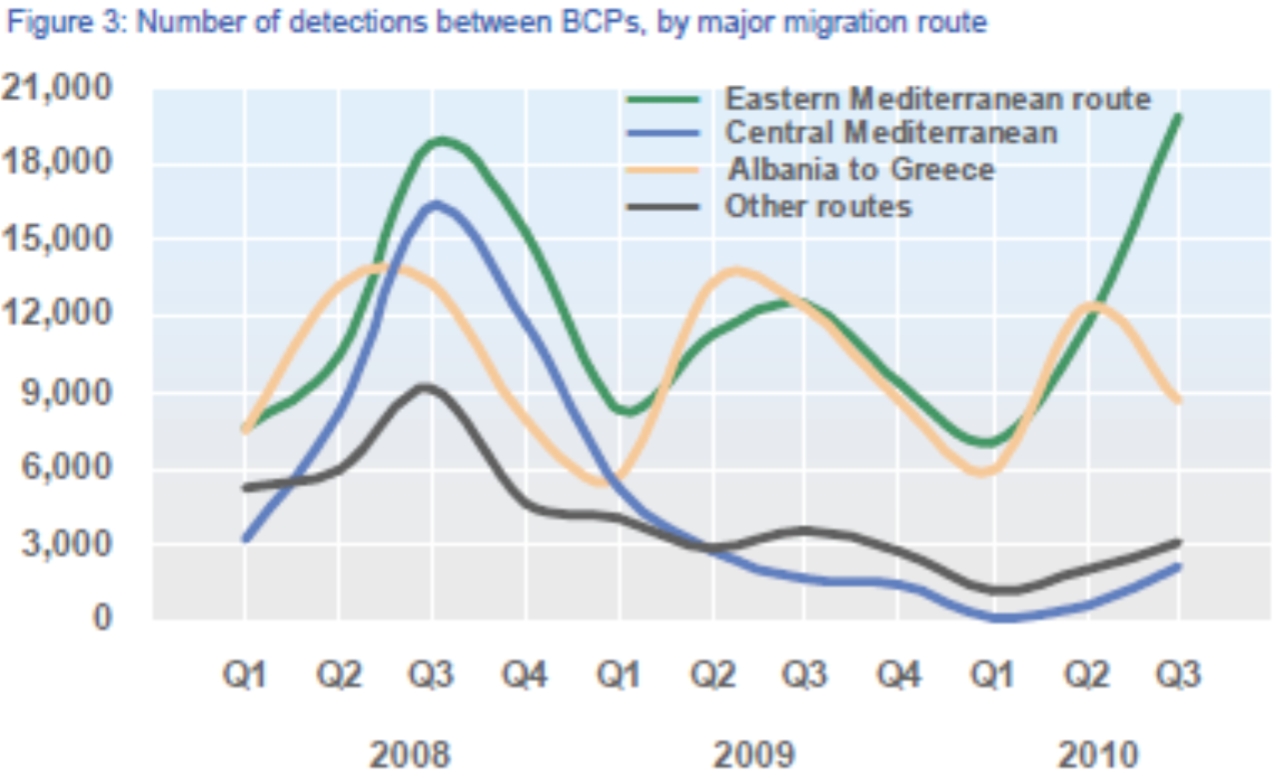
The Report also notes an increase in the number of detections on the Central and Western Mediterranean sea routes compared to Q2 which may be attributable to seasonal variations or “may be indicative of reorganized modi operandi in these areas in response to Frontex Joint Operations, more effective border controls and bilateral agreements implemented in 2008.”  See Figure 3 below.

Excerpts from the Report:

“Detections of illegal border-crossing”

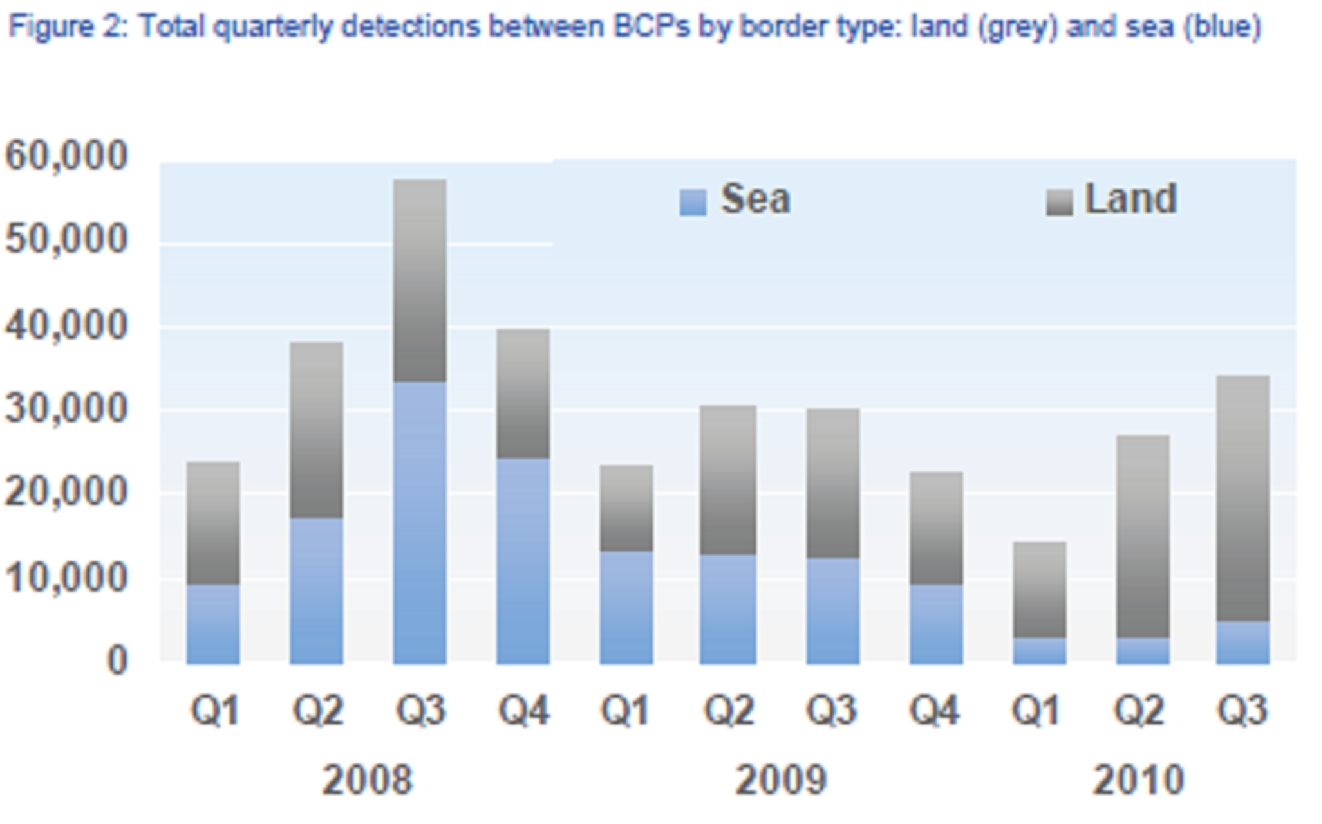
“…  Fig. 2 [see below] shows quarterly detections at the land and sea borders of the EU since the beginning of 2008. The 30% increase in the number of detections between the previous and present quarters is comprised of a 60% increase at the sea borders (although from a lower base) and a 23% increase at the land borders. This means that the shift from sea to land borders has not continued to same extent as in the previous quarters.  Nevertheless in Q3 2010, there were some 29 000 detections of illegal border-crossing at the external land border of the EU, which constitutes 85% of all the detections at the EU level, and the highest number of detections at the land border since data collection began in early 2008….”

“Eastern Mediterranean route”

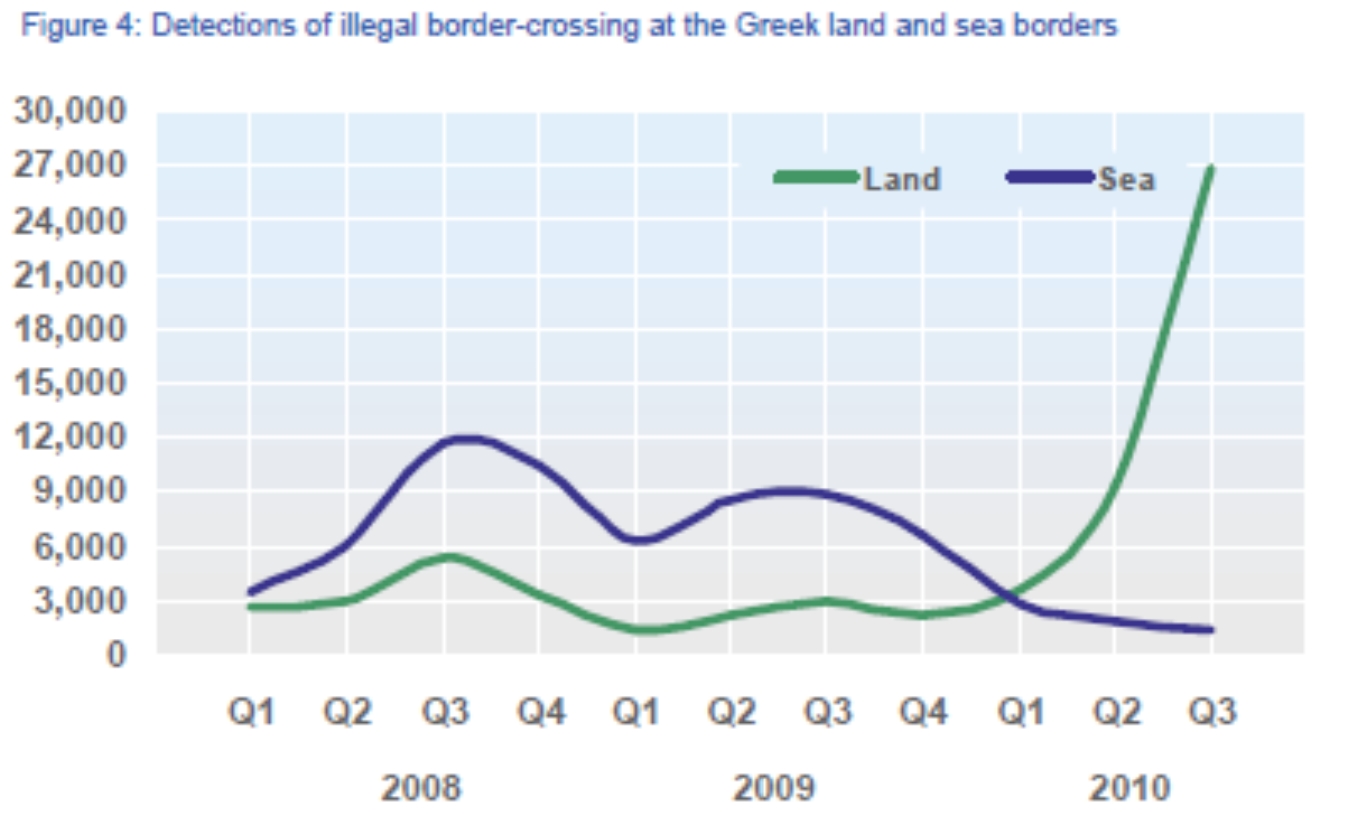
The Report observes that there has been a shift in illegal crossings from the Greece-Turkey maritime border to the Greece-Turkey land border and notes an increase in the number of nationals from Maghreb countries apprehended at the Greece-Turkey land border.  “This route [being taken by Maghreb nationals] is very indirect, but is thought to be the result of a displacement effect from the West Africa and Western Mediterranean routes….”

See Figure 4 below which shows that detections of illegal border crossers at the land border of Greece have exceeded detections at the sea border since Q1 of 2010.

“Central Mediterranean route”

“There were 2 157 detections of illegal border-crossing during Q3 2010. This is more than a three-fold increase compared to the previous quarter and a third higher than the same period last year. However despite this apparently large increase, detections still remain massively reduced compared to the peak of around 16 000 during the same period in 2008 (Fig. 3)….”

“The JO Hermes 2010 which was operational between June and October 2010, focused on illegal migratory flows departing from Algeria to the southern borders of the EU, specifically to Sardinia. In 2010, there were fewer detections than in previous years….”

“Departures from Libya also remained low. In June 2010, a new law was implemented to serve more severe punishments for facilitating illegal immigration. Ambassadors of the countries of origin were called into the Ministry of Foreign Affairs in Tripoli to be informed about the consequences of the new law, which suggests that this may be a serious implementation.”

“Western Mediterranean route”

“In general, irregular immigration to southern Spain has decreased massively since the beginning of 2006. However, in Q3 2010 there were 2 200 detections of illegal border crossing in the Western Mediterranean, more than twice that of the previous quarter and around a third higher than the same period in 2009. There is growth in the number of detections of a wide range of African nationalities, nine of which more than doubled in number between Q2 and Q3 2010. The most detected nationalities were Algerian, Moroccan, Cameroonian and Guinean.”

“Western Africa route”

“The cooperation and bilateral agreements between Spain and the rest of the Western African countries (Mauritania, Senegal and Mali) are developing steadily, and are one of the main reasons for the decrease in arrivals, as is the presence of patrolling assets near the African coast.”

“According to data collected during JO Hera, the numbers of arrivals in the Canary Islands and detections in West Africa are very low compared to the same time last year. The main nationality and place of departure is from Morocco, to where migrants are returned within a few days.”

Click here for the 3rd Quarter 2010 Report.

Click here for the 2nd Quarter 2010 Report.

Click here for the 1st Quarter 2010 Report.

Click here for my previous post regarding the 2nd Quarter Report.


Leave a comment

Filed under Aegean Sea, Algeria, Data / Stats, Eastern Atlantic, European Union, Frontex, General, Greece, Italy, Libya, Malta, Mauritania, Mediterranean, Morocco, News, Reports, Senegal, Spain, Tunisia, Turkey

Greece requests 2d extension of Frontex RABIT deployment due to events in Egypt

Kathimerini reported on 1 February that Greece requested an additional extension of the Frontex RABIT deployment in Greece due to the situation in Egypt and a fear that there may be a surge in migration towards Greece.  The current RABIT deployment is scheduled to end on 3 March.  The deployment was originally scheduled to end in November 2010 and was extended until March 2011.  The Kathimerini article said that Frontex’s initial informal response to the requested extension was positive.

Click here (EL) and here (EN) for articles.

1 Comment

Filed under Aegean Sea, Egypt, European Union, Frontex, Greece, Mediterranean, News, Turkey

WikiLeaks 2009 US Cable: Libya takes back 500 Italy-bound migrants

This US Department of State cable, released by WikiLeaks on 31 Jan 2011, was written in May 2009 and describes the first major interdictions of migrants by Italy under the terms of the Italian-Libyan Friendship Agreement.  The events described in the cable are the subject of the communicated case currently pending before the Second Section of the European Court of Human Rights, Hirsi and others v Italy, Requête no 27765/09.  Click here for previous post on the Hirsi case.

Excerpts from the Cable:

“Implementation of a key component of the Italian-Libyan “friendship agreement” has begun, as Italy has returned approximately 500 migrants rescued and interdicted at sea to Libya over the past week. Libyan authorities have notified the local offices of IOM and UNHCR before returning boats arrive in Tripoli to facilitate medical screening, identification, and consular notification. The returnees are then placed in immigrant detention centers. UNHCR has interviewed a number of the detained returnees, noting that only “a handful” of the 500 are likely asylum seekers – mostly of Somali and Eritrean origin; the rest are economic migrants….”

“Libya has accepted the return of three tranches of migrants interdicted or rescued at sea by Italian authorities in recent days, beginning implementation of a key component of the Italian-Libyan “friendship agreement” signed last August aimed at reducing the flow of migrants from Libya to Italy. In each case, the Italians contacted the Libyan navy, which agreed to accept their return to Libya. The Libyan navy did not/not agree to take the migrants on Libyan vessels; rather, in one case, it instructed Italian energy company ENI, which operates an offshore platform in the area, to tow an African vessel to shore; in the other cases, it permitted the Italian navy to transport the migrants back to Tripoli. Once in Tripoli, according to the Italian Embassy, the migrants were processed in an orderly fashion and sent to a detention center.”

“The first group of 227 returnees arrived in Tripoli on May 7. A regional IOM team in Tripoli implementing a G/TIP-funded workshop to enhance Libya’s response to human smuggling and trafficking was on hand to help screen the arrivals and visit one of the three detention centers where the migrants were held….”

“IOM staff here characterized the recent returnees as “the usual suspects” of Nigerian, Nigerien, Ghanaian, and South Asian nationality. The UNHCR mission reportedly interviewed many of the returnees and found fewer than 10 migrants who were likely asylum seekers including “four or five” Somalis and “a handful” of Eritreans….”

Click here or here for the full cable.

Leave a comment

Filed under European Court of Human Rights, European Union, Italy, Libya, Mediterranean, News, UNHCR

WikiLeaks 2009 US Cable: UN Official says Libya, Italy shirking HR responsibilities

Several US State Department cables discussing Libya, Italy, Malta, and the EU have been released over the past several days by WikiLeaks.  I will post several of the memos over the next day or so.

Among the cables released by WikiLeaks on 31 January 2011, is a Cable written in August 2009 by Gene Cretz, US Ambassador to Libya.  The cable is headed: “UN OFFICIAL SAYS LIBYA, ITALY SHIRKING HUMAN RIGHTS RESPONSIBILITIES.” Excerpts from the cable:

“In a July 28 [2009] meeting with Pol/Econ chief and Poloff, UNHCR Chief of Mission Mohammed al-Wash complained that Italy was breaking its commitments to support UN and EU charters on human rights by returning asylum seekers to Libya with other economic migrants, and strongly denounced the Italian Coast Guard’s tactics while forcing migrants to return. He cited the example of the return of 80 migrants — including several refugees registered with UNHCR in Tripoli, Addis Ababa, and Cairo — interdicted by Italy on or around July 1 who later related their story to UNHCR staff. When the vessel carrying the migrants was stopped, three Eritrean representatives reportedly asked to speak with the Italian ship’s commander to inform him of their refugee status. Several on the boat produced their UNHCR attestations for the commander. Replying that he was under strict orders from his government to return migrants to Libya, the Italian commander reportedly ordered that all migrants – including those registered with UNHCR — be removed from their vessel for transport to Libya. Some of the migrants refused, leading to physical altercations between the migrants and the Italian crew that ended with the Italians beating some Africans with plastic and metal batons, leaving at least six injured. Migrants on the boat reportedly filmed the incident with their mobile phones, leading the Italian crew to confiscate phones, documents, and personal belongings that have not yet been returned….”

“Al-Wash alleged that the Italian government was intentionally stonewalling the UN. According to al-Wash, Italian Ambassador Francesco Trupiano refuses to meet with UNHCR and told al-Wash that he was a “troublemaker.” Al-Wash believed that that Trupiano was single-mindedly focused on returning migrants to Libya and claimed to be unaware that Rome had agreed in principle to accept 63 refugees for resettlement from Libya. UNHCR has also submitted to the GOI a list of 93 refugees that have been returned since Italy and Libya began joint patrols in May. According to al-Wash, Rome agreed to accept “20 or 30″ of the 93 refugees, provided EU states committed to a burden-sharing agreement, though states did not seem eager to undertake one. Al-Wash was hopeful the EC would intercede to bring Italy in line, citing the EC’s inclusion of Libya signing an MOU with UNHCR as part of its requirements for a Framework Agreement (ref A) and a recent letter from the Commission to the Italian Interior Ministry, reminding it of its obligations under the EU’s Human Rights Charter….”

“Al-Wash alleged that the Italian government was intentionally stonewalling the UN. According to al-Wash, Italian Ambassador Francesco Trupiano refuses to meet with UNHCR and told al-Wash that he was a “troublemaker.” Al-Wash believed that that Trupiano was single-mindedly focused on returning migrants to Libya and claimed to be unaware that Rome had agreed in principle to accept 63 refugees for resettlement from Libya. UNHCR has also submitted to the GOI a list of 93 refugees that have been returned since Italy and Libya began joint patrols in May. According to al-Wash, Rome agreed to accept “20 or 30″ of the 93 refugees, provided EU states committed to a burden-sharing agreement, though states did not seem eager to undertake one. Al-Wash was hopeful the EC would intercede to bring Italy in line, citing the EC’s inclusion of Libya signing an MOU with UNHCR as part of its requirements for a Framework Agreement (ref A) and a recent letter from the Commission to the Italian Interior Ministry, reminding it of its obligations under the EU’s Human Rights Charter.”

Click here or here for the full memo.

Leave a comment

Filed under European Union, Italy, Libya, Mediterranean, News, UNHCR

Goodwin-Gill Lecture: “Right to Seek Asylum: Interception at Sea and the Principle of Non-Refoulement” (16 Feb., Brussels)

Professor Guy Goodwin-Gill will give the Chaire W.J. Ganshof Van Der Meersch lecture in Brussels, 16 February 2011, 17:00, at the Académie Royale des Sciences, des Lettres et des Beaux-Arts de Belgique, salle Albert II.

The lecture will address “The Right to Seek Asylum: Interception at Sea and the Principle of Non-Refoulement ” – The right to seek asylum is continuously challenged by the fight against irregular migration. In particular, the European Union and its Member States take measures to intercept boats on the sea in order to prevent irregular migration: patrols at sea, treaties with countries of origin or transit to readmit the concerned persons, agreements regarding the place of disembarkation,… The problem comes from the fact that asylum seekers are traveling together with undocumented migrants, what is called “mixed flows”. Even if the applicability of the principle of non-refoulement is often reaffirmed, the way to implement it represents a real difficulty in such a context.”

RSVP by 11 Feb.:

Votre réponse est attendue au plus tard le 11 février 2011

Tél: +32(0)2 650 27 16 (9h00 à 12h00)

Fax : +32(0)2 650 39 57

Courriel : fwa@ulb.ac.be

Click here for more information.

1 Comment

Filed under Belgium, Colloques / Conferences, European Union, News

EP Adopts Recommendation to Council on EU-Libya Framework Agreement

On 20 January 2011 the European Parliament adopted a slightly watered down recommendation to the Council regarding the negotiations on the EU-Libya Framework Agreement.  The adopted text is similar in most, but not all respects to the Draft Proposal prepared 23 November 2010 by the Committee on Foreign Affairs and Rapporteur MEP Ana Gomes.  One substantive difference between the draft proposal and the final adopted text is a weakening of the language addressing the negotiation of the readmission agreement with Libya.  The final adopted text is also critical of the secrecy of the Council/Commission negotiations with Libya.

The Draft Proposal prepared by MEP Ana Gomes in Nov. 2010 called for an end to negotiations on the readmission agreement with Libya given the poor human rights conditions in Libya.  (Click here (pdf) or here for ECRE interview with MEP Gomes.)  The final text eliminated the call for an end to negotiations on readmission and replaced the language with a call for the respect of the rights of persons subjected to a future readmission agreement.

The Draft Proposal’s language stated:

“(d)  [the Council is urged] to cease pursuing a readmission agreement with Libya, as sending individuals back to a country with a record of continuous human rights violations and the use of the death penalty would be in breach of EU legal obligations;”

The final adopted text now states:

“(d)  [the Council and the Commission are reminded] of their obligations to ensure full compliance of the EU’s external policy with the Charter of Fundamental Rights, particularly its Article 19, which prohibits collective expulsion and grants the principle of ‘non-refoulement’;

[***]

(f)  [the Council and the Commission are urged] to ensure that a readmission agreement with Libya could only be envisaged for irregular immigrants, excluding therefore those who declare themselves asylum-seekers, refugees or persons in need of protection, and reiterates that the principle of ‘non-refoulement’ applies to any persons who are at risk of the death penalty, inhumane treatment or torture;”

The final adopted text is critical of the secrecy surrounding the Commission’s negotiations with Libya:

“(a) [The Parliament] [n]otes the recent Council decision to finally allow a limited number of Members of Parliament to read the mandate given to the Commission to negotiate a Framework Agreement between the EU and Libya; regrets however the delay in this decision and calls for the EP to be granted access to the mandates of all international agreements under negotiation, in accordance with Article 218(10) TFEU, which states that Parliament shall be immediately and fully informed at all stages of the procedure;”

The final text urges the Council and Commission to take steps to encourage Libya to ratify and implement various international agreements and to allow the UNHCR to work within the country.  For example, the Council and Commission are urged-

  • “to strongly recommend that Libya ratify and implement the Geneva Convention on Refugees of 1951 and its 1967 Protocol, including full cooperation with UNHCR so as to guarantee adequate protection and rights for migrants, and adopt asylum legislation that recognises refugees‘ status and rights accordingly, notably the prohibition of collective expulsion and the principle of ’non-refoulement‘;”
  • “to request that the Libyan authorities sign a Memorandum of Understanding granting UNHCR a legal presence in the country, with a mandate to exercise its full range of access and protection activities;”
  • “to encourage Libya to fully respect its pledges given when acceding to the UNHRC and thus urges Libya to issue standing invitations to those appointed under UN special procedures such as the UN Special Rapporteur on extrajudicial, summary or arbitrary executions, the Special Rapporteur on torture, the Special Rapporteur on freedom of expression and the Special Rapporteur on contemporary forms of racism, racial discrimination, xenophobia and related intolerance as well as the Working Group on enforced and involuntary disappearances and the Working Group on arbitrary detentions, as requested in the recent Universal Periodic Review on Libya; calls in the same spirit for unfettered access to the country for independent scrutiny of the overall human rights situation;”

Click here for final adopted text.

Click here for draft proposal.

Click here for link to EP’s Procedure File – Negotiations on EU-Libya Framework Agreement.

Click here (pdf) or here for ECRE interview with MEP Ana Gomes.

Leave a comment

Filed under Analysis, European Union, Libya, News, UNHCR

Frontex Signs Cooperation Agreement with Cape Verde

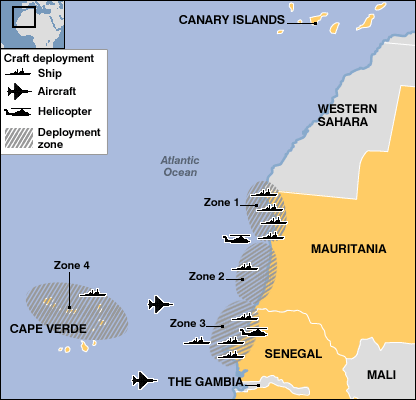
2006 BBC Map of Frontex Deployment

Frontex and Cape Verde signed a “Working Arrangement” on 14 January.  According to the Frontex press release, “the arrangement aims at promoting the development of broad cooperation on operational and technical border security/management matters between the Agency and the competent authorities of Cape Verde, with a view to working toward sustainable partnership. The intended cooperation in areas related to border security and management include exchange of best practices and strategic information, training, capacity-building and collaboration on relevant technologies as well as participation in joint operations. Information sharing regarding people-smuggling and trafficking in human beings is also foreseen as part of the arrangement.”

Frontex has coordinated operations with Cape Verde for many years pursuant to the provisions of bi-lateral agreements between Spain and Cape Verde.  In a September 2010 interview with EurAsylum, Frontex Director Laitinen said:  “In West Africa, Senegal, Mauritania and Cape Verde have all been integrated into Frontex operations for many years with good results, always demonstrating a willingness and capacity to work for the same aims and goals as their European colleagues. Although we do not have formal working arrangements in place yet with these countries, we are able to work together on the basis of their existing bi-lateral provisions with Spain. This cooperation has had measurable results in reducing people smuggling via the Canary Islands and in preventing the loss of human lives at sea.”

Click here for Frontex Press Release.

1 Comment

Filed under Eastern Atlantic, Frontex, News

Greece May Use Dutch “Ships” to Detain Migrants

Following its announcement that it was considering building a wall along portions of its land border with Turkey, Greek officials announced earlier this month that they are considering the acquisition of two floating migrant detention centres from the Netherlands.  The two vessels would be leased and would have the capacity to hold approximately 1000 persons.  Greece reportedly was considering using passenger ships to detain migrants, but decided that floating detention centres used by Dutch authorities in Rotterdam are a better option.  The floating detention centres would be used in conjunction with prefabricated detention facilities that are being constructed on land to detain the large numbers of migrants being detained by Greek and Frontex authorities along the Greek-Turkish land border.

Click here and here for articles. (EL)  (Read with Google translate)

1 Comment

Filed under Aegean Sea, European Union, Frontex, Greece, Netherlands, News, Turkey

INEX Report and Interview with Frontex Director Laitinen

A final report prepared as part of the INEX Work Package 3 “Value Dilemmas of Security Professionals” has just been released.  The Report is entitled “Ethical Security in Europe? Empirical Findings on Value Shifts and Dilemmas across European Internal-External Security Policies.”  The report’s authors are Dr. Matteo Tondini and Dr. Isabelle Ioannides.  The report contains extensive empirical findings and policy recommendations that are based primarily on two case studies: “the recent interception of migrants in the Central Mediterranean Sea undertaken by the Italian authorities” and “the implementation of anti-terrorism/radicalisation measures in the Netherlands and the UK.”

The report contains a significant amount of information which will be of interest to anyone concerned with migrant interdiction practices in the Mediterranean (and elsewhere).  I will try to post a few summaries of some portions of the report in the coming days, but in the meantime I wanted to call attention to an interview that was conducted in May of this year by Dr. Tondini with Frontex Executive Director Ilkka Laitinen as part of the research project.  A transcript of the interview is included in the report. [INEX Laitinen Interview 12May2010]

In the interview Mr Laitinen said that contrary to the information contained in the Human Rights Watch Report of 21 September 2009, Frontex had no involvement in the 18/19 June 2009 incident where Italian and Libyan authorities jointly intercepted and returned a group of migrants to Libya.  He noted that the recent agreements between Libya and Italy had closed the central Mediterranean migration route and that it is therefore now “the right moment for the Agency to intervene, with the aim of consolidating the results achieved so far … The only way of doing this is to cooperate with neighbouring countries such as Libya.”  And while Mr Laitinen stated that the “respect of fundamental rights is a crucial part of the European border control service” he also stated that “the right of boat people to claim asylum or other forms of protection outside [Member States’] territorial waters is not yet acknowledged Europe-wide.”  In response to this latter point, Dr. Tondini pointed out that it is the position of the Italian government that if an asylum claim is made on board an Italian vessel, the asylum seeker is supposed to be transported to Italy for the purpose of making a formal claim.

(Thank you to Matteo Tondini for sharing the Report.)

Click here for the final Report.

Click on this link- INEX Laitinen Interview 12May2010 -for the transcript of the Interview.

1 Comment

Filed under Analysis, Data / Stats, European Union, Frontex, Italy, Libya, Mediterranean, Reports

EC Request for Services: “Technical Assistance for the Identification and Formulation of a Programme of Support to the Libyan Authorities in the field of Migration” (26 Nov Deadline)

This was just posted on the SRLAN listserve.  The deadline for an expression of interest has been extended to 26 November (but this date should be verified):

“Dear Sir,  I would like to inform you about a new EC funded project, entitled: ‘Technical Assistance for the Identification and Formulation of a Programme of Support to the Libyan Authorities in the field of Migration’.

We are looking for 2 Experts mastering English, from January 2011, with the following profile:

Expert in Migration/Team Leader:

  • Master Degree (or higher academic degree) in an area relevant to Migration (Law, Political Sciences, Humanities, Sociology, etc).
  • At least 10 years of professional experience in the field of Migration.
  • Thorough knowledge of migration policies and strategies, in particular the EU global approach to migration and the international set of rules, laws and conventions related to border management, migration and asylum.
  • Experience in the identification, formulation, and management of programmes of support or technical assistance in the framework of the EC external aid to third countries.
  • Fluency in written and spoken English.
  • Knowledge of development issues in North Africa and the Middle East and/or Sub-Saharan Africa.
  • Good understanding of the social and economic policies of the EU
  • Ability to manage and lead a team.
  • Excellent writing and communication skills
  • Knowledge of Arabic is considered an asset.

Expert in International Law (other field could be International Relations):

  • Master Degree (or higher academic degree) or equivalent professional experience in the field of International law, International Relations or Migration.
  • At least 10 years of professional experience in the field of migration.
  • Thorough knowledge of migration policies and strategies, in particular the EU global approach to migration and the international set of rules, laws and conventions related to border management, migration and asylum.
  • Fluency in written and spoken English.
  • Good knowledge and working experience in the Middle East and North Africa Region.
  • Experience in project management, identification, formulation, implementation and evaluation of similar EC funded projects.
  • A good understanding of the economic and social policies of the European Union.
  • Knowledge of Arabic is considered an asset.
  • Excellent writing and communication skills.

Please find attached the ToRs for further details.  Should you be interested in partaking in the offer please reply by return of mail and send me your updated Cv (according to the attached model) before 21/11/2010 and I will inform you about the application process.

Nadia Bedhiaf
Assistant Project Manager
+216 71 76 68 66
+216 71 76 69 66
www.ccm-cg.com

From the Terms of Reference: “… The assignment will provide the necessary information for the beneficiary of the EU contributions (Libyan Authorities responsible for the management of borders and mixed migration flows) and Delegation of the European Union to Libya (DEU) to formulate a Cooperation and Technical Assistance Programme between the EU and Libya on Migration related issues, including management of borders and mixed migration flows.

The identification and formulation of this programme will be divided in two parts:

i) Programme to Support the Libyan authorities to enhance the management of borders and migration flows (10 million Euros) [and] ii) Programme to support the Libyan authorities on migration related issues, risks and challenges (30 million Euros) [***]

The assignment will include:

1. An analysis of the sector and needs assessment of the migration sector in Libya, in relation to border management, the management of migratory flows, and international protection. In this sense it will identify the social, demographic, financial, legal or institutional constraints to the implementation of actions and the design of policies to effectively manage migration in Libya.

2. Support the consultation and dialogue process on the migration related issues and policy between the Government of Libya and the Delegation of the European Union to reach a common agreement on the areas of intervention of the programmes.

3. Present in a clear and exhaustive manner the objectives, the actions, the expected results and the possible indicators of the programmes being identified and formulated. [***]”

Click on this link- TofR_066810_1-1 -for Terms of Reference and on this link- CVtemplateEnglish -for CV template.

Leave a comment

Filed under European Union, General, Libya, Mediterranean

INTERIGHTS Litigation Workshop: Human Security and Migration (27-28 Jan)

Of possible interest to some readers. The deadline for applications [INTERIGHTS_Workshop_Application_Form] is Sunday, 12 December 2010.  Early applications are strongly encouraged.

INTERIGHTS‘ Europe Programme covering Council of Europe countries within Central and Eastern Europe and former Soviet Union is pleased to invite applications for a strategic litigation workshop on “Human Security and Migration” which will be held in London on 27-28 January 2011. The workshop is open to lawyers and human rights activists engaged in legal advocacy from Council of Europe states, especially those from Central and Eastern Europe, the Baltic States and the Caucasus. To ensure a fruitful in-depth discussion, only a limited number of places will be offered.

Throughout the region, migrants – in particular, undocumented/irregular migrants, unskilled migrant workers, and asylum seekers and refugees – are vulnerable to a wide range of human rights abuses such as ill-treatment, arbitrary detention, servitude and forced labour, denial of access to justice, interference with private and family life, and denial of access to medical treatment and social services.  Moreover, due to their non-citizen (often irregular) status, migrants can be denied or severely restricted in their access to legal redress both in theory and practice.

The workshop’s objectives include:

  • – facilitating cooperation and exchange of ideas and experiences between local lawyers and human rights defenders who are engaged in litigation and other forms of legal advocacy related to human security in the context of migration;
  • – achieving a better understanding of the nature and scale of violations occurring in this context;
  • –  examining legal strategies to address those violations, including the identification of applicable legal standards and appropriate international, regional and national legal fora;
  • –  increasing the capacity of participating lawyers and NGOs to litigate abuses of human rights in the context of migration at international and regional level, especially before the European Court of Human Rights;
  • –  improving INTERIGHTS’ understanding of the legal challenges existing in the field of human security and migration and the ways in which we can participate in addressing them;
  • –  nurturing cooperation between INTERIGHTS and local lawyers and NGOs on the thematic issues identified below.

As an organisation focussing on strategic litigation, we are primarily interested in applications from practicing lawyers who have experience of representation and legal advice in cases involving serious violations of human rights of migrants or victims of trafficking.  However, we also wish to encourage applications from non-lawyers or non-litigating lawyers who are directly involved in protecting the rights of migrants. We shall prioritise applications from lawyers and activists working in Central and Eastern Europe (including Russia and Ukraine), the Baltic States and the Caucasus. In exceptional cases, however, applications from Western Europe could be accepted as well. We are especially – but not exclusively – interested in applicants who have an experience of working on any of the following areas:

  • (a)     treatment of asylum seekers and refugees, including issues arising under Articles 2, 3, 5, 6, 8 and 14 of the European Convention of Human Rights, such as violations of the right to life, the non-refoulement principle in the context of expulsions and deportations, unlawful detention, ill-treatment in detention, inadequate procedural guarantees for detainees or persons subject to transfer, such as denial of access to a lawyer, and discrimination in the application of immigration rules;
  • (b)     prevention of trafficking and human beings and protection of the human rights of victims of trafficking, including in the context of transit countries and countries of origin;
  • (c)    treatment of migrant labourers/undocumented migrants, especially issues arising under Article 4 (e.g. exploiting their vulnerable position to deny remuneration or provide grossly inadequate remuneration for their work; coercing into work by withholding their identity papers or deliberately failing to regularise their legal status); and Articles 2, 3 and 8 (e.g. poor health and safety standards at work, a lack of access to health care).

To ensure that the workshop reflects current and emerging trends in the identified area and is practical use to the participating lawyers, all applicants are asked to submit the description of a relevant case they have worked/are working on. The workshop’s agenda will be shaped by the legal issues arising out of the cases submitted by the selected participants.

The workshop will be held in English with simultaneous interpretation into Russian. Therefore, it is essential that participants are proficient in either English or Russian.

All reasonable travel and subsistence costs associated with attendance at the training will be covered by INTERIGHTS.

To apply, please email a completed application form (SEE BELOW) to Arpi Avetisyan, Legal Team Coordinator, at aavetisyan@interights.org. The deadline for applications is Sunday, 12 December 2010.  Early applications are strongly encouraged.

For further information, please contact Yuri Marchenko at ymarchenko@interights.org.

Click on this link for Application:  INTERIGHTS_Workshop_Application_Form

Leave a comment

Filed under Colloques / Conferences, Council of Europe

Commission Issues New “EU Internal Security Strategy”

Earlier today the Commission released a Communication entitled “The EU Internal Security Strategy in Action.” The Communication to the EP and Council contains 41 proposals in five general areas: organised crime, terrorism, cybercrime and cyber security, border management, and crises and disasters.  It contains a strategy which is described as an effort to identify, explain, and coordinate what the EU seeks to achieve in the area of internal security.  The accompanying Commission Press Release quotes Commissioner Malmström as stating that “EU internal security has traditionally been following a silo mentality, focusing on one area at a time. Now we take a common approach on how to respond to the security threats and challenges ahead. Terrorism, organised, cross-border and cyber crime, and crises and disasters are areas where we need to combine our efforts and work together in order to increase the security of our citizens, businesses, and societies across the EU. This strategy outlines the threats ahead and the necessary actions we must take in order to be able to fight them….”

Here are several excerpts (with some footnotes omitted) from Objective Number 4 entitled “Strengthen security through border management”:

“[***] In relation to movement of persons, the EU can treat migration management and the fight against crime as twin objectives of the integrated border management strategy. It is based on three strategic strands.

  • An enhanced use of new technology for border checks (the second generation of the Schengen Information System (SIS II), the Visa Information System (VIS), the entry/exit system and the registered traveller programme);
  • an enhanced use of new technology for border surveillance (the European Border Surveillance System, EUROSUR) with the support of GMES security services, and the gradual creation of a common information sharing environment for the EU maritime domain [25 Commission communication, ‘Towards the integration of maritime surveillance: A Common information environment for the EU maritime domain’, COM (2009) 538 ]; and
  • an enhanced coordination of Member States through Frontex.

[***]

Action 1: Exploit the full potential of EUROSUR

The Commission will present a legislative proposal to set up EUROSUR in 2011 to contribute to internal security and the fight against crime. EUROSUR will establish a mechanism for Member States’ authorities to share operational information related to border surveillance and for cooperation with each other and with Frontex at tactical, operational and strategic level. [27 Commission proposals for the development of the EUROSUR system and for the development of a common information sharing environment (CISE) for the EU maritime domain are set out in COM (2008) 68 and COM(2009) 538 respectively. A six step road map for establishing the CISE was recently adopted – COM(2010) 584.]  EUROSUR will make use of new technologies developed through EU funded research projects and activities, such as satellite imagery to detect and track targets at the maritime border, e.g. tracing fast vessels transporting drugs to the EU. In recent years, two major initiatives on operational cooperation at the maritime borders have been launched – one on human trafficking and human smuggling under the umbrella of Frontex and the second on drugs smuggling in the framework of MAOC-N [28 MAOC-N – Maritime Analysis and Operations Centre – Narcotics] and CeCLADM. [29 CeCLAD-M – Centre de Coordination pour la lutte antidrogue en Méditerranée.]

As part of the development of integrated and operational action at the EU’s maritime border, the EU will launch in 2011 a pilot project at its southern or south-western border, involving those two centres, the Commission, Frontex and Europol. This pilot project will explore synergies on risk analysis and surveillance data in common areas of interest concerning different types of threats, such as drugs and people smuggling. [30 This project will complement the other integrated maritime surveillance projects such as BlueMassMed and Marsuno, which aim to optimise the efficiency of maritime surveillance in the Mediterranean Sea, Atlantic and the northern European sea basins.]

Action 2: Enhancing the contribution of Frontex at the external borders

[***] From 2011 onwards, the Commission, with joint input from Frontex and Europol, will present a report by the end of each year on specific cross-border crimes such as human trafficking, human smuggling and smuggling of illicit goods. This annual report will serve as a basis for assessing the need for Frontex and its joint operations and joint operations between police, customs and other specialised law enforcement authorities to be carried out from 2012 onwards. [***]”

Click here for the complete Commission Document.

Click here for Commission’s Press Release.

Click here for the Feb 2010 Council Draft Internal Security Strategy.

Click here (SW) for comments on Commissioner Malmström’s blog.

Leave a comment

Filed under European Union, Frontex, News

Israel Begins Construction of Border Fence to Block African Migrants

Israel today begins the construction of a 250 km border fence along portions of its border with Egypt.  The barrier is primarily designed to prevent the entry into Israel of African migrants and asylum seekers.  Prime Minister Benjamin Netanyahu is quoted as saying that “Peace does not include the flood of illegal infiltrators, who come from Africa through Sinai … This is a blow which our neighbours in Egypt are also suffering from.”

The Israeli Interior Ministry reported that on average on a weekly basis 1,100 irregular migrants enter Israel along its southern border with Egypt.  The Ministry reported that over 10,000 such migrants have entered Israel in this manner so far in 2010 compared with 4,431 for all of 2009.

The construction project will take at least one year to complete and will include sensors and other devices designed to detect persons along the border.

One effect of such a fence will be the diversion of migrants and asylum seekers who will either attempt to cross at unfenced portions of the border or pursue new destinations, with or without the assistance of human traffickers.

Click here, here, and here for articles.

Click here for the Association for Civil Rights in Israel “Refugee and Asylum-Seeker” Fact Sheet.

Leave a comment

Filed under Data / Stats, Egypt, Israel, News

Migreurop Report: European borders- Controls, detention and deportations

Migreurop has released its second report on Europe’s borders: “European borders- Controls, detention and deportations.”  Migreurop describes the report as a “[denunciation of] the « externalization » process of the European union migratory policy [which] shows how third countries are obliged, through the threat of the reconsideration of cooperation agreements and development aid, not only to readmit the migrants chased from Europe, but also to keep them on their own territory from travelling towards its doors.   From Calais area in France to the edge of Turkey and the Adriatic sea, from the surroundings of Gibraltar to the Sahel Saharan desert and the new member states of eastern Europe, a subcontracting of migratory control is carried out in series, sometimes very far away from the Union but also within its territory, especially when it deals with sending asylum seekers from country to country considered as unwanted. A large population of exiles, from both sides of the European borders, is subjected to arbitrary incarceration, wandering, and the constant humiliation of a hostile environment….”

Here is the Table of Contents:

Introduction

  • What have migrants become 3

Ceuta, a gilded prison

  • A murderous border 7
  • A legal limbo 8
  • The situation of migrants in detention 8
  • The situation of migrants in the CETI (open centre) 9
  • Deportations and expulsions 12
  • Surviving without resources 14

Sahel-Saharan countries, Europe’s new sentries

  • I – European interference in inter-African migrations – the case of Mauritania 18
    • The “crisis of the cayucos” 18
    • 1. Cooperation instigated by Europe 18
    • 2. Mauritania tramples on its own principles and conforms 21
    • 3. Subcontracting repression and endangering foreigners 22
  • II – Bargaining between Libya and Europe: migrants as an exchange currency –the case of Niger 33
    • 1. A reciprocal exploitation 34
    • 2. An increasingly repressive control of borders 37
    • 3. Arrests and detention in Libyan territory 39
    • 4. A deadly expulsion policy 42
  • Conclusion: the real face of Kadhafi’s pan-Africanism 44

Poland, Romania: how to be good state members in the enlarged EU

  • I – At the new frontiers: the screening of migration 47
    • 1. Reducing the transit and deserving Schengen 48
    • 2. The border police, Frontex and cooperation with other European states 48
  • II – Reception and detention centres 52
    • 1. The detention of foreigners 52
    • 2. Reception centres: isolating asylum seekers 60
    • 3. “Dublinized” asylum seekers 61
  • III – Returns 63
  • IV – Intolerance towards migrants and refugees 66
  • V – Embryonic mobilizations 70

The Ionian and Adriatic seas: forced returns between Italy and Greece

  • A new migration route at Europe’s gates 73
  • I – Controlling and blocking 75
    • 1. Controls in Greece 75
    • 2. Controls at sea 77
    • 3. Controls in Italian ports 78
  • II – Turning back and readmission 82
    • 1. Arbitrary practices and violation of rights 82
    • 2. The port of Venice: collective returns 83
    • 3. The port of Ancona 86
    • 4. Forced return to Greece 86
  • III – Detention 88
    • 1. At the borders and at sea: areas beyond legality 88
    • 2. Detention in Italy 89
    • 3. Detention in Greece 90
  • IV – Some cruel situations 93
    • 1. In Greece 93
    • 2. In Italy 96
  • V – Mobilizations 97
    • 1. In Venice 97
    • 2. In Ancona 97
    • 3. In Greece 98

Ping-pong at the Greco-Turkish border

  • Selective expulsions and random readmissions 106
  • Reactions to a degrading and sometimes murderous situation 107
  • Assistance, support, resistance 108

Dismantling the Calais jungle: a deceptive operation

  • I – The declared objectives of the 22 September 2009 operation 112
  • II – The real objectives of dismantling the jungle 113
  • III – The Modus Operandi: brutality and trickery 115
  • IV – What next? 116

Migreurop network 121

Annexes 122

  • Knocking down walls and defending the right to migrate 122
  • UNHCR-Libya : the bid is rising, migrants pay the price 124
  • All for the closure of camps for migrants, in Europe and beyond 125
  • Italia and Libya: hand in hand 127
  • Roma people victims of the French government xenophobia 128

Click here for the report (EN), or  here (FR), or here (ES).

Click here for article (ES) in Periodismo Humano about the report.

1 Comment

Filed under Aegean Sea, Eastern Atlantic, English Channel / La Manche, European Union, France, Frontex, Italy, Libya, Mauritania, Mediterranean, Morocco, Niger, Reports, Spain, Turkey, UNHCR

Yemen to End Prima Facie Refugee Status for Somalis

Yemen announced a plan to end its policy of granting prima facie refugee status to Somali nationals.  If the change is approved by the Council of Ministers, arriving Somalis would be required to make individual requests for refugee status.  The Yemen Observer reported that “[a]ccording to Essam al-Mahbashi, member of the National Committee for Refugee Affairs (NACRA), not all Somalis are fleeing conflict as many of them come from safe regions such as the port of Bosasso in the Puntland region of northern Somalia in search of better economic opportunities. Al-Mahbashi said that the emergence of extremist groups in Somalia like al-Shabab al-Mujahideen is one of the reasons why Yemen wants to cancel the prima facie refugee status policy.”  “Patrick Duplat of NGO Refugees International (RI) told IRIN that RI encouraged countries, including Yemen, to offer Somalis the broadest protection mechanisms possible given the current situation in their homeland. However, he said Yemen’s new policy would be in line with newly issued UNHCR guidelines on Somalis that allow for such screening but call for those Somalis not granted refugee status to be afforded ‘complementary forms of international protection.’”

Click here for article.

1 Comment

Filed under Gulf of Aden, News, Somalia, UNHCR, Yemen